Assyrian Cities: The Major Cities of Ancient Assyria
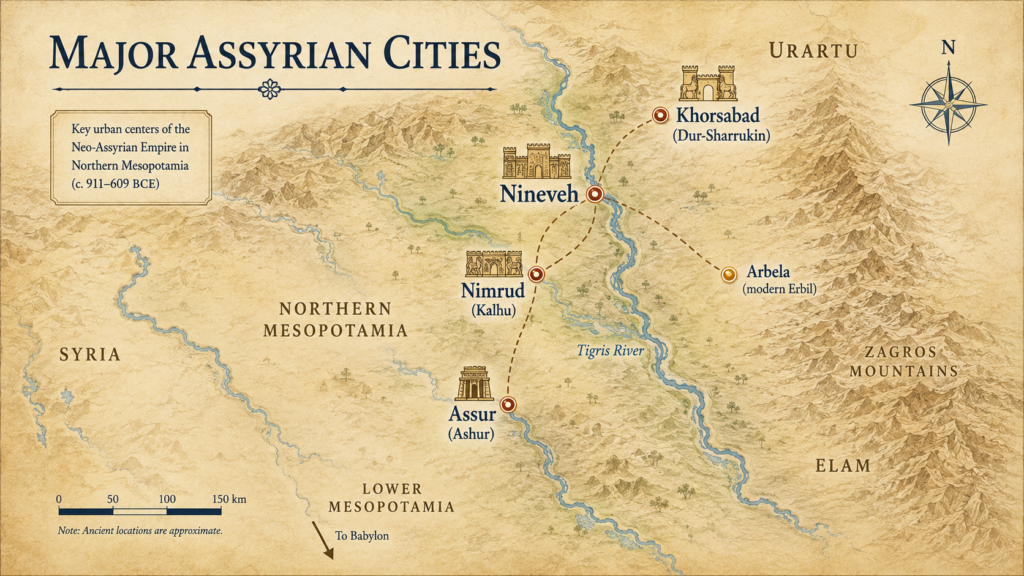
The major Assyrian cities included Nineveh, Assur, Nimrud, and Khorsabad (Dur-Sharrukin). These urban centers served different political, religious, military, and administrative functions throughout Assyrian history. Nineveh became the most famous capital of the Neo-Assyrian Empire, while Assur was the ancient religious and political heart of Assyria. Nimrud and Khorsabad were also important royal centers known for their monumental palaces, temples, fortifications, and elaborate architecture.
Major Assyrian Cities at a Glance
| City | Main Role | What It Is Known For |
|---|---|---|
| Nineveh | Neo-Assyrian capital | Palaces, massive walls, libraries, monumental reliefs |
| Assur | Religious and political center | Temples, ancient capital, sacred traditions |
| Nimrud | Royal and administrative center | Palaces, reliefs, monumental sculpture |
| Khorsabad | Planned royal capital | Dur-Sharrukin, palace complex, lamassu |
| Arbela | Religious and strategic center | Cult of Ishtar and regional importance |
| Dur-Sharrukin | Imperial capital project | Monumental planned architecture |
What Was the Capital of the Assyrian Empire?
Nineveh was the most famous capital of the Neo-Assyrian Empire, particularly during its final period.
However, Assyria did not have one permanent capital throughout its entire history. Assur, Nimrud, and Dur-Sharrukin also served as major political centers at different periods.
This distinction is important when studying the history of ancient Assyrian cities.
Where Were the Assyrian Cities Located?
Most major Assyrian cities were located in northern Mesopotamia, in the region corresponding largely to modern northern Iraq.
Their location connected them with:
- The Tigris River
- Major trade routes
- Agricultural areas
- Military routes
- Regional centers of power
Their geographic position helped Assyria develop a network of urban centers capable of supporting administration, religion, trade, and military expansion.
Why Were Assyrian Cities Important?
Assyrian cities were much more than settlements.
They could function simultaneously as:
Capitals + Religious Centers + Administrative Hubs + Military Strongholds + Economic Centers
Their monumental architecture also turned them into visible symbols of Assyrian power.
Understanding these cities therefore means understanding how the Assyrian state organized its territory and projected its authority across the ancient Near East.
Timeline of the Major Assyrian Cities
The history of Assyria was closely connected to the rise, transformation, and decline of its major cities.
Rather than having one permanent capital throughout its entire history, Assyria developed a succession of important urban centers. Each reflected a different stage in the political and cultural development of the state.
c. 2000–1800 BCE — The Rise of Assur
Assur emerged as the central city of early Assyria.
Located on the Tigris River, it became an important political, economic, and religious center.
Its temples and sacred traditions gave the city a special role in Assyrian identity.
Key role: Early political and religious center
14th–11th centuries BCE — Middle Assyrian Assur
During the Middle Assyrian period, Assur remained an important center of political and religious life.
Monumental construction expanded the city’s temples and palaces.
The city increasingly represented the territorial and religious identity of Assyria.
Key role: Political and religious heartland
9th century BCE — Nimrud Becomes a Royal Center
Under Ashurnasirpal II, Nimrud—ancient Kalhu—was transformed into a major royal center.
Monumental palaces, temples, sculptures, and reliefs reshaped the city.
Nimrud became one of the most impressive urban projects of the Neo-Assyrian period.
Key role: Royal and administrative center
8th century BCE — Khorsabad and the Imperial Capital Project
Sargon II established a new royal capital at Dur-Sharrukin, modern Khorsabad.
The city was planned on a monumental scale.
Its palace complex, fortifications, temples, and colossal lamassu reflected the ambitions of the Neo-Assyrian state.
Key role: Planned imperial capital
Late 8th–7th centuries BCE — Nineveh Rises
Under rulers including Sennacherib, Nineveh was transformed into the dominant political center of the Assyrian Empire.
Major building projects expanded the city and created monumental palaces, temples, walls, and infrastructure.
Nineveh became the most famous of the Assyrian cities.
Key role: Imperial capital
7th century BCE — Nineveh at Its Height
During the height of the Neo-Assyrian Empire, Nineveh developed into a vast urban center.
Its monumental landscape included:
- Massive defensive walls
- Royal palaces
- Temples
- Processional routes
- Gardens
- Hydraulic infrastructure
- Monumental sculpture
The city became a powerful symbol of Assyrian imperial authority.
Key role: Major imperial capital and administrative center
612 BCE — The Fall of Nineveh
A coalition of enemies captured and destroyed Nineveh in 612 BCE.
The fall of the city marked one of the decisive moments in the collapse of the Neo-Assyrian Empire.
Other Assyrian centers continued to exist for a time, but the political system that had made Nineveh the center of an enormous empire was breaking apart.
Key event: Fall of Nineveh
609 BCE — The End of the Assyrian Empire
By 609 BCE, the last major Assyrian resistance had been defeated.
The imperial political structure collapsed, and Assyria’s major cities entered a new phase of their history.
Some were abandoned or declined, while others continued to be occupied for centuries.
Key event: End of the Neo-Assyrian Empire
The Assyrian Urban Timeline at a Glance
| Period | Major City | Main Role |
|---|---|---|
| Early Assyria | Assur | Political and religious center |
| Middle Assyrian period | Assur | Religious and political heartland |
| 9th century BCE | Nimrud | Royal and administrative center |
| 8th century BCE | Dur-Sharrukin | Planned royal capital |
| Late 8th–7th centuries BCE | Nineveh | Imperial capital |
| 7th century BCE | Nineveh | Major imperial metropolis |
| 612 BCE | Nineveh | Captured and destroyed |
| 609 BCE | — | End of Assyrian imperial rule |
The changing importance of Assur, Nimrud, Dur-Sharrukin, and Nineveh reveals an important characteristic of ancient Assyria: its urban landscape was constantly evolving alongside the political ambitions of the state.
The cities were not simply places where people lived.
They were instruments through which Assyria organized religion, administration, economy, warfare, and imperial power.
Nineveh: The Most Famous Assyrian City
Nineveh was the most famous city of the Neo-Assyrian Empire and became its principal capital during the empire’s final period.
Located on the eastern bank of the Tigris River, Nineveh developed into a vast urban center containing monumental palaces, temples, defensive walls, gardens, and sophisticated water infrastructure.
Its size and monumental architecture made Nineveh one of the most important cities of the ancient Near East.
Why Was Nineveh Important?
Nineveh served several functions simultaneously.
It was:
- A political center
- An administrative hub
- A religious center
- A military headquarters
- A monumental royal city
- An important economic center
Its importance grew dramatically during the Neo-Assyrian period.
When Did Nineveh Become the Capital?
Nineveh became the principal capital of the Neo-Assyrian Empire during the reign of Sennacherib in the late 8th century BCE.
Earlier Assyrian rulers had used other cities as major political centers, including Assur, Nimrud, and Dur-Sharrukin.
This is why the history of Assyrian capitals is better understood as a sequence rather than as a single permanent capital.
The Walls of Nineveh
The city was surrounded by enormous defensive walls.
The fortifications included:
- Massive stone and mud-brick walls
- Defensive towers
- Monumental gates
- Moats and other defensive features
These structures emphasized both the practical defensive importance of the city and its monumental scale.
The walls also helped define Nineveh as a distinct urban space within the wider landscape.
Palaces and Monumental Architecture
Nineveh became famous for its monumental palace complexes.
Palaces contained:
- Large courtyards
- Administrative spaces
- Decorative reliefs
- Monumental sculptures
- Cuneiform inscriptions
- Ceremonial areas
The architecture was designed not simply to accommodate political activity but also to communicate the power of the Assyrian state.
The Reliefs of Nineveh
Some of the most famous examples of Assyrian art come from Nineveh.
Palace reliefs represented:
- Military campaigns
- Siege warfare
- Hunting scenes
- Animals
- Ceremonial activities
- Supernatural figures
These reliefs transformed palace walls into extensive visual narratives.
This makes Nineveh particularly important for understanding the relationship between Assyrian cities, architecture, and art.
Water and Engineering
Nineveh also depended on sophisticated water-management systems.
Canals and aqueducts helped bring water toward the city and its surrounding areas.
One of the best-known projects was the extensive hydraulic system associated with the Neo-Assyrian capital.
Water was essential for:
- The urban population
- Gardens
- Agriculture
- Palaces
- The wider urban environment
The development of these systems demonstrates that the city’s monumental appearance depended on substantial engineering infrastructure.
Nineveh as an Imperial Capital
Nineveh’s importance was closely connected to the expansion of the Neo-Assyrian Empire.
As the empire grew, the city became a center from which enormous administrative and political systems could be coordinated.
Tribute, information, officials, military resources, and goods moved through the imperial system.
The city therefore represented the connection between the Assyrian heartland and territories extending across much of the ancient Near East.
The Library of Ashurbanipal
Nineveh is also famous for the collection of cuneiform tablets associated with Ashurbanipal.
The collection preserved texts covering subjects such as:
- Literature
- Religion
- Medicine
- Divination
- Scholarship
- Lexical knowledge
- Historical traditions
Among the best-known works associated with the collection is the Epic of Gilgamesh.
This makes Nineveh important not only for the study of Assyrian urbanism but also for the history of writing and ancient scholarship.
Nineveh and Urban Scale
The scale of Nineveh is one of the reasons the city continues to attract historians and archaeologists.
Its monumental landscape combined:
Walls + Palaces + Temples + Gardens + Reliefs + Water Systems + Administrative Buildings
The city was therefore an integrated urban environment rather than a collection of isolated monuments.
Why Nineveh Became the Symbol of Assyria
Modern popular culture often treats Nineveh almost as a synonym for the Assyrian Empire.
Historically, however, Assyria had several major cities and political centers.
Nineveh became dominant only during the later phase of the empire.
Its fame today is largely connected to the extraordinary scale of its remains, the surviving palace reliefs, its literary collections, and its role as the final great capital of the Neo-Assyrian Empire.
The Fall of Nineveh
Nineveh was captured in 612 BCE by a coalition that included the Babylonians and Medes.
Its fall was a decisive event in the collapse of the Neo-Assyrian Empire.
The city was damaged and eventually declined as a major political center.
Its destruction became one of the most important archaeological events for modern understanding of the end of Assyrian imperial power.
Why Nineveh Matters When Studying Assyrian Cities
Nineveh brings together many of the characteristics that define the major cities of Assyria.
It demonstrates how an urban center could combine:
- Political authority
- Religious importance
- Monumental architecture
- Military organization
- Hydraulic engineering
- Scholarship
- Visual propaganda
For this reason, Nineveh should be understood not simply as the capital of the Assyrian Empire, but as the clearest example of how Assyrian urbanism reached its greatest monumental scale.
Assur: The Ancient Heart of Assyria
Assur, also written Ashur, was one of the most important cities in ancient Assyria and gave its name to both the Assyrian people and their state.
Located on the western bank of the Tigris River, Assur developed from an important early settlement into the religious and political center of Assyria.
Although Nineveh became the most famous capital of the Neo-Assyrian Empire, Assur remained fundamental to Assyrian identity throughout much of its history.
Why Was Assur Important?
Assur had several interconnected roles.
It functioned as:
- A religious center
- An early political capital
- A royal city
- An economic center
- A ceremonial center
- A symbol of Assyrian identity
Its importance therefore extended far beyond its physical size.
Assur and the Identity of Assyria
The relationship between the city and the wider Assyrian state was unusually close.
The name Assur referred not only to the city but also to the principal deity associated with Assyria and, by extension, to the Assyrian state itself.
This connection made the city exceptionally important in Assyrian political and religious thought.
Assur was therefore both a real urban center and a powerful symbol.
Temples and Religious Architecture
Religious buildings dominated important areas of Assur.
The city contained major temples dedicated to Assyrian deities and became one of the most important sacred centers in northern Mesopotamia.
Temples served functions that extended beyond worship.
They could also be connected with:
- Economic activity
- Administration
- Ritual ceremonies
- Royal patronage
- The organization of urban life
Religion was therefore deeply integrated into the structure of the city.
The Temple of Ashur
The principal sanctuary of the city was dedicated to the god Ashur.
Its importance reflected the central position of the deity within Assyrian ideology.
The temple complex developed over time and became one of the defining architectural features of the city.
The relationship between the sanctuary, the city, and the Assyrian state illustrates how closely religion and political identity were connected.
Assur as an Early Capital
Before the rise of Nimrud and Nineveh as dominant royal centers, Assur served as the principal political center of Assyria.
Royal buildings and administrative structures developed alongside its religious institutions.
The city therefore represents an earlier phase of Assyrian state formation.
Its history helps explain why later Assyrian capitals inherited such strong connections between:
Religion + Kingship + Administration + Urban Architecture
The City and the Tigris
Assur’s location beside the Tigris was fundamental to its development.
The river provided:
- Transportation
- Access to trade routes
- Water resources
- Agricultural connections
- Strategic advantages
Its position also connected Assur with wider networks extending through Mesopotamia.
The city was therefore both a sacred center and an important node within the Assyrian economic and political landscape.
Assur and Trade
Assur was connected to long-distance commercial networks from an early period.
Assyrian merchants participated in trade extending beyond the immediate region.
This commercial activity helped connect northern Mesopotamia with other parts of the ancient Near East.
The city’s economic importance therefore predates the great territorial expansion of the Neo-Assyrian Empire.
Royal Tombs and Burial Traditions
Assur also contains evidence relating to royal burial practices.
Royal tombs discovered beneath residential and monumental areas demonstrate the importance of the city as a place associated with Assyrian rulers and dynastic traditions.
These remains provide another connection between the physical city and the political history of Assyria.
Assur and the Later Capitals
The rise of Nimrud and later Nineveh did not erase Assur’s importance.
Instead, the Assyrian urban landscape became more complex.
Different cities could perform different functions:
| City | Major Historical Role |
|---|---|
| Assur | Religious and ancestral heart of Assyria |
| Nimrud | Royal and administrative center |
| Dur-Sharrukin | Planned imperial capital |
| Nineveh | Major late imperial capital |
This distinction is essential when studying ancient Assyrian cities.
There was no need for every major city to perform exactly the same function.
Assur as a Sacred Urban Center
The city’s importance continued even when political power increasingly shifted toward other urban centers.
Assur remained closely connected to the religious foundations of Assyrian kingship and state ideology.
This gave the city a special status within the wider network of Assyrian cities.
The Fall of Assur
The city suffered during the collapse of the Neo-Assyrian Empire at the end of the 7th century BCE.
Assur was captured and destroyed during the conflicts that brought down Assyrian imperial power.
Its destruction marked the end of an urban tradition that had lasted for many centuries.
The city nevertheless continued to be occupied and used at different points in later history.
Assur and Modern Archaeology
The ancient site of Assur has provided archaeologists with evidence for many aspects of Assyrian civilization.
Excavations have revealed:
- Temples
- Palaces
- City walls
- Residential areas
- Royal tombs
- Administrative remains
- Religious buildings
These discoveries make Assur particularly valuable for reconstructing the long-term development of Assyrian urbanism.
Why Assur Matters
Assur is essential for understanding the history of Assyrian cities because it represents something that Nineveh alone cannot explain.
Nineveh shows the enormous scale reached by the Neo-Assyrian Empire.
Assur shows the much deeper foundations on which that empire was built.
Its temples, political institutions, trade networks, royal traditions, and symbolic importance reveal the origins of an urban and religious identity that eventually supported one of the most powerful states of the ancient Near East.
Assur was therefore not simply another Assyrian city.
It was the ancient heart from which the wider Assyrian identity developed.
Nimrud: A Royal and Administrative Center of Assyria
Nimrud, known in ancient times as Kalhu, became one of the most important cities of the Neo-Assyrian Empire.
Located south of Nineveh on the Tigris River, Nimrud was transformed into a major royal center during the 9th century BCE. Its palaces, temples, fortifications, and administrative buildings made it an important part of the Assyrian imperial system.
When Did Nimrud Become Important?
Nimrud rose to prominence during the reign of Ashurnasirpal II, who developed the city as a major royal center.
Large construction projects transformed the existing settlement into a monumental urban environment.
The city became associated with:
- Royal palaces
- Administration
- Religious institutions
- Military organization
- Monumental architecture
The Northwest Palace
One of Nimrud’s most important monuments was the Northwest Palace.
Its decoration included extensive carved reliefs, inscriptions, and monumental sculptures.
The palace was not simply a royal residence.
It also functioned as a place where political authority, ceremonial activity, and imperial ideology were brought together.
Nimrud and Assyrian Administration
Nimrud played an important administrative role within the empire.
The city contained spaces and institutions associated with the management of the state.
Officials, scribes, administrators, soldiers, and other personnel contributed to the operation of the royal center.
This makes Nimrud particularly important for understanding how an Assyrian city could function as part of a much larger imperial system.
A City of Palaces and Temples
Monumental architecture was one of Nimrud’s defining characteristics.
The city contained:
- Royal palaces
- Temples
- Administrative buildings
- Defensive structures
- Residential areas
- Monumental gateways
The combination of religious, political, and administrative buildings reflected the interconnected nature of Assyrian urban life.
Nimrud and the Tigris
Nimrud’s location was strategically important.
Its position near the Tigris connected the city with major routes through northern Mesopotamia.
This helped facilitate:
- Movement of people
- Transportation of goods
- Communication
- Military operations
- Administration of surrounding territories
The city’s location therefore contributed to its importance as a royal and administrative center.
Monumental Sculpture and Reliefs
Nimrud is also one of the most important archaeological sources for Assyrian art.
Excavations revealed:
- Palace reliefs
- Colossal sculptures
- Lamassu
- Inscribed objects
- Ivory carvings
- Decorative architectural elements
These discoveries demonstrate how extensively art was integrated into the city’s monumental architecture.
The Ivories of Nimrud
Nimrud became particularly famous for its large collection of ivory objects.
These included finely decorated pieces that reveal connections between Assyria and wider artistic traditions of the ancient Near East.
The objects also provide evidence for the movement of luxury goods across the region.
Nimrud was therefore not culturally isolated.
Its material culture reflects the extensive networks connected to the Assyrian Empire.
Nimrud as an Imperial City
The importance of Nimrud extended beyond its monuments.
It was part of the infrastructure through which the Assyrian state managed its growing territories.
The city brought together:
Royal Power + Administration + Religion + Military Organization + Luxury Culture
This combination made Nimrud one of the most important urban centers of the Neo-Assyrian period.
Nimrud Compared with Nineveh
Nimrud and Nineveh were both major Assyrian cities, but they should not be treated as identical.
| Feature | Nimrud | Nineveh |
|---|---|---|
| Ancient name | Kalhu | Nineveh |
| Major period of prominence | 9th century BCE onward | Especially late 8th–7th centuries BCE |
| Main role | Royal and administrative center | Major late imperial capital |
| Famous monuments | Northwest Palace and royal complexes | Palaces, walls, gardens, libraries |
| Artistic evidence | Reliefs, sculpture, ivories | Reliefs, sculpture, monumental architecture |
This distinction helps explain the changing urban landscape of the Assyrian Empire.
The Decline of Nimrud
Nimrud lost its dominant political position as the center of Assyrian power shifted toward other cities.
The rise of Nineveh was particularly important.
After the collapse of the Neo-Assyrian Empire, Nimrud declined as a major political center and was eventually abandoned.
Its remains nevertheless preserved an extraordinary amount of evidence about Assyrian urban and royal life.
Rediscovering Nimrud
Modern archaeological excavations revealed the scale and richness of the ancient city.
Archaeologists uncovered:
- Palace complexes
- Reliefs
- Sculptures
- Ivory objects
- Inscriptions
- Administrative remains
- Religious architecture
These discoveries transformed modern understanding of Neo-Assyrian civilization.
Why Nimrud Matters
Nimrud is essential to the study of Assyrian cities because it demonstrates how a city could be deliberately transformed into a royal center.
Its monumental architecture, administrative institutions, luxury objects, and artistic decoration reveal the complexity of the Neo-Assyrian urban system.
If Nineveh represents the enormous scale of the empire at its height, Nimrud provides an especially clear picture of how royal power was physically constructed within an Assyrian city.
Khorsabad: The Planned Capital of Dur-Sharrukin
Khorsabad, the modern name for the ancient city of Dur-Sharrukin, was one of the most ambitious urban projects of the Neo-Assyrian Empire.
The city was founded by Sargon II in the 8th century BCE as a new royal capital. Unlike older Assyrian cities that had developed over long periods, Dur-Sharrukin was conceived and constructed according to a large-scale imperial plan.
Why Was Khorsabad Built?
Sargon II established Dur-Sharrukin as a new royal center during a period of major Assyrian expansion.
The project was intended to create:
- A royal residence
- An administrative center
- A monumental imperial capital
- A religious center
- A visible symbol of Assyrian power
The scale of the project demonstrates the enormous resources available to the Neo-Assyrian state.
A Planned Assyrian City
One of the most distinctive characteristics of Khorsabad was its planned layout.
The city was surrounded by massive defensive walls and organized around monumental architectural complexes.
Unlike cities that had grown organically over centuries, Dur-Sharrukin provides an unusually clear example of deliberate imperial urban planning.
Its layout integrated:
Fortifications + Palace + Temples + Administrative Areas + Monumental Gates
This makes Khorsabad particularly valuable for understanding Assyrian urban planning.
The Royal Palace
The palace complex was the dominant architectural feature of the city.
It included:
- Large courtyards
- Ceremonial spaces
- Administrative rooms
- Religious areas
- Monumental entrances
- Sculptural decoration
The palace was designed to make the authority of the Assyrian state physically visible.
Visitors entering the complex would encounter a carefully controlled sequence of monumental spaces.
Lamassu at Khorsabad
Khorsabad is particularly famous for its colossal lamassu.
These protective figures combined:
- Human heads
- Bull bodies
- Wings
They were placed at important entrances and formed part of the monumental visual program of the palace.
Their enormous scale transformed architectural entrances into powerful statements about protection, authority, and imperial strength.
Temples and Religious Buildings
The planned capital also contained temples dedicated to important Assyrian deities.
Religious architecture was integrated into the wider urban plan rather than existing separately from political authority.
This reflects the close relationship between:
Religion + Kingship + Architecture
within the Neo-Assyrian state.
Khorsabad and Imperial Administration
Dur-Sharrukin was intended to function as more than a royal residence.
Its administrative buildings and palace spaces were designed to support the operation of the imperial government.
Officials could manage:
- Provincial administration
- Tribute
- Communication
- State resources
- Royal affairs
The city therefore formed part of the administrative infrastructure of the empire.
Monumental Gates
The entrances to Khorsabad were important elements of its design.
Monumental gates controlled movement into the city and palace complexes.
They also created an impressive visual transition between the outside world and the carefully ordered imperial environment.
The combination of massive walls, gateways, sculptures, and inscriptions made the city itself an expression of Assyrian authority.
Khorsabad and Assyrian Architecture
Khorsabad provides some of the clearest evidence for the architectural ambitions of the Neo-Assyrian Empire.
Its remains demonstrate the use of:
- Mud brick
- Stone foundations
- Monumental sculpture
- Decorative reliefs
- Colossal protective figures
- Large ceremonial courtyards
The architecture was therefore both functional and ideological.
The Short Life of Dur-Sharrukin
Despite its enormous scale, Dur-Sharrukin had a surprisingly short period as the main royal capital.
After the death of Sargon II in 705 BCE, the royal center shifted toward Nineveh under Sennacherib.
The unfinished or partially occupied character of some areas helps illustrate how rapidly political priorities could change in the Neo-Assyrian Empire.
Khorsabad Compared with Other Assyrian Cities
Khorsabad occupies a distinctive position among the major Assyrian urban centers.
| City | Main Character |
|---|---|
| Assur | Ancient religious and political heart |
| Nimrud | Royal and administrative center |
| Dur-Sharrukin | Planned imperial capital |
| Nineveh | Major late imperial metropolis |
This sequence demonstrates that Assyrian cities did not all perform the same role.
Their functions changed as the political structure of the empire evolved.
Rediscovering Khorsabad
Modern excavations at Khorsabad revealed much of the city’s monumental character.
Archaeologists uncovered:
- Palace architecture
- Monumental gates
- Lamassu
- Relief sculptures
- Temple remains
- Inscriptions
- Architectural fragments
These discoveries provided valuable evidence for understanding Neo-Assyrian architecture and urban planning.
Why Khorsabad Matters
Khorsabad is one of the clearest examples of an ancient Assyrian planned city.
Its relatively short political life does not diminish its importance.
Instead, it provides a remarkable snapshot of how the Neo-Assyrian state attempted to create an ideal imperial capital through architecture, urban planning, religion, and administration.
Where Assur represents the deep historical foundations of Assyria, Nimrud its royal development, and Nineveh its mature imperial metropolis, Khorsabad represents the Assyrian ambition to deliberately design an imperial city from the ground up.
Other Important Assyrian Cities
Although Assur, Nimrud, Khorsabad, and Nineveh are the best-known Assyrian cities, the Assyrian urban landscape included many other important settlements.
These cities supported the empire in different ways. Some were religious centers, others were regional administrative hubs, military strongholds, or important settlements along trade and communication routes.
Arbela
Arbela, ancient Arbailu and modern Erbil, was one of the important cities of northern Mesopotamia.
Its importance was closely connected to religion, particularly the cult of the goddess Ishtar of Arbela.
The city also occupied a strategically valuable position east of the Tigris.
Arbela therefore combined:
- Religious importance
- Regional administration
- Strategic location
- Economic activity
Its long history makes it an important part of the wider network of ancient Assyrian cities.
Tarbisu
Tarbisu was located north of Nineveh and became closely connected with the imperial capital during the Neo-Assyrian period.
The settlement included religious and monumental buildings and occupied a strategically useful position near Nineveh.
Its proximity to the imperial capital demonstrates that the Assyrian urban landscape was not limited to the main capital itself.
Instead, a network of settlements supported the political and economic life of the region.
Kar-Tukulti-Ninurta
Kar-Tukulti-Ninurta was a royal foundation established by the Middle Assyrian ruler Tukulti-Ninurta I.
The city was created as a new royal and religious center near Assur.
Its foundation provides an earlier example of a pattern that would appear again in later Assyrian history: rulers could establish new monumental centers to express political authority and reshape the urban landscape.
Ekallatum
Ekallatum was an important early Assyrian city associated with the political development of the kingdom.
Its history belongs largely to the Old Assyrian period, when Assyria was developing as a regional power.
Although it is less famous today than Nineveh or Assur, cities such as Ekallatum help demonstrate that Assyria’s urban network developed long before the Neo-Assyrian Empire.
Dur-Katlimmu
Dur-Katlimmu became an important administrative center in the western part of the Assyrian Empire.
Its location made it useful for managing territories and populations beyond the traditional Assyrian heartland.
Archaeological evidence from the site provides information about:
- Administration
- Settlement
- Trade
- Provincial government
- Imperial expansion
It demonstrates how Assyrian urban organization extended far beyond the principal capitals.
Kar-Salmanasar
Kar-Salmanasar was a settlement associated with the expansion of Assyrian power and the organization of conquered territories.
Its name reflects the common Assyrian practice of founding or reorganizing settlements in connection with royal authority.
Such places formed part of the wider network through which the empire administered its territories.
A Network of Assyrian Cities
The importance of these settlements becomes clearer when they are viewed together.
The Assyrian state depended on a network of urban centers rather than on a single city.
Different settlements could specialize in different functions:
| Type of City | Main Function |
|---|---|
| Sacred center | Temples and religious ceremonies |
| Royal center | Palace and court |
| Administrative center | Government and record keeping |
| Military center | Troops, fortifications, and campaigns |
| Economic center | Trade, markets, and resources |
| Provincial center | Administration of imperial territories |
This network allowed Assyria to connect its heartland with territories across the ancient Near East.
Why These Cities Matter
The lesser-known Assyrian cities are important because they show that Assyrian urbanism was not limited to spectacular capitals.
Nineveh may have been the most famous metropolis, but the empire depended on dozens of settlements that supported administration, religion, trade, communication, and military organization.
Studying these cities therefore changes the way we understand the Assyrian Empire.
It was not simply a civilization of monumental capitals.
It was a network of interconnected cities and settlements, each contributing to the functioning of one of the most powerful states of the ancient Near East.
Assyrian City Planning and Architecture
Assyrian cities were carefully organized urban environments in which architecture, defense, administration, religion, and royal power were closely connected.
Although each city developed differently, the major urban centers of Assyria shared several features: massive defensive walls, monumental gates, palaces, temples, administrative buildings, streets, and carefully controlled spaces.
The result was an urban landscape that reflected the organization of the Assyrian state itself.
What Did an Assyrian City Look Like?
A major Assyrian city could contain a combination of:
- Defensive walls
- Monumental gates
- Palaces
- Temples
- Administrative buildings
- Residential neighborhoods
- Streets and courtyards
- Storage facilities
- Gardens
- Water infrastructure
Not every city contained all these elements on the same scale, but together they provide a useful picture of Assyrian urban life.
City Walls and Fortifications
Defensive walls were among the most visible features of major Assyrian cities.
They protected urban populations while also defining the boundaries of the city.
Large capitals such as Nineveh developed extensive fortifications that included:
- Massive walls
- Towers
- Gates
- Moats
- Controlled entrances
The defensive architecture was therefore both practical and monumental.
A city wall demonstrated that the settlement was capable of protecting itself while simultaneously projecting the strength of the state.
Monumental City Gates
City gates were important points of access and control.
They regulated the movement of:
- People
- Animals
- Goods
- Officials
- Soldiers
- Visitors
Major gates could also become monumental architectural spaces decorated with inscriptions and protective imagery.
Entering an important Assyrian city was therefore not simply a practical experience.
It could be a carefully designed encounter with imperial architecture.
Palaces at the Center of Power
Palaces occupied some of the most important areas within major Assyrian cities.
They could function simultaneously as:
- Royal residences
- Administrative headquarters
- Ceremonial spaces
- Diplomatic environments
- Storage and economic centers
- Displays of imperial ideology
Their courtyards, halls, reliefs, inscriptions, and monumental entrances created controlled environments in which political authority was constantly visible.
Temples and Sacred Spaces
Religion was also embedded within the urban landscape.
Major Assyrian cities contained temples and sanctuaries dedicated to important deities.
These sacred buildings could occupy prominent positions within the city and were connected with:
- Rituals
- Festivals
- Economic activity
- Administration
- Royal patronage
The distinction between religious and political architecture was therefore not always clear.
Streets and Urban Movement
Assyrian cities required systems for moving people, goods, and officials through increasingly complex urban environments.
Streets connected important areas of the city and provided routes between gates, palaces, temples, residential districts, and administrative spaces.
In monumental capitals, some routes could also have ceremonial significance.
Urban movement was therefore part of the way the city communicated its structure and hierarchy.
Residential Areas
Behind monumental buildings were ordinary urban neighborhoods.
People living in Assyrian cities included:
- Craftsmen
- Merchants
- Farmers
- Soldiers
- Officials
- Scribes
- Religious personnel
- Laborers
Their houses and working spaces formed the everyday environment behind the monumental architecture associated with the empire.
This distinction is important: Assyrian cities were not simply collections of palaces and temples.
They were living urban communities.
Administrative Districts
Administration was one of the fundamental functions of major Assyrian cities.
Officials and scribes managed information relating to:
- Taxes
- Tribute
- Land
- Labor
- Military resources
- Provincial government
- Royal orders
Cuneiform tablets and administrative archives provide evidence for the enormous amount of information required to operate the Assyrian state.
Urban architecture therefore supported a highly organized administrative system.
Gardens and Water
Water management was essential to the development of large Assyrian cities.
Canals, aqueducts, reservoirs, and other hydraulic structures helped provide water for urban populations and agricultural areas.
In some royal centers, gardens also became important elements of the monumental landscape.
The combination of architecture, vegetation, and water could transform parts of an otherwise dry environment.
A City Designed Around Hierarchy
One of the most important characteristics of Assyrian urban planning was hierarchy.
Different spaces had different levels of importance.
A simplified model looks like this:
City Gate
↓
Main Urban Routes
↓
Administrative & Religious Areas
↓
Palace Complex
↓
Ceremonial and Private Spaces
The exact arrangement varied from city to city, but the principle is useful for understanding how Assyrian architecture organized movement and access.
Planned Cities vs. Older Urban Centers
Not all Assyrian cities developed in the same way.
Assur had a long history and evolved over many centuries.
Nimrud was transformed into a major royal center through large-scale construction.
Dur-Sharrukin was deliberately planned as a new imperial capital.
Nineveh expanded dramatically and incorporated monumental projects into an older urban landscape.
These differences are important because there was no single model of an Assyrian city.
Architecture as a Political Statement
Assyrian architecture did more than provide functional spaces.
Walls communicated strength.
Gates controlled access.
Palaces displayed wealth and authority.
Temples connected the city with the gods.
Reliefs and inscriptions presented the achievements of the Assyrian state.
The urban landscape therefore became a form of political communication.
The Assyrian City as a System
The most useful way to understand an ancient Assyrian city is not as a collection of individual monuments.
It was an interconnected system:
Defense → Administration → Religion → Economy → Royal Power → Daily Life
Each element supported the others.
This organization allowed major cities to function as political centers while also supporting large populations and complex imperial institutions.
Why Assyrian Urban Planning Matters
The architecture of Assyrian cities reveals how the empire transformed urban space into an instrument of government.
Their walls, gates, palaces, temples, streets, administrative buildings, and water systems were not independent features.
Together they created cities that could protect populations, organize resources, manage territories, support religious institutions, and project imperial authority.
That is what makes Assyrian urbanism so important: the city itself became part of the machinery of empire.
Daily Life in Assyrian Cities
The monumental palaces, temples, and defensive walls of Assyrian cities often dominate modern images of Assyria. But behind these structures lived thousands of people whose work sustained the cities and the wider empire.
Daily life in Assyrian cities included trade, crafts, agriculture, administration, religious activity, military service, and household life.
The population was diverse, and different groups occupied very different positions within the urban hierarchy.
Who Lived in Assyrian Cities?
An Assyrian city could contain people from many different social and professional backgrounds.
Among them were:
- Farmers
- Craftsmen
- Merchants
- Soldiers
- Scribes
- Officials
- Priests
- Laborers
- Servants
- Members of elite households
The largest cities therefore functioned as complex communities rather than simply as royal residences.
Houses and Neighborhoods
Most inhabitants did not live inside palaces.
Ordinary residential neighborhoods contained houses built primarily from mud brick, with rooms organized around courtyards.
The exact size and quality of houses varied according to the wealth and status of their inhabitants.
Elite households could have considerably more space and resources than the homes of craftsmen or laborers.
Food and Agriculture
Cities depended heavily on the surrounding countryside.
Agricultural production supplied urban populations with staples such as:
- Barley
- Dates
- Vegetables
- Fruits
- Livestock products
Grain was particularly important to the economy and diet.
Farmers in the countryside and people working in urban markets and storage facilities were therefore closely connected.
Markets and Trade
Trade was an important part of urban life.
Merchants could exchange:
- Agricultural products
- Textiles
- Metals
- Timber
- Luxury goods
- Animals
- Imported materials
Major cities were connected to wider commercial networks extending across the ancient Near East.
This was particularly important for imperial centers that attracted goods and people from distant regions.
Craftsmen and Workshops
Assyrian cities contained numerous skilled workers.
Craft production could include:
- Metalworking
- Pottery
- Textile production
- Woodworking
- Stone carving
- Ivory working
- Leatherworking
Some craftsmen worked for royal or temple institutions, while others served private customers.
Their work contributed both to everyday life and to the monumental architecture of the cities.
Scribes and Administration
Writing was essential to the functioning of Assyrian cities.
Scribes recorded information concerning:
- Taxes
- Land
- Trade
- Labor
- Military affairs
- Religious activities
- Royal orders
- Legal matters
Cuneiform tablets provide some of the most valuable evidence for reconstructing urban life.
They reveal that Assyrian cities depended on extensive systems of record keeping.
Soldiers and Military Personnel
Military personnel were another important part of urban society.
Major cities could serve as bases for troops, commanders, weapons, supplies, and animals.
The relationship between the city and the army was particularly strong during the Neo-Assyrian period, when imperial expansion required enormous logistical resources.
Religion in Everyday Life
Religion was not confined to monumental temples.
Religious beliefs influenced everyday activities, family life, festivals, rituals, and ideas about illness and misfortune.
Temples were important institutions within the urban economy and could employ priests, craftsmen, administrators, and other workers.
Religious life was therefore deeply integrated into the city.
Women in Assyrian Cities
Women participated in many aspects of urban society.
Their roles could include:
- Household management
- Textile production
- Economic activity
- Property ownership
- Religious activity
The surviving textual evidence is uneven, however, and much of what we know about women comes from administrative and legal documents rather than descriptions of everyday experiences.
This means that the lives of ordinary women remain less visible in the archaeological record than those of elite figures.
Foreigners and Deportees
Assyrian imperial expansion brought people from many different regions into Assyrian cities.
Population movements included the deportation and resettlement of conquered communities.
As a result, some urban populations were ethnically and culturally diverse.
This movement of people was an important part of Assyria’s imperial system and contributed to the changing character of its cities.
Festivals and Public Life
Cities were also places of collective activity.
Religious festivals, royal ceremonies, processions, markets, and other public events brought different parts of the population together.
Monumental streets and ceremonial spaces could therefore have both practical and symbolic functions.
Life Behind the Monuments
The impressive architecture of Assyrian cities can sometimes create the impression that these were cities designed exclusively for rulers.
The archaeological evidence tells a more complex story.
Behind the palaces and temples were:
Homes + Workshops + Markets + Storage Areas + Streets + Administrative Offices + Religious Institutions
These spaces supported the everyday activities that allowed the city to function.
An Urban Society Built Around the Empire
Daily life was closely connected to the needs of the Assyrian state.
Farmers produced food.
Craftsmen produced goods.
Merchants moved resources.
Scribes recorded information.
Officials administered territories.
Soldiers protected and expanded the empire.
Religious personnel maintained temples and rituals.
The city brought these different activities together.
Why Daily Life Matters
Studying everyday life changes the way we understand Assyrian cities.
They were not simply monumental capitals filled with palaces, temples, and walls.
They were living communities in which thousands of people worked, traded, worshipped, raised families, produced goods, and interacted with an enormous imperial system.
The monumental architecture represents only one part of the story.
The people who lived and worked around those monuments were what turned an Assyrian city into a functioning urban society.
Economy, Trade, and Resources in Assyrian Cities
Assyrian cities depended on a complex economic system that connected urban populations with agricultural communities, merchants, craftsmen, temples, and the imperial administration.
The largest cities were not economically independent. They relied on resources arriving from the surrounding countryside and from territories incorporated into the Assyrian Empire.
Agriculture and the Urban Economy
Agriculture provided the foundation of urban life.
The countryside surrounding Assyrian cities produced essential resources such as:
- Barley
- Dates
- Fruits
- Vegetables
- Livestock
- Wool
- Other agricultural products
These resources supported both ordinary households and large institutions such as palaces and temples.
The relationship between city and countryside was therefore fundamental to the survival of Assyrian urban centers.
Grain and Food Storage
Large institutions required considerable quantities of food.
Grain and other agricultural products could be collected, stored, redistributed, and used to support:
- Workers
- Soldiers
- Officials
- Religious personnel
- Palace households
Storage facilities were therefore an important part of the economic infrastructure of major cities.
Markets and Merchants
Merchants connected Assyrian cities with wider commercial networks.
Urban markets provided places where goods could be exchanged, while merchants transported products between different regions.
Trade could involve:
- Metals
- Timber
- Textiles
- Food
- Livestock
- Luxury goods
- Imported materials
This commercial activity helped Assyrian cities remain connected to distant parts of the ancient Near East.
Long-Distance Trade
Assyrian economic networks extended well beyond the immediate surroundings of individual cities.
Merchants and officials could participate in long-distance exchanges involving regions that supplied resources unavailable locally.
This was particularly important for a state whose major building projects required enormous quantities of materials.
Stone, timber, metals, and luxury products could all be transported over considerable distances.
Crafts and Urban Production
Cities were also centers of manufacturing.
Specialized workers produced goods for households as well as for large institutions.
Urban workshops could be involved in:
- Metalworking
- Pottery
- Textile production
- Leatherworking
- Woodworking
- Stoneworking
- Ivory carving
Some production was closely connected to royal and temple institutions.
The Palace Economy
Palaces were not simply residential complexes.
They could function as major economic institutions that controlled workers, resources, storage, workshops, and redistribution.
The palace therefore connected political authority with economic activity.
Large building projects also required the coordination of enormous quantities of labor and materials.
Temples and Economic Activity
Temples were important economic institutions within Assyrian cities.
They could own land, employ workers, manage resources, and participate in systems of redistribution.
Religious institutions were consequently part of the wider urban economy rather than isolated places of worship.
Tribute and the Imperial Economy
Assyrian imperial expansion changed the economic scale of the cities.
Conquered territories could provide:
- Agricultural products
- Metals
- Timber
- Livestock
- Luxury goods
- Labor
- Tribute
These resources helped support the imperial centers and their monumental construction projects.
Tribute was therefore not simply a political payment.
It became part of the material infrastructure that sustained the empire’s major cities.
Deportation and Economic Organization
Population movements also affected the economy.
The Assyrian state relocated populations between different parts of its territory for political and economic purposes.
Deported populations could contribute agricultural, construction, and craft labor to new settlements.
This policy changed the demographic composition of cities while also helping the state redistribute labor and skills.
Roads and Transportation
Economic activity depended on transportation networks.
Roads connected cities with:
- Agricultural areas
- Provincial centers
- Military routes
- Trade routes
- Royal centers
The movement of goods was essential for maintaining both urban populations and distant imperial territories.
The Tigris and River Transport
The Tigris River was another important element of the Assyrian economic landscape.
Its waterways provided opportunities for transporting people and goods, while the river also connected important urban centers.
Cities such as Assur and Nineveh benefited from their position within this broader river network.
The Economic Network of an Assyrian City
The economy can be understood as a continuous flow:
Countryside → City → Palace & Temples → Workers, Soldiers & Population
At the imperial level, the system expanded:
Conquered Territories → Tribute & Resources → Provincial Centers → Major Cities → Imperial Institutions
This network allowed Assyria to concentrate resources in its most important urban centers.
Why the Economy Matters
The monumental cities of Assyria could not have existed without this economic infrastructure.
Palaces required workers.
Temples required resources.
Armies required food and equipment.
Cities required water, building materials, and supplies.
Urban life therefore depended on a constant movement of people, goods, labor, information, and resources.
Understanding this economic system helps explain how Assyrian cities grew into some of the most impressive urban centers of the ancient Near East.
Religion and Temples in Assyrian Cities
Religion was deeply integrated into urban life in Assyria. Temples and sanctuaries were among the most important buildings in major cities, while religious rituals, festivals, and institutions influenced the organization of the city and the daily lives of its inhabitants.
Assyrian cities were therefore not only political and economic centers. They were also sacred landscapes in which architecture, religion, and political authority were closely connected.
Temples as Urban Centers
Temples occupied prominent positions within many Assyrian cities.
They served as places of worship, but their functions extended considerably further.
Temples could be associated with:
- Religious ceremonies
- Festivals
- Economic activity
- Storage
- Administration
- Land ownership
- Employment
A temple was therefore an institution that could influence several aspects of urban life.
The Main Gods of Assyrian Cities
Different cities were associated with particular deities and religious traditions.
Among the most important gods and goddesses were:
- Ashur — the principal deity of the Assyrian state
- Ishtar — associated with several major Assyrian cities
- Shamash — associated with justice and the sun
- Sin — associated with the moon
- Adad — associated with storms and weather
- Nabu — associated with writing and scholarship
Their temples formed part of the religious geography of Assyria.
Assur: The Sacred Heart
The religious importance of Assur was particularly strong.
The city was closely associated with the god Ashur, whose name was also connected with the identity of the Assyrian state.
The principal sanctuary dedicated to Ashur became one of the most important religious institutions in Assyria.
This relationship between:
City + God + State
was fundamental to Assyrian identity.
Ishtar and Arbela
Arbela was particularly associated with Ishtar of Arbela.
The goddess had an important role in Assyrian religious traditions, and the city became one of the significant religious centers of the empire.
The connection demonstrates that Assyrian religious life was not concentrated exclusively in Assur.
Different cities could develop their own important cults and religious identities.
Temples and Royal Patronage
Assyrian rulers invested heavily in temples.
They could:
- Construct new sanctuaries
- Restore older temples
- Add monumental structures
- Provide offerings
- Fund religious ceremonies
- Dedicate inscriptions to the gods
Building or restoring a temple was therefore both a religious act and a demonstration of political authority.
Religion and Political Legitimacy
Assyrian political ideology presented imperial rule as closely connected with divine will.
The success of the state and its rulers was represented as evidence of divine support.
Temples therefore formed part of a broader system in which religious beliefs reinforced political authority.
Architecture made this relationship visible.
Religious Processions and Festivals
Festivals were important moments in urban life.
Religious processions could move through monumental parts of the city, connecting temples with other important urban spaces.
Such events brought together:
- Priests
- Officials
- Royal personnel
- Craftsmen
- Ordinary inhabitants
Religious ceremonies could therefore transform the city into a collective public space.
Temples and the Economy
Religious institutions were also economic organizations.
Temples could control:
- Agricultural land
- Livestock
- Storage facilities
- Workers
- Goods
- Administrative resources
This meant that religious institutions participated directly in the functioning of Assyrian cities.
The temple was both a sacred building and part of the urban economy.
Temples and Writing
Scribes were essential to the administration of religious institutions.
Cuneiform records could document:
- Offerings
- Rituals
- Property
- Workers
- Supplies
- Religious ceremonies
This written evidence provides valuable information about how temples operated and how closely religion was connected with administration.
Religion in Everyday Urban Life
Religious beliefs extended beyond the major temples.
People also practiced rituals within households and communities.
Religious ideas influenced attitudes toward:
- Illness
- Birth
- Death
- Omens
- Family life
- Protection
- Misfortune
The monumental temples were therefore only the most visible part of a much broader religious culture.
Temples and the Urban Landscape
A major Assyrian city could contain a hierarchy of sacred spaces.
A simplified model is:
Main Temple
↓
Secondary Sanctuaries
↓
Processional Routes
↓
Neighborhood Religious Spaces
↓
Household Rituals
This helped create a city in which religion was present at multiple levels of urban life.
Why Temples Were Important to Assyrian Cities
Temples helped connect several parts of Assyrian society.
They linked:
- Religion with politics
- Kingship with divine authority
- Agriculture with redistribution
- Writing with administration
- Festivals with public life
- Architecture with ideology
This makes religious buildings essential for understanding the structure of Assyrian cities.
The Sacred City and the Imperial City
Assyrian cities cannot be divided neatly into religious and secular areas.
A palace could have religious significance.
A temple could have economic functions.
A city gate could combine defense with symbolic imagery.
A processional street could serve both practical and ceremonial purposes.
The urban environment was therefore deeply interconnected.
Why Assyrian Religious Architecture Matters
The temples of Assyrian cities reveal how religion was embedded within the structure of urban society.
They were places where people worshipped their gods, but they were also institutions that managed resources, employed workers, organized ceremonies, preserved written records, and reinforced the relationship between divine authority and the Assyrian state.
For that reason, understanding the temples means understanding one of the foundations of Assyrian urban life.
Water Systems and Engineering in Assyrian Cities
Water was one of the essential foundations of Assyrian urban life.
Large cities needed reliable supplies of water for their inhabitants, animals, gardens, agriculture, palaces, and religious institutions. The Assyrians therefore developed sophisticated systems of canals, aqueducts, reservoirs, and channels that connected urban centers with distant water sources.
These projects reveal an important aspect of Assyrian cities that is easy to overlook: monumental architecture depended on equally impressive infrastructure.
Why Was Water So Important?
Northern Mesopotamia could support productive agriculture, but large urban populations required more water than local rainfall and nearby sources could always provide.
Water was needed for:
- Drinking
- Cooking
- Livestock
- Agriculture
- Gardens
- Palaces
- Temples
- Urban sanitation
- Industrial activities
As Assyrian cities expanded, supplying this water became an increasingly important administrative and engineering challenge.
Canals and Water Channels
Canals formed an important part of the Assyrian hydraulic landscape.
They could transport water from rivers and springs toward:
- Agricultural areas
- Settlements
- Gardens
- Reservoirs
- Urban centers
Some systems were relatively local, while major imperial projects could extend considerable distances.
The construction and maintenance of these channels required substantial labor and administrative organization.
Aqueducts
The Assyrians also constructed monumental aqueducts to carry water across difficult terrain.
One of the best-known examples is the Jerwan aqueduct, associated with the water-supply system developed for Nineveh during the reign of Sennacherib.
Built from carefully fitted stone blocks, the aqueduct allowed water to cross a valley while maintaining the flow of the canal.
Its construction demonstrates that Assyrian engineers understood the importance of controlling elevation and water flow over long distances.
The Water Supply of Nineveh
The hydraulic infrastructure associated with Nineveh was particularly ambitious.
Water was brought toward the region of the capital through an extensive network of canals and channels.
These projects helped support:
- The growing urban population
- Agricultural production
- Royal gardens
- Palace complexes
- The surrounding landscape
The system illustrates the relationship between the expansion of the capital and the development of its infrastructure.
Water and the Royal Landscape
Water had an additional importance in the monumental environment of Assyrian royal cities.
Gardens, orchards, and landscaped areas could transform the appearance of the city.
For rulers, controlling water allowed them to create cultivated environments that contrasted with the surrounding landscape.
These gardens could therefore have both practical and symbolic importance.
Water was not simply a resource.
It could become part of the visual expression of royal power.
Engineering and Imperial Organization
Large hydraulic projects required more than technical knowledge.
They also required:
- Labor
- Materials
- Surveying
- Planning
- Maintenance
- Administrative coordination
The construction of a long canal or aqueduct therefore depended on the ability of the Assyrian state to mobilize people and resources across large areas.
Hydraulic engineering was consequently connected to the wider organization of the empire.
Water Beyond the Capital
Although Nineveh provides some of the best-known examples, hydraulic engineering was not restricted to the imperial capital.
Water-management systems supported agricultural and urban communities throughout the Assyrian heartland.
This helped connect cities with their surrounding territories.
The urban environment should therefore be understood as part of a larger landscape in which:
City + Countryside + Canals + Rivers + Agriculture
formed a single interconnected system.
Irrigation and Agriculture
Water management was particularly important for agriculture.
Reliable irrigation could increase agricultural productivity and help support the populations of major cities.
Agricultural production supplied cities with food, while urban institutions provided administration, labor, storage, and markets.
The hydraulic system therefore connected the countryside directly to urban life.
Water and the Assyrian State
The construction of major water projects also demonstrates the organizational capacity of the Assyrian state.
A large project could involve:
- Identifying a suitable water source.
- Planning the route.
- Excavating canals.
- Constructing channels and bridges.
- Building aqueducts where necessary.
- Distributing water toward agricultural and urban areas.
- Maintaining the infrastructure over time.
This was a long-term investment in the functioning of Assyrian cities.
The Engineering Behind Monumental Cities
The monumental appearance of Assyrian capitals can sometimes make their infrastructure invisible.
A palace could dominate the archaeological remains, but behind that palace were systems that supplied:
- Water
- Food
- Building materials
- Labor
- Transportation
- Waste management
Without this infrastructure, the largest Assyrian cities could not have functioned at their enormous scale.
Water as a Symbol of Power
Hydraulic engineering also had an ideological dimension.
The ability to bring water from distant sources demonstrated that the ruler could transform the landscape.
A canal crossing dry terrain or an aqueduct carrying water toward a major city was a visible demonstration of organized power.
The landscape itself could therefore become evidence of imperial authority.
Assyrian Cities and Their Landscape
This is particularly important when studying ancient Assyrian cities.
They should not be viewed as isolated settlements surrounded by empty land.
Instead, they formed the center of wider systems:
Rivers → Canals → Agriculture → Cities → Palaces & Temples
The surrounding landscape supplied the resources that allowed urban centers to grow, while the cities organized and redistributed those resources.
Why Assyrian Hydraulic Engineering Matters
The water systems of Assyria reveal a side of urban civilization that monumental buildings alone cannot explain.
Walls and palaces show the visible power of the state.
Canals and aqueducts show the infrastructure behind that power.
By controlling water, organizing labor, and connecting cities with their surrounding landscapes, the Assyrians created the conditions that allowed large urban centers such as Nineveh, Nimrud, Assur, and Khorsabad to function.
Their hydraulic projects therefore belong at the heart of the story of Assyrian cities.
Assyrian Cities and Military Organization
The military power of Assyria was closely connected to its cities.
Major urban centers were not only places where people lived and rulers governed. They also functioned as military bases, logistical hubs, storage centers, and fortified strongholds.
The organization of Assyrian cities therefore played an important role in allowing the empire to mobilize armies and maintain control over its territories.
Fortified Cities
Defense was one of the most important functions of an Assyrian city.
Major settlements could be surrounded by substantial defensive systems designed to protect inhabitants and important institutions.
These defenses could include:
- Massive city walls
- Towers
- Fortified gates
- Moats
- Internal defensive structures
The walls protected the population, but they also helped define the city as a controlled political space.
Cities as Military Strongholds
An Assyrian city could serve as a secure base from which military operations were organized.
Its protected environment could accommodate:
- Soldiers
- Weapons
- Horses
- Chariots
- Food supplies
- Equipment
- Military officials
This made fortified urban centers particularly valuable in a state that depended on constant military activity.
Military Storage and Logistics
Armies required enormous quantities of supplies.
Urban institutions could therefore be involved in storing and distributing:
- Grain
- Animals
- Weapons
- Armor
- Textiles
- Transport equipment
- Other provisions
The ability to collect and store these resources before a campaign was essential to military logistics.
This helps explain why administration and military organization were so closely connected in Assyrian cities.
Horses and Chariot Forces
Horses were particularly important to the military system.
Urban centers could support facilities associated with:
- Horses
- Chariots
- Harnesses
- Training
- Transport
The maintenance of these resources required specialized workers and considerable quantities of food and materials.
Military infrastructure was therefore part of the wider urban economy.
Roads and Military Movement
The position of cities within regional communication networks was strategically important.
Roads connected major urban centers with:
- Provincial territories
- Agricultural regions
- Border zones
- River crossings
- Other military centers
These routes allowed troops and supplies to move across the empire.
A city was therefore valuable not only because of what existed inside its walls, but also because of its position within the wider network.
Assyrian Cities and Provincial Control
The empire depended on numerous provincial centers to maintain authority over conquered territories.
These settlements could serve as administrative and military points from which officials controlled surrounding regions.
They helped the state:
- Collect tribute
- Manage populations
- Store resources
- Communicate royal orders
- Support military operations
The result was a network of cities that linked the imperial center with distant provinces.
Cities Behind the Campaigns
Military campaigns could take place hundreds of kilometers away from the Assyrian heartland.
Yet those campaigns depended on urban infrastructure.
Before an army could move, the state needed to organize:
Food → Animals → Weapons → Personnel → Transportation → Communication
Much of this preparation depended on administrative institutions located in cities.
This means that Assyrian military power cannot be understood separately from Assyrian urban organization.
Fortifications and Imperial Ideology
The defensive architecture of Assyrian cities had another function.
Massive walls and monumental gates communicated strength.
They showed inhabitants, visitors, allies, and potential enemies that the city belonged to a powerful state.
A fortified city therefore served simultaneously as:
Defense + Administration + Symbol of Power
Nineveh and Military Organization
As Nineveh became the dominant imperial capital, its enormous urban infrastructure supported the central administration of the empire.
The capital was connected to roads, canals, agricultural areas, and provincial networks.
Its scale allowed the concentration of people and resources on an exceptional level.
Nineveh was therefore not simply a political capital.
It was part of the logistical system that supported Assyrian imperial power.
Nimrud and the Royal Military Center
Nimrud also demonstrates the relationship between urban development and military organization.
As a major royal center, the city was connected with administration, royal institutions, and the resources required to maintain imperial operations.
Its strategic location and connections with other parts of the empire increased its importance.
Assur and Strategic Geography
Assur occupied an important position along the Tigris and within the Assyrian heartland.
Its location connected religious and political traditions with transportation and communication routes.
The city therefore illustrates how geography could contribute to the strategic importance of an Assyrian urban center.
The City as Part of the Military Machine
The relationship between cities and warfare can be summarized as:
Cities
↓
Administration & Storage
↓
Resources & Personnel
↓
Military Mobilization
↓
Campaigns
↓
Imperial Control
The army was therefore only one component of a much larger system.
Without cities capable of collecting resources, organizing labor, storing supplies, and maintaining communication, sustained imperial expansion would have been far more difficult.
Why Military Organization Matters to the Study of Assyrian Cities
The military dimension helps explain why Assyrian cities were so heavily organized and fortified.
Their walls protected populations.
Their gates controlled movement.
Their administrative buildings managed resources.
Their storage facilities supported armies.
Their roads connected them with distant territories.
Their position within the landscape allowed the state to move people and supplies efficiently.
The Assyrian city was therefore not separate from the empire’s military power.
It was one of the places where that power was organized, supplied, and maintained.
Rediscovery and Archaeology of Assyrian Cities
Much of what we know about Assyrian cities comes from archaeology.
For centuries, places such as Nineveh, Nimrud, Khorsabad, and Assur survived mainly as archaeological remains beneath or around later settlements. The systematic exploration of these sites during the 19th and 20th centuries transformed our understanding of Assyria and revealed the extraordinary scale of its ancient urban centers.
How Were Assyrian Cities Rediscovered?
The rediscovery of Assyrian cities began in earnest during the 19th century, when European travelers and archaeologists became increasingly interested in the ancient civilizations of Mesopotamia.
Large mounds in northern Iraq attracted particular attention because local traditions and ancient sources suggested that important cities could lie beneath them.
Excavations eventually revealed:
- Monumental palaces
- City walls
- Temples
- Sculptures
- Cuneiform tablets
- Administrative archives
- Residential structures
- Ancient streets
- Hydraulic infrastructure
These discoveries changed the study of the ancient Near East.
Excavating Nineveh
The remains of Nineveh became one of the most important archaeological discoveries in Mesopotamia.
Excavations revealed enormous defensive walls and monumental palace complexes.
Archaeologists also discovered thousands of cuneiform tablets associated with the famous library of Ashurbanipal.
These texts provided information about:
- Administration
- Literature
- Religion
- Science
- Royal correspondence
- Scholarship
- Daily life
The archaeological remains and written sources could therefore be studied together to reconstruct the city.
Nimrud and Its Palaces
Excavations at Nimrud uncovered some of the most spectacular remains of the Neo-Assyrian period.
Archaeologists discovered major palace complexes containing:
- Stone reliefs
- Colossal sculptures
- Inscriptions
- Ivory objects
- Administrative materials
- Architectural decoration
The discoveries demonstrated the extraordinary wealth and sophistication of the city’s royal institutions.
They also provided evidence for the connections between Assyria and other regions of the ancient Near East.
Khorsabad and the Planned Capital
The excavation of Khorsabad, ancient Dur-Sharrukin, was particularly important for understanding Assyrian urban planning.
Because the city was established as a new royal center, its remains provide an unusually clear picture of a deliberately planned imperial city.
Archaeological discoveries included:
- City walls
- Monumental gates
- Palace complexes
- Temples
- Lamassu
- Relief sculptures
- Inscriptions
Khorsabad therefore offers an important comparison with older cities such as Assur and Nineveh.
Assur and the Long History of Assyria
The archaeological site of Assur is particularly valuable because it preserves evidence from different periods of Assyrian history.
Unlike a city that was primarily associated with a single royal project, Assur developed over a much longer period.
Excavations have revealed evidence relating to:
- Temples
- Palaces
- Fortifications
- Residential areas
- Tombs
- Administrative buildings
- Religious institutions
This long archaeological sequence helps researchers understand how Assyrian urbanism changed over time.
What Do Archaeologists Look For?
Archaeologists studying Assyrian cities do not focus only on monumental buildings.
They also examine less spectacular evidence.
Important discoveries can include:
- Pottery
- Animal remains
- Tools
- Cuneiform tablets
- Building foundations
- Drainage systems
- Food remains
- Household objects
- Industrial installations
These materials help reconstruct the everyday functioning of the city.
Archaeology and Urban Planning
The remains of walls, streets, buildings, gates, and water systems allow researchers to reconstruct the physical organization of ancient settlements.
By studying the relationship between different structures, archaeologists can identify:
- Residential districts
- Administrative areas
- Religious complexes
- Palace zones
- Industrial areas
- Defensive systems
- Transportation routes
This makes archaeology essential for understanding not simply what Assyrian cities contained, but how their different parts worked together.
Cuneiform and the Archaeology of Cities
Written sources are particularly important for Assyrian urban archaeology.
Cuneiform tablets can provide information about people, institutions, property, taxes, workers, supplies, and administrative decisions.
When these texts are found in their archaeological context, they become even more valuable.
A tablet found in an administrative building, for example, can tell researchers not only what was written but also something about where and how that information was used.
Reconstructing Ancient Urban Life
Archaeology allows researchers to combine different types of evidence.
A palace may reveal the architecture of the elite.
A residential house can provide evidence about ordinary households.
A storage facility can show how resources were managed.
A tablet can reveal administrative activity.
A canal can demonstrate how water reached the city.
Together, these discoveries allow archaeologists to reconstruct a much more complete picture of urban life.
The Destruction Layers
Some Assyrian cities also preserve archaeological evidence of their destruction.
Burned buildings, collapsed structures, abandoned objects, and destruction deposits can provide clues about the final stages of occupation.
These archaeological layers are particularly valuable for understanding the dramatic collapse of the Neo-Assyrian Empire in the late 7th century BCE.
The destruction of major urban centers was therefore not simply a historical event recorded in texts.
It also left a physical record in the archaeological landscape.
Challenges of Archaeological Research
Studying Assyrian cities is not always straightforward.
Ancient settlements were occupied, modified, abandoned, and sometimes reused over long periods.
Later construction could disturb earlier remains.
Modern development, erosion, looting, and political instability have also affected archaeological sites.
Researchers therefore have to combine excavation with:
- Remote sensing
- Architectural analysis
- Epigraphy
- Material analysis
- Historical sources
- Digital reconstruction
Modern archaeology increasingly uses several methods together to understand ancient urban environments.
What Archaeology Has Revealed
The archaeological record has demonstrated that Assyrian cities were far more complex than monumental palace remains alone might suggest.
They contained interconnected systems of:
Housing + Administration + Religion + Industry + Defense + Agriculture + Water Management
This evidence supports a broader understanding of Assyrian urbanism as a sophisticated system rather than simply a collection of monumental buildings.
Why the Archaeology of Assyrian Cities Matters
The archaeological remains of Assyrian cities provide one of the most detailed windows into urban civilization in the ancient Near East.
They allow us to move beyond the names of cities and their rulers and examine how people actually built, organized, supplied, defended, and inhabited these settlements.
From the enormous walls of Nineveh to the planned layout of Khorsabad and the long history preserved at Assur, archaeology allows the ancient Assyrian urban landscape to be reconstructed piece by piece.
The cities may have disappeared as living centers thousands of years ago, but their archaeological remains continue to reveal how one of the ancient world’s most powerful civilizations organized urban life.
The Fall and Fate of Assyrian Cities
The great cities of Assyria did not disappear simply because the empire came to an end. Their decline was the result of warfare, political change, destruction, abandonment, and the gradual transformation of the urban landscape.
The fall of the Neo-Assyrian Empire at the end of the 7th century BCE dramatically changed the fate of cities such as Nineveh, Nimrud, Khorsabad, and Assur.
The Collapse of the Neo-Assyrian Empire
The Neo-Assyrian Empire reached the height of its power during the 8th and 7th centuries BCE.
Its territory extended across much of the ancient Near East, and its major cities had become enormous centers of political, religious, economic, and military activity.
But maintaining such a large empire created significant political and military pressures.
During the final decades of the 7th century BCE, Assyria faced increasingly powerful enemies, including the Medes and Babylonians.
The Assyrian imperial system eventually collapsed.
The Fall of Nineveh
The fall of Nineveh in 612 BCE was one of the decisive events in the destruction of the Neo-Assyrian Empire.
The city was attacked by a coalition led by the Babylonians and Medes.
After the city’s defenses were overcome, Nineveh was destroyed and its role as the imperial capital came to an end.
The archaeological record preserves evidence of this violent episode.
Burned buildings, collapsed structures, and destruction deposits provide physical evidence that complements the historical accounts.
What Happened to Nimrud?
Nimrud also suffered during the collapse of the empire.
Its political importance had already declined as Nineveh became the dominant imperial center.
The destruction associated with the final period of the Neo-Assyrian Empire contributed to the abandonment of major parts of the city.
Once its royal institutions disappeared, there was little reason for Nimrud to continue functioning at the same scale.
The Fate of Khorsabad
Khorsabad, or Dur-Sharrukin, had an unusual history.
The city had been established as a new imperial capital by Sargon II, but its role as the principal royal center was relatively short-lived.
After Sargon’s death, political attention shifted toward Nineveh.
As a result, Khorsabad never developed the same long-term importance as some of the older Assyrian cities.
The later collapse of the empire further accelerated its decline.
Assur After the Empire
The history of Assur was different.
Unlike Khorsabad, Assur had existed for many centuries and had importance extending far beyond the Neo-Assyrian Empire.
Its religious significance also gave it a distinctive place within Assyrian history.
Although the city was affected by the political collapse of Assyria, its long archaeological sequence demonstrates that urban life in the region did not simply end in 612 BCE.
Different parts of the settlement continued to change over subsequent periods.
Destruction and Abandonment
The end of an Assyrian city could take several forms.
A settlement might experience:
- Military destruction
- Burning
- Population displacement
- Abandonment of palaces
- Decline of administrative institutions
- Reuse of older buildings
- Gradual reduction in population
Not every city experienced all of these processes in exactly the same way.
The archaeological evidence therefore needs to be examined city by city.
What Happens When an Empire Disappears?
The collapse of the Assyrian state removed the political system that had supported its monumental urban centers.
Palaces no longer served the same administrative purpose.
Royal workshops lost their principal patrons.
Imperial officials disappeared.
Tribute networks were reorganized.
Military institutions changed.
The cities therefore lost many of the functions that had made them major centers of power.
The Reuse of Assyrian Cities
Abandonment did not necessarily mean that every part of a city was immediately deserted.
Buildings could be reused, modified, dismantled, or incorporated into later settlements.
Stone and other valuable materials could also be removed from older structures and used elsewhere.
Over time, the monumental appearance of the Assyrian capitals changed substantially.
The End of Assyrian Urban Power
The fall of the empire marked the end of a particular form of urban organization.
For centuries, Assyrian cities had served as interconnected centers of:
Administration + Religion + Military Power + Economy + Royal Authority
When the imperial system collapsed, this network was fundamentally reorganized.
The cities remained part of the landscape, but they no longer operated as the centers of a powerful Assyrian empire.
From Imperial Capitals to Archaeological Sites
Over the centuries, the remains of Assyrian cities became increasingly buried beneath accumulated soil and later occupation.
Palaces collapsed.
Walls deteriorated.
Canals changed course.
Monuments were buried or reused.
Eventually, the great imperial capitals became archaeological mounds whose original identities were no longer obvious.
Their rediscovery thousands of years later required archaeologists to reconstruct their history from fragments.
Why the Fall of Assyrian Cities Matters
The destruction of Assyrian cities provides an important lesson about the relationship between urban centers and political power.
A city can appear permanent because of its enormous walls and monumental buildings.
But its institutions depend on political, economic, and social systems that can change rapidly.
The history of Nineveh, Nimrud, Khorsabad, and Assur demonstrates that even the most powerful urban centers of the ancient Near East were vulnerable to political collapse.
The Legacy of the Assyrian Cities
Although the Assyrian cities ceased to function as imperial capitals, their influence did not disappear.
Their architecture, administrative traditions, artistic remains, written records, and urban planning provide some of the most important evidence for the study of ancient Mesopotamia.
Today, the ruins of these cities allow us to reconstruct a civilization that disappeared as a political power more than two thousand years ago.
From Cities to Archaeological Landscapes
The story of Assyrian cities therefore has two very different endings.
First came the destruction of the imperial urban system.
Then came the gradual rediscovery of its remains.
What had once been living cities became archaeological landscapes containing:
- Palace ruins
- Temple foundations
- City walls
- Cuneiform tablets
- Sculptures
- Streets
- Water systems
- Household remains
These fragments allow modern researchers to reconstruct the structure and history of Assyrian urban civilization.
Why Assyrian Cities Still Matter
The story of Assyrian cities is ultimately more than a list of ancient settlements.
Assur reveals the deep historical and religious foundations of Assyria.
Nimrud demonstrates the development of royal urban centers.
Khorsabad shows the ambition of deliberately planned imperial capitals.
Nineveh represents the extraordinary scale reached by the Assyrian state at the height of its power.
Their destruction and later rediscovery complete the story.
Together, these cities show how an empire could build monumental urban centers, organize their populations and resources, connect them through infrastructure, and use them to project power across the ancient Near East.
Their ruins remain among the most important archaeological records of ancient Mesopotamia.
The Main Assyrian Cities at a Glance
The major Assyrian cities did not all serve the same purpose.
Some were ancient religious centers, others became royal capitals, and some were deliberately planned as new imperial foundations. Comparing them side by side makes it easier to understand how the Assyrian urban landscape changed over time.
The Four Most Important Assyrian Cities
| City | Ancient Name | Main Role | What It Is Famous For |
|---|---|---|---|
| Assur | Aššur | Religious and political center | Temple of Ashur and long Assyrian history |
| Nimrud | Kalhu | Royal and administrative center | Palaces, reliefs, and monumental architecture |
| Khorsabad | Dur-Sharrukin | Planned imperial capital | Sargon’s palace and monumental lamassu |
| Nineveh | Ninua | Major imperial capital | Massive walls, palaces, library, and urban scale |
This comparison highlights an important point: there was no single model for an Assyrian city.
Each major center developed according to its historical circumstances and political role.
Assur: The Ancient Heart of Assyria
Assur had the longest and most continuous historical importance of the four.
Its identity was closely connected with the god Ashur and with the origins of the Assyrian state itself.
The city combined:
- Religious institutions
- Political traditions
- Palaces
- Temples
- Defensive structures
- Residential areas
Its importance therefore extended far beyond the Neo-Assyrian Empire.
Nimrud: The Royal City
Nimrud became a major royal center during the Neo-Assyrian period.
Its monumental palaces and administrative buildings demonstrate the scale of royal investment in urban development.
The city is particularly famous for:
- Palace reliefs
- Monumental sculptures
- Ivory objects
- Administrative buildings
- Royal architecture
Nimrud shows how an existing settlement could be transformed into a major imperial center.
Khorsabad: The Planned Capital
Khorsabad was different from the older Assyrian cities.
Sargon II created Dur-Sharrukin as a new royal capital, giving the city a deliberately planned layout.
Its monumental architecture included:
- Defensive walls
- Palace complexes
- Temples
- Monumental gates
- Colossal lamassu
Khorsabad therefore provides one of the clearest examples of deliberate imperial urban planning in Assyria.
Nineveh: The Great Imperial Metropolis
Nineveh eventually became the dominant capital of the Neo-Assyrian Empire.
Its enormous scale reflected the power that Assyria had accumulated by the 7th century BCE.
The city became famous for:
- Massive defensive walls
- Royal palaces
- Monumental reliefs
- Extensive water infrastructure
- The library associated with Ashurbanipal
Nineveh represents the culmination of Assyrian urban development.
How the Cities Changed Over Time
The sequence of these cities reveals an important historical pattern:
Assur
→ ancient religious and political foundation
Nimrud
→ major royal center
Khorsabad
→ deliberately planned imperial capital
Nineveh
→ enormous late imperial metropolis
The movement between these centers reflects changing political priorities within the Assyrian state.
Why Did Assyria Have Several Capitals?
Assyria did not simply choose one city and keep it permanently as the center of political power.
Rulers could invest heavily in different cities for political, strategic, religious, or ideological reasons.
A new royal center could:
- Display the achievements of a ruler
- Reorganize administration
- Strengthen a strategic region
- Create new monumental architecture
- Reinforce a particular religious or political identity
This explains why Assyrian urban history is characterized by several major royal centers.
Assyrian Cities Were More Than Capitals
It is also important not to reduce the Assyrian urban landscape to these four cities.
Other settlements played important roles as:
- Religious centers
- Provincial capitals
- Military strongholds
- Administrative hubs
- Economic centers
- Agricultural settlements
The empire depended on this wider network.
The four famous cities are therefore the most visible parts of a much larger urban system.
Which Assyrian City Was the Most Important?
The answer depends on the period and the criterion being used.
For religious and historical importance: Assur.
For royal development: Nimrud.
For planned urban design: Khorsabad.
For imperial scale: Nineveh.
There is therefore no single answer that works for every period of Assyrian history.
What Made Assyrian Cities Different?
Despite their differences, major Assyrian cities shared several characteristics.
They could combine:
- Monumental architecture
- Defensive walls
- Religious institutions
- Administrative buildings
- Economic activity
- Military infrastructure
- Water systems
- Residential neighborhoods
What made them distinctive was the way these functions were integrated into the wider organization of the Assyrian state.
The Assyrian Urban Network
The major cities can be understood as interconnected nodes rather than isolated settlements.
A simplified model is:
Assur
↓
Nimrud
↓
Khorsabad
↓
Nineveh
↓
Provincial Cities and Settlements
Goods, officials, soldiers, information, and resources moved through this wider network.
This urban system helped connect the Assyrian heartland with the territories controlled by the empire.
Why This Comparison Matters
Looking at the major Assyrian cities together reveals something that is easy to miss when studying them individually.
Assyrian urbanism was constantly changing.
Cities could rise in importance, lose their political role, be transformed by new rulers, or become administrative centers after losing their status as capitals.
The history of Assur, Nimrud, Khorsabad, and Nineveh is therefore also the history of how Assyria adapted its urban landscape to the needs of an expanding empire.
Rather than being a collection of similar settlements, the Assyrian world contained a diverse network of cities whose different roles helped sustain one of the most powerful states of the ancient Near East.
How Assyrian Cities Were Connected
Assyrian cities were not isolated settlements scattered across northern Mesopotamia.
They formed part of a wider network connected by roads, rivers, canals, administrative routes, and imperial communication systems.
This network allowed people, goods, armies, officials, and information to move between major urban centers and the territories controlled by Assyria.
Understanding these connections helps explain how cities such as Assur, Nimrud, Khorsabad, and Nineveh functioned within the wider Assyrian state.
Roads Between Assyrian Cities
Roads were essential for maintaining communication across the Assyrian heartland.
They connected major cities with:
- Provincial centers
- Agricultural regions
- Military routes
- Border areas
- River crossings
- Smaller settlements
These routes allowed officials and messengers to travel between different parts of the state.
They also facilitated the movement of supplies and military forces.
Rivers and Urban Connections
Rivers provided another important form of connection.
The Tigris was particularly significant for Assyrian urban development.
Several important cities were located close to the river or its wider drainage system, giving them access to water, agriculture, transportation, and communication routes.
The river landscape therefore helped shape the geography of Assyrian cities.
Canals and the Urban Network
Canals connected urban centers with their surrounding agricultural landscapes.
They transported water toward fields and settlements while also forming part of a broader infrastructure system.
This meant that the relationship between an Assyrian city and its countryside was continuous:
River → Canal → Agriculture → City
The city depended on the surrounding landscape, while the countryside benefited from the administrative and economic institutions concentrated in urban centers.
Cities and Provincial Centers
The Assyrian Empire depended on provincial administration.
Major cities were connected with smaller administrative centers that helped manage territories beyond the Assyrian heartland.
These centers could collect resources, maintain records, communicate orders, and support local military organization.
The resulting system created multiple layers of urban importance.
Not every city needed to be a capital to be strategically valuable.
The Movement of Goods
Goods constantly moved between Assyrian settlements.
Agricultural products could travel from rural areas toward cities, while manufactured and imported goods could move in the opposite direction.
Urban networks therefore connected:
- Farmers
- Merchants
- Craftsmen
- Officials
- Temples
- Palace institutions
- Military organizations
The movement of goods was one of the foundations of Assyrian urban life.
The Movement of People
People also moved extensively between Assyrian cities.
Merchants, soldiers, officials, craftsmen, laborers, religious personnel, and administrators could travel for different reasons.
Imperial expansion also resulted in the movement and resettlement of conquered populations.
This contributed to the diverse populations found within some Assyrian urban centers.
Communication Across the Empire
The Assyrian state depended heavily on information.
Officials needed to communicate:
- Military developments
- Provincial reports
- Tribute
- Agricultural conditions
- Administrative decisions
- Royal orders
Written messages and official couriers helped maintain communication between the imperial center and distant territories.
Cities were therefore important nodes in an information network as well as physical transportation networks.
The Role of Nineveh
As the dominant imperial capital, Nineveh occupied a particularly important position within this network.
Its enormous population and concentration of political institutions required connections with:
- Agricultural regions
- Water systems
- Provincial administrations
- Military routes
- Other major cities
The growth of Nineveh therefore depended on much more than what existed inside its walls.
It depended on the wider network surrounding it.
Assur and the Southern Connection
Assur’s location along the Tigris gave it a strategic position within the Assyrian heartland.
Its religious importance was reinforced by its geographical connections.
The city linked political and religious traditions with routes extending toward other parts of Mesopotamia.
Its importance therefore cannot be explained by its buildings alone.
Nimrud and the Imperial Network
Nimrud occupied an important position within the network of Neo-Assyrian royal centers.
Its location allowed it to connect royal institutions with surrounding territories and communication routes.
The city became a major administrative and political center precisely because it was part of this wider system.
Khorsabad and Planned Connectivity
Khorsabad was deliberately established as a new royal center.
Its planned architecture was therefore only one part of the project.
The city also needed to connect with existing roads, agricultural areas, water sources, and administrative territories.
A planned capital could not function independently of the network around it.
A Network Rather Than a Collection of Cities
The Assyrian urban landscape can be visualized as a network:
Assur
↕
Nimrud
↕
Nineveh
↕
Khorsabad
↕
Provincial Centers
↕
Smaller Settlements & Agricultural Areas
The connections between these places were just as important as the cities themselves.
They allowed resources, information, and people to circulate throughout the state.
Cities as Nodes of Imperial Power
Each major urban center concentrated several different forms of power.
A city could combine:
Political Power
+
Economic Resources
+
Religious Authority
+
Military Organization
+
Information
The network connected these concentrations of power and allowed the Assyrian state to operate across a vast territory.
Why Connectivity Matters
Looking at Assyrian cities as a network changes our understanding of ancient urbanism.
Nineveh was not simply a huge city.
Nimrud was not simply a royal residence.
Assur was not simply a religious center.
Khorsabad was not simply a planned capital.
Each depended on connections with other places.
The strength of Assyrian urban civilization came partly from its ability to link cities, countryside, infrastructure, and imperial administration into a single interconnected system.
That network helps explain how Assyria could maintain large urban populations and govern territories extending far beyond its traditional heartland.
Types of Assyrian Cities and Settlements
Not every Assyrian settlement was a royal capital or a monumental city like Nineveh.
The Assyrian urban landscape included imperial capitals, ancient religious centers, provincial cities, fortified settlements, administrative centers, and smaller communities.
Understanding these different types of settlements helps explain why the Assyrian Empire needed a large and interconnected urban network.
Imperial Capitals
The most monumental Assyrian cities were the royal capitals.
These cities concentrated political authority and received enormous investments in architecture and infrastructure.
They could contain:
- Royal palaces
- Temples
- Administrative buildings
- Monumental gates
- Defensive walls
- Gardens
- Storage facilities
- Ceremonial spaces
Nineveh, Nimrud, and Khorsabad are particularly important examples of major royal urban centers.
Their scale reflected the resources available to the Assyrian state.
Ancient Political and Religious Centers
Some cities had importance that went back centuries before the height of the Neo-Assyrian Empire.
Assur is the clearest example.
Its importance was not based solely on its role as a political center.
The city was deeply connected with the god Ashur and with the historical identity of Assyria itself.
Its religious significance continued even as political attention shifted toward other cities.
Provincial Cities
The empire also depended on cities that were not capitals.
Provincial centers helped the state administer territories and connect the imperial government with local populations.
They could function as places where officials:
- Collected taxes and tribute
- Managed agricultural production
- Kept administrative records
- Organized labor
- Communicated royal orders
- Coordinated local military resources
These cities formed an important middle layer between the imperial capitals and smaller settlements.
Fortified Settlements
Defense was another important factor in Assyrian urban development.
Some settlements occupied strategically valuable locations and required strong fortifications.
Defensive features could include:
- Walls
- Towers
- Fortified entrances
- Moats
- Elevated positions
A fortified settlement could protect people and resources while also controlling movement through an important area.
Administrative Centers
Some urban settlements were particularly important because of their administrative functions.
Scribes, officials, and other personnel managed information relating to:
- Land
- Agriculture
- Taxes
- Labor
- Supplies
- Military activity
- Royal orders
Cuneiform documents demonstrate how extensive this administrative system could become.
Administration was therefore not limited to the largest royal capitals.
Religious Centers
Certain cities acquired particular importance because of their religious traditions.
Temples could attract:
- Priests
- Pilgrims
- Officials
- Craftsmen
- Workers
Religious institutions could also control land and resources, making religious centers important economically as well as spiritually.
The importance of a city could therefore derive from its relationship with a particular deity rather than from its political status.
Economic and Commercial Settlements
Other settlements played important economic roles.
Their position could connect agricultural areas with larger urban centers.
Markets, workshops, storage facilities, and transportation routes allowed goods to circulate between different parts of the Assyrian landscape.
These settlements were essential to the wider urban economy even if they lacked monumental palaces.
Agricultural Communities
At the base of the urban network were smaller settlements connected to agriculture.
Their inhabitants produced many of the resources that sustained the larger cities.
They supplied:
- Grain
- Dates
- Livestock
- Wool
- Agricultural labor
- Other essential products
The relationship between these communities and the major cities was fundamental.
Without the agricultural landscape surrounding them, the largest Assyrian cities could not have survived.
Settlements Along Rivers and Roads
Geography strongly influenced where settlements developed.
Communities located near rivers could benefit from:
- Water
- Agriculture
- Transportation
- Communication
Settlements along important roads could also become valuable stopping points for merchants, officials, and military forces.
Location could therefore make a relatively modest settlement strategically important.
The Assyrian Settlement Hierarchy
The Assyrian urban landscape can be understood as a hierarchy:
Imperial Capitals
↓
Major Religious & Political Centers
↓
Provincial Cities
↓
Fortified & Administrative Settlements
↓
Villages and Agricultural Communities
These categories were not always completely separate.
A city could perform several functions simultaneously.
A religious center could also be an economic hub.
A provincial city could also be heavily fortified.
An agricultural settlement could become strategically important because of its location.
Why Was This Network Necessary?
The Assyrian Empire controlled a large territory with very different landscapes and populations.
A single capital could not administer everything directly.
Instead, authority was distributed through a network of settlements.
This network allowed the state to move:
People → Goods → Information → Resources → Military Forces
between the imperial center and the surrounding territories.
From Settlement to Imperial City
Urban importance could change over time.
A settlement might become more important because:
- A ruler selected it as a royal center.
- Its strategic position became valuable.
- Its temple gained religious importance.
- It became an administrative center.
- New infrastructure connected it with other cities.
- Population and economic activity increased.
This helps explain why the Assyrian urban landscape changed considerably from one period to another.
Why Assyrian Settlements Matter
Studying only the famous capitals can give an incomplete picture of Assyrian urban civilization.
Nineveh and Nimrud reveal the monumental side of the empire.
Assur reveals its deep religious and historical foundations.
Provincial cities show how territories were administered.
Smaller settlements reveal the agricultural and economic foundations that supported the entire system.
Together, they form a much more complete picture of Assyrian cities and settlements.
The Assyrian urban world was therefore not simply a collection of famous capitals.
It was a hierarchy of interconnected communities whose different functions allowed the state to organize people, resources, religion, administration, defense, and economic activity across its territory.
The Legacy of Assyrian Cities Today
The ancient Assyrian cities no longer function as the great urban centers they once were, but their remains continue to shape our understanding of Mesopotamian civilization.
Sites such as Nineveh, Assur, Nimrud, and Khorsabad preserve evidence of urban planning, architecture, administration, religion, engineering, and everyday life that would otherwise be lost.
Today, these archaeological landscapes are essential for understanding how one of the ancient Near East’s most powerful civilizations organized its cities and territories.
From Living Cities to Archaeological Sites
Thousands of years ago, these settlements were living communities.
People worked in workshops, traded goods, worshipped in temples, administered territories, cultivated surrounding lands, and lived in residential neighborhoods.
Today, what remains are fragments of that urban world:
- City walls
- Palace foundations
- Temple remains
- Sculptures
- Cuneiform tablets
- Streets
- Canals
- Household objects
- Administrative archives
Archaeologists use these remains to reconstruct the cities piece by piece.
Nineveh’s Legacy
Nineveh remains the most famous of the Assyrian cities.
Its enormous scale, defensive walls, palaces, reliefs, libraries, and water infrastructure demonstrate the extraordinary urban development reached during the final centuries of the Assyrian Empire.
The site also remains important because it combines evidence for monumental architecture with information about administration, scholarship, religion, and everyday life.
Assur’s Legacy
Assur provides a different perspective.
Its long history makes it particularly valuable for understanding the development of Assyrian civilization over many centuries.
The city’s religious importance, temples, fortifications, residential areas, and administrative remains reveal how Assyrian urbanism developed gradually rather than appearing fully formed during the Neo-Assyrian period.
Nimrud’s Legacy
Nimrud is especially important for the study of Assyrian royal architecture and artistic production.
Its palaces, reliefs, monumental sculptures, and luxury objects demonstrate the extraordinary resources invested in major Assyrian urban centers.
The archaeological remains also provide evidence for the cultural connections between Assyria and other regions of the ancient Near East.
Khorsabad’s Legacy
Khorsabad offers a particularly valuable example of planned imperial urbanism.
Because Dur-Sharrukin was established as a new royal center, its layout provides evidence for how Assyrian planners could organize:
- Defensive walls
- Gates
- Palace complexes
- Temples
- Ceremonial spaces
- Residential areas
It therefore remains an important site for understanding Assyrian ideas about planned cities.
What These Cities Teach Us
Together, the major Assyrian cities provide evidence for several aspects of ancient civilization.
They help researchers study:
Urban Planning
How large settlements were organized.
Architecture
How palaces, temples, gates, and walls were constructed.
Administration
How governments managed people and resources.
Religion
How sacred institutions shaped urban life.
Engineering
How water and infrastructure supported large populations.
Economy
How cities depended on agriculture, trade, and redistribution.
Daily Life
How ordinary people lived and worked behind the monuments.
The Importance of Preservation
Archaeological sites are fragile.
Weather, erosion, modern construction, looting, conflict, and other pressures can damage ancient remains.
Preserving Assyrian cities is therefore essential for future research.
Once archaeological evidence is destroyed or removed from its original context, researchers can lose information about how different parts of a city were connected.
Why Context Matters
A single sculpture or tablet can be fascinating.
But its archaeological context can reveal much more.
The location of an object can help researchers understand:
- Who used it
- Which building it belonged to
- What activities took place nearby
- How different urban spaces were connected
- How the city changed over time
For this reason, preserving entire archaeological landscapes is just as important as preserving individual artifacts.
Assyrian Cities in Museums
Many objects discovered at Assyrian sites are now held in museums around the world.
These collections have made Assyrian art, sculpture, inscriptions, and architecture accessible to millions of visitors.
At the same time, the relationship between museums, archaeological sites, source communities, and cultural heritage remains an important part of modern discussions about the preservation and interpretation of ancient civilizations.
Why Assyrian Cities Still Matter
The importance of Assyrian cities extends far beyond their archaeological remains.
They provide a case study in how cities can become:
- Political centers
- Religious landscapes
- Economic hubs
- Military strongholds
- Administrative networks
- Symbols of state power
Their history also demonstrates how closely urban development can be connected with the rise and fall of political systems.
The Assyrian Urban Legacy
The legacy of Assyrian cities can be summarized as a long transformation:
Living Communities
↓
Imperial Capitals and Regional Centers
↓
Political Collapse
↓
Abandonment and Transformation
↓
Archaeological Rediscovery
↓
Modern Research and Preservation
This process explains why these ancient settlements remain relevant today.
They are not simply ruins.
They are archaeological records of how people built, organized, inhabited, and transformed cities thousands of years ago.
Why Studying Assyrian Cities Matters
Looking at Assyrian cities as a whole reveals something larger than the history of individual settlements.
Assur shows the ancient foundations of Assyrian identity.
Nimrud demonstrates the development of royal urban centers.
Khorsabad reveals the ambitions of planned imperial architecture.
Nineveh illustrates the enormous scale reached by Assyrian urban civilization.
Together, they show how cities could become essential instruments of government, religion, economy, defense, and cultural identity.
That is ultimately why the study of Assyrian cities remains so valuable: their ruins allow us to reconstruct not only where the Assyrians lived, but how their entire urban civilization worked.
❓ Frequently Asked Questions
What was the capital of the Assyrian Empire?
Nineveh became the most famous capital during the Neo-Assyrian period.
What were the main Assyrian cities?
Nineveh, Assur, Nimrud, and Khorsabad were among the most important.
Why were Assyrian cities heavily fortified?
Because they were political and military centers that needed protection.
Where were Assyrian cities located?
Mostly in northern Mesopotamia, in modern Iraq.
Related Topics