What Was the Sumerian Civilization?
The Sumerian civilization was the world’s first known urban civilization, flourishing in southern Mesopotamia (modern-day Iraq) between approximately 4500 and 1900 BCE. The Sumerians established the first cities, developed cuneiform writing, built complex systems of government and religion, and introduced innovations that transformed human history. Their achievements influenced later civilizations such as the Akkadians, Babylonians, and Assyrians, making Sumer the foundation of ancient Mesopotamian civilization.
Sumerian Civilization at a Glance
| Feature | Description |
|---|---|
| Location | Southern Mesopotamia (modern Iraq) |
| Period | c. 4500–1900 BCE |
| Famous Cities | Uruk, Ur, Eridu, Lagash, Nippur, Kish |
| Government | Independent city-states ruled by kings |
| Writing System | Cuneiform |
| Religion | Polytheistic |
| Major Innovations | Cities, writing, irrigation, mathematics, the wheel |
| Legacy | The world’s first civilization and the foundation of Mesopotamian culture |
The Rise and Development of Sumerian Civilization
| Period | Major Developments |
|---|---|
| c. 6500–3800 BCE | The Ubaid Period establishes the first farming communities in southern Mesopotamia, laying the foundations for later urban society. |
| c. 4000–3100 BCE | During the Uruk Period, the world’s first cities emerge. Uruk grows into the largest settlement on Earth, while cuneiform writing begins to develop. |
| c. 2900–2334 BCE | The Early Dynastic Period sees independent Sumerian city-states such as Ur, Uruk, Lagash, Kish, Eridu, and Nippur compete for power under their own kings. |
| c. 2334 BCE | Sargon of Akkad conquers the Sumerian city-states and creates the Akkadian Empire, the first empire in recorded history. |
| c. 2112–2004 BCE | The Third Dynasty of Ur (Ur III) revives Sumerian political power, literature, monumental architecture, and royal administration. |
| After 2000 BCE | Amorite dynasties gradually replace Sumerian political control, but Sumerian language, religion, law, and culture continue to influence Mesopotamia for many centuries. |
How Sumerian Civilization Worked
The world’s first civilization was built upon a network of interconnected institutions that shaped every aspect of life in ancient Mesopotamia.
Cities such as Uruk, Ur, Lagash, Eridu, and Nippur formed the political, economic, and cultural foundations of Sumer.
Each city-state was ruled by its own king, who organised administration, justice, warfare, and major public works.
Temples dedicated to the city’s patron deity acted as religious, economic, and administrative centres.
Writing allowed officials to record trade, laws, taxes, literature, and religious traditions, preserving the earliest written history.
Sophisticated canal systems supported large harvests, creating food surpluses that sustained growing urban populations.
Long-distance trade, technological innovation, and organised administration transformed Sumer into the model for later Mesopotamian civilizations.
Key Aspects of the Sumerians
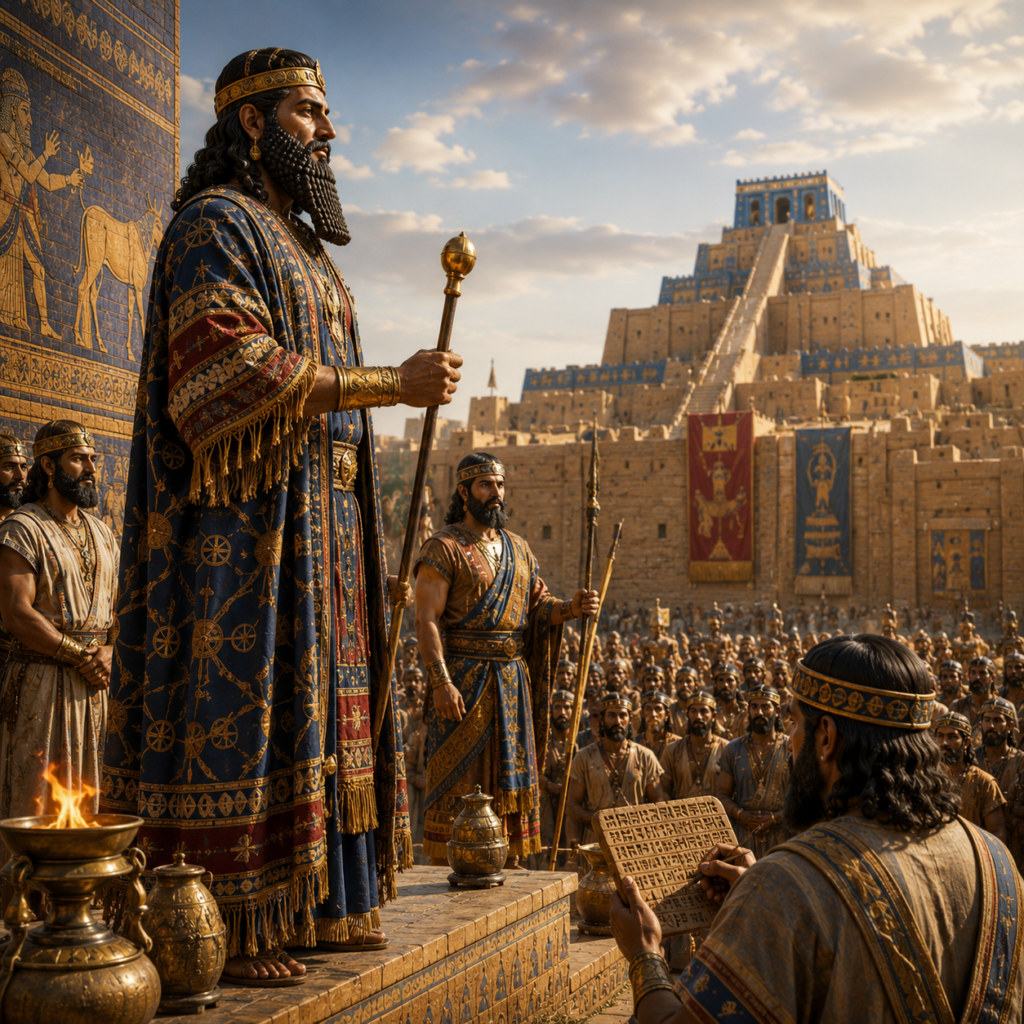
Sumerian kings
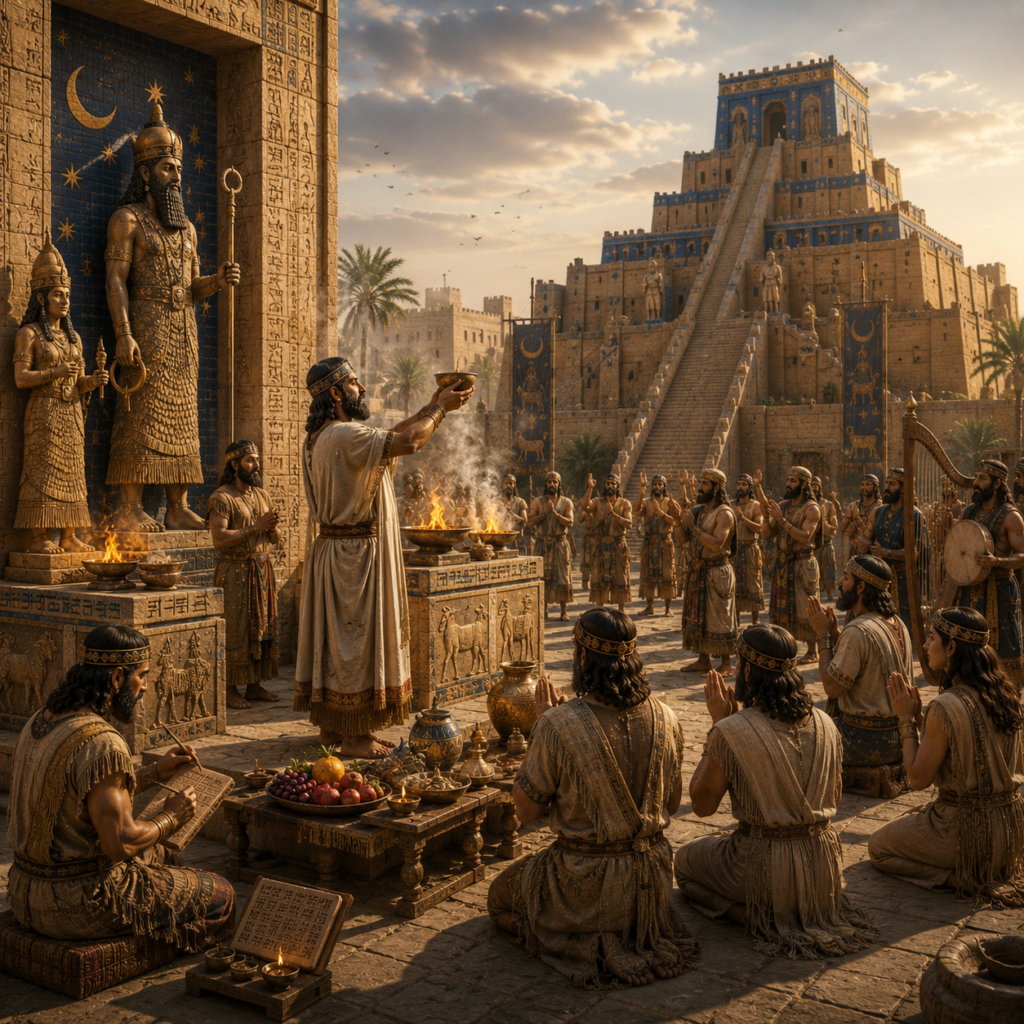
Sumerian religion
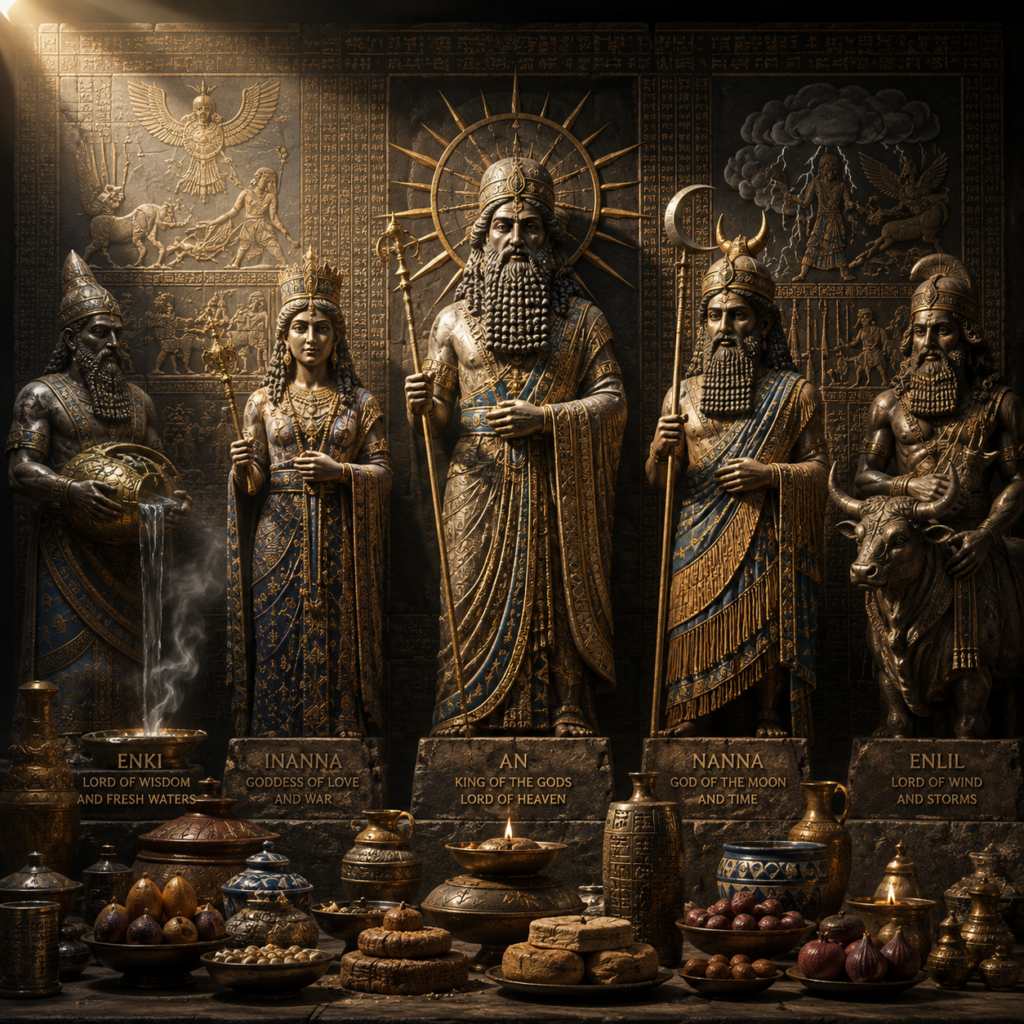
Sumerian gods
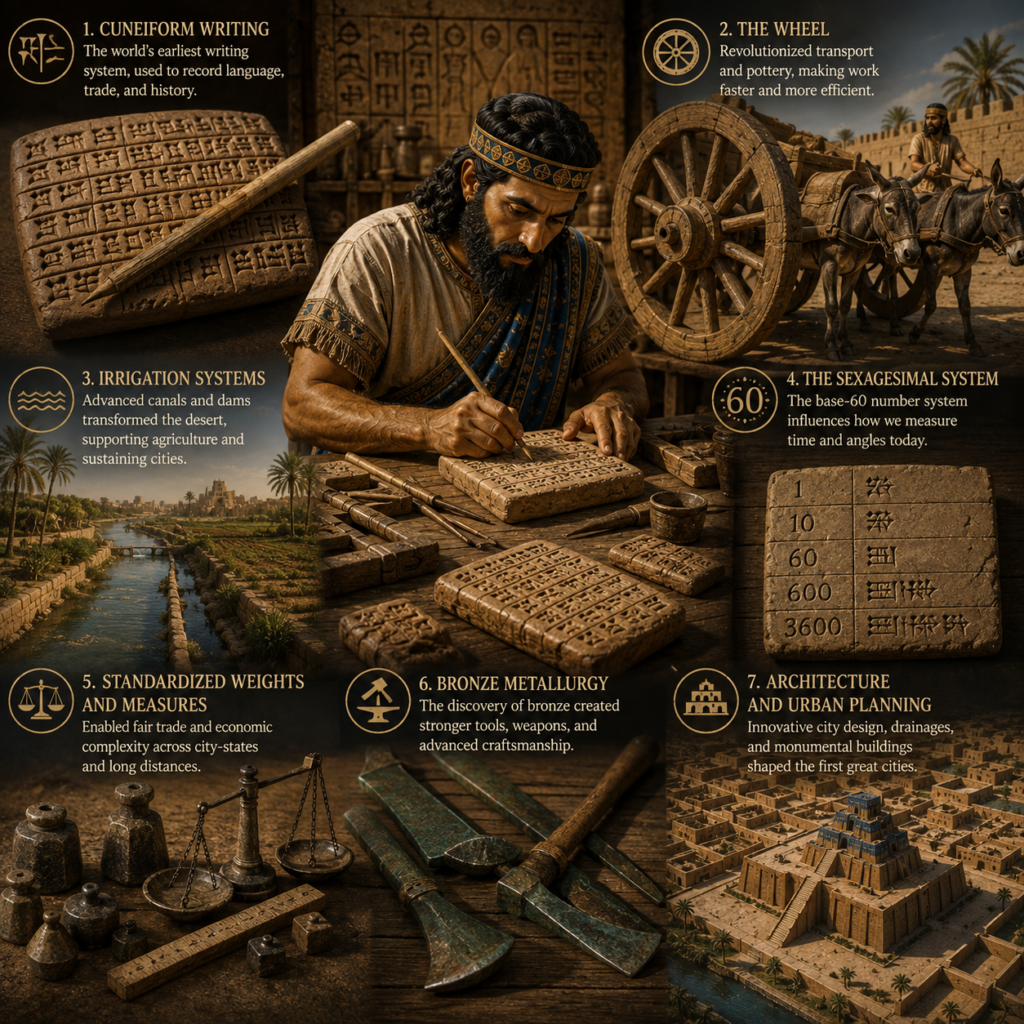
Sumerian inventions
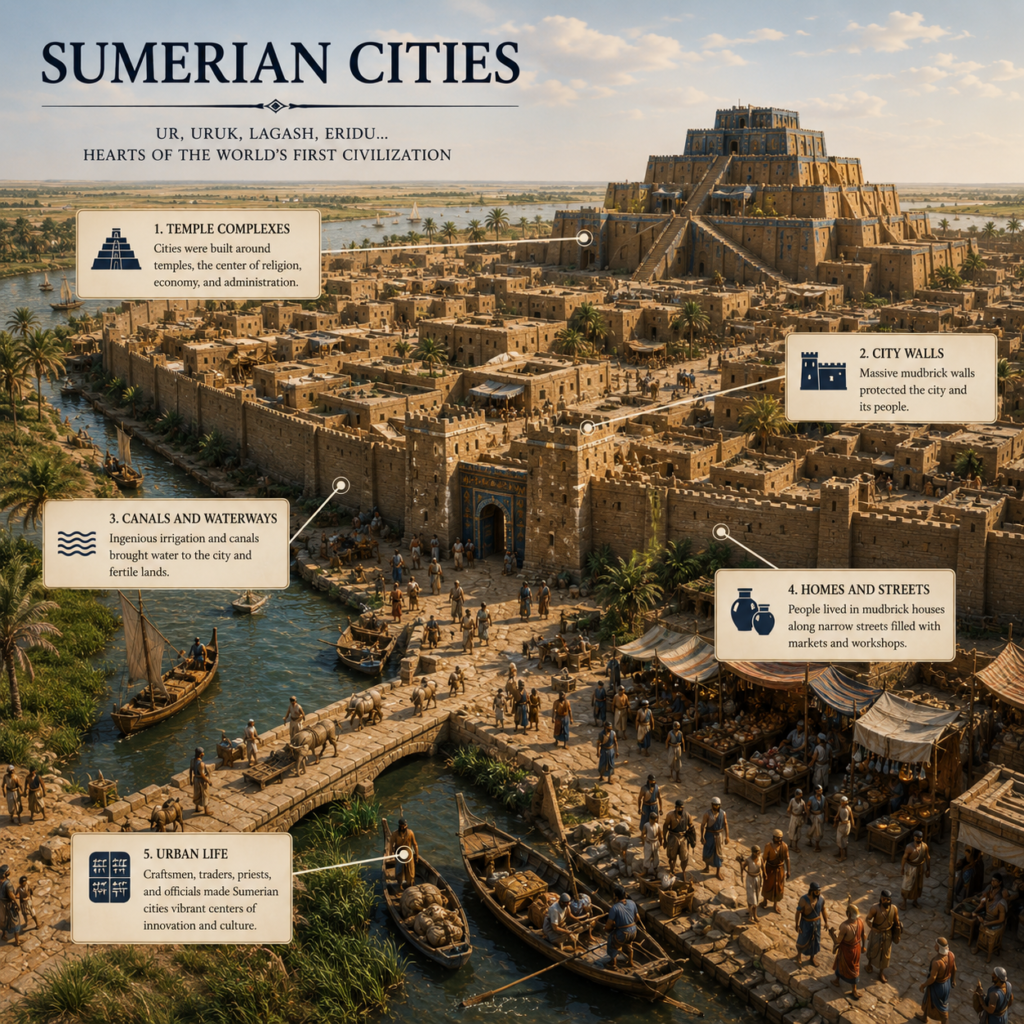
Sumerian cities
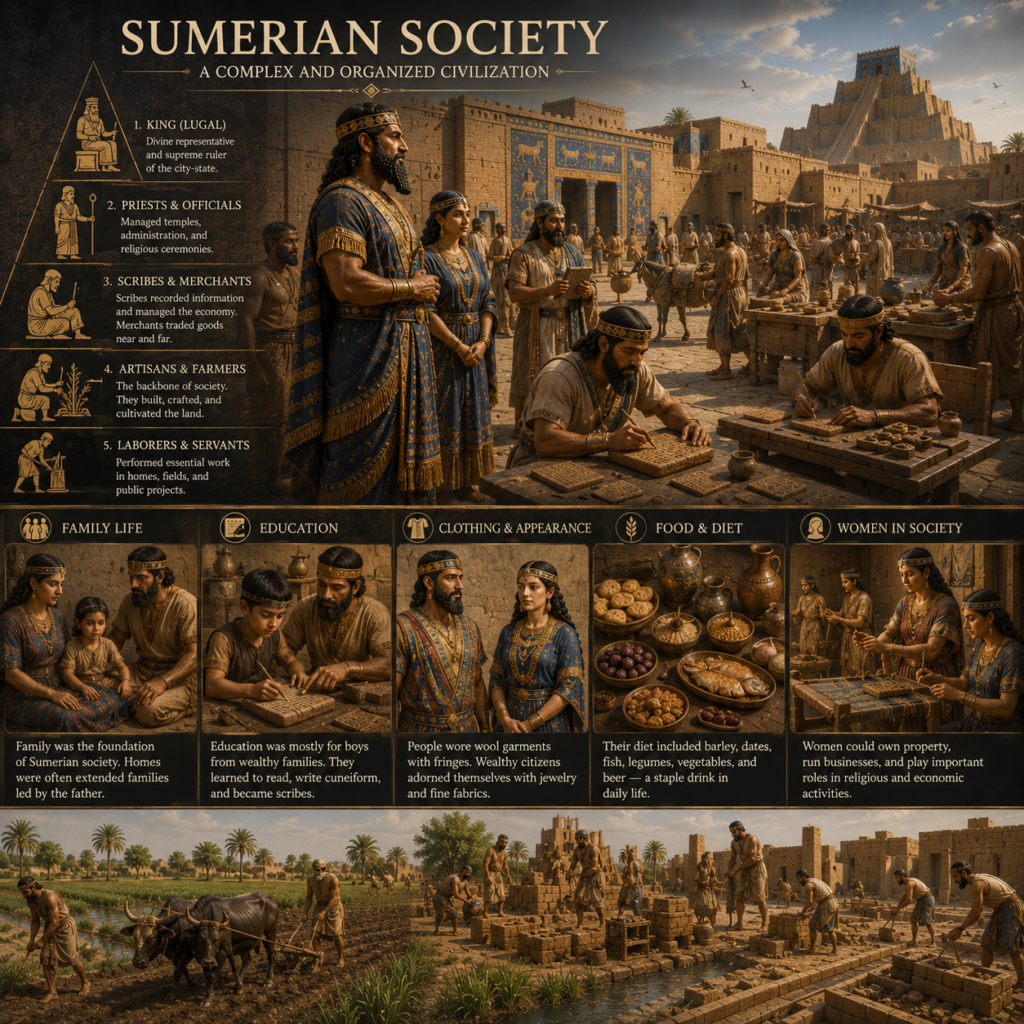
Sumerian society and economy
What Was the Sumerian Civilization?
The Sumerian civilization was one of the earliest complex civilizations in human history, developing in southern Mesopotamia between the Tigris and Euphrates rivers. Rather than being a single unified kingdom, Sumer was a network of independent communities that gradually developed into powerful urban societies.
What made Sumer remarkable was the way several new forms of organisation came together. Large permanent settlements required systems for producing and distributing food, managing labour, organising political authority, and maintaining religious institutions. Over time, these developments created a society that was fundamentally different from the smaller farming communities that had existed in Mesopotamia before the rise of cities.
The Sumerians are particularly important because their civilization provides some of the earliest evidence for urban life, institutional administration, and written records. The appearance of cuneiform allowed increasingly complex economic and administrative activities to be recorded, while monumental buildings demonstrate the ability of Sumerian communities to mobilise large numbers of people and resources.
Sumer should therefore not be understood simply as an ancient kingdom. It was a civilizational system in which settlements, political institutions, religious traditions, agriculture, trade, technology, and writing developed alongside one another.
Where Did Sumerian Civilization Develop?
Sumer developed in the southern part of Mesopotamia, corresponding broadly to modern-day southern Iraq. The region consisted largely of flat alluvial plains formed by the Tigris and Euphrates rivers.
This environment offered enormous agricultural potential, but it also presented serious challenges. Rainfall was relatively limited, while the rivers could flood unpredictably. Communities therefore had to develop ways of controlling and distributing water.
Irrigation became one of the foundations of settled life in the region. Canals allowed farmers to bring river water to agricultural fields, helping communities produce the surpluses necessary to support increasingly large populations.
The geography also influenced Sumer’s economic development. Southern Mesopotamia lacked many important raw materials, including good sources of stone and timber. This encouraged long-distance exchange with neighbouring regions and helped connect Sumerian communities to a much wider network of ancient societies.
When Did Sumerian Civilization Begin?
There was no single moment when Sumerian civilization suddenly appeared.
Its development was gradual. Earlier communities in southern Mesopotamia, particularly those associated with the Ubaid Period, established many of the agricultural and settlement traditions that later supported urbanisation. During the Uruk Period, these communities experienced an extraordinary transformation as settlements grew larger and administrative systems became increasingly sophisticated.
By the fourth millennium BCE, Uruk had developed into an exceptionally large urban centre. Administrative practices expanded, monumental architecture became increasingly important, and the earliest forms of writing began to appear.
This transformation is one of the most important developments in ancient history because it marks the transition from complex villages to genuinely urban societies.
What Made Sumer a Civilization?
The importance of Sumer lies not in a single invention but in the combination of several developments.
Agricultural production created food surpluses. Surpluses supported larger populations. Larger populations required administration. Administration encouraged record keeping. Political and religious institutions organised labour and resources, while trade connected the cities with distant regions.
The result was a self-reinforcing system in which different parts of society supported one another.
This is also why the Sumerians should not be described simply as the people who “invented civilization.” The process was gradual and built upon developments that began before the historical Sumerians appeared. What makes Sumer exceptional is that these developments became integrated into a remarkably complex urban society.
From there, Sumerian civilization continued to evolve for centuries, producing new political institutions, technologies, written traditions, and cultural practices that would influence later civilizations throughout Mesopotamia.
The Origins of Sumerian Civilization
The origins of the Sumerian civilization were not the result of a sudden invasion or the appearance of a completely new society. Instead, Sumer developed through a long process of cultural, agricultural, and technological evolution in southern Mesopotamia.
For thousands of years, communities living between the Tigris and Euphrates rivers gradually transformed their way of life. Small farming settlements became increasingly organised, irrigation systems expanded, populations grew, and new forms of social organisation appeared. Over time, these changes created the foundations for the world’s first urban civilization.
From Early Farming Communities to Urban Society
Before the rise of Sumerian cities, southern Mesopotamia was home to agricultural communities that depended on farming and animal husbandry. These early settlements developed techniques for managing the challenging environment of the alluvial plains.
The region had fertile soil but limited rainfall, meaning communities needed to cooperate in order to control water resources. The construction and maintenance of canals encouraged collective organisation and created the need for increasingly complex forms of leadership.
As agricultural production improved, some communities generated enough surplus food to support people who specialised in other activities, including craftsmen, builders, administrators, and religious specialists.
This gradual process created the social conditions necessary for the emergence of cities.
The Legacy of the Ubaid Period
The Ubaid Period (approximately 6500–3800 BCE) represents one of the earliest stages in the development of complex societies in southern Mesopotamia.
During this period, communities developed:
- Permanent settlements
- Advanced agricultural practices
- Regional networks of exchange
- Early forms of social hierarchy
Although these communities were not yet the urban civilization associated with Sumer, they established many of the traditions that later allowed cities to emerge.
The importance of the Ubaid Period is that it shows Sumer was built upon centuries of gradual development rather than appearing fully formed.
The Transformation of the Uruk Period
The most dramatic transformation occurred during the Uruk Period (approximately 4000–3100 BCE).
During this era, settlements expanded into large urban centres, with Uruk becoming one of the largest and most influential cities in the ancient world.
This period witnessed several developments that changed human history:
- Monumental architecture
- Large-scale administration
- Specialised labour
- Long-distance trade networks
- The emergence of early writing systems
The growth of cities created new challenges. Managing populations, organising economic activity, and distributing resources required more advanced administrative systems. These pressures contributed to the development of institutions that would define Sumerian civilization.
The Birth of the World’s First Cities
By the late fourth millennium BCE, southern Mesopotamia had experienced a transformation unlike anything before it.
Urban centres became places where different aspects of society came together:
- Political authority
- Religious institutions
- Economic activity
- Skilled craftsmanship
- Written administration
Cities such as Uruk, Eridu, Ur, and Lagash became more than settlements. They became complex systems that connected thousands of people through shared institutions and organised production.
This transition from villages to cities represents one of the most important turning points in human history.
Why Did Civilization Begin in Sumer?
Several factors helped explain why southern Mesopotamia became the birthplace of the first civilization.
The region’s rivers provided water and fertile land, while the challenges of the environment encouraged cooperation and innovation. Irrigation required collective planning, trade compensated for the lack of natural resources, and growing populations encouraged new forms of administration.
However, geography alone does not explain Sumer’s success. The Sumerians transformed environmental challenges into opportunities by creating institutions capable of managing increasingly complex societies.
This combination of agriculture, organisation, technology, and cultural innovation created the foundations of a civilization that would influence the ancient Near East for thousands of years.
A Step Into the Ancient World
A Day in the World’s First Civilization
Imagine waking up in southern Mesopotamia more than four thousand years ago.
The sun is already rising over the flat landscape between the Tigris and Euphrates. Around you, people are beginning another day in a society that would have been almost unimaginable to earlier farming communities.
Nearby, farmers are preparing their fields and checking the irrigation channels that bring water from the rivers. Their harvest will eventually feed the population of the city and provide the surplus needed to support craftsmen, builders, administrators, and religious specialists.
Inside the city, the streets are becoming busier.
Craftsmen are working in their workshops, producing pottery, textiles, metal objects, and other goods. Merchants are preparing exchanges with traders who have travelled from distant regions. Sumer had few natural sources of materials such as stone and timber, so long-distance trade was essential to urban life.
At the centre of the city stands a monumental religious complex.
The temple is not simply a place where people come to worship. It is part of a much larger institutional system that connects religion, administration, labour, and economic activity. Priests and officials oversee resources, while offerings and agricultural products move through the institution.
Elsewhere, scribes are at work.
Using a sharpened reed, they press wedge-shaped marks into wet clay tablets. What began primarily as a practical method for recording goods and transactions is becoming something much more powerful: a system capable of preserving information beyond the memory of any individual.
A tablet might record quantities of grain, the distribution of goods, a legal agreement, or an administrative transaction.
This is one of the great transformations of Sumerian civilization.
For the first time in human history, enormous amounts of information could be systematically recorded, stored, and transmitted.
Life Beyond the City
The civilization does not end at the city walls.
Surrounding settlements, agricultural villages, canals, and cultivated fields form an interconnected landscape. The city depends upon this countryside for food, while the countryside benefits from the institutions, markets, workshops, and protection concentrated in the urban centre.
People therefore experience Sumerian civilization in very different ways.
A farmer may spend most of the day working the fields. A craftsman may rarely leave his workshop. A merchant may travel hundreds of kilometres along ancient trade routes. A scribe may spend his entire working life recording information on clay.
Yet all of them participate in the same larger system.
A Civilization Built on Connections
This is what makes Sumer so important.
There was no single invention that suddenly created civilization. Instead, thousands of people became connected through institutions that were increasingly sophisticated.
Agriculture created surpluses.
Cities concentrated populations and resources.
Government organised labour and administration.
Religion provided institutions and shared traditions.
Writing preserved information.
Trade connected Sumer to distant lands.
Each development reinforced the others.
The result was a society capable of building monumental structures, managing large populations, organising complex economic networks, and preserving information in written form.
When we look at Sumer today, it can be tempting to see only ruins, broken tablets, and the foundations of ancient buildings. But behind those remains was a living civilization made up of farmers, merchants, craftsmen, priests, rulers, labourers, and scribes.
They were not simply living in the world’s first cities.
They were creating a new way for human societies to organise themselves.
The Pillars of Sumerian Civilization
Sumerian civilization was not built around a single achievement. Its strength came from the interaction of several systems that allowed increasingly large communities to live, work, govern, and exchange resources together.
These pillars developed over centuries, and none existed in complete isolation. Agriculture supported growing populations, cities concentrated people and resources, political institutions organised collective activity, writing made administration possible, and trade connected Sumer with regions far beyond southern Mesopotamia.
| Pillar | What It Provided | Why It Mattered |
|---|---|---|
| 🏙 Cities | Permanent urban centres and specialised communities | Created the framework for complex urban society |
| 👑 Kingship & Government | Political authority, administration, and public works | Allowed large communities to be organised |
| 🏛 Religious Institutions | Temples, rituals, and shared traditions | Connected communities through powerful institutions and beliefs |
| 📜 Writing | Records of goods, transactions, laws, and literature | Made large-scale administration and written knowledge possible |
| 🌾 Agriculture | Food production and agricultural surpluses | Supported dense populations and specialised occupations |
| 🛒 Trade & Craft Production | Exchange networks and specialised goods | Connected Sumer to distant regions and provided scarce resources |
Cities and Urban Life
The rise of permanent urban centres was one of the defining transformations of Sumerian civilization. Cities such as Uruk, Ur, Lagash, Eridu, and Nippur became centres where political authority, economic activity, craftsmanship, and public institutions were concentrated.
The city-state became the basic political framework of Sumer for much of its history. Each major urban centre controlled surrounding agricultural land and smaller settlements while developing its own institutions and political traditions.
For the full story of these urban centres, see Sumerian Cities.
Kingship and Government
As Sumerian communities became more complex, they required institutions capable of organising labour, resources, defence, and public construction.
Rulers and administrators fulfilled these roles within the individual city-states. Political authority could change considerably over time, but organised government became an essential part of Sumerian urban life.
The development of kingship also demonstrates how Sumerian civilization was increasingly dependent on institutions rather than small-scale village leadership.
For a closer look at the rulers who governed these city-states, see Sumerian Kings.
Religious Institutions
Religious institutions were deeply integrated into Sumerian society. Temples were important centres of collective activity, while cities maintained strong associations with particular deities.
Religion therefore formed part of the wider institutional structure of Sumer rather than existing separately from everyday life.
However, the beliefs, deities, rituals, and mythology of Sumer deserve their own detailed treatment. For that reason, this page provides only the civilizational context.
Writing and Knowledge
The development of cuneiform transformed the way information could be stored and transmitted.
The earliest written records were closely connected with administration, particularly the management of goods and resources. Over time, however, writing became much more than an accounting tool.
Sumerian scribes eventually recorded laws, royal inscriptions, literary works, religious compositions, school texts, and other forms of knowledge.
Writing therefore became one of the most powerful foundations of Sumerian civilization: it allowed information to survive beyond the individual who created or remembered it.
For the development and significance of this writing system, see Cuneiform Writing.
Agriculture and Surplus
Agriculture provided the material foundation on which Sumerian urban society depended.
The fertile alluvial plains of southern Mesopotamia could produce substantial agricultural yields when supported by irrigation. This allowed communities to generate surpluses that could be redistributed among people who were not directly involved in farming.
That surplus helped support administrators, craftsmen, builders, merchants, scribes, and other specialised occupations.
Agriculture was therefore not simply a source of food. It helped make increasingly complex urban society possible.
Trade and Craft Production
Southern Mesopotamia had fertile agricultural land but lacked many important natural resources, including substantial supplies of timber, stone, and certain metals.
Sumerian communities therefore developed extensive exchange networks.
Merchants and traders connected southern Mesopotamia with neighbouring regions, while specialised craftsmen transformed imported materials into tools, ornaments, weapons, vessels, and other goods.
Trade also encouraged cultural connections beyond the boundaries of individual city-states.
How the Pillars Worked Together
The real achievement of Sumerian civilization was the way these systems became interconnected.
Agriculture produced surpluses.
Those surpluses supported cities and specialised workers.
Cities required government to organise resources and labour.
Political and economic institutions relied increasingly on writing to record information.
Trade supplied materials that were unavailable locally.
And all of these activities operated within a society shaped by powerful religious institutions and traditions.
This interconnected system allowed Sumerian society to grow beyond the limits of a traditional farming community.
It was this combination — rather than any single invention — that made Sumer one of the most important turning points in human history.
The Cities That Made Sumer a Civilization
The rise of cities was one of the defining transformations of ancient Sumer. Urban centres brought together large populations, agricultural resources, political institutions, craftsmen, merchants, and administrative systems within relatively concentrated spaces.
This was more than a change in settlement size. The emergence of cities created a new way of organising human society.
From Settlements to Urban Centres
Early communities in southern Mesopotamia had already developed agriculture and permanent settlements, but the cities that emerged during the fourth and third millennia BCE were fundamentally different in scale and complexity.
Places such as Uruk, Ur, Lagash, Eridu, and Nippur became centres around which surrounding agricultural communities were organised.
A city could control farmland, canals, workshops, storage facilities, and trade routes. It could also mobilise labour for large construction projects and maintain institutions that would have been impossible for a small village to support.
The result was a growing distinction between the urban centre and the countryside that supplied it.
Why Cities Became So Important
Sumerian cities performed several functions simultaneously.
They were places where people:
- lived in increasingly dense communities
- exchanged agricultural and manufactured goods
- worked in specialised occupations
- administered resources
- participated in public institutions
- gathered around major monumental complexes
This concentration of people and resources created opportunities for specialisation.
A farmer did not need to produce every object required by his household. A craftsman could dedicate more time to a particular trade. An administrator could focus on organising resources, while scribes could maintain records.
Urban life therefore encouraged a division of labour that made Sumerian society increasingly complex.
The City-State System
Sumerian cities were not simply urban settlements. For much of Sumerian history, they functioned as independent city-states.
Each major city could have its own political leadership, administration, territory, and institutions.
This helps explain why Sumerian history contains so many rival rulers and conflicts. There was no permanent central government controlling all of Sumer.
Instead, political authority shifted between competing cities.
At different moments, cities such as Uruk, Kish, Lagash, Ur, and Umma became especially influential. Their fortunes depended on military power, economic resources, political alliances, and the ability of their rulers to control surrounding territory.
Cities and the Wider Landscape
A Sumerian city could not survive independently of its surrounding countryside.
Agricultural communities produced the food needed to sustain urban populations, while irrigation networks connected fields with the rivers and with the settlements that depended upon them.
This created a close relationship between the city and its hinterland.
The city concentrated administration, craftsmanship, exchange, and political authority, while the surrounding agricultural landscape provided much of the material foundation for urban life.
The Sumerian city was therefore not an isolated settlement. It was the centre of a much larger economic and political network.
The Urban Revolution
The importance of Sumerian cities extends far beyond Mesopotamian history.
The development of large urban centres changed how human communities could organise themselves. Populations could grow beyond the limits of small villages, occupations could become increasingly specialised, institutions could become permanent, and information could be managed on a much larger scale.
This urban transformation created the environment in which many other features of Sumerian civilization could flourish.
Writing, organised government, large-scale construction, specialised crafts, and long-distance exchange all benefited from the concentration of people and resources within cities.
That is why the emergence of Sumerian urban centres was not simply one achievement among many. It was one of the foundations upon which the rest of the civilization was built.
For a closer look at the individual urban centres, their layout, development, and historical importance, continue to Sumerian Cities.
Key Takeaways
- Sumerian civilization developed in southern Mesopotamia and became one of the earliest complex civilizations in human history.
- Sumer emerged gradually, building upon earlier Mesopotamian communities and reaching a major turning point during the Uruk Period.
- Urbanization was fundamental to Sumerian civilization. Cities became centres of administration, production, exchange, and political authority.
- Sumer was not a single unified kingdom. For much of its history, it consisted of competing city-states with their own rulers and institutions.
- Cuneiform transformed administration and knowledge, allowing Sumerians to record economic transactions, laws, literature, and other information.
- Agricultural surpluses supported urban society, while irrigation helped communities make productive use of the challenging environment of southern Mesopotamia.
- Trade connected Sumer with distant regions, providing access to resources that were scarce or unavailable locally.
- The most important Sumerian achievement was the integration of these systems. Cities, government, agriculture, writing, trade, and religious institutions worked together to create a new model of organised human society.
- Sumerian civilization shaped the later history of Mesopotamia, influencing the Akkadians, Babylonians, Assyrians, and other cultures for centuries.
Frequently Asked Questions
What was the Sumerian civilization?
The Sumerian civilization was one of the earliest complex civilizations in human history. It developed in southern Mesopotamia and became known for its cities, writing, organised government, agriculture, trade, and influential cultural traditions.
Where was Sumerian civilization located?
Sumer developed in southern Mesopotamia, between the Tigris and Euphrates rivers, in an area corresponding largely to modern-day southern Iraq.
When did the Sumerian civilization begin?
Sumerian civilization developed gradually from earlier Mesopotamian communities. Its major transformation occurred during the fourth millennium BCE, particularly during the Uruk Period, when large urban centres and early writing emerged.
Why is Sumerian civilization considered so important?
Sumer is important because it provides some of the earliest evidence for large-scale urban society, written administration, complex institutions, and specialised economic activity. Its developments influenced later civilizations throughout Mesopotamia.
Were the Sumerians the first civilization?
Sumer is commonly described as the world’s first known civilization because southern Mesopotamia produced some of the earliest cities, administrative institutions, and written records. However, the emergence of civilization was a gradual process built upon earlier communities and cultures.
Did the Sumerians have an empire?
Sumer was generally divided into independent city-states rather than forming a single permanent empire. Political control shifted between cities over time, while larger territorial states such as the Akkadian Empire later incorporated Sumer.
What did the Sumerians invent?
Sumerians are associated with major developments including cuneiform writing, sophisticated irrigation systems, mathematical traditions, and important technological innovations. Many of these developments evolved gradually rather than appearing as single inventions at one moment.
What language did the Sumerians speak?
The Sumerians spoke Sumerian, a language that is generally considered a language isolate because no confirmed linguistic relatives are known. It was eventually replaced as a spoken language by Akkadian, but Sumerian continued to be used in scholarly and religious contexts for centuries.
What happened to the Sumerian civilization?
Sumerian political independence gradually weakened during the late third and early second millennia BCE. Sumer was incorporated into larger political states, including the Akkadian Empire, while many elements of Sumerian culture continued to influence later Mesopotamian societies.
What was the legacy of Sumerian civilization?
The legacy of Sumer can be seen throughout later Mesopotamian history. Writing, administrative traditions, literary works, political institutions, and cultural practices associated with Sumer continued to influence civilizations including the Akkadians, Babylonians, and Assyrians.
Further readings
- The Metropolitan Museum of Art — Mesopotamia
- The British Museum — Mesopotamia
- The Oriental Institute — Ancient Mesopotamia
Related Topics