What Did the Sumerians Invent?
The Sumerians developed and pioneered foundational technologies and administrative systems that shaped the ancient Near East (c. 4500–1900 BCE). Their most transformative breakthroughs span cuneiform script, the wheel, gravity-fed canal irrigation, the seeder plow, sexagesimal mathematics, and codified statutory law.
Rather than appearing as sudden, isolated discoveries, Sumerian technology developed through centuries of practical experimentation, resource management, and urbanization.
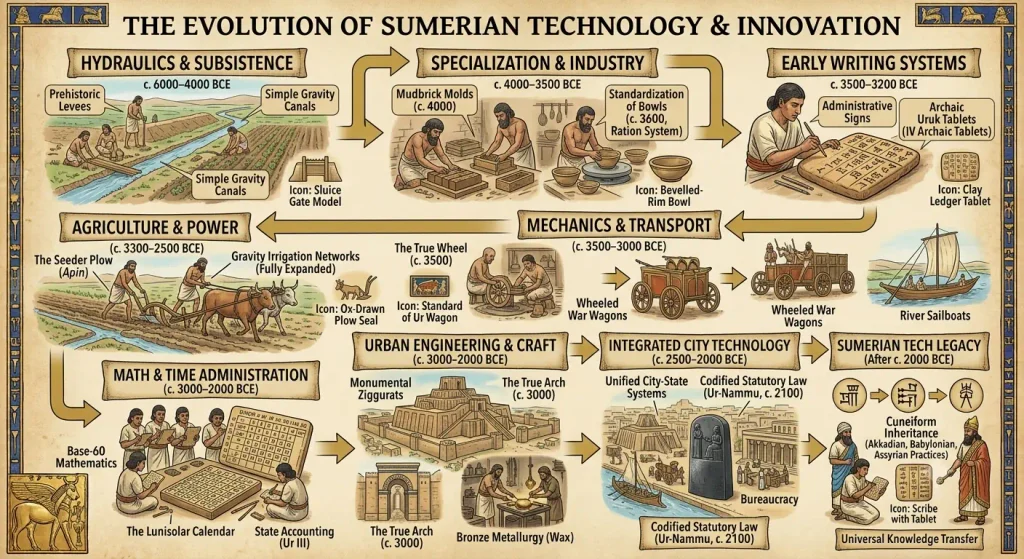
The Evolution of Sumerian Technology
| Period | Technological Development | Why It Mattered |
| c. 6000–4000 BCE | 🌾 Early Irrigation & Farming | Communities developed increasingly sophisticated ways to manage water and cultivate the alluvial plains of southern Mesopotamia. |
| c. 4000–3500 BCE | 🏺 Specialised Craft Production | Pottery, tools, construction techniques, and other specialised crafts became increasingly important as settlements grew. |
| c. 3500–3200 BCE | 📜 Early Writing | Administrative signs and early cuneiform emerged, allowing institutions to record goods, resources, and transactions. |
| c. 3500–3000 BCE | 🛞 The Wheel | Wheeled technology developed in Mesopotamia and was eventually adapted for transport as well as other practical uses. |
| c. 3300–2500 BCE | 🌱 The Plow & Agricultural Technology | Improved farming technology increased the efficiency of cultivation and helped support growing urban populations. |
| c. 3000–2000 BCE | 🧮 Mathematics & Measurement | Sumerian scribes developed sophisticated systems for counting, measuring, accounting, and managing resources. |
| c. 3000–2000 BCE | ⛵ Boats & Transport | Boats, carts, and other transport technologies facilitated the movement of people, agricultural products, and trade goods. |
| c. 3000–2000 BCE | 🏛️ Large-Scale Construction | Engineering, brickmaking, and organised labour allowed Sumerians to construct temples, walls, canals, and other monumental structures. |
| c. 2500–2000 BCE | ⚙️ Integrated Urban Technology | Agriculture, transport, writing, craft production, construction, and administration increasingly worked together within complex city-states. |
| After c. 2000 BCE | 🌍 Sumerian Technological Legacy | Later Mesopotamian societies inherited and adapted many Sumerian technologies, mathematical practices, and administrative traditions. |
The 15 Greatest Sumerian Inventions That Built Civilization
Sumerian innovation did not occur in isolation; it functioned as an interconnected technological and administrative network. These 15 foundational breakthroughs are grouped into three core civilizational pillars:
Comparative Overview: The 15 Inventions That Shaped History
| # | Invention | Historical Period | Key Archaeological Artifact | Modern Practical Legacy |
| 1 | Cuneiform Writing | c. 3400–3200 BCE | Uruk IV Archaic Clay Tablets | Foundation of recorded history, literature, and written administrative law. |
| 2 | Cylinder Seals | c. 3500 BCE | Queen Puabi’s Lapis Lazuli Seal (Ur) | Earliest legal signatures, tamper-proof security, and intellectual property marks. |
| 3 | Codified Law (Code of Ur-Nammu) | c. 2100 BCE | Istanbul Cuneiform Tablet Si 277 | Oldest surviving statutory law code, establishing financial restitution over retribution. |
| 4 | Urban City Planning & Zoning | c. 4000 BCE | Nippur City Map Clay Tablet | Division of metropolitan space into sacred, civic, residential, and commercial zones. |
| 5 | The Seeder Plow (Apin) | c. 3000 BCE | Uruk Cylinder Seals with Sowing Funnels | Simultaneous furrow cutting and seed drilling, tripling agricultural crop yield. |
| 6 | Gravity Canal Irrigation | c. 5000–3500 BCE | Prehistoric Tigris-Euphrates Levees & Dikes | Hydraulic engineering that made agriculture viable across arid alluvial plains. |
| 7 | Standardized Mass Ceramics | c. 3600 BCE | Uruk Bevelled-Rim Bowls | The first mass-produced industrial container, used for state labor grain rations. |
| 8 | Lost-Wax Bronze Metallurgy | c. 3000 BCE | Copper Reliefs from the Temple of al-‘Ubaid | Advanced metal alloying (cire perdue) and precision socketed tool fabrication. |
| 9 | Industrial Beer Brewing | c. 3500 BCE | Cuneiform Hymn to Ninkasi / Godin Tepe Vats | Biochemical fermentation preserving grains as a clean, pathogen-free nutritional staple. |
| 10 | The True Architectural Arch | c. 3000 BCE | Vaulted Tombs of the Royal Cemetery at Ur | Structural load dispersion in architecture using standardized sun-dried mudbricks. |
| 11 | The Potter’s Tournette & Wheel | c. 3500 BCE | Uruk Ceramic Kiln Strata | Horizontal flywheel revolutionizing mass pottery production prior to vehicular use. |
| 12 | Riverine Sailboats | c. 3200 BCE | Eridu Terracotta Sailboat Model | Exploitation of wind power and river currents for bulk upstream freight transport. |
| 13 | Wheeled War Wagons & Carts | c. 3200 BCE | The Standard of Ur (British Museum) | Tripartite wooden wheels mounted on fixed axles for heavy freight and battle tactics. |
| 14 | Sexagesimal Number System (Base-60) | c. 3000 BCE | Shuruppak (Fara) Accounting Tablets | Mathematical foundation surviving today in the 60-minute hour, 60-second minute, and 360° circle. |
| 15 | 12-Month Lunisolar Calendar | c. 2500 BCE | Nippur Agricultural Almanac Tablets | Division of the solar year into 12 lunar cycles of 29/30 days with intercalary correction months. |
Detailed Breakdown of the 15 Breakthroughs
1. Cuneiform Script (c. 3400–3200 BCE)
Sumerians transitioned pictographic administrative tokens into wedge-shaped (cuneiform) abstract signs pressed into damp river clay. Originating in Uruk, it allowed institutions to record economic transactions, royal decrees, epic literature (such as the Epic of Gilgamesh), and diplomatic treaties.
2. Cylinder Seals & Administrative Signatures (c. 3500 BCE)
These small, intricately engraved stone cylinders were rolled across wet clay documents, bullae, and storeroom seals. They served as personal and official signatures, providing counterfeit-proof administrative security.
3. The Code of Ur-Nammu (c. 2100 BCE)
Promulgated during the Third Dynasty of Ur, this legal collection predates Hammurabi’s Code by roughly three centuries. It introduced formalized legal principles where violent crimes and bodily damages received monetary compensation (restitution) rather than pure physical mutilation.
4. Urban City Planning & Zoning (c. 4000 BCE)
Sumerian city-states like Uruk, Ur, and Eridu developed structured public zoning. Cities were divided into distinct quarters: the central temenos (temple-ziggurat complex), civic administrative buildings, residential sectors, industrial ceramic/metallurgical areas, and external harbor districts (karum).
5. The Seeder Plow (Apin, c. 3000 BCE)
A major leap over simple hand-held scratching sticks, the Sumerian apin was an animal-drawn wooden plow equipped with a central funnel. As oxen pulled the blade through the soil, seed grain fell directly into the furrow at precise depths, preventing wind erosion and bird consumption.
6. Gravity-Fed Canal Irrigation & Sluice Gates (c. 5000–3500 BCE)
The arid climate of southern Mesopotamia required active water management. Sumerians constructed expansive systems of artificial levees, dikes, and gravity-fed irrigation channels to control dangerous spring floods from the Tigris and Euphrates, turning desert alluvium into the most productive farmland in the ancient world.
7. Standardized Mass Ceramics: The Bevelled-Rim Bowl (c. 3600 BCE)
Found by the millions throughout the ancient Near East, these coarse, mold-made clay vessels were mass-produced in standardized sizes. They served as standard ration containers used by temple administrations to distribute daily barley, oil, and grain allotments to state workers.
8. Lost-Wax Bronze Metallurgy (Cire Perdue, c. 3000 BCE)
Sumerian smiths mastered the alloying of copper with tin and arsenic, pioneering the lost-wax casting technique. This enabled the mass production of heavy-duty tools, socketed battle axes, adzes, and lifelike bronze statuary.
9. Industrial Beer Brewing & Fermentation (c. 3500 BCE)
Through the double-fermentation of baked barley loaves (bappir), Sumerians created a nutritious, pathogen-free beverage rich in proteins and vitamins. Documented in the religious text The Hymn to Ninkasi, brewing was vital for civil hygiene and worker sustenance.
10. The True Architectural Arch & Mudbrick Molds (c. 3000 BCE)
Due to a lack of timber and natural stone, Sumerians invented standardized wooden rectangular brick molds. They developed structural arches, barrel vaults, and corbelled ceilings—exemplified in the subterranean Royal Tombs at Ur—long before Roman engineers popularized them.
11. The Potter’s Tournette & Rotary Wheel (c. 3500 BCE)
Initially engineered as a heavy stone flywheel rotated by hand or foot to spin clay vessels with continuous momentum, this mechanical innovation drastically increased production speed and established symmetrical ceramic typology.
12. Hydrostatic River Sailboats (c. 3200 BCE)
Sumerians fitted shallow-draft wooden and reed boats with square linen sails. By capturing prevailing Persian Gulf winds for upstream navigation and riding river currents downstream, they established trade networks extending to Bahrain (Dilmun) and Oman (Magan).
13. Wheeled War Wagons & Heavy Freight Carts (c. 3200 BCE)
By fixing tripartite wooden discs with copper studs to axles, Sumerians engineered the earliest four-wheeled war wagons (depicted on the Standard of Ur) and two-wheeled agricultural carts, dramatically lowering overland transport costs.
14. The Sexagesimal Number System (Base-60, c. 3000 BCE)
Sumerian scribes developed a positional mathematical system based on the number 60, chosen for its divisibility by $1, 2, 3, 4, 5, 6, 10, 12, 15, 20,$ and $30$. This invention dictates the modern division of time ($60\text{ seconds}$, $60\text{ minutes}$) and Euclidean geometry ($360^\circ\text{ circle}$).
15. The 12-Month Lunisolar Calendar (c. 2500 BCE)
Sumerians mapped the night sky and divided the agricultural year into twelve 29- or 30-day lunar months ($354\text{ days}$). To keep the calendar synchronized with agricultural solar seasons, astronomers developed the concept of an intercalary 13th month (diri), establishing the blueprint for subsequent Babylonian and Hellenistic calendars.
What Made Sumerian Innovations So Important?
The importance of Sumerian innovation was not simply that particular technologies were early. What made these developments remarkable was the way they were combined to solve practical problems on an increasingly large scale.
Solving the Challenges of Southern Mesopotamia
Southern Mesopotamia presented both opportunities and difficulties. The fertile alluvial plains could support productive agriculture, but communities had to manage water carefully and had limited access to many natural resources.
Sumerian communities responded by developing irrigation, agricultural tools, transport methods, and systems for organising labour and resources.
Technology therefore developed in response to real environmental and economic pressures rather than appearing in isolation.
Supporting Larger Populations
Better agricultural and water-management techniques increased the amount of food that communities could produce.
This created surpluses that could support people who worked outside agriculture, including craftsmen, merchants, builders, administrators, and scribes.
The relationship was cumulative: more productive agriculture supported larger settlements, while larger settlements created demand for increasingly specialised technologies.
Making Complex Administration Possible
Some of the most important Sumerian innovations were not physical objects.
Systems for writing, accounting, measurement, and record keeping allowed institutions to manage resources on a scale that would have been extremely difficult through memory alone.
Clay tablets could record quantities of grain, livestock, labour, goods, and other economic information. These administrative practices helped connect technology with the organisation of increasingly complex societies.
Connecting Cities and Trade
Transportation technology also expanded the possibilities available to Sumerian communities.
Boats could move goods along rivers and canals, while wheeled vehicles and animal transport provided another way to move materials across land.
These technologies helped cities access resources that were scarce locally and strengthened connections between different communities and regions.
Innovation as a Cumulative Process
It is important not to imagine Sumerian inventions as a series of sudden breakthroughs created by individual inventors.
Many technologies developed gradually, building upon earlier Mesopotamian knowledge and adapting existing techniques to new circumstances.
For that reason, describing the Sumerians as innovators and developers is often more accurate than presenting every technology as an invention that appeared at a single moment.
Their greatest contribution was the cumulative development of technologies, knowledge, and practical systems that could operate together within increasingly complex societies.
A Foundation for Later Mesopotamian Technology
Sumerian innovations did not disappear when Sumerian political power declined.
Later Mesopotamian societies inherited and adapted many of these technologies and intellectual traditions. Akkadian, Babylonian, and Assyrian communities continued to develop practices that had roots in earlier southern Mesopotamian traditions.
The lasting importance of Sumerian technology therefore lies not only in individual inventions, but in the technological foundation it provided for the civilizations that followed.
How Sumerian Innovations Influenced Later Civilizations
Sumerian innovations did not remain confined to the cities of southern Mesopotamia. As political powers changed and different peoples gained control of the region, many Sumerian technologies, systems of knowledge, and administrative practices were preserved, adapted, and developed further.
This long process of transmission is one of the most important reasons why Sumerian achievements matter. Their influence was not always the result of a single invention being copied unchanged. Instead, later societies inherited a technological and intellectual tradition and adapted it to their own needs.
From Sumer to Akkad
The Akkadian Empire incorporated the major cities of southern Mesopotamia during the 3rd millennium BCE.
Although Akkadian rulers introduced their own political and linguistic traditions, they continued to use many established Sumerian administrative practices. Sumerian remained an important language of scholarship and administration even as Akkadian became increasingly dominant.
This meant that writing, accounting, mathematics, and administrative knowledge could survive political changes.
Sumerian Foundations in Babylonian Culture
Later Babylonian civilization inherited a substantial body of knowledge from earlier Mesopotamian traditions.
Babylonian scribes continued to use cuneiform and developed sophisticated mathematical and astronomical traditions based partly on earlier foundations.
The connection can be understood as a process of accumulation rather than simple copying:
| Sumerian Development | Later Mesopotamian Use |
|---|---|
| 📜 Writing and record keeping | Administrative records, literature, scholarship, and law |
| 🧮 Mathematical traditions | Advanced calculations, measurement, and astronomy |
| 🌾 Irrigation | Large-scale agricultural production and water management |
| 🛞 Wheeled transport | Movement of goods, people, and military equipment |
| ⛵ River transport | Trade and communication between settlements |
| 🧱 Mud-brick construction | Temples, palaces, walls, and urban architecture |
| 🏛️ Administrative systems | Management of cities, labour, taxation, and resources |
The Preservation of Knowledge
One of the most important aspects of Mesopotamian civilization was the preservation of knowledge by scribes.
Texts could be copied, studied, reorganised, and transmitted across generations. As a result, ideas that originated centuries earlier could remain part of scholarly traditions long after the political structures that produced them had disappeared.
This is particularly important for understanding Sumerian mathematics, literature, religious traditions, and administrative practices.
From Practical Technology to Scientific Knowledge
Some Sumerian innovations also contributed to longer-term developments in Mesopotamian science.
Systems of measurement and calculation became increasingly sophisticated. Observations of the natural world were recorded and organised, while mathematical techniques were applied to practical problems involving land, agriculture, construction, and trade.
Later Babylonian scholars took these traditions considerably further, particularly in mathematics and astronomy.
A Step into the Ancient World
Imagine a Sumerian tablet being copied by a Babylonian scribe centuries after it was first written.
The political world around the tablet may have changed completely, but the knowledge recorded on it could still survive.
This is one of the most remarkable features of ancient Mesopotamia: knowledge could outlive kingdoms.
A mathematical calculation, an administrative practice, or a literary tradition developed in southern Mesopotamia could be preserved and transformed by generations of scribes.
In this sense, the legacy of Sumer was not simply a collection of inventions. It was a tradition of recording, adapting, and transmitting knowledge.
Why the Sumerian Legacy Was So Durable
The durability of Sumerian innovation came from the combination of technology and institutions.
A wheel was useful because it could be incorporated into transport. Irrigation became powerful because communities organised labour to maintain canals. Writing became transformative because administrators and scribes used it to manage increasingly complex societies.
The lasting contribution of Sumer was therefore a system of interconnected technologies, knowledge, and organisational practices.
Later Mesopotamian civilizations did not simply inherit individual Sumerian inventions. They inherited a foundation on which they could continue to build.
What Was the Most Important Sumerian Invention?
There is no single answer to the question of which Sumerian invention was the most important, because different innovations solved very different problems. However, writing and record keeping stand out because they allowed knowledge, transactions, laws, and administrative information to be preserved and transmitted across generations.
The importance of Sumerian innovation becomes clearer when the major developments are compared by their wider impact.
| Innovation | Main Function | Long-Term Importance |
|---|---|---|
| 📜 Writing & Record Keeping | Recording goods, transactions, labour, and information | Made complex administration and long-term knowledge preservation possible |
| 🌾 Irrigation | Managing water for agriculture | Supported food surpluses and larger settled populations |
| 🛞 Wheel | Pottery and transportation | Improved production and the movement of goods |
| 🌱 Plow | Cultivating agricultural land | Increased the efficiency of farming |
| 🧮 Mathematics | Counting, measuring, and accounting | Supported trade, construction, administration, and later scientific traditions |
| ⛵ Transport Technology | Moving people and goods | Expanded trade and connections between settlements |
Why Writing Was So Transformative
Writing was particularly important because it changed how information could be stored.
Before written records, economic information and institutional knowledge depended heavily on human memory and direct transmission. Written records created a more durable way to preserve quantities, transactions, obligations, and other information.
This had consequences far beyond administration. Once information could be recorded, it could also be copied, studied, reorganised, and transmitted to people who had not witnessed the original event.
That made writing a technology for preserving knowledge itself.
Why Irrigation Was Equally Important
For the development of Sumerian society, however, irrigation was arguably just as fundamental.
The agricultural landscape of southern Mesopotamia required communities to manage water carefully. Canals and other water-management systems helped farmers make productive use of the region’s fertile alluvial soils.
Irrigation therefore supported the food surpluses that made larger settlements possible.
In this sense, writing and irrigation solved completely different problems:
- Irrigation helped produce the surplus.
- Administration helped manage the surplus.
- Transport helped move the surplus.
- Writing helped record and organise it.
The real breakthrough was the interaction between these systems.
The Greatest Sumerian Achievement Was a System
Rather than identifying one invention as the sole “greatest” achievement, it is more useful to look at how Sumerian innovations worked together.
A productive agricultural system could support larger populations. Larger populations required more administration. Administration created demand for accounting and record keeping. Growing cities required better transport, construction, and resource management.
This created a cycle in which technological and organisational innovations reinforced one another.
That interconnected system may be the most important Sumerian contribution of all.
The Sumerians did not simply create individual technologies. They developed ways of combining practical knowledge, specialised labour, administration, and resources to operate increasingly complex societies.
Key Takeaways
- The Sumerians pioneered several influential technologies and systems, including writing and record keeping, the wheel, irrigation, the plow, mathematics, transport, and large-scale construction.
- Sumerian innovation was gradual, with many technologies developing over centuries rather than appearing as sudden inventions by a single individual.
- Irrigation and agricultural technology helped produce the food surpluses needed to support growing populations and urban communities.
- Writing transformed administration and knowledge, allowing goods, labour, transactions, and other information to be recorded and transmitted across generations.
- Sumerian technology worked as an interconnected system. Agriculture, transport, mathematics, administration, and construction reinforced one another as cities became more complex.
- Later Mesopotamian civilizations built upon Sumerian foundations, adapting earlier technologies and intellectual traditions rather than simply replacing them.
- The most important Sumerian contribution was therefore not one isolated invention, but the development of a sophisticated technological and organisational tradition that influenced the ancient Near East for centuries.
Frequently Asked Questions
What did the Sumerians invent?
The Sumerians developed or pioneered several important technologies and systems, including writing and record keeping, the wheel, irrigation, the plow, mathematics, transportation technologies, and large-scale construction techniques.
What was the most important Sumerian invention?
Writing and record keeping can be considered one of the most important Sumerian innovations because they allowed information, transactions, resources, and knowledge to be recorded and transmitted across generations. However, irrigation, agriculture, transport, and mathematics were also fundamental to the development of Sumerian society.
Did the Sumerians invent the wheel?
The wheel emerged in Mesopotamia during the 4th millennium BCE, and the Sumerians are commonly associated with its early development and use. Early wheeled technology was used in pottery production before being adapted for transportation.
What technology did the Sumerians use?
Sumerians used a wide range of technologies, including irrigation systems, plows, wheeled vehicles, boats, pottery technology, mud-brick construction, metalworking, and systems for writing, measurement, and accounting.
What tools did the Sumerians use?
Sumerians used agricultural tools such as plows and harvesting implements, craft tools for pottery and metalworking, construction equipment, and tools associated with transportation and food processing. The exact tools varied according to occupation and period.
What were three important Sumerian accomplishments?
Three major Sumerian accomplishments were the development of early writing and record keeping, sophisticated irrigation and agricultural systems, and important advances in mathematics and measurement. Their urban and administrative systems were also fundamental to the development of complex societies.
How did Sumerian inventions influence later civilizations?
Later Mesopotamian civilizations inherited, adapted, and expanded many Sumerian technologies and intellectual traditions. Akkadian, Babylonian, and Assyrian societies continued to use and develop practices associated with writing, mathematics, agriculture, transportation, construction, and administration.
Did the Sumerians invent government?
It is more accurate to describe the Sumerians as developing sophisticated systems of administration and political organisation rather than claiming that they invented government itself. Their city-states required organised institutions to manage resources, labour, agriculture, trade, and public projects.
Why are Sumerian inventions important?
Sumerian inventions and innovations are important because they helped make increasingly complex urban societies possible. Their technologies were interconnected: agriculture produced surpluses, transportation moved resources, mathematics supported measurement and accounting, and administration helped manage growing cities.
Further Reading
- The British Museum — Mesopotamia
- The Metropolitan Museum of Art — Mesopotamia, 8000–2000 B.C.
- The Oriental Institute — Ancient Mesopotamia
- Penn Museum — Mesopotamia
- Encyclopaedia Britannica — Sumer