Cuneiform writing was the world’s first known writing system, developed by the Sumerians in Mesopotamia around 3200 BCE. Written by pressing wedge-shaped marks into clay tablets, it was used to record trade, laws, literature, religion, and government, becoming the foundation of written communication across the ancient Near East.
Timeline
| Date | Development |
|---|---|
| c. 3400 BCE | The first pictographic symbols appear in Uruk. |
| c. 3200 BCE | Proto-cuneiform develops into the earliest writing system. |
| c. 3000 BCE | Cuneiform becomes standardized for administration and trade. |
| c. 2600 BCE | The script expands to literature, religion, and royal inscriptions. |
| c. 2300 BCE | The Akkadians adopt cuneiform for the Akkadian language. |
| c. 1800 BCE | Babylonian scribes produce some of Mesopotamia’s greatest literary works. |
| 1st century CE | Cuneiform gradually disappears as alphabetic scripts replace it. |
How Cuneiform Writing Developed
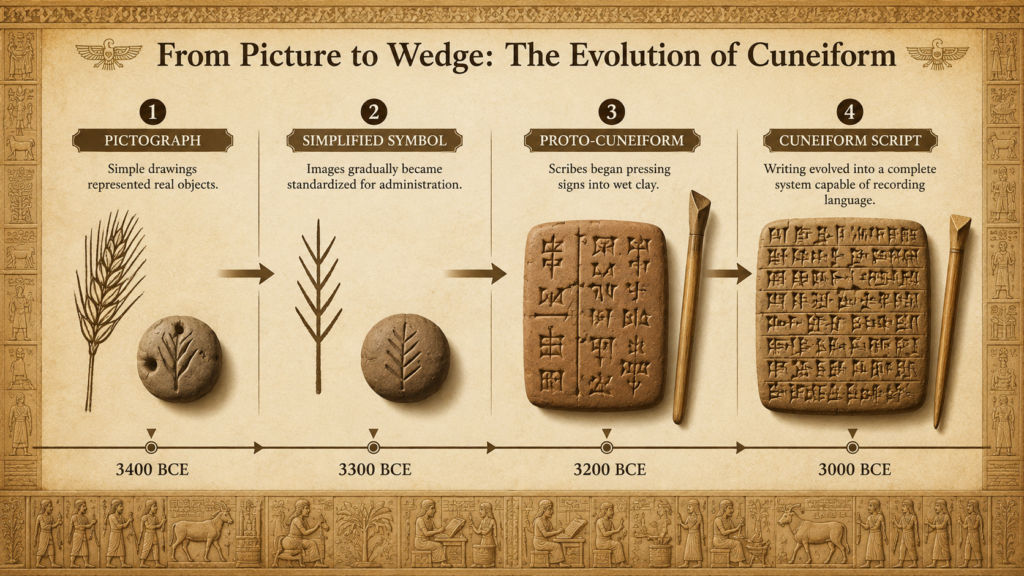
From simple pictures used for accounting to one of the world’s first fully developed writing systems.
Simple drawings representing objects, animals, and goods.
Symbols became more abstract to record trade and administration.
Reed styluses created wedge-shaped impressions on clay tablets.
Writing expanded beyond accounting to history, literature, religion, and legal codes.
Key Insight: Cuneiform did not appear overnight. It evolved gradually over centuries, transforming from simple accounting symbols into a sophisticated writing system capable of recording languages, laws, myths, royal inscriptions, and scientific knowledge across the ancient Near East.
What Was Cuneiform Writing?
Cuneiform writing was the world’s first known writing system, developed by the Sumerians in southern Mesopotamia around 3200 BCE. Instead of using an alphabet, it relied on hundreds of wedge-shaped signs pressed into soft clay tablets with a reed stylus. These symbols could represent complete words, sounds, numbers, or ideas, allowing people to record information in a permanent form for the first time.
The name “cuneiform” comes from the Latin words cuneus (“wedge”) and forma (“shape”), referring to the distinctive triangular impressions left by the stylus. Although modern scholars gave it this name in the nineteenth century, the people of ancient Mesopotamia simply regarded it as their everyday method of writing.
Unlike modern alphabetic scripts, cuneiform was not built around a small set of letters. Over the centuries it evolved into a sophisticated system containing hundreds of signs that could be combined in different ways depending on the language and the period. Learning to master these signs required years of training, which is why literacy was largely restricted to professional scribes.
More importantly, cuneiform was far more than a collection of symbols. It was a complete writing system capable of preserving information across generations. Before its invention, knowledge depended almost entirely on memory and oral tradition. With writing, governments could manage taxes, merchants could record trade, priests could preserve religious texts, and rulers could issue laws that remained unchanged over time.
From my perspective, one of the greatest misconceptions is that cuneiform was invented to write stories or literature. In reality, its earliest purpose was remarkably practical: keeping track of goods, livestock, and economic transactions in the rapidly growing cities of ancient Sumer. Only later did it become the medium for royal inscriptions, scientific observations, diplomatic correspondence, legal codes, and masterpieces such as the Epic of Gilgamesh.
Cuneiform Writing at a Glance
| Feature | Description |
|---|---|
| Invented by | The Sumerians |
| Date | Around 3200 BCE |
| Place of Origin | Uruk, southern Mesopotamia |
| Writing Surface | Clay tablets |
| Writing Tool | Reed stylus |
| Type of Script | Logophonetic writing system using wedge-shaped signs |
| Primary Purpose | Administration, trade, law, religion, and literature |
| Historical Significance | The earliest known writing system in human history |
The Origins of Cuneiform Writing
Cuneiform writing originated in southern Mesopotamia, the region often called the Cradle of Civilization, where the Sumerians established some of the world’s first cities. Most scholars agree that the earliest forms of writing appeared in Uruk around 3400–3200 BCE, making cuneiform the oldest known writing system in human history.
Rather than being invented by a single individual, cuneiform developed gradually as Sumerian society became more complex. As cities expanded, trade increased, and temples managed growing amounts of land, livestock, and agricultural products, people needed a reliable way to record information. What began as a practical solution for administration eventually transformed into a sophisticated system capable of expressing language itself.
The earliest tablets did not resemble writing as we know it today. They consisted of simple pictographs—small drawings representing objects such as grain, animals, tools, or containers. These symbols helped officials record goods entering and leaving temples and storehouses, allowing administrators to keep accurate accounts of the resources that sustained the city’s economy.
Over time, these pictures became increasingly simplified. Instead of drawing detailed objects, scribes began pressing a reed stylus into wet clay, creating the distinctive wedge-shaped impressions that gave cuneiform its modern name. At the same time, the symbols evolved from representing physical objects to expressing sounds, ideas, and grammatical concepts, allowing people to write names, official documents, myths, and eventually entire works of literature.
From my perspective, one of the most remarkable aspects of cuneiform is that it demonstrates how writing was born from everyday needs rather than artistic expression. Long before recording epic stories or royal achievements, the first scribes were solving practical problems related to trade, taxation, and the management of increasingly complex urban societies.
The Evolution of Early Writing
| Stage | Approximate Date | Main Characteristics |
|---|---|---|
| Clay Tokens | Before 3400 BCE | Small clay objects used to count goods and livestock before writing existed. |
| Pictographs | c. 3400 BCE | Simple drawings representing objects, people, and commodities. |
| Proto-Cuneiform | c. 3200 BCE | More abstract symbols used primarily for administration and accounting. |
| Developed Cuneiform | c. 3000 BCE onward | Wedge-shaped signs capable of recording language, literature, laws, religion, and diplomacy. |
How Cuneiform Was Written
Unlike modern writing, cuneiform was not created with ink and paper. Instead, Mesopotamian scribes wrote by pressing a reed stylus into soft clay tablets, producing the distinctive wedge-shaped impressions that give cuneiform its name. This simple yet remarkably durable technique allowed thousands of documents to survive for more than four thousand years.
The writing process began by preparing a flat tablet from moist clay collected along the banks of the Tigris and Euphrates rivers. While the clay was still soft, the scribe used a sharpened reed stylus to press individual signs into the surface rather than drawing lines. By changing the angle and pressure of the stylus, it was possible to create different combinations of wedges that formed words, sounds, and numerical symbols.
Unlike an alphabet, cuneiform consisted of hundreds of individual signs. Some represented complete words, others represented syllables, and many could have different meanings depending on the context. Mastering this complex system required years of study, which is why professional scribes became some of the most respected members of Mesopotamian society.
Once the text was finished, most tablets were simply left to dry in the sun. Important administrative records, royal inscriptions, and legal documents were often baked in kilns, making them extremely resistant to time. Ironically, many tablets that survive today owe their preservation to accidental fires that hardened the clay when ancient cities were destroyed.
From my experience studying Mesopotamian archaeology, one of the most fascinating aspects of cuneiform is how practical the entire process was. Clay was inexpensive, abundant, and easy to reuse, making it an ideal writing material for one of the world’s earliest urban civilizations. This simple combination of clay and reed allowed governments to record taxes, merchants to manage trade, priests to preserve religious traditions, and rulers to issue laws that could be consulted for generations.
The Cuneiform Writing Process
| Step | What Happened |
|---|---|
| 1. Prepare the Clay | Soft clay was shaped into a flat tablet ready for writing. |
| 2. Write with a Reed Stylus | A cut reed was pressed into the clay to create wedge-shaped signs. |
| 3. Record Information | Scribes wrote accounts, letters, laws, hymns, literature, and official documents. |
| 4. Dry or Fire the Tablet | Everyday tablets were sun-dried, while important records were often kiln-fired for long-term preservation. |
| 5. Store in Archives | Finished tablets were kept in temples, palaces, and libraries, where thousands have survived to the present day. |
💡 Did You Know?
Thousands of cuneiform tablets survived for over 4,000 years because many were accidentally baked during fires that destroyed ancient cities. Instead of being lost, the intense heat hardened the clay, preserving contracts, school exercises, royal inscriptions, and literary masterpieces that archaeologists continue to decipher today.
What Was Cuneiform Used For?
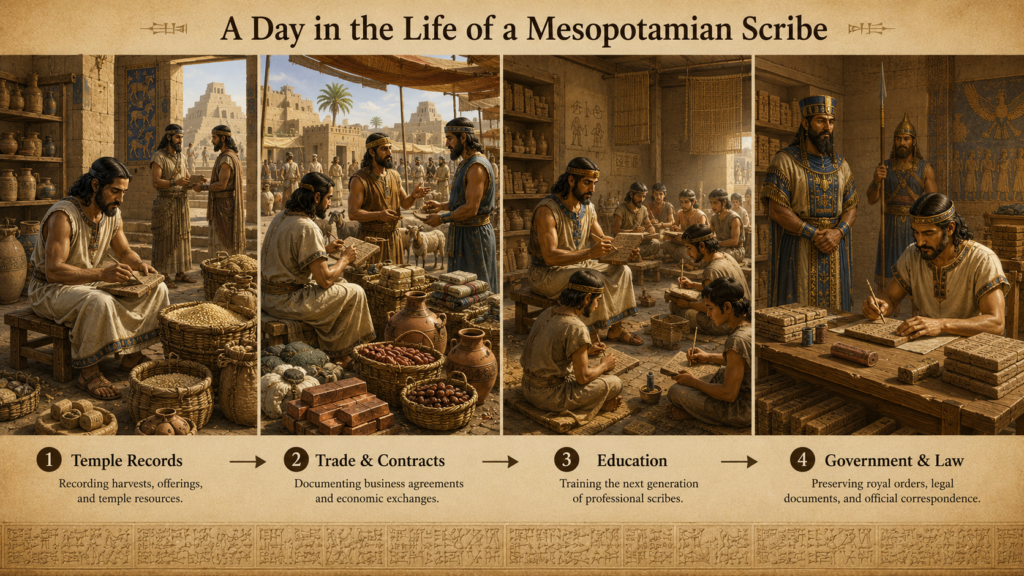
Although cuneiform eventually became capable of recording almost every aspect of Mesopotamian life, its original purpose was surprisingly practical. The earliest tablets were created to keep track of agricultural products, livestock, trade, and taxes, helping the growing cities of Sumer manage increasingly complex economies.
As Mesopotamian civilization expanded, so did the role of writing. What began as a simple accounting tool evolved into a versatile system used by governments, merchants, priests, scholars, and kings. For more than three thousand years, cuneiform remained the principal means of recording information across much of the ancient Near East.
Administrative records formed the largest group of surviving tablets. Scribes documented harvests, temple inventories, land ownership, tax payments, and commercial transactions, allowing cities to organize resources with remarkable efficiency. Thousands of these everyday documents have survived, providing historians with an extraordinary window into daily life in ancient Mesopotamia.
Cuneiform also transformed government and justice. Kings used it to issue royal decrees, record treaties, and preserve legal codes, ensuring that laws could be consulted long after they were written. Some of the most famous examples include monumental inscriptions celebrating military victories and collections of laws that regulated society.
Religion represented another major area in which cuneiform played an essential role. Priests copied hymns, prayers, rituals, temple records, and myths onto clay tablets, preserving beliefs that might otherwise have disappeared. Thanks to these texts, modern scholars can reconstruct many aspects of Mesopotamian religion and mythology.
Perhaps its greatest legacy lies in literature. Epic poems, wisdom texts, scientific observations, astronomical records, and diplomatic correspondence were all written in cuneiform. Without these tablets, masterpieces such as the Epic of Gilgamesh and countless historical documents would have been lost forever.
From my perspective, one of the most remarkable achievements of cuneiform is its versatility. It was never limited to a single purpose. Instead, it became the administrative, cultural, religious, and intellectual foundation of Mesopotamian civilization, supporting everything from local trade to royal government and literary tradition.
Common Uses of Cuneiform Writing
| Purpose | Examples |
|---|---|
| Administration | Tax records, inventories, census lists, and temple accounts. |
| Trade | Commercial contracts, receipts, loans, and merchant correspondence. |
| Law | Legal agreements, court decisions, and law codes issued by rulers. |
| Religion | Hymns, prayers, rituals, offerings, and temple archives. |
| Literature | Myths, epics, proverbs, and wisdom texts, including the Epic of Gilgamesh. |
| Science | Astronomical observations, mathematical tables, and medical texts. |
| Diplomacy | Royal letters, treaties, and correspondence between kingdoms. |
Who Could Read and Write Cuneiform?
Contrary to what many people imagine, the ability to read and write cuneiform was not widespread in ancient Mesopotamia. Literacy was limited to a relatively small group of highly educated professionals known as scribes, whose expertise made them indispensable to governments, temples, and royal courts.
Learning cuneiform was a demanding process. Unlike modern alphabets with only a few dozen letters, the script contained hundreds of individual signs, many of which could represent different sounds or meanings depending on the context. Becoming proficient required years of study, discipline, and constant practice.
Most future scribes received their education in institutions called Edubba, meaning “tablet houses.” These schools were often attached to temples or administrative centers, where experienced teachers instructed students in reading, writing, mathematics, accounting, and the copying of traditional texts. Lessons frequently involved copying the same signs repeatedly onto clay tablets until they could be reproduced accurately from memory.
Scribes occupied one of the most respected positions in Mesopotamian society. Their skills allowed them to manage temple archives, record commercial transactions, draft legal contracts, preserve religious traditions, and prepare official correspondence for kings and governors. Because so few people possessed these abilities, scribes became essential to the functioning of every major city.
From my perspective, one of the most fascinating aspects of Mesopotamian civilization is that scribes were far more than simply writers. They were administrators, accountants, teachers, historians, and guardians of knowledge. Without their work, much of what we know about the ancient Near East—from royal inscriptions to the Epic of Gilgamesh—would never have survived.
Becoming a Mesopotamian Scribe
| Stage | What Students Learned |
|---|---|
| Learning Basic Signs | Students memorized hundreds of cuneiform signs by copying them onto clay tablets. |
| Writing Practice | They developed precision using a reed stylus to produce consistent wedge-shaped impressions. |
| Mathematics & Accounting | Future scribes learned calculations, measurements, and record-keeping for trade and administration. |
| Copying Classical Texts | Advanced students reproduced legal documents, hymns, proverbs, and literary works to perfect their skills. |
| Professional Service | Qualified scribes worked in temples, palaces, courts, schools, and commercial centers throughout Mesopotamia. |
🌍 Step Into the Ancient World
Inside a Sumerian Scribal School
Imagine entering a modest mudbrick building in the bustling city of Uruk more than four thousand years ago. Sunlight filters through the doorway as rows of young students kneel on woven mats, each holding a fresh clay tablet on their lap. In one hand they grip a sharpened reed stylus; in the other, they steady the damp clay while carefully copying the same cuneiform signs again and again.
At the front of the room, an experienced master scribe walks slowly between the students, inspecting their work. Mistakes are gently corrected, and difficult signs are demonstrated on a larger practice tablet. Around the room, shelves are filled with hundreds of dried tablets containing vocabulary lists, mathematical exercises, legal formulas, and ancient stories that every apprentice must eventually master.
In one corner, the most advanced pupils copy official contracts and royal letters, preparing for careers in temples and palaces. Others recite long lists of signs aloud, committing them to memory before pressing them into the clay. The steady rhythm of reed styluses tapping against wet tablets fills the room—a sound that echoes through one of humanity’s earliest classrooms.
Here, writing is far more than a practical skill. It is the gateway to knowledge, administration, and social prestige. In a world where only a small fraction of the population can read and write, becoming a scribe offers access to one of the most influential professions in the ancient Near East.
Why Was Cuneiform Important?
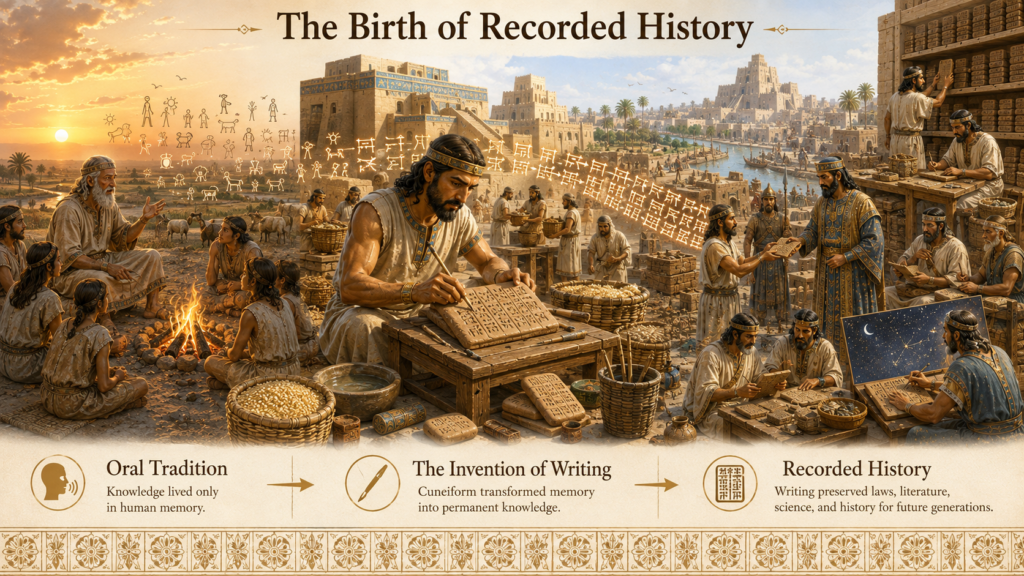
The invention of cuneiform writing marked one of the greatest turning points in human history. For the first time, information could be recorded permanently rather than relying solely on memory or oral tradition. This innovation transformed the way societies governed, traded, preserved knowledge, and understood the world, laying the foundations for written civilization.
Before writing existed, agreements, stories, and administrative decisions depended on human memory. As Mesopotamian cities grew larger and more complex, this was no longer sufficient. Cuneiform provided a reliable system for recording taxes, harvests, trade, laws, and religious practices, allowing governments and temples to manage resources with a level of organization that had never been possible before.
The impact of cuneiform extended far beyond administration. It enabled the preservation of literature, scientific observations, mathematical calculations, diplomatic correspondence, and historical records. Thanks to clay tablets written thousands of years ago, modern historians can reconstruct not only the political history of Mesopotamia but also the everyday lives of its people.
Equally important, cuneiform became a shared technology adopted by several civilizations, including the Akkadians, Babylonians, Assyrians, and Hittites. Although these cultures spoke different languages, they continued to use variations of the same writing system for centuries, demonstrating its extraordinary adaptability and influence across the ancient Near East.
From my perspective, the true significance of cuneiform is not simply that it was the first writing system, but that it fundamentally changed how knowledge was transmitted. Once information could be preserved beyond a single generation, civilizations gained the ability to build upon previous discoveries instead of constantly starting from the beginning. In many ways, cuneiform represents the moment when humanity began creating a permanent historical memory.
How Cuneiform Changed Society
| Before Cuneiform | After Cuneiform |
|---|---|
| Knowledge depended mainly on memory and oral tradition. | Information could be permanently recorded and preserved. |
| Trade relied on verbal agreements. | Contracts, inventories, and receipts could be documented. |
| Laws varied according to memory and local custom. | Legal codes and official decrees could be written and consulted. |
| Religious traditions were transmitted orally. | Myths, hymns, rituals, and prayers were preserved on clay tablets. |
| History was difficult to preserve accurately. | Kings, wars, achievements, and historical events could be recorded for future generations. |
| Education was based on personal instruction alone. | Schools copied and transmitted knowledge through written texts. |
Legacy at a Glance
📜 Marked the beginning of recorded history and the preservation of human knowledge.
🏛️ Enabled the administration of the world’s earliest cities.
⚖️ Made written laws and legal systems possible.
📖 Preserved literature such as the Epic of Gilgamesh.
🔭 Recorded advances in astronomy, mathematics, and medicine.
🌍 Influenced the writing traditions of Mesopotamian civilizations for more than three millennia.
How Cuneiform Spread Across the Ancient Near East
Although cuneiform was invented by the Sumerians, it soon became much more than the writing system of a single civilization. As Mesopotamia developed into a network of powerful kingdoms connected by trade, diplomacy, and conquest, neighboring peoples adopted and adapted cuneiform to write their own languages.
The first major civilization to embrace the script was the Akkadian Empire. Rather than replacing Sumerian writing, Akkadian scribes modified the existing system to record a Semitic language, demonstrating the remarkable flexibility of cuneiform. This adaptation allowed the script to survive even after Sumerian gradually disappeared as a spoken language.
Over the following centuries, cuneiform became the principal writing system of several great Mesopotamian civilizations, including the Babylonians and Assyrians. Royal inscriptions, legal codes, diplomatic correspondence, astronomical observations, religious texts, and literary works continued to be written on clay tablets using the same fundamental system developed thousands of years earlier in southern Mesopotamia.
Its influence extended far beyond Mesopotamia itself. Archaeologists have discovered cuneiform tablets in regions corresponding to modern-day Syria, Turkey, Iran, and even Egypt. One of the most famous examples is the Amarna Letters, a collection of diplomatic correspondence exchanged between Egyptian pharaohs and Near Eastern rulers during the Late Bronze Age. Although written by different kingdoms, these letters used Akkadian cuneiform as the international language of diplomacy.
From my perspective, one of the most extraordinary aspects of cuneiform is its longevity. Few writing systems in history remained in continuous use for more than three thousand years while serving multiple civilizations, languages, and political empires. Its survival reflects not only the ingenuity of its inventors but also its effectiveness as a tool for communication across the ancient world.
Civilizations That Used Cuneiform
| Civilization | Period | Main Uses |
|---|---|---|
| Sumerians | c. 3200–2000 BCE | Administration, religion, literature, trade, and law. |
| Akkadians | c. 2334–2154 BCE | Government, diplomacy, royal inscriptions, and literature. |
| Babylonians | c. 1894–539 BCE | Legal codes, science, mathematics, astronomy, and literature. |
| Assyrians | c. 2025–609 BCE | Military records, administration, royal archives, and libraries. |
| Hittites | c. 1650–1180 BCE | Diplomacy, treaties, laws, and royal administration. |
| Elamites and Other Kingdoms | Various periods | Administrative records and international correspondence. |
🌍 Step Into the Ancient World
The Royal Archive of Nineveh
Imagine walking through the vast royal library of King Ashurbanipal in the Assyrian capital of Nineveh. Long rows of wooden shelves are filled with thousands of carefully arranged clay tablets, each bearing neat columns of wedge-shaped cuneiform signs. Scribes move quietly through the rooms, copying damaged texts, cataloguing new tablets, and preserving centuries of accumulated knowledge.
Some tablets contain royal annals celebrating military victories. Others preserve ancient Sumerian myths copied more than a thousand years after they were first composed. Nearby, scholars consult astronomical observations, medical treatises, and bilingual dictionaries used to study languages that had already become ancient in their own time.
The library is more than a collection of documents—it is one of the world’s earliest centres of learning. Thanks to these archives, countless works of Mesopotamian literature, science, and history survived long after the civilizations that created them had disappeared.
Why Cuneiform Writing Still Matters Today
Although cuneiform disappeared as a living writing system more than two thousand years ago, its importance has never diminished. Every clay tablet that archaeologists recover provides another piece of the puzzle of humanity’s earliest civilizations, allowing us to hear voices that would otherwise have been lost forever.
Much of what we know about ancient Mesopotamia comes directly from cuneiform texts. Royal inscriptions reveal how kings viewed their achievements, legal documents explain how society was organized, and administrative records show how cities managed agriculture, trade, and taxation. Even the smallest tablet can offer valuable evidence about everyday life more than four millennia ago.
Cuneiform has also transformed our understanding of literature and science. Masterpieces such as the Epic of Gilgamesh, collections of hymns, medical prescriptions, astronomical observations, and mathematical exercises all survived because generations of scribes carefully impressed them into clay. These texts demonstrate that Mesopotamian civilization possessed an extraordinary intellectual tradition long before the classical civilizations of Greece and Rome.
The script continues to play a vital role in modern archaeology. Thousands of tablets remain untranslated in museums and excavation storerooms around the world, and every year researchers decipher new texts that refine our understanding of politics, religion, economics, and daily life in the ancient Near East. In many ways, cuneiform is still telling new stories.
From my perspective, one of the greatest lessons of cuneiform is that writing does far more than record information. It preserves ideas, connects generations, and allows civilizations to pass on their knowledge across centuries. The wedge-shaped impressions left by Mesopotamian scribes became the foundation upon which recorded history itself was built.
The Legacy of Cuneiform
| Legacy | Why It Matters Today |
|---|---|
| The First Writing System | Marked the beginning of recorded history and transformed human communication. |
| Historical Records | Preserved the earliest evidence of governments, trade, and urban civilization. |
| Literature | Protected works such as the Epic of Gilgamesh, one of the world’s oldest surviving epics. |
| Science & Mathematics | Recorded advances in astronomy, mathematics, medicine, and engineering. |
| Archaeology | Thousands of tablets continue to provide new discoveries about the ancient Near East. |
| Human Heritage | Demonstrates how the invention of writing changed the course of civilization forever. |
🌍 Step Into the Ancient World
The Discovery of a Lost Library
Imagine standing beside a team of archaeologists as they carefully brush away layers of dust from the ruins of an ancient Mesopotamian city. One by one, hundreds of clay tablets begin to emerge from the earth, still covered with tiny wedge-shaped signs pressed into their surface more than three thousand years ago.
Some tablets contain royal decrees. Others preserve school exercises written by apprentice scribes, while nearby lie fragments of hymns, legal contracts, and letters exchanged between kings. Although the civilization that created them vanished long ago, the words remain remarkably clear, waiting to be read once again.
As specialists photograph, catalogue, and decipher each tablet, forgotten voices return to life. Merchants describe their businesses, priests record religious ceremonies, astronomers note the movements of the stars, and poets recount stories that had been silent for millennia. Every new translation adds another chapter to humanity’s earliest written history.
It is a powerful reminder that the invention of cuneiform did more than create a writing system—it created a bridge across time. Thanks to those small impressions left in clay, we can still listen to the people who lived at the dawn of civilization.
Why Did Cuneiform Disappear?
For more than three thousand years, cuneiform remained the dominant writing system across Mesopotamia and much of the ancient Near East. Yet despite its extraordinary longevity, it gradually disappeared as new empires, languages, and alphabets transformed the region.
One of the main reasons for its decline was its complexity. Learning cuneiform required mastering hundreds of signs and spending years in scribal education. By contrast, alphabetic writing systems used far fewer symbols, making reading and writing easier to learn and more accessible to a wider population.
Political changes also played an important role. As the Assyrian and Babylonian empires fell, new powers such as the Achaemenid Persians introduced different administrative traditions. At the same time, the Aramaic alphabet spread throughout the Near East, becoming the preferred language and script for diplomacy, trade, and government because of its simplicity and flexibility.
Even so, cuneiform did not disappear overnight. For centuries it continued to be used by priests and scholars, particularly for copying religious texts, astronomical observations, and traditional literature. Some temples preserved scribal schools long after everyday administration had shifted to alphabetic scripts.
The last known cuneiform tablets date to the first century AD, marking the end of one of the longest-lasting writing traditions in human history. Although the script itself fell silent, the thousands of clay tablets it left behind ensured that the knowledge of ancient Mesopotamia would never be completely lost.
From my perspective, the disappearance of cuneiform reminds us that even the most influential technologies eventually evolve or give way to new forms. Yet its legacy endured: without cuneiform, much of the history, literature, science, and religion of the ancient Near East would have vanished forever.
The Decline of Cuneiform
| Period | What Changed |
|---|---|
| Late Assyrian & Babylonian Periods | Cuneiform remained the main script for administration, religion, and scholarship. |
| Achaemenid Persian Empire | Aramaic became increasingly important for government and international communication. |
| Hellenistic Period | Greek influence expanded, while cuneiform survived mainly in temples and scholarly circles. |
| 1st Century AD | The last known cuneiform tablets were written, bringing the tradition to an end after more than 3,000 years. |
Frequently Asked Questions About Cuneiform Writing
What is cuneiform writing? ▼
Cuneiform writing is the earliest known writing system, developed by the Sumerians in Mesopotamia around 3200 BCE. Instead of using ink, scribes pressed wedge-shaped marks into soft clay tablets with a reed stylus, creating a script that remained in use for more than three thousand years.
Who invented cuneiform writing? ▼
The Sumerians invented cuneiform in the city of Uruk, in southern Mesopotamia. It began as a practical method for recording goods and trade before evolving into a sophisticated writing system capable of expressing language, literature, religion, and law.
Why was cuneiform important? ▼
Cuneiform was important because it allowed information to be recorded permanently. It transformed administration, trade, government, religion, and education, making it possible to preserve laws, historical records, scientific knowledge, and literary works for future generations.
What was cuneiform used for? ▼
Cuneiform was used for many purposes, including:
- Recording taxes and trade.
- Writing legal contracts and royal decrees.
- Preserving myths and religious texts.
- Keeping astronomical and mathematical records.
- Producing literature such as the Epic of Gilgamesh.
What does the word “cuneiform” mean? ▼
The term cuneiform comes from the Latin words cuneus (“wedge”) and forma (“shape”). It refers to the wedge-shaped impressions made by pressing a reed stylus into wet clay.
How was cuneiform written? ▼
Scribes used a reed stylus to press wedge-shaped signs into soft clay tablets. Once the text was complete, the tablets were left to dry in the sun or baked in kilns, allowing many of them to survive for thousands of years.
Was cuneiform an alphabet? ▼
No. Cuneiform was not an alphabet. It consisted of hundreds of signs that could represent words, syllables, or ideas, making it far more complex than modern alphabetic writing systems.
Who could read and write cuneiform? ▼
Only a small number of highly trained scribes could read and write cuneiform. They studied for years in schools called Edubba, where they learned hundreds of signs along with mathematics, accounting, and administrative skills.
Which civilizations used cuneiform? ▼
Although it was invented by the Sumerians, cuneiform was later adopted by many civilizations, including the Akkadians, Babylonians, Assyrians, Hittites, and Elamites, becoming the dominant writing system of the ancient Near East for over three millennia.
Why did cuneiform disappear? ▼
Cuneiform gradually declined because alphabetic writing systems, particularly Aramaic, were much simpler to learn and use. As new empires emerged and administrative practices changed, cuneiform was abandoned. The last known tablets were written during the 1st century AD.
Is cuneiform still used today? ▼
No. Cuneiform is no longer used as a living writing system. However, archaeologists and Assyriologists continue to study and decipher thousands of surviving clay tablets, providing invaluable insights into the history, culture, and daily life of ancient Mesopotamia.
Further Reading
- The British Museum – Cuneiform Tablets
https://www.britishmuseum.org/collection/galleries/mesopotamia - The Metropolitan Museum of Art – Cuneiform
https://www.metmuseum.org/toah/hd/cune/hd_cune.htm - World History Encyclopedia – Cuneiform
https://www.worldhistory.org/cuneiform/ - Encyclopaedia Britannica – Cuneiform
https://www.britannica.com/topic/cuneiform - CDLI (Cuneiform Digital Library Initiative) – University of California, Los Angeles
https://cdli.ucla.edu/ - The Louvre Museum – Mesopotamia Collection
https://www.louvre.fr/en/departments/near-eastern-antiquities
Related Topics