What were Akkadian cities?
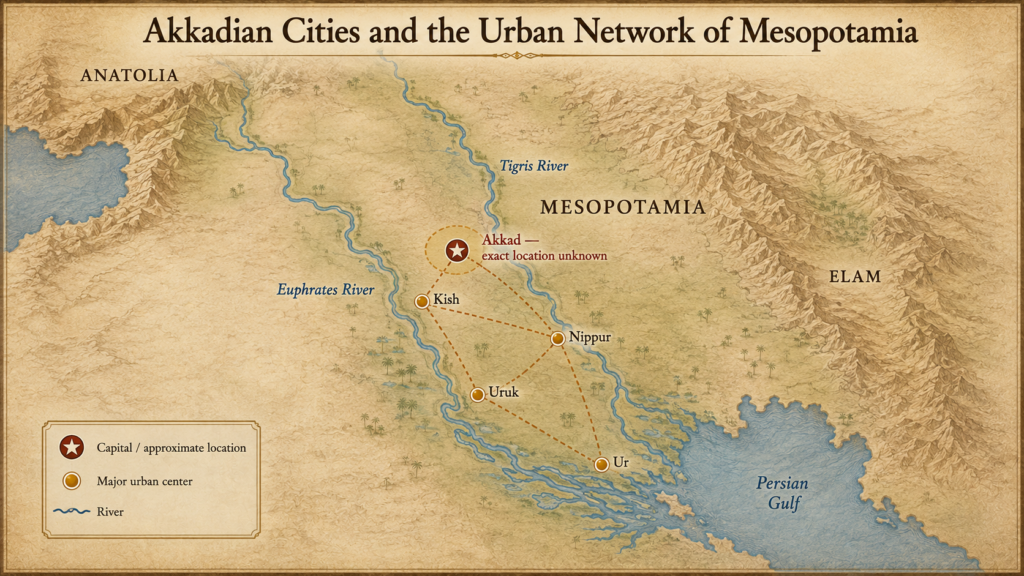
Akkadian cities were the urban centers that supported the Akkadian Empire, serving as political, administrative, economic, religious, and military hubs. Many were inherited from earlier Sumerian urban traditions and incorporated into the Akkadian imperial system. The most important city was Akkad, the imperial capital, although its exact location remains unknown. Other major centers included Kish, Ur, Uruk, and Nippur, which continued to play important roles within the wider urban network.
Rather than forming a single uniform city system, the Akkadian world consisted of interconnected urban centers that helped the empire govern territory, manage resources, support trade, and maintain political control.
Timeline: The Development of Akkadian Cities
| Period | Urban Development |
|---|---|
| Before the Akkadian Empire | Major cities such as Kish, Ur, Uruk, and Nippur had already developed important political, economic, and religious functions within southern Mesopotamia. |
| c. 2334 BC | Sargon of Akkad established the Akkadian Empire and brought existing urban centers into a wider imperial network. |
| Early Akkadian Rule | Cities inherited from earlier Mesopotamian traditions became important centers for administration, resource management, religion, and political control. |
| Expansion of the Empire | The growing imperial system connected cities with territories farther beyond southern Mesopotamia, increasing the importance of urban centers as nodes of communication and resource distribution. |
| Akkad as Imperial Capital | Akkad became the political center of the empire. Its precise archaeological location remains unknown, making it one of the most famous lost cities of the ancient Near East. |
| Under Naram-Sin | The imperial urban network continued to support centralized authority as Akkadian power reached its greatest extent. |
| Late Akkadian Period | Political instability and pressures on the empire weakened the centralized system that had connected its cities. |
| After the Fall of the Empire | Akkadian political control disappeared, but many established cities continued to exist and remained important in later Mesopotamian history. |
The Urban Network of the Akkadian World
The Akkadian Empire was not simply a continuous territory controlled from one capital. Its power depended on a network of cities and established urban centers that connected political authority with local communities.
This network allowed the Akkadian rulers to work through cities that already had administrative, religious, and economic importance before the empire was established.
A Network Rather Than a Single Center
Akkadian rule extended across a landscape that already contained important cities.
Instead of creating an entirely new urban system, the empire incorporated existing centers such as:
- Kish
- Uruk
- Ur
- Nippur
These cities retained their local importance while becoming part of a wider political structure.
This combination of local continuity and imperial authority was one of the practical strengths of Akkadian rule.
Akkad at the Center
The city of Akkad occupied a special position within this network because it served as the imperial capital.
From the capital, royal authority could be projected across the territories controlled by the empire.
However, Akkad’s precise location remains unknown. This makes it different from many of the other important cities associated with the empire, whose archaeological remains provide direct evidence of their urban development.
The lost capital therefore represents an important gap in our understanding of how the Akkadian urban system was physically organized.
Connecting Different Urban Centers
The cities of the empire were connected through the movement of:
- People
- Goods
- Officials
- Information
- Administrative resources
Urban centers therefore acted as points of connection between local communities and the wider imperial system.
A city could have its own traditions and institutions while simultaneously participating in a much larger political network.
The Importance of Existing Cities
The Akkadian rulers inherited a landscape shaped by centuries of urban development.
This meant that cities already possessed:
- Established populations
- Religious institutions
- Administrative traditions
- Local elites
- Economic connections
The empire could therefore build upon systems that already existed rather than creating urban organization from the beginning.
From my perspective, this is one of the most interesting aspects of Akkadian urban history: imperial expansion depended partly on adapting an existing city network rather than replacing it.
Local Cities Within an Imperial System
Being incorporated into the Akkadian Empire did not necessarily mean that every city became identical.
Different urban centers continued to have their own histories and local importance.
Kish had a long political tradition. Nippur retained major religious significance. Ur and Uruk remained important urban centers with deep roots in earlier Mesopotamian history.
Their incorporation into the empire created a relationship between local identity and imperial authority.
Why the Urban Network Mattered
The Akkadian urban network helped transform imperial power from an abstract political claim into something that could operate across real communities.
Through its cities, the empire could:
- Exercise authority
- Organize administration
- Move resources
- Connect different regions
- Maintain political influence
The strength of the Akkadian Empire therefore depended not only on its kings or armies, but also on the cities through which imperial power could operate.
In this sense, the Akkadian Empire can be understood as a political network built upon an older urban landscape.
From Earlier Urban Traditions to Akkadian Rule
The Akkadian Empire emerged in a region where cities had already been developing for centuries. When Akkadian rulers expanded their power, they did not encounter an empty landscape waiting to be reorganized. They inherited established urban centers with their own populations, institutions, religious traditions, and political histories.
This existing urban landscape became one of the foundations of Akkadian imperial power.
Cities Before the Akkadian Empire
Long before Sargon established the Akkadian Empire, southern Mesopotamia contained some of the world’s most developed urban communities.
Cities such as:
- Ur
- Uruk
- Kish
- Nippur
already had important political, economic, and religious functions.
Their populations were accustomed to urban administration and institutional organization, giving the Akkadian rulers an established framework on which they could build.
Conquest Did Not Mean Starting Over
Akkadian expansion changed who controlled these cities, but it did not necessarily erase their earlier identities.
Instead, imperial rule could be layered over existing structures.
Local communities continued to live in established urban environments while royal authority was introduced through:
- Governors and officials
- Imperial administration
- Tribute and resource management
- Royal building activity
- Military presence
This created a relationship between local continuity and centralized power.
Kish and the Northern Connection
Kish was particularly important because of its long political tradition and its position within the wider landscape of Mesopotamian cities.
Its importance demonstrates that Akkadian power did not depend exclusively on the new capital of Akkad.
Existing centers could continue to serve important political and administrative functions while becoming connected to the imperial system.
Uruk and Urban Continuity
Uruk was already one of the major cities of southern Mesopotamia when Akkadian rule emerged.
Its long history meant that the city possessed institutions and traditions that predated the empire by centuries.
Its continued importance illustrates a broader pattern: Akkadian imperial rule was integrated into an existing urban civilization rather than replacing it completely.
Nippur and Religious Authority
Nippur occupied a different position within this network.
Its importance was closely connected to the cult of Enlil, making it one of the most significant religious centers in Mesopotamia.
For Akkadian rulers, controlling or maintaining relationships with established religious centers was therefore also a way of interacting with traditions that carried authority far beyond a single city.
Adapting Existing Urban Systems
The Akkadian achievement was not simply the creation of new cities.
It was the ability to connect established urban communities to a larger imperial structure.
This meant that the empire could combine:
Older cities + local institutions + imperial administration = a wider political network
From my perspective, this helps explain why the Akkadian urban system could expand relatively quickly. The rulers were working with institutions and communities that already existed rather than building an entirely new system from the ground up.
Continuity and Change
Akkadian rule therefore produced both continuity and transformation.
The cities remained recognizable as ancient urban communities, but their political context changed dramatically.
They became part of an empire in which authority was increasingly connected to the Akkadian royal center.
This combination of inherited urban traditions and new imperial structures was one of the defining characteristics of Akkadian urban development.
Where Were the Akkadian Cities Located?
Akkadian cities were concentrated primarily in Mesopotamia, especially across the regions of southern and central Iraq. Their position along the Tigris and Euphrates river systems connected urban communities with agricultural land, waterways, and routes leading toward other parts of the ancient Near East.
The Akkadian urban landscape was therefore shaped by both geography and the older pattern of settlement that had developed across Mesopotamia.
The Heartland of Akkadian Urban Life
The main urban centers associated with Akkadian rule were located across the Mesopotamian plain.
Important cities included:
- Kish
- Uruk
- Ur
- Nippur
- Akkad
These cities were not all located in exactly the same environment or served identical purposes. Their importance came partly from their position within a wider network of settlements.
Rivers and Urban Settlement
The Tigris and Euphrates were fundamental to life in Mesopotamia.
River systems supported:
- Agriculture
- Transportation
- Communication
- Access to surrounding settlements
- The movement of goods and people
Cities developed within this wider landscape rather than existing as isolated settlements.
Their location helped determine how communities interacted with the countryside and with other urban centers.
Northern and Southern Connections
The Akkadian political sphere connected regions that had previously been governed through separate local traditions.
This gave certain cities importance as points between different parts of the imperial landscape.
Urban centers in southern Mesopotamia were connected with areas farther north, while routes extended beyond the core region toward territories with access to valuable materials and resources.
The cities therefore formed part of a geographical system that was considerably larger than any individual urban center.
Why Location Mattered
Geography influenced the practical role of Akkadian cities.
A city’s position could affect its:
- Access to agricultural production
- Connection to waterways
- Relationship with neighboring settlements
- Strategic importance
- Ability to participate in long-distance exchange
This helps explain why Akkadian urban development cannot be understood separately from the landscape around it.
The Mystery of Akkad
The most famous geographical mystery is the location of Akkad itself.
Although the city gave its name to the Akkadian Empire and served as its capital, archaeologists have not identified its exact location with certainty.
Ancient sources make clear that Akkad was an important royal center, but its remains have not been securely identified.
This creates an unusual situation: we know that one of the most important cities of the ancient Near East existed, yet its precise archaeological location remains unknown.
A City Network Shaped by Geography
The location of Akkadian cities reveals an important feature of the empire.
There was no single type of Akkadian urban center. Instead, cities occupied different positions within a broader geographical network.
Some were associated with long-established southern urban traditions, while others helped connect the imperial heartland with territories farther north.
Together, they created a landscape in which rivers, agriculture, communication routes, political authority, and urban settlement were closely connected.
Understanding this geography also makes it easier to understand why cities were so important to Akkadian power: controlling urban centers meant controlling key points within the landscape through which people, resources, and authority moved.
Akkad: The Lost Capital
Akkad was the capital of the Akkadian state and the royal center associated with Sargon and his successors. The city became one of the most important political centers of ancient Mesopotamia, yet its exact archaeological location remains unknown.
This combination of historical importance and geographical mystery makes Akkad one of the most fascinating cities of the ancient Near East.
The City That Gave Its Name to an Empire
Akkad was unusual because its name became associated not only with the city itself, but also with the wider political and cultural tradition that developed around it.
The city served as a royal center from which rulers could exercise authority over a much larger network of urban communities.
Its importance was therefore closely connected to the rise of centralized kingship under Sargon of Akkad.
A Royal and Administrative Center
As the capital, Akkad would have been closely associated with the institutions of royal government.
The city represented:
- Royal authority
- Political administration
- Centralized decision-making
- The movement of officials and resources
- The prestige of the ruling dynasty
Its role was different from that of older religious centers such as Nippur or established urban communities such as Uruk and Ur.
Akkad’s particular importance came from its connection to the royal court and the central administration.
Where Was Akkad Located?
The exact location of Akkad remains uncertain.
Ancient references provide evidence for the city’s existence and importance, but archaeologists have not identified its remains with enough certainty to establish its precise location.
Several possible locations have been proposed over the years, but none can currently be accepted as definitively proven.
This uncertainty is especially striking because Akkad was one of the most influential cities of its period.
Why Has Akkad Not Been Found?
Several factors may help explain the mystery.
The city may have been located in an area where archaeological remains are difficult to identify, while later settlement and changes in the landscape may have obscured earlier remains.
The shifting courses of Mesopotamian rivers also complicate attempts to reconstruct the ancient landscape.
Unlike cities whose monumental remains have survived in clearly identifiable ruins, Akkad has not yet provided archaeologists with an undisputed archaeological signature.
Akkad and the Royal Dynasty
The city’s history was closely connected with the rulers who established and expanded the Akkadian state.
Sargon made Akkad the center of his royal power, while later rulers continued to use the city as an important political symbol.
Under Naram-Sin, Akkadian royal ideology reached a particularly powerful expression, reinforcing the connection between the capital, kingship, and imperial authority.
The city therefore represented more than a physical settlement. It became a symbol of centralized political power.
A Lost City With a Lasting Legacy
The disappearance of Akkad from the archaeological record did not erase its historical importance.
Its name continued to be remembered in Mesopotamian traditions, and later civilizations preserved knowledge of the dynasty and political system associated with the city.
Today, Akkad occupies a unique position in ancient history.
We know that it existed. We know that it was a royal capital. We know that it gave its name to one of the most important political formations of early Mesopotamia.
But we still do not know exactly where its ruins lie.
That unresolved mystery is what makes Akkad not only an important ancient city, but also one of archaeology’s great lost cities.
The Main Cities of the Akkadian World
The Akkadian urban landscape was made up of several important cities, each with its own history and function. Some had been major centers long before Akkadian rule, while others gained particular importance through their connection with the royal administration.
Rather than treating these cities as identical, it is more useful to see them as different urban centers within a shared political network.
Kish
Kish was one of the most important cities in the Mesopotamian landscape before and during the rise of Akkadian power.
Its long political tradition gave it particular significance. The city was associated with kingship and remained an important urban center as Akkadian rulers expanded their authority.
Kish therefore illustrates how Akkadian power could build upon an already established political landscape.
Uruk
Uruk was one of the great urban centers of ancient Mesopotamia.
Its importance stretched back centuries before the Akkadian period, and its institutions and population continued to make it a significant city under Akkadian rule.
Uruk’s long history also demonstrates that the rise of the Akkadian state did not mark the beginning of urban life in Mesopotamia. Instead, a new political structure was imposed upon an already highly developed urban world.
Ur
Located in southern Mesopotamia, Ur was another major center with a long-established history.
The city was particularly important because of its religious and economic connections, as well as its position within the wider network of settlements along the southern Mesopotamian plain.
Its continued existence through different political periods shows how individual cities could outlast the states that controlled them.
Nippur
Nippur occupied a distinctive position because of its religious importance.
The city was closely associated with Enlil, one of the most important gods in Mesopotamian religious tradition.
Its significance was therefore not simply political. Nippur represented a form of religious authority that could remain important even when political power shifted between different dynasties.
For Akkadian rulers, maintaining relationships with such established religious centers was an important part of operating within the wider Mesopotamian urban landscape.
Akkad
Akkad was different from the other major cities discussed here because it was closely associated with the royal center of Akkadian rule.
The city became the capital under Sargon and served as a powerful symbol of centralized authority.
Yet its exact location remains unknown.
This makes Akkad particularly important for understanding the limitations of archaeological evidence. We have historical evidence for the city’s existence and political importance, but we do not yet have a securely identified archaeological site that can be presented as Akkad itself.
Different Cities, Different Roles
These cities did not perform exactly the same functions.
| City | Main Significance |
|---|---|
| Akkad | Royal and political center |
| Kish | Long-standing political importance |
| Uruk | Major established urban center |
| Ur | Southern urban, religious, and economic importance |
| Nippur | Major religious authority |
Together, these centers demonstrate the diversity of the Akkadian urban landscape.
The empire depended on a combination of royal authority, established cities, religious institutions, and regional connections rather than on a single type of settlement.
A Connected Urban Landscape
Looking at these cities together reveals something important about Akkadian urban development.
Akkad could provide centralized royal authority, while cities such as Kish, Uruk, Ur, and Nippur brought their own traditions and institutions into the wider political system.
The result was not a completely uniform urban landscape.
It was a network in which old centers and new imperial authority existed side by side.
From my perspective, this is one of the best ways to understand Akkadian cities: not as isolated places on a map, but as communities with different histories that became connected through a new form of political organization.
What Did Akkadian Cities Look Like?
Akkadian cities were dense urban environments built around religious, administrative, residential, and defensive spaces. Although the archaeological record from the Akkadian period is incomplete, evidence from Mesopotamian urban centers helps us understand the basic features that shaped city life.
Rather than looking like modern cities with clearly separated districts, these settlements developed organically around institutions, neighborhoods, workshops, and important public buildings.
Mudbrick as the Main Building Material
Mudbrick was one of the defining materials of Mesopotamian architecture.
Builders could produce bricks from the abundant clay available across the region, making mudbrick practical for:
- Houses
- Walls
- Administrative buildings
- Religious structures
- Storage facilities
The material also required constant maintenance because exposure to weather could gradually damage unprotected brickwork.
Temples and Religious Buildings
Religious structures occupied an important position within urban communities.
Temples were not simply places of worship. They could also be connected with:
- Administration
- Storage
- Labor organization
- Redistribution of resources
Their presence therefore reflected the close relationship between religious institutions and other aspects of urban life.
Residential Neighborhoods
Most people did not live in monumental buildings.
Ordinary residents lived in houses built primarily from mudbrick, often arranged along narrow streets and passageways.
The size and quality of houses could vary according to the wealth and status of their inhabitants.
This created a city in which elite residences, modest homes, workshops, and institutional buildings existed within the same broader urban environment.
Defensive Features
Protection was another important consideration.
Mesopotamian cities could be surrounded by defensive walls, particularly where political competition and warfare were significant.
Walls could serve several purposes:
- Protect inhabitants
- Mark the limits of the settlement
- Control movement
- Demonstrate political power
For an imperial city, monumental defensive structures could also communicate the authority of the ruling government.
Streets, Workshops, and Daily Movement
Urban life depended on constant movement.
People travelled between homes, workshops, religious buildings, administrative spaces, and markets or areas of exchange.
Craft specialists produced objects such as:
- Pottery
- Textiles
- Metal goods
- Tools
These activities connected everyday life with the wider economic system.
A City Built Around Institutions
One of the most important characteristics of an Akkadian-period city was the relationship between ordinary urban life and major institutions.
A single urban environment could contain:
Religious institutions → administration → storage → workshops → residential neighborhoods
These spaces were interconnected rather than completely separated.
This helps explain why cities were so important to Akkadian society: urban organization brought political authority, economic activity, religion, and daily life into the same physical environment.
An Interpretive Reconstruction
Because the archaeological evidence for individual Akkadian cities is uneven, any visual reconstruction should be treated as interpretive rather than an exact representation of one known city.
This is particularly important for Akkad itself, whose precise location remains unknown.
A historically grounded reconstruction can nevertheless help us imagine the kinds of environments in which Akkadian inhabitants lived: mudbrick buildings, institutional complexes, narrow streets, workshops, defensive structures, and busy residential areas forming a dense urban landscape.
The result would have been a city that looked very different from a modern metropolis, but was already highly organized and deeply connected to the political and economic systems around it.
How Akkadian Cities Were Organized
Akkadian cities were not random collections of houses and buildings. Their spaces were organized around the institutions, activities, and needs of urban communities.
Although the exact layout varied from one settlement to another, Mesopotamian cities commonly brought together religious complexes, administrative spaces, residential neighborhoods, workshops, storage areas, streets, and defensive structures.
Religious and Institutional Areas
Important buildings tended to occupy prominent positions within urban settlements.
Temples and other institutional complexes were closely connected with the organization of community life. Their importance went beyond religious ceremonies, as institutions could also be involved in administration, storage, and the organization of labor.
This meant that institutional areas could become important focal points within the city.
Residential Neighborhoods
Residential areas occupied much of the urban landscape.
Most inhabitants lived in relatively modest mudbrick houses, while wealthier families could occupy larger and more substantial residences.
Homes were often arranged closely together, producing compact neighborhoods rather than the spacious blocks familiar from many modern cities.
The layout reflected the need to make efficient use of limited urban space.
Streets and Passageways
Movement through the city took place along streets and narrower passageways connecting different areas.
These routes allowed residents to move between:
- Homes
- Workshops
- Institutional buildings
- Religious complexes
- Storage areas
- Commercial spaces
Urban movement was therefore closely connected with everyday work and social interaction.
Workshops and Craft Areas
Specialized production was another important part of urban life.
Craft workers could produce goods such as pottery, textiles, tools, and metal objects.
Workshops brought together skilled labor, raw materials, and consumers or institutions that required finished products.
Their presence also demonstrates that cities were centers of specialization rather than simply places where farmers lived.
Storage and Distribution
Urban institutions required spaces for storing food, materials, and other resources.
Storage facilities helped communities manage supplies and allowed institutions to organize the movement and redistribution of goods.
This was particularly important in a society where large institutions could coordinate the work of many people.
Walls and Controlled Entrances
Defensive walls could define the outer limits of a city.
Entrances provided controlled points through which people and goods could enter or leave.
Beyond their practical defensive role, monumental walls could also communicate the importance and power of the city itself.
A large fortified settlement was a visible expression of political authority.
Different Spaces, One Urban System
The important point is that these elements did not operate independently.
A resident might live in a neighborhood, work in a workshop, interact with a temple institution, and travel through the same streets used by officials and traders.
The city therefore functioned as an interconnected system:
Residential areas → workplaces → institutions → storage → movement routes
This physical organization reflected the broader complexity of Akkadian urban society.
Urban Space and Social Status
The organization of a city also reflected differences in wealth and status.
Not every inhabitant had access to the same type of housing or institutional spaces.
Elite residences and major public buildings could stand apart from more modest homes and working areas, creating visible differences within the urban environment.
From my perspective, this is one of the most revealing aspects of ancient cities: social hierarchy was not only a political structure but something people could experience in the physical spaces around them.
A Functional Urban Environment
Akkadian cities should therefore be understood as multifunctional environments.
They combined:
- Places to live
- Places to work
- Places to worship
- Places to administer authority
- Places to store resources
- Places to move and gather
This organization allowed large communities to function within relatively compact settlements and helped connect everyday urban life with the institutions that governed it.
Life Inside an Akkadian City
Life inside an Akkadian city was shaped by work, family, religion, craft production, and constant interaction with the institutions that organized urban communities. The experience of living in a city varied considerably according to a person’s occupation, wealth, and position, but most inhabitants shared the same dense urban environment.
Homes and Family Life
For many inhabitants, daily life centered on the household.
Most homes were built from mudbrick and were designed around practical needs rather than monumental appearance. Families could use different parts of the house for sleeping, cooking, storage, and domestic activities.
The household was also an important economic unit. Family members could contribute to food preparation, craft production, trade, or other forms of work.
Artisans and Skilled Workers
Cities brought together people with specialized skills.
Artisans could work with materials such as:
- Clay
- Wool
- Metal
- Wood
- Stone
Potters, textile workers, metalworkers, builders, and other specialists contributed to the everyday functioning of the urban community.
Their presence demonstrates why cities were more than residential settlements: they concentrated specialized knowledge and labor in one place.
Merchants and Urban Exchange
People involved in exchange also formed part of city life.
Merchants and other traders helped connect urban communities with sources of materials and goods beyond their immediate surroundings.
Within the city, people encountered a constant movement of products, workers, animals, officials, and visitors.
This gave urban life a level of activity that would have been very different from life in smaller rural settlements.
Workers and Institutional Labor
Many inhabitants worked for or through large institutions.
Temples and palaces could organize labor and require workers for activities such as:
- Construction
- Agriculture
- Craft production
- Transportation
- Storage
- Maintenance
For some people, therefore, work was closely connected to the institutions that structured urban life.
Children and Growing Up
Children were part of this same household and community environment.
Their lives would have been shaped by family responsibilities, domestic work, and, for some, preparation for specialized occupations.
The urban environment also meant that children grew up surrounded by workshops, religious buildings, streets, households, and institutional activity.
Religion in Everyday Life
Religion was not restricted to temples.
Beliefs about the gods could influence everyday decisions, rituals, offerings, festivals, and ideas about family and community.
Urban inhabitants therefore encountered religious practices as part of ordinary life rather than as something completely separate from work or domestic activities.
Food and Daily Necessities
Daily life depended on the regular availability of food and basic materials.
Households needed access to:
- Grain
- Water
- Fuel
- Textiles
- Tools
- Animals and animal products
The city’s institutions and surrounding agricultural communities helped make these necessities available to urban populations.
This also shows why urban life depended on constant connections between the city and the countryside.
A Busy Urban Environment
An Akkadian city would have been a place of continual movement.
People travelled through streets and passageways while workers carried materials, artisans produced goods, officials conducted administrative activities, and religious institutions organized ceremonies.
From my perspective, this is what makes ancient urban history especially interesting: a city was not simply a collection of buildings. It was a living environment in which thousands of individual activities were connected.
City Life and the Wider Community
Although inhabitants lived within the city, their lives were closely connected to communities outside its walls.
Agricultural production supported urban populations, while cities provided institutions, specialized labor, storage, administration, and exchange.
The boundary between urban and rural life was therefore not absolute.
The Akkadian city functioned as part of a wider landscape in which families, workers, institutions, and surrounding communities depended on one another.
Cities, Authority, and Imperial Administration
Akkadian cities were closely connected to the way political authority was exercised across the wider realm. Royal power could not operate only from the capital. It needed officials, institutions, and established urban centers through which decisions could be implemented and resources could be managed.
This made cities essential to the practical functioning of Akkadian rule.
Officials in the Urban Environment
Royal authority was represented within important cities by officials responsible for carrying out administrative tasks.
Their responsibilities could include:
- Managing resources
- Supervising workers
- Maintaining order
- Communicating royal decisions
- Organizing institutional activities
The presence of officials helped connect local urban communities with the royal center.
The Palace and Royal Authority
The palace represented the interests of the ruling dynasty.
Although archaeological evidence varies between individual sites, palatial institutions were associated with the organization of political authority and the management of resources.
The palace therefore complemented other major institutions within the city, particularly temples.
Together, these institutions formed part of the administrative environment through which authority could be exercised.
Temples and Administration
Temples remained important urban institutions during the Akkadian period.
Their religious role was inseparable from their broader institutional functions. Temples could possess land, organize labor, receive offerings, and manage stored resources.
This meant that religious and administrative activity could overlap within the same urban environment.
The city was therefore a place where political, religious, and practical administration interacted.
Connecting Local and Royal Power
Akkadian rulers faced a basic challenge: how could a king exercise authority across numerous established cities?
One answer was to connect local institutions with representatives of royal power.
This created several layers of administration:
Royal center → officials → urban institutions → local communities
The system allowed the ruling dynasty to project authority without having to directly manage every aspect of everyday urban life.
Managing Resources
Cities provided places where resources could be collected, recorded, stored, and redistributed.
This required people who could:
- Keep records
- Supervise storage
- Organize labor
- Monitor deliveries
- Coordinate institutional activities
Cuneiform writing was particularly important in this environment because written records could help administrators track transactions and resources.
Cities as Administrative Nodes
An Akkadian city was therefore more than a settlement surrounded by walls.
It could function as an administrative node, connecting the population of the city with institutions operating at a larger political scale.
This network helped make centralized authority possible across a landscape containing numerous established communities.
Imperial Control Without Complete Uniformity
Akkadian administration did not necessarily require every city to become identical.
Local traditions and institutions could continue while being incorporated into a broader political framework.
This allowed the ruling dynasty to combine centralized authority with existing urban structures.
From my perspective, this is one of the most interesting features of Akkadian urban organization: imperial control could operate through existing cities without completely eliminating their local character.
Why Cities Were Essential
Without cities, royal authority would have been much harder to organize across such a large territory.
Urban centers provided:
- Administrative infrastructure
- Institutional authority
- Skilled workers
- Storage facilities
- Communication networks
- Connections with surrounding communities
The Akkadian rulers therefore depended on cities not simply as places where people lived, but as the physical infrastructure through which political authority could function.
How Akkadian Cities Were Connected
The cities associated with Akkadian rule were not isolated settlements. They formed part of a wider network through which people, goods, officials, information, and political authority could move.
This connectivity was essential because the strength of an urban center depended partly on its relationship with the settlements and landscapes around it.
Rivers as Urban Connections
The rivers of Mesopotamia provided some of the most important natural routes through the region.
The Tigris and Euphrates connected different parts of the landscape and supported the movement of people and materials.
Waterways could therefore complement overland routes, helping urban communities maintain connections with surrounding settlements.
Movement Between Cities
People regularly moved between urban centers for different reasons.
Officials could travel on administrative business, workers could be moved between institutions, and traders and other travelers could connect different communities.
This movement helped create a sense of an interconnected urban landscape rather than a collection of completely independent cities.
Urban Centers and Their Surroundings
Cities also depended on the countryside around them.
Agricultural communities supplied essential resources to urban populations, while cities provided administrative institutions, specialized labor, religious centers, and places for exchange.
The relationship worked in both directions.
Countryside → city → wider urban network
This connection was fundamental to the survival and development of Mesopotamian cities.
Communication and Political Authority
Connectivity was also important for political administration.
Royal decisions needed to reach officials and communities beyond the immediate royal center.
Information could therefore move through the same networks that connected cities physically.
The ability to communicate across distances helped transform royal authority into something that could operate across multiple urban communities.
Cities as Network Nodes
Each important city could function as a node within the larger system.
A city might have its own local institutions while simultaneously connecting to:
- The royal center
- Neighboring cities
- Rural settlements
- Religious institutions
- Long-distance routes
This made the urban landscape more flexible and interconnected than a simple hierarchy with one city controlling everything directly.
Distance and Imperial Power
The greater the distance between cities, the more important communication and transportation became.
Maintaining authority across a large territory required the movement of people and information as well as military force.
This helps explain why strategically positioned cities could become particularly valuable.
Their importance was not necessarily determined by size alone, but also by where they were located within the wider network.
A Connected Urban Landscape
When viewed together, Akkadian cities appear as parts of a broader system.
The capital provided a center of royal authority, established cities contributed their own institutions and populations, and surrounding settlements supported the urban communities.
Rivers and routes connected these different elements.
From my perspective, this network is one of the best ways to understand Akkadian urban life: a city was important not only because of what existed inside its walls, but also because of everything connected to it beyond them.
What Happened to the Akkadian Cities?
The fall of Akkadian political power did not mean that its cities suddenly disappeared. Urban communities continued to exist, change, and adapt as political authority shifted across Mesopotamia.
The end of Akkadian rule therefore marked a political transformation rather than the end of urban life.
Cities After Akkadian Rule
Many of the cities associated with the Akkadian period had histories that extended far beyond the dynasty itself.
Urban centers such as:
- Ur
- Uruk
- Kish
- Nippur
continued to play important roles in later periods.
Their survival demonstrates how deeply established urban communities were in Mesopotamian civilization.
Political Change and Urban Continuity
When centralized Akkadian authority weakened, political control became more fragmented.
Cities could once again become centers of competing regional powers, while local institutions continued to operate.
The buildings, populations, religious traditions, and established urban locations provided continuity even as rulers changed.
This is an important distinction: the fall of a political system did not necessarily destroy the urban network on which it had depended.
The Long Life of Mesopotamian Cities
One of the most remarkable features of Mesopotamian history is the longevity of its urban centers.
A city could survive multiple dynasties and political transformations while continually adapting to new circumstances.
For this reason, the history of Akkadian cities should not be viewed as a short period beginning with Sargon and ending with the collapse of his dynasty.
Instead, the Akkadian period represents one chapter in the much longer history of Mesopotamian urban life.
Why Akkadian Cities Matter
Akkadian cities are essential to understanding how one of the earliest territorial states in Mesopotamia could function beyond the battlefield and the royal court.
They were places where people lived, worked, worshipped, produced goods, stored resources, and interacted with political institutions. Their importance came from the combination of these activities within connected urban communities.
The capital of Akkad represented centralized royal authority, while established cities such as Kish, Uruk, Ur, and Nippur contributed their own political, religious, and institutional traditions.
The location of Akkad itself remains unknown, but the broader urban landscape is much easier to understand through the cities whose archaeological remains and historical records have survived.
From my perspective, this is what makes Akkadian cities so significant. The story of the period is not only a story of kings and territorial expansion. It is also a story of urban communities becoming connected to a larger system of political authority.
In that sense, the cities were not simply places within the Akkadian world.
They were the infrastructure that made that world possible.
Frequently Asked Questions
What were Akkadian cities? ▼
Akkadian cities were urban centers that served political, administrative, religious, residential, and economic functions within the Akkadian world. Some were long-established Mesopotamian cities that were incorporated into Akkadian rule, while Akkad itself became the royal capital.
Where did the Akkadians live? ▼
The Akkadians lived primarily in Mesopotamia, especially in settlements across central and southern Mesopotamia. Important urban centers included Akkad, Kish, Nippur, Uruk, and Ur.
Where was the Akkadian capital located? ▼
The capital was Akkad, a major royal center associated with Sargon and his successors. However, the exact archaeological location of the ancient city remains unknown.
Where was Akkad located? ▼
The precise location of Akkad has not been securely identified. Ancient evidence confirms the city’s existence and importance, but archaeologists have not yet established its exact location.
What was the most important Akkadian city? ▼
Akkad was the principal royal center, but other cities such as Kish, Uruk, Ur, and Nippur were also important because of their political, religious, or urban significance.
What did Akkadian cities look like? ▼
Akkadian-period cities contained mudbrick houses, religious complexes, administrative buildings, workshops, storage areas, streets, and, in some cases, defensive walls. Their exact appearance varied between individual settlements.