Topographical Overview, Archaeological Profile, and Chronology
Nineveh (Akkadian: Ninua / Ninâ; Neo-Assyrian cuneiform: 𒌷𒉌𒉡𒀀) was the largest, most fortified, and culturally sophisticated metropolis of the ancient world during the height of the Neo-Assyrian Empire (c. 911–609 BCE). Situated on the eastern bank of the Tigris River at its strategic confluence with the Khosr River (modern-day Mosul, Ninawa Governorate, northern Iraq), Nineveh served as the political, administrative, and military command center of an empire that stretched from Egypt to the Persian Gulf.
The ancient city covered a massive enclosed area of roughly 750 hectares (1,850 acres), surrounded by a 12-kilometer circuit of stone and mudbrick fortification walls. The core administrative and religious topography was anchored by two massive elevated mounds (tells):
- Kuyunjik (The Citadel Mound): The northern elevated acropolis measuring over 40 hectares, housing the grand imperial palaces of Sennacherib and Ashurbanipal, as well as the ancient temples of Ishtar of Nineveh and the god Nabu.
- Tell Nebi Yunus (The Weaponry Mound / Fort Sennacherib): The southern tell, historically functioning as the imperial royal arsenal, military parade grounds, and cavalry barracks (ekal māšarti), later identified in regional tradition with the tomb of the biblical prophet Jonah.
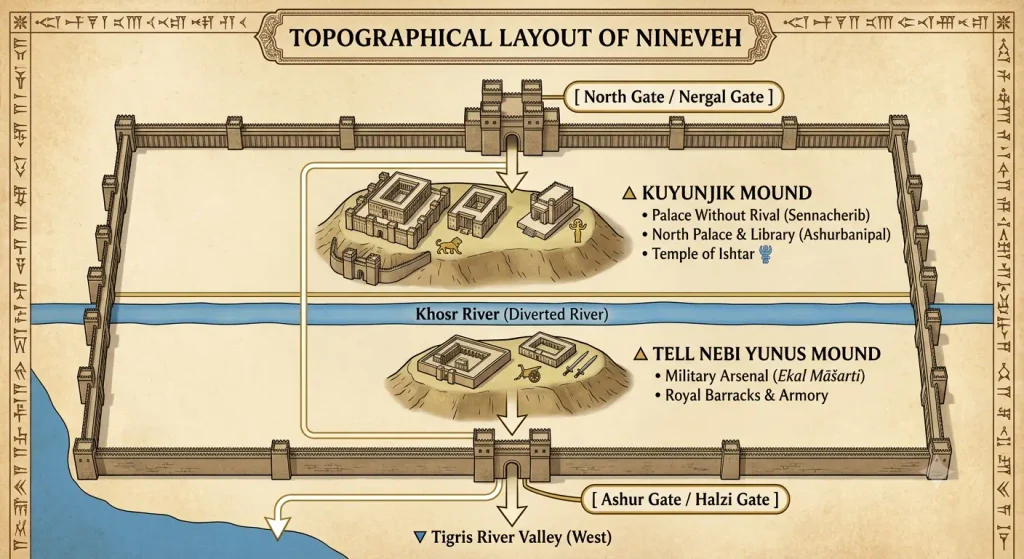
Archaeological & Epigraphic Profile of Nineveh
| Historical & Archaeological Parameter | Ancient Record & Excavation Data |
| Ancient Names | Ninua / Ninâ (Akkadian); Ninuwa (Hurrian); Ninive (Latin/Greek) |
| Geographic Coordinates | 36°21′34″ N, 43°09′10″ E (Mosul, Upper Mesopotamia, Iraq) |
| Peak Imperial Population | Estimated between 100,000 and 150,000 inhabitants (c. 700–630 BCE) |
| Urban Surface Area | ~7.5 km² (750 hectares) enclosed within defensive ramparts |
| Primary Fortification System | Outer stone rampart fronted by a ditch + inner mudbrick wall (25m high, 15m thick) |
| Monumental Gates | 15 named entry gates (e.g., Nergal Gate, Shamash Gate, Halzi Gate, Adad Gate) |
| Principal Royal Dynasts | Sennacherib (705–681 BCE), Esarhaddon (681–669 BCE), Ashurbanipal (669–631 BCE) |
| Catastrophic Fall / Sacking | 612 BCE (Siege by allied Medes, Babylonians, and Scythians) |
| Pioneering Excavators | Paul-Émile Botta (1842), Austen Henry Layard (1847), Hormuzd Rassam (1853) |
Chronological Evolution of Nineveh Across Mesopotamian History
| Archaeological Period | Approximate Dates | Historical Developments at Nineveh |
| Hassuna & Halaf Cultures | c. 6000–5000 BCE | Earliest prehistoric agrarian settlement on the fertile alluvial soils of the Tigris terrace. |
| Uruk & Early Dynastic Periods | c. 4000–2500 BCE | Growth of the prehistoric sanctuary of Ishtar (Sumerian Inanna), establishing Nineveh as a major regional religious cult center. |
| Akkadian & Ur III Empires | c. 2334–2004 BCE | King Manishtushu rebuilds the grand Temple of Ishtar; dynamic trade node connecting southern Sumer to the Anatolian trade network. |
| Middle Assyrian Kingdom | c. 1365–1056 BCE | Kings Shalmaneser I and Tiglath-Pileser I construct royal residences on Kuyunjik, expanding the city’s ceremonial footprint. |
| Neo-Assyrian Imperial Peak | 705–612 BCE | King Sennacherib designates Nineveh as the permanent imperial capital, transforming it into the world’s most populous and fortified city. |
| Collapse and Destruction | 612 BCE | A coalition of Babylonians, Medes, and Scythians breaches the walls after a 3-month siege, burning the royal palaces and razing the city. |
Sennacherib’s Imperial Transformation: “The Palace Without Rival” and Hydraulic Engineering
In 705 BCE, following the violent death of his father Sargon II on the battlefield in Tabal (which was viewed as a terrifying divine curse), Sennacherib (reigned 705–681 BCE) took the radical decision to abandon the newly built capital of Dur-Sharrukin (Khorsabad) and relocate the imperial throne to Nineveh.
Sennacherib transformed what had been an ancient provincial city into the most advanced, fortified, and awe-inspiring metropolis in the ancient Near East, tripling the urban perimeter and mobilizing tens of thousands of skilled craftsmen, deportees, and engineers.
“The Palace Without Rival” (Egalzagedilu)
Constructed on the southwestern corner of the Kuyunjik mound, Sennacherib’s imperial residence—officially named Egalzagidilu (“The Palace Without Rival”)—was a marvel of ancient engineering and political propaganda:
- Scale and Foundations: Built on a massive terrace of limestone and mudbrick rising nearly 20 meters above the riverbed, the palace covered over 500 meters by 242 meters, comprising at least 80 distinct rooms, halls, and monumental courtyards.
- Monumental Colossi (Lamassu): The palace entrances were guarded by pairs of colossal winged human-headed bulls and lions (lamassu and aladlammû), carved from single monolithic blocks of white alabaster (gypsum stone) quarried from Balawat, each weighing up to 30 tons.
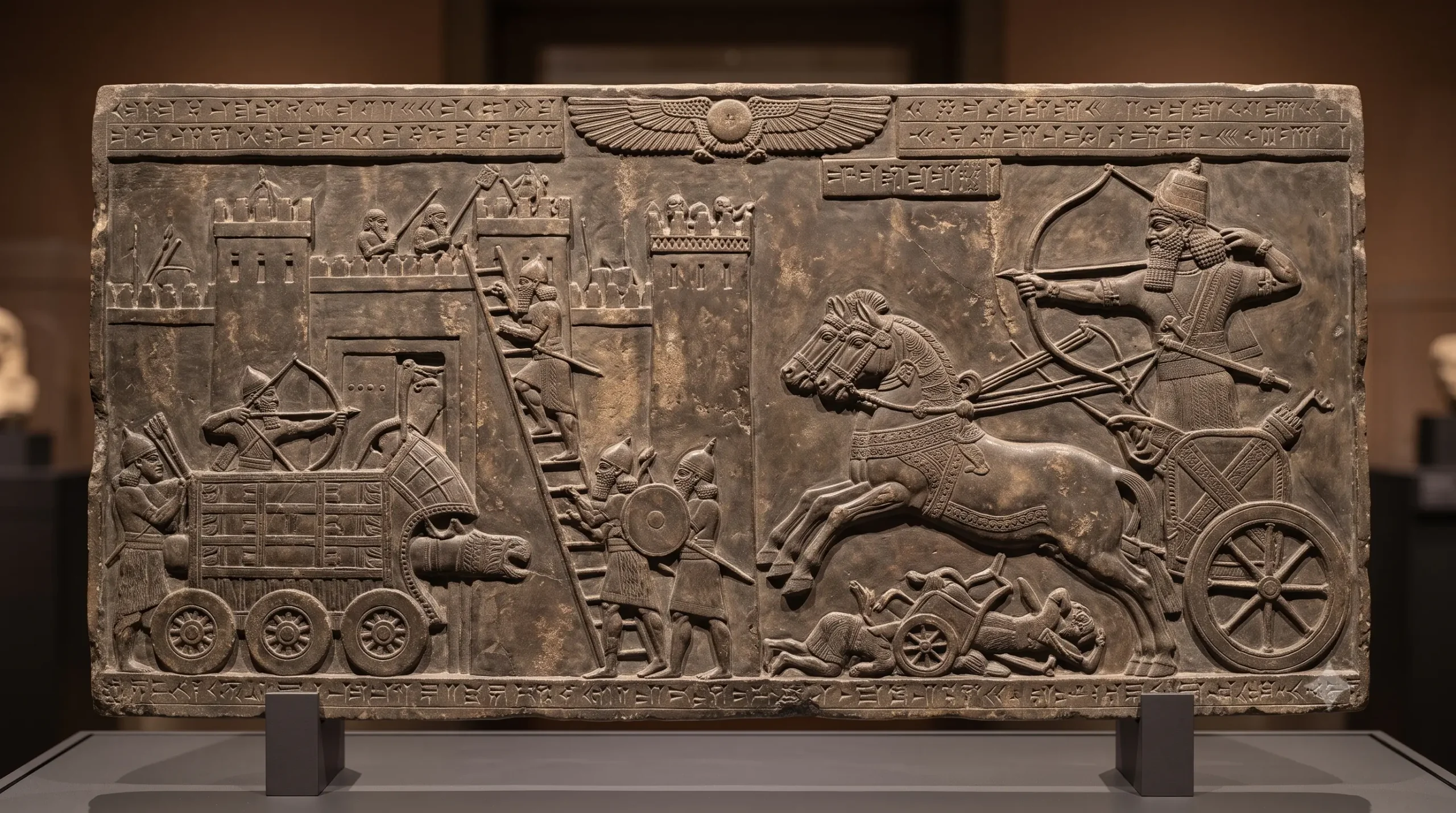
- The Sculptural Narrative of Conquest: Over three kilometers of continuous carved stone reliefs lined the interior walls, depicting Sennacherib’s engineering triumphs, marshland campaigns against Chaldean tribes, and his military campaigns across the Levant—most famously the detailed narrative of the Siege of Lachish (701 BCE), preserved in Room XXXVI.
The 15 Monumental City Gates
Sennacherib surrounded the inner city with a double wall system: an inner rampart constructed of solid stone foundations topped with sun-dried mudbrick rising 25 meters high and 15 meters thick, fronted by a deep defensive moat fed by diverted river channels.
Entry into the metropolis was strictly regulated through 15 named monumental gates, each protected by fortified towers, stone revetments, and lamassu sculptures:
- Nergal Gate: The northern portal dedicated to the underworld and war god Nergal, featuring imposing winged colossi.
- Shamash Gate: The massive eastern ceremonial portal controlling access from the Zagros mountain trade routes.
- Adad Gate & Sin Gate: Regulating the northwestern approaches to the upper Tigris basin.
- Halzi Gate & Ashur Gate: Heavily fortified southern gateways guarding the approaches from the ancient religious capital of Assur and the southern Babylonian plains.
Revolutionary Hydraulic Engineering: Canals and the Jerwan Aqueduct
Nineveh required a vast water supply to support its estimated population of over 100,000 citizens, its royal orchards, and its military cavalry corps. Because the Tigris sat at too low an elevation to irrigate the higher terraces, Sennacherib designed an extensive hydraulic network spanning over 150 kilometers:
- The Zagros Mountain Canal System: Sennacherib diverted rushing water from mountain springs in Mount Musri (modern Mount Bashiqa) and Mount Tas (Zagros) through a network of 18 separate canal channels.
- The Jerwan Aqueduct: Constructed around 690 BCE near modern Khenis, the Jerwan Aqueduct carried millions of gallons of freshwater across a 300-meter-wide valley. Built from more than two million dressed limestone blocks, it is widely recognized by architectural historians as the world’s oldest standing stone aqueduct, predating Roman aqueduct engineering by more than five centuries.
- The Royal Botanical Gardens (The True “Hanging Gardens”?): The freshwater surplus irrigated terraced botanical gardens filled with exotic flora from across the empire, including cotton plants (“trees that bear wool”), aromatic spices, and olive groves. Several prominent Assyriologists (notably Dr. Stephanie Dalley) argue that Nineveh, not Babylon, was the historical site of the legendary Hanging Gardens, misattributed to Nebuchadnezzar II by later Greco-Roman historians.
The Royal Library of Ashurbanipal: The Epigraphic Treasure of Kuyunjik
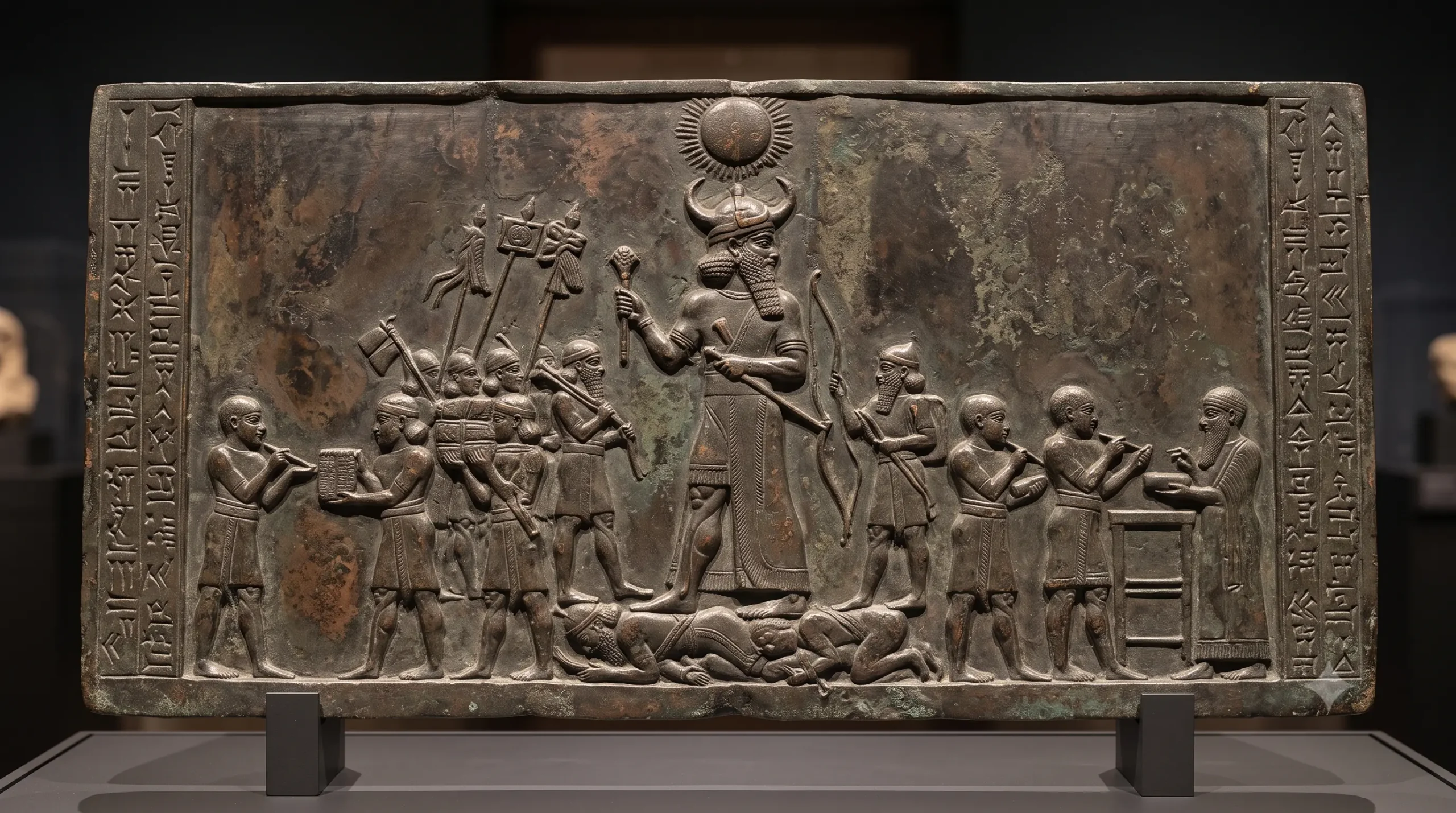
The Royal Library of Ashurbanipal (founded c. 668–631 BCE) represents the earliest known attempt in human history to create a universal, systematically cataloged archive of all extant literature, science, and religious knowledge. Situated within the royal palace complexes on the Kuyunjik mound at Nineveh, this vast institutional archive preserved the epigraphic heritage of Mesopotamia, rescuing the literary traditions of Sumer, Akkad, Babylonia, and Assyria from historical oblivion.
Ashurbanipal’s Unique Intellectual Training
Unlike typical ancient Near Eastern rulers who relied entirely on courtiers for administrative matters, King Ashurbanipal was formally educated in the scribal arts (ṭupšarrūtu). In his royal autobiographical inscriptions, he boasted of his exceptional literary and analytical competencies:
“I, Ashurbanipal, learned the wisdom of Nabu, the entirety of the scribal art. I solved complex mathematical problems that had no obvious answer; I read cunningly written cuneiform tablets in Sumerian and obscure Akkadian that were difficult to decipher; I examined stone inscriptions from the time before the Flood.”
Because he could personally read and write cuneiform, Ashurbanipal recognized the strategic and theological value of compiling complete canonical editions of foundational texts.
The Collection Process: Royal Seizures and Scribal Missions
To build the library, the Assyrian state launched an aggressive, imperial campaign of intellectual collection:
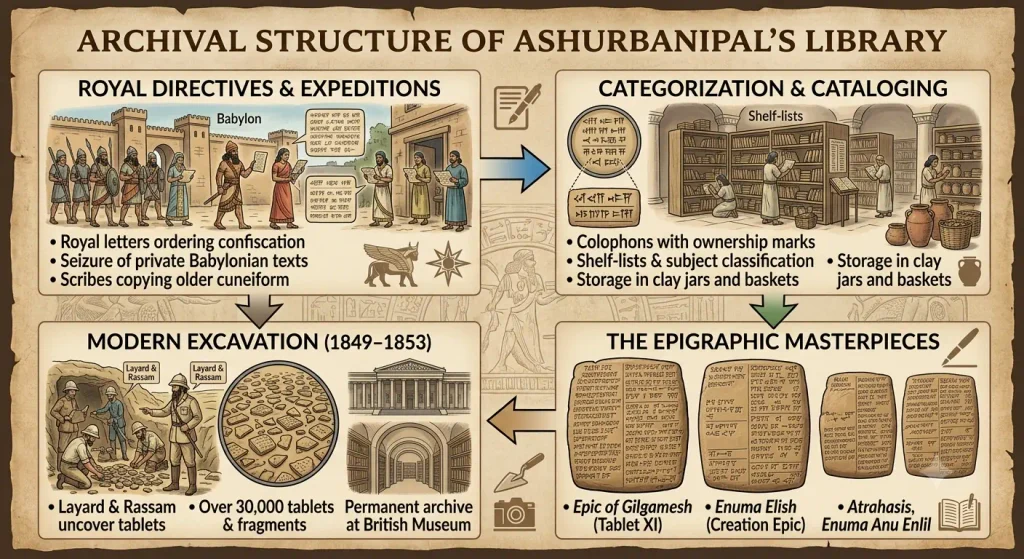
- Royal Decrees for Confiscation: Letters discovered in the Nineveh archives show Ashurbanipal writing directly to his governors, military officers, and scholars across southern Mesopotamia (especially in cities like Babylon, Borsippa, Nippur, and Uruk), demanding that they seize original cuneiform tablets from temple archives and private family libraries.
- The Scribal Workshop at Nineveh: Hundreds of Babylonian and Assyrian scribes were quartered in Nineveh to clean, bake, transcribe, collate, and modernize ancient damaged clay tablets written in archaic script dialects.
- Colophons and Royal Ownership Marks: Every tablet entered into the collection was inscribed with a standardized scribal colophon (subscriptio), indicating that it was property of the King:“Palace of Ashurbanipal, King of the World, King of Assyria, who trusts in Ashur and Ninlil… I wrote, checked, and collated this tablet, and placed it in my palace for my royal inspection.”
- Archival System and Storage: Tablets were systematically arranged by genre, labeled with ceramic tags (clay summary labels), stored in lidded wicker baskets and earthen jars, and cataloged via master shelf-lists that recorded the title (incipit), number of lines, and tablet count for each series.
The Major Literary, Scientific, and Divinatory Corpora
The Library of Ashurbanipal yielded over 30,000 clay tablets and fragments, covering the full spectrum of Mesopotamian intellectual thought:
| Literary / Scientific Corpus | Tablet Content & Academic Significance |
| Epic & Mythological Literature | The Standard Babylonian Epic of Gilgamesh (12 tablets edited by Sîn-lēqi-unninni), the Babylonian Creation Epic (Enuma Elish), the Epic of Anzu, the Descent of Ishtar to the Netherworld, and the Epic of Erra. |
| Astronomical & Astrological Series | Enuma Anu Enlil (“When Anu and Enlil”), a colossal 70-tablet compilation of over 7,000 celestial omens linking lunar eclipses, planetary movements, and comets to geopolitical events. |
| Divination & Teratology | Šumma Izbu (anomalous births), Šumma Ālu (terrestrial omens across daily urban life), and extensive collections of extispicy records (reading entrails of sacrificial sheep). |
| Medicine & Pharmacology | Prescriptions, surgical procedures, botanical pharmacological recipes, and therapeutic rituals against fevers, venomous bites, and internal ailments. |
| Lexical & Linguistic Texts | Bilingual Sumerian-Akkadian sign lists, syllabaries, synonym dictionaries, and grammar manuals essential for scribal education. |
| Royal Administrative Archives | State correspondence, intelligence dispatches from frontier spies, vassal treaties (adê), economic tax rolls, and royal building commemorative cylinders. |
Discovery and Excavation of the Library (1849–1853)
The physical remains of the library were discovered between 1849 and 1853 during British excavations on the Kuyunjik tell:
- Austen Henry Layard (1849): Discovered the first major cache of tablets in the Southwest Palace (Palace Without Rival).
- Hormuzd Rassam (1853): Excavating the North Palace, Rassam uncovered the primary library chambers of Ashurbanipal, finding thousands of pristine tablets preserved where they fell during the destruction of 612 BCE.
- The British Museum Collection: The tablets were packed in crates and shipped to London, forming the foundation of modern Assyriology. The decipherment of these tablets over the late 19th and early 20th centuries revolutionized the modern understanding of world literature, biblical textual history, and ancient Near Eastern science.
Imperial Art and Architecture: The North Palace and the Royal Lion Hunts
While Sennacherib established the monumental urban blueprint of Nineveh, his grandson Ashurbanipal elevated the city’s artistic expression to the highest peak of ancient Near Eastern visual culture through the construction of the North Palace on the Kuyunjik mound.
Architecture of the North Palace
Built around 645 BCE over the site of an older administrative residence, the North Palace was designed to project absolute royal dominance, divine sanction, and imperial refinement:
- Paved Courtyards and Bitumen Waterproofing: The palace featured vast paved courtyards drained by subterranean terracotta brick sewer systems, protecting the mudbrick structural walls from moisture and river seepage.
- Monolithic Portals: Massive limestone and gypsum gate-colossi (lamassu) flanked every state entryway, designed with an illusionistic five-legged stance so that they appeared stationary from the front and walking when viewed from the side.
- Monumental Wall Panels: Hundreds of meters of narrative stone slabs lined the private royal apartments and public reception halls, showcasing detailed scenes of diplomatic banquets, foreign tribute processions from Elam and Egypt, and imperial campaigns.
The Royal Lion Hunt Reliefs: The Pinnacle of Assyrian Sculptural Mastery
The gypsum wall reliefs excavated from Room C and Room S of the North Palace (now preserved in the British Museum) are universally regarded by art historians as the greatest masterworks of ancient Mesopotamian narrative art.
                    THE SACRED RITUAL OF THE ROYAL HUNT

   DIVINE MANDATE              ARENA ENCLOSURE             RITUAL LIBATION
 ┌─────────────────┐         ┌─────────────────┐         ┌─────────────────┐
 │ King acts as    │         │ Lions released  │         │ Wine poured over│
 │ the shepherd of │───────> │ from cages into │───────> │ carcasses before│
 │ civilization    │         │ royal arena     │         │ the altar       │
 └─────────────────┘         └─────────────────┘         └─────────────────┘
- The Theological Meaning of the Hunt: In Neo-Assyrian royal ideology, the lion represented primal chaos, untamed wilderness, and destructive forces threatening cosmic order. By hunting and killing lions, Ashurbanipal acted as the divine earthly agent of the war goddess Ishtar and the supreme god Ashur, imposing civilization (mīšaru) over primeval disorder.
- The Controlled Royal Arena: Unlike dangerous open-wilderness hunts, these events were meticulously staged royal spectacles. Lions were captured in river thickets, transported in wooden crates, and released into a secured arena lined with spearmen, shield-bearers, and archers to ensure the safety of the royal spectators.
- Unprecedented Anatomical Realism: The Assyrian sculptors rendered animal anatomy with extraordinary dynamism, psychological tension, and physiological accuracy:
- Muscular Tension: Bulging veins, extended claws, and roaring snouts capture the ferocity of the dying beasts.
- The “Dying Lioness”: One of the most famous individual relief panels in world art, depicting a paralyzed lioness dragging her hindquarters after being pierced by three royal arrows, howling in agony as her forelegs give out.
- The Ritual Libation: The hunt concluded with a formal religious ceremony in which Ashurbanipal, dressed in ceremonial regalia and holding a bow, poured a libation of sacred wine over the slain lions before a sacrificial altar, returning their life-force to the gods.
The “Garden Party” Relief (Banquet Beneath the Arbor)
Another world-renowned sculptural masterpiece from the North Palace is the Garden Party Relief (Room S), which illustrates the chilling intersection of royal luxury and imperial brutality:
- The Intimate Scene: Ashurbanipal reclines on an ornate ivory-inlaid couch beneath a grapevine arbor in the royal botanical gardens, attended by his queen, Libbali-sharrat, while musicians play harps and servants wave flywhisks.
- The Gruesome Trophy: Hanging prominently from a nearby pine branch is the severed head of Teumman, King of Elam, who had been defeated and decapitated by Assyrian troops at the Battle of the Ulai River (653 BCE). The relief served as a stark political statement: imperial tranquility and leisurely peace were purchased through the absolute annihilation of the empire’s enemies.
The Siege and Fall of Nineveh (612 BCE)
Despite its colossal stone fortifications and reputation as an impregnable fortress, Nineveh survived as the imperial capital for less than a century. The sudden collapse of the Neo-Assyrian Empire culminated in the catastrophic summer of 612 BCE, when an international coalition of allied powers converged on the city to end centuries of Assyrian hegemony.
                    THE GEOPOLITICAL COLLAPSE OF NINEVEH

   INTERNAL INSTABILITY            COALITION FORMATION             THE 3-MONTH SIEGE
 ┌──────────────────────┐        ┌──────────────────────┐        ┌──────────────────────┐
 │ • Post-Ashurbanipal  │        │ • Nabopolassar       │        │ • River Khosr flooded│
 │   civil wars         │──────> │   (Babylon) joins    │──────> │ • City breached,     │
 │ • Military exhaustion│        │   Cyaxares (Medes)   │        │   palaces burned     │
 └──────────────────────┘        └──────────────────────┘        └──────────────────────┘
Prelude: Dynastic Civil War and Overextension
Following the death of Ashurbanipal (c. 631 BCE), the Assyrian Empire fractured rapidly due to internal structural crises:
- Crippling Succession Conflicts: Sibling rivalries and civil wars between Ashur-etil-ilani, Sin-shumu-lishir, and Sin-shar-ishkun depleted the elite royal army and emptied the imperial treasuries.
- The Rise of Southern Rebellion: In 626 BCE, a Chaldean military leader named Nabopolassar expelled Assyrian garrisons from southern Mesopotamia, seized the throne of Babylon, and established the Neo-Babylonian Empire.
- The Incursion of the Medes: To the east, the Iranian plateau was unified by the Median king Cyaxares (Huvakhshatra), who organized a powerful cavalry army eager to dismantle Assyrian dominance.
In 614 BCE, the Medes captured and sacked the ancient religious heart of Assyria, the holy city of Ashur. Nabopolassar arrived shortly after, and the two kings met upon the ruins of the temple of Ashur to seal a formal military alliance, cemented by the diplomatic marriage of Nabopolassar’s son, Nebuchadnezzar II, to Cyaxares’s daughter (or granddaughter), Princess Amytis.
The Three-Month Siege (May–July/August 612 BCE)
In the spring of 612 BCE, the combined armies of the Babylonians, Medes, Scythians, and Cimmerians marched up the Tigris River and laid siege to Nineveh, which was defended by King Sin-shar-ishkun:
- Assault on the Outer Defenses: The allied forces launched three major assaults against the eastern and northern city walls. Archaeological excavations at the Halzi Gate and Shamash Gate uncovered clear physical evidence of the desperate defense: the gateways had been rapidly narrowed with crude stone blocks to impede allied battering rams, and the ground was littered with hundreds of bronze and iron arrowheads.
- The Hydraulic Assault (The Breaching of the Walls): According to the Babylonian Fall of Nineveh Chronicle (ABC 3) and later accounts preserved by the Greek historian Diodorus Siculus, the attackers weaponized Nineveh’s own hydraulic engineering against itself. By breaking the sluice gates of the Khosr River upstream during the spring flood, the rushing waters eroded and undermined the sun-dried mudbrick foundations of the city wall, creating a massive structural breach.
- The Sacking and Destruction: The allied troops poured through the breach into the city streets. The royal palaces of Sennacherib and Ashurbanipal were thoroughly looted and torched. The extreme heat of the burning cedar roof beams collapsed the royal chambers, inadvertently baking and vitrifying tens of thousands of cuneiform clay tablets in the royal archives, preserving them for modern archaeology.
- The Fate of King Sin-shar-ishkun: King Sin-shar-ishkun perished during the final assault inside his burning palace. A small remnant of the Assyrian military escaped westward to Harran under a general who proclaimed himself King Ashur-uballit II, but the imperial state was permanently extinguished following the Battle of Carchemish (605 BCE).
The Aftermath and Prophetic Reflections
The sudden and absolute destruction of the greatest metropolis of the ancient Near East sent shockwaves across the Mediterranean and Middle East:
- Total Abandonment: Unlike Babylon, which endured for centuries after foreign conquest, Nineveh was never rebuilt as an imperial center. The vast site was reduced to scattered agrarian villages within a generation, gradually swallowed by windblown silt and grass.
- The Biblical Prophecies: The dramatic fall of Nineveh was celebrated in the Hebrew Bible by the prophet Nahum, who described the downfall of the “bloody city” (Nahum 3:1):
“Nineveh is laid waste; who will bemoan her?… Thy shepherds slumber, O king of Assyria: thy nobles shall dwell in the dust: thy people is scattered upon the mountains, and no man gathereth them.”
Aquí tienes el siguiente bloque, centrado en el redescubrimiento arqueológico del siglo XIX, las excavaciones que fundaron la Asiriología y los desafíos de preservación del patrimonio moderno:
Modern Archaeological Rediscovery and Heritage Preservation
For more than two millennia after its catastrophic destruction in 612 BCE, Nineveh remained an enigmatic, legendary site buried beneath the barren mounds of northern Mesopotamia. Its rediscovery during the mid-19th century transformed biblical studies, art history, and established the scientific discipline of Assyriology.
The 19th-Century Pioneers of Assyriology
The modern rediscovery of Nineveh was driven by intense archaeological competition between British and French diplomatic explorers:
- Paul-Émile Botta (1842): Serving as French consular agent in Mosul, Botta conducted the first exploratory soundings at the Kuyunjik mound. Frustrated by initial lack of spectacular finds, he shifted his excavations north to Khorsabad (Dur-Sharrukin), believing he had found Nineveh.
- Austen Henry Layard (1845–1851): Working for the British Museum, Layard returned to Kuyunjik and made the breakthrough discovery of Sennacherib’s Southwest Palace (“The Palace Without Rival”). He unearthed miles of sculptured wall reliefs, colossal lamassu gate guardians, and the first major chambers of the royal cuneiform tablet archives. Layard’s popular books, Nineveh and Its Remains (1849) and Discoveries in the Ruins of Nineveh and Babylon (1853), became international bestsellers.
- Hormuzd Rassam (1852–1854): An ethnic Assyrian archaeologist and protégé of Layard, Rassam made the monumental discovery of Ashurbanipal’s North Palace. It was Rassam who uncovered the famous Royal Lion Hunt reliefs and the primary repository of the Royal Library of Ashurbanipal, including the tablets containing the Epic of Gilgamesh.
- George Smith (1872–1873): An epigrapher at the British Museum who deciphered the flood narrative on Tablet XI of Gilgamesh. The discovery caused such public interest that The Daily Telegraph funded Smith to travel directly to Kuyunjik, where he famously excavated the missing lines of the flood text.
                   PIONEERS OF THE REDISCOVERY OF NINEVEH

      1842 (FRANCE)               1845–1851 (BRITAIN)              1852–1854 (IRAQ/BRITAIN)
  [ Paul-Émile Botta ]       ───► [ Austen H. Layard ]       ───►    [ Hormuzd Rassam ]
  First soundings at              Southwest Palace &                 North Palace, Lion Hunts
  Kuyunjik Mound                  Sennacherib's relief panels        & Ashurbanipal's Library
Key Discoveries and Global Museum Collections
The artifacts excavated from Nineveh reshaped the world’s understanding of ancient Near Eastern civilization. Today, the artistic and epigraphic treasures of Nineveh are housed in major international institutions:
- The British Museum (London): Holds the definitive global collection of Nineveh antiquities, including the complete corpus of the Library of Ashurbanipal (over 30,000 tablets and fragments), the Lion Hunt reliefs, and the monumental Lachish relief room.
- The Louvre Museum (Paris): Preserves monumental Assyrian architectural sculptures and foundational cuneiform inscriptions.
- The Iraq Museum (Baghdad) and Mosul Museum: Preserved colossal lamassu figures, royal stelae, palace foundation deposits, and decorative ivory furniture plaques excavated across the 20th century.
20th-Century Systematic Fieldwork
Throughout the 20th century, scientific excavations transitioned from treasure hunting to stratigraphic analysis:
- The British School of Archaeology in Iraq: Under Max Mallowan and R. Campbell Thompson, excavations in the 1920s and 1930s established the deep prehistoric sequence of Nineveh (identifying the Ninevite 5 culture).
- The Iraqi Directorate of Antiquities (1960s–1980s): Iraqi archaeologists partially restored several monumental city portals, including the Nergal Gate, the Adad Gate, and segments of the massive mudbrick and stone fortification walls.
- The University of California, Berkeley Expedition (1987–1990): Directed by David Stronach, this project conducted modern geophysical surveys and extensive excavations at the Halzi Gate and Shamash Gate, discovering the skeletal remains of defenders killed during the 612 BCE final siege.
Modern Threats and Heritage Reconstruction
In the 21st century, Nineveh faced unprecedented peril due to rapid urban encroachment from the modern city of Mosul and deliberate acts of destruction during regional conflicts:
- Cultural Heritage Destruction (2014–2016): The extremist group ISIS occupied Mosul and deliberately destroyed monumental antiquities. The historic Nergal Gate and Mashki Gate were bulldozed, original lamassu colossi were defaced, and the ancient Tell Nebi Yunus shrine was dynamited.
- The Discovery Beneath Nebi Yunus: Following the liberation of Mosul in 2017, archaeologists inspecting the clandestine tunnels dug beneath the destroyed Nebi Yunus shrine made unexpected discoveries: untouched military palace corridors of King Esarhaddon, featuring previously unseen cuneiform inscriptions and carved relief panels depicting the goddess Ishtar.
- International Reconstruction Initiatives: Multi-institutional heritage partnerships—including the State Board of Antiquities and Heritage (SBAH) of Iraq, ALIPH Foundation, the University of Pennsylvania, and the University of Bologna—have undertaken extensive stabilization, 3D laser mapping, and architectural reconstruction of the destroyed gates and palace foundations.
0 Essential Facts About Ancient Nineveh
- 1. It was once the largest city in the world: Under King Sennacherib (c. 700 BCE), Nineveh covered roughly 750 hectares (1,850 acres) and housed over 100,000 to 150,000 inhabitants, making it the most populous and heavily fortified metropolis of its era.
- 2. It housed humanity’s first systematically organized universal library: The Royal Library of Ashurbanipal contained more than 30,000 cuneiform clay tablets, systematically cataloged with title tags and shelf-lists covering literature, medicine, astronomy, and religion.
- 3. The Epic of Gilgamesh was rediscovered here: In 1872, British Museum scholar George Smith deciphered the famous Deluge Tablet (Tablet XI of Gilgamesh), which had been excavated from the ruins of Ashurbanipal’s palace at Nineveh.
- 4. Sennacherib built the “Palace Without Rival”: The Southwest Palace featured at least 80 monumental rooms, colossal 30-ton lamassu gate guardians, and more than 3 kilometers of continuous carved stone wall reliefs.
- 5. It might be the real location of the “Hanging Gardens”: Several prominent Assyriologists argue that the legendary Hanging Gardens, traditionally attributed to Babylon, were actually the terraced botanical gardens built by Sennacherib at Nineveh, irrigated via complex aqueducts.
- 6. It boasted the world’s oldest standing stone aqueduct: The Jerwan Aqueduct, built around 690 BCE using over two million limestone blocks, carried mountain spring water across a 300-meter valley to supply Nineveh’s hydraulic network.
- 7. The city had 15 monumental fortified gates: Massive portals like the Nergal Gate, Shamash Gate, and Halzi Gate regulated access through defensive ramparts that stood 25 meters high and 15 meters thick.
- 8. Its destruction was aided by weaponized floodwaters: During the 612 BCE siege, the allied Medes and Babylonians breached Nineveh’s defenses by breaking the dams on the Khosr River, eroding the city’s mudbrick walls.
- 9. The burning of the city accidentally preserved its clay archives: When allied forces torched the royal palaces in 612 BCE, the intense heat from collapsing cedar beams baked and vitrified the clay tablets, preserving them for modern archaeologists.
- 10. It is located inside the modern city of Mosul: The ancient mounds of Kuyunjik and Tell Nebi Yunus sit directly across the Tigris River from downtown Mosul in northern Iraq.
Frequently Asked Questions About Nineveh
Where was ancient Nineveh located?
Ancient Nineveh was located in Upper Mesopotamia on the eastern bank of the Tigris River, at its intersection with the Khosr River. Today, the archaeological site sits within the modern city limits of Mosul (Ninawa Governorate) in northern Iraq, primarily marked by the two large elevated mounds of Kuyunjik and Tell Nebi Yunus.
Who built and expanded Nineveh?
While settlement at Nineveh dates back to the prehistoric Hassuna period (c. 6000 BCE) with major temples built during the Akkadian and Middle Assyrian periods, King Sennacherib (reigned 705–681 BCE) transformed the city into the grand imperial capital of the Neo-Assyrian Empire. He tripled its urban footprint, built the massive 12-kilometer defensive walls with 15 monumental gates, engineered the Jerwan Aqueduct system, and constructed his magnificent palace (Egalzagidilu). Later, King Ashurbanipal built the North Palace and established the royal library.
What was the Royal Library of Ashurbanipal?
The Library of Ashurbanipal was the ancient world’s first systematically arranged and cataloged universal archive. Commissioned by King Ashurbanipal in the 7th century BCE on the Kuyunjik mound, it contained over 30,000 cuneiform clay tablets and fragments encompassing Mesopotamian literature, medicine, astronomy, mathematics, rituals, and state treaties, including the canonical versions of the Epic of Gilgamesh and the Enuma Elish.
Why was Nineveh destroyed and how did it fall?
Nineveh fell in 612 BCE following a brutal three-month siege conducted by an allied coalition of Babylonians (led by Nabopolassar), Medes (led by Cyaxares), Scythians, and Cimmerians. The besiegers weaponized the floodwaters of the Khosr River to undermine and breach the city’s mudbrick walls, subsequently storming the metropolis, killing King Sin-shar-ishkun, looting the riches, and burning the palaces to the ground.
What is Nineveh’s significance in the Bible?
In the Hebrew Bible, Nineveh features prominently in two key books:
- The Book of Jonah: Depicts Nineveh as a “great city” of wickedness whose inhabitants, from the king to the commoners, repented in sackcloth and ashes following the preaching of the prophet Jonah, temporarily averting divine destruction.
- The Book of Nahum: Contains a vivid prophetic oracle detailing the violent and final collapse of Nineveh in 612 BCE as divine retribution for centuries of imperial oppression and warfare.
Are the Hanging Gardens of Babylon actually in Nineveh?
A leading scholarly hypothesis advanced by Assyriologist Dr. Stephanie Dalley argues that the legendary Hanging Gardens of the Ancient World were built by King Sennacherib at Nineveh, rather than by King Nebuchadnezzar II in Babylon. Archaeological evidence supports this through Sennacherib’s sophisticated high-elevation canal networks, the Jerwan Aqueduct, screw-pump water-lifting devices, and palace wall reliefs depicting terraced mountain gardens irrigated by aqueducts.
Further Readings & Academic Web Resources
- The British Museum – The Ashurbanipal Library Project & Kuyunjik Cuneiform Collection
- Musée du Louvre – Department of Near Eastern Antiquities: Neo-Assyrian Palaces & Inscriptions
- Cuneiform Digital Library Initiative (CDLI) – Inscriptions and Royal Artifacts from Nineveh (Kuyunjik)
- World History Encyclopedia – Nineveh: History, Sennacherib’s Expansion, and Fall
- Encyclopaedia Britannica – Nineveh: Ancient Capital, History, Excavations, & Facts
Pingback: Atrahasis: The Mesopotamian Flood Myth Explained - ancientneareast.site
Pingback: Michael
Pingback: Epic of Gilgamesh: The Oldest Epic Poem in History - ancientneareast.site