Fernando Espejel Arroyo

The Battle of Plataea (479 BCE): History, Summary & The Final Clash

The Battle of Plataea was the final and most decisive land engagement of the Greco-Persian Wars. Fought in the late summer of 479 BCE, this massive clash finally broke the back of the Persian military presence in Europe. While the naval victory at the Battle of Salamis the previous year had crippled King Xerxes’ fleet,

The Battle of Plataea (479 BCE): History, Summary & The Final Clash Read More »
The Battle of Salamis (480 BCE): History, Summary & The Naval Clash

The Battle of Salamis stands as one of the most pivotal naval engagements in ancient history. Fought in September of 480 BCE, this massive clash between the allied city-states of ancient Greece and the invading fleet of the Achaemenid Persian Empire fundamentally altered the course of Western civilization. Taking place entirely on the water, the

The Battle of Salamis (480 BCE): History, Summary & The Naval Clash Read More »

The Battle of Thermopylae (480 BCE): History, Facts & The 300 Spartans

The Battle of Thermopylae (480 BCE): History, Facts & The 300 Spartans The Battle of Thermopylae is arguably the most famous last stand in military history. Fought in the late summer of 480 BCE, this legendary clash between a vastly outnumbered Greek coalition and the invading Achaemenid Persian Empire has captivated historians, artists, and filmmakers

The Battle of Thermopylae (480 BCE): History, Facts & The 300 Spartans Read More »

The Battle of Marathon (490 BCE): History, Tactics, and the Marathon Race Origin

The Battle of Marathon is arguably one of the most famous and significant military engagements in ancient history. Fought in 490 BCE (or BC), this monumental clash between the defending army of Athens and the invading forces of the Achaemenid Persian Empire not only shaped the geopolitical future of ancient Greece but also left an

The Battle of Marathon (490 BCE): History, Tactics, and the Marathon Race Origin Read More »

The Outcome and Effects of the Greco-Persian Wars

What Happened After the Persian Wars? The Shift to the Offensive When casual readers or students ask what happened after the Persian war, they often assume the conflict ended abruptly in 479 BCE with the decisive Greek victories at the battles of Plataea and Mycale. However, the true aftermath of the Greco-Persian Wars was a

The Outcome and Effects of the Greco-Persian Wars Read More »

The Major Battles of the Greco-Persian Wars

Between 490 BCE and 479 BCE, the survival of Western civilization hinged on a handful of pivotal military engagements. The major battles of the Greco-Persian Wars were not just clashes between rival nations, but a fundamental collision between two entirely different philosophies of warfare, logistics, and military technology. While the Achaemenid Persian Empire relied on

The Major Battles of the Greco-Persian Wars Read More »

The Second Persian Invasion of Greece (480–479 BCE)

What Was the Second Persian War? The Second Persian invasion of Greece (480–479 BCE) was a massive, multi-year military campaign ordered by the Achaemenid King Xerxes I. Unlike the first invasion ten years earlier—which had been a limited punitive expedition directed primarily at Athens and Eretria—the Second Persian War was designed as a war of

The Second Persian Invasion of Greece (480–479 BCE) Read More »

The Ionian Revolt: Causes of the Greco-Persian Wars

What Was the Ionian Revolt? (Summary) The Ionian Revolt (499–493 BCE) was a massive military uprising by several Greek regions of Asia Minor—along with Cyprus and parts of Caria—against the autocratic rule of the Achaemenid Persian Empire. Standing as the first major conflict between Greece and Persia, the Ionian Revolt represents the defining catalyst that

The Ionian Revolt: Causes of the Greco-Persian Wars Read More »

The First Persian War: Darius I’s Invasion of Greece

What Was the First Greco-Persian War? The First Greco-Persian War (often simply called the 1st Persian War) was a major military expedition launched by the Achaemenid Persian Empire against the city-states of mainland Greece between 492 and 490 BCE. Commanded under the absolute authority of King Darius I (Darius the Great), this campaign marked the

The First Persian War: Darius I’s Invasion of Greece Read More »

The Herod’s Gate in Jerusalem: History, Map, and the Gate of Flowers

Piercing the massive northern wall of the Old City, Herod’s Gate often goes unnoticed by casual tourists who favor the monumental Damascus Gate just a short walk to the west. However, for historians and archaeologists exploring the fortifications of Jerusalem, this modest entrance offers a fascinating window into the city’s complex linguistic evolution and its

The Herod’s Gate in Jerusalem: History, Map, and the Gate of Flowers Read More »

The Lions’ Gate in Jerusalem: History, Map, and the Via Dolorosa

Of all the historical entrances to the Old City, the Lions Gate Jerusalem stands out as a unique bridge between ancient mythology, biblical devotion, and modern military history. Located on the eastern wall, directly facing the Mount of Olives and the deep Kidron Valley, the lion gate jerusalem serves as the primary portal for millions

The Lions’ Gate in Jerusalem: History, Map, and the Via Dolorosa Read More »

The Zion Gate in Jerusalem: History, Map, and Mount Zion

Of all the historical entrances to the Old City, the Zion Gate in Jerusalem is arguably the most visually striking, not because of its grand Ottoman ornamentation, but because of its violent modern history. Known historically as the Gate of Zion or simply Zion Gate, it stands on the southern wall of the city, serving

The Zion Gate in Jerusalem: History, Map, and Mount Zion Read More »

The Dung Gate in Jerusalem: History, Map, and Biblical Meaning

Despite its unflattering name, the Dung Gate in Jerusalem is currently the most heavily trafficked route for worshippers heading directly to the Western Wall. Unlike the other historical gates of Jerusalem, which were built for trade or defense, this southern portal functioned in biblical antiquity as the city’s primary sanitation exit, funneling garbage and altar

The Dung Gate in Jerusalem: History, Map, and Biblical Meaning Read More »

The Jaffa Gate in Jerusalem: History, Map, and Jaffa Street

Of all the historical entrances piercing the limestone walls of the Holy City, the Jaffa Gate in Jerusalem is arguably the most famous and heavily trafficked. Situated prominently on the western wall, the Jaffa Gate serves as the primary bridge between the modern, bustling commercial districts of West Jerusalem and the ancient stone alleys of

The Jaffa Gate in Jerusalem: History, Map, and Jaffa Street Read More »

The Damascus Gate in Jerusalem: History, Map, and Biblical Meaning

Of all the entrances piercing the ancient limestone walls of the Holy City, none is as visually imposing or culturally vibrant as the Damascus Gate in Jerusalem. Serving as the main northern access point, the Damascus Gate is a masterpiece of Ottoman architecture and a living, breathing hub of daily life. For anyone studying biblical

The Damascus Gate in Jerusalem: History, Map, and Biblical Meaning Read More »

The Golden Gate in Jerusalem: The Eastern Gate Prophecy and History

Of all the ancient Jerusalem city gates that pierce the monumental walls of the Old City, none is more steeped in mystery, prophecy, and geopolitical tension than the Golden Gate in Jerusalem. Unlike the bustling Jaffa Gate or the Damascus Gate, this specific entrance stands in absolute silence, firmly sealed with solid stone. Known interchangeably

The Golden Gate in Jerusalem: The Eastern Gate Prophecy and History Read More »

The Sheep Gate in Jerusalem: Biblical History and Meaning

When exploring the ancient defensive walls and entrances of the Holy City, the Jerusalem sheep gate stands out as one of the most significant archaeological and scriptural sites. Unlike the modern entrances seen today, the sheep gate in Jerusalem was a crucial part of the city’s infrastructure during the First and Second Temple periods.. This

The Sheep Gate in Jerusalem: Biblical History and Meaning Read More »

The Ultimate Time Illusion: Cleopatra, the Pyramids, and the iPhone

When we think of Ancient Egypt, the human brain tends to compress thousands of years of history into a single, static image. We picture pharaohs, mummies, the Great Sphinx, and Cleopatra all existing simultaneously. However, the true timeline of Egyptian civilization is so incredibly vast that it creates historical paradoxes that seem almost impossible to

The Ultimate Time Illusion: Cleopatra, the Pyramids, and the iPhone Read More »

Has Cleopatra’s Tomb Been Found? The Search for the Lost Queen

Despite being one of the most famous historical figures in human history, the final resting place of Cleopatra VII, the last pharaoh of Egypt, remains one of archaeology’s greatest unsolved mysteries. We know precisely when she died, how she died, and the exact political circumstances surrounding the fall of Egypt in 30 BCE. Yet, the

Has Cleopatra’s Tomb Been Found? The Search for the Lost Queen Read More »

The Fate of Cleopatra’s Children: Did Her Bloodline Survive?

When Cleopatra VII, the last pharaoh of ancient Egypt, and Mark Antony committed suicide in August 30 BCE, the Roman Empire absorbed the wealth of Egypt, ending a 3,000-year-old tradition of independent pharaohs. But while the Ptolemaic kingdom fell, a lingering historical mystery remained: what happened to her children? Despite Augustan propaganda that sought to

The Fate of Cleopatra’s Children: Did Her Bloodline Survive? Read More »

What Did Cleopatra Actually Look Like? The Historical Truth

For centuries, the image of Cleopatra VII has been heavily distorted by Roman propaganda, Renaissance paintings, and Hollywood casting. Popular culture envisions a cinematic seductress of unmatched conventional beauty, while modern social media hotly debates her racial background and skin color. But when we strip away the myths, what did the last pharaoh of Egypt

What Did Cleopatra Actually Look Like? The Historical Truth Read More »

Hatshepsut and Thutmose III: Relationship, Myths & Revenge

The story of Queen Hatshepsut and her successor, Thutmose III, has often been portrayed by modern pop culture as an ancient Egyptian soap opera filled with bitter rivalry, stolen thrones, and violent revenge. For decades, early Egyptologists fueled the narrative of a wicked stepmother who usurped the crown from a helpless young prince, leading to

Hatshepsut and Thutmose III: Relationship, Myths & Revenge Read More »

Why Did Hatshepsut Wear a False Beard? (The Truth About Egypt’s Female King)

When visitors walk through the halls of the Egyptian Museum or explore her magnificent mortuary temple at Deir el-Bahari, they are often struck by a confusing visual puzzle: the statues of Queen Hatshepsut clearly depict her wearing the traditional royal nemes headdress, a male kilt, and, most surprisingly, a prominent false beard. For early historians,

Why Did Hatshepsut Wear a False Beard? (The Truth About Egypt’s Female King) Read More »

Hatshepsut’s Tomb and Mummy: The Mystery of KV20 and KV60

For over three thousand years, the physical remains of Egypt’s most successful female pharaoh were completely lost to history. Following her death around 1458 BCE, Queen Hatshepsut was subjected to a damnatio memoriae—a systematic campaign by her successor to erase her name from monuments and history. As her statues were smashed and her obelisks walled

Hatshepsut’s Tomb and Mummy: The Mystery of KV20 and KV60 Read More »

How Did Hatshepsut Become Pharaoh? The Rise of Egypt’s Female King

In the patriarchal society of ancient Egypt, the throne was exclusively reserved for men, passed down from father to son. Yet, during the prosperous Eighteenth Dynasty, a woman shattered three millennia of tradition to claim the highest office in the land. But how did Hatshepsut become pharaoh when the laws of succession strictly forbade it?

How Did Hatshepsut Become Pharaoh? The Rise of Egypt’s Female King Read More »

Hatshepsut’s Expedition to Punt: The Great Egyptian Trade Voyage

During the early New Kingdom, pharaohs typically measured their greatness and divine favor through military conquest and the subjugation of foreign lands. However, Queen Hatshepsut, the fifth pharaoh of the Eighteenth Dynasty, chose a highly effective alternative to secure her imperial legacy. In Year 9 of her reign (c. 1464 BCE), she launched one of

Hatshepsut’s Expedition to Punt: The Great Egyptian Trade Voyage Read More »

Hatshepsut’s Temple at Deir el-Bahari: Architecture, History and Facts

Introduction Located on the western bank of the Nile near modern Luxor, Hatshepsut’s Temple at Deir el-Bahari is one of the greatest architectural achievements of ancient Egypt’s Eighteenth Dynasty. Built during the reign of Pharaoh Hatshepsut (c. 1479–1458 BCE), the monument was designed as a mortuary temple dedicated primarily to the god Amun and to

Hatshepsut’s Temple at Deir el-Bahari: Architecture, History and Facts Read More »

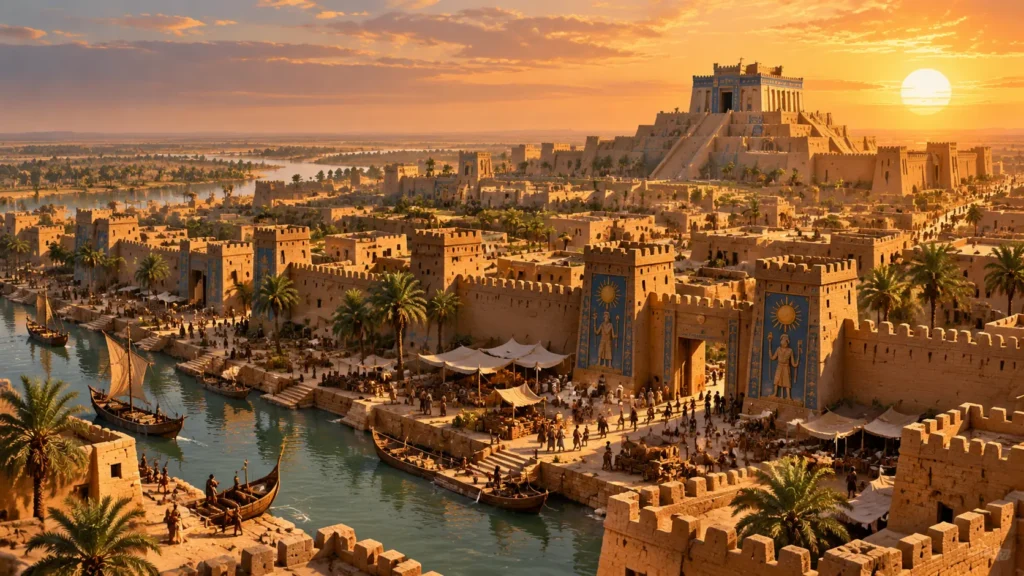
Historical reconstruction of Larsa, an ancient Sumerian city in Mesopotamia showing the E-babbar temple of Shamash, mudbrick architecture, canals, and urban life

Larsa: The Ancient Mesopotamian City of the Sun God and Kings

Introduction: The Ancient Sumerian City of Larsa Larsa was one of the most important cities of ancient Mesopotamia, a historic urban center that played a significant role in the political, religious, and economic development of southern Sumer. Located in the fertile plains of modern-day Iraq, Larsa became especially influential during the periods that followed the

Larsa: The Ancient Mesopotamian City of the Sun God and Kings Read More »

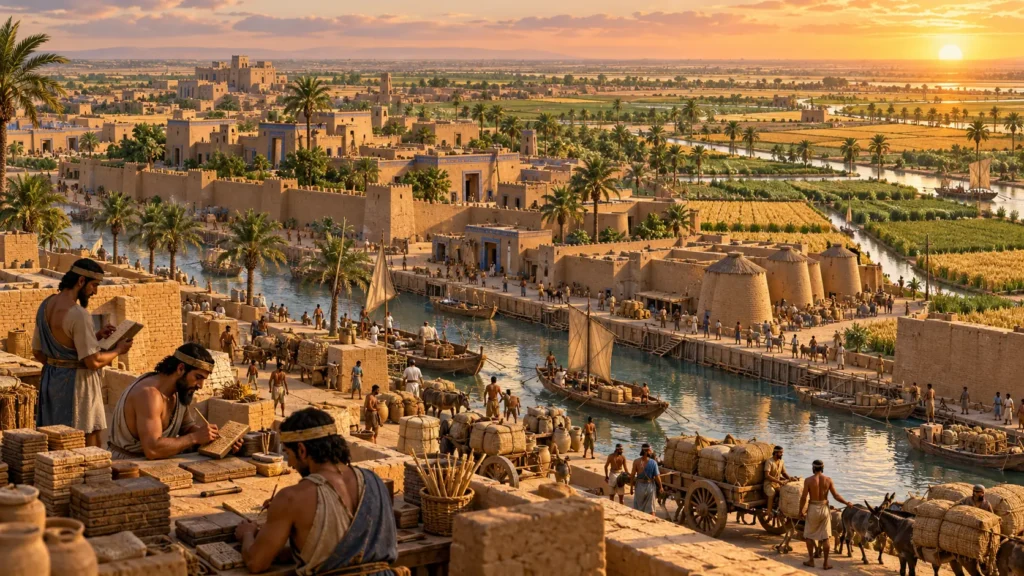
Historical reconstruction of Umma, an ancient Sumerian city in Mesopotamia showing mudbrick buildings, irrigation canals, agricultural fields, and daily life

Umma: The Ancient Sumerian City of Rivalry and Power

Introduction: The Ancient Sumerian City of Umma Umma was one of the most important city-states of ancient Sumer, a civilization that developed in southern Mesopotamia more than 5,000 years ago. Located in present-day Iraq, Umma became a major agricultural, political, and economic center during the Early Dynastic Period, when Sumer was divided into numerous independent

Umma: The Ancient Sumerian City of Rivalry and Power Read More »