Of all the historical entrances to the Old City, the Lions Gate Jerusalem stands out as a unique bridge between ancient mythology, biblical devotion, and modern military history. Located on the eastern wall, directly facing the Mount of Olives and the deep Kidron Valley, the lion gate jerusalem serves as the primary portal for millions of Christian pilgrims retracing the steps of Jesus. Whether you are studying ancient architecture or planning a spiritual pilgrimage, understanding the layered history of this specific entrance is essential.
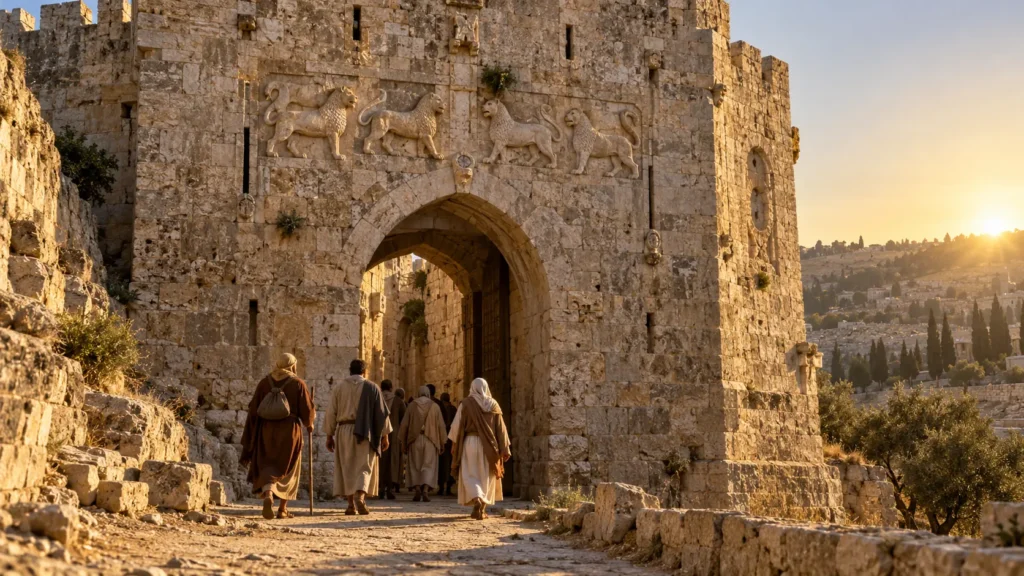
What is the Lions’ Gate? (St. Stephen’s Gate)
Built in 1538 by the Ottoman Sultan Suleiman the Magnificent, this arched stone portal serves as the main eastern entryway into the bustling Muslim Quarter. However, depending on the community you ask, the gate goes by completely different names, reflecting the city’s complex cultural mosaic.
In Christian tradition, it is widely known as St. Stephen’s Gate. This name honors the first Christian martyr, Stephen, who, according to long-held tradition, was stoned to death in the valley just outside this section of the wall. In Arabic, the local population calls it Bab al-Asbat, which translates to the “Gate of the Tribes” (referencing the twelve tribes of Israel). Yet, it is its most popular and heavily searched nickname, the Lions Gate Jerusalem, that draws the most visual curiosity from tourists.
The “Lions” Myth: The Panthers of Sultan Baibars
If you look closely at the limestone facade just above the archway, you will see four feline figures carved in relief—two facing each other on the left, and two on the right. A famous local legend claims that Sultan Suleiman dreamed he would be torn apart by lions if he did not rebuild the ruined walls of the Holy City. According to the myth, he placed these carvings there to commemorate his terrifying vision.
However, archaeologists and historians know a very different truth. These animals are not actually lions at all; they are panthers (or leopards). Furthermore, they were not carved for Suleiman. These stone reliefs are much older, originally serving as the heraldic crest of the fearsome 13th-century Mamluk Sultan Baibars, who ruled the region long before the Ottomans arrived. When Suleiman’s 16th-century engineers were constructing the new walls, they pragmatically recycled these older Mamluk carvings from a ruined building, inadvertently giving birth to the famous “lions” myth that permanently named the gate.
The Lions’ Gate and the Via Dolorosa (Biblical Connection)
For Christian pilgrims, stepping through the Lions’ Gate Jerusalem is not just a matter of entering the Old City; it is the commencement of one of the most profound spiritual journeys in the world. Because the gate is located on the eastern wall, it sits directly adjacent to the traditional site of the Antonia Fortress—the ancient Roman military barracks where Pontius Pilate is believed to have condemned Jesus to death.
Consequently, the street that begins immediately inside this gate is the starting point of the Via Dolorosa (The Way of Sorrow). Every Friday afternoon, Franciscans lead crowds of faithful pilgrims starting from this exact spot, carrying wooden crosses and tracing the fourteen Stations of the Cross through the winding, stone-paved alleys all the way to the Church of the Holy Sepulchre. This makes the gate the undeniable focal point of Christian devotion in the city.
The Pools of Bethesda and St. Anne’s Church
Beyond the Via Dolorosa, the area immediately inside the gate holds two monumental sites of biblical and historical immense value. Just a few dozen yards past the stone panthers, visitors will find the sprawling archaeological ruins of the Pools of Bethesda. According to the Gospel of John (Chapter 5), this is the exact location where Jesus miraculously healed a paralyzed man who had been waiting by the water for 38 years. The deep, excavated ruins provide a rare, tangible look at the Herodian-era street level of the First Century.
Standing proudly over these ancient ruins is the Church of St. Anne. Built by the Crusaders in the 12th century, this perfectly preserved Romanesque basilica honors the traditional birthplace of the Virgin Mary. It is world-renowned among historians and musicians alike for its flawless, echoing acoustics. Tour groups passing through the gate almost always stop here to sing hymns, letting their voices reverberate through the stone vaults before continuing their journey into the Muslim Quarter.
Lions Gate Jerusalem Israel: The 1967 Six-Day War
While the gate is deeply steeped in medieval mythology and ancient biblical narratives, its most defining modern moment occurred during the mid-20th century. For modern historians studying the Lions Gate Jerusalem Israel sector, this specific portal is synonymous with one of the most famous military operations in the history of the Middle East: the 1967 Six-Day War.
Between 1948 and 1967, the Old City was under Jordanian control, and Jewish access to the holy sites was completely barred. That changed dramatically on the morning of June 7, 1967. Israeli paratroopers from the 55th Brigade, commanded by Colonel Motta Gur, launched a fierce, coordinated assault down from the Mount of Olives and across the Kidron Valley. Under heavy Jordanian sniper and artillery fire, an Israeli half-track armored vehicle smashed through the wooden doors of the gate, breaking the Jordanian defenses.
When military enthusiasts search for archives of lionsgate jerusalem (often typed as a single word in rapid searches), they are usually looking for the iconic photographs of these exhausted, battle-hardened paratroopers pouring through this exact archway. By storming through this eastern entrance, the Israeli forces were able to sprint down the Via Dolorosa and secure the Temple Mount and the Western Wall. This dramatic breach marked the first time in nearly 2,000 years that the Old City and its holiest sites were back under Jewish control, forever cementing the gate’s legacy in the narrative of the modern State of Israel.
Where is the Lions’ Gate Located? (Map & Directions)
When looking at a standard map of the Old City, the gate is easily identifiable as the primary entrance on the eastern wall. Because the famous Golden Gate just to its south has been sealed shut for centuries, this is the only open and functional transit point along the entire eastern perimeter of the city.
Geographically, the gate sits at a spectacular topographical vantage point. It directly faces the Mount of Olives and overlooks the steep, ancient Kidron Valley (also known as the Valley of Jehoshaphat). For travelers and pilgrims following directions or a physical map, the approach is unmistakable: if you walk down the Mount of Olives, pass the Garden of Gethsemane, and hike up the modern road toward the eastern wall, this arched portal is the gateway that welcomes you directly into the Muslim Quarter.
Study Guide & Quick Answers (FAQs)
Is the Lions Gate in Jerusalem the same as the one in Mycenae?
No. Because of the shared name, this is a very common point of historical confusion. The Lion Gate of Mycenae is an ancient Bronze Age citadel entrance in Greece, famous for its massive Cyclopean masonry. The gate in Jerusalem, on the other hand, is a 16th-century Ottoman structure in Israel featuring 13th-century Mamluk panther reliefs.
What is the gate called in Spanish?
In Spanish-speaking tourism guides, academic literature, and biblical studies, it is known as la puerta de los leones jerusalén. Catholic pilgrims from Spanish-speaking countries will also frequently refer to it as la puerta de San Esteban (St. Stephen’s Gate).
Why is it called the Lions’ Gate?
It is named after the four feline reliefs carved into the stone facade above the archway. While local legends claim they are lions placed there by the Ottoman Sultan Suleiman the Magnificent after a terrifying dream, historians confirm they are actually panthers belonging to the heraldic crest of the 13th-century Mamluk Sultan Baibars, which the Ottomans recycled for the wall’s construction.