Ancient Egyptian religion was a polytheistic belief system centred on hundreds of gods and goddesses who governed nature, kingship, and the afterlife. For more than 3,000 years, religion shaped every aspect of Egyptian civilization, from the authority of the pharaoh and the construction of temples to daily rituals, mummification, and the belief in eternal life through the preservation of Ma’at, the principle of cosmic order.
Timeline of Ancient Egyptian Religion
| Period | Approximate Date | Religious Development |
|---|---|---|
| 🌾 Predynastic Egypt | Before 3100 BCE | Local communities worshipped regional deities associated with nature, fertility, the Nile, and sacred animals. |
| 👑 Unification of Egypt | c. 3100 BCE | Narmer united Upper and Lower Egypt, helping merge local cults into a broader national religious tradition. |
| ☀️ Old Kingdom | 2686–2181 BCE | The cult of Ra became dominant, pyramids were built as royal funerary monuments, and the divine status of the pharaoh reached its height. |
| ⚖️ Middle Kingdom | 2055–1650 BCE | Worship of Osiris expanded throughout Egypt, making the promise of eternal life accessible beyond the royal family. |
| 🏛️ New Kingdom | 1550–1070 BCE | Egypt’s religious system reached its greatest influence. Massive temples such as Karnak and Luxor flourished, while Amun-Ra became the kingdom’s supreme deity. |
| ☀️ The Amarna Period | c. 1353–1336 BCE | Pharaoh Akhenaten attempted to replace traditional polytheism with the exclusive worship of Aten, creating Egypt’s most radical religious revolution. |
| 🔄 Restoration of Traditional Religion | After 1336 BCE | Under Tutankhamun and his successors, the traditional gods, temples, and priesthood were restored after the Amarna experiment. |
| 🏺 Late Period & Greco-Roman Egypt | 664 BCE–395 CE | Egyptian religion blended with Greek and Roman traditions. Cults such as Isis spread across the Mediterranean before traditional temple worship gradually disappeared. |
The Foundations of Ancient Egyptian Religion
How beliefs, gods, temples, and the afterlife formed one interconnected religious system.
Truth • Justice • Harmony • Cosmic Order
Protector of Ma’at
Mediator between gods and humanity
Offerings
Religious festivals
Horus • Anubis
Hundreds of deities
Book of the Dead • Eternal Life
What Was Ancient Egyptian Religion?
Ancient Egyptian religion was a polytheistic belief system that shaped every aspect of life in one of history’s longest-lasting civilizations. Rather than being confined to temples or religious ceremonies, it influenced politics, law, architecture, art, agriculture, and even the daily routines of ordinary people.
The Egyptians believed that the universe was governed by a vast pantheon of gods and goddesses, each responsible for different forces of nature and aspects of human existence. These divine beings controlled the rising of the sun, the flooding of the Nile, fertility, kingship, justice, wisdom, and the journey into the afterlife. Maintaining a harmonious relationship with them was considered essential for the survival of both individuals and the kingdom itself.
Unlike many modern religions, ancient Egyptian religion had no single sacred book or central doctrine. Instead, it developed over more than 3,000 years, adapting to political changes, regional traditions, and the rise of new dynasties. Different cities often honoured different patron gods, yet these local cults coexisted within a shared religious framework that united the entire civilization.
At the heart of this belief system was the concept of Ma’at, the principle of truth, justice, balance, and cosmic order. Egyptians believed that the universe could only function if Ma’at was preserved. The gods upheld this balance, the pharaoh was responsible for protecting it on Earth, and every individual contributed through moral behaviour and religious devotion.
Religion also provided answers to life’s greatest questions. It explained how the world had been created, why natural events occurred, what happened after death, and how humans should live to achieve eternal life. This close connection between the divine and the everyday world meant that religion was not simply a matter of faith—it was the foundation upon which Egyptian civilization was built.
From my perspective, one of the most fascinating aspects of ancient Egyptian religion is its remarkable continuity. While rulers, capitals, and even dominant gods changed over the centuries, the underlying belief that the cosmos depended on harmony between humanity, the gods, and nature remained strikingly consistent. That enduring vision helps explain why Egyptian religion survived for more than three millennia and continues to captivate people around the world today.
The Origins of Ancient Egyptian Religion
Ancient Egyptian religion did not emerge fully formed. It evolved gradually over thousands of years, beginning long before the construction of the pyramids or the rise of the pharaohs. Its earliest roots can be traced to the Predynastic Period, when communities living along the Nile worshipped local deities connected to the natural world and the forces that shaped their daily lives.
The annual flooding of the Nile, the movement of the sun across the sky, the changing seasons, and the behaviour of animals all inspired religious beliefs. Many early gods were associated with specific places or represented powerful natural elements, while sacred animals such as falcons, jackals, crocodiles, cats, and ibises became symbols of divine power. Over time, these local cults developed into a far more sophisticated religious system.
The unification of Upper and Lower Egypt around 3100 BCE marked a turning point in this evolution. As the kingdom became politically unified under the first pharaohs, many regional beliefs were brought together into a shared religious tradition. Local gods retained their importance, but major deities such as Ra, Horus, and later Amun gained influence across the country, helping to create a common religious identity for all Egyptians.
Rather than replacing older beliefs, Egyptian religion absorbed and combined them. New gods were introduced, existing deities were merged, and different creation stories coexisted without contradiction. A god worshipped as the creator in one city could exist alongside another creator god honoured elsewhere. This remarkable flexibility allowed Egyptian religion to evolve continuously while preserving its essential principles.
Religious beliefs also became closely intertwined with kingship. The pharaoh was regarded as the chosen representative of the gods on Earth, responsible for maintaining Ma’at, the principle of truth, justice, and cosmic order. As temples grew in size and influence, religion became one of the foundations upon which Egyptian society, government, and culture were built.
From my perspective, one of the most extraordinary characteristics of ancient Egyptian religion is its ability to adapt without losing its identity. Across more than three millennia, dynasties rose and fell, foreign rulers arrived, and new religious ideas emerged, yet the core belief that harmony between the gods, humanity, and the universe sustained all life remained remarkably constant.
The Core Beliefs of Ancient Egyptian Religion
Ancient Egyptian religion was built upon a set of interconnected beliefs that explained the origin of the universe, humanity’s place within it, and what happened after death. Although individual gods, local traditions, and religious practices evolved over time, these core principles remained remarkably consistent for more than three millennia.
At the heart of Egyptian belief was Ma’at, the concept of truth, justice, harmony, and cosmic order. Egyptians believed that the universe functioned according to this divine balance, and it was the responsibility of both the gods and humanity to preserve it. The pharaoh upheld Ma’at through righteous rule, priests maintained it through sacred rituals, and ordinary people contributed by living honest and moral lives.
Another fundamental belief was that every person possessed several spiritual elements rather than a single soul. The most important were the ka, the ba, and the akh, each playing a different role in both life and the afterlife.
| Spiritual Element | Meaning | Role |
|---|---|---|
| Ka | Life force | Continued to exist after death and required offerings to survive. |
| Ba | Personality or individuality | Could leave the tomb and travel between the worlds of the living and the dead. |
| Akh | Transfigured spirit | The perfected form achieved after successful judgment in the afterlife. |
Because these spiritual elements depended on the preservation of the body, Egyptians developed elaborate funerary traditions centred on mummification, carefully prepared tombs, and the inclusion of food, possessions, and sacred texts. These practices were intended to ensure that the deceased could continue their existence in the next world.
The afterlife itself was not guaranteed. According to Egyptian belief, each person faced the Judgment of the Dead, during which the heart was weighed against the feather of Ma’at. Only those who had lived according to truth and justice could enter the eternal paradise known as the Field of Reeds, while those who failed the judgment risked losing their existence forever.
Unlike many later religions, ancient Egyptian belief did not separate the sacred from the everyday world. Natural events, political authority, agricultural cycles, and even personal success were all understood as expressions of the same divine order established by the gods. Religion therefore shaped not only what Egyptians believed, but also how they understood every aspect of life itself.
From my perspective, these beliefs are what gave Egyptian religion its extraordinary resilience. While dynasties changed and individual gods rose or declined in importance, the underlying ideas of Ma’at, the immortality of the soul, and the hope of eternal life provided a stable spiritual framework that endured for over 3,000 years.
The Egyptian Gods and the Divine Order
The ancient Egyptians believed that the universe was governed by a vast community of gods and goddesses, each responsible for maintaining a particular aspect of creation. Rather than competing with one another, these divine beings formed an interconnected system in which every deity contributed to the preservation of Ma’at, the universal balance that sustained both the natural world and human society.
Unlike many later religions centred on a single supreme deity, Egyptian religion was polytheistic. Hundreds of gods were worshipped throughout Egypt, although only a smaller group held national importance. Some deities represented cosmic forces such as the sun or the sky, while others protected the dead, inspired wisdom, oversaw fertility, or safeguarded the kingdom.
Major gods often became associated with one another as religious traditions evolved. For example, Amun and Ra were combined into Amun-Ra, reflecting the growing influence of both cults. This ability to merge deities and incorporate local traditions allowed Egyptian religion to adapt over centuries without abandoning its core beliefs.
The relationship between the gods was equally important. Myths describing the family of Osiris, Isis, Horus, and Set explained not only the origins of kingship but also the eternal struggle between order and chaos. These stories were far more than legends—they helped Egyptians understand the cycles of nature, political authority, justice, and the hope of life after death.
Although each god had unique responsibilities, certain deities occupied particularly prominent roles within Egyptian religion.
| Deity | Principal Role | Closely Associated With |
|---|---|---|
| Ra | Creator and sun god | Creation, kingship, cosmic order |
| Osiris | Lord of the afterlife | Resurrection, judgment of the dead |
| Isis | Goddess of magic and protection | Motherhood, healing, royal legitimacy |
| Horus | God of kingship and the sky | The living pharaoh, divine authority |
| Anubis | Protector of the dead | Mummification, tombs, funerary rites |
| Thoth | God of wisdom and writing | Knowledge, scribes, sacred texts |
Rather than understanding these gods in isolation, Egyptians saw them as parts of a larger divine order that governed every aspect of existence. Their temples, myths, festivals, and rituals reinforced the belief that the prosperity of Egypt depended upon maintaining harmony between humanity and the gods.
If you’d like to explore the Egyptian pantheon in greater detail, including the origins, powers, symbols, and myths of each major deity, see our complete guide to Egyptian Gods.
Temples, Priests, and Religious Rituals
Religion in ancient Egypt was not practised through personal worship alone. Instead, it revolved around a vast network of temples, priesthoods, and daily rituals designed to maintain harmony between the gods and the human world. These institutions formed the practical foundation of Egyptian religion and ensured that the divine order established by Ma’at was preserved throughout the kingdom.
Temples were considered the earthly homes of the gods rather than places where large congregations gathered to pray. At the heart of every temple stood a sacred sanctuary containing the cult statue of the resident deity. Only priests—and on special occasions the pharaoh himself—could enter these inner chambers to perform the daily ceremonies.
Each morning, priests carried out a carefully prescribed sequence of rituals. They purified themselves before entering the sanctuary, presented food and drink offerings, burned incense, dressed the divine statue in fresh garments, and recited sacred hymns. Egyptians believed that these ceremonies nourished the gods and renewed the divine forces that sustained both nature and society.
Beyond their religious function, temples became some of the most influential institutions in ancient Egypt. They owned agricultural land, employed thousands of workers, stored grain, commissioned works of art, and preserved religious knowledge. Some temple complexes grew into enormous economic centres whose influence extended far beyond spiritual life.
Priests were therefore much more than religious officials. They acted as guardians of sacred traditions, maintained temple libraries and archives, organised festivals, interpreted rituals, and ensured that worship continued according to ancient customs. Although the pharaoh remained the supreme religious authority, it was the priesthood that carried out the daily responsibilities of maintaining Egypt’s relationship with the gods.
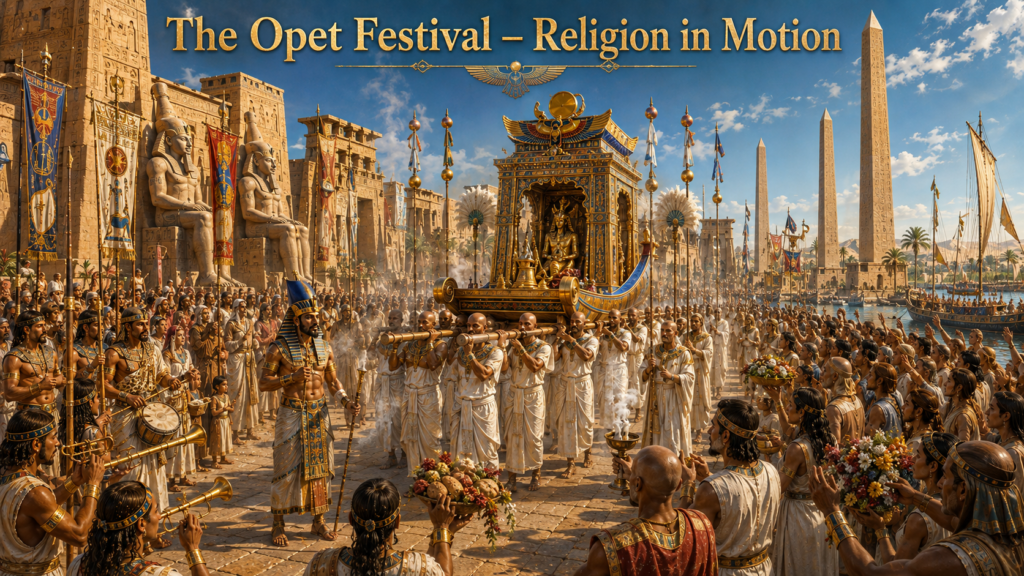
Throughout the year, religious festivals brought the gods beyond the temple walls. During these celebrations, sacred statues were carried in ceremonial processions so that ordinary Egyptians could honour their deities, present offerings, and participate in public acts of worship. These festivals strengthened the bond between local communities, the temples, and the divine world.
From my perspective, one of the defining features of Egyptian religion is that it was remarkably organised. Its temples, priests, and rituals formed a sophisticated religious system that operated continuously for centuries, helping to preserve both spiritual traditions and the political stability of one of history’s longest-lasting civilizations.
Death, the Afterlife, and the Promise of Eternal Life
For the ancient Egyptians, death was not the end of existence but the beginning of a new stage in an eternal journey. One of the central purposes of Egyptian religion was to prepare individuals for life beyond the grave, ensuring that they could continue to exist in harmony with the gods after leaving the earthly world.
Egyptians believed that a successful afterlife depended on both moral conduct during life and proper funerary preparation after death. Living according to Ma’at—the principles of truth, justice, and balance—was just as important as receiving the correct burial rites. Only by fulfilling both requirements could a person hope to reach eternal life.
According to religious tradition, every deceased individual faced the Judgment of the Dead. In this symbolic ceremony, the heart was weighed against the feather of Ma’at, representing truth and justice. A heart found to be pure allowed its owner to continue into the afterlife, while one burdened by wrongdoing risked losing the opportunity for eternal existence.
Preparing for this journey required elaborate funerary practices. Egyptians carefully preserved the body through mummification, placed offerings inside tombs, and included objects intended to support the deceased in the next world. These customs reflected the belief that physical preservation and spiritual survival were closely connected.
Religious texts also played an essential role in this process. Collections of hymns, prayers, and protective spells were buried alongside the dead to help them overcome the dangers of the underworld and navigate their path toward eternal life. These writings reveal how deeply religion shaped Egyptian ideas about death, morality, and human destiny.
The importance of the afterlife explains why so many of Egypt’s greatest monuments—including pyramids, royal tombs, and vast funerary temples—were built with religious purposes in mind. They were not simply monuments to the dead but expressions of a civilization that believed life continued beyond death.
If you’d like to explore these beliefs in greater detail, our guides to the Book of the Dead, Mummification, Anubis, and the Valley of the Kings examine the rituals, texts, and sacred places that formed the foundation of the Egyptian journey into the afterlife.
How Ancient Egyptian Religion Changed Over Time
Ancient Egyptian religion remained remarkably consistent for more than three thousand years, yet it was never a fixed or unchanging belief system. As Egypt’s political landscape evolved, new dynasties emerged, and foreign influences arrived, religious traditions adapted while preserving their fundamental principles.
During the Old Kingdom, the worship of Ra, the sun god, became increasingly prominent. Royal religion centred on the divine nature of the pharaoh, and the construction of the great pyramids reflected the belief that the ruler would join the gods after death. Monumental funerary architecture became one of the defining features of Egyptian religious life.
In the Middle Kingdom, religious beliefs became more accessible to ordinary people. Concepts that had once been closely associated with the pharaoh—such as the hope of eternal life—gradually extended to a much larger part of the population. The cult of Osiris, lord of the afterlife, expanded across Egypt and transformed ideas about death, resurrection, and personal salvation.
The New Kingdom marked the height of Egyptian religion. Vast temple complexes such as Karnak and Luxor became centres of worship, while the cult of Amun-Ra rose to national prominence. Priests gained enormous influence, religious festivals attracted thousands of participants, and Egypt’s temples became some of the wealthiest institutions in the ancient world.
One of the most dramatic moments in Egyptian religious history occurred during the reign of Akhenaten in the fourteenth century BCE. Rejecting centuries of religious tradition, the pharaoh promoted the exclusive worship of Aten, the visible disk of the sun, while reducing the importance of many traditional gods. Although this religious revolution was unprecedented, it proved short-lived. After Akhenaten’s death, Tutankhamun and his successors restored the traditional temples, priesthoods, and gods that had shaped Egyptian religion for centuries.
Even after Egypt came under Persian, Greek, and Roman rule, many ancient beliefs continued to flourish. Egyptian deities such as Isis spread throughout the Mediterranean world, attracting worshippers far beyond the Nile Valley. Temples remained active for centuries until the gradual decline of traditional Egyptian religion during the Roman period, when Christianity eventually became the dominant faith.
From my perspective, one of the greatest strengths of Egyptian religion was its ability to evolve without losing its identity. New gods could rise in importance, local traditions could merge, and political changes could reshape religious practice, yet the enduring ideals of Ma’at, divine kingship, and the hope of eternal life remained at the heart of Egyptian belief throughout its long history.
The Legacy of Ancient Egyptian Religion
Although the temples of ancient Egypt eventually fell silent, the influence of Egyptian religion has endured for thousands of years. Its beliefs, symbols, and mythology continue to shape our understanding of one of history’s most remarkable civilizations, inspiring histoians, archaeologists, writers, artists, and millions of visitors each year.
The monumental architecture of temples such as Karnak, Luxor, and Philae stands as a lasting testament to the central role religion played in Egyptian society. These sacred complexes were not only places of worship but also centres of education, administration, art, and economic life, demonstrating how deeply religious belief was woven into every aspect of the civilization.
Egyptian religious ideas also left a profound intellectual legacy. The concepts of divine kingship, sacred ritual, moral judgment after death, and the preservation of the soul have fascinated scholars for centuries. Discoveries such as the Book of the Dead, beautifully decorated tombs, and thousands of temple inscriptions continue to provide invaluable evidence for understanding the beliefs and daily lives of the ancient Egyptians.
Perhaps the greatest legacy of Egyptian religion lies in its extraordinary mythology. Stories of Osiris, Isis, Horus, and Set, together with the enduring symbolism of Ra, Anubis, and Thoth, remain among the most recognizable religious traditions of the ancient world. Their myths continue to appear in books, films, documentaries, museums, and popular culture, introducing new generations to the spiritual world of ancient Egypt.
Modern archaeology has further strengthened this legacy. Every excavation, restored temple, and newly translated inscription adds another piece to our understanding of how religion shaped Egyptian civilization for more than three thousand years. Rather than belonging only to the past, Egyptian religion remains an active field of research that continues to reveal new discoveries about one of humanity’s oldest and most influential belief systems.
From my perspective, one of the reasons ancient Egyptian religion continues to captivate people today is its remarkable balance between the familiar and the mysterious. It addressed universal questions about life, justice, death, and eternity while expressing them through a unique worldview filled with magnificent temples, powerful gods, elaborate rituals, and an enduring belief that harmony was the foundation of both the universe and human existence.
Key Takeaways
- Ancient Egyptian religion was a complex polytheistic belief system that shaped every aspect of Egyptian civilization for more than 3,000 years.
- The principle of Ma’at—truth, justice, balance, and cosmic order—formed the foundation of Egyptian religious thought.
- Egyptians worshipped hundreds of deities, each responsible for different aspects of nature, society, and the universe, while together maintaining the divine order.
- Pharaohs were regarded as sacred rulers who acted as intermediaries between the gods and humanity, ensuring that Ma’at prevailed throughout the kingdom.
- Temples were far more than places of worship; they functioned as religious, economic, administrative, and cultural centres managed by powerful priesthoods.
- Belief in the afterlife influenced Egyptian ethics, funerary practices, mummification, tomb construction, and religious literature.
- Egyptian religion evolved continuously, adapting to new dynasties and historical changes while preserving its essential beliefs about the gods, the cosmos, and eternal life.
- The legacy of ancient Egyptian religion continues today through its monuments, mythology, archaeological discoveries, and lasting influence on our understanding of one of history’s greatest civilizations.
Frequently Asked Questions
What was the religion of ancient Egypt?
Ancient Egyptian religion was a polytheistic belief system based on the worship of hundreds of gods and goddesses who governed nature, society, and the universe. It influenced every aspect of Egyptian life, from government and law to architecture, festivals, and beliefs about the afterlife.
What did ancient Egyptians believe?
The ancient Egyptians believed that the universe was governed by divine forces and maintained through Ma’at, the principle of truth, justice, harmony, and cosmic order. They also believed in an eternal afterlife, where every individual would be judged according to their actions in life.
Was ancient Egyptian religion polytheistic?
Yes. Ancient Egyptian religion was polytheistic, meaning that Egyptians worshipped many gods and goddesses. Each deity had specific roles and responsibilities, although together they formed a single religious system that explained the workings of the universe.
Who was the main Egyptian god?
There was no single permanent supreme deity throughout Egyptian history. Different periods emphasized different gods, but Ra, Amun-Ra, Osiris, Horus, and Isis were among the most important and widely worshipped deities.
Why was Ma’at important?
Ma’at represented truth, justice, balance, and cosmic order. Egyptians believed that maintaining Ma’at ensured the stability of the universe, the prosperity of Egypt, and the successful journey of the dead into the afterlife.
Why was the afterlife so important in Egyptian religion?
Egyptians believed that death marked the beginning of eternal life rather than its end. Preparing for the afterlife through moral behaviour, religious rituals, mummification, and proper burial practices was therefore one of the central goals of Egyptian religion.
What role did temples play in ancient Egypt?
Temples were the religious centres of Egyptian civilization. They housed the gods, hosted daily rituals performed by priests, organised major religious festivals, preserved sacred traditions, and also functioned as important economic and administrative institutions.
Is ancient Egyptian religion still practised today?
No. Traditional ancient Egyptian religion gradually disappeared during the Roman period as Christianity became the dominant religion in Egypt. However, its mythology, monuments, religious texts, and archaeological discoveries continue to be studied and admired around the world.
Further Reading
- Encyclopaedia Britannica – Ancient Egyptian Religion
https://www.britannica.com/topic/ancient-Egyptian-religion - World History Encyclopedia – Egyptian Religion
https://www.worldhistory.org/Egyptian_Religion/ - The British Museum – Ancient Egypt
https://www.britishmuseum.org/collection/galleries/egypt - The Metropolitan Museum of Art – Ancient Egyptian Religion
https://www.metmuseum.org/about-the-met/collection-areas/egyptian-art
Related Topics