Egyptian pharaohs were the supreme monarchs of ancient Egypt (c. 3100–30 BCE), uniting political absolute power, supreme military command, judicial supremacy, and divine priesthood. Regarded as the living earthly incarnation of the falcon god Horus and transitioning to Osiris upon death, the pharaohs governed for over three millennia. Their fundamental theological mission was maintaining Ma’at—the divine cosmic balance, truth, and universal order against primordial chaos (Isfet).
The Pharaonic Divine Hierarchy & Royal Roles
The Dual Divine & Civic Power of the Pharaoh
- Living Manifestation of Horus
- Chief High Priest of All Gods
- Sustainer of Cosmic Ma’at
- The Royal Residence (Per-Aa)
- Dual Viziers (North & South)
- Nomarchs (Provincial Regents)
- Supreme Commander-in-Chief
- Defense of Sacred Borders
- Subjugation of Chaos (Isfet)
Chronological Table of Egypt’s Greatest Pharaohs
Below is a historical overview of the most influential rulers who shaped the dynastic trajectory of ancient Egypt:
| Pharaoh (Royal Name) | Dynasty & Period | Approximate Reign | Monumental Achievements | Key Historical Impact |
| Narmer (Menes) | First Dynasty (Early Dynastic) | c. 3100 BCE | Foundation of Memphis capital; Narmer Palette | Unification of Upper and Lower Egypt; established centralized dynastic monarchy. |
| Djoser (Netjerikhet) | Third Dynasty (Old Kingdom) | c. 2670 BCE | Step Pyramid complex at Saqqara (by Imhotep) | Inaugurated monumental stone architecture in human history. |
| Khufu (Cheops) | Fourth Dynasty (Old Kingdom) | c. 2589–2566 BCE | The Great Pyramid of Giza (Akhet Khufu) | Zenith of Old Kingdom centralized royal power and administrative logistics. |
| Mentuhotep II | Eleventh Dynasty (Middle Kingdom) | c. 2061–2010 BCE | Mortuary temple at Deir el-Bahari | Reunified Egypt after First Intermediate Period; ushered in Middle Kingdom Golden Age. |
| Senusret III | Twelfth Dynasty (Middle Kingdom) | c. 1878–1839 BCE | Nubian boundary fortresses (Semna, Buhen) | Centralized royal power by crushing provincial nomarch autonomy; secured gold routes. |
| Hatshepsut (Maatkare) | Eighteenth Dynasty (New Kingdom) | c. 1479–1458 BCE | Terraced Mortuary Temple at Deir el-Bahari | Major trading expedition to Punt; period of monumental building and stability. |
| Thutmose III (Menkheperre) | Eighteenth Dynasty (New Kingdom) | c. 1479–1425 BCE | Expansion of Karnak temple; Battle of Megiddo | The “Napoleon of Egypt”; expanded the empire from Nubia to the Euphrates River. |
| Akhenaten (Amenhotep IV) | Eighteenth Dynasty (New Kingdom) | c. 1353–1336 BCE | Construction of new capital at Akhetaten (Amarna) | Revolutionary religious reform centered exclusively on the solar disk Aten. |
| Tutankhamun (Nebkheperure) | Eighteenth Dynasty (New Kingdom) | c. 1332–1323 BCE | Restoration Stela; Tomb KV62 in Valley of the Kings | Restored traditional Amun worship; intact tomb discovery revolutionized Egyptology. |
| Ramesses II (Usermaatre Setepenre) | Nineteenth Dynasty (New Kingdom) | c. 1279–1213 BCE | Abu Simbel, Ramesseum, Pi-Ramesses capital | Battle of Kadesh; signed the world’s first recorded international peace treaty with Hittites. |
| Cleopatra VII Philopator | Ptolemaic Dynasty | 51–30 BCE | Rebuilt maritime commerce; Alexandria Library patronage | Final active pharaoh of ancient Egypt; suicide marked the Roman annexation into an imperial province. |
Explore Ancient Egypt’s Most Famous Pharaohs
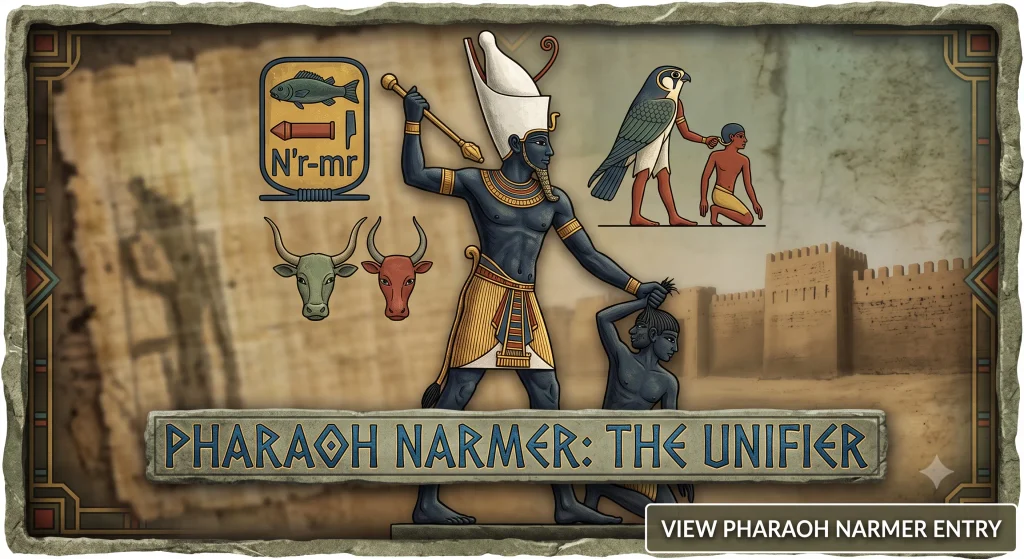
Narmer
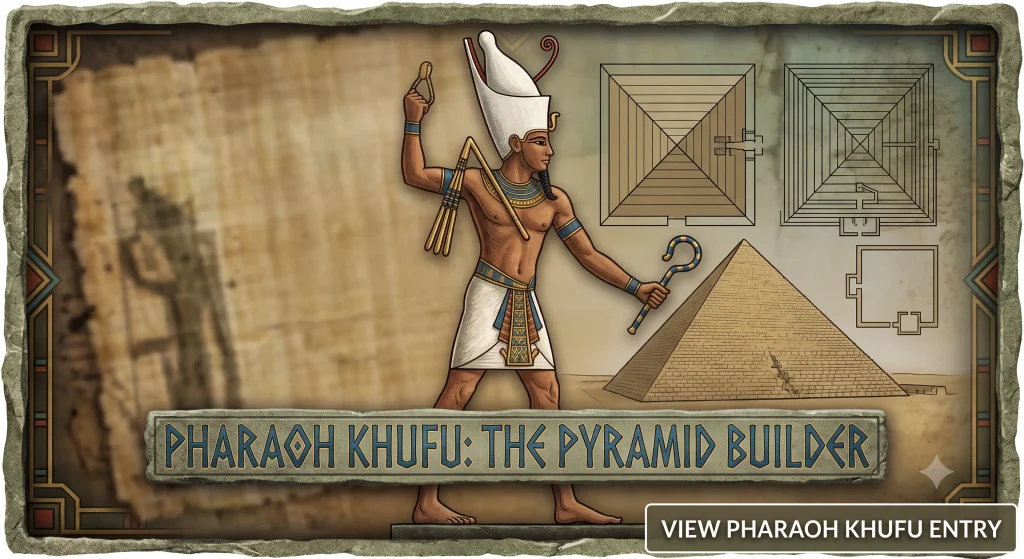
Khufu
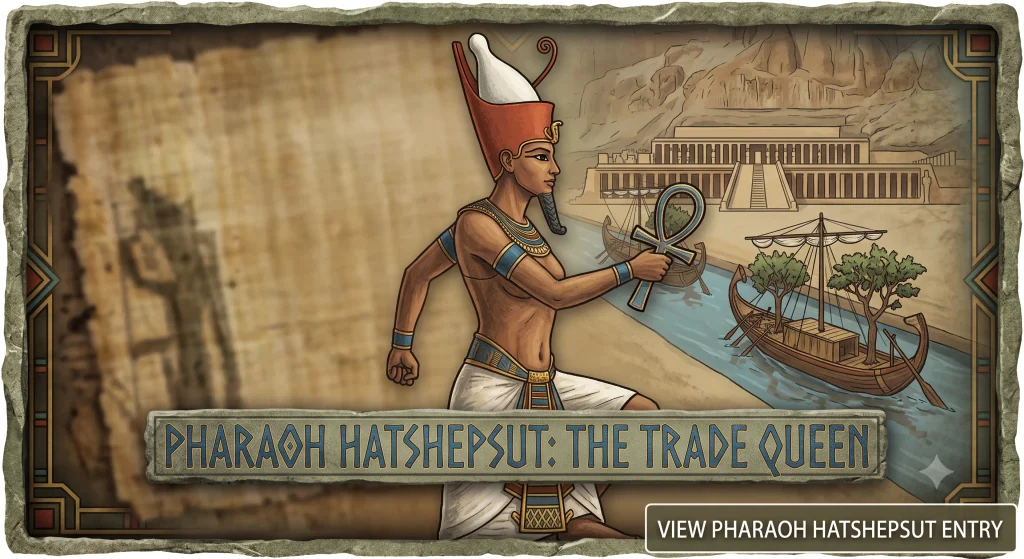
Hatshepsup
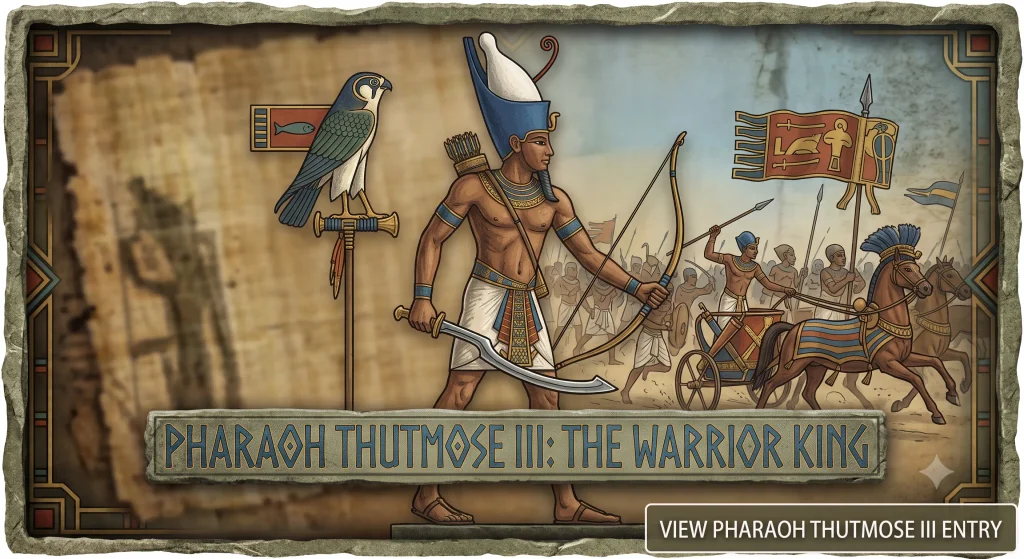
Thutmose III
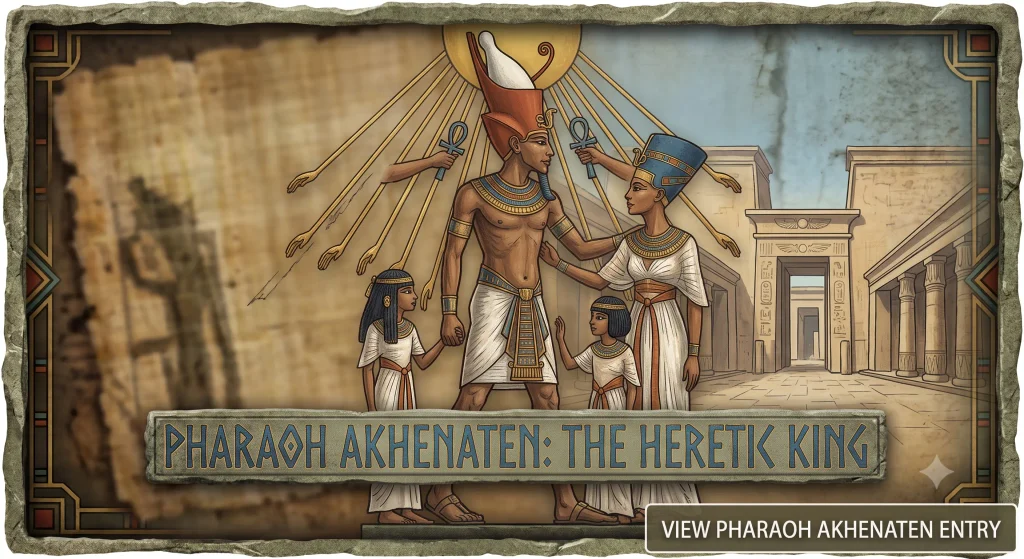
Akhenaten
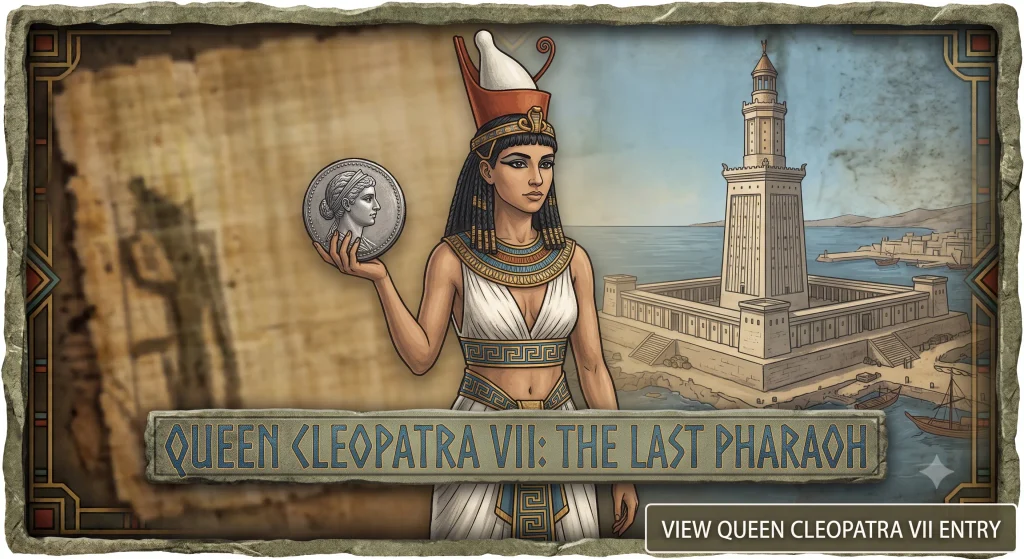
Cleopatra VII
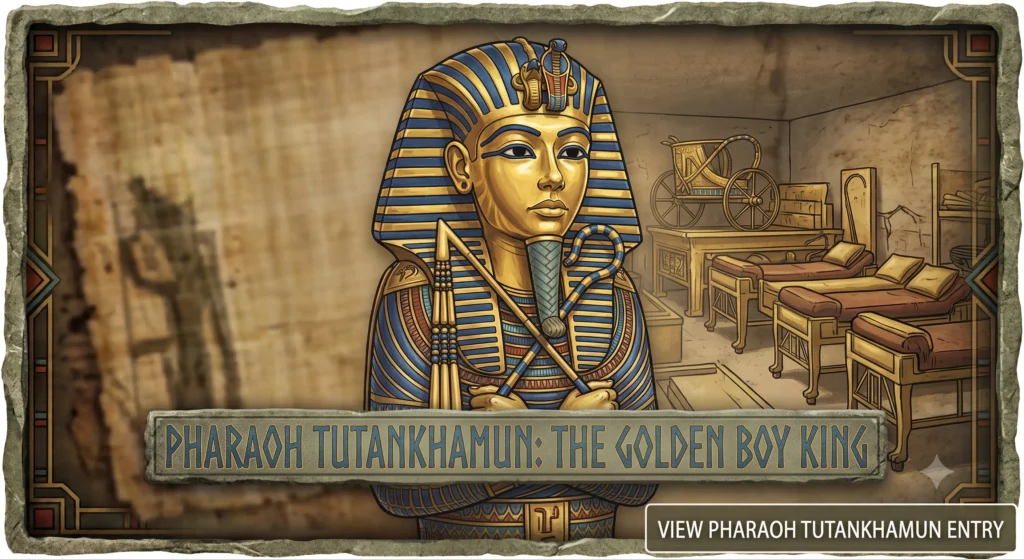
Tutankhamun
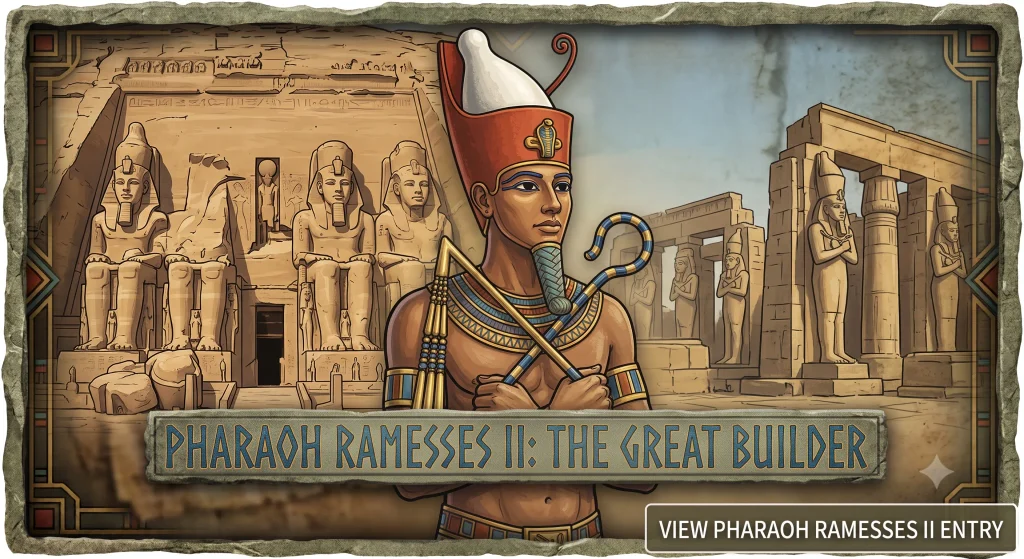
Ramesses II
What Was an Egyptian Pharaoh? Etymology and Divine Kingship
The modern term pharaoh originates from the ancient Egyptian compound Per-Aa (pr-ꜥꜣ), literally meaning “Great House.” Originally designating the royal palace compound, the term began referring directly to the ruling monarch during the New Kingdom (specifically under Thutmose III and Akhenaten).
The Fivefold Royal Titulary
Upon ascending the throne, every Egyptian pharaoh assumed five formal names (The Great Titulary) that defined their theological program:
- Horus Name: Associated the king with the celestial falcon god Horus.
- Nebty (“Two Ladies”) Name: Placed the ruler under the protection of the tutelary goddesses of Upper and Lower Egypt (Nekhbet the vulture and Wadjet the cobra).
- Golden Horus Name: Expressed the king’s eternal, divine nature (gold being the flesh of the gods).
- Prenomen (Throne Name): Preceded by the title Nesut-Bity (“He of the Sedge and Bee”), enclosed in a royal oval cartouche.
- Nomen (Birth Name): Preceded by Sa-Ra (“Son of Ra”), also enclosed in a cartouche.
The Sacred Regalia and Royal Insignia
The authority of the pharaoh was projected through a codified visual grammar of crowns, scepters, and sacred adornments:
- The Double Crown (Pschent / Sekhemty): The combination of the White Crown (Hedjet) of Upper Egypt and the Red Crown (Deshret) of Lower Egypt, embodying absolute rule over the unified Two Lands (Sema-Tawy).
- The Nemes Headdress: The iconic striped blue-and-gold linen cloth covering the royal wig, crowned with the Uraeus (Wadjet cobra) to ward off enemies.
- The Crook (Heka) and Flail (Nekhakha): The crook symbolized the pharaoh as the shepherd and protector of the people; the flail symbolized judicial discipline, authority, and agricultural fertility.
- The False Ceremonial Beard: A plaited ceremonial goat-hair beard tied behind the ears, worn even by female monarchs (such as Hatshepsut) to denote divine status.
- The Blue Crown (Khepresh): The leather war crown adorned with gold discs, frequently worn in military campaigns and New Kingdom temple reliefs.
Daily Responsibilities and Royal Governance
A reigning pharaoh oversaw a massive administrative apparatus:
- The Vizierate (Tjaty): The highest bureaucratic official, often divided into a Northern Vizier (Memphis) and Southern Vizier (Thebes), supervising tax collection, land archives, and the judiciary.
- The Heb Sed (Jubilee Festival): Celebrated after 30 years of rule (and every 3–4 years thereafter), the pharaoh underwent rigorous physical and magical rituals to renew their divine vitality, run a ritual course, and prove their fitness to sustain Egypt.
A Step into the Ancient World: A Royal Audience in Thebes
Step past the colossal sandstone pylons into the great hypostyle hall of the royal palace at Thebes around 1250 BCE during the reign of Ramesses II.
Sunlight slants through high clerestory grilles, illuminating massive papyrus-shaped columns painted in vivid red, turquoise, and gold. Incense smoke from burning kyphi drifts across polished limestone flagstones.
At the far end of the elevated dais sits the pharaoh, crowned with the Double Crown and gripping the golden crook and flail across his chest. Standing beside the throne, the Southern Vizier unrolls papyrus scrolls recording the flood height measured by the Nilometers of Elephantine.
Foreign emissaries from Babylon, the Hittite Empire, and the Aegean kneel before the throne, offering bronze vessels and lapis lazuli beads. Every decree spoken by the king is recorded on fresh papyrus by scribes whose reeds scratch across the sheets. In this chamber, political power, military might, and sacred theology converge in the living embodiment of Horus on earth.
To explore the economic foundation and grain ration systems that funded the pharaohs’ monuments, read our guide to the Ancient Sumerian and Mesopotamian Economy.
Key Takeaways
- Divine Kingship: Pharaohs were regarded as the earthly incarnation of Horus in life and Osiris in death, serving as the sole mediator between gods and mankind.
- Preserving Ma’at: The king’s paramount spiritual duty was maintaining universal truth, justice, and cosmic order against chaos (Isfet).
- The Fivefold Titulary: Every ruler assumed five sacred names upon coronation, including the Throne Name (Prenomen) and Personal Name (Nomen) inside cartouches.
- Enduring Architecture: Pharaohs initiated monumental engineering, from the Old Kingdom stone pyramids to the New Kingdom rock-cut tombs of the Valley of the Kings.
- Three Millennia of Continuity: Over 30 dynasties governed Egypt from the unification by Narmer (c. 3100 BCE) until the suicide of Cleopatra VII and Roman annexation (30 BCE).
Frequently Asked Questions About Egyptian Pharaohs
Who was the very first pharaoh of ancient Egypt?
King Narmer (frequently identified with Menes) is recognized as the first pharaoh. Around 3100 BCE, he unified the warring kingdoms of Upper and Lower Egypt, founded the First Dynasty, and established the capital at Memphis.
What does the word “pharaoh” mean?
The word pharaoh derives from the ancient Egyptian Per-Aa (pr-ꜥꜣ), meaning “Great House.” Originally referring to the royal palace, it became an official title for the king during the New Kingdom.
Who was the most powerful female pharaoh?
While several women ruled Egypt (including Sobekneferu, Twosret, and Cleopatra VII), Hatshepsut (Eighteenth Dynasty) was the most successful female pharaoh. She ruled for over two decades, directing massive trading expeditions to Punt and building the terraced mortuary temple at Deir el-Bahari.
What are the royal symbols of an Egyptian pharaoh?
The primary royal insignias include the Double Crown (Pschent), the Nemes striped linen headdress, the Uraeus cobra, the ceremonial false beard, and the crossed Crook (Heka) and Flail (Nekhakha).
Why was Tutankhamun so famous if he died young?
Tutankhamun ruled for only nine years (c. 1332–1323 BCE). He achieved modern global fame because his tomb (KV62) in the Valley of the Kings was discovered virtually intact by Howard Carter in 1922, containing thousands of untouched royal gold artifacts.
Who was the last pharaoh of Egypt?
Cleopatra VII Philopator (51–30 BCE) was the final active pharaoh of ancient Egypt. Following her defeat by Octavian (later Emperor Augustus) and her suicide in 30 BCE, Egypt was annexed as a province of the Roman Empire.
Further Reading & Academic Sources
- The British Museum — Ancient Egypt and Pharaonic CollectionsCurated exhibitions, royal statue galleries, and administrative stelae.
- The Griffith Institute — University of Oxford Tutankhamun ArchiveComplete photographic and transcription excavation journals of Howard Carter’s discovery.
- The Metropolitan Museum of Art — Chronology of Egyptian PharaohsDetailed historical essays covering dynastic transitions, royal titulary, and royal tombs.
- World History Encyclopedia — Egyptian Pharaohs and KingshipComprehensive historical analysis of the religious, judicial, and military functions of the crown.
- Encyclopaedia Britannica — List of Pharaohs and Egyptian DynastiesAuthoritative chronological reference detailing Old, Middle, and New Kingdom rulers.
Related Topics