Hatshepsut (Maatkare): Egypt’s Greatest Female Pharaoh, Reign, & Monuments
Hatshepsut (Ancient Egyptian: ḤꜢt-špswt, meaning “Foremost of Noble Women”; throne name: Maatkare, “Truth/Cosmic Order is the Soul of Ra”) was the fifth pharaoh of the Eighteenth Dynasty of Egypt (c. 1479–1458 BCE). Ruling during the apex of the early New Kingdom, she stands as one of the most capable, ambitious, and politically sophisticated sovereigns in world history.
Transcendently moving from royal daughter to Great Royal Wife, then to co-regent, and ultimately assuming the full, supreme titular authority of King of Upper and Lower Egypt (Nisut-Bity), Hatshepsut directed Egyptian civilization through more than two decades of unrivaled economic prosperity, pioneering maritime exploration, and unprecedented architectural genius.
Origins, Royal Lineage, and the Power of the God’s Wife of Amun
Understanding Hatshepsut’s extraordinary ascent requires examining the dynastic mechanics of the early 18th Dynasty—a royal house that had recently expelled the foreign Hyksos rulers and centralized absolute political and religious power in the southern capital of Thebes (Waset).
Royal Genealogy and the Dynastic Crisis of the Thutmosid Line
Hatshepsut was born into the elite core of the Thutmosid royal dynasty around 1507 BCE. Her biological pedigree gave her an exceptionally strong claim to pure royal lineage, setting her apart from subsequent male contenders.
| Royal Figure | Kinship to Hatshepsut | Dynastic Role & Historical Context |
| Thutmose I (Aakheperkare) | Father | Celebrated warrior pharaoh who expanded Egyptian imperial borders to the Euphrates in Syria and the Fourth Cataract of the Nile in Nubia. |
| Queen Ahmose | Mother | Great Royal Wife (Hemet Nesut Weret); directly linked to the Ahmosid founding line that liberated Egypt from the Hyksos. |
| Thutmose II (Aakheperenre) | Half-Brother & Husband | Son of Thutmose I and a secondary, non-royal wife named Mutnofret; ruled briefly (c. 1493–1479 BCE) in frail health. |
| Thutmose III (Menkheperre) | Step-Son & Nephew | Son of Thutmose II and a secondary harem concubine named Iset (Isis); nominal child heir upon his father’s death. |
| Princess Neferure | Daughter | Sole surviving child of Hatshepsut and Thutmose II; groomed to inherit high dynastic and religious functions. |
The Dynastic Dilemma of Thutmose II’s Death
When Thutmose I died, all his legitimate sons by Queen Ahmose had predeceased him. To secure the succession, Hatshepsut was married to her half-brother, Thutmose II, elevating him through her impeccable maternal pedigree.
When Thutmose II died prematurely in 1479 BCE, the legitimate dynastic line faced a critical vacuum:
- The sole surviving male heir, the future Thutmose III, was an infant of uncertain age born to a secondary consort (Iset).
- An infant king could not lead military campaigns, preside over complex temple liturgies, or govern a sprawling imperial bureaucracy.
- Hatshepsut stepped into the role of Regent (Khenemet), supported by the Theban court, the high military command, and the powerful priesthood of Amun-Ra.
The Office of the God’s Wife of Amun (Hemet Netjer en Amun)
Long before she donned the Double Crown of Egypt, Hatshepsut accumulated monumental institutional and economic leverage through the supreme sacerdotal title: God’s Wife of Amun (Ḥmt nṯr n Jmn).
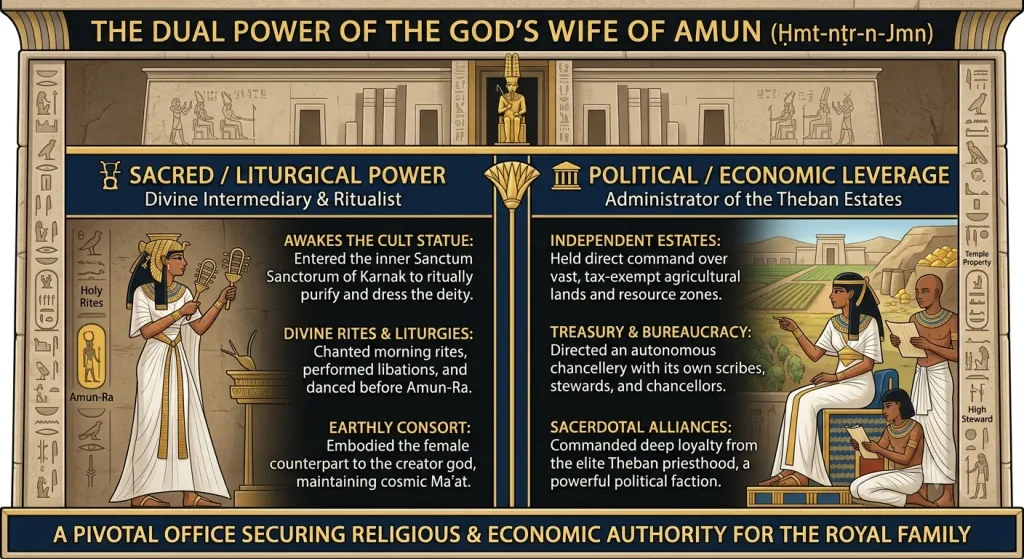
- Origins of the Title: Instituted during the early 18th Dynasty for royal matriarchs like Queen Ahmose-Nefertari, the office transformed the queen into the earthly female counterpart of the supreme creator-god Amun-Ra of Karnak.
- Vast Economic Power: The God’s Wife of Amun was not an honorary decorative post. It was an independent corporate estate endowed with vast tracts of fertile agricultural land, gold mines, merchant fleets, and tax-exempt revenues administered by its own dedicated chancellery of scribes and estate managers.
- Ritual Authority: Hatshepsut physically entered the Sanctum Sanctorum of Karnak, performed sacred libations, and communed directly with the deity—privileges historically restricted to the High Priest and the reigning Pharaoh.
- Strategic Succession: Upon claiming the pharaonic throne, Hatshepsut transferred this vital sacerdotal title to her young daughter, Princess Neferure, ensuring the financial and theological apparatus of Karnak remained under her family’s direct command.
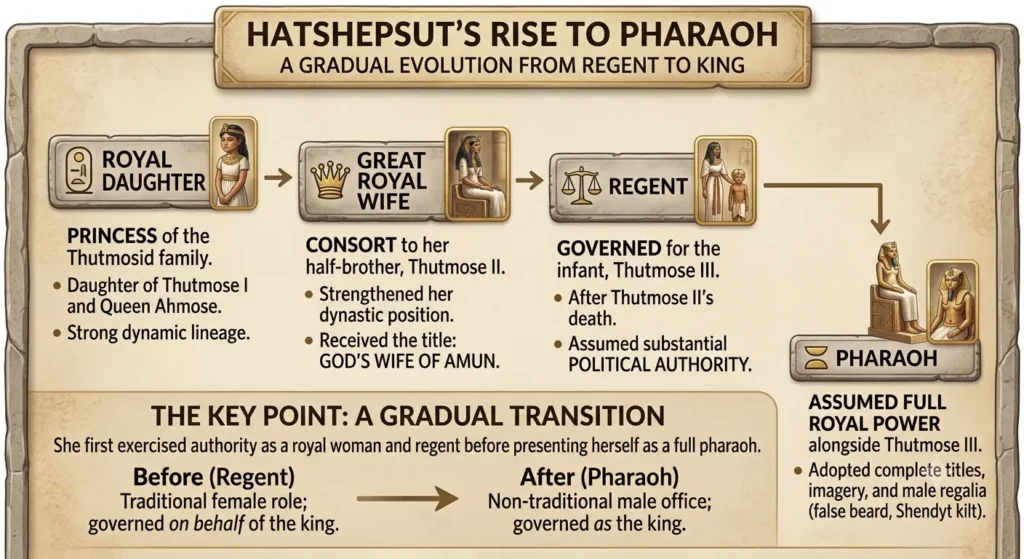
The Transition: From Royal Regent to Co-Ruler
For the first two to seven years of young Thutmose III’s nominal reign, Hatshepsut respected standard regency protocols. Funerary and administrative inscriptions at Thebes dating to Years 1–2 depict her in conventional queenly attire, standing discreetly behind the boy king.
However, as recorded by the contemporary courtier and high official Ineni on the walls of his Theban tomb (TT81):
“His son stood in his place as king of the Two Lands, having ruled upon the throne of him that begat him. His sister, the God’s Wife Hatshepsut, conducted the affairs of the land according to her own will. Egypt was made to labor with bowed head for her, the excellent seed of the god, which came forth from him…”
By Year 7 of the regency (c. 1473 BCE), facing geopolitical complexities and possessing the total loyalty of the Theban military and priesthood, Hatshepsut made the unprecedented ideological leap: she proclaimed herself full Sovereign and King of Egypt.
⏳ Chronological Timeline of Hatshepsut’s Life and Reign
The reign of Hatshepsut (c. 1507–1458 BCE) represents a pivotal era of the early 18th Dynasty. Below is the historical chronology tracing her evolution from royal princess to King of Upper and Lower Egypt:
| Approximate Date | Regnal / Life Phase | Major Historical & Archaeological Event |
| c. 1507 BCE | Birth & Royal Lineage | Born in Thebes to Pharaoh Thutmose I and Great Royal Wife Queen Ahmose; establishes her direct dynastic claim. |
| c. 1493 BCE | Great Royal Wife | Marries her half-brother Thutmose II; receives the supreme sacerdotal title of God’s Wife of Amun (Hemet Netjer en Amun). |
| c. 1479 BCE | Regency (Year 1) | Death of Thutmose II. Hatshepsut assumes the regency on behalf of her young step-son/nephew, the infant Thutmose III. |
| c. 1473 BCE | Coronation as Pharaoh (Year 7) | Formally crowns herself King of Upper and Lower Egypt, adopting the throne name Maatkare (“Truth is the Ka of Ra”). |
| c. 1470 BCE | Monumental Building Program | Initiates construction of her masterwork mortuary temple, Djeser-Djeseru at Deir el-Bahari, directed by royal architect Senenmut. |
| c. 1464 BCE | The Red Sea Expedition (Year 9) | Dispatches the celebrated five-ship naval expedition to the Land of Punt, returning with living myrrh trees, gold, ivory, and exotic flora. |
| c. 1458 BCE | Death & Burial (Year 22) | Dies in her late forties/early fifties. Interred in the Valley of the Kings (KV20 alongside Thutmose I, and later resting in KV60). |
| c. 1438 BCE | Damnatio Memoriae | Approximately 20 years after her death, during the late sole reign of Thutmose III, her pharaonic cartouches and statues are selectively chiseled away to normalize dynastic succession. |
| 1903–2007 CE | Archaeological Rediscovery | Howard Carter clears tomb KV20 (1903); Zahi Hawass and modern forensic teams scientifically identify her mummy in KV60 via CT scans and a matching molar tooth (2007). |
Hatshepsut’s Reign at a Glance
Royal woman → Regent → Pharaoh → Builder and patron of trade → Death → Erasure from some monuments → Rediscovery
Hatshepsut’s career was unusual because she moved from the traditional role of royal woman and regent into the full institution of Egyptian kingship. Her reign was then followed by a complicated treatment of her memory, making her one of the most intriguing rulers of the New Kingdom.
The Ideology of Kingship, Divine Birth, and Royal Titulary
Hatshepsut did not merely seize administrative control; she executed a masterclass in religious and legal justification. In ancient Egypt, the pharaoh was not simply a monarch, but an essential cosmic intermediary (the living Horus) responsible for maintaining Ma’at (universal order, balance, and truth) against Isfet (chaos).
To integrate herself seamlessly into an office historically codified as masculine, Hatshepsut engineered a sophisticated theological narrative and adopted the complete royal protocol.
The Divine Birth Myth (Theogamy) at Djeser-Djeseru
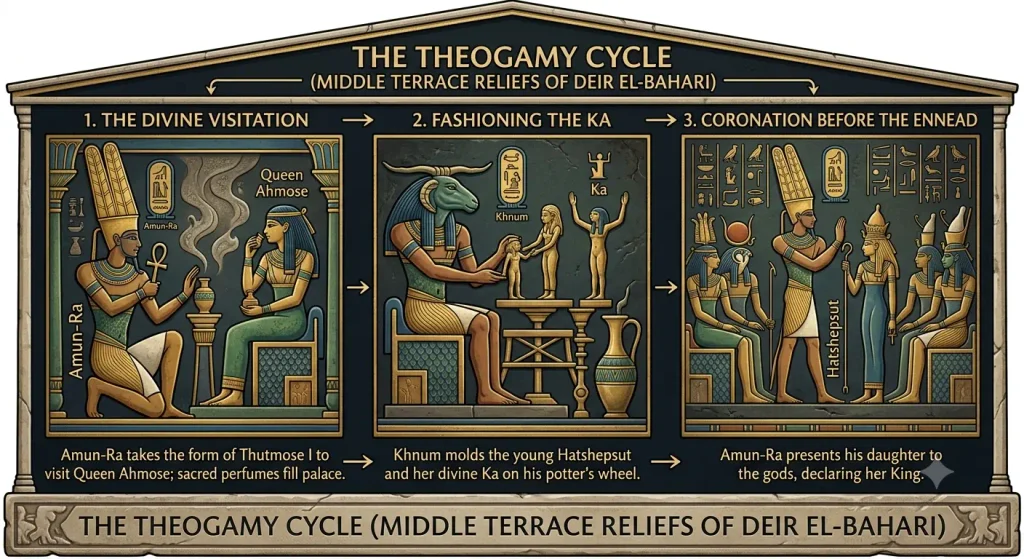
To substantiate her direct appointment by the divine realm, Hatshepsut had the cycle of her Divine Birth carved in high relief along the Middle Terrace (Northern Colonnade) of her mortuary temple at Deir el-Bahari.
This narrative circumvented any mortal dynastic challenge by asserting that she was the literal, physical daughter of Amun-Ra, the supreme King of the Gods.
Key Elements of the Inscription:
- The Sacred Conception: The text narrates that Amun-Ra “found her [Queen Ahmose] as she slept in the beauty of her palace. She awoke at the fragrance of the god… His love entered into her limbs. The palace was flooded with the fragrance of the god, all his odors were of Punt.”
- The Royal Ka: The ram-headed creator god Khnum, accompanied by Heket (goddess of childbirth), crafts the infant Hatshepsut and her Ka (vital life force) upon his potter’s wheel, shaping her with distinct male physical vigor to denote sovereign capacity.
- The Oracle of Karnak: Hatshepsut claimed that during a sacred procession at Karnak, the barque sanctuary of Amun-Ra bowed before her, and an oracle proclaimed her the legitimate ruler of Upper and Lower Egypt.
The Fivefold Royal Titulary (Prenomen & Nomen)
Upon her formal coronation in Year 7 (c. 1473 BCE), Hatshepsut assumed the canonical Fivefold Titulary (Great Name) required of every legitimate Pharaoh. Her titular choices reveal a deliberate balance of feminine grammar and masculine cosmic roles:
| Royal Title | Transliteration | Ancient Egyptian Meaning | Symbolic & Theological Function |
| Horus Name | Ḥr wsr.t-kꜢ.w | Weserettkau (“Mighty of Kas”) | Aligns her with Horus, the falcon god and living essence of the throne. |
| Two Ladies (Nebty) | Nbt.j wꜢḏ.t-rnp.wt | Wadjerenput (“Flourishing of Years”) | Invokes the protection of Wadjet (Lower Egypt) and Nekhbet (Upper Egypt). |
| Golden Horus | Ḥr-nbw nṯr.t-ḫꜥ.w | Netjeretkhaw (“Divine of Appearances”) | Proclaims her divine solar radiance and celestial authority. |
| Throne Name (Prenomen) | Nswt-bjt MꜢꜥ.t-kꜢ-Rꜥ | Maatkare (“Truth/Order is the Ka of Ra”) | Inscribed in a cartouche; asserts her eternal commitment to maintaining Ma’at. |
| Birth Name (Nomen) | SꜢ Rꜥ ḤꜢt-šps.wt ẖnm.t-Jmn | Hatshepsut Khenemetamun (“Foremost of Noble Women, United with Amun”) | Inscribed in a cartouche; highlights both her noble bloodline and personal union with Amun. |
Linguistic Innovation: Royal scribes occasionally blended genders within state inscriptions, addressing her with masculine titles (“His Majesty”, Nisut) followed by feminine grammatical endings (“She lived forever”, T-endings in Egyptian verbs and adjectives), demonstrating the adaptability of the language to royal context.
Visual Iconography: Why Hatshepsut Adopted Male Regalia
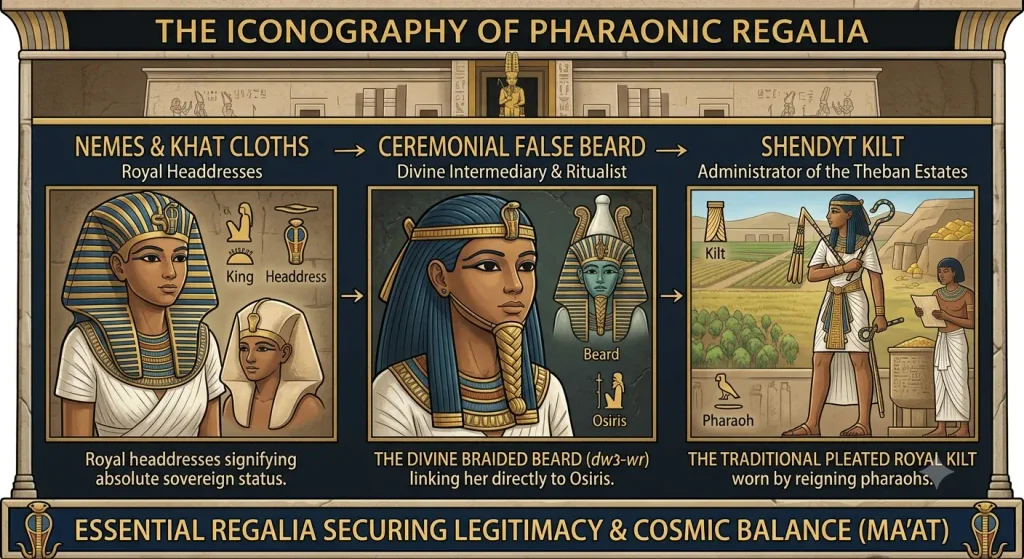
A common modern misconception is that Hatshepsut “cross-dressed” or attempted to deceive her subjects into believing she was biologically male. In Ancient Egyptian society, this was neither the intention nor the reality.
The Evolution of Her Representations:
- Early Phase (Years 1–7): Depicted as a conventional royal queen (Hemet Nesut) wearing the sheath dress, tripartite wig, and queenly vulture headdress.
- Transitional Phase (Years 7–10): Portrayed with a female body and feminine robes, but adorned with royal insignia such as the Khat headcloth and the Uraeus cobra.
- Full Pharaonic Canons (Years 10–22): Depicted in the idealized, muscular physique of a traditional male Pharaoh, wearing the Shendyt kilt, the Nemes headcloth, and the ceremonial braided False Beard (DwꜢ-wr).
Why Was This Necessary?
Office over Gender: Egyptian kingship was not an individual personality; it was an eternal, divinely established office created by the gods during the Zep Tepi (the First Time). The physical iconography of the pharaoh represented the office itself, which was canonically codified as male.
Monumental Permanence: In the sacred reliefs of Karnak and Deir el-Bahari, the ruler had to embody the cosmic archetype of the divine intermediary. Presenting herself in standard pharaonic regalia reaffirmed institutional stability, dynastic continuity, and cosmic balance (Ma’at) throughout the empire.t remains one of the most fascinating pharaohs of ancient Egypt.
The Great Maritime Expedition to the Land of Punt (Year 9)
In Year 9 of her reign (c. 1464 BCE), Hatshepsut organized and funded one of the most celebrated maritime trading ventures in ancient history: the state expedition to the enigmatic, distant land of Punt (Ta-Netjer, meaning “The Land of the God”).
Rather than seeking military subjugation or levying coercive tribute (inw), the expedition was conducted as an official diplomatic and commercial mission (biw), recorded with extraordinary naturalistic detail on the walls of the southern Middle Terrace colonnade at Djeser-Djeseru (Deir el-Bahari).
The Enigma of Punt (Ta-Netjer): Location and Nautical Logistics
The exact geographical location of Punt remains one of the most debated topics in Near Eastern archaeology. Egyptian inscriptions indicate that Punt was situated south of Egypt, accessible both by maritime navigation down the Red Sea and through overland desert routes.
| Proposed Region | Geographical Indicators & Modern Consensus | Archaeological & Biological Evidence |
| Horn of Africa (Eritrea / Eastern Ethiopia / Djibouti) | Primary consensus among modern Egyptologists; coastal savannah bordering the southern Red Sea basin. | Indigenous habitat of frankincense (Boswellia), myrrh (Commiphora), baboons (Papio anubis), and cheetahs. |
| Southern Red Sea Coast (Eastern Sudan / Northern Somalia) | Coastal trading hub connecting Indian Ocean trade networks with the Nile corridor. | Stilt houses (pile dwellings), tropical fish species depicted in reliefs, and isotopic analysis of mummified baboons. |
| Southern Arabian Peninsula (Yemen / Dhofar in Oman) | Historical source of high-grade aromatics; favored by early 19th-century historians. | Discounted by modern scholars due to African fauna (giraffes, rhinoceroses, and African fauna) recorded in the Punt reliefs. |
Nautical Engineering and the Red Sea Route
To bypass the impassable cataracts of the southern Nile, the expedition utilized a sophisticated logistics network:
- The Desert Overland Port: Ship timber and components were manufactured in the Nile Valley, disassembled, and transported via pack donkeys through the Wadi Hammamat to the pharaonic Red Sea harbor of Mersa/Wadi Gawasis (Saww).
- The Fleet: The naval fleet consisted of five large trading vessels, each measuring roughly 21 meters (70 feet) in length. They were equipped with a single square sail, thirty rowers (fifteen per side), a robust hogging truss to prevent hull sag on ocean waves, and two heavy steering oars at the stern.
Diplomatic Exchange: Chancellor Nehsi, King Parahu, and Queen Eti
The Deir el-Bahari reliefs immortalize the peaceful meeting between the Egyptian expeditionary force, led by the royal treasurer and chancellor Nehsi, and the indigenous rulers of Punt.
| Figure in Punt Reliefs | Cultural / Political Role | Visual Representation & Epigraphic Detail |
| Chancellor Nehsi | Royal Egyptian Envoy & Fleet Commander | Depicted with an escort of eight armed marines, presenting trade beads, bronze daggers, axes, and necklaces to the Puntites. |
| King Parahu | Sovereign of Punt | Shown wearing a pointed beard, gold armlets, and a short kilt, raising his hands in peaceful greeting to the Egyptian envoy. |
| Queen Eti (Aty) | Royal Consort of Punt | Depicted with severe lordosis and adiposis dolorosa (steatopygia), accompanied by her royal retinue and an attendant donkey labeled “the donkey that carried his wife.” |
The Diplomatic Cargo Exchange Recorded at Deir el-Bahari
| Egyptian Export Commodities (Traded by Chancellor Nehsi) | Puntite Luxury Goods (Acquired for the Temple of Amun) |
| Bronze Metallurgy & Tools • Daggers, ceremonial axes, chisels, and cutting tools. | Living Botanical Marvels • 31 rooted myrrh/frankincense trees (Commiphora myrrha) in wicker baskets. |
| Prestige Ornaments & Adornments • Blue-glazed faience beads, glass necklaces, and rings. | Aromatic Resins & Perfumes • Piles of raw, fresh myrrh resin (anti) and sacred unguents. |
| Finished Textiles & Luxuries • Fine white Egyptian linen garments, sashes, and robes. | Precious Metals & Raw Materials • Pure gold nuggets and electrum from the region of Amu. • Heavy logs of black ebony wood and raw elephant ivory tusks. |
| Food Rations & Banquet Offerings • Cured meats, traditional barley beer, loaves, and grain cakes. | Exotic Fauna & Animal Pelts • Live sacred baboons (Papio anubis), green monkeys, and greyhounds. • Southern panther/leopard skins worn by high-ranking priests. |
The Living Trees and Religious Botany: Aromatics for Amun-Ra
The most radical botanical and logistical feat of the expedition was the successful transplantation of living flora across maritime waters—the first documented botanical relocation in recorded history.
- The 31 Rooted Myrrh Trees (Commiphora myrrha): The Egyptians excavated thirty-one living incense trees, encasing their root balls within woven wicker baskets filled with native soil to ensure survival aboard the open deck during the return voyage through the Red Sea.
- The Sacred Garden of Amun: Upon arrival at Thebes, the trees were ritually presented to Amun-Ra and planted along the monumental wide terraces of Djeser-Djeseru, transforming the mortuary complex into a fragrant earthly replica of Punt (“A Punt in Egypt for Amun”).
- The Incense Economy: Hatshepsut used the vast resin reserves (anti) to supply the daily liturgies of Karnak, Luxor, and Abydos, ending Egypt’s dependency on erratic middlemen across the Levantine overland trails.
As recorded on the temple walls:
“The ships were laden heavily with the marvels of the country of Punt: all goodly fragrant woods of God’s Land, heaps of myrrh-resin, of fresh myrrh trees, with ebony and pure ivory, with green gold of Emu, with cinnamon wood, khesyt wood, with two kinds of incense, eye-cosmetic, with apes, monkeys, dogs, and with skins of the southern panther… Never was brought the like of this for any king who has been since the beginning.”
Ideological Impact: Commercial Mastery as Pharaonic Legitimacy
Hatshepsut used the triumph of the Punt expedition to rewrite the paradigm of New Kingdom royal propaganda:
- Divine Fulfillment: The voyage was presented as the fulfillment of a direct prophetic oracle from Amun-Ra, proving that the gods actively supported her rule.
- Prosperity without Warfare: While her male predecessors (Ahmose I, Amenhotep I, Thutmose I) derived their legitimacy from territorial conquest and the destruction of foreign cities, Hatshepsut proved that commercial mastery, diplomatic alliances, and economic wealth were equally valid manifestations of the pharaonic mandate to uphold Ma’at.
Entendido, nos centramos 100% en el texto y las tablas estructuradas.
Aquí tienes el Bloque 4, redactado con la máxima densidad arqueológica, arquitectónica y epigráfica, analizando su templo mortuorio (Djeser-Djeseru), las intervenciones en Karnak y el santuario rupestre de Speos Artemidos:
The Monumental Building Program: Deir el-Bahari, Karnak, and Speos Artemidos
Hatshepsut was one of the most prolific builders in ancient Egyptian history, commissioning architectural works of unprecedented scale, technical sophistication, and stylistic elegance. Her building program aimed to restore temples neglected during the Second Intermediate Period, provide work for a booming economy, and permanently etch her theological legitimacy into the landscape of Egypt.
Under the direction of her chief architect and royal steward Senenmut, her projects harmonized monumental scale with the natural desert topography.
Djeser-Djeseru: The Mortuary Masterpiece at Deir el-Bahari
Her crowning architectural achievement was her mortuary temple, anciently named Djeser-Djeseru (Ḏsr-ḏsrw, meaning “Holy of Holies”), constructed against the towering dramatic limestone cliffs of Deir el-Bahari on the west bank of Thebes.
| Architectural Level | Key Structures & Sanctuaries | Epigraphic & Theological Program |
| Lower Terrace | • Monumental processional causeway lined with sphinxes. • Two grand colonnades with square pillars. | Hunting & Papyrus Reliefs: Scenes of the transport of two monumental granite obelisks from Aswan by river barge. |
| Middle Terrace | • Birth Colonnade (Northern side). • Punt Colonnade (Southern side). • Chapel of Anubis & Chapel of Hathor. | Legitimacy & Exploration: Detailed narrative of the Divine Birth (Theogamy) and the Year 9 maritime expedition to Punt. |
| Upper Terrace | • Colonnade of colossal Osiride statues. • Open-air solar court dedicated to Ra-Horakhty. • Main sanctuary cut directly into the cliff rock. | The Cult of Amun-Ra & Royal Ancestors: Daily mortuary liturgies for Hatshepsut and Thutmose I, receiving the solar barque during the Beautiful Feast of the Valley. |
Architectural Significance of the Design:
- Terraced Geometry: Designed as three successive terraced courts linked by wide central ramps, the temple echoed the adjacent 11th Dynasty mortuary complex of Mentuhotep II, deliberately linking Hatshepsut to the unifier of the Middle Kingdom.
- Hathoric Chapels: The dedicated chapel to Hathor, lady of the Theban necropolis, featured massive Hathor-headed sistrum pillars, emphasizing divine maternal protection over the female king.
- Axial Alignment: The sanctuary was positioned on a direct visual axis through the Theban mountain range toward the sanctuary of Amun-Ra at Karnak across the Nile, visually tying the mortuary cult to the supreme state god.
Building Works at Karnak: The Obelisks and the Chapelle Rouge
At the great religious capital of Karnak (Ipet-sut), Hatshepsut transformed the sacred precinct with major structural additions:
| Monument at Karnak | Material & Dimensions | Historical & Ideological Function |
| The Standing Obelisk (Eighth Pylon Precinct) | Red Aswan Granite; 29.5 meters tall, ~320 metric tons. | The tallest surviving standing obelisk in Egypt. Cut and polished at Aswan in only seven months; capped with flashing electrum to reflect the sun’s primordial rays. |
| The Fallen Obelisk (Near the Sacred Lake) | Red Aswan Granite; Fragmentary upper section surviving. | Dedicated to her father Amun-Ra; inscriptions declare: “They were made of a single block of hard granite, without seam or joining… My heart led me to create this for him.” |
| The Red Chapel (Chapelle Rouge) | Red quartzite from Gebel Ahmar and black diorite base. | A monumental barque sanctuary constructed to house the sacred portable barque of Amun-Ra during liturgical processions; later dismantled by Thutmose III and Amenhotep III. |
| The Eighth Pylon | Massive mudbrick and sandstone gateway. | Created a new north-south processional avenue leading directly toward the southern precinct of the goddess Mut and the temple of Luxor. |
Speos Artemidos: The Rock-Cut Shrine of Pakhet and the Anti-Hyksos Manifesto
Located in Middle Egypt near Beni Hasan, Hatshepsut excavated a unique rock-cut temple dedicated to the lioness goddess Pakhet (“She Who Scratches”), later associated by the Greeks with Artemis and named Speos Artemidos.
The Great Inscription of Speos Artemidos:
The facade of the cliff temple bears a long biographical inscription serving as a political and historical manifesto:
- Restoration of Order: Hatshepsut claims credit for rebuilding the ruined shrines and temples neglected since the rule of the Asiatic Hyksos during the Second Intermediate Period.
- The Royal Proclamation:“I have restored that which was in ruins; I have raised up that which was unfinished since the Asiatics were in the midst of Avaris of the Northland, overthrowing that which had been made… I have removed the abominations of the great god, and the earth has carried away their footprints.”
- The Theological Claim: By portraying herself as the ultimate restorer of Egypt’s sacred heritage, she proved that her reign had banished chaos (Isfet) and restored divine cosmic harmony (Ma’at).
Senenmut: High Steward, Royal Architect, and Confidant
No discussion of Hatshepsut’s architectural achievements is complete without Senenmut, an official of non-royal birth who rose to become the most influential administrator of her court.
| Title & Function of Senenmut | Administrative Sphere & Privileges |
| Chief Architect & Overseer of Works | Directed the quarrying at Aswan, the transport of the granite obelisks, and the entire construction of Djeser-Djeseru. |
| High Steward of Amun (Great Steward) | Managed the immense economic wealth, agricultural estates, and treasuries of the Amun temple complex at Thebes. |
| Royal Tutor to Princess Neferure | Entrusted with the education and guardianship of Hatshepsut’s sole daughter; commemorated in famous block statues cradling the child. |
| Exceptional Funerary Privileges | Granted permission to build a lavish tomb (TT353) whose subterranean corridor extended beneath the first terrace of Hatshepsut’s mortuary temple, decorated with the earliest known astronomical ceiling in Egypt. |
Co-Regency, Military Campaigns, and the Role of Thutmose III
For decades, early 20th-century historiography presented Hatshepsut as a tyrannical usurper who imprisoned her young stepson in the palace while pursuing an exclusively pacifist foreign policy.
Modern archaeological research, epigraphic analysis, and contemporary military biographies have thoroughly debunked this Victorian narrative. The relationship between Hatshepsut and Thutmose III was a highly structured, mutually advantageous co-regency (synarchy), during which the Egyptian empire maintained active military readiness and conducted strategic foreign campaigns.
The Power-Sharing Dynamic: Dual Monarchy in Practice
Rather than eliminating or suppressing Thutmose III, Hatshepsut integrated him directly into the state apparatus as junior co-ruler, establishing a clear division of executive authority:
| Realm of Authority | Pharaoh Hatshepsut (Maatkare) | Co-Regent Thutmose III (Menkheperre) |
| Seniority & Precedence | Senior Pharaoh: Held ritual primacy in state ceremonies, monumental inscriptions, and diplomatic exchanges. | Junior King: Maintained full royal titles, cartouches, and dynastic legitimacy throughout the co-regency. |
| Primary State Focus | Monumental architecture, religious reform, trade infrastructure, and imperial administration. | Military leadership, chariot training, command of frontier garrisons, and battlefield logistics. |
| Public Representation | Depicted making primary offerings to Amun-Ra inside the inner sanctuaries of Karnak and Deir el-Bahari. | Depicted alongside Hatshepsut performing secondary rituals, validating the dual presence of kingship. |
Why Co-Regency Was Maintained:
- Dynastic Stability: Preserving Thutmose III as recognized co-ruler prevented civil factions from rallying behind alternative claimants, guaranteeing undisputed succession upon her death.
- Institutional Balance: While Hatshepsut governed the domestic economy and civil bureaucracy from Thebes, Thutmose III was systematically trained in the military camps of the Nile Delta (Memphis and Avaris), mastering the chariot tactics that would later make him the “Napoleon of Egypt.”
Documented Military Expeditions Under Hatshepsut
The widespread popular belief that Hatshepsut fought no wars is contradicted by epigraphic and archaeological records. Her government authorized multiple armed expeditions to protect trade corridors, quell rebellions, and secure essential natural resources.
| Military Theater | Regnal Year / Evidence | Strategic Objective & Historical Outcome |
| First Nubian Campaign | Early Regency / Year 9 (Tomb of Tiw / TT84) | Expedition into Lower Nubia (Wawat and Kush) to suppress rebellious tribes threatening Egyptian gold mines and southern Nile trade routes. |
| Second Nubian Campaign | c. Year 12 (Graffito at Sehel Island) | Major punitive military sweep led into Upper Nubia; inscriptions at Sehel declare that Hatshepsut personally oversaw troops in the region of the First Cataract. |
| Gaza & Levantine Incursions | c. Year 15–20 (Armant Stele) | Preemptive military strikes into southern Palestine (Gaza and the Sharon Plain) to reinforce Egyptian border garrisons against the expanding power of the Kingdom of Mitanni. |
| Sinai Mining Expeditions | Years 11, 16, and 20 (Serabit el-Khadim Inscriptions) | Heavily armed military-escorted mining expeditions dispatched to the turquoise and copper mines of Sinai; dedicated monumental stelae to Hathor, Lady of Turquoise. |
Eyewitness Accounts: The Autobiography of Ineni
As recorded by the contemporary military commander and official Ineni (TT81), Hatshepsut actively maintained the imperial standing armies:
“She controlled the frontiers of the South and North; the bowmen of Nubia were in her grasp, and the chiefs of the Asiatics brought their tribute to her palace.”
The Military Apprenticeship of Thutmose III
Far from being sidelined, Thutmose III spent his formative years serving as the supreme commander of the Egyptian armed forces under Hatshepsut’s authority:
- Command of the Standing Army: In the closing years of the co-regency, Thutmose III was given full tactical command over Egypt’s elite chariot units, archer corps, and maritime troop transports.
- The Strategic Foundation for Megiddo: When Hatshepsut died in Year 22 (c. 1458 BCE), a massive Levantine coalition led by the King of Kadesh rebelled against Egyptian hegemony. Thutmose III was able to launch the victorious Battle of Megiddo only a few months after her death precisely because the army had been continuously funded, trained, and modernized under Hatshepsut’s prosperous 22-year administration.
Comparison of Foreign Policy Strategies
The transition from Hatshepsut to the sole reign of Thutmose III represented an ideological pivot in imperial strategy, not a rupture in state power:
| Strategic Dimension | Hatshepsut’s Imperial Model | Thutmose III’s Imperial Model |
| Primary Vector of Influence | Economic & Commercial Hegemony: Bilateral trade missions, resource extraction (Sinai/Nubia), and ideological diplomacy (Punt). | Direct Military Subjugation: Seventeen foreign military campaigns, territorial annexations, and imposition of tributary vassalage. |
| Resource Allocation | Massive investment in domestic monumental temples, religious infrastructure, and civic arts. | Massive investment in military logistics, frontier fortress networks, and weapon production. |
| Imperial Result | Wealthiest, most financially stable period of the early 18th Dynasty, creating immense fiscal reserves. | Creation of the largest territorial empire in Egyptian history, stretching from Syria to Sudan. |
Aquí tienes el Bloque 6, estructurado con el máximo nivel de rigor arqueológico, historiográfico y forense, analizando la verdadera naturaleza de la damnatio memoriae y la identificación científica de su momia:
The Damnatio Memoriae and the Modern Forensic Discovery of KV60
The posthumous fate of Hatshepsut’s legacy and the recovery of her physical remains represent one of the most compelling detective stories in modern Egyptology.
For centuries, early historians interpreted the physical destruction of her monuments as the immediate, vengeful act of an angry stepson. However, modern archaeological dating, epigraphic stratigraphy, and paleopathological research have completely revised both the political motives behind the erasure of her name and the mystery of her final resting place.
Deconstructing the Myth of Vengeance: The True Motive of the Erasure
The systematic removal of Hatshepsut’s name, titles, and images from public monuments was not a spontaneous outburst of rage following her death in Year 22 (c. 1458 BCE).
| Historiographical Factor | The Old Victorian Theory (Early 20th Century) | Modern Egyptological Consensus |
| Timing of Destruction | Immediate destruction executed as soon as Hatshepsut died in 1458 BCE. | Late Sole Reign of Thutmose III (c. Year 42–47 / 1438–1433 BCE), roughly twenty years after her death. |
| Primary Perpetrator | Thutmose III acting out of intense personal hatred and misogynistic revenge. | Initiated late under Thutmose III and completed under his successor, Amenhotep II. |
| Target of the Attacks | Universal, indiscriminate destruction of all depictions of Hatshepsut across Egypt. | Highly Selective Erasure: Only her identity as King (Pharaoh) was attacked; depictions of her as queen/priestess were largely spared. |
| Real Political Objective | Emotional retaliation and personal censorship. | Dynastic Normalization: Securing the royal succession for Amenhotep II against rival collateral branches of the royal family. |
Why Was Her Pharaonic Memory Attacked?
- Legitimizing the Thutmosid Succession: In the later years of Thutmose III’s sole reign, his chosen successor—the future Amenhotep II—faced potential dynastic challenges from rival royal cousins (the descendants of Hatshepsut and Princess Neferure). By chiseling out Hatshepsut’s kingship cartouches, the royal chancery restored a direct, uninterrupted male lineage from Thutmose II directly to Thutmose III and Amenhotep II.
- Preserving Cosmic Ma’at: In the Egyptian worldview, a female occupying the supreme office of the male falcon Horus was an extraordinary constitutional anomaly. Erasing her pharaonic titulary was seen as a ritual correction to prevent future dynastic precedent, ensuring that the eternal cosmic order (Ma’at) was preserved for future generations.
- Selective Removal: Monuments like the Chapelle Rouge at Karnak were systematically dismantled, and the blocks were reused as building fill inside the Third Pylon—ironically preserving the exquisite paint and inscriptions from weathering for millennia. Her standing obelisks at Karnak were not torn down, but merely boxed in with high sandstone masonry walls to obscure them from public view while respecting their sacred dedication to Amun-Ra.
The Tombs of Hatshepsut: From KV20 to the Secret Cache of KV60
Hatshepsut’s funerary arrangements spanned multiple locations in the Theban Necropolis:
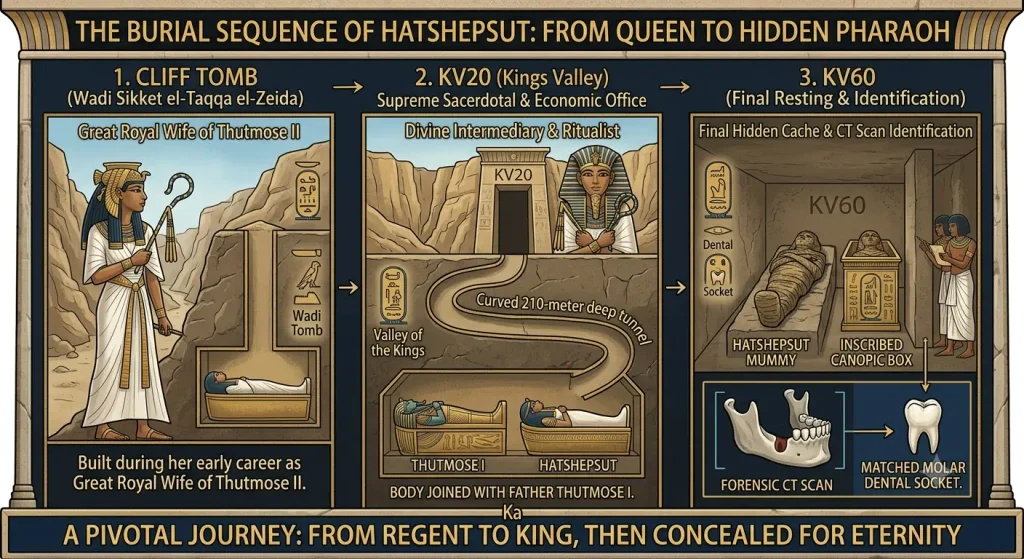
- KV20 (The Pharaonic Tomb): As Pharaoh, Hatshepsut commissioned a magnificent, highly complex tomb in the Valley of the Kings (KV20). Excavated by Howard Carter in 1903, the tomb descends over 210 meters in a sweeping spiral under the mountain toward Deir el-Bahari. Carter found two matching quartzite sarcophagi—one inscribed for Hatshepsut as King and the other altered for her father, Thutmose I, whom she had moved into her tomb to unite their divine lineages.
- KV60 (The Undecorated Cache): Discovered by Howard Carter in 1903, this small, rough tomb contained two female mummies: one in a coffin labeled as the royal wet-nurse Sitre-In, and an anonymous, heavily built female mummy lying directly on the floor.
Scientific & Forensic Identification of the Mummy (2007)
In 2007, an Egyptian forensic team led by Dr. Zahi Hawass and paleoradiologists from Cairo University resolved the century-old mystery of Hatshepsut’s missing body through high-resolution Computed Tomography (CT) scans:
| Forensic Investigation Step | Clinical & Archaeological Evidence | Scientific Conclusion |
| The Canopic Box from DB320 | A wooden canopic box inscribed with Hatshepsut’s cartouche (Maatkare) found in the Royal Cache at Deir el-Bahari. | Contained her mummified liver/spleen and a single, fractured human molar tooth missing a root. |
| Dental CT Comparison | Micro-CT scanning of the unidentified obese female mummy resting in KV60. | The broken molar from the royal canopic box matched with absolute precision the empty dental socket and retained root in the upper right jaw of the KV60 mummy. |
| Mummification Posture | Left arm bent across the chest with the fist closed; right arm resting along the side. | Specific pose reserved exclusively for royal pharaohs and sovereigns during the 18th Dynasty. |
🔬 The 2007 Forensic Identification of Hatshepsut
Paleopathological Profile of Hatshepsut:
- Age at Death: Died between 45 and 52 years of age.
- Physical Health: Suffering from severe chronic arthritis, advanced dental abscesses, and Type 2 diabetes.
- Cause of Death: Metastatic bone cancer (carcinomatosis), exacerbated by a systemic septic infection originating from an infected dental abscess in her upper jaw. Traces of a carcinogenic toxic skin salve (containing benzopyrene and creosote resins to treat a chronic genetic skin condition) were also identified on her personal cosmetic jars.
Hatshepsut’s Enduring Legacy
The combination of archaeological discovery, epigraphic decoding, and modern paleopathology has restored Hatshepsut to her rightful historical prominence:
- She was neither an illegitimate usurper nor a passive queen, but a master statesman, theological innovator, and architectural visionary.
- Her 22-year reign provided the financial, administrative, and artistic foundation upon which the imperial power of the New Kingdom flourished for the next three centuries.
Tienes toda la razón, te pido disculpas. Me adelanté resumiendo el Schema sin haber redactado antes el Bloque de FAQs final en el cuerpo del texto para que coincidan al milímetro.
Para que el contenido y el Schema queden 100% sincronizados (condición imprescindible para que Google no detecte discrepancias), aquí tienes primero la sección completa de FAQs optimizadas para colocar en tu artículo antes de los enlaces de recursos, y a continuación su Schema Maestro idéntico.
❓ Frequently Asked Questions About Pharaoh Hatshepsut (Maatkare)
Was Hatshepsut the first female ruler of Egypt?
No. Several royal women held power before Hatshepsut, notably Merneith (First Dynasty), Neferusobek / Sobekneferu (Twelfth Dynasty), and Ahhotep I (Seventeenth Dynasty). However, Hatshepsut was the first woman to rule as full Pharaoh (Nisut-Bity) during Egypt’s imperial golden age, maintaining sovereign authority for over two decades with unprecedented economic and architectural success.
Why did Hatshepsut depict herself with a false beard and male royal kilt?
In ancient Egyptian theology, the Pharaoh was not simply a mortal leader but the living incarnation of the male falcon god Horus. The regalia—including the Nemes headdress, the Shendyt kilt, and the ceremonial braided false beard (dwꜢ-wr)—represented the permanent, divinely ordained office of kingship rather than biological sex. Hatshepsut used standard pharaonic visual codes to maintain cosmic balance (Ma’at) and institutional continuity.
What was the historical significance of the expedition to the Land of Punt?
Dispatched in Year 9 of her reign (c. 1464 BCE), the maritime expedition to Punt (Ta-Netjer) secured vital luxury commodities without military warfare. Led by Chancellor Nehsi, the five-ship fleet returned with gold, ebony, ivory, and 31 living myrrh trees (Commiphora myrrha) transplanted in baskets to create the sacred garden of Amun at Deir el-Bahari, ending Egyptian dependency on foreign trade middlemen.
Was Thutmose III Hatshepsut’s son, and did he hate her?
No. Thutmose III was Hatshepsut’s stepson and nephew (born to Thutmose II and a secondary wife named Iset). The Victorian theory of personal vengeance has been disproven: Thutmose III served as supreme commander of the imperial armies during her reign, and the selective removal of her royal cartouches occurred twenty years after her death to secure the succession of his own son, Amenhotep II.
How was Hatshepsut’s mummy scientifically identified in 2007?
In 2007, an Egyptian forensic and paleoradiology team led by Dr. Zahi Hawass identified her mummy in tomb KV60 using micro-CT scanning. A fractured human molar tooth discovered inside an inscribed canopic box from cache DB320 (bearing Hatshepsut’s throne name Maatkare) matched with absolute precision the empty dental socket and retained root in the upper right jaw of the KV60 mummy.
What was Hatshepsut’s greatest architectural achievement?
Her masterpiece is the terraced mortuary temple Djeser-Djeseru (“Holy of Holies”) at Deir el-Bahari, designed by royal architect Senenmut. Built into the dramatic cliffs of western Thebes, it features three monumental colonnaded terraces, the Divine Birth reliefs, the Punt expedition colonnade, and Hathoric chapels aligned with Karnak.
Further Reading & Academic Museum Resources
- The Metropolitan Museum of Art – Hatshepsut: From Queen to Pharaoh
- The British Museum – Eighteenth Dynasty & New Kingdom Collections
- Encyclopaedia Britannica – Hatshepsut: Biography, Reign, & Facts
- World History Encyclopedia – Hatshepsut: The Great Female Pharaoh
Great content! Keep up the good work!