The Boy King of Ancient Egypt: Identity, Metrics, and Lineage
Tutankhamun (reigned c. 1332–1323 BCE), originally named Tutankhaten, was an Egyptian pharaoh of the Eighteenth Dynasty during the New Kingdom period. Ascending the throne at approximately eight or nine years of age, he earned the enduring historical epithet “The Boy King” (The Boy Pharaoh).
While his nine-year reign was historically defined by the systematic dismantling of his father Akhenaten’s religious revolution and the restoration of the traditional Amun priesthood at Thebes, Tutankhamun’s modern fame derives from the discovery of his nearly intact tomb (KV62) in the Valley of the Kings in 1922. The unprecedented preservation of his funerary equipment provided the most complete physical record of New Kingdom royal court culture, state religion, and burial ritual ever recovered.
Quick Identity & Bioanthropological Card of Tutankhamun
| Historical & Physical Parameter | Epigraphic, Archaeological & CT/DNA Data |
| Birth Name (Nomen) | Tutankhaten (Twt-ꜥnḫ-Jtn — “Living Image of Aten”); renamed Tutankhamun Heqaiunushem (Twt-ꜥnḫ-Jmn ḤqꜢ-Jwnw-šmꜥ — “Living Image of Amun, Ruler of Southern Heliopolis”) |
| Throne Name (Prenomen) | Nebkheperure (Nb-ḫpr.w-Rꜥ — “Lord of Manifestations is Ra”) |
| Dynasty & Period | 18th Dynasty, New Kingdom of Egypt (Late Bronze Age) |
| Regnal Chronology | c. 1332–1323 BCE (approx. 9–10 years) |
| Age at Accession / Death | Crowned at 8–9 years old; died at approximately 18–19 years old |
| Physical Height & Build | 1.67 meters (5 feet 6 inches); slight build with mild scoliosis and left-foot clubfoot (talipes equinovarus) |
| Parentage (DNA / KV55) | Son of Pharaoh Akhenaten (KV55 mummy) and the “Younger Lady” (KV35YL mummy, a biological sister of Akhenaten) |
| Royal Consort | Ankhesenamun (originally Ankhesenpaaten, his half-sister) |
| Key Regents / Administrators | Ay (Grand Vizier and successor) and General Horemheb (Commander-in-Chief of the Army) |
| Burial Site & Discovery | Tomb KV62, Valley of the Kings; discovered November 4, 1922, by Howard Carter and Lord Carnarvon |
Chronological Timeline of the Boy King’s Reign
| Year (BCE) | Historical Event | Sociopolitical & Religious Impact |
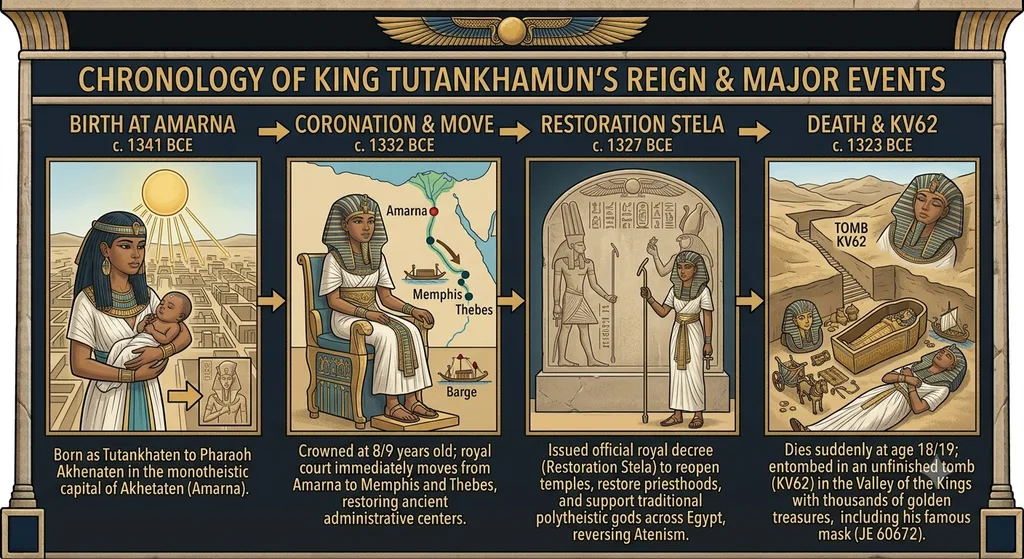
| c. 1341 | Birth at Akhetaten (Amarna) | Born as Prince Tutankhaten during the height of the Atenist monotheistic revolution. |
| c. 1332 | Coronation at Memphis | Ascends the throne at age 8/9; regency council governed by Ay and Horemheb. |
| c. 1330 | Rejection of Atenism & Renaming | Changes royal name to Tutankhamun; Queen becomes Ankhesenamun; abandonment of Amarna. |
| c. 1327 | The Restoration Stela | Official royal decree restoring the cults, properties, and revenues of Amun and the ancient pantheon. |
| c. 1325 | Military Operations in the Levant | Horemheb leads military campaigns against Hittite expansion in Syria and skirmishes in Nubia. |
| c. 1323 | Sudden Death of the King | Dies at age 18/19; hasty 70-day mummification and burial in unfinished tomb KV62; succeeded by Vizier Ay. |
The Amarna Aftermath and The Restoration Stela
Tutankhamun ascended the throne during one of the most volatile geopolitical and religious crises in Egyptian history. His father and predecessor, Pharaoh Akhenaten (KV55), had initiated the “Amarna Revolution,” a radical theological shift that sought to eliminate Egypt’s traditional polytheistic pantheon in favor of a single deity: the Aten (the deified sun disk). This centralization of divine power at the new capital, Akhetaten (Amarna), effectively dismantled the entrenched socioeconomic authority of the powerful priesthood of Amun-Ra at Thebes.
Reversing the Heresy: From Tutankhaten to Tutankhamun
The primary historical significance of the Boy King’s short reign lies in its total rejection of Akhenaten’s Atenist heresy and the deliberate restoration of traditional religious and political order.
- Abandonment of Amarna: While the court was initially established at Amarna, it was swiftly relocated to Memphis and Thebes, the historic political and religious capitals. This move signaled a decisive break from Akhenaten’s failed monotheistic experiment.
- Theophoric Name Change: To further solidify this return to orthodoxy, the King changed his birth name, Tutankhaten (“Living Image of Aten”), to Tutankhamun (“Living Image of Amun”). Similarly, his queen, Ankhesenpaaten, became Ankhesenamun (“Her Life is of Amun”). This semantic shift was a crucial act of public political propaganda, aligning the royal family with the newly restored supreme deity.
- The Restoration Stela: The central artifact documenting this theological pivot is the Restoration Stela (Cairo Museum, CG 34025). Erected by Tutankhamun and later usurped by Horemheb, the hieroglyphic text vividly describes the catastrophic state of Egypt under Akhenaten, stating that the temples were “ruined” and the land “forsaken by the gods.” The decree formally announces the reopening of the temples, the restoration of traditional priesthoods, and the reinvestment of royal revenues into the ancient cults.
The Power Behind the Throne: The Regency of Ay and Horemheb
Modern Egyptology emphasizes that the complex diplomatic and religious reversals during Tutankhamun’s decade of rule were orchestrated by a highly skilled regency council. Given the King’s extreme youth, executive authority was managed by two dominant figures:
Ay (Grand Vizier): Holding the prestigious title of God’s Father (an intimate familial connection to the royal house), Ay was a master administrator who served both Akhenaten and Tutankhamun, eventually succeeding the Boy King on the throne.
Horemheb (Commander-in-Chief): The preeminent military figure of the late 18th Dynasty, Horemheb commanded the national army. While focusing on restoring Egyptian military presence in the Levant against the rising Hittite threat, Horemheb was instrumental in enforcing the domestic transition back to Amunism.
The Discovery of Tomb KV62: Carter, Carnarvon, and the Four Chambers
Prior to 1922, many prominent archaeologists—including the American Theodore M. Davis—believed that the Valley of the Kings had yielded all its secrets and was essentially exhausted. However, British archaeologist Howard Carter, funded by his wealthy patron George Herbert, 5th Earl of Carnarvon, remained convinced that an intact royal burial belonging to the elusive 18th Dynasty pharaoh Tutankhamun remained hidden beneath the valley floor.
On 4 November 1922, Carter’s excavation team uncovered a carved limestone step beneath the remnants of ancient 20th-Dynasty workmen’s huts near the entrance to the tomb of Ramses VI (KV9). By 26 November, having cleared a 16-step descending staircase and a plaster-sealed corridor bearing the necropolis seal of the jackal and nine captives, Carter made a small breach in the inner doorway. Inserting a candle through the opening into the darkness, he was famously asked by Lord Carnarvon if he could see anything, to which he replied:
“Yes, wonderful things.”
The Archaeological Layout of KV62
Tomb KV62 was remarkably small for a New Kingdom pharaoh, suggesting it was originally cut for a high-ranking private official (possibly Vizier Ay) and hastily adapted for Tutankhamun following his unexpected death. Despite two minor intrusions by ancient grave robbers shortly after the burial, the inner chambers remained virtually undisturbed for over 3,200 years.
The tomb is architecturally divided into four distinct underground chambers:
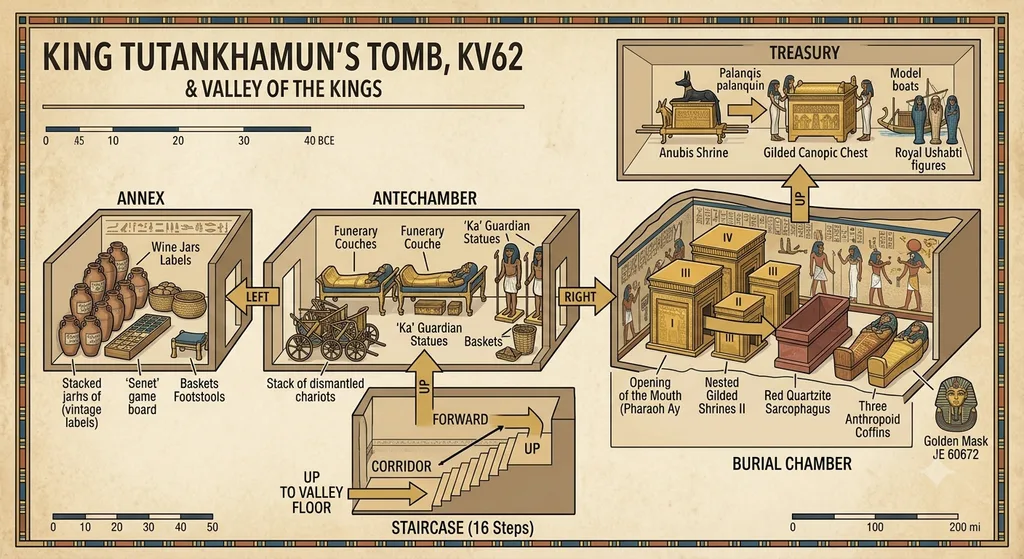
- The Antechamber: Discovered in an astonishing state of organized chaos, containing over 700 items including three large gilded animalistic funerary couches (representing the cow goddess Hathor, the hippopotamus Tauret, and the lioness/cheetah), dismantled royal chariots, ritual walking sticks, and alabaster cosmetic vessels.
- The Annex: Located off the southwest corner of the Antechamber, filled with provisions for the afterlife: dozens of sealed wine jars (amphorae) with vintage inscriptions, oil vessels, board games (Senet), baskets of food, and extra royal furniture.
- The Burial Chamber: The only plastered and painted room in the tomb. Its walls feature scenes of the Opening of the Mouth ceremony performed by Pharaoh Ay, the solar barque of Ra, and the King entering the underworld accompanied by Osiris. It housed four nested gilded wooden shrines enclosing a red quartzite sarcophagus and three nested anthropoid coffins.
- The Treasury: Guarded by a wooden statue of the jackal god Anubis lying on a gilded palanquin, this room contained the King’s most sacred ritual apparatus: the gilded Canopic Shrine (guarded by the four protective goddesses Isis, Nephthys, Neith, and Serqet), the royal ushabti figures, and a small box containing the mummified remains of two stillborn fetuses (Tutankhamun’s daughters).
The 5,398 Registered Treasures: Craftsmanship and Iconography
Carter spent a decade methodically clearing, cataloging, and conserving the 5,398 individual objects recovered from KV62 (registered in the Griffith Institute archives and now primarily housed in the Grand Egyptian Museum and the Egyptian Museum in Cairo).
- The Innermost Gold Coffin: While the two outer coffins were carved from wood and gilded with gold leaf and glass paste, the innermost coffin was hammered from heavy solid gold sheet (110.4 kilograms / 243 pounds of 22-carat gold), depicting the pharaoh holding the ceremonial crook (heqa) and flail (nekhakha).
- The Golden Mask of Tutankhamun (JE 60672): Weighing 10.23 kg (22.6 lb), this masterpiece of ancient metallurgy portrays the idealized face of the teenage king. Inlaid with lapis lazuli (eyebrows and eye cosmetics), obsidian, calcite, turquoise, and carnelian, the reverse side is inscribed with Spell 151b from the Book of the Dead, securing the protection of the King’s senses in the afterlife.
- The Golden Throne: A wooden chair overlaid with gold sheet, silver, colored glass, and faience. The backrest depicts an intimate Amarna-style scene where Queen Ankhesenamun tenderly anoints Tutankhamun with perfumed oil beneath the blessing rays of the Aten sun disk—a rare surviving artifact bridging both religious eras.
Inventory of the Four Chambers of KV62
| Chamber | Primary Function & Contents | Notable Masterpieces Found |
| Antechamber | Royal transport, ritual furniture, and court luxury goods. | Gilded ritual animal couches, dismantled state chariots, two life-sized wooden Guardian Statues (Ka figures). |
| Annex | Food supplies, oils, games, and household storage. | Senet board games, inscribed vintage wine jars, footstools with depictions of bound foreign captives. |
| Burial Chamber | The sacred core of royal mummification and divine protection. | Four nested gilded shrines, quartzite sarcophagus, solid gold coffin, and the iconic Golden Funerary Mask. |
| Treasury | Sacral and funerary ritual equipment for the journey to the Duat. | Anubis shrine on palanquin, gilded canopic chest with alabaster jars, model boats, royal ushabti army. |
Paleopathology: How Did the Boy King Die?
The sudden death of Tutankhamun at approximately 18 to 19 years of age has generated extensive scientific inquiry, forensic analysis, and historical debate. For decades, popular theories ranged from political assassination to systemic disease. Over the past two decades, comprehensive radiological scans, genetic analyses, and bioarchaeological studies have reconstructed a precise medical profile of the young monarch.
                   CHRONOLOGY OF MODERN FORENSIC INVESTIGATIONS

       1968: X-RAY STUDY              2005: CT SCAN STUDY           2010: KING TUT DNA PROJECT
 ┌───────────────────────────┐   ┌───────────────────────────┐   ┌───────────────────────────┐
 │ • Skull fragment observed │   │ • 1,700+ CT slices taken  │   │ • Genetic fingerprinting  │
 │ • Murder theory emerges   │──>│ • Murder theory dismissed │──>│ • Severe malaria verified │
 │   (blow to the head)      │   │ • Compound fracture in    │   │ • Severe inbreeding &     │
 │                           │   │   left femur identified   │   │   Köhler disease confirmed│
 └───────────────────────────┘   └───────────────────────────┘   └───────────────────────────┘
The Evolution of Forensic Theories
- The 1968 X-Ray Study (Harrison & Abdalla): The first modern radiological examination revealed a loose bone fragment inside the skull cavity and radiopaque density at the base of the cranium. This led to widespread speculation that Tutankhamun had suffered a fatal blow to the head, sparking popular theories of assassination orchestrated by Vizier Ay or General Horemheb.
- The 2005 Multi-Slice CT Scan: A joint Egyptian-international team led by Dr. Zahi Hawass and radiologist Dr. Ashraf Selim performed a high-resolution CT scan yielding over 1,700 cross-sectional images. The analysis conclusively demonstrated that the skull fragment was dislodged post-mortem—either during embalming (when resin was introduced through the nasal passage) or during Howard Carter’s 1925 team interventions when detaching the gold mask. The murder-by-craniocerebral-trauma hypothesis was definitively refuted.
- The Critical Discovery of the Distal Femur Fracture: The 2005 CT scan identified a severe, comminuted fracture above the left knee joint (distal femur). Unlike post-mortem damage caused by modern handling, this fracture showed evidence of embalming resin penetrating into the marrow cavity and irregular ragged edges with no signs of bone healing. This proved the break occurred shortly before death (ante-mortem or peri-mortem), resulting in a severe open wound vulnerable to acute septic shock or fat embolism.
The 2010 DNA and Bioanthropological Findings
In 2010, the Journal of the American Medical Association (JAMA) published the findings of the King Tutankhamun Family Project, a multidisciplinary study that integrated molecular genetics and paleopathology:
- Familial Inbreeding and Genetic Vulnerabilities: DNA profiling confirmed that Tutankhamun was the direct biological product of a full brother-sister union between Akhenaten (mummy from tomb KV55) and the unidentified royal woman known as the “Younger Lady” (KV35YL). This generational inbreeding resulted in congenital physical malformations, including a mildly cleft palate and significant orthopedic pathology.
- Orthopedic Pathologies & Köhler Disease II: The skeletal analysis confirmed severe Köhler disease II (avascular necrosis of the second and third metatarsal heads) in his left foot, combined with talipes equinovarus (clubfoot). This condition caused chronic pain, circulatory necrosis in the foot bones, and severe mobility impairment—explaining why over 130 ceremonial walking sticks showing genuine wear patterns were buried with him in KV62.
- Severe Plasmodium falciparum Infection: Genomic DNA extraction from the King’s bone tissue revealed the presence of specific DNA sequences of Plasmodium falciparum, the deadliest strain of the malaria parasite. Tutankhamun suffered from recurring, severe malaria infections that critically compromised his immune system.
Modern Egyptological Consensus on Cause of Death
The current scientific consensus rejects a single isolated catastrophe in favor of a multifactorial collapse:
- A vulnerable constitution resulting from multiple generations of royal sibling inbreeding.
- Chronic bone necrosis in the left foot requiring supportive canes for mobility.
- An acute, debilitating bout of Plasmodium falciparum malaria.
- A catastrophic compound fracture of the left leg (likely sustained in a fall or chariot accident), which rapidly developed into an uncontrollable, lethal bacterial infection (septicemia).
Summary of Major Forensic Studies on Tutankhamun’s Remains
| Year & Lead Study | Methodology Used | Primary Scientific Finding | Impact on Death Theory |
| 1968 (Harrison) | Conventional X-Ray radiography | Loose bone fragment inside cranium; dark mass at skull base. | Origin of the murder/blunt force trauma theory. |
| 2005 (Hawass et al.) | Multi-detector CT scanning (1,700+ slices) | Skull fragment proven post-mortem; open distal left femur fracture with resin ingress. | Dismissed assassination; identified acute peri-mortem leg trauma. |
| 2010 (Hawass, Gad, et al.) | Ancient DNA (aDNA) & MS-CT analysis | First-degree sibling parentage; Plasmodium falciparum malaria; Köhler disease. | Established multifactorial death (trauma + infection + compromised immunity). |
10 Essential & Interesting Facts About King Tutankhamun
10. His height was approximately 1.67 meters (5 feet 6 inches): Skeletal measurements from his mummy confirm he stood at roughly 167 cm, possessing a slight physical build consistent with late 18th-Dynasty royal anatomy.
1. He was crowned as a child: Tutankhamun ascended the throne of Egypt around 1332 BCE when he was only eight or nine years old, which is why he is universally known as the “Boy King” or “Boy Pharaoh.”
2. He changed his original name: Born Tutankhaten (“Living Image of Aten”), he changed his name to Tutankhamun (“Living Image of Amun”) in his third regnal year to formalize the return to Egypt’s traditional polytheism after his father Akhenaten’s religious experiment.
3. His parents were biological siblings: Genetic testing conducted in 2010 confirmed that his father was the “heretic king” Akhenaten (mummy KV55) and his mother was an unidentified biological sister of Akhenaten, known by archaeologists as the “Younger Lady” (mummy KV35YL).
4. He was physically frail and walked with a cane: Far from the invincible warrior depicted on royal reliefs, CT scans revealed he suffered from severe Köhler disease (bone necrosis in his left foot), a clubfoot, and mild scoliosis. His tomb contained over 130 walking sticks showing genuine wear.
5. His tomb was discovered almost intact in 1922: British archaeologist Howard Carter discovered tomb KV62 in the Valley of the Kings on November 4, 1922, funded by Lord Carnarvon. It contained over 5,398 cataloged treasures, making it the most complete royal burial ever recovered.
6. His golden mask is a global masterpiece: The famous death mask (artifact JE 60672) weighs 10.23 kilograms (22.6 pounds) of solid 22.5-carat gold inlaid with lapis lazuli, turquoise, obsidian, and carnelian, inscribed on the back with Spell 151b from the Book of the Dead.
7. He had a space dagger made from a meteorite: One of two daggers found strapped to his mummified body features an iron blade made from an extraterrestrial iron-nickel-cobalt meteorite, reflecting the sophisticated pyrotechnology of Bronze Age Egyptian craftsmen.
8. He died suddenly around age 18 or 19: While early 20th-century theories suggested he was murdered by a blow to the head, 2005 CT scans proved this damage occurred post-mortem. Modern consensus points to a fatal combination of a severe open fracture in his left femur, immune deficiency, and multiple bouts of virulent malaria (Plasmodium falciparum).
9. The “Curse of the Pharaohs” was a media myth: Following Lord Carnarvon’s death from an infected mosquito bite in 1923, sensationalist newspapers invented the curse. In reality, Howard Carter lived until 1939 (dying at age 64), and the average lifespan of the team members who opened the tomb was over 70 years.
Frequently Asked Questions About Tutankhamun
Who was the “Boy King” of ancient Egypt?
Tutankhamun (reigned c. 1332–1323 BCE) is universally known as the “Boy King” or “Boy Pharaoh” because he inherited the throne of Egypt’s 18th Dynasty during the New Kingdom at approximately eight or nine years of age. He ruled for roughly a decade before dying suddenly around age 18 or 19.
What is King Tutankhamun most famous for?
Tutankhamun is famous primarily for the discovery of his nearly intact tomb (KV62) in the Valley of the Kings by British archaeologist Howard Carter in November 1922. Unlike most royal tombs looted in antiquity, KV62 yielded over 5,398 pristine artifacts, including his iconic solid gold death mask, four gilded shrines, ceremonial chariots, and royal jewelry.
How tall was King Tut when he died?
Based on skeletal measurements and high-resolution multi-slice CT scans of his mummy, Tutankhamun stood approximately 1.67 meters (5 feet 6 inches) tall at the time of his death at age 18–19. He had a slender build, mild scoliosis, and a deformed left foot (talipes equinovarus / clubfoot).
What was King Tut’s real or birth name?
Tutankhamun was born Tutankhaten (Twt-ꜥnḫ-Jtn), meaning “Living Image of Aten,” during the reign of his father Akhenaten at the sun-worshipping capital of Amarna. In his third regnal year, he officially changed his name to Tutankhamun (“Living Image of Amun”) to signify the restoration of Egypt’s traditional polytheistic gods and the priesthood of Amun at Thebes.
How did King Tutankhamun die?
Modern forensic and paleopathological consensus (including the 2005 CT scan and 2010 DNA project) indicates Tutankhamun died from a multifactorial medical collapse:
- A severe, comminuted open fracture of his left distal femur (likely from a chariot accident or fall).
- Multiple virulent infections of Plasmodium falciparum malaria.
- Immune and physical vulnerabilities caused by generational royal inbreeding (his parents were biological siblings).The theory of murder by a blow to the head was disproven in 2005 when the skull damage was confirmed to be post-mortem.
What was found inside Tomb KV62?
Tomb KV62 contained over 5,398 registered archaeological objects distributed across four small underground chambers:
- The Golden Mask (JE 60672): A 10.23 kg solid gold funerary mask inlaid with lapis lazuli and semi-precious stones.
- The Innermost Coffin: Made of 110.4 kg of solid 22-carat gold.
- Royal Transportation & Weapons: Six dismantled chariots, bows, throwing sticks, and a celestial dagger forged from meteoritic iron.
- Personal & Ritual Gear: Over 130 ceremonial walking sticks, four nested gilded shrines, the gilded canopic chest guarded by four goddesses, and the jackal shrine of Anubis.
Was there really a “Curse of the Pharaohs” on King Tut’s tomb?
No. The “Curse of the Pharaohs” was a sensationalist myth fabricated by 1920s newspapers after the excavation sponsor, Lord Carnarvon, died in Cairo in April 1923 from an infected mosquito bite that developed into pneumonia and blood poisoning. Statistical studies prove the vast majority of people who entered the tomb lived long lives; lead discoverer Howard Carter died of natural causes in 1939 at age 64.
What are 5 quick facts about Tutankhamun?
Meteorite dagger: Buried with an iron dagger crafted from an extraterrestrial meteorite.
Crowned as a child: Ascended the throne at age 8 or 9.
Restored the gods: Issued the Restoration Stela returning Egypt to polytheism after Akhenaten’s Atenist heresy.
Physical disability: Required walking sticks due to clubfoot and bone necrosis (Köhler disease).
Intact burial: Tomb KV62 was discovered with over 5,000 golden artifacts in 1922.
Further Readings & Academic Web Resources
- The Griffith Institute (University of Oxford) – Tutankhamun: Anatomy of an Excavation (Howard Carter’s Complete Excavation Archives)
- The Grand Egyptian Museum (GEM) – The Complete Tutankhamun Collection
- The British Museum – Howard Carter and the Discovery of Tutankhamun’s Tomb
- Journal of the American Medical Association (JAMA) – Ancestry and Pathology in King Tutankhamun’s Family (2010 Study)
- Encyclopaedia Britannica – Tutankhamun: King of Egypt, Discovery of Tomb, & Facts