Who Was Ramses II?
Ramses II, also known as Ramses the Great, was the third pharaoh of Egypt’s Nineteenth Dynasty and ruled during the New Kingdom for about 66 years, c. 1279–1213 BCE. He is famous for his military campaigns, the Battle of Kadesh, the peace treaty with the Hittites, Abu Simbel, Pi-Ramesses, and his enormous building program.
Ramses II at a Glance
| Fact | Information |
|---|---|
| Full name | Ramesses II / Ramses II |
| Also known as | Ramses the Great |
| Dynasty | Nineteenth Dynasty |
| Period | New Kingdom |
| Reign | c. 1279–1213 BCE |
| Reign length | About 66 years |
| Father | Seti I |
| Mother | Tuya |
| Great Royal Wife | Nefertari |
| Famous for | Kadesh, Abu Simbel, diplomacy, monuments |
| Capital | Pi-Ramesses |
| Burial | KV7, Valley of the Kings |
| Date | Event |
|---|---|
| c. 1303 BCE | Birth of Ramses II |
| c. 1290s BCE | Becomes prince regent under Seti I |
| 1279 BCE | Becomes pharaoh |
| c. 1274 BCE | Battle of Kadesh |
| Later reign | Further conflicts with the Hittites |
| c. 1259 BCE | Egyptian-Hittite peace treaty |
| Later reign | Abu Simbel and major building projects |
| Late reign | Numerous Sed festivals and enormous royal family |
| 1213 BCE | Death of Ramses II |
| After death | Mummy eventually moved to the Deir el-Bahari cache |
Ramses II’s Reign at a Glance
From his accession to the throne to Kadesh, diplomacy with the Hittites, monumental construction and his death, these events shaped the legacy of Ramses the Great.
Birth of Ramses II
Ramses was born into the royal family during the later years of Egypt’s Nineteenth Dynasty.
Training for Kingship
As the son of Seti I, Ramses received military and administrative training that prepared him for royal power.
Ramses Becomes Pharaoh
After the death of Seti I, Ramses II ascended the Egyptian throne and began one of the longest reigns in ancient Egyptian history.
Beginning of a 60+ year reignA Powerful Kingdom
Ramses inherited a major Near Eastern power and worked to defend and strengthen Egypt’s influence.
Battle of Kadesh
Ramses confronted the Hittite king Muwatalli II near Kadesh in one of the most famous military encounters of the ancient Near East.
Military campaignThe Pharaoh as Hero
Egyptian monuments presented Ramses as a heroic victor, making Kadesh a central element of his royal image.
Diplomacy With the Hittites
Years of conflict eventually gave way to a formal diplomatic settlement between Egypt and the Hittite Empire.
Peace Treaty
The Egyptian-Hittite treaty became one of the earliest surviving examples of a formal international peace agreement.
Diplomacy & statecraftAbu Simbel
Ramses commissioned monumental temples and colossal statues that projected his authority throughout Egypt and Nubia.
Monumental architectureThe Great Builder
Temples, statues, palaces and other projects appeared across the Egyptian kingdom, leaving an enormous architectural legacy.
A Royal Family of Extraordinary Size
Ramses had numerous wives and children, creating one of the largest royal households known from ancient Egypt.
Dynasty & successionThe Great Royal Wife
Nefertari became one of the most famous queens associated with Ramses II and was honored at Abu Simbel and in her magnificent tomb.
Death of Ramses II
Ramses died after a reign of roughly six decades. His mummy was later moved and ultimately became one of the most famous royal mummies of ancient Egypt.
End of an extraordinary reignRamses the Great
His monuments, military image and diplomatic achievements ensured that Ramses II remained one of the most recognizable pharaohs in Egyptian history.
Ramses II: What the Ancient Sources Actually Tell Us
Ramses II is unusually well documented, but that does not mean that every story told about him can be taken at face value. Much of what survives was produced by the Egyptian royal court itself, and its purpose was not to write an impartial biography. Temples, inscriptions, reliefs, papyri, royal titulary, and diplomatic documents all helped construct an image of Ramses as a divinely favored king, victorious warrior, and guarantor of Egypt’s prosperity.
That distinction matters most when we examine the Battle of Kadesh. Egyptian inscriptions describe Ramses fighting almost alone against overwhelming Hittite forces and emerging victorious through the intervention of the god Amun. The surviving evidence, however, suggests a more complicated military outcome. The Egyptian version is therefore invaluable—but partly because it tells us not only what happened, but also how Ramses wanted the battle to be remembered.
The Main Primary Sources for Ramses II
| Primary source | Approximate date | What it tells us | Main limitation |
|---|---|---|---|
| Kadesh Poem | After Year 5 | Ramses’ version of the battle and his relationship with Amun | Royal propaganda and highly literary |
| Kadesh Bulletin | After Year 5 | A more structured Egyptian account of the campaign | Still presents the pharaoh from an Egyptian royal perspective |
| Egyptian-Hittite Peace Treaty | Year 21 | Diplomatic relations, obligations, peace and mutual assistance | Survives in Egyptian and Hittite traditions that must be read comparatively |
| Temple inscriptions and reliefs | Throughout the reign | Royal ideology, campaigns, building projects and titulary | Monumental propaganda emphasizes royal achievement |
| Statues and royal inscriptions | Throughout the reign | Titles, divine associations and political image | Designed to express kingship rather than private biography |
| Funerary and mummy evidence | Later periods | Burial history, physical remains and subsequent treatment of the king | Tells us little about many political events of his reign |
This combination of sources makes Ramses II one of the best-documented pharaohs of the New Kingdom. It also makes him an excellent case study in the difference between historical evidence and royal representation.
The Kadesh Poem: Ramses as the Hero of His Own History
The most famous source for Ramses II’s military career is the text conventionally known as the Poem of Kadesh. Versions of the composition were preserved in several monumental contexts, while a later hieratic copy survives on Papyrus Sallier III.
The narrative presents Ramses as the central actor in the battle against the Hittites. Separated from much of his army, the king describes himself as confronting the enemy while relying on the god Amun. The theological message is unmistakable: the pharaoh succeeds because he possesses exceptional courage and because the gods support legitimate Egyptian kingship.
The British Museum’s description of Papyrus Sallier III is especially useful here because it identifies the text as a literary account of the Battle of Kadesh and notes that the narrative attributes the Egyptian victory to Ramses, aided by Amun.
The important point is not simply whether the Poem is “true” or “false.” It belongs to a specific genre of royal representation. Its purpose was to celebrate the king’s courage, divine favor and military authority.
That makes the text valuable on two different levels:
- Historical evidence: it preserves information about the campaign, military organization, geography and the confrontation with the Hittites.
- Ideological evidence: it shows how Egyptian kingship presented military success to contemporary audiences.
Those two uses should never be confused.
What the Kadesh Texts Reveal About Royal Propaganda
The Kadesh inscriptions repeatedly place Ramses at the center of events. The king is not simply the commander of an army; he becomes the decisive force upon which Egyptian survival depends.
This is particularly revealing because the Egyptian army was actually a complex military organization involving multiple divisions, officers, chariot forces and allied contingents. The literary presentation compresses that complexity into a dramatic confrontation between the pharaoh and his enemies.
The result is a highly memorable political message:
The king personally protects Egypt because the gods have chosen him to do so.
This idea appears repeatedly in Egyptian royal art and inscriptions. Military success becomes evidence of divine legitimacy, while the king’s body and name become symbols of the stability of the entire state.
For a historian, therefore, the exaggeration is not simply an obstacle. It is itself evidence.
Kadesh: Victory, Stalemate or Strategic Failure?
The Battle of Kadesh is one of the clearest examples of why ancient royal inscriptions must be read critically.
Ramses’ monuments celebrate the battle as a personal triumph. Modern historians, however, generally do not treat the Egyptian account as proof of a decisive Egyptian victory.
The battle was fought against the Hittite king Muwatalli II around the fifth year of Ramses’ reign, probably around 1274–1275 BCE. Ramses entered the region of Kadesh with a major army divided into formations. Hittite deception contributed to the Egyptian forces becoming vulnerable, and the resulting battle was fierce and strategically complicated.
The Egyptian king survived and recovered the situation, but the wider political outcome was less straightforward than the monumental propaganda suggests.
A useful way to read the evidence is:
| Question | Royal Egyptian narrative | Historical interpretation |
|---|---|---|
| Did Ramses fight bravely? | Yes, emphatically | His forces did engage in a serious and dangerous battle |
| Did Egypt destroy the Hittite state? | The inscriptions imply overwhelming success | No |
| Was Kadesh an unquestionable Egyptian victory? | Yes, according to the royal narrative | The outcome is better understood as inconclusive |
| Did Ramses abandon his Syrian ambitions permanently? | Not immediately | Conflict continued before diplomacy eventually prevailed |
| Did Kadesh lead directly to peace? | No | The treaty came years later, after continued strategic competition |
The British Museum likewise notes that both sides claimed victory. That is precisely why Kadesh should be treated as a case of competing historical narratives, rather than reduced to the simple statement that Ramses “won the battle.”
The Egyptian-Hittite Treaty: A Different Kind of Evidence
The peace treaty concluded in the twenty-first regnal year of Ramses II is particularly valuable because it is fundamentally different from the Kadesh inscriptions.
Instead of presenting the king as a lone heroic warrior, the treaty records a negotiated political relationship between two great powers: Egypt and the Hittite kingdom.
The surviving Egyptian version was inscribed at places including Karnak and the Ramesseum. The agreement was originally formulated in Akkadian, the principal diplomatic language of the eastern Mediterranean and Near East, and a Hittite version also survives.
The treaty establishes peace and brotherhood between Ramses II and Hattusili III. It includes provisions concerning non-aggression, mutual relations and the return of political fugitives.
This document is extraordinarily important because it reveals something that the Kadesh inscriptions largely conceal: Ramses’ foreign policy was not simply a story of conquest.
Egypt eventually accepted a negotiated relationship with the Hittite superpower.
What the Treaty Tells Us About Ramses II
The treaty changes the way we understand Ramses’ reign.
A king who is presented in temple reliefs as the supreme conqueror could also participate in highly sophisticated international diplomacy. The Egyptian-Hittite agreement reflects a political world in which rulers negotiated, exchanged envoys, established dynastic relationships and attempted to regulate future conflict.
The treaty therefore provides a useful counterweight to the heroic language of Kadesh.
It also helps explain why Ramses II became such an important historical figure. His reign was not defined solely by battlefield success. He operated within a wider international system in which Egypt had to negotiate with other powerful states.
The Monumental Record: History Written in Stone
Ramses II’s temples add another layer of evidence.
At the Ramesseum, Karnak, Luxor and other sites, his name and image were reproduced on a massive scale. Reliefs depict military campaigns, religious ceremonies, divine encounters and royal victories. Statues present Ramses with idealized physical and divine associations.
The inscriptions on his colossal statue at the Ramesseum, for example, identify him through an elaborate royal titulary and connect his kingship with Amun-Ra. The British Museum notes that the inscriptions explicitly proclaim Ramses’ titles and divine relationship with Amun-Ra.
This is not biography in the modern sense.
A colossal statue does not tell us what Ramses thought privately, what ordinary Egyptians thought of him, or precisely how successful every military campaign was. It tells us how the Egyptian state wanted kingship to appear.
That distinction is essential.
A Simple Rule for Reading Ramses II’s Sources
When reading an inscription commissioned by Ramses, three questions are particularly useful:
1. What happened?
What historical event, institution, person or place does the source actually mention?
2. How is it presented?
What does the text exaggerate, omit or emphasize?
3. Why was it presented that way?
What political, religious or ideological purpose did the monument or document serve?
This approach produces a much more interesting portrait of Ramses II than simply repeating his official achievements.
He was certainly a long-reigning and exceptionally influential pharaoh. But his historical importance lies partly in the fact that he left behind such an enormous archive of royal self-representation.
The surviving evidence allows us to see Ramses both as a historical ruler and as a king who deliberately shaped his own memory.
Primary Sources at a Glance
For readers who want to go beyond modern summaries, several ancient sources are especially important:
- The Kadesh Poem — the Egyptian royal narrative of the Battle of Kadesh.
- The Kadesh Bulletin — a related Egyptian account of the campaign.
- The Egyptian-Hittite Peace Treaty — the diplomatic agreement between Ramses II and Hattusili III.
- Ramesseum inscriptions — evidence for Ramses’ royal ideology, titulary, military memory and monumental program.
- Karnak inscriptions — including the Egyptian version of the peace treaty.
- Papyrus Sallier III — a later hieratic manuscript preserving the Kadesh Poem.
Taken together, these sources allow us to move beyond the popular image of Ramses as simply “the greatest pharaoh” and examine how military power, diplomacy, religion and royal propaganda worked together during the nineteenth dynasty.
The Battle of Kadesh: Ramses II Against the Hittites
The Battle of Kadesh was one of the most important military confrontations of the Late Bronze Age and the defining battlefield episode of Ramses II’s reign. It was fought against the Hittite king Muwatalli II near the city of Kadesh, in the region of modern Syria, during the fifth year of Ramses’ reign.
What makes Kadesh particularly valuable to historians is not simply the battle itself. It is the unusually large body of evidence surrounding it. Ramses ordered an extensive account of the campaign to be carved on several temples, preserving both a narrative known as the Poem of Kadesh and a shorter military account usually called the Bulletin.
These Egyptian texts are among the most detailed surviving royal accounts of a Bronze Age battle. They are also propaganda.
That combination makes Kadesh unusually interesting. We can reconstruct important aspects of the campaign from the Egyptian material, but we also have to ask where the historical record ends and the royal presentation begins.
Why Did Ramses II Fight the Hittites?
Kadesh was part of a much larger struggle for influence in the Levant.
During the fifteenth and fourteenth centuries BCE, Egypt had established considerable political influence over territories in the Levant. By the time of Ramses II, however, the Hittite kingdom had become the dominant power in northern Syria and posed a direct challenge to Egyptian interests.
The city of Kadesh was strategically important because of its position in the Orontes region. Control of northern Syria was not simply a matter of possessing one city. It was connected with trade routes, political alliances and the balance of power between Egypt and the Hittite kingdom.
The confrontation was therefore not an isolated border clash.
It was part of a wider competition between two major states of the eastern Mediterranean and Near East.
| Egyptian interest | Hittite interest |
|---|---|
| Maintain influence in the Levant | Expand and preserve influence in Syria |
| Secure Egyptian client kingdoms | Control strategic Syrian territories |
| Challenge Hittite expansion | Prevent further Egyptian advances |
| Protect political and commercial networks | Strengthen the Hittite sphere of influence |
Kadesh should therefore be understood as a geopolitical conflict, rather than simply as an Egyptian invasion led by an ambitious king.
The Egyptian Army on the March
Ramses’ army advanced northwards toward Kadesh in several major divisions.
The Egyptian sources name four principal divisions:
- Amun
- Ra
- Ptah
- Seth
They were named after major Egyptian deities and represented substantial formations of the Egyptian army.
The arrangement was potentially dangerous because the divisions were not concentrated in a single compact formation. They were moving along the approach to Kadesh while the king’s position and the distance between units became increasingly important to the outcome of the campaign.
Ramses was with the Amun division when the critical events began.
The Egyptian sources portray the pharaoh as personally leading the army and moving ahead toward Kadesh. This is important because the dramatic structure of the surviving narrative depends upon the king becoming temporarily isolated from the main Egyptian force.
The Information That Changed the Battle
According to the Egyptian account, Ramses captured two Shasu scouts who claimed that the Hittite king Muwatalli was still far to the north, beyond Aleppo.
The information was false.
The Hittite army was actually positioned much closer to Kadesh.
The episode is one of the most important moments in the Egyptian narrative because it explains how Ramses’ army became vulnerable. The pharaoh acted on misleading intelligence and advanced before the other Egyptian divisions had fully joined him.
The account then has Egyptian officials informing Ramses of the supposed location of the Hittite king.
The king’s reaction is presented in dramatic terms.
He realizes that the Egyptian army has been placed in serious danger.
This episode also gives historians a rare glimpse into an ancient military problem that remains familiar: intelligence can determine the outcome of a campaign before the main armies even meet.
The Hittite Ambush
Muwatalli II had assembled a large force near Kadesh.
The Egyptian account describes the Hittite army emerging from concealment and attacking the Egyptian position. The first major target was the Ra division, which was moving toward the king’s location.
The resulting attack caused serious disruption.
The Egyptian army was suddenly confronted by a much larger enemy force than it had expected.
The Poem of Kadesh transforms this crisis into the central heroic moment of Ramses’ reign.
The king is depicted as being surrounded by enemy forces and separated from his supporting troops. Rather than retreating, he calls upon Amun and attacks.
This is where the distinction between the military event and the literary narrative becomes particularly important.
The Egyptian text does not merely describe a tactical engagement. It constructs a theological drama in which the pharaoh’s courage becomes the mechanism through which Egypt survives.
The Battlefield According to the Egyptian Narrative
A simplified reconstruction of the sequence looks like this:
                NORTH
                  ↑

          HITTITE FORCES
        ┌─────────────────┐
        │   Muwatalli II  │
        │  near Kadesh    │
        └────────┬────────┘
                 │
                 │ Hittite attack
                 ↓

       RA DIVISION
            ↓
     ┌─────────────┐
     │             │
     │   RAMSES    │
     │  AMUN DIV.  │
     │             │
     └─────────────┘
            ↑
            │
      PTah / Seth
      divisions
      approaching

                SOUTH
This diagram is necessarily simplified. The exact battlefield geography and sequence of movements remain subjects of scholarly discussion.
What matters is the basic strategic problem: Ramses’ forces were separated, while the Hittites were able to exploit the gap between Egyptian formations.
Ramses II’s Counterattack
The Egyptian account presents Ramses as responding with an aggressive counterattack.
The pharaoh attributes his strength to the god Amun and describes himself as fighting when his army is unable to support him.
The theological language is significant.
Egyptian royal ideology presented the pharaoh as the link between the human and divine worlds. A successful king did not simply possess military skill; he was expected to demonstrate that the gods supported legitimate kingship.
The Kadesh narrative therefore turns the battlefield into a test of divine favor.
Ramses’ survival becomes proof of his relationship with Amun.
His personal courage becomes proof of his fitness to rule.
His military success becomes proof of Egyptian legitimacy.
This explains why the account repeatedly emphasizes the king rather than the ordinary soldiers and commanders who would actually have determined much of the battle’s outcome.
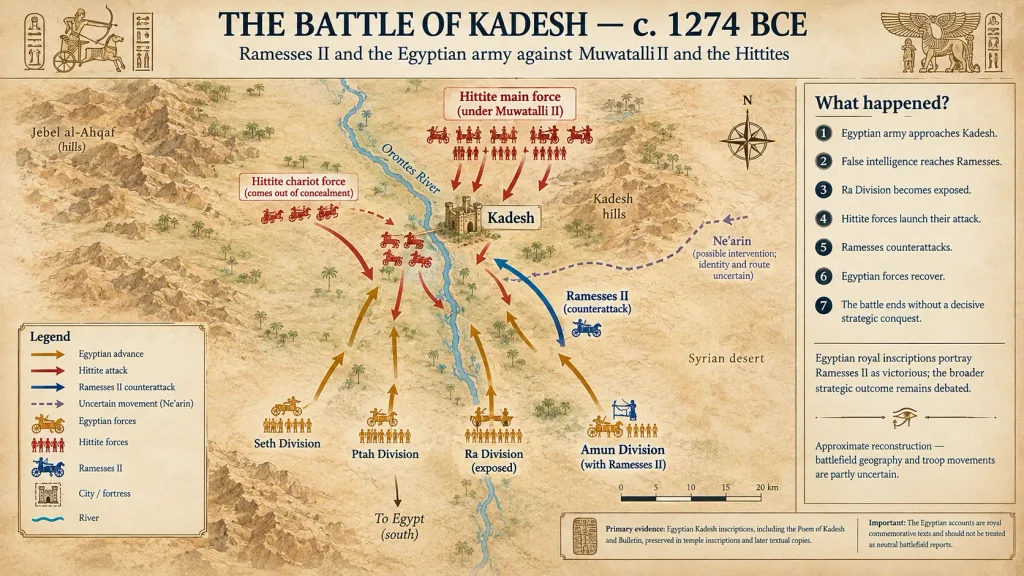
Did Ramses Really Fight Alone?
This is one of the most famous questions surrounding Kadesh.
The Egyptian literary account makes Ramses appear almost completely isolated. The pharaoh addresses Amun and describes himself as confronting the enemy without adequate support.
Taken literally, the episode would suggest that Ramses personally defeated an enormous enemy army.
Historians do not interpret the passage in such a straightforward way.
The pharaoh certainly participated in the fighting, and the Egyptian army appears to have launched a successful counterattack after the initial crisis. But the literary image of the king single-handedly saving Egypt belongs to the conventions of royal propaganda.
Ancient Egyptian kings routinely appeared in art and inscriptions as the decisive actor in military victories.
The army existed, but the ideological focus was the king.
This distinction is crucial:
Ramses’ personal participation in the battle is historical; the image of Ramses single-handedly defeating the Hittite army is a royal literary construction.
The difference between those two statements is precisely where historical analysis begins.
The Role of the Ne’arin
One of the more intriguing elements in the Egyptian account is the appearance of the Ne’arin, a military force that arrives during the crisis.
The precise identity and origin of the Ne’arin remain debated. They are often understood as a separate force associated with Egyptian military operations in the region, although scholars disagree about their exact composition and status.
Their arrival is important because it complicates the simplified image of Ramses fighting completely alone.
The Egyptian narrative emphasizes the pharaoh’s isolation because that makes his eventual recovery more dramatic. The broader military situation was almost certainly more complex.
This is a useful example of how ancient texts can simultaneously preserve information and shape it.
A source may tell us that a military unit was present while presenting its arrival in a way designed to magnify the king’s heroism.
Did Ramses II Win the Battle of Kadesh?
The safest answer is: not in the simple sense suggested by the Egyptian monuments.
Ramses represented Kadesh as a great personal victory. The monuments celebrated his courage and the destruction of his enemies.
But the larger strategic outcome was considerably less decisive.
The Hittite army was not destroyed.
Muwatalli II remained ruler of the Hittite kingdom.
Egypt did not permanently conquer the Hittite sphere of influence in northern Syria as a result of the battle.
Conflict between Egypt and the Hittites also continued after Kadesh.
For this reason, modern historians generally avoid describing Kadesh as an unequivocal Egyptian victory.
A more cautious interpretation is that Ramses survived a dangerous battlefield situation, recovered his position and claimed a major ideological victory, while neither side achieved a decisive strategic conquest.
Kadesh: What We Can Say With Confidence
| Question | Assessment |
|---|---|
| Did Egypt and the Hittites fight at Kadesh? | Yes |
| Was Muwatalli II the Hittite king? | Yes |
| Was Ramses personally present? | Yes |
| Did Egyptian forces suffer a serious surprise attack? | The Egyptian account strongly indicates this |
| Did Ramses recover from the crisis? | Yes |
| Did Egypt destroy the Hittite army? | No |
| Did Egypt permanently conquer Kadesh? | No |
| Was the battle an unequivocal Egyptian victory? | No |
| Did Ramses present it as a victory? | Absolutely |
This distinction between tactical survival, political outcome and royal propaganda is essential for understanding the battle.
The Kadesh Poem as a Historical Source
The Poem of Kadesh should not be dismissed simply because it is propaganda.
In fact, propaganda can preserve valuable historical information.
The text provides evidence about:
- the Egyptian military divisions;
- the names of political and military figures;
- the geographical setting;
- the movement of Egyptian forces;
- the relationship between intelligence and military decision-making;
- the Egyptian conception of kingship;
- the role of Amun in royal ideology;
- the way Ramses wanted his campaign remembered.
The historian’s task is to separate these layers.
The narrative is not a neutral battlefield report, but neither is it a fictional story disconnected from historical events.
It is a politically constructed account of a real military campaign.
The Kadesh Bulletin and the Poem
Two related Egyptian accounts are particularly important: the Poem and the Bulletin.
They overlap, but they are not identical.
| Feature | Kadesh Poem | Kadesh Bulletin |
|---|---|---|
| Style | Literary and dramatic | More concise and military |
| Focus | Ramses’ heroic struggle | Campaign and battlefield events |
| Divine intervention | Strongly emphasized | Present but less literary |
| Ramses’ isolation | Central to the narrative | Also emphasized |
| Main purpose | Celebrate royal heroism | Record and commemorate victory |
Reading the two together is more useful than relying on either one alone.
The repetition of certain details suggests that the Egyptian court considered the Kadesh episode especially important for Ramses’ public image.
The differences between the texts, meanwhile, demonstrate that the battle was being narrated through more than one literary format.
Kadesh in Temple Reliefs
The written accounts were reinforced by monumental art.
Scenes at temples such as the Ramesseum, Luxor and Karnak depict Ramses in battle, usually emphasizing his enormous scale compared with his enemies.
The visual language is deliberate.
The king is often shown:
- standing prominently above the battlefield;
- firing arrows from his chariot;
- attacking enemy soldiers;
- receiving divine protection;
- defeating foreign rulers;
- controlling the battlefield through his physical presence.
These images should not be interpreted as literal photographs of combat.
Egyptian artists were communicating hierarchy.
The pharaoh’s larger scale expressed his political and cosmic importance. The defeated enemy represented disorder; the victorious king represented ma’at, the principle of order and legitimate rule.
Kadesh was therefore transformed from a complicated military confrontation into a permanent statement about kingship.
Why Kadesh Mattered So Much to Ramses II
The extraordinary attention devoted to Kadesh tells us something important.
If the battle had been an uncomplicated military triumph, there would be little reason to emphasize Ramses’ personal struggle so intensely.
Instead, the campaign became a foundational episode in his royal identity.
Kadesh allowed Ramses to present himself simultaneously as:
- the courageous warrior;
- the protected son of Amun;
- the savior of his army;
- the legitimate ruler of Egypt;
- the conqueror of foreign enemies.
The battle therefore had a second life after the fighting ended.
Its historical outcome was one thing.
Its political meaning was another.
And its memory became something larger still.
From Battlefield to Royal Memory
REAL MILITARY EVENT
        ↓
Egyptian surprise and battlefield crisis
        ↓
Ramses' counterattack and recovery
        ↓
ROYAL NARRATIVE
        ↓
Ramses portrayed as heroic victor
        ↓
TEMPLE INSCRIPTIONS + RELIEFS
        ↓
Kadesh becomes part of Ramses' identity
        ↓
LATER HISTORICAL MEMORY
This process is one of the most important reasons Ramses II became known as Ramses the Great.
His reputation was not created only by what happened on the battlefield.
It was created by the systematic recording, monumentalization and repetition of his version of what happened.
The Historical Significance of Kadesh
Kadesh is sometimes described simply as a battle between Egypt and the Hittites.
That undersells its importance.
It is one of the best-documented military confrontations of the ancient Near East and provides rare evidence for Bronze Age warfare, military intelligence, chariot warfare, royal ideology and international politics.
It also demonstrates a fundamental problem in ancient history: the surviving evidence is often produced by the people who had the greatest political interest in controlling the story.
In the case of Ramses II, we are fortunate to possess an unusually rich record.
But abundance does not automatically mean objectivity.
The monuments tell us what Ramses wanted Egyptians and foreign audiences to remember.
The historian must then reconstruct what probably happened behind that carefully constructed image.
That is why Kadesh remains fascinating more than three thousand years later.
It was not simply a battle that Ramses II fought.
It was a battle that Ramses II turned into history.
Primary Sources for Kadesh
The most important ancient evidence includes:
- The Poem of Kadesh — preserved in monumental copies and in the later hieratic tradition of Papyrus Sallier III.
- The Kadesh Bulletin — a shorter Egyptian account associated with the campaign.
- Temple reliefs at Karnak — combining visual scenes with inscriptions describing the campaign.
- Luxor Temple inscriptions and reliefs — further evidence for the royal presentation of Kadesh.
- Ramesseum inscriptions and reliefs — monumental versions of Ramses’ military ideology and the Kadesh narrative.
These sources should be read together rather than treated as independent eyewitness reports. They were products of the Egyptian royal establishment and share a common political purpose.
Further Reading on the Battle of Kadesh
For a modern study grounded in the ancient evidence, useful starting points include the translations and editions of Egyptian texts by James B. Pritchard, Kenneth A. Kitchen and other Egyptologists working on the Ramesside period.
The original Egyptian material remains particularly valuable because Kadesh is one of those rare cases in ancient history where the primary sources themselves are central to the modern debate.
The Egyptian-Hittite Peace Treaty: Ramesses II and Hattusili III
The conflict between Egypt and the Hittite kingdom did not end at Kadesh. Fighting and political competition continued in the Levant, but by the twenty-first year of Ramesses II’s reign the two powers had reached a diplomatic settlement.
The agreement between Ramesses II and the Hittite king Hattusili III is one of the most important surviving diplomatic documents from the ancient Near East. It survives in both Egyptian hieroglyphic and Hittite cuneiform versions, allowing historians to study an international agreement from the perspective of both participating states.
It is often called the first peace treaty in history. That label is useful as shorthand but should be qualified. Earlier treaties and diplomatic agreements existed in the ancient Near East. What makes the Ramesses-Hattusili agreement exceptional is the unusually detailed text that survives from a formal treaty between two major independent powers.
From War to Diplomacy
The treaty was not an immediate consequence of the Battle of Kadesh.
After Kadesh, Egypt and Hatti continued competing for influence in Syria. The conflict produced no decisive Egyptian conquest of the Hittite kingdom, while the Hittites remained a major power in northern Syria.
The diplomatic situation changed after Hattusili III became king of Hatti. The treaty concluded in Year 21 of Ramesses’ reign formalized a new relationship between the two states.
A useful way to understand the transition is:
| Phase | Relationship between Egypt and Hatti |
|---|---|
| Before Kadesh | Competition for influence in Syria |
| Kadesh | Major military confrontation |
| After Kadesh | Continued rivalry and warfare |
| Hattusili III’s reign | Increasing diplomatic engagement |
| Year 21 of Ramesses II | Formal peace agreement |
| After the treaty | Dynastic and diplomatic relations |
The treaty therefore represents a change in strategy, not simply a ceremonial declaration that the previous war had ended.
What Did the Treaty Actually Promise?
The Egyptian version begins by establishing the relationship between Ramesses II and Hattusili III and invokes the gods of both countries as witnesses to the agreement.
Its central principle was mutual non-aggression.
The Egyptian text states that Ramesses would not attack the land of Hatti in order to take territory, while Hattusili similarly agreed not to attack Egypt. The treaty therefore established a reciprocal commitment rather than presenting Egypt as the victorious power dictating terms to a defeated enemy.
The agreement also included provisions concerning mutual assistance and the treatment of political fugitives.
This is one of the most revealing aspects of the document.
The treaty was not simply:
“We will stop fighting.”
It attempted to establish rules governing the future relationship between the two kingdoms.
The Treaty in Five Principles
The surviving clauses can be understood through five broad diplomatic principles:
- Non-aggression — neither king would invade the other’s territory.
- Mutual recognition — the rulers recognized each other as legitimate great kings.
- Military cooperation — the agreement provided for assistance if either ruler faced an external threat.
- Treatment of fugitives — political fugitives were not to become a source of conflict between the two states.
- Dynastic diplomacy — relations between the royal houses were strengthened through marriage and continued diplomatic contact.
This makes the document much more sophisticated than the modern phrase “peace treaty” might suggest.
It was effectively a framework for managing relations between two competing imperial powers.
The Fugitives Clause
One of the treaty’s most interesting provisions concerns people who fled from one kingdom to the other.
The agreement required the two powers to cooperate in returning fugitives rather than allowing them to remain permanently under the protection of the rival state.
This clause reveals something about how ancient states understood sovereignty.
A political fugitive was not simply an individual seeking safety. His presence could become a diplomatic problem.
If Egypt sheltered someone wanted by Hatti, or Hatti sheltered someone wanted by Egypt, the dispute could damage the entire relationship between the kingdoms.
The treaty therefore attempted to prevent relatively small political disputes from escalating into renewed interstate conflict.
The Gods as Witnesses
The treaty was not secular diplomacy in the modern sense.
The agreement invoked the gods of Egypt and Hatti as guarantors of the arrangement. Divine sanctions gave the treaty religious as well as political force.
This was fundamental to ancient Near Eastern diplomacy.
A treaty was not merely a document signed by two officials. It was an oath binding rulers under the authority of their gods.
The surviving Egyptian text consequently combines several different forms of language:
- political;
- legal;
- religious;
- dynastic;
- military.
That mixture reflects the nature of kingship itself.
The king represented the state, commanded its armies and acted as the principal intermediary between the political and divine worlds.
Egyptian and Hittite Versions
The existence of versions in both Egyptian and Hittite contexts is particularly important.
The Egyptian text is preserved in hieroglyphic inscriptions, while the Hittite version survives in cuneiform tablets from the Hittite capital, Hattusa. The diplomatic tradition was associated with an Akkadian version, reflecting the role of Akkadian as a major international language of the Late Bronze Age.
This creates an unusually valuable situation for historians.
Instead of possessing only one state’s account of an agreement, we have evidence from both sides.
That does not eliminate every ambiguity. Modern scholars continue to debate aspects of the treaty’s transmission and wording. But the parallel traditions provide a much stronger basis for interpretation than a single royal inscription would.
What the Treaty Reveals About the Balance of Power
The treaty is particularly revealing because of what it does not look like.
It does not read like the settlement imposed by a conqueror upon a destroyed enemy.
Hatti remained a powerful state.
Egypt remained a major power.
Neither kingdom disappeared as a result of the conflict.
The agreement instead reflects a recognition that continued warfare was less useful than negotiated coexistence.
A study published by the University of Chicago notes that the treaty established the two kingdoms on equal terms and brought the prolonged conflict to an end. It also preserves provisions concerning their respective spheres of interest.
This changes the way we should interpret Ramesses II’s foreign policy.
His reign cannot be reduced to military conquest.
The same king whose monuments celebrated Kadesh also accepted a diplomatic settlement with the power he had fought.
Why Did Egypt and Hatti Make Peace?
The treaty probably made sense for both sides because neither had achieved a decisive strategic victory.
For Egypt, prolonged campaigning in Syria consumed resources without producing permanent control over the northern Levant.
For Hatti, maintaining its Syrian sphere of influence also required military and political resources, while the Hittite kingdom faced pressures elsewhere.
Diplomacy offered both rulers a way to stabilize their positions.
The treaty therefore makes sense not as an act of sudden friendship, but as a rational response to a prolonged strategic stalemate.
The Treaty and Royal Marriage
Diplomatic relations between the two royal houses continued after the agreement.
Ramesses II eventually married a daughter of Hattusili III. Egyptian sources describe the marriage within the broader framework of the king’s diplomatic relationship with Hatti.
This was not simply a private marriage.
Royal marriage was an instrument of international politics in the Late Bronze Age.
A dynastic marriage could:
- reinforce an alliance;
- demonstrate trust between ruling houses;
- create family ties between rival monarchies;
- provide symbolic confirmation of a diplomatic settlement.
The marriage therefore complemented the written treaty.
The agreement established the political framework; dynastic connection reinforced it.
A Different Image of Ramesses II
The treaty forces us to reconsider the image of Ramesses II created by his monuments.
His temple reliefs emphasize:
- the warrior king;
- the conqueror;
- the protector of Egypt;
- the king favored by the gods.
The treaty reveals another dimension:
- negotiator;
- diplomatic partner;
- guarantor of international agreements;
- participant in a system of interstate law and royal diplomacy.
Neither image should simply replace the other.
They describe different aspects of the same reign.
The warrior image served royal ideology inside monumental and religious contexts. The treaty reflects the practical requirements of governing a major power in an international system.
Why the Treaty Matters
The importance of the Egyptian-Hittite treaty lies in its unusually detailed evidence for how powerful states attempted to regulate their relationship.
It demonstrates that Late Bronze Age diplomacy was not primitive or informal.
Great powers exchanged envoys, negotiated formal agreements, invoked divine guarantees, regulated fugitives, established mutual obligations and reinforced diplomacy through dynastic marriage.
The treaty also provides an important counterweight to the Egyptian narrative of Kadesh.
At Kadesh, Ramesses presented himself as the heroic victor.
In the treaty, the political language is different.
The emphasis is on reciprocity, permanence and mutual security.
That contrast is historically revealing.
The Treaty at a Glance
| Feature | Evidence from the treaty |
|---|---|
| Egyptian ruler | Ramesses II |
| Hittite ruler | Hattusili III |
| Date | Year 21 of Ramesses II |
| Main purpose | End prolonged Egyptian-Hittite conflict |
| Central principle | Mutual non-aggression |
| Diplomatic character | Agreement between two major powers |
| Religious element | Gods invoked as guarantors |
| Political fugitives | Regulated by treaty provisions |
| Dynastic diplomacy | Reinforced through royal marriage |
| Surviving traditions | Egyptian hieroglyphic and Hittite cuneiform |
| Historical significance | Exceptional evidence for Late Bronze Age international diplomacy |
The treaty is therefore one of the clearest pieces of evidence that Ramesses II’s reign cannot be understood solely through his battlefield monuments.
Kadesh created the memory of the warrior king.
The treaty reveals the diplomat.
Together, the two sources show a ruler operating in a world where military force and negotiation were not opposites. They were complementary instruments of state power.
Ramesses II and the International Politics of the Late Bronze Age
Ramesses II ruled Egypt at a time when the eastern Mediterranean and Near East were connected by an unusually dense network of powerful kingdoms. Egypt was not an isolated civilization at the edge of the ancient world. It was one of several great states competing, negotiating and exchanging goods, envoys and dynastic marriages across the region.
The diplomatic correspondence preserved in the Amarna Letters, although mostly dating to the reigns before Ramesses II, provides important background for understanding this international system. By the nineteenth dynasty, Egypt was operating within a political environment in which rulers of Egypt, Hatti, Babylonia, Assyria, Mitanni and other states communicated through established diplomatic conventions.
The reign of Ramesses II belongs to this wider world of Late Bronze Age international diplomacy.
Egypt Among the Great Powers
The political landscape of the eastern Mediterranean was dominated by several major kingdoms rather than a single imperial power.
| Power | Principal region | Relationship with Egypt |
|---|---|---|
| Egypt | Nile Valley, Nubia and southern Levantine sphere | Major regional power |
| Hittite Kingdom | Anatolia and northern Syria | Principal strategic rival |
| Babylonia | Mesopotamia | Diplomatic partner |
| Assyria | Northern Mesopotamia | Important emerging power |
| Mitanni | Northern Syria and Upper Mesopotamia | Former major rival and diplomatic partner |
| Cyprus / Alashiya | Eastern Mediterranean | Commercial and diplomatic contact |
These states did not interact according to a simple hierarchy.
A ruler might be described as a “great king” while another monarch was treated as an equal diplomatic partner. Correspondence could use familial language—kings addressing one another as “brother”—without implying an actual family relationship.
The diplomatic vocabulary itself reveals something important: the great powers understood themselves as members of a shared international system.
The Levant as a Zone of Competition
For Egypt, the Levant was particularly important.
The region connected Egypt with Syria, Anatolia and Mesopotamia and contained politically significant cities and kingdoms. Egyptian influence depended not simply on occupying territory but on maintaining relationships with local rulers.
This distinction is essential when discussing Egyptian imperial power.
An Egyptian king did not necessarily administer every territory under his influence in the same way that a modern state administers a province. Political control could involve:
- local rulers acknowledging Egyptian authority;
- payment of tribute;
- military intervention when alliances were threatened;
- Egyptian garrisons in strategic locations;
- diplomatic correspondence;
- dynastic relationships;
- control of important routes.
The result was a layered political system.
Egyptian power could be substantial without requiring direct administration of every settlement.
Amurru and the Politics of Syria
The kingdom of Amurru illustrates the difficulties faced by both Egypt and Hatti.
Situated in the northern Levant, Amurru became strategically important because of its position between competing spheres of influence.
Its rulers had to navigate the interests of larger powers, while Egypt and Hatti sought to secure their own position in the region.
This explains why cities and small kingdoms in Syria mattered disproportionately to the great powers.
A relatively small polity could become strategically valuable if its allegiance affected:
- military routes;
- access to inland Syria;
- communication between larger states;
- commercial networks;
- the political loyalty of neighboring rulers.
The struggle over Amurru therefore belonged to the same geopolitical environment that produced the confrontation at Kadesh.
But diplomacy could sometimes achieve what warfare could not.
Military Power Was Only One Instrument
Ramesses II is remembered primarily as a warrior king, but his foreign policy relied on several instruments simultaneously.
Military force could punish rebellion or demonstrate strength.
Diplomacy could stabilize relations with another great power.
Tribute and gift exchange could reinforce political relationships.
Dynastic marriage could turn a political agreement into a relationship between royal houses.
Monumental display communicated Egyptian power to both domestic and foreign audiences.
This combination is important because ancient diplomacy was not separate from military power.
Diplomacy worked partly because the states involved possessed armies capable of enforcing their interests.
Gifts, Tribute and the Language of Equality
Late Bronze Age diplomacy involved extensive exchanges of valuable objects.
Gold, silver, textiles, luxury goods and other commodities circulated between royal courts. These exchanges were not simply commercial transactions.
They could function as diplomatic gifts, payments or markers of political status.
The distinction between a gift and tribute was politically important.
A subordinate ruler might be expected to provide tribute to a dominant power. A great king, by contrast, could exchange gifts with another great king while maintaining the language of equality.
This diplomatic system is visible in the broader corpus of Late Bronze Age correspondence and helps explain the formal language used by Egyptian and Hittite rulers.
The exchange of wealth was therefore part of international politics.
Royal Marriage as Foreign Policy
Marriage was another diplomatic instrument.
The marriage of Ramesses II to a daughter of Hattusili III after the peace agreement illustrates the political importance of dynastic relationships.
The Egyptian sources emphasize the significance of the Hittite princess entering the Egyptian royal household. The marriage did not replace the treaty; it reinforced the political relationship established by it.
Royal marriage could serve several purposes:
- Confirm an alliance.
- Demonstrate trust between ruling houses.
- Create personal bonds between monarchs.
- Give diplomatic agreements a dynastic dimension.
- Signal stability to other powers.
It is important not to interpret such marriages through modern assumptions about private romantic relationships.
In the political culture of the Late Bronze Age, the royal household was an institution of statecraft.
Egypt and Babylonia
The relationship between Egypt and Babylonia provides another example of great-power diplomacy.
Egyptian and Babylonian rulers participated in a system in which kings exchanged correspondence and diplomatic gifts. Their interactions were not primarily defined by direct military confrontation.
The contrast with Hatti is revealing.
Egypt could confront one great power militarily while maintaining diplomatic relations with another.
Foreign policy was therefore not a single strategy applied uniformly to every neighboring state.
It was a collection of relationships, each governed by its own political circumstances.
A Network Rather Than a Pyramid
It is tempting to imagine the ancient Near East as a pyramid with Egypt at the top.
The surviving evidence suggests something more complicated.
The great kingdoms formed a network.
                    HATTI
                      │
            ┌─────────┼─────────┐
            │         │         │
        AMURRU     SYRIA     ANATOLIA
            │
            │
          EGYPT ───── BABYLONIA
            │             │
            │             │
          NUBIA        MESOPOTAMIA
This is not a territorial map. It is a simplified representation of political relationships.
The important feature is the number of connections.
Egypt’s international position depended on relationships with multiple states simultaneously. A crisis in one region could alter the calculations of rulers elsewhere.
Why the Levant Could Not Simply Be Abandoned
Egypt’s interest in the Levant was not merely ideological.
The region provided a strategic buffer between Egypt and northern powers.
Control or influence in southern Syria and Canaan could help protect Egypt’s northeastern approaches. At the same time, maintaining Egyptian influence required resources, military campaigns and cooperation with local rulers.
This created a recurring strategic problem.
The farther Egyptian armies moved into Syria, the more difficult it became to maintain secure supply lines and reliable political alliances.
The political geography of the Levant therefore placed limits on Egyptian military power.
This helps explain why diplomacy became increasingly important during the later stages of Ramesses’ reign.
The Balance of Power After Kadesh
The long-term significance of Kadesh becomes clearer when viewed from this wider perspective.
Neither Egypt nor Hatti had eliminated the other as a great power.
The two kingdoms remained capable of threatening one another, but neither could easily impose a permanent settlement through military conquest.
A negotiated balance was therefore more sustainable.
The peace between Ramesses II and Hattusili III should be understood as an expression of this balance of power.
It did not mean that Egypt suddenly became peaceful or that Ramesses abandoned military activity.
It meant that one of the most dangerous interstate rivalries of his reign had been converted into a regulated diplomatic relationship.
Diplomacy as a Sign of Strength
The treaty and subsequent royal marriage also complicate the modern image of diplomacy as something that happens only after military failure.
For an ancient ruler, negotiating from a position of strength could itself demonstrate power.
Ramesses could present the peace as evidence of his greatness because the agreement preserved Egypt’s status as a major kingdom.
The Hittites could do the same.
Both royal courts had an interest in presenting the agreement as compatible with their own prestige.
This is why the diplomatic language of the treaty matters.
Neither side needed to describe itself as defeated.
The political objective was not humiliation.
It was stability.
The Wider International System
The reign of Ramesses II therefore belongs to a period in which international politics had reached a remarkable degree of institutional complexity.
Diplomatic practices included:
- formal treaties;
- royal correspondence;
- diplomatic envoys;
- gift exchange;
- dynastic marriages;
- extradition agreements;
- military alliances;
- recognition of royal status.
These practices did not create a modern international law system. The ancient Near East remained a world in which warfare, conquest and political coercion were normal.
But the existence of formal rules and conventions shows that interstate relations were not governed by force alone.
The same ruler could be a warrior, diplomat, treaty partner and dynastic patron depending on the political circumstances.
What This Tells Us About Ramesses II
Seen within the international system of the Late Bronze Age, Ramesses II appears less like an isolated conqueror and more like a ruler managing a complicated balance of power.
His military campaigns demonstrated Egypt’s ability to project force.
His monuments advertised that power.
His diplomacy helped preserve it.
His royal marriages strengthened political relationships.
His treaty with Hatti reduced the danger posed by Egypt’s most important rival.
These were not separate aspects of his reign.
They were interconnected tools of kingship.
The historical importance of Ramesses II therefore lies partly in his ability to combine warfare, diplomacy, dynastic politics and royal ideology over an exceptionally long reign.
That broader perspective also helps explain why his reputation survived.
The image of Ramesses as “the Great” was created not by one battle or one monument, but by decades of political activity across Egypt and the wider Near East.
Ramesses II the Builder: Architecture, Power and Memory
Ramesses II left behind one of the most extensive monumental records of any Egyptian pharaoh. Temples, colossal statues, reliefs and inscriptions bearing his name appear across Egypt and Nubia, creating the impression of a ruler who was constantly building.
The scale is real, but the historical question is more interesting than simply asking how many monuments Ramesses constructed.
His building program was a political system.
Architecture allowed the king to make his presence permanent, associate himself with the gods, commemorate military achievements and present his reign as an age of order and prosperity. A temple was therefore not merely a religious building, and a colossal statue was not simply a portrait.
They were instruments through which royal power was made visible.
A Building Program With Several Purposes
Ramesses’ monuments served different functions, often simultaneously.
| Function | How monumental architecture served it |
|---|---|
| Religious | Connected the king with major Egyptian gods |
| Political | Demonstrated royal authority across the kingdom |
| Military | Commemorated campaigns and victories |
| Dynastic | Preserved the king’s name and royal lineage |
| Territorial | Projected Egyptian power into Nubia and the southern frontier |
| Memorial | Created a durable record of the king’s reign |
| Ideological | Presented the pharaoh as guarantor of cosmic order |
This is why the monuments should not be studied individually.
Taken together, they formed a geographical network of royal representation.
A traveler moving through Egypt and Nubia encountered the same king repeatedly: in colossal statues, temple reliefs, inscriptions and divine scenes.
The result was a carefully constructed landscape of kingship.
Abu Simbel: Monumental Power on the Southern Frontier
The temples of Abu Simbel are perhaps the most recognizable monuments associated with Ramesses II.
Built in Nubia, they were not simply expressions of religious devotion. Their location was politically significant.
The temples stood within a region where Egypt projected power southward and where monumental architecture could communicate the authority of the Egyptian king.
The Great Temple is dominated by four colossal seated figures of Ramesses II carved into the rock façade.
Their scale is the message.
The visitor does not encounter Ramesses as an ordinary human ruler. The monument presents him as an enormous, enduring presence integrated into the sacred landscape.
Inside, reliefs reinforce this message through representations of Ramesses, the gods and royal military achievements.
The monument therefore combines several dimensions of kingship:
King → Warrior → Divine partner → Builder → Protector of Egypt
This is why Abu Simbel belongs in the history of political communication as much as in the history of Egyptian architecture.
Abu Simbel as a Political Statement
The location matters almost as much as the architecture.
Egyptian monumental construction in Nubia communicated the presence of the Egyptian state beyond the Nile Valley. Temples and royal images transformed territory into political space.
The message was not necessarily directed at one specific group.
It could be understood by:
- Egyptian officials;
- local elites;
- Nubian populations;
- foreign visitors;
- priests;
- soldiers;
- future generations.
The monument therefore operated at several levels simultaneously.
The Ramesseum: A Temple to Ramesses’ Eternal Memory
On the west bank of the Nile at Thebes, Ramesses built what modern scholarship calls the Ramesseum, his great memorial temple.
Its ancient name was Usermaatre Setepenre is Joined with Thebes, reflecting the temple’s role within the religious landscape of western Thebes.
The Ramesseum was designed to sustain the king’s cult after his death.
This makes it fundamentally different from a modern monument erected simply to commemorate a historical figure.
In ancient Egypt, the continued existence of the king’s name, image, offerings and cult formed part of the mechanism through which royal memory was maintained.
The temple therefore connected three things:
ROYAL NAME
     ↓
DIVINE CULT
     ↓
ETERNAL MEMORY
Ramesses was not merely asking future generations to remember him.
The institution was designed to make his presence ritually active.
That distinction is important.
A modern memorial represents someone who is absent.
A royal mortuary temple was intended to maintain a relationship between the deceased king, the gods, priests and the living community.
Karnak and Luxor: Building Within Older Sacred Landscapes
Ramesses II also added to major temple complexes at Karnak and Luxor.
This is particularly revealing because he was not always creating monuments on untouched ground.
He was inserting himself into sacred landscapes that already contained the monuments and memories of earlier rulers.
At Karnak, additions associated with Ramesses contributed to the monumental environment dedicated principally to Amun and the Theban religious tradition.
At Luxor, Ramesses’ additions included a monumental pylon and colossal statues.
This created an architectural conversation between generations of kings.
The underlying political message was subtle:
Ramesses belonged within the established history of Egyptian kingship.
By building beside earlier rulers, he could simultaneously inherit their legitimacy and compete with their memory.
The Colossus and the Politics of Scale
Colossal statuary is one of the defining features of Ramesses II’s monumental image.
The statues do not attempt to reproduce an ordinary human body at realistic scale.
Their purpose was ideological.
Scale creates hierarchy.
A colossal king dominates the surrounding architectural space, while smaller human figures appear subordinate. Divine associations and royal titulary reinforce the same hierarchy through text.
The result is a visual grammar that can be summarized simply:
| Visual element | Political meaning |
|---|---|
| Colossal scale | Exceptional royal power |
| Idealized body | Permanent kingship |
| Royal regalia | Legitimate authority |
| Divine association | Sacred status |
| Inscription | Control of royal identity |
| Temple setting | Connection with the gods |
This explains why statues mattered even when they were not directly connected to a specific military event.
The statue itself was an argument about who possessed authority.
Ramesses and the Reuse of Earlier Monuments
One of the more complicated aspects of Ramesses’ building program is his reuse and alteration of earlier monuments.
In some cases, earlier royal names were removed or replaced with those of Ramesses. Other monuments were incorporated into new architectural contexts.
This practice was not unique to Ramesses II.
Ancient Egyptian rulers frequently modified earlier monuments.
But in Ramesses’ case, the scale of construction means that the practice is particularly visible.
The historian therefore has to distinguish between:
- a monument commissioned entirely under Ramesses;
- a monument substantially modified under Ramesses;
- an earlier monument reused by Ramesses;
- an object whose original attribution has been altered or remains uncertain.
This distinction matters because simply saying that Ramesses “built” everything bearing his name can produce a misleading picture.
His monumental legacy was partly the product of construction, modification, appropriation and monumental expansion.
The Ramesseum and the Memory of Kadesh
The building program also provided a permanent setting for the military narratives discussed earlier.
Scenes associated with Kadesh were incorporated into monumental contexts where the battle could be repeatedly presented to audiences.
This transformed a historical event into a component of sacred royal memory.
The sequence was powerful:
MILITARY CAMPAIGN
       ↓
ROYAL NARRATIVE
       ↓
TEMPLE RELIEF
       ↓
RITUAL SPACE
       ↓
PERMANENT ROYAL MEMORY
The battle was no longer confined to the moment in which it occurred.
It became part of the physical environment through which later generations encountered Ramesses.
Architecture therefore extended propaganda across time.
Pi-Ramesses: A Royal Capital
Ramesses II was also associated with the development of Pi-Ramesses, the royal residence in the eastern Nile Delta.
The city became an important political center during the nineteenth dynasty and reflected the strategic importance of the northeastern Delta.
Its location placed the royal court closer to the routes connecting Egypt with the Levant.
This had practical advantages.
A ruler whose foreign policy required sustained attention to the northeastern frontier benefited from having a major royal residence in the Delta rather than concentrating the entire political apparatus farther south.
Pi-Ramesses therefore illustrates a different dimension of Ramesses’ monumental policy.
Abu Simbel projected royal power into Nubia.
The monuments of Thebes embedded Ramesses within Egypt’s religious and dynastic tradition.
Pi-Ramesses placed the royal court closer to Egypt’s northeastern geopolitical environment.
The building program consequently followed the strategic geography of the kingdom.
Nubia and the Architecture of Egyptian Authority
Ramesses’ construction activity in Nubia was extensive.
Temples and royal monuments were established or expanded at several locations, including Abu Simbel and other important sites.
These monuments should not all be interpreted in exactly the same way.
Some were associated with major cult centers.
Others reinforced royal presence in strategically important regions.
Together, however, they contributed to a visible architecture of Egyptian authority.
The pattern is significant:
Northern Egypt → Delta → Nile Valley → Upper Egypt → Nubia
The king’s monuments connected different regions to the same royal identity.
This was particularly valuable in a territorial state whose political geography stretched far beyond the immediate environment of the royal court.
Why Did Ramesses Build So Much?
There was no single reason.
The scale of Ramesses’ construction program can be explained through several overlapping priorities.
1. Religious obligation
Temples were places where the gods were served and where the king demonstrated his role as intermediary between divine and human worlds.
2. Royal legitimacy
New monuments established the king within the continuous tradition of Egyptian kingship.
3. Political communication
Colossal statues and inscriptions made royal authority visible to large audiences.
4. Military commemoration
Campaigns could be transformed into permanent monumental narratives.
5. Territorial integration
Temples and royal images reinforced Egyptian authority in distant regions.
6. Dynastic memory
A monument bearing the king’s name could preserve his identity long after his death.
The building program therefore served both the present and the future.
Architecture as a Form of Historical Writing
Modern historians often think of history as something written in books.
Ancient Egyptian kings also wrote history—but they frequently wrote it in stone.
A temple wall could combine:
- text;
- image;
- geography;
- ritual;
- genealogy;
- military narrative;
- royal titulary.
The result was not history in the modern academic sense.
It was royal historical memory.
The distinction is essential.
A relief showing Ramesses defeating enemies does not tell us exactly what an ancient battle looked like. It tells us how the Egyptian state wanted military victory and kingship to be understood.
Architecture therefore becomes a historical source precisely because it reveals the political priorities of its creators.
Reading Ramesses II’s Monuments Critically
A useful approach is to treat every monument as both an archaeological object and a political statement.
Ask four questions:
| Question | What it reveals |
|---|---|
| Who commissioned it? | Royal authority and institutional context |
| Where was it built? | Religious and geopolitical priorities |
| What images appear? | Ideological messages |
| What texts accompany them? | Official interpretation of events |
A fifth question is equally important:
What existed before Ramesses arrived?
This can reveal whether the king was creating something new, expanding an established sacred center or inserting his identity into an older monument.
That question prevents us from turning the entire monumental landscape into a simple list of “things Ramesses built.”
The Monumental Legacy of Ramesses II
The extraordinary survival of Ramesses II’s reputation is partly explained by the physical durability of the strategy he employed.
Kings died.
Political circumstances changed.
Dynasties disappeared.
But temples remained.
Colossal statues remained.
Inscriptions remained.
Even when later rulers modified or reused parts of these monuments, the name of Ramesses continued to appear across the Egyptian landscape.
His monumental program therefore achieved something that military victories alone could not.
It gave his reign a physical afterlife.
That is one reason Ramesses II became one of the most recognizable pharaohs in modern scholarship and popular culture.
His fame is not simply the product of what he did during his lifetime.
It is also the result of how successfully he turned his kingship into architecture.
Ramesses II’s Monumental Strategy at a Glance
                 RAMSES II
                     │
        ┌────────────┼────────────┐
        ↓            ↓            ↓
     RELIGION     POLITICS      MEMORY
        │            │            │
      Temples      Statues      Inscriptions
        │            │            │
        └────────────┼────────────┘
                     ↓
             ROYAL LANDSCAPE
                     ↓
        POWER MADE VISIBLE IN SPACE
                     ↓
          MEMORY PRESERVED IN STONE
The monuments of Ramesses II should therefore not be reduced to evidence that he was simply a prolific builder.
They reveal a ruler who understood that political power had to be seen, repeated and remembered.
His temples made the king visible before the gods.
His statues made him physically dominant within the landscape.
His inscriptions controlled the interpretation of his reign.
And his monumental network connected distant parts of Egypt and Nubia to a single royal identity.
For Ramesses II, architecture was not an accessory to kingship.
It was one of the principal ways in which kingship itself was performed.
Ramesses II and Nefertari: Royal Marriage, Power and Memory
Nefertari was the most prominent royal woman associated with Ramesses II and one of the best-documented queens of the Egyptian New Kingdom. Her importance, however, should not be reduced to the fact that she was the wife of a famous pharaoh.
As Great Royal Wife, Nefertari occupied a highly significant position within the royal household and participated in the religious and ideological presentation of kingship. Her name and image appear prominently in monuments connected with Ramesses II, most famously at Abu Simbel and in her extraordinary tomb in the Valley of the Queens.
The evidence suggests that Nefertari was not simply an ornamental figure placed beside the king.
Her monuments present her as a queen with her own religious identity, titles and symbolic importance.
At the same time, the surviving evidence does not allow us to reconstruct every aspect of her political activity. Egyptian royal inscriptions were designed to communicate ideals of kingship and queenship, not to provide modern biographies.
The most useful approach is therefore to examine what Nefertari’s titles, monuments and images actually reveal.
Who Was Nefertari?
Nefertari was one of the principal wives of Ramesses II and is generally identified as his Great Royal Wife, the highest-ranking queen within the royal household.
Her full titulary emphasized her royal status and her relationship with the gods. One of the titles associated with her was Mistress of the Two Lands, a formulation that placed her within the ideological vocabulary of Egyptian queenship.
Unlike many Egyptian queens whose historical presence is known primarily from isolated inscriptions, Nefertari is represented across several major monuments.
This gives historians an unusually rich body of evidence.
| Evidence | What it tells us |
|---|---|
| Royal titles | Her formal position within the monarchy |
| Abu Simbel | Her religious and dynastic representation |
| Tomb QV66 | Her funerary beliefs and elite status |
| Inscriptions | Her relationship with gods and royal ideology |
| Family evidence | Her place within Ramesses’ large royal household |
But the evidence must be interpreted carefully.
A monument tells us what the Egyptian state wanted to communicate about Nefertari. It does not automatically tell us what she privately thought, how much political influence she exercised, or what her daily relationship with Ramesses was like.
That distinction separates historical analysis from later romantic storytelling.
The Great Royal Wife
The title Great Royal Wife was more than a description of marriage.
Egyptian kings could have multiple wives and consorts, but the Great Royal Wife occupied a distinctive ideological position.
She was closely connected with the royal family, religious symbolism and the reproduction of dynastic legitimacy.
The queen could participate in ceremonies and appear in contexts associated with major deities, particularly goddesses whose identities were connected with motherhood, kingship and cosmic order.
This meant that royal marriage had a public and ideological dimension.
A pharaoh’s queen was part of the presentation of the monarchy itself.
Nefertari’s prominence therefore tells us something about the way Ramesses’ court represented royal femininity.
She was presented not merely as the king’s spouse but as an important participant in the sacred order surrounding the monarchy.
Nefertari at Abu Simbel
One of the clearest expressions of Nefertari’s importance is the smaller temple at Abu Simbel.
The temple was dedicated principally to the goddess Hathor, while Nefertari was associated prominently with the goddess in the temple’s religious program.
This is significant because royal queens could be connected symbolically with divine feminine figures.
At Abu Simbel, Nefertari’s identity is therefore constructed through a combination of:
- queenship;
- motherhood;
- religious authority;
- royal legitimacy;
- association with Hathor.
Her monumental representation also provides an important comparison with Ramesses himself.
The Great Temple of Abu Simbel presents Ramesses through enormous royal images.
The smaller temple presents Nefertari on a different scale but with exceptional prominence for a queen.
The two monuments together create a carefully organized royal partnership:
                 RAMSES II
                     │
          ┌──────────┴──────────┐
          ↓                     ↓
     GREAT TEMPLE          TEMPLE OF HATHOR
          │                     │
      Royal power            Nefertari
      and kingship        and divine queenship
          │                     │
          └──────────┬──────────┘
                     ↓
             ROYAL IDEOLOGY
This does not mean that Ramesses and Nefertari possessed identical political authority.
It means that the monumental program presented their roles as complementary.
Why Was Nefertari Associated With Hathor?
Hathor was one of the most important goddesses in ancient Egyptian religion.
Her associations included:
- femininity;
- motherhood;
- music and celebration;
- sexuality and fertility;
- the protection of the dead;
- royal legitimacy.
Her relationship with queenship made her an especially appropriate divine figure for a royal woman.
At Abu Simbel, the connection between Nefertari and Hathor strengthened the ideological role of the queen.
Nefertari was not simply depicted as a woman accompanying the king.
She was presented within a religious framework that gave her an active symbolic role.
This is one reason the Abu Simbel temple is so important for understanding Egyptian queenship.
It demonstrates how the identity of a queen could be constructed through relationships with the divine world.
QV66: Nefertari’s Extraordinary Tomb
Nefertari’s tomb, QV66, in the Valley of the Queens is one of the most remarkable surviving royal tombs from ancient Egypt.
Its decoration is exceptionally elaborate.
The walls contain scenes and texts connected with Nefertari’s journey through the afterlife and her relationship with the gods.
The quality of the decoration reflects her exceptional status.
Rather than treating the tomb simply as an artistic masterpiece, however, it should be understood as a religious document.
Its decoration was intended to participate in the transformation of the deceased queen and her successful passage into the afterlife.
The images and texts therefore tell us about Egyptian beliefs concerning:
- death;
- regeneration;
- divine protection;
- the afterlife;
- the identity of the deceased queen.
Nefertari’s tomb is particularly valuable because it allows us to see royal funerary ideology from the perspective of a queen rather than exclusively through the monuments of the king.
The Book of the Dead and Nefertari’s Afterlife
Some of the imagery in QV66 belongs to the wider tradition of funerary literature commonly associated with the Book of the Dead.
The term “Book of the Dead” can be misleading if understood as the title of one fixed book.
Egyptian funerary papyri contained collections of spells and illustrations whose purpose was to help the deceased navigate the afterlife.
Tomb decoration could employ related religious concepts.
Nefertari’s tomb presents her encountering gods and divine beings who participate in her journey.
The message is clear:
Nefertari remains a person of exceptional status even after death.
Her royal identity does not disappear at the entrance to the afterlife.
Instead, it becomes part of her eternal identity.
Nefertari and the Royal Family
Ramesses II had a large royal household, and Nefertari was not his only wife.
This is important when interpreting their relationship.
Later popular culture often turns Ramesses and Nefertari into a conventional romantic couple, but the historical evidence does not allow such a simple reconstruction.
Royal marriage in ancient Egypt was simultaneously personal, dynastic, religious and political.
The Great Royal Wife occupied one particular position within that system.
Nefertari’s prominence indicates that she was especially important, but it does not mean that she was the only woman in the king’s household or that every aspect of court politics revolved around her.
The royal family was much larger and more complicated.
Nefertari’s Children
Nefertari was the mother of several children of Ramesses II, although reconstructing the entire royal family is complicated by the enormous number of sons and daughters associated with the king.
The best-known children connected with Nefertari include Amun-her-khepeshef and Meritamen, among others.
Meritamen later became an important royal woman in her own right and appears in monumental representations associated with her father.
The succession history also illustrates an important point.
The eldest surviving son was not automatically guaranteed to become pharaoh.
Ramesses II outlived many of his older sons.
His eventual successor was Merenptah, one of his later sons.
This is one reason the sheer size of Ramesses’ family should not be confused with a straightforward succession system.
Nefertari’s Political Role: What Can We Actually Prove?
This is where caution is especially important.
Nefertari clearly possessed high status.
She was the Great Royal Wife.
She received major monumental representation.
She had an extraordinarily elaborate tomb.
She participated in the ideological presentation of the monarchy.
There is also evidence for diplomatic correspondence associated with her relationship with the Hittite royal household.
But these facts do not allow us to reconstruct a modern political biography.
We should avoid claims that Nefertari personally directed Egyptian foreign policy, controlled the administration or functioned as a co-ruler unless specific evidence supports such statements.
The surviving evidence is strongest when discussing her institutional and religious status.
It becomes much weaker when attempting to reconstruct her private influence.
That distinction is crucial.
Nefertari and the Hittite Royal Court
The diplomatic relationship between Egypt and the Hittite Empire changed dramatically during Ramesses II’s reign.
After years of conflict, Egypt and Hatti established a formal peace agreement.
Royal women participated in the diplomatic culture surrounding this new relationship.
Nefertari is associated with correspondence to Puduhepa, the influential queen of the Hittite king Hattusili III.
The surviving letters are valuable because they show royal women participating in the diplomatic language of the Late Bronze Age.
They should not be interpreted as evidence that queens operated completely independently of their husbands.
Instead, they demonstrate that elite women could occupy recognized positions within international royal diplomacy.
The correspondence also reveals something larger about the ancient world.
Diplomacy was not conducted exclusively through armies and male kings.
Royal households themselves were part of the international political system.
Nefertari as a Diplomatic Figure
The correspondence between the Egyptian and Hittite courts provides a different perspective on Nefertari from the monumental evidence.
A temple presents an idealized image.
A diplomatic letter shows communication between royal institutions.
Together, the sources provide a more nuanced picture.
Nefertari’s correspondence belongs to a wider tradition in which royal women could exchange gifts, greetings and diplomatic messages.
This does not necessarily make them independent foreign-policy actors.
But it does demonstrate that the women of royal households could participate in the practical relationships connecting different courts.
That is an important distinction.
Ancient diplomacy was a network of institutions.
The king, queen, officials, scribes and messengers could all contribute to maintaining relationships between royal courts.
Nefertari occupied one of those positions.
Ramesses and Nefertari as a Royal Partnership
The monuments associated with Ramesses and Nefertari repeatedly emphasize complementary forms of royal identity.
Ramesses represents the king as:
- warrior;
- ruler;
- builder;
- protector;
- intermediary with the gods.
Nefertari represents the queen through:
- Great Royal Wife;
- mother;
- religious participant;
- royal consort;
- divine association.
This should not be interpreted as equality in the modern political sense.
The pharaoh remained the central figure of Egyptian kingship.
But the prominence of Nefertari shows that royal power was not represented exclusively through the male king.
Queenship was itself an important institution.
Why Is Nefertari So Historically Important?
Nefertari matters because her surviving evidence allows historians to examine several dimensions of New Kingdom society at once.
She provides evidence for:
- Royal queenship
- Religious ideology
- Funerary beliefs
- Dynastic representation
- International diplomacy
- The organization of the royal household
- The relationship between royal women and divine symbolism
Her monuments also demonstrate how carefully the Egyptian monarchy could construct the public identity of an individual queen.
Nefertari was remembered because the state invested in remembering her.
That investment is itself historical evidence.
Nefertari Beyond the Romantic Image
Modern popular culture often portrays Nefertari primarily as the beloved wife of Ramesses II.
There is nothing wrong with recognizing the personal dimension of royal marriage, but the historical evidence is much richer.
Nefertari was a political institution as well as a royal individual.
Her titles placed her within the hierarchy of the Egyptian monarchy.
Her temple connected her with Hathor.
Her tomb presented her eternal existence among the gods.
Her diplomatic correspondence connected her with another royal court.
Her children linked her to the future of the dynasty.
These dimensions are more historically significant than an unprovable reconstruction of her romantic relationship with Ramesses.
What Nefertari’s Monuments Tell Us About Egyptian Queenship
Nefertari’s monuments provide an unusually clear demonstration of how queenship functioned in the New Kingdom.
The queen could be simultaneously:
Wife + Mother + Religious Figure + Dynastic Symbol + Diplomatic Participant
None of these identities existed independently.
They reinforced one another.
Her position as Great Royal Wife strengthened her dynastic importance.
Her association with Hathor reinforced her religious identity.
Her children connected her to royal succession.
Her diplomatic correspondence placed her within the international royal network.
Her tomb transformed these identities into an eternal funerary image.
This is why Nefertari deserves to be studied as a historical figure in her own right rather than simply as an appendix to the biography of Ramesses II.
Primary Sources for Nefertari
| Source | Historical value |
|---|---|
| Abu Simbel, Temple of Hathor | Evidence for royal queenship and Nefertari’s religious representation |
| QV66 | Evidence for funerary ideology and Nefertari’s elite status |
| Nefertari’s royal titles | Evidence for her institutional position |
| Egyptian-Hittite correspondence | Evidence for women’s participation in international royal diplomacy |
| Representations of her children | Evidence for dynastic and family relationships |
These sources should be read together rather than treated as independent biographies.
The temple shows how the monarchy represented her.
The tomb shows how her eternal identity was constructed.
The diplomatic correspondence reveals a different dimension of royal life.
Together, they provide a far more reliable picture than later legends.
Nefertari’s Place in the Legacy of Ramesses II
Ramesses II is remembered primarily as a pharaoh.
Nefertari survives in historical memory for a different reason.
She represents one of the clearest surviving examples of the status that an elite Egyptian queen could achieve during the New Kingdom.
Her tomb remains one of the most extraordinary royal funerary monuments in Egypt.
Her representations at Abu Simbel demonstrate the importance of royal women in monumental ideology.
Her diplomatic connections reveal that queens belonged to the wider international world of Late Bronze Age courts.
And her children connect her directly to the dynastic structure of the nineteenth dynasty.
Nefertari therefore adds an essential dimension to the story of Ramesses II.
The pharaoh’s reign cannot be understood solely through armies, temples and inscriptions celebrating the king.
It also depended upon a royal household in which queens, children, priests, officials and foreign courts all participated.
Nefertari stood near the center of that world.
Her surviving monuments do not allow us to hear her private voice.
But they do allow us to see how the Egyptian monarchy wanted the Great Royal Wife of Ramesses II to be remembered.
And that memory was anything but incidental.
Nefertari’s Historical Significance at a Glance
                 NEFERTARI
                     │
        ┌────────────┼────────────┐
        ↓            ↓            ↓
    QUEENSHIP     RELIGION    DIPLOMACY
        │            │            │
 Great Royal      Hathor      Hittite Court
    Wife           QV66       Correspondence
        │            │            │
        └────────────┼────────────┘
                     ↓
             DYNASTIC MEMORY
                     ↓
             NEW KINGDOM QUEENSHIP
Nefertari’s importance ultimately lies in the convergence of these roles.
She was a Great Royal Wife, a mother within one of Egypt’s most powerful royal households, a figure of religious symbolism and a participant in the diplomatic culture of the Late Bronze Age.
Her surviving monuments preserve not simply the image of a famous queen, but evidence for how Egyptian kingship itself was constructed through relationships between men, women, gods, families and foreign courts.
Ramesses II’s Family and Children: Wives, Sons and Succession
Ramesses II had one of the largest royal families known from ancient Egypt. Ancient sources and archaeological evidence associate him with numerous wives, consorts, sons and daughters, with the Egyptian National Museum of Egyptian Civilization describing his family as including around 100 children.
That number is impressive, but it can also be misleading.
The most important historical question is not simply how many children Ramesses II had. It is how his enormous royal household functioned, which members were given prominence, and how the succession eventually passed to Merenptah after Ramesses’ unusually long reign.
Ramesses survived many of his older children. As a result, the succession of the nineteenth dynasty was not simply a matter of the king’s eldest son automatically becoming pharaoh.
His family history reveals something fundamental about Egyptian kingship: royal succession depended on survival, status, political legitimacy and the circumstances of the royal household.
How Many Children Did Ramesses II Have?
The traditional figure associated with Ramesses II is around 100 children, although the exact number is difficult to establish with complete certainty.
The evidence comes from monuments, tombs, inscriptions and representations of royal family members.
Ramesses’ children were not all equally important.
Some appear prominently in royal monuments.
Others are known primarily through inscriptions or funerary evidence.
Still others remain difficult to identify securely.
This means that the figure of approximately 100 children should be understood as an indication of the extraordinary scale of Ramesses’ family rather than as a perfectly documented census.
| Question | Historical answer |
|---|---|
| Did Ramesses II have many children? | Yes |
| Is the number 100 certain? | It is a traditional approximate figure |
| Were all his children equally important? | No |
| Did his eldest son succeed him? | No |
| Who eventually succeeded Ramesses? | Merenptah |
| Why did succession change? | Ramesses outlived several older sons |
The enormous size of the family was partly a consequence of Ramesses’ exceptionally long reign.
A ruler who remained on the throne for roughly six decades had time to see several generations of his family emerge.
Ramesses II’s Wives
Ramesses II had several wives and consorts, but two women stand out particularly strongly in the surviving evidence:
- Nefertari
- Isetnofret
Nefertari was the Great Royal Wife whose monuments and tomb make her one of the most recognizable queens of ancient Egypt.
Isetnofret was another highly important royal woman and the mother of several children who became significant within the dynasty.
Other women were also part of Ramesses’ enormous royal household, including foreign princesses connected with Egypt’s diplomatic relationships.
The existence of multiple royal wives should not be interpreted through modern assumptions about marriage.
Royal marriage in ancient Egypt was closely connected with dynastic reproduction, status, diplomacy and religious ideology.
The royal household was therefore simultaneously a family, a political institution and a mechanism of dynastic continuity.
Nefertari and Isetnofret
The prominence of Nefertari sometimes overshadows Isetnofret.
That is understandable because Nefertari’s tomb and the temple at Abu Simbel provide exceptionally spectacular evidence.
But Isetnofret was also extremely important.
Her children included members of the royal family who played major roles during and after Ramesses’ reign.
Among them was Merenptah, who eventually became pharaoh.
This makes Isetnofret particularly important when studying succession.
The family tree cannot therefore be reduced to Ramesses and Nefertari.
A more accurate model is:
                    RAMSES II
                        │
          ┌─────────────┼─────────────┐
          ↓             ↓             ↓
      NEFERTARI     ISETNOFRET     OTHER ROYAL
          │             │            WOMEN
          │             │
     Several sons    Several sons
      and daughters  and daughters
          │             │
          └─────────────┼─────────────┘
                        ↓
                LARGE ROYAL HOUSEHOLD
This structure helps explain why succession was complicated.
There were many possible royal heirs.
Amun-her-khepeshef: The Crown Prince
One of the most prominent sons of Ramesses II was Amun-her-khepeshef, who is often identified as the king’s eldest son during the early part of his reign.
He appears in royal representations and was associated with the position of heir.
His importance is especially visible in monuments connected with Ramesses’ family.
But Amun-her-khepeshef did not become pharaoh.
He died before his father.
His death is one of the reasons the eventual succession of Ramesses II became so complicated.
The expected heir was gone.
Other princes consequently moved through the hierarchy of royal succession.
This is an important reminder that the Egyptian monarchy did not operate according to a simple rule in which the firstborn son inevitably inherited the throne.
The survival of the designated heir mattered enormously.
Why Didn’t Ramesses II’s Eldest Son Become Pharaoh?
The simplest answer is that Ramesses II outlived him.
Amun-her-khepeshef died during Ramesses’ reign, meaning that the succession passed to another generation of royal sons.
This pattern repeated.
Several older sons of Ramesses II died before their father.
As the decades passed, younger princes moved closer to the position of heir.
The succession therefore developed almost as a moving line through the enormous royal family.
This was unusual mainly because Ramesses lived so long.
A shorter reign would have produced a very different succession history.
His longevity transformed the normal dynamics of dynastic inheritance.
The Tomb of the Sons of Ramesses II
One of the most extraordinary archaeological discoveries associated with Ramesses’ family is KV5 in the Valley of the Kings.
The tomb was constructed for several sons of Ramesses II and became one of the largest and most complex tombs in the valley.
Its significance goes beyond its size.
KV5 provides archaeological evidence for the scale of Ramesses’ royal family.
The tomb contained numerous chambers and corridors associated with royal princes.
Its investigation has also helped archaeologists reconstruct relationships within the nineteenth dynasty.
KV5 therefore offers a different kind of evidence from the monumental temples.
A temple tells us how the king presented his family publicly.
A royal tomb provides evidence for how members of that family were incorporated into the funerary system.
Together, these sources reveal the institutional scale of Ramesses’ dynasty.
Royal Children as Political Figures
The sons of Ramesses II were not simply children in the modern sense.
Royal princes could perform official roles.
They could appear in military contexts, participate in ceremonies and occupy important positions within the state.
Some were associated with the army.
Others became priests or administrators.
Their public appearances reinforced the idea that the king had a large and capable dynasty behind him.
This mattered politically.
The royal family represented continuity.
It demonstrated that the monarchy possessed heirs.
It also allowed the king to place members of his household within different institutions of the Egyptian state.
The family was therefore part of the machinery of government.
Meritamen: A Prominent Royal Daughter
Among Ramesses II’s daughters, Meritamen is one of the most prominent.
She was associated with Nefertari and became an important royal woman during her father’s reign.
Meritamen appears in monumental representations and held significant titles.
Her prominence demonstrates that royal daughters could also have an important public role.
They were not simply invisible members of the palace.
Royal daughters could participate in religious symbolism, appear in monumental programs and contribute to the dynastic image of the monarchy.
Their importance varied, however, and the surviving evidence does not allow us to reconstruct the personal lives of most royal daughters in detail.
Foreign Princesses and Royal Diplomacy
Ramesses II also married foreign princesses, particularly in the context of his relationship with the Hittite Empire.
After the Egyptian-Hittite peace agreement, the marriage of a Hittite princess to Ramesses became part of the diplomatic relationship between the two kingdoms.
Such marriages were not unusual in the international politics of the Late Bronze Age.
They could formalize relationships between royal courts and reinforce diplomatic agreements.
But the marriage should not be interpreted as evidence that Egypt became culturally or politically subordinate to the Hittite Empire.
Instead, it was part of the diplomatic language of two major powers negotiating a stable relationship.
Royal marriage could therefore function as an extension of foreign policy.
The Royal Household and Succession
The size of Ramesses’ family created both strength and complexity.
On one hand, numerous children meant that the dynasty possessed many potential heirs.
On the other hand, a large number of princes could make the hierarchy of succession difficult to follow.
The succession can be simplified as a process:
RAMSES II
   │
   ├── Amun-her-khepeshef
   │       ↓
   │     Dies before his father
   │
   ├── Other older princes
   │       ↓
   │     Several die before Ramesses
   │
   └── Merenptah
           ↓
      Becomes Pharaoh
The important point is that Merenptah was not simply the obvious first choice from the beginning of Ramesses’ reign.
His eventual accession was the product of a long reign in which older heirs died before the king.
Who Was Merenptah?
Merenptah was one of the later sons of Ramesses II and eventually succeeded him.
By the time Merenptah became king, Ramesses II had already ruled for approximately six decades.
Merenptah was therefore considerably older than the typical new heir might have been in a shorter-lived dynasty.
His accession illustrates one of the unusual consequences of Ramesses’ longevity.
The pharaoh’s extraordinarily long reign meant that succession occurred unusually late.
Merenptah inherited not simply a throne but the legacy of one of Egypt’s most monumental rulers.
His reign also demonstrates that the nineteenth dynasty continued after Ramesses II rather than ending with his death.
Why Did Ramesses II’s Family Matter Politically?
The royal family helped communicate stability.
A king with numerous sons and daughters could present himself as the head of a powerful dynasty with a future.
The family also provided personnel for important religious and administrative roles.
Royal princes and princesses could appear in temples and ceremonies, reinforcing the visibility of the dynasty.
But there was another dimension.
The family became part of Ramesses’ monumental memory.
His children appear in the architecture and inscriptions associated with his reign.
This transformed the royal household into part of the historical record.
The king was not represented only as an individual.
He was represented as the head of a dynasty.
Family, Memory and Monumental Representation
Ramesses repeatedly presented members of his family in monumental contexts.
This had several effects.
First, it documented dynastic continuity.
Second, it established the status of particular royal family members.
Third, it connected the king’s reign with future generations.
Fourth, it created a permanent visual record of the royal household.
This is particularly important because the family was so large.
The monuments did not attempt to represent every child equally.
They selected particular individuals.
That selection itself can provide evidence for hierarchy.
When a prince or princess appears repeatedly in royal monuments, historians can ask why that individual was important at that particular moment.
The answer may involve succession, religious office, military status or royal motherhood.
Did Ramesses II Really Have 100 Children?
Probably not in the sense that we can document exactly 100 individual children with complete certainty.
The approximate figure is useful because it communicates the exceptional size of his family, and ancient and modern sources commonly associate Ramesses II with around 100 sons and daughters.
But historians should avoid treating the number as a precise demographic statistic.
Ancient Egyptian records were not designed to provide a complete modern-style family register.
Some individuals are securely identified.
Others are known only through fragments of evidence.
Some relationships remain debated.
The safest conclusion is therefore:
Ramesses II had an exceptionally large royal family, probably numbering around 100 children, but the exact figure cannot be established with complete certainty.
That formulation preserves what the evidence can support without pretending to a precision the sources do not possess.
The Succession After a Sixty-Year Reign
Ramesses II’s family history becomes particularly significant because his reign lasted so long.
A ruler who dies after a few decades may be succeeded by his eldest adult son.
Ramesses lived long enough to outlast several generations of potential heirs.
This changed the succession dramatically.
By the time of his death, the throne eventually passed to Merenptah.
The story therefore illustrates one of the most important consequences of Ramesses’ extraordinary longevity:
His greatest political asset became a succession problem.
The long reign created stability while Ramesses lived.
But it also meant that many of the princes who might ordinarily have inherited the throne had already died.
The result was a succession shaped by mortality rather than simply by birth order.
What Ramesses II’s Family Tells Us About Egyptian Kingship
The royal family of Ramesses II reveals that Egyptian kingship was fundamentally dynastic.
The pharaoh was not an isolated ruler.
He stood at the center of a network involving:
- wives;
- sons;
- daughters;
- priests;
- military officials;
- administrators;
- foreign royal families.
Royal marriage connected Egypt to foreign courts.
Royal children represented dynastic continuity.
Royal princes could occupy state positions.
Royal daughters participated in religious and ceremonial representation.
The entire household therefore contributed to the public identity of the monarchy.
This is why studying Ramesses’ family is essential to understanding his reign.
The enormous number of children is fascinating, but the deeper historical story concerns dynasty, succession and political memory.
Ramesses II’s Family at a Glance
| Family member / group | Historical significance |
|---|---|
| Nefertari | Great Royal Wife; major religious and monumental presence |
| Isetnofret | Important royal wife and mother within the dynasty |
| Amun-her-khepeshef | Prominent early heir who died before Ramesses |
| Meritamen | Prominent royal daughter associated with Nefertari |
| Other royal princes | Served in military, religious and administrative contexts |
| Foreign princesses | Part of Late Bronze Age diplomatic marriages |
| Merenptah | Son who eventually succeeded Ramesses II |
| KV5 | Major archaeological evidence for Ramesses’ sons |
The family was therefore much more than a collection of names.
It was one of the institutions through which Ramesses’ kingship operated.
His wives helped construct royal and religious legitimacy.
His children embodied dynastic continuity.
His foreign marriages reinforced diplomacy.
And the deaths of several older sons ultimately reshaped the succession.
Ramesses II may have ruled Egypt for approximately six decades, but his dynasty continued to evolve throughout that extraordinary period.
His family history is consequently inseparable from the history of his reign.
How Did Ramesses II Die? His Age, Health and Mummy
Ramesses II died after one of the longest reigns in ancient Egyptian history. He was approximately 90 years old when he died, an extraordinary age for an ancient ruler and one of the reasons his succession became so complicated.
His death was not the result of a single dramatic event recorded by an ancient historian. Instead, the evidence from his mummy points toward the physical consequences of extreme old age and several chronic health problems.
Understanding how Ramesses II died therefore requires separating what the archaeological evidence demonstrates from what remains uncertain.
How Old Was Ramesses II When He Died?
Ramesses II was born around 1303 BCE and died around 1213 BCE, making him approximately 90–91 years old.
The precise dates are debated slightly because Egyptian chronology is reconstructed from several types of evidence, but there is broad agreement that Ramesses lived to an unusually advanced age.
His reign lasted roughly 66 years.
That longevity had enormous political consequences. Ramesses outlived several of his older sons, including princes who might otherwise have succeeded him. By the time of his death, the succession eventually passed to his son Merenptah.
His age was therefore not merely a biographical curiosity.
It shaped the final decades of the nineteenth dynasty.
What Did Ramesses II Look Like in Old Age?
The mummy of Ramesses II provides a rare opportunity to study the physical condition of an individual who lived to an exceptional age in ancient Egypt.
Scientific examination has identified evidence of significant age-related degeneration.
His skeleton shows changes associated with arthritis, while researchers have also identified evidence consistent with diffuse idiopathic skeletal hyperostosis, commonly abbreviated as DISH.
These conditions would have affected mobility and caused considerable physical discomfort.
The evidence is particularly interesting because royal art normally presents Ramesses as eternally youthful and physically powerful.
His statues show an idealized king.
His mummy shows an elderly man.
The contrast illustrates an important distinction between Egyptian royal representation and biological reality.
Did Ramesses II Have Arthritis?
Evidence from his remains indicates that Ramesses II suffered from severe degenerative changes associated with advanced age, including arthritis.
This is unsurprising given his exceptional lifespan.
The condition would probably have affected his joints and mobility, particularly during the final years of his life.
But we should avoid turning this evidence into a detailed medical biography that the mummy cannot support.
Ancient remains can reveal pathological changes, but they cannot always tell us exactly how those conditions affected an individual’s daily life.
The safest conclusion is that Ramesses suffered substantial age-related skeletal degeneration.
His famous image as the powerful warrior king therefore belongs primarily to the ideological world of royal art, while his remains reveal the physical consequences of a very long life.
What Caused Ramesses II’s Death?
The exact cause of death cannot be established with complete certainty.
Examinations of the mummy have identified several health problems, including advanced skeletal degeneration and serious dental disease.
A particularly severe dental abscess has been proposed as a possible contributing factor.
In an ancient population without modern antibiotics, a serious infection could become dangerous.
However, historians and scientists should be cautious about stating that the dental abscess definitively killed him.
The evidence does not provide a modern medical death certificate.
A more defensible conclusion is that Ramesses died at an advanced age while suffering from multiple chronic conditions, with severe dental infection potentially contributing to his final illness.
What the Evidence Supports
| Evidence | What we can reasonably conclude |
|---|---|
| Advanced age | He lived to approximately 90–91 |
| Skeletal degeneration | He suffered significant age-related deterioration |
| Arthritis | Degenerative joint disease affected his body |
| DISH | His skeleton shows changes consistent with this condition |
| Dental disease | He suffered serious oral problems |
| Dental abscess | A possible contributor to his final illness |
| Exact cause of death | Not established with certainty |
This distinction is important.
Saying that Ramesses II probably died from complications associated with old age and serious health problems is defensible.
Saying that one specific disease definitely killed him goes beyond the evidence.
Where Was Ramesses II Buried?
Ramesses II was originally buried in KV7, his royal tomb in the Valley of the Kings.
KV7 was an enormous royal burial complex designed for one of the most important pharaohs of the New Kingdom.
Like many royal tombs, however, it was vulnerable to ancient tomb robbery.
The mummy of Ramesses II was eventually removed from its original burial place and transferred to a cache containing other royal mummies.
This was not an unusual response to the threat of looting.
Priests and officials moved royal remains when necessary in an attempt to protect them.
The movement of Ramesses’ mummy therefore tells us something about the changing conditions of Egypt long after his death.
The Royal Mummy Cache
Ramesses II was eventually placed in the Deir el-Bahari royal cache, commonly associated with the tomb known as DB320.
The cache contained the remains of numerous important rulers and members of the New Kingdom royal elite.
Among them were famous pharaohs whose original tombs had become vulnerable.
The discovery of the cache transformed modern understanding of Egyptian royal mummification.
Instead of finding every king exactly where he had originally been buried, archaeologists discovered that later Egyptian officials had actively reorganized the royal dead.
This means that the archaeological location of a mummy does not necessarily correspond to its original tomb.
For Ramesses II, the sequence was approximately:
KV7
Original royal burial
      ↓
Later protection and reburial
      ↓
Deir el-Bahari royal cache
      ↓
Modern archaeological discovery
      ↓
Scientific examination
      ↓
National Museum of Egyptian Civilization
The journey of his mummy is therefore part of the history of Egypt itself.
When Was the Mummy of Ramesses II Discovered?
Ramesses II’s mummy was identified in the nineteenth century after its discovery in the royal cache at Deir el-Bahari.
The discovery was extremely important because the mummy could be connected with one of Egypt’s best-known historical kings.
The remains provided physical evidence for a ruler who had previously been known primarily through monuments, inscriptions and later historical traditions.
Scientific examination subsequently added another dimension.
Researchers could study the physical remains of Ramesses rather than relying exclusively on the royal image presented by Egyptian art.
This helped establish his advanced age and document several pathological conditions.
Why Was Ramesses II’s Mummy Moved to France?
In the twentieth century, Ramesses II’s mummy was transported to France for scientific examination and conservation treatment.
The journey became famous for an unusual bureaucratic detail.
Because the mummy was being transported internationally, it was reportedly issued documentation identifying its occupation as “king (deceased).”
The episode has become one of the more memorable stories associated with the mummy.
More importantly, the scientific examination allowed specialists to study the physical remains using modern methods.
The mummy thus became an important object not only for Egyptology but also for the scientific study of ancient human remains.
Ramesses II’s Mummy Today
Ramesses II’s mummy is now preserved and displayed as part of Egypt’s modern heritage institutions.
It was transferred to the National Museum of Egyptian Civilization (NMEC) in Cairo as part of the major relocation of Egypt’s royal mummies.
The move placed Ramesses II alongside other prominent rulers of the New Kingdom.
This is historically appropriate in an important sense.
The mummy is no longer simply an archaeological object.
It has become part of the modern presentation of ancient Egyptian history.
Visitors can encounter the physical remains of the king whose monuments dominate so much of the ancient Egyptian landscape.
The Difference Between the Pharaoh and the Mummy
There is a fascinating historical tension between Ramesses II’s monumental image and his physical remains.
His statues present an ideal king.
His temple reliefs emphasize military strength.
His inscriptions celebrate royal authority.
His mummy presents something very different: an elderly man whose body shows the effects of decades of life.
Neither image should simply replace the other.
The idealized image tells us how Egyptian kingship was supposed to appear.
The mummy tells us something about the biological individual who occupied that position.
Together, they provide a much richer picture.
Did Ramesses II Die Peacefully?
We cannot know exactly what his final moments were like.
There is no reliable contemporary narrative describing the circumstances of his death in the way a modern medical report might.
The evidence instead suggests a ruler who reached extreme old age while experiencing significant physical deterioration.
His death was therefore probably connected with the cumulative effects of aging and disease rather than a battlefield death or assassination.
But “probably” matters here.
The mummy cannot reconstruct the final hours of Ramesses’ life with certainty.
Historical writing should preserve that uncertainty rather than invent a dramatic ending.
What Happened to Egypt After Ramesses II Died?
Ramesses II was succeeded by Merenptah, one of his sons.
The transition marked the beginning of a new phase in the nineteenth dynasty.
Merenptah inherited a kingdom shaped by Ramesses’ exceptionally long reign, including its military reputation, diplomatic relationships and monumental legacy.
The succession also illustrates why Ramesses’ family history matters.
Several older princes had already died before their father.
The throne therefore passed to a later generation of the royal family.
Ramesses’ death did not represent the immediate collapse of Egyptian power.
His dynasty continued.
Ramesses II’s Death in Historical Perspective
The death of Ramesses II is sometimes presented as the end of an almost superhuman reign.
In reality, the evidence shows something more interesting.
He was an extraordinarily long-lived ruler whose body eventually reflected the physical consequences of advanced age.
His skeleton shows significant degeneration.
His dental health was poor.
His mummy preserves evidence of disease.
Yet his monumental image continued to present him as eternally powerful.
That contrast helps explain the nature of Egyptian royal representation.
The pharaoh did not need to appear old, weak or mortal in official art.
The purpose of royal imagery was to communicate permanence.
The aging body belonged to biological reality.
The idealized king belonged to the ideological world of Egyptian kingship.
What We Know About Ramesses II’s Death
The strongest conclusions can be summarized simply:
- Ramesses II died at approximately 90–91 years old.
- He had ruled Egypt for roughly 66 years.
- His remains show significant age-related degeneration.
- He suffered from serious dental disease.
- A dental abscess may have contributed to his final illness.
- The precise cause of death remains uncertain.
- He was originally buried in KV7.
- His mummy was later moved to the Deir el-Bahari royal cache.
- Modern scientific examination provided important evidence about his physical condition.
- He was eventually succeeded by Merenptah.
The most important point is that there is no need to invent a dramatic cause of death.
Ramesses II had already achieved something extraordinary: he lived long enough to rule Egypt for more than six decades.
His body eventually failed after an exceptionally long life.
That may be less dramatic than an assassination or battlefield death, but historically it is far more consistent with the surviving evidence.
Ramesses II: Life, Death and Mummy
        c.1303 BCE
            │
          BIRTH
            │
            ↓
      ROYAL PRINCE
            │
            ↓
       1279 BCE
        ACCESSION
            │
            ↓
       ~66-YEAR REIGN
            │
      ┌─────┴─────┐
      ↓           ↓
   WARFARE     BUILDING
      │           │
   KADESH     ABU SIMBEL
      │       RAMESSEUM
      │       PI-RAMESSES
      └─────┬─────┘
            ↓
      ADVANCED AGE
            │
            ↓
       c.1213 BCE
          DEATH
            │
            ↓
           KV7
            │
            ↓
     ROYAL REBURIAL
            │
            ↓
      MODERN STUDY
            │
            ↓
       NMEC, CAIRO
Ramesses II died as an old man, but his royal image did not age with him.
The temples and statues he commissioned continued to present him as a powerful and enduring king.
His mummy tells the other side of the story: behind the eternal image stood a human body subject to disease, degeneration and mortality.
That tension between the mortal king and the eternal pharaoh is one of the most revealing aspects of Ramesses II’s legacy.
Was Ramesses II the Pharaoh of the Exodus?
One of the most persistent questions surrounding Ramesses II is whether he was the pharaoh who confronted Moses in the biblical story of the Exodus.
The association is understandable. Ramesses ruled Egypt during the nineteenth dynasty, was associated with the city of Pi-Ramesses, and belonged to the period traditionally connected by some interpretations with the biblical Exodus.
But the historical evidence does not establish that Ramesses II was the pharaoh of the Exodus.
The identification remains a hypothesis rather than a demonstrated historical fact.
To understand why, it is necessary to separate three different things: the biblical narrative, the Egyptian evidence and the archaeological chronology of the Late Bronze Age.
Why Is Ramesses II Associated With Moses?
The connection between Ramesses II and Moses became particularly popular because the biblical Book of Exodus mentions the Israelites building the cities of Pithom and Raamses.
The name “Raamses” naturally invites comparison with Pi-Ramesses, the royal city associated with Ramesses II.
This has led to a straightforward argument:
Exodus mentions "Raamses"
          ↓
Pi-Ramesses was an important Egyptian city
          ↓
Ramesses II developed Pi-Ramesses
          ↓
Therefore Ramesses II was the Pharaoh of Exodus
The problem is that the conclusion does not necessarily follow from the evidence.
A place name can survive, change or be updated across different periods.
The biblical text itself also has a complicated history of composition and transmission.
The existence of Pi-Ramesses therefore demonstrates that the name has a plausible Egyptian connection, but it does not prove that Ramesses II personally encountered Moses.
What Does the Bible Actually Say?
The Book of Exodus describes the Israelites living in Egypt under a pharaoh who imposed forced labor upon them.
The Israelites are portrayed as building store cities, suffering oppression and eventually leaving Egypt under the leadership of Moses.
The narrative contains important geographical and chronological references, but it does not explicitly name the pharaoh as Ramesses II.
This is a crucial point.
The identification with Ramesses II is an interpretation made by later readers and historians rather than a statement explicitly made by the biblical text.
The Bible provides the narrative framework.
It does not provide a securely dated Egyptian royal name that can be matched directly with Ramesses II.
What Was Pi-Ramesses?
Pi-Ramesses was a major royal residence in the eastern Nile Delta associated with Ramesses II and the nineteenth dynasty.
Its location was strategically important because the eastern Delta was closely connected with routes leading toward the Levant.
The city became an important center of royal power.
Its name means approximately “House of Ramesses”, making the connection with the biblical “Raamses” particularly tempting.
But the archaeological chronology creates an important complication.
The region had been occupied and politically important before the reign of Ramesses II.
Ramesses developed and monumentalized the royal residence, but he did not create Egyptian settlement in the eastern Delta from nothing.
This distinction matters when comparing the city with the biblical account.
Does the Name “Raamses” Prove the Exodus Happened Under Ramesses II?
No.
The name provides an intriguing connection, but not definitive chronological proof.
Ancient texts could use contemporary place names when describing earlier events.
A later writer describing an earlier geographical location might employ the name familiar to their own audience rather than the name used during the original historical period.
This possibility is particularly relevant when dealing with texts whose final literary forms may postdate the events they describe.
Therefore:
Raamses ≠ automatic proof of Ramesses II.
The name makes the nineteenth dynasty relevant to the discussion.
It does not settle the question.
The Archaeological Problem
The largest difficulty is the lack of direct archaeological evidence connecting Ramesses II with an Exodus led by Moses.
No Egyptian inscription from the reign of Ramesses II describes Moses, the Israelites leaving Egypt or the biblical plagues.
Nor is there a contemporary Egyptian record identifying Ramesses as the pharaoh defeated by an Israelite exodus.
This absence does not automatically prove that the biblical story is fictional.
Ancient states did not record every event.
Egyptian royal inscriptions were especially selective, focusing heavily on kingship, warfare, religion and royal achievements.
But the absence of direct evidence means that historians cannot responsibly present the identification as established fact.
The distinction is essential:
| Claim | Historical status |
|---|---|
| Ramesses II was a real pharaoh | Well established |
| Ramesses II was associated with Pi-Ramesses | Well established |
| Exodus mentions a place called Raamses | Biblical textual evidence |
| The biblical Raamses refers specifically to Ramesses II’s city | Plausible but debated |
| Ramesses II personally confronted Moses | Not established |
| Ramesses II was definitely the Exodus pharaoh | Not demonstrated |
Did Ramesses II Rule During the Time of Moses?
That depends entirely on which chronology for the Exodus is adopted.
There is no universally accepted historical date for the Exodus narrative.
Different interpretations have proposed different chronological frameworks.
Some place the story broadly within the Late Bronze Age.
Others have proposed earlier dates.
Still others interpret the biblical chronology differently or question whether the narrative preserves the memory of a single historical migration.
Because the chronology itself is disputed, identifying a specific pharaoh becomes even more difficult.
A proposed pharaoh must fit not only the biblical narrative but also Egyptian chronology, archaeological evidence and the broader history of the eastern Mediterranean.
The Traditional “Ramesses II = Pharaoh” Theory
The traditional identification generally rests on several observations.
1. The name Raamses
Exodus mentions a city called Raamses.
2. Pi-Ramesses
Ramesses II was closely associated with Pi-Ramesses in the eastern Delta.
3. The nineteenth dynasty
Ramesses ruled during a period of major Egyptian power in the Levant.
4. Egyptian building activity
The biblical description of forced construction has sometimes been connected with the extensive building activity of the nineteenth dynasty.
These points make Ramesses II an attractive candidate.
But they remain circumstantial.
None provides direct evidence that Ramesses was the pharaoh described in Exodus.
The Case Against a Simple Identification
There are several reasons historians should be cautious.
First, the biblical text does not name the pharaoh.
Second, the archaeological evidence does not provide a contemporary Egyptian account of the Exodus.
Third, the chronology of the biblical narrative remains disputed.
Fourth, the place-name argument may reflect the use of a later geographical name.
Fifth, the archaeological record of the southern Levant does not provide straightforward evidence for a mass migration of the biblical population on the scale described in the narrative.
These problems do not make the Exodus question irrelevant.
They simply mean that the evidence must be evaluated rather than assumed.
What About the Israelites in Egypt?
The question becomes even more complicated when we ask what “Israelites” means historically.
The earliest widely recognized extra-biblical reference to Israel comes from the Merneptah Stele, dating to the reign of Ramesses II’s successor, Merenptah.
The inscription refers to Israel in Canaan.
This is extremely important because it demonstrates that a population identified as Israel existed in the southern Levant by the late thirteenth century BCE.
But the stele does not describe the Exodus.
It does not say that Israel had recently left Egypt.
It does not mention Moses.
It simply provides early evidence for Israel as a population in Canaan.
This distinction is essential.
The Merneptah Stele establishes a historical data point about Israel.
It does not solve the Exodus question.
Ramesses II and the Merneptah Stele
The chronology is especially interesting.
Ramesses II died around 1213 BCE.
His son Merenptah subsequently ruled Egypt.
The Merneptah Stele belongs to Merenptah’s reign and contains the earliest widely accepted Egyptian reference to Israel.
This means that Israel was present in Canaan relatively soon after Ramesses’ reign.
That fact has naturally attracted attention from historians studying the Exodus.
But chronology alone cannot establish the sequence:
Ramesses II
      ↓
Exodus
      ↓
Israel enters Canaan
      ↓
Merenptah
      ↓
Israel mentioned in Egyptian inscription
The evidence does not allow us to fill every gap in that sequence.
The historical relationship remains uncertain.
Did Egypt Record the Ten Plagues?
There is no known contemporary Egyptian inscription from Ramesses II’s reign that records the biblical Ten Plagues.
This is sometimes used as an argument that the Exodus did not happen.
That conclusion is too strong.
The absence of an Egyptian record is certainly relevant, but ancient Egyptian royal inscriptions were not neutral chronicles of everything that happened.
They were highly selective forms of royal communication.
A catastrophic event humiliating the pharaoh would also have been unlikely to receive favorable treatment in official royal propaganda.
Therefore, the absence of a plague account cannot by itself disprove the biblical narrative.
At the same time, historians cannot use the same absence to claim that the plagues definitely happened.
The evidence simply does not establish the event either way.
Was Ramesses II the Pharaoh Who Chased Moses?
There is no contemporary Egyptian source demonstrating that Ramesses II personally pursued Moses or an Israelite population through the Sinai.
This is one of the clearest boundaries between history and later interpretation.
The biblical story describes a dramatic confrontation between Moses and Pharaoh.
Egyptian sources do not provide an independent account that can be securely matched to that episode.
Consequently, a historical biography of Ramesses II should not state as fact that he chased Moses.
The responsible formulation is:
Ramesses II has often been proposed as the pharaoh of the Exodus, but the identification remains unproven.
What Do Historians Think?
There is no single scholarly position that can be reduced to “Ramesses was definitely the pharaoh” or “Ramesses definitely was not.”
Instead, historians approach the question from different methodological perspectives.
Some investigate possible historical memories behind the Exodus narrative.
Others focus on the archaeological evidence and emphasize the absence of evidence for a mass migration.
Others examine how biblical traditions may have developed over time.
The important point is that the question crosses several fields:
- Egyptology;
- biblical studies;
- archaeology;
- ancient Near Eastern history;
- historical geography;
- chronology.
No single piece of evidence resolves all of these problems.
Ramesses II and Moses in Popular Culture
The association between Ramesses II and Moses has become extremely powerful in modern culture.
Films, novels, documentaries and popular histories have frequently presented Ramesses as the pharaoh of Exodus.
This has made the identification feel more certain than the historical evidence warrants.
Popular culture often needs a named antagonist.
Historical scholarship does not.
When the ancient sources leave the pharaoh unnamed, historians have to preserve that uncertainty.
The difference may seem small, but it is fundamental.
A compelling story can fill gaps.
Historical analysis has to acknowledge them.
So, Who Was the Pharaoh of the Exodus?
The most accurate historical answer is:
We do not know.
Ramesses II is one of the most commonly proposed candidates because of his association with Pi-Ramesses and the chronology of the nineteenth dynasty.
But these connections do not constitute proof.
The Bible does not name him.
Egyptian records do not identify him.
Archaeology does not provide a decisive contemporary record linking him to Moses.
The question therefore remains open.
Ramesses II and Moses: What We Can Say With Confidence
| Question | Best historical answer |
|---|---|
| Was Ramesses II a real historical king? | Yes |
| Did he rule during the nineteenth dynasty? | Yes |
| Was he associated with Pi-Ramesses? | Yes |
| Does Exodus mention “Raamses”? | Yes |
| Does that prove Ramesses II was Pharaoh? | No |
| Does an Egyptian source mention Moses? | No secure contemporary source |
| Does an Egyptian source describe the Exodus? | No secure contemporary source |
| Is Israel attested in Egypt? | Israel is attested in the Merneptah Stele |
| Does the Merneptah Stele describe the Exodus? | No |
| Do we know the Exodus pharaoh with certainty? | No |
This is ultimately a question where historical discipline matters more than a dramatic answer.
Ramesses II remains a plausible candidate within certain chronological interpretations, but plausible is not the same as proven.
The evidence allows us to establish Ramesses’ reign, his political power, his connection with Pi-Ramesses and the wider Egyptian presence in the Levant.
It does not allow us to place Moses securely within his reign.
Why the Exodus Question Still Matters
Even without identifying the pharaoh, the Exodus tradition remains historically important.
It became one of the foundational narratives of biblical Israelite identity.
It also preserves a tradition centered on Egypt, forced labor, liberation and the movement of a people from one political world into another.
For historians, the challenge is to understand how much of that tradition reflects recoverable Late Bronze Age history and how much reflects later literary and theological development.
Ramesses II sits directly at the center of that debate because his reign provides such a tempting chronological and geographical framework.
But the temptation should not become certainty.
Ramesses II, Moses and the Evidence
             BIBLICAL EXODUS
                    │
                    ↓
             Pharaoh unnamed
                    │
          ┌─────────┴─────────┐
          ↓                   ↓
   "Raamses" mentioned    Moses narrative
          │                   │
          ↓                   ↓
    Pi-Ramesses         No Egyptian
    association         confirmation
          │                   │
          └─────────┬─────────┘
                    ↓
             RAMSES II?
                    │
             plausible theory
                    │
                    ↓
          NOT HISTORICALLY PROVEN
The historical Ramesses II was undoubtedly one of Egypt’s most powerful and celebrated kings.
Whether he was also the pharaoh remembered in the Exodus story is a different question.
For now, the evidence requires us to keep those two identities separate.
Was Ramesses II the Greatest Pharaoh of Egypt?
Ramesses II is often described as one of the greatest, most powerful, and most famous pharaohs in ancient Egyptian history. His extraordinary reputation comes from a combination of military ambition, diplomatic success, monumental construction, political longevity, and an exceptionally effective royal image.
But calling him the greatest pharaoh of Egypt requires some caution. Ancient Egyptian history spans more than three thousand years, and different rulers achieved very different kinds of success. Ramesses II was undoubtedly one of the most important kings of the New Kingdom, but there is no objective historical ranking that makes him number one.
Why Is Ramesses II Considered One of the Greatest Pharaohs?
Few Egyptian rulers left such a visible mark on the landscape.
Ramesses II ruled for roughly 66 years, commissioned an enormous number of monuments, fought major campaigns in the Levant, negotiated with the Hittite Empire, and presided over a royal household that produced a remarkably large number of descendants.
His reign also benefited from something that historians cannot ignore: survival. His name, statues, temples, inscriptions, and images have survived in large numbers, making him much easier to study than many earlier kings.
This does not necessarily mean that he was objectively more successful than every other pharaoh. It means that Ramesses II was exceptionally successful at creating and preserving the image of royal greatness.
1. His Exceptionally Long Reign
One of the strongest arguments for Ramesses II’s importance is the sheer length of his reign.
He became pharaoh in the late thirteenth century BCE and remained on the throne for approximately six and a half decades. Several generations of Egyptians lived their entire lives under the same king.
Long reigns mattered enormously in ancient Egyptian political culture. A ruler who survived for decades could build monuments, organize repeated religious ceremonies, consolidate dynastic authority, and present himself as the stable center of the kingdom.
Ramesses also celebrated multiple Sed festivals, royal ceremonies associated with the renewal of the king’s power. These celebrations reinforced the idea that his reign was not merely long but divinely sustained.
Why Longevity Matters
A long reign gave Ramesses II something that many pharaohs never had: time.
He could begin ambitious projects early in his reign and continue expanding them decades later. He could also reshape his political image over time, turning individual military campaigns and building projects into part of a much larger narrative of kingship.
His longevity therefore became more than a demographic fact. It became part of the ideology of his reign.
2. His Military Reputation
Ramesses II developed a reputation as a warrior king.
His reign included campaigns in the Levant and Nubia, and the most famous military episode was the Battle of Kadesh, fought against the Hittite Empire during his fifth regnal year.
The battle became central to Ramesses’ public image. The king’s inscriptions and temple reliefs presented him as a heroic warrior who confronted an overwhelming enemy and personally saved the Egyptian army.
But this is precisely where historical analysis needs to separate royal propaganda from military reality.
Kadesh was not an unequivocal Egyptian victory in the modern sense. The battle appears to have ended without a decisive destruction of the Hittite army, and the wider strategic situation eventually encouraged Egypt and the Hittites to pursue a diplomatic settlement.
That does not make Ramesses a failure. Instead, it demonstrates how successfully he transformed a complicated military confrontation into one of the defining narratives of his reign.
3. His Diplomatic Achievement
Ramesses II’s greatness was not limited to warfare.
After years of conflict between Egypt and the Hittite Empire, Ramesses and the Hittite king Hattusili III concluded a peace treaty in the twenty-first year of Ramesses’ reign.
The agreement established diplomatic cooperation, mutual assistance, and provisions concerning fugitives. It was preserved in both Egyptian and Hittite traditions and became one of the best-known diplomatic documents from the Late Bronze Age.
This matters because the international politics of the period were highly sophisticated.
Egypt was not operating in isolation. Ramesses was dealing with other major powers through diplomacy, royal marriages, envoys, correspondence, gifts, and treaties. His reign therefore belongs to a broader international system rather than a simple story of Egyptian military dominance.
Was the Treaty the First Peace Treaty in History?
It is often called the first peace treaty in history, but that description is too absolute.
Earlier agreements existed in the ancient Near East. What makes the Egyptian-Hittite treaty remarkable is its exceptional preservation and the amount of information it provides about interstate diplomacy in the Late Bronze Age.
For understanding Ramesses II, the treaty is especially important because it reveals another side of his kingship: the ability to turn prolonged rivalry into a durable diplomatic relationship.
4. His Monumental Building Program
Perhaps nothing contributed more to Ramesses II’s modern reputation than architecture.
His reign produced or transformed an extraordinary number of temples, statues, inscriptions, and royal monuments throughout Egypt and Nubia.
The most famous include Abu Simbel, the Ramesseum, major additions at Karnak and Luxor, monuments in Nubia, and the royal city of Pi-Ramesses in the eastern Nile Delta.
These projects were not simply decoration.
Egyptian temples were political, religious, and economic institutions. Their walls communicated messages about divine kingship, military success, territorial authority, and the relationship between the pharaoh and the gods.
Ramesses understood the political value of architecture exceptionally well.
Abu Simbel and the Image of Power
The temples at Abu Simbel are among the clearest examples.
The enormous seated statues of Ramesses II dominate the façade of the Great Temple, creating an unmistakable visual statement about royal authority. The smaller temple dedicated to Hathor and associated with Nefertari also integrated the royal family into this monumental landscape.
The location mattered as well. Abu Simbel was constructed in Nubia, where monumental architecture could communicate Egyptian power far beyond the traditional political heartland of the Nile Valley.
The result was a carefully constructed message: Ramesses II was not simply ruling Egypt; he was presenting himself as the embodiment of Egyptian kingship across the empire’s territories.
5. Pi-Ramesses and the Projection of Royal Power
Ramesses II was also associated with the development of Pi-Ramesses, a major royal center in the eastern Delta.
The city reflected the strategic importance of the region. It was positioned closer to Egypt’s northeastern frontier and to the routes leading toward the Levant.
Its importance demonstrates that Ramesses was thinking about kingship geographically as well as symbolically.
A capital or royal residence was not merely a place where the king lived. It could function as a center for administration, military organization, production, religious activity, and the display of royal wealth.
Pi-Ramesses therefore belongs to the wider political strategy of Ramesses’ reign.
6. His Ability to Control Royal Memory
Another reason Ramesses II became so famous is his extraordinary concern with memory.
His monuments repeatedly displayed his name, titles, victories, religious legitimacy, and relationship with the gods. Important events were transformed into permanent visual and written statements.
The Kadesh campaign is the clearest example.
The military episode was reproduced across several monumental contexts, ensuring that the king’s version of events reached different audiences and survived long after the soldiers and officials who participated in the campaign had died.
This was not accidental self-promotion. It was a fundamental feature of Egyptian kingship.
The pharaoh’s role was to maintain order, defeat enemies, honor the gods, and preserve ma’at, the principle of cosmic and social order. Monumental representation allowed those responsibilities to become part of the permanent landscape.
7. His Royal Family Was Enormous
Ramesses II also stands out because of the extraordinary size of his royal household.
Sources associated with his reign identify numerous wives and children, and the total number of children is commonly estimated at around 100. The figure should be treated as approximate rather than as an exact demographic census.
His children included princes and princesses from different stages of his exceptionally long reign.
The succession history of the family illustrates an unusual consequence of longevity. Several potential heirs died before Ramesses himself, meaning that the eventual successor, Merenptah, was already an older man when he became pharaoh.
The royal family therefore became another visible expression of the scale and duration of Ramesses’ reign.
8. Was Ramesses II the Most Powerful Pharaoh?
Ramesses II is frequently described as one of the most powerful pharaohs of ancient Egypt.
That reputation is understandable. He ruled during the New Kingdom, one of Egypt’s most influential periods, commanded military forces, negotiated with major foreign powers, controlled extensive territories, and presided over enormous state-sponsored building projects.
However, “most powerful” is not a simple historical measurement.
Power can mean military strength, territorial control, economic resources, diplomatic influence, administrative authority, or ideological control. Different pharaohs excelled in different areas.
Thutmose III, for example, is often highlighted for the scale and effectiveness of Egyptian military expansion. Akhenaten transformed Egypt’s religious and political landscape in a radically different way. Hatshepsut demonstrated the extraordinary possibilities of royal ideology, trade, and monumental construction.
Ramesses II belongs in this conversation, but the evidence does not justify an objective league table of Egyptian pharaohs.
9. His Greatness Was Also a Product of Propaganda
This is perhaps the most important point when evaluating Ramesses II.
Ramesses was extraordinarily successful at making his reign look extraordinary.
His monuments emphasized his victories, his relationship with the gods, his physical strength, his courage, and his role as defender of Egypt. The repetition of these messages helped create a coherent image of the ideal pharaoh.
But propaganda does not mean that everything was false.
Ancient Egyptian royal inscriptions combined real events with ideological interpretation. Ramesses genuinely ruled for decades, genuinely fought the Hittites, genuinely negotiated a treaty, and genuinely sponsored a vast building program.
The historian’s task is therefore not to dismiss the sources as propaganda, but to ask what the propaganda tells us about how Ramesses wanted kingship to be understood.
10. Why His Reputation Survived for Thousands of Years
Ramesses II’s reputation did not end with his death.
Later Egyptians continued to remember him as an important royal figure, while his monuments preserved his name and image across the landscape.
Modern archaeology then amplified this memory.
Excavations, museum collections, inscriptions, royal tombs, monumental architecture, and the discovery and scientific study of his mummy brought Ramesses II back into public attention.
His association with the biblical Exodus also contributed enormously to his modern fame, although the identification of Ramesses as the pharaoh of Moses remains unproven.
The result is unusual: Ramesses II was a powerful ancient ruler, an exceptionally effective royal propagandist, and later became a global cultural icon.
Ramesses II vs. Other Great Pharaohs
It is more useful to compare Ramesses II by type of achievement than to ask who was objectively number one.
| Pharaoh | Major Strength | Why They Matter |
|---|---|---|
| Ramesses II | Monumental kingship and diplomacy | Long reign, Kadesh, Hittite treaty, Abu Simbel |
| Thutmose III | Military expansion | Major campaigns and imperial expansion |
| Hatshepsut | Trade and monumental kingship | Prosperity, architecture, and royal ideology |
| Akhenaten | Religious transformation | Radical changes to Egyptian religious practice |
| Amenhotep III | Wealth and diplomacy | Prosperity, international relations, monumental projects |
| Narmer | Political unification | Traditionally associated with the formation of unified Egypt |
This comparison makes the problem clear.
There is no single definition of “greatest.” A pharaoh who was exceptional militarily may not have been the most influential architect, diplomat, religious reformer, or state-builder.
Ramesses II’s distinctive achievement was the combination of several forms of royal power.
The Real Meaning of “Ramesses the Great”
The title Ramesses the Great captures a historical reputation rather than a simple objective measurement.
His greatness rests on the unusual combination of longevity, military reputation, diplomatic activity, monumental construction, dynastic continuity, and control over royal memory.
The most impressive feature of his reign may therefore be its scale and coherence.
Military campaigns became monumental narratives. Diplomatic agreements became evidence of royal authority. Temples became political statements. A long reign became proof of divine favor. Even his family and physical remains became part of the historical memory surrounding his kingship.
That is why Ramesses II remains one of the first names that comes to mind when people think about the pharaohs of ancient Egypt.
He may not be demonstrably “the greatest” ruler Egypt ever produced. But he was extraordinarily successful at constructing the image of greatness—and, unusually, enough archaeological evidence survives to show just how powerful that image was.
Conclusion
Ramesses II deserves his place among the greatest pharaohs of ancient Egypt, but not because historians can prove that he was objectively number one.
His importance comes from the extraordinary combination of a roughly 66-year reign, military campaigns, diplomacy with the Hittite Empire, monumental construction, dynastic longevity, and an exceptionally durable royal image.
His legacy is therefore both historical and ideological.
Ramesses II did not simply rule for a long time. He built a version of kingship designed to survive him. More than three thousand years later, the monuments and inscriptions of his reign continue to make that strategy remarkably visible.
Ramesses II’s Legacy: How the Great Pharaoh Was Remembered
The legacy of Ramesses II extends far beyond the sixty-six years in which he ruled Egypt. Few pharaohs left such a powerful combination of monuments, inscriptions, royal imagery, family memory, and archaeological evidence.
His reputation was already being constructed during his lifetime. Centuries later, surviving temples and statues helped preserve that image, while modern archaeology transformed Ramesses II into one of the most recognizable rulers of the ancient world.
Ramesses II and the Construction of Royal Memory
Ramesses II understood that a pharaoh’s power depended partly on how his reign was remembered.
His monuments repeatedly presented him as a victorious warrior, favored by the gods, protector of Egypt, and legitimate ruler of an immense kingdom. These messages appeared in temples, statues, inscriptions, and royal monuments across Egypt and Nubia.
This makes Ramesses II particularly interesting to historians.
We are not simply studying what happened during his reign. We are also studying how an ancient ruler deliberately constructed a version of his own history and embedded it into the physical landscape.
The Memory of Kadesh
The Battle of Kadesh became one of the central elements of this royal memory.
Ramesses presented the campaign as a dramatic demonstration of his courage and divine protection. The battle was recorded in inscriptions and represented in monumental reliefs, ensuring that the story could be encountered repeatedly by Egyptians visiting important religious sites.
Modern historians, however, approach the story differently.
The surviving evidence suggests that Kadesh was a complicated military confrontation rather than a straightforward Egyptian victory. The importance of the battle therefore lies not only in its military outcome but also in the extraordinary way Ramesses transformed it into a lasting statement of kingship.
His Monuments Became His Greatest Legacy
The physical remains of Ramesses II’s reign are perhaps his most enduring legacy.
Abu Simbel, the Ramesseum, monuments at Karnak and Luxor, temples in Nubia, colossal statues, inscriptions, and the royal city of Pi-Ramesses all contributed to an architectural landscape dominated by the memory of the king.
These monuments served several purposes simultaneously.
They honored the gods, supported royal ideology, commemorated military achievements, demonstrated the resources of the Egyptian state, and established the king’s presence in places far beyond his immediate residence.
Abu Simbel
Abu Simbel became the most recognizable symbol of Ramesses II.
The enormous statues of the king carved into the façade of the Great Temple communicate royal power on a monumental scale. The associated temple dedicated to Hathor and connected with Nefertari further incorporated the royal household into the ideological landscape.
The monument therefore tells us much more than simply where Ramesses built.
It demonstrates how architecture could turn political authority into something visible, permanent, and almost impossible to ignore.
Ramesses II After His Death
Ramesses II’s death did not immediately end his presence in Egyptian religious and political culture.
Later generations continued to encounter his monuments and royal name. His long reign had created an unusually extensive physical record, allowing his memory to remain embedded in the landscape.
The survival of this material evidence is one reason his reputation is so much stronger today than that of many other ancient Egyptian rulers.
A historian studying Ramesses II has access to an unusually large collection of inscriptions, monuments, statues, tomb evidence, and representations.
His legacy is therefore partly a legacy of preservation.
The Ramesseum and the Memory of the King
The Ramesseum, Ramesses II’s mortuary temple on the west bank of the Nile at Thebes, played an important role in the royal cult surrounding the king.
Like other Egyptian mortuary temples, it connected the deceased ruler with religious practice and the continued maintenance of his royal memory.
Its monumental remains also demonstrate how the ancient Egyptians understood the relationship between architecture and eternity.
A successful king was expected to leave behind structures that could continue participating in religious and social life after his death. Ramesses II did this on an exceptional scale.
His Mummy and the Archaeology of Ramesses II
The discovery and study of Ramesses II’s mummy added another dimension to his modern legacy.
His original burial was in KV7 in the Valley of the Kings, but ancient priests later moved his remains as part of efforts to protect royal mummies from tomb robbery.
His mummy was eventually found in the royal cache at Deir el-Bahari, alongside the remains of other important rulers.
The mummy provides an unusual contrast with the monumental image of the king.
Statues and temple reliefs portray an idealized, powerful, eternally youthful pharaoh. The preserved body, by contrast, provides physical evidence of an elderly man who experienced the biological realities of aging.
Modern examination has identified evidence of conditions including severe arthritis and degenerative changes. Some dental disease may also have contributed to his final illness, although the precise cause of death remains uncertain.
This contrast between ideological representation and physical remains is one of the most fascinating aspects of Ramesses II’s historical legacy.
Ramesses II in Modern Archaeology
Modern archaeology transformed Ramesses II from an ancient royal name into an international historical figure.
Excavations, epigraphic studies, museum collections, architectural surveys, and scientific examination of his mummy have allowed researchers to reconstruct different aspects of his reign.
The result is a more complicated portrait than the traditional image of an invincible warrior king.
We can now study Ramesses simultaneously as a military commander, diplomat, builder, political ruler, propagandist, husband, father, and aging human being.
That complexity makes him more historically interesting, not less.
Ramesses II and Ozymandias
Ramesses II also acquired an unexpected literary afterlife through Ozymandias.
The name appears in the Greek tradition as a form associated with the Egyptian king, and the famous poem Ozymandias by Percy Bysshe Shelley helped connect the pharaoh with one of the most enduring literary reflections on power and the passage of time.
The poem’s modern meaning is not a straightforward historical account of Ramesses II.
Instead, the image of a shattered monument and a forgotten empire uses the ancient king as a meditation on political ambition, pride, and mortality.
Ironically, the real historical Ramesses achieved almost the opposite of oblivion.
His monuments survived precisely long enough for his name to remain famous thousands of years after his death.
Ramesses II in Popular Culture
Ramesses II has also become a recurring figure in books, documentaries, museums, films, television, and video games.
His connection with the biblical Exodus has played a particularly important role in popular culture.
Modern entertainment often presents him as the pharaoh who confronted Moses, but the historical evidence does not establish that identification. The association remains a hypothesis rather than a demonstrated fact.
This distinction matters because the modern image of Ramesses is partly constructed from ancient evidence and partly from much later traditions.
The historical Ramesses II is therefore different from the fictional or popular-culture version of the pharaoh.
Why Does Ramesses II Remain Famous?
Ramesses II remains famous because several different legacies reinforce one another.
His monuments provide the visual legacy. His inscriptions provide the textual legacy. His mummy provides the archaeological legacy. His military campaigns provide the heroic narrative, while his treaty with the Hittites provides evidence of sophisticated diplomacy.
His unusually long reign connects all of these elements.
Few Egyptian kings left such a large body of evidence across so many different categories, which helps explain why Ramesses II occupies such a prominent position in both academic history and popular imagination.
The Legacy of Ramesses II in Historical Perspective
The most important lesson of Ramesses II’s legacy is that historical memory is not created by one factor.
His fame did not survive simply because he was a successful military ruler, nor simply because he built impressive temples. It survived because his reign generated an enormous and interconnected system of political, religious, architectural, and textual memory.
Ramesses II built monuments that remembered him, inscriptions that explained him, and an ideology that defined his reign as an age of royal power.
Modern archaeology then recovered enough of that material to reconstruct the system.
That is why Ramesses II remains more than a famous pharaoh. He is one of the clearest examples of how an ancient ruler could deliberately shape the memory of his own reign—and how that memory could survive for more than three thousand years.
Conclusion
Ramesses II’s greatest legacy may not be any single monument or military campaign.
It is the extraordinary durability of his royal image.
From Abu Simbel and the Ramesseum to his inscriptions, mummy, and later literary reputation, Ramesses II left behind multiple layers of memory. Some were created deliberately by the Egyptian state, while others were produced centuries later by archaeologists, writers, historians, and popular culture.
The result is a remarkably persistent historical figure.
Ramesses II died more than three thousand years ago, yet his name remains immediately recognizable. His legacy demonstrates the extraordinary power of monuments and historical memory—and the unusual success of a pharaoh who intended his reign to be remembered long after his own generation had disappeared.
Frequently Asked Questions About Ramesses II
Who was Ramesses II?
Ramesses II, also known as Ramesses the Great, was the third pharaoh of Egypt’s Nineteenth Dynasty. He ruled during the New Kingdom for roughly 66 years, from about 1279 to 1213 BCE.
He is famous for his military campaigns, the Battle of Kadesh, the peace treaty with the Hittite Empire, Abu Simbel, Pi-Ramesses, and his enormous building program.
What was Ramesses II famous for?
Ramesses II was famous for his exceptionally long reign, military campaigns, monumental architecture, diplomacy, and powerful royal image.
His best-known monuments include Abu Simbel and the Ramesseum, while the Battle of Kadesh and the Egyptian-Hittite peace treaty are among the most important events associated with his reign.
Why was Ramesses II called Ramesses the Great?
Ramesses II became known as Ramesses the Great because of the extraordinary scale and longevity of his reign.
His reputation rests on his approximately 66-year rule, military campaigns, diplomatic achievements, monumental building projects, large royal family, and the remarkably durable image of power created by his inscriptions and monuments.
How long did Ramesses II rule Egypt?
Ramesses II ruled Egypt for approximately 66 years, making his reign one of the longest securely documented reigns of an Egyptian pharaoh.
His extraordinary longevity allowed him to complete major construction projects, conduct military campaigns, establish diplomatic relationships, and shape royal memory over several generations.
What was Ramesses II’s greatest achievement?
There is no single universally accepted greatest achievement.
His most important accomplishments include the extensive building program, the diplomatic settlement with the Hittites, his long reign, and the consolidation of a powerful royal image. The Battle of Kadesh was also central to his reputation, although it should not be described simply as an unequivocal Egyptian victory.
Did Ramesses II win the Battle of Kadesh?
Ramesses II claimed a great victory at Kadesh, but modern historical analysis is more cautious.
The battle appears to have ended without a decisive destruction of the Hittite army. Ramesses nevertheless used the campaign extensively in royal inscriptions and temple reliefs, making Kadesh one of the defining events of his reign.
What happened at the Battle of Kadesh?
The Egyptian army encountered the Hittite forces near Kadesh after receiving misleading intelligence about the enemy’s position.
Ramesses’ division became dangerously exposed, and the Egyptians were attacked. The king presented himself as personally overcoming the crisis and recovering the situation, while the wider military outcome appears to have been inconclusive.
Did Ramesses II make a peace treaty with the Hittites?
Yes.
In the twenty-first year of his reign, Ramesses II concluded a major peace treaty with the Hittite king Hattusili III. The agreement established diplomatic cooperation and included provisions concerning mutual assistance and fugitives.
Was the treaty of Ramesses II the first peace treaty in history?
It is often called the first peace treaty in history, but that description is too absolute.
Earlier agreements existed in the ancient Near East. The Egyptian-Hittite treaty is especially important because it is exceptionally well preserved and provides valuable evidence for Late Bronze Age international diplomacy.
Did Ramesses II have 100 children?
Ancient evidence and later reconstructions suggest that Ramesses II had around 100 children, although the exact number is uncertain.
His large royal family included numerous sons and daughters from several royal wives. The unusually long reign also meant that several potential heirs died before Ramesses, contributing to a complicated succession.
Who was Ramesses II’s wife?
Ramesses II had several wives.
His most famous Great Royal Wife was Nefertari, whose tomb in the Valley of the Queens is one of the most celebrated royal tombs in Egypt. Another important royal wife was Isetnofret.
Ramesses also entered royal marriages involving foreign princesses, reflecting the diplomatic world of the Late Bronze Age.
Who was Nefertari to Ramesses II?
Nefertari was one of Ramesses II’s most important wives and held the title Great Royal Wife.
She was prominently represented in royal monuments, most famously at Abu Simbel, where a temple was dedicated to the goddess Hathor and associated with Nefertari.
Where is Ramesses II’s mummy?
Ramesses II’s mummy is preserved in Egypt and is associated with the National Museum of Egyptian Civilization in Cairo.
His body was originally buried in KV7 in the Valley of the Kings, but ancient priests later moved it to a royal cache at Deir el-Bahari to protect it from tomb robbery.
How did Ramesses II die?
The exact cause of Ramesses II’s death is not known with certainty.
He died at an exceptionally advanced age for the ancient world, probably around 90 or 91. Examination of his mummy has revealed severe degenerative conditions, including arthritis and other health problems, but no single cause of death can be established with confidence.
How old was Ramesses II when he died?
Ramesses II is generally estimated to have been around 90–91 years old when he died.
His exceptionally advanced age was unusual and helps explain why his reign lasted roughly six and a half decades.
Was Ramesses II the Pharaoh of the Exodus?
Ramesses II is sometimes proposed as the pharaoh associated with the biblical Exodus, partly because the biblical text mentions a place called Raamses and because Pi-Ramesses was an important royal center during his reign.
However, there is no direct Egyptian evidence proving that Ramesses II was the pharaoh of Moses or that the biblical Exodus occurred during his reign. The identification remains uncertain.
Who was Ramesses to Moses?
In popular culture, Ramesses II is frequently portrayed as the pharaoh who opposed Moses.
Historically, however, the identification is unproven. The biblical account does not provide enough secure chronological evidence to establish Ramesses II as the historical pharaoh of the Exodus.
Was Ramesses II the most powerful pharaoh?
Ramesses II is often described as one of the most powerful and celebrated pharaohs of the New Kingdom.
However, “most powerful” depends on how power is measured. Other rulers, such as Thutmose III, are particularly important when considering military expansion, while Hatshepsut and Amenhotep III excelled in other dimensions of royal power.
Was Ramesses II the greatest pharaoh of Egypt?
Ramesses II can reasonably be considered one of Egypt’s greatest pharaohs, but there is no objective way to prove that he was the single greatest.
His extraordinary reign combined military activity, diplomacy, monumental construction, political longevity, and royal propaganda on a remarkable scale.
Why is Ramesses II still famous today?
Ramesses II remains famous because an unusually large amount of evidence about his reign has survived.
His temples, statues, inscriptions, mummy, royal tombs, military narratives, diplomatic treaty, and connection with later traditions have made him one of the most recognizable rulers of ancient Egypt.
What did Ramesses II build?
Ramesses II sponsored or transformed numerous monuments throughout Egypt and Nubia.
His best-known projects include Abu Simbel, the Ramesseum, monuments at Karnak and Luxor, temples in Nubia, colossal statues, and the royal center of Pi-Ramesses.
What is Ramesses II’s most famous monument?
Abu Simbel is generally the monument most strongly associated with Ramesses II in the modern imagination.
Its enormous royal statues and monumental temples make it one of the most recognizable surviving expressions of New Kingdom royal power.
What is the Ramesseum?
The Ramesseum was the mortuary temple of Ramesses II on the west bank of the Nile at Thebes.
It was designed to support the king’s mortuary cult and preserve his royal memory while also functioning as a monumental expression of his relationship with the gods.
What happened to Ramesses II’s body after his death?
Ramesses II was originally buried in KV7, but his remains were later moved by ancient priests to a safer royal cache at Deir el-Bahari.
His mummy was discovered there alongside those of other important New Kingdom rulers and subsequently became the subject of modern archaeological and scientific study.
What is Ramesses II’s legacy?
Ramesses II’s legacy combines monumental architecture, military memory, diplomacy, royal ideology, and archaeology.
His monuments and inscriptions helped preserve his image for thousands of years, while the discovery and study of his mummy provided a physical connection with the historical individual behind the monumental royal image.
What is the difference between Ramses, Ramesses and Rameses?
Ramses, Ramesses, and Rameses are different English spellings of the same ancient Egyptian royal name.
The spelling Ramesses II is common in academic and museum contexts, while Ramses II is extremely widespread in English-language searches. Using both forms naturally helps readers find the information they need without treating them as different rulers.