Who Were the Babylonian Kings?
The Babylonian kings were the rulers of Babylon and the Babylonian kingdoms that controlled parts of Mesopotamia at different periods of ancient history. The most famous Babylonian kings include Hammurabi, who transformed Babylon into a major regional power in the 18th century BCE, Nebuchadnezzar II, who expanded the Neo-Babylonian Empire and rebuilt Babylon on a monumental scale, and Nabonidus, the last king of independent Babylon before Cyrus the Great conquered the city in 539 BCE.
Babylonian kings were responsible for governing their territories, leading armies, maintaining temples, administering justice, and sponsoring major construction projects. Their authority was closely connected to Babylonian religion, particularly the patron god Marduk.
Famous Babylonian Kings
| King | Reign | Why He Is Important |
|---|---|---|
| Hammurabi | c. 1792–1750 BCE | Expanded Babylon and became famous for the Code of Hammurabi |
| Samsu-iluna | c. 1750–1712 BCE | Successor of Hammurabi |
| Nebuchadnezzar II | c. 605–562 BCE | Reached the height of Neo-Babylonian power and monumental building |
| Nabonidus | c. 556–539 BCE | Last king of independent Babylon |
| Cyrus the Great | 539 BCE | Conquered Babylon and incorporated it into the Persian Empire |
In short: Hammurabi and Nebuchadnezzar II were the most famous rulers of Babylon, while Nabonidus was the final king of independent Babylon.
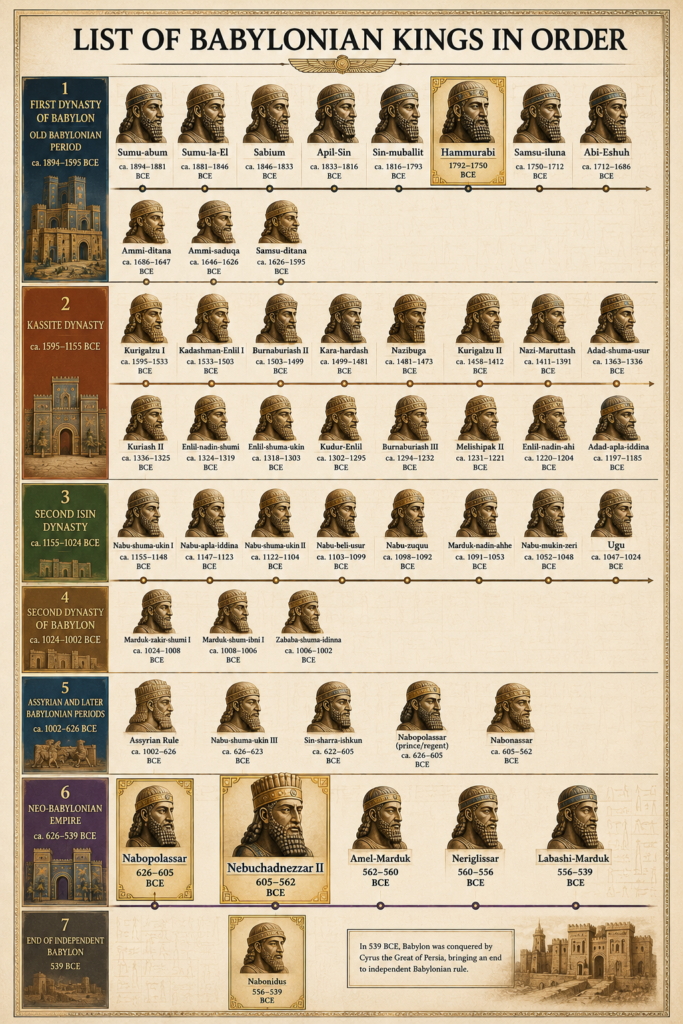
Babylonian Kings Timeline
The history of the kings of Babylon spans several different dynasties and periods. Babylon was not continuously an independent empire for two thousand years; its political importance changed repeatedly as different rulers and foreign powers controlled Mesopotamia.
c. 1894 BCE — Babylonian Dynasty Begins
The First Dynasty of Babylon traditionally begins with Sumu-abum, who established Babylon as an independent kingdom.
At this stage, Babylon was still one of several competing city-states in southern Mesopotamia. Its later prominence would come through the expansion of its territory and the achievements of its kings.
c. 1792 BCE — Hammurabi Becomes King
Hammurabi became king of Babylon around 1792 BCE.
During his long reign, he gradually defeated rival kingdoms and transformed Babylon into the dominant political power in much of Mesopotamia.
His reign represents the most important stage in the rise of the Old Babylonian Empire.
c. 1760s BCE — Hammurabi Expands Babylonian Power
Hammurabi conquered or incorporated major rival states, including Larsa, Eshnunna, and Mari.
By the later part of his reign, Babylon controlled a large portion of Mesopotamia.
His political achievements established Babylon as one of the most important kingdoms of the ancient Near East.
c. 1750 BCE — Hammurabi Dies
Hammurabi died around 1750 BCE and was succeeded by his son Samsu-iluna.
Although Samsu-iluna inherited a powerful kingdom, maintaining Hammurabi’s territorial gains proved difficult.
c. 1750–1712 BCE — Reign of Samsu-iluna
Samsu-iluna ruled Babylon for several decades.
His reign was marked by rebellions and territorial losses as Babylon struggled to maintain control over the territories conquered by Hammurabi.
Despite these challenges, the Babylonian dynasty continued to rule from Babylon.
1595 BCE — Fall of the Old Babylonian Dynasty
Babylon was captured by the Hittite king Mursili I around 1595 BCE.
This event brought the Old Babylonian period to an end and was followed by the rise of the Kassite dynasty, which ruled Babylon for several centuries.
c. 1531–1155 BCE — Kassite Kings Rule Babylon
The Kassites established a long-lasting dynasty in Babylon.
Although they were not originally Babylonian in origin, they adopted Babylonian traditions and maintained Babylon as an important political and cultural center.
This period demonstrates that the history of Babylonian kings included several different dynasties rather than one continuous royal family.
1155 BCE — Kassite Dynasty Ends
The Kassite dynasty was overthrown, beginning another period of political instability and competition for control of Babylon.
Babylon continued to be an important city even when its kings did not control a large empire.
626 BCE — Nabopolassar Establishes the Neo-Babylonian Empire
Nabopolassar became king of Babylon in 626 BCE and founded the Neo-Babylonian dynasty.
He successfully rebelled against the Assyrian Empire and established Babylonian independence.
This marked the beginning of Babylon’s final major period as an imperial power.
605 BCE — Nebuchadnezzar II Becomes King
Nebuchadnezzar II succeeded Nabopolassar in 605 BCE.
He became the most powerful ruler of the Neo-Babylonian Empire and greatly expanded Babylonian influence in the Near East.
c. 605–562 BCE — Reign of Nebuchadnezzar II
Nebuchadnezzar II ruled for more than four decades.
His reign is associated with:
- expansion of the Neo-Babylonian Empire
- campaigns in the Levant
- the conquest of Jerusalem
- rebuilding projects in Babylon
- temples dedicated to Marduk
- monumental city walls and gates
Under Nebuchadnezzar, Babylon reached an extraordinary level of political and architectural importance.
562 BCE — Nebuchadnezzar II Dies
Nebuchadnezzar II died in 562 BCE.
Several relatively short reigns followed, creating a period of political instability before Nabonidus eventually became king.
556 BCE — Nabonidus Becomes King
Nabonidus became king of Babylon in 556 BCE.
He was the final king of independent Babylon and is particularly notable for his interest in ancient temples, religious traditions, and archaeological restoration.
His long absence from Babylon also became one of the distinctive features of his reign.
539 BCE — Cyrus the Great Conquers Babylon
In 539 BCE, Cyrus the Great conquered Babylon and incorporated the city into the expanding Achaemenid Persian Empire.
This ended Babylon’s political independence and brought the Neo-Babylonian period to a close.
Babylon itself remained an important city under Persian rule, but its independent line of kings had ended.
Babylonian Kings in Historical Order
Sumu-abum → Hammurabi → Samsu-iluna → Kassite kings → Nabopolassar → Nebuchadnezzar II → Nabonidus → Persian rule
This sequence highlights the major turning points in the history of Babylonian kings rather than attempting to list every ruler from every Babylonian dynasty.
Babylonian Kings and Dynasties
The major dynasties and rulers that shaped the political history of Babylon, from its early kings to the end of Babylonian independence.
Sumu-abum
Founder of the First Dynasty of Babylon
c. 1894–1595 BCE
Babylon develops from a regional kingdom into a major Mesopotamian power.
Hammurabi
c. 1792–1750 BCE
Expanded Babylonian territory and established Babylon as a dominant power.
Samsu-iluna
c. 1750–1712 BCE
Successor of Hammurabi who faced rebellions and territorial losses.
Fall of the First Dynasty
Babylon was captured by the Hittite king Mursili I around 1595 BCE.
c. 1531–1155 BCE
A long period of Kassite rule during which Babylon remained an important political and cultural center.
Periods of Political Instability
Babylon passed through periods of political instability and changing rulers before its final imperial revival.
Nabopolassar
626–605 BCE
Founded the Neo-Babylonian dynasty and ended Assyrian dominance in Babylon.
626–539 BCE
Babylon becomes one of the major imperial powers of the ancient Near East.
Nebuchadnezzar II
c. 605–562 BCE
Expanded the empire and transformed Babylon through monumental construction projects.
Nabonidus
c. 556–539 BCE
The last king of independent Babylon.
Cyrus the Great
Conquered Babylon and incorporated the city into the Persian Empire.
539 BCE
Babylon remained an important city, but its independent line of kings had ended.
Key sequence: Sumu-abum → Hammurabi → Samsu-iluna → Kassite kings → Nabopolassar → Nebuchadnezzar II → Nabonidus → Cyrus the Great
Origins of Babylonian Kingship
Babylonian kingship developed from earlier Mesopotamian traditions established by the Sumerians and Akkadians.
The earliest rulers of Babylon inherited concepts of sacred kingship that had existed for centuries throughout Mesopotamia.
Kings were viewed as intermediaries between humanity and the divine world.
Although they were not considered gods themselves, most Babylonian rulers claimed special favor from deities such as:
- Marduk
- Shamash
- Ishtar
- Ea
This religious foundation strengthened royal authority and political stability.
Hammurabi: The Builder of Babylonian Power
No Babylonian king is more famous than Hammurabi.
Ruling during the eighteenth century BCE, Hammurabi transformed Babylon from a regional kingdom into one of the dominant powers of Mesopotamia.
His achievements included:
- territorial expansion
- political unification
- administrative reforms
- legal codification
Today, Hammurabi is best known for the Code of Hammurabi.
One of the earliest and most famous collections of laws in human history.
The code addressed:
- property rights
- trade
- contracts
- family law
- criminal justice
Hammurabi’s reign marked the beginning of Babylon’s rise as a major civilization.
Nebuchadnezzar II: The Greatest Babylonian King
Among all Babylonian rulers, Nebuchadnezzar II is often considered the most powerful.
He ruled during the Neo-Babylonian Empire and oversaw a period of extraordinary prosperity and expansion.
Under his leadership:
- Babylon became one of the largest cities in the world
- major construction projects were completed
- the kingdom expanded across the Near East
- Jerusalem was conquered
Nebuchadnezzar is closely associated with:
- the Ishtar Gate
- Babylon’s monumental walls
- imperial expansion
His reign represents the peak of Babylonian political and architectural achievement.
Nabonidus and the Fall of Babylon
The final major ruler of independent Babylon was Nabonidus.
His reign remains controversial among historians due to his unusual religious policies and long absence from Babylon.
During this period:
- internal tensions increased
- Persian power expanded
- political instability weakened the kingdom
In 539 BCE, Babylon was conquered by Cyrus the Great.
The Persian ruler who incorporated Babylon into the growing Persian Empire.
This event marked the end of Babylonian political independence, although Babylon remained an important cultural and religious center.
Kings and Religion in Babylon
Religion formed the foundation of Babylonian kingship.
Kings regularly participated in:
- temple rituals
- religious festivals
- public ceremonies
- offerings to the gods
The most important deity was Marduk.
Royal inscriptions often describe kings as chosen by Marduk to maintain order and protect civilization.
Without divine approval, legitimate kingship was considered impossible.
Kings and Warfare
Military success was essential for Babylonian rulers.
Kings commanded armies that protected trade routes, expanded territory, and defended Mesopotamia from rival powers.
Babylonian armies employed:
- infantry
- archers
- siege warfare
- fortified cities
Successful military campaigns increased royal prestige and demonstrated divine favor.
Conquest also generated wealth through tribute, trade, and territorial expansion.
Kings and Monumental Architecture
The Babylonian kings invested heavily in construction projects designed to demonstrate power and piety.
Major achievements included:
- temples
- palaces
- city walls
- canals
- gates
- ziggurats
The city of Babylon became a symbol of imperial grandeur thanks to centuries of royal patronage.
Nebuchadnezzar II in particular transformed Babylon into one of the most impressive urban centers of the ancient world.
Administration and Government
Babylonian kings governed vast territories through a sophisticated administrative system.
Officials managed:
- taxation
- agriculture
- trade
- military logistics
- legal affairs
Written records preserved in cuneiform tablets reveal a highly organized bureaucracy capable of administering complex economies and large populations.
This administrative tradition helped sustain Babylonian power for centuries.
Legacy of the Babylonian Kings
The Babylonian kings left a lasting impact on world history.
Their contributions influenced:
- law
- kingship
- architecture
- religion
- imperial government
Figures such as Hammurabi and Nebuchadnezzar II remain among the most recognizable rulers of antiquity.
Their achievements helped shape the development of later civilizations throughout the Near East and beyond.
Today, the history of Babylonian kings continues to provide valuable insight into the origins of political authority and statecraft in the ancient world.
Babylonian Kings Timeline
| King | Approximate Reign | Significance |
|---|---|---|
| Hammurabi | c. 1792–1750 BCE | Unified much of Mesopotamia and created the famous law code |
| Samsu-iluna | c. 1749–1712 BCE | Successor of Hammurabi |
| Nebuchadnezzar II | c. 605–562 BCE | Expanded the Neo-Babylonian Empire |
| Nabonidus | c. 556–539 BCE | Last king of independent Babylon |
| Cyrus the Great | 539 BCE | Conquered Babylon for Persia |
Frequently Asked Questions
Who was the most famous Babylonian king?
Hammurabi and Nebuchadnezzar II are generally considered the most famous Babylonian rulers.
Why was Hammurabi important?
Hammurabi unified much of Mesopotamia and issued one of the earliest surviving law codes.
Who conquered Babylon?
Cyrus the Great conquered Babylon in 539 BCE and incorporated it into the Persian Empire.
What was the role of Babylonian kings?
Babylonian kings governed the kingdom, maintained religious order, led armies, and oversaw administration.
Were Babylonian kings considered gods?
Unlike some ancient rulers, Babylonian kings were generally not considered gods, but they ruled with divine approval.
Related Topics
- Babylonian Civilization
- Babylonian Religion
- Babylonian Gods
- Babylonian Empire
- Hammurabi
- Nebuchadnezzar II
- Nabonidus
- Babylon
- Persian Empire