The Architect of the Neo-Babylonian Empire
Nebuchadnezzar II (Akkadian: Nabû-kudurri-uṣur II, meaning “O Nabu, preserve my firstborn son”; reigned c. 605–562 BCE) was the second and most powerful monarch of the Neo-Babylonian (Chaldean) Empire. Inheriting a newly liberated Mesopotamian kingdom from his father, Nabopolassar, Nebuchadnezzar transformed Babylon into the preeminent military, political, and cultural metropolis of the ancient Near East during his 43-year reign.
His rule defined the peak of the Babylonian Golden Age. Through decisive military campaigns—most notably his victory over Pharaoh Necho II at the Battle of Carchemish (605 BCE) and the subsequent sieges of Jerusalem (597 and 586 BCE)—Nebuchadnezzar secured undisputed hegemony over the Levant, Syria, and ancient trade routes linking the Persian Gulf to the Mediterranean.
Beyond his military conquests, primary cuneiform building inscriptions reveal that Nebuchadnezzar viewed himself primarily as a master builder and pious restorer of sacred spaces. He completely reconstructed Babylon, erecting the glazed-brick Ishtar Gate, the monumental Processional Way, the massive royal palace complex (Southern Palace), and the colossal seven-tiered ziggurat Etemenanki (the historical foundation of the biblical Tower of Babel).
Quick Identity & Epigraphic Card of Nebuchadnezzar II
| Historical & Epigraphic Parameter | Primary Cuneiform & Archaeological Record |
| Royal Akkadian Name | Nabû-kudurri-uṣur (𒀭𒀝𒆪𒁺𒌨𒊑𒋀 — “O god Nabu, protect my eldest son / boundary”) |
| Biblical / Classical Variants | Nebuchadrezzar, Nebuchadnezzar (Hebrew: נְבוּכַדְנֶאצַּר); Nabouchodonosor (Greek: Ναβουχοδονόσορ) |
| Dynasty & Civilization | 11th Dynasty of Babylon (Chaldean Dynasty), Neo-Babylonian Period |
| Regnal Span | 605–562 BCE (43 years of sovereign rule) |
| Predecessor & Successor | Son of Nabopolassar (founder); succeeded by his son Amel-Marduk (Evil-Merodach) |
| Royal Capital & Palaces | Babylon (Bābili); Southern Palace (Südburg) and Northern Palace (Museum Palace) |
| Primary Patron Deities | Marduk (supreme national god of Babylon) and Nabu (god of wisdom and writing) |
| Key Primary Sources | Babylonian Chronicles (ABC 5 / Nebuchadnezzar Chronicle), Wadi Brisa Inscription, Ishtar Gate Dedication Inscription, Jehoiachin’s Ration Tablets |
Chronological Timeline of Nebuchadnezzar II’s Reign
| Year (BCE) | Historical Benchmark | Geopolitical & Architectural Significance |
| c. 634 | Birth of Nabû-kudurri-uṣur | Born as eldest son of the Chaldean general Nabopolassar during the anti-Assyrian rebellion. |
| 605 | The Battle of Carchemish | Crown Prince Nebuchadnezzar crushes the allied Egyptian-Assyrian army in Syria; establishes Babylonian hegemony over the Levant. |
| 605 | Accession to the Babylonian Throne | Returns hastily across the desert to Babylon following Nabopolassar’s death; crowned King in the Temple of Marduk (Esagila). |
| 597 | First Siege of Jerusalem | Captures Jerusalem; deports King Jeconiah (Jehoiachin) and the Judean elite to Babylon; installs Zedekiah as vassal king. |
| 586 | Fall of Jerusalem & Temple Destruction | Quells Judean revolt; razes Solomon’s Temple; initiates the historic Babylonian Exile. |
| 585–572 | The Thirteen-Year Siege of Tyre | Sustains an extended naval and land blockade against the Phoenician island-city of Tyre, securing coastal tribute. |
| c. 575 | Dedication of the Glazed Ishtar Gate | Completes the double-gated northern ceremonial entrance and the polychrome Processional Way. |
| 562 | Death and Succession | Dies peacefully in Babylon after 43 regnal years; succeeded by his son Amel-Marduk. |
Military Expansion: Carchemish, the Levant, and the Siege of Jerusalem
The foundation of Nebuchadnezzar II’s geopolitical dominance was established before he even took the crown. Following the collapse of the Neo-Assyrian capital of Nineveh in 612 BCE under the joint assault of Medes and Babylonians, Pharaoh Necho II of Egypt moved north to annex Syria and the Levant, seeking to prop up the surviving Assyrian rump state at Harran.
The Battle of Carchemish (605 BCE)
In 605 BCE, while his aging father Nabopolassar remained in Babylon, Crown Prince Nebuchadnezzar assumed supreme command of the Babylonian army. He marched north toward the fortified city of Carchemish on the Euphrates River (modern Turkish-Syrian border).
- The Tactical Triumph: As recorded in the contemporary cuneiform tablet known as the Nebuchadnezzar Chronicle (British Museum, BM 21946 / ABC 5), Nebuchadnezzar crossed the river under heavy resistance, outflanked the Egyptian garrison, and annihilated the allied Egyptian-Greek mercenary force.
- Geopolitical Consequence: The victory permanently expelled Egyptian military presence from Asia and established Babylonian suzerainty over the fertile trade routes of Syria, Phoenicia, and the kingdoms of the southern Levant (including Judah, Ammon, Moab, and Edom).
The Sieges of Jerusalem and the Babylonian Exile (597 & 586 BCE)
The Kingdom of Judah, situated strategically between Egypt and Mesopotamia, repeatedly vacillated between paying tribute to Babylon and forming anti-Babylonian coalitions backed by Egypt.
- The First Siege (597 BCE): Following King Jehoiakim’s rebellion, Nebuchadnezzar marched westward and besieged Jerusalem. The young king Jehoiachin surrendered on 2 Adar (March 16, 597 BCE). Nebuchadnezzar stripped the temple of gold, deported Jehoiachin, the royal court, and 10,000 elite artisans and soldiers to Babylon, and installed Jehoiachin’s uncle, Zedekiah, as a puppet ruler.
- The Jehoiachin Ration Tablets (Weidner Tablets): Archaeological excavations near the Ishtar Gate in Babylon uncovered cuneiform administrative lists recording daily food allowances (sesame oil, barley) allocated to “Ya’ukīnu, king of the land of Yahud (Judah)”, offering direct historical confirmation of the royal Judean captives in Babylon.
- The Second Siege and Fall of Jerusalem (586 BCE): Zedekiah rebelled again, relying on false promises of Egyptian military aid. Nebuchadnezzar deployed the full imperial army, conducting an 18-month siege that starved the city. In the summer of 586 BCE, the Babylonian general Nebuzaradan breached the walls:
- King Solomon’s Temple (First Temple) and the royal palace were burned to the ground.
- The city walls were dismantled.
- Zedekiah was captured, blinded, and dragged in bronze fetters to Babylon.
- The mass deportation of the Judean population began, initiating the landmark historical period known as the Babylonian Captivity (Babylonian Exile).
The Thirteen-Year Siege of Tyre (585–572 BCE)
Recognizing that naval commerce along the Mediterranean coast was essential for imperial revenue, Nebuchadnezzar turned his attention to the wealthy Phoenician island-city of Tyre.
- Because the primary citadel of Tyre was situated on an offshore island surrounded by massive seawalls, the Babylonian infantry could not take the city by storm without a major navy.
- Nebuchadnezzar established an uninterrupted 13-year economic and military blockade (c. 585–572 BCE).
- The siege ended in a negotiated compromise: King Baal II of Tyre accepted Babylonian overlordship, agreed to host a permanent Babylonian royal governor, and paid substantial annual tributes in cedar wood, purple dye, and silver, without the island fortress being sacked.
Key Military Campaigns of Nebuchadnezzar II
Battle of Carchemish (605 BCE): Decisive victory over Egyptian Pharaoh Necho II; secured total control over Syria and northern Mesopotamia.
Campaign against Ashkelon (604 BCE): Sacked the Philistine coastal stronghold to sever Egypt’s direct land access to the Levant.
First Siege of Jerusalem (597 BCE): Captured the city, seized temple treasures, and deported King Jehoiachin along with the aristocracy to Babylon.
Second Siege and Destruction of Jerusalem (586 BCE): Razed the First Temple, leveled the defensive fortifications, and initiated the general Babylonian Exile.
Siege of Tyre (585–572 BCE): Longest recorded siege in ancient Near Eastern history; forced Phoenician maritime trade networks under Babylonian tributary administration.
Invasion of Egypt (568/567 BCE): Cuneiform fragmentary chronicle (BM 33041) confirms a punitive expedition into the Nile Delta against Pharaoh Amasis II, preventing further Egyptian meddling in Asian affairs.
The Monumental Rebuilding of Babylon
While military chronicles detail his campaigns abroad, Nebuchadnezzar II dedicated the vast majority of his royal inscriptions to his architectural achievements. Drawing on the tribute, timber from Lebanon, and enslaved labor forces brought back from his conquests, he launched the most ambitious urban renewal project in ancient history, turning Babylon (Bāb-Ilim — “Gate of the Gods”) into a fortified metropolis of over 200,000 inhabitants.
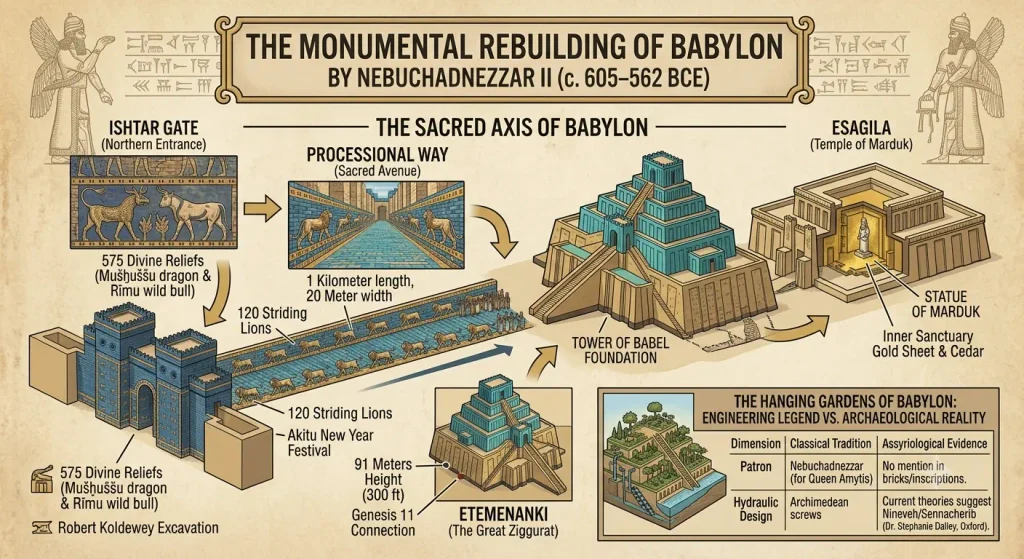
                    THE SACRED AXIS OF NEBUCHADNEZZAR'S BABYLON

       [ ISHTAR GATE ] ───► [ PROCESSIONAL WAY ] ───► [ ETEMENANKI ] ───► [ ESAGILA ]
     (Northern Entrance)      (Glazed Brick Avenue)     (The Great Ziggurat)    (Temple of Marduk)
The Ishtar Gate and the Processional Way
Excavated between 1899 and 1917 by German archaeologist Robert Koldewey, the Ishtar Gate was the eighth and most magnificent inner city gate of Babylon. Dedicated to the goddess of love and war, the double gate stood over 14 meters (46 feet) high and was covered entirely in blue-glazed fired bricks made with lapis lazuli pigment formulations.
- Sacred Animal Iconography: The gate and its adjacent walls featured alternating molded bas-reliefs of 575 divine creatures:
- The Mušḫuššu (Sirrush): The dragon-serpent hybrid of Marduk, possessing a horned viper head, lion forelegs, and eagle talons.
- The Aurochs (Rīmu): The wild bull representing Adad, the storm god.
- The Lion: The sacred predatory beast symbolizing Ishtar herself.
- The Processional Way (Aibur-shabu): Stretching south from the Ishtar Gate for nearly one kilometer toward the temple complex, this 20-meter-wide sacred ceremonial avenue was lined with walls displaying 120 striding lions in glazed relief. During the annual Akitu Festival (New Year), statues of the gods were carried along this paved limestone and red-breccia avenue before the gathered populace.
- The Royal Dedication Inscription: Nebuchadnezzar left a prominent cuneiform inscription on the Ishtar Gate declaring his architectural intent:“I, Nebuchadnezzar, King of Babylon… made the interior of the gate with blue glazed bricks on which bulls and dragons were depicted. I placed wild bulls and ferocious dragons in the gateways and adorned them with luxurious splendor so that all mankind might gaze upon them in wonder.”
Religious Centerpieces: Esagila and the Etemenanki
The religious heart of the empire lay in the massive sacred precinct south of the royal palaces:
- The Esagila (“House Whose Top is High”): The central temple complex dedicated to Babylon’s supreme patron god, Marduk, and his consort Sarpanit. Nebuchadnezzar overlaid its inner sanctuary walls with solid gold sheets, bronze gates, and imported cedar beams from Mount Lebanon.
- The Etemenanki (“Temple of the Foundation of Heaven and Earth”): A colossal seven-tiered ziggurat rising roughly 91 meters (300 feet) high on a square base of equal width. Crowned by an upper temple coated in brilliant blue-enameled brickwork, the Etemenanki was the historical reality behind the biblical tradition of the Tower of Babel (Genesis 11), designed to serve as a symbolic cosmic stairway between the mortal realm and the heavenly pantheon.
The Hanging Gardens of Babylon: Engineering Legend vs. Archaeological Reality
Classical Greek and Roman historians—including Berossus, Strabo, and Diodorus Siculus—attributed the legendary Hanging Gardens of Babylon (one of the Seven Wonders of the Ancient World) to Nebuchadnezzar II.
According to literary tradition, the King built an artificial multi-tiered mountain of terraced gardens equipped with hydraulic screw pumps to console his Median wife, Queen Amytis, who longed for the forested hills of her Persian homeland.
| Dimension | Classical Literary Tradition | Modern Assyriological & Archaeological Evidence |
| Builder / Patron | Nebuchadnezzar II (to comfort Queen Amytis). | No mention exists in thousands of surviving Nebuchadnezzar cuneiform bricks. |
| Hydraulic Design | Archimedean-style continuous screws lifting Euphrates water. | Vaulted building found at Southern Palace lacks adequate irrigation channels. |
| Leading Academic Theory | Located within the Southern Palace of Babylon. | Dr. Stephanie Dalley (Oxford) proposes the gardens were built at Nineveh by Sennacherib. |
The Fortification of Babylon
Nebuchadnezzar turned Babylon into an impregnable military redoubt by constructing multiple concentric defense rings:
The Double Outer Wall: An outer defensive circuit over 18 kilometers (11 miles) long, broad enough atop its battlements to allow four-horse chariots to pass each other.
The Median Wall: A massive rampart of baked brick and bitumen stretching from the Euphrates to the Tigris north of the city, designed to repel any potential invasion from the northern highlands.
Hydraulic Moats: Deep water channels diverting the flow of the Euphrates completely around the city perimeter, enabling administrators to deliberately flood the surrounding agricultural plains in times of siege.
Nebuchadnezzar in the Bible, Ethnicity, and the End of His Reign
Nebuchadnezzar II occupies a prominent role in ancient historiography because his actions are recorded across three distinct textual traditions: cuneiform administrative and royal inscriptions, classical Greco-Roman accounts, and the Hebrew Bible (Old Testament).
What Did Nebuchadnezzar II Do in the Bible?
In biblical literature, Nebuchadnezzar is portrayed with theological nuance. He appears extensively in the books of 2 Kings, 2 Chronicles, Jeremiah, Ezekiel, and Daniel, cast primarily as an instrument of divine judgment against Judah for its religious transgressions, yet also as a monarch capable of recognizing the supreme authority of Yahweh.
- The Siege of Jerusalem and Temple Destruction: In 2 Kings 24–25 and Jeremiah 52, he is the conqueror who captures Jerusalem, strips the First Temple of its sacred gold and bronze furnishings, blinds King Zedekiah, and enforces the Babylonian Captivity.
- Prophetic Dreams and the Statue of Empires (Daniel 2): The prophet Daniel interprets the King’s recurring dream of a colossal statue made of four metals (gold, silver, bronze, and iron) mixed with clay, symbolizing a succession of world empires beginning with Nebuchadnezzar’s Babylon (“You are this head of gold”).
- The Fiery Furnace (Daniel 3): When Daniel’s three Judean companions—Shadrach, Meshach, and Abednego—refuse to bow down to Nebuchadnezzar’s 60-cubit golden idol in the plain of Dura, the King orders them cast into a blazing furnace, only to witness their miraculous survival alongside a divine figure.
- The Seven Years of Madness / Lycanthropy (Daniel 4): According to the biblical narrative, Nebuchadnezzar’s excessive hubris led to a temporary mental breakdown: he was struck with boanthropy / zoanthropy (behaving like an ox, grazing on grass, and living in the wilderness) for “seven times” (years) until he humbled himself before God and had his sanity restored.
Assyriological Insight: While cuneiform texts do not record Nebuchadnezzar’s mental illness, Dead Sea Scroll fragments (The Prayer of Nabonidus / 4Q242) describe an identical condition afflicting King Nabonidus (the last king of Babylon), suggesting biblical authors may have conflated or transferred this historical tradition to Babylon’s most famous monarch.
What Ethnicity Was King Nebuchadnezzar?
Nebuchadnezzar II was of Chaldean (Kaldu) ethnicity, an ancient Northwest Semitic-speaking tribal people who settled in southern Mesopotamia (the marshlands of the Persian Gulf / modern southern Iraq) during the early first millennium BCE.
- Chaldean vs. Babylonian: While “Babylonian” designates a geopolitical and cultural identity rooted in the ancient Akkadian language, the Chaldeans were a distinct tribal group that gradually assimilated into Babylonian society, adopted Akkadian cuneiform writing, and ultimately seized the imperial throne under Nebuchadnezzar’s father, Nabopolassar.
- Dynastic Heritage: Because of his lineage, the empire he ruled (626–539 BCE) is termed both the Neo-Babylonian Empire and the Chaldean Dynasty.
How Did Nebuchadnezzar’s Life End?
Contrary to dramatized legends depicting a violent downfall, primary cuneiform administrative records and the Babylonian King List confirm that Nebuchadnezzar II died of natural causes in Babylon in 562 BCE, at approximately 72 years of age, having ruled uninterrupted for 43 years.
The Succession Crisis: His death marked the end of the empire’s stability. He was succeeded by his son Amel-Marduk (biblical Evil-Merodach), who released King Jehoiachin of Judah from prison. However, Amel-Marduk ruled for only two years before being assassinated in a palace coup orchestrated by his brother-in-law Neriglissar (Nergal-sharezer), plunging the Chaldean dynasty into internal dynastic factionalism that left Babylon vulnerable to the Persian conquest by Cyrus the Great in 539 BCE.
10 Essential & Interesting Facts About King Nebuchadnezzar II
- 1. He was the longest-reigning Neo-Babylonian monarch: Nebuchadnezzar II ruled for 43 continuous years (c. 605–562 BCE), presiding over the political, architectural, and economic pinnacle of the Chaldean Empire.
- 2. His name is a prayer to the god of wisdom: In Akkadian, his name Nabû-kudurri-uṣur translates directly to “O Nabu, protect my firstborn son” (or “preserve my boundary”), invoking Nabu, the patron god of scribes and wisdom.
- 3. He conquered Jerusalem and destroyed Solomon’s Temple: In 586 BCE, his imperial armies razed the First Temple of Jerusalem, dismantled the city fortifications, and deported the Judean aristocracy, initiating the historic Babylonian Exile.
- 4. He built the iconic blue-glazed Ishtar Gate: As the grand northern portal to Babylon, he erected an imposing 14-meter double gateway adorned with lapis-lazuli-colored glazed bricks and 575 relief figures of sacred dragons (mušḫuššu), wild bulls (rīmu), and lions.
- 5. He constructed the historical “Tower of Babel”: Nebuchadnezzar completed and expanded the colossal seven-tiered ziggurat Etemenanki (“Temple of the Foundation of Heaven and Earth”), which stood roughly 91 meters high and inspired the biblical narrative in Genesis 11.
- 6. His connection to the Hanging Gardens remains unproven: While classical Greco-Roman writers credit him with building terraced gardens for his Median wife Amytis, no contemporary cuneiform tablet mentions them, leading modern Assyriologists to suggest they may have been located at Nineveh under Sennacherib.
- 7. He was of Chaldean ethnic origin: Hailing from the Kaldu tribes of the southern Persian Gulf marshlands, his dynasty (the 11th Dynasty of Babylon) successfully displaced centuries of Neo-Assyrian imperial domination.
- 8. He maintained a 13-year siege on Tyre: Demonstrating extraordinary logistical resilience, his military blockaded the offshore Phoenician fortress-island of Tyre from 585 to 572 BCE until the city accepted Babylonian tributary terms.
- 9. Archaeological cuneiform tablets corroborate his biblical captives: The Jehoiachin Ration Tablets excavated near the Ishtar Gate confirm administrative food provisions allocated to the deposed king of Judah (Ya’ukīnu) living in Babylon.
- 10. He died peacefully in his palace: Despite biblical allegories describing periods of madness and wild living in Daniel 4, royal records prove he died of natural causes in Babylon in 562 BCE at around 72 years of age, passing the throne to his son Amel-Marduk.
Frequently Asked Questions About Nebuchadnezzar II
What is Nebuchadnezzar II best known for?
Nebuchadnezzar II (reigned c. 605–562 BCE) is best known for being the greatest king of the Neo-Babylonian Empire, renowned for two monumental historical legacies:
- Imperial Architecture: Transforming Babylon into the ancient world’s most magnificent city through the construction of the Ishtar Gate, the Processional Way, and the Etemenanki ziggurat (the historical foundation of the Tower of Babel).
- Military Conquests & The Babylonian Exile: Crushing the Egyptian army at the Battle of Carchemish (605 BCE), destroying Solomon’s Temple in Jerusalem in 586 BCE, and initiating the historic Babylonian Captivity of the Jewish people.
What did Nebuchadnezzar II do in the Bible?
In the Hebrew Bible (Old Testament)—primarily in the books of 2 Kings, 2 Chronicles, Jeremiah, Ezekiel, and Daniel—Nebuchadnezzar plays several pivotal theological and historical roles:
- Conquest of Judah: He besieged Jerusalem, burned down the First Temple, blinded King Zedekiah, and deported thousands of Judeans to Babylon.
- Prophetic Dreams (Daniel 2): He had the famous dream of a multi-metallic statue representing successive world empires, interpreted by the prophet Daniel.
- The Fiery Furnace (Daniel 3): He cast Daniel’s companions (Shadrach, Meshach, and Abednego) into a furnace for refusing to worship his golden image, only to witness their miraculous deliverance.
- The Seven Years of Madness (Daniel 4): He suffered a temporary bout of madness (boanthropy), living outdoors like an animal until acknowledging the sovereignty of God.
What ethnicity was King Nebuchadnezzar?
Nebuchadnezzar II was of Chaldean (Kaldu) ethnicity. The Chaldeans were a Semitic-speaking tribal group from southern Mesopotamia (the Persian Gulf marshland region) who integrated into Babylonian society, revived the native Akkadian imperial traditions, and established the 11th Dynasty of Babylon (the Neo-Babylonian Empire).
How did Nebuchadnezzar’s life end?
According to primary cuneiform records and the Babylonian King List, Nebuchadnezzar II died of natural causes in his palace at Babylon in 562 BCE at approximately 72 years of age. He had ruled for 43 continuous years and was succeeded peacefully by his son, Amel-Marduk (Evil-Merodach).
Did Nebuchadnezzar II really build the Hanging Gardens of Babylon?
While classical Greek and Roman authors (such as Berossus and Strabo) credit Nebuchadnezzar with constructing the Hanging Gardens for his Median wife Amytis, no contemporary Babylonian cuneiform text or archaeological excavation in Babylon mentions them. Modern Assyriological research suggests that if the gardens existed as described, they may have been built in Nineveh by the Assyrian king Sennacherib.
What is the meaning of the name Nebuchadnezzar?
His royal Akkadian name, Nabû-kudurri-uṣur, translates to “O god Nabu, protect my firstborn son” (or “preserve my boundary”). It invokes Nabu, the patron god of wisdom, literacy, and scribes, who was the son of Marduk.
What was the Etemenanki in Babylon?
The Etemenanki (“Temple of the Foundation of Heaven and Earth”) was a massive seven-tiered ziggurat in central Babylon dedicated to Marduk. Rising roughly 91 meters (300 feet) high, it served as a symbolic cosmic stairway connecting heaven and earth and is widely recognized by historians as the architectural inspiration for the biblical Tower of Babel (Genesis 11).
Further Readings & Academic Web Resources
- The British Museum – The Nebuchadnezzar Chronicle (Cuneiform Account of the Fall of Jerusalem & Carchemish)
- Vorderasiatisches Museum (Pergamonmuseum Berlin) – The Ishtar Gate and the Processional Way of Babylon
- Encyclopaedia Britannica – Nebuchadnezzar II: King of Babylon, Military Campaigns, & Architecture
- Livius.org (Jona Lendering) – Nebuchadnezzar II: Babylonian Chronicles, Building Inscriptions, & History
- The Metropolitan Museum of Art (Heilbrunn Timeline) – The Neo-Babylonian Empire (Chaldean Dynasty)