The Sumerian gods were the deities worshipped by the ancient Sumerians in southern Mesopotamia. They formed one of the world’s earliest polytheistic pantheons, with each god governing a specific aspect of the universe, such as the sky, water, fertility, justice, or war. Major deities including An, Enlil, Enki, and Inanna played central roles in religion, politics, and everyday life, while later civilizations such as the Akkadians, Babylonians, and Assyrians adopted many of these gods into their own belief systems.
Timeline
| Date | Event |
|---|---|
| c. 4500 BCE | Early Sumerian religious traditions emerge |
| c. 3500 BCE | First temple cities develop |
| c. 2900 BCE | Patron gods dominate Sumerian city-states |
| c. 2334 BCE | Akkadians adopt many Sumerian gods |
| c. 1800 BCE | Babylonian mythology absorbs the Sumerian pantheon |
The Structure of the Sumerian Pantheon
Sumerian gods formed an interconnected divine hierarchy in which different deities governed the forces, institutions, and aspects of life that shaped the ancient world.
Anu occupied one of the highest positions in the Sumerian pantheon and was associated with the heavens and divine authority.
Enlil was one of the most powerful Sumerian deities and was closely associated with kingship, authority, and the ordering of the world.
Enki was associated with fresh water, wisdom, craftsmanship, magic, and the preservation of knowledge.
Nanna, also known as Sin, was the lunar deity whose cult was especially important at the city of Ur.
Utu was associated with the sun, justice, truth, and the protection of those who upheld proper order.
Inanna was one of the most important and complex Sumerian deities, associated with love, sexuality, political power, and warfare.
What Were the Sumerian Gods?
The Sumerian gods were the deities worshipped by the people of ancient Sumer, one of the world’s earliest civilizations, which flourished in southern Mesopotamia during the fourth and third millennia BCE. Together, these gods formed a vast and complex pantheon that sought to explain every aspect of existence, from the creation of the universe to the annual flooding of rivers, the fertility of the land, the success of kings, and the fate of individuals.
Unlike modern monotheistic religions, which recognize a single supreme deity, the Sumerians practiced polytheism—the belief in many gods, each with distinct powers, responsibilities, and personalities. Every major force of nature and every important aspect of society was believed to be under the protection of a particular deity. The sky, the earth, fresh water, the sun, the moon, love, war, wisdom, agriculture, and even individual cities all had their own divine patrons.
The Sumerian pantheon was not simply a collection of unrelated gods but a highly organised system with its own hierarchy and relationships. Powerful deities such as An, Enlil, Enki, and Inanna occupied the highest positions, while hundreds of lesser gods served more specialised roles. Some protected individual professions, others watched over rivers, mountains, fields, or households, reflecting the Sumerian belief that the divine world was present in every part of daily life.
The large number of Sumerian gods developed over many centuries as independent city-states established their own patron deities and local religious traditions. Cities such as Uruk, Nippur, Eridu, and Ur each honoured particular gods as their divine protectors. As political alliances shifted and cultures interacted, these local traditions merged into an increasingly rich and interconnected pantheon without replacing the older beliefs.
From my perspective, one of the most remarkable features of the Sumerian gods is their extraordinary longevity. Rather than disappearing with the decline of Sumer, many of these deities continued to be worshipped by the Akkadians, Babylonians, and Assyrians, making the Sumerian pantheon one of the most influential religious traditions in the history of the ancient Near East.
The Origins of the Sumerian Pantheon
The Sumerian pantheon developed gradually over thousands of years as the first cities of southern Mesopotamia grew into powerful urban centres. Rather than being created at a single moment, the gods of Sumer emerged alongside the civilization itself, reflecting the environment, economy, and social organisation of one of the world’s earliest complex societies.
The fertile plains between the Tigris and Euphrates rivers played a central role in shaping these beliefs. Agriculture depended on seasonal floods, irrigation canals, and favourable weather, all of which appeared unpredictable and beyond human control. To explain these powerful natural forces, the Sumerians associated them with divine beings who governed the sky, the rivers, the earth, the sun, and the moon. Every aspect of the natural world was believed to operate according to the will of the gods.
As independent city-states such as Uruk, Ur, Nippur, Eridu, and Lagash became established, each developed its own patron deity. These gods were regarded not only as protectors of their cities but also as their true rulers, with human kings governing on their behalf. This close relationship between religion and civic identity meant that political power and religious devotion evolved together throughout Sumerian history.
Over time, contacts between cities through trade, diplomacy, and conflict encouraged local traditions to merge into a broader religious system. Rather than replacing existing deities, new gods were incorporated into an increasingly complex pantheon, with myths explaining their relationships, responsibilities, and hierarchy. This flexibility allowed the Sumerian religious tradition to grow while preserving many of its oldest beliefs.
From my perspective, one of the most remarkable features of the Sumerian pantheon is its ability to balance local identity with a shared worldview. Every city honoured its own divine protector, yet all belonged to the same cosmic order. This combination of regional traditions and common beliefs helped create one of the most influential religious systems of the ancient world.
👉 To explore how these beliefs shaped temples, rituals, and everyday worship, continue with our guide to Sumerian Religion.
The Major Sumerian Gods
Although the Sumerian pantheon included hundreds of deities, a relatively small group of major gods occupied the highest positions within the divine hierarchy. These gods governed the fundamental forces of the universe and played central roles in mythology, kingship, agriculture, justice, and everyday religious life. Many continued to be worshipped for more than two thousand years, influencing the religions of the Akkadians, Babylonians, and Assyrians.
An (Anu): The Supreme God of Heaven
An, later known as Anu in Akkadian tradition, was the highest-ranking deity in the Sumerian pantheon and the personification of the sky. Although he rarely intervened directly in human affairs, he was regarded as the ultimate source of divine authority, granting legitimacy to both gods and kings.
- Domain: Sky and supreme authority
- Main symbols: Horned crown and the heavens
- Principal cult centre: Uruk
- Why he mattered: Considered the father of the gods and the highest divine authority.
Enlil: Lord of Air and Kingship
Enlil was one of the most influential gods in Sumerian religion and often the most active ruler of the divine world. As god of the air, storms, and political authority, he was believed to decide the fate of kingdoms and grant legitimacy to earthly rulers. His temple at Nippur became one of the most important religious centres in Mesopotamia.
- Domain: Air, storms, kingship
- Main symbols: Horned cap and sceptre
- Principal cult centre: Nippur
- Why he mattered: The divine authority behind kingship and political order.
Enki: God of Wisdom and Fresh Water
Enki, known later as Ea, was associated with wisdom, creation, craftsmanship, and the life-giving waters that flowed beneath the earth. Unlike many other gods, he frequently appeared as a protector of humanity, offering knowledge and practical solutions during times of crisis.
- Domain: Fresh water, wisdom, creation
- Main symbols: Flowing streams and fish
- Principal cult centre: Eridu
- Why he mattered: Protector of humanity and patron of knowledge and innovation.
Inanna: Goddess of Love, War, and Power
Inanna was one of the most dynamic and complex figures in the Sumerian pantheon. She embodied both love and fertility as well as war and political ambition, reflecting the dual nature of life itself. Her myths, particularly the famous Descent of Inanna, became some of the best-known religious narratives of ancient Mesopotamia.
- Domain: Love, fertility, war
- Main symbols: Eight-pointed star and lion
- Principal cult centre: Uruk
- Why she mattered: One of the most widely worshipped and influential deities of the ancient Near East.
Nanna: God of the Moon
Nanna, later identified with Sin, governed the moon and the passing of time. His regular lunar cycle was essential for measuring months, organising religious festivals, and regulating agricultural activities throughout Mesopotamia.
- Domain: Moon and time
- Main symbols: Crescent moon
- Principal cult centre: Ur
- Why he mattered: His cycles shaped calendars, festivals, and agricultural life.
Utu: God of the Sun and Justice
Utu, known later as Shamash, represented the sun, justice, and truth. Because the sun illuminated everything, Utu was believed to witness all human actions and ensure fairness in both legal disputes and moral conduct.
- Domain: Sun, justice, truth
- Main symbols: Solar disk
- Principal cult centre: Sippar and Larsa
- Why he mattered: Divine guardian of justice and protector of law.
Ninhursag: Mother Goddess of Life
Ninhursag was the great mother goddess associated with the earth, fertility, mountains, and childbirth. She frequently appeared in creation myths as the divine force responsible for nurturing both gods and humans.
- Domain: Earth, fertility, motherhood
- Main symbols: Omega-shaped emblem and mountains
- Principal cult centre: Kesh
- Why she mattered: Symbolised fertility, creation, and the continuity of life.
Ereshkigal: Queen of the Underworld
Ereshkigal ruled the underworld, the realm where the dead were believed to dwell after death. Although feared, she represented an essential part of the cosmic order, maintaining the balance between life and death.
Why she mattered: Guardian of the realm of the dead and one of the oldest underworld deities in Mesopotamian belief.
Domain: Underworld and the dead
Main symbols: Throne of the underworld
Principal cult centre: Associated with the netherworld rather than a single city
How the Sumerian Gods Governed the Universe
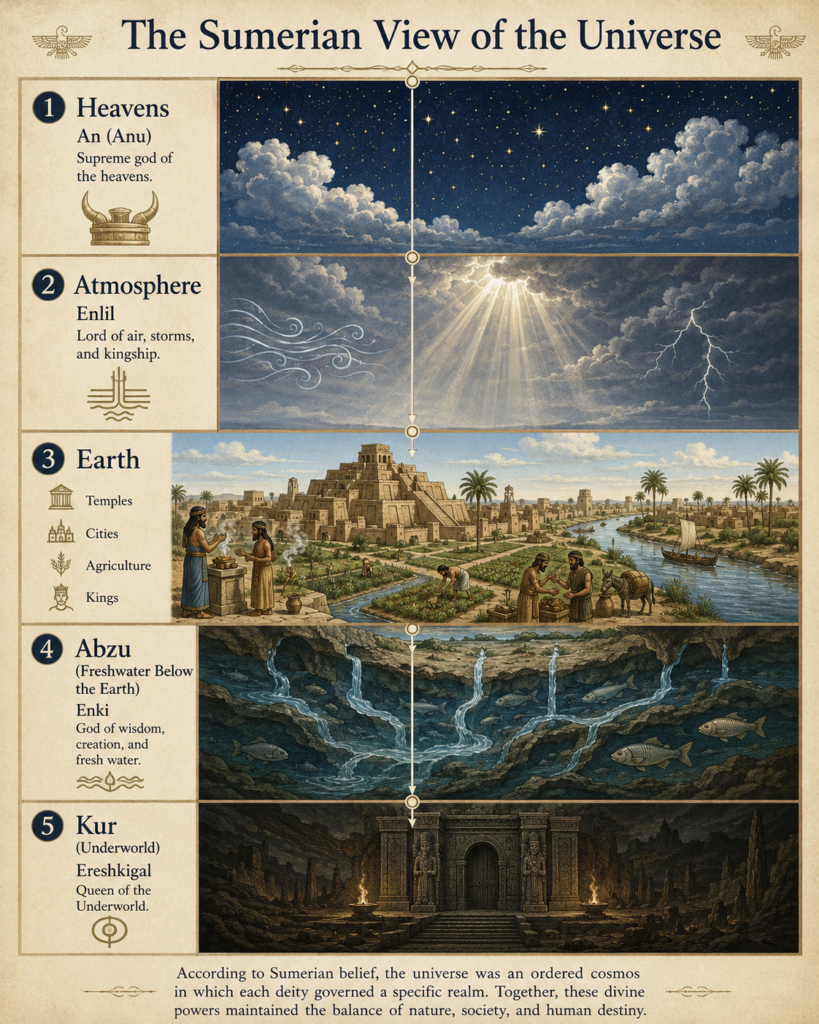
The Sumerians believed that the universe functioned according to a carefully maintained divine order. Every natural phenomenon, every successful harvest, every political decision, and every human life unfolded under the supervision of the gods. Rather than acting randomly, each deity was responsible for a specific part of the cosmos, working alongside the others to preserve balance and stability.
At the highest level stood the great gods, who governed the fundamental forces of existence. An ruled the heavens, Enlil controlled the atmosphere and the authority of kings, Enki watched over the life-giving waters and wisdom, while Ninhursag embodied the fertile earth. Together, these deities ensured that nature continued to function and that human society remained in harmony with the divine order.
The Sumerians also believed that the gods determined the destinies of both individuals and kingdoms. Kings did not rule by personal ambition alone but because divine authority had been granted to them. Victories in war, prosperous harvests, and the success of cities were all interpreted as signs of divine favour, while famine, defeat, or natural disasters could indicate that the gods had withdrawn their support.
This divine order extended beyond the natural world into every aspect of society. Temples served as the earthly residences of the gods, priests performed rituals to maintain communication between humans and the divine, and festivals reinforced the relationship between each city and its patron deity. Religion was therefore not separate from politics, agriculture, or law—it provided the framework through which the entire world was understood.
From my perspective, one of the most fascinating aspects of the Sumerian worldview is that the universe was seen as a living system governed by cooperation rather than by a single all-powerful deity. Each god had defined responsibilities, and maintaining harmony between these divine forces was considered essential for the survival and prosperity of both individuals and entire civilizations.
👉 Many of these gods appear as central characters in Sumerian myths, where their relationships, rivalries, and decisions explain the origins of the world and humanity. Explore these stories in our guide to Sumerian Mythology.
A Day at the Temple of Enlil
Imagine arriving at Nippur, one of the holiest cities of ancient Sumer, just before sunrise. Towering above the surrounding mudbrick houses stands the great temple dedicated to Enlil, the lord of air and kingship. Its massive walls and elevated terraces dominate the skyline, reminding every visitor that the gods are the true rulers of the city.
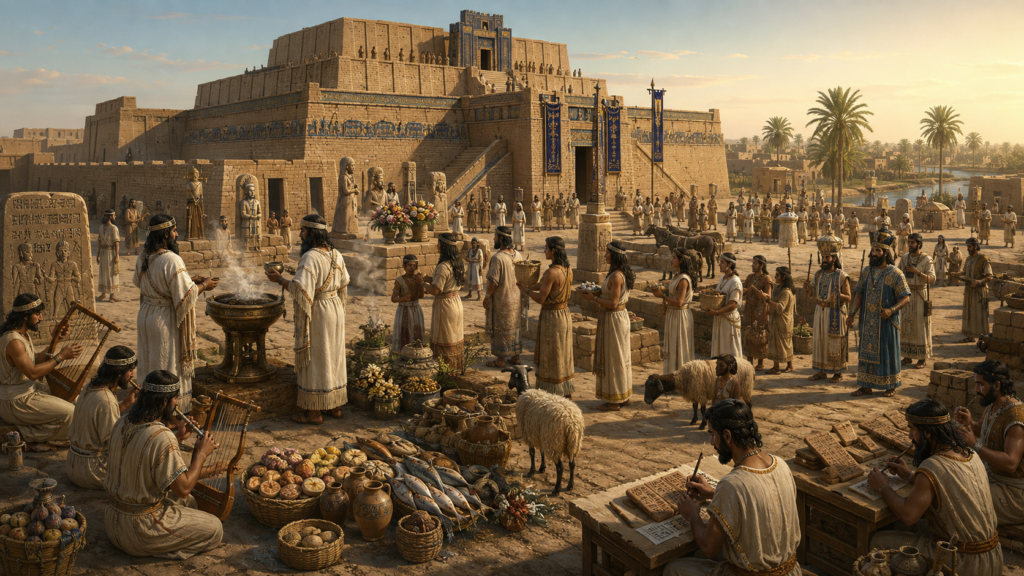
As the first light reaches the temple courtyard, priests begin the day’s rituals. Incense burns before the sanctuary while offerings of bread, beer, dates, and livestock are carefully prepared. Hymns are recited in the Sumerian language, accompanied by musicians playing lyres and drums. For the people gathered outside, these ceremonies are more than acts of devotion—they help maintain the harmony between humanity and the divine world.
Merchants, farmers, craftsmen, and officials all visit the temple throughout the day. Some bring gifts to thank the gods for a successful harvest, while others seek protection, guidance, or favourable omens before making important decisions. The temple also functions as an economic and administrative centre, storing grain, managing land, and employing large numbers of workers, making it one of the busiest places in the city.
For a Sumerian citizen, visiting the temple was part of everyday life rather than an exceptional event. Religion shaped agriculture, government, justice, and family life, and the gods were believed to be actively involved in each of these activities. Maintaining their favour through regular worship was considered essential for the prosperity of both individuals and the community.
From my perspective, imagining a single day inside one of these great temples helps explain why the Sumerian gods occupied such a central place in society. They were not distant or abstract beings but living presences whose influence was thought to extend into every aspect of daily existence.
How the Sumerian Gods Shaped Later Civilizations
The influence of the Sumerian gods did not end with the decline of Sumer. As new kingdoms emerged across Mesopotamia, they inherited much of the Sumerian religious tradition, adapting its deities, myths, and rituals to their own languages and political systems. This remarkable continuity allowed many Sumerian gods to remain at the centre of religious life for more than two thousand years.
The Akkadians, who established the first empire in history, adopted the Sumerian pantheon almost in its entirety. Rather than replacing the old gods, they identified them with their own language and traditions. An became Anu, Enki became Ea, Inanna became Ishtar, and Utu became Shamash. Although their names changed, their principal roles and attributes remained largely the same.
This process continued under the Babylonians and Assyrians. Babylonian priests preserved many Sumerian myths by translating them into Akkadian, while Assyrian kings continued to honour ancient deities in temples that had been founded centuries earlier. Even as political powers rose and fell, the religious foundations established by the Sumerians remained remarkably resilient.
The survival of these gods also helped preserve Sumerian culture itself. Long after the Sumerian language had ceased to be spoken in everyday life, it continued to be used in religious ceremonies, scholarly texts, and temple inscriptions. Priests and scribes copied ancient hymns and myths generation after generation, ensuring that the names of the Sumerian gods endured throughout Mesopotamian history.
From my perspective, this long continuity is one of the strongest examples of cultural influence in the ancient world. Few civilizations have left such a lasting religious legacy, and the Sumerian pantheon became the foundation upon which later Mesopotamian religions were built.
| Sumerian God | Akkadian Name | Main Domain |
|---|---|---|
| An | Anu | Sky and supreme authority |
| Enki | Ea | Wisdom and fresh water |
| Inanna | Ishtar | Love, fertility, and war |
| Utu | Shamash | Sun and justice |
| Nanna | Sin | Moon |
| Ereshkigal | Ereshkigal | Underworld |
👉 Discover how these deities evolved in later civilizations in our guides to Akkadian Gods and Babylonian Gods.
Why the Sumerian Gods Matter
The Sumerian gods represent far more than the religious beliefs of an ancient civilization. They form the earliest known pantheon to be preserved in written history, offering an extraordinary window into how the first urban societies understood the universe, organised political authority, and explained the forces of nature.
Through their myths and religious traditions, the Sumerians developed ideas that would influence the civilizations of Akkad, Babylon, and Assyria for more than two millennia. Many of their deities continued to be worshipped under different names, while their stories, symbols, and concepts of divine kingship became fundamental elements of Mesopotamian culture.
Studying the Sumerian gods also reveals how closely religion was connected to everyday life. The gods were believed to govern agriculture, justice, trade, warfare, and the prosperity of entire cities. Temples functioned not only as places of worship but also as economic, political, and cultural centres, making religion one of the foundations upon which Sumerian civilization was built.
Perhaps most importantly, the Sumerian pantheon demonstrates that the world’s earliest civilizations were already capable of developing remarkably sophisticated systems of thought. Their gods were not simply supernatural beings but part of an organised worldview that sought to explain humanity’s place within the cosmos and the relationship between the natural and divine worlds.
From my perspective, understanding the Sumerian gods is essential for anyone interested in the history of religion or the ancient Near East. Their influence extended far beyond Sumer itself, shaping the beliefs of later civilizations and leaving a legacy that can still be traced in mythology, literature, and the history of human thought today.
Key Takeaways
Studying the Sumerian gods provides valuable insight into how the world’s first urban civilization understood the universe, power, and humanity’s place within it.
The Sumerian gods formed one of the world’s earliest recorded pantheons and shaped the religious beliefs of ancient Mesopotamia.
Sumerians practiced polytheism, believing that different gods governed every aspect of nature, society, and human life.
The most important deities included An, Enlil, Enki, Inanna, Nanna, Utu, Ninhursag, and Ereshkigal, each with distinct roles and symbols.
Every major Sumerian city-state had its own patron deity, making religion central to both political identity and daily life.
The Sumerian pantheon strongly influenced the Akkadians, Babylonians, and Assyrians, whose religions preserved many of the same gods under different names.
Temples served as religious, economic, and administrative centres, demonstrating how closely worship and government were connected.
Many of the myths surrounding the Sumerian gods became the foundation of later Mesopotamian mythology and continued to be copied for centuries.
Frequently Asked Questions
Who were the most important Sumerian gods?
The most important Sumerian gods were An, the sky god; Enlil, god of air and kingship; Enki, god of wisdom and fresh water; Inanna, goddess of love and war; Nanna, god of the moon; Utu, god of the sun and justice; Ninhursag, the mother goddess; and Ereshkigal, queen of the underworld.
How many Sumerian gods were there?
The Sumerian pantheon included hundreds of gods and goddesses. While only a small number occupied the highest positions in the divine hierarchy, many local deities protected individual cities, temples, rivers, mountains, professions, and households.
Were the Sumerians polytheistic?
Yes. The Sumerians practiced polytheism, believing that many different gods governed the natural world, human society, and the cosmos. Each deity had specific powers, responsibilities, and areas of influence.
Which Sumerian god was the most powerful?
Although An was regarded as the supreme god of the heavens, Enlil was often considered the most influential deity in everyday religious and political life because he controlled kingship, storms, and divine authority.
Did the Akkadians worship the Sumerian gods?
Yes. The Akkadians adopted most of the Sumerian pantheon, often giving the gods Akkadian names while preserving their original roles. For example, Inanna became Ishtar, Enki became Ea, and Utu became Shamash.
What was the role of temples in Sumerian religion?
Temples were far more than places of worship. They served as religious, economic, and administrative centres where priests conducted rituals, stored agricultural produce, managed land, and organised many aspects of city life.
Which city was dedicated to Enlil?
The city of Nippur was the principal religious centre dedicated to Enlil and became one of the holiest cities in ancient Mesopotamia.
Why are the Sumerian gods important today?
The Sumerian gods represent one of the earliest recorded religious systems in human history. Their myths, symbols, and beliefs influenced later Mesopotamian civilizations and continue to help historians understand the origins of religion, mythology, and early urban society.
Related Topics