Introduction: Pharaoh Khufu and the Golden Age of the Fourth Dynasty
Pharaoh Khufu (reigned c. 2589–2566 BCE), known to the classical Greco-Roman world as Cheops (Χέοψ) or Suphis, stands as one of the most monumental and debated figures in human history. As the second sovereign of ancient Egypt’s Fourth Dynasty (Old Kingdom), Khufu presided over an era of unprecedented state centralization, bureaucratic sophistication, and architectural ambition.
His defining monument—the Great Pyramid of Giza (Akhet Khufu, “The Horizon of Khufu”)—remained the tallest man-made structure on Earth for over 3,800 years. Yet, while his funerary monument achieved architectural immortality, the historical reality of Khufu’s administration was obscured for centuries by classical Greek folklore, which falsely portrayed him as a tyrannical despot who enslaved his subjects.
Modern archaeological discoveries—most notably the Wadi el-Jarf papyri (The Diary of Merer) and the excavation of the Heit el-Ghurab workers’ settlement at Giza—have dismantled these myths. Khufu’s reign was not an exercise in brutal tyranny, but the administrative zenith of the Old Kingdom state: a sophisticated, highly organized sacred monarchy capable of mobilizing national logistics, quarrying operations across Nubia and Sinai, and maintaining complex redistribution networks for thousands of specialized, well-fed craftsmen.
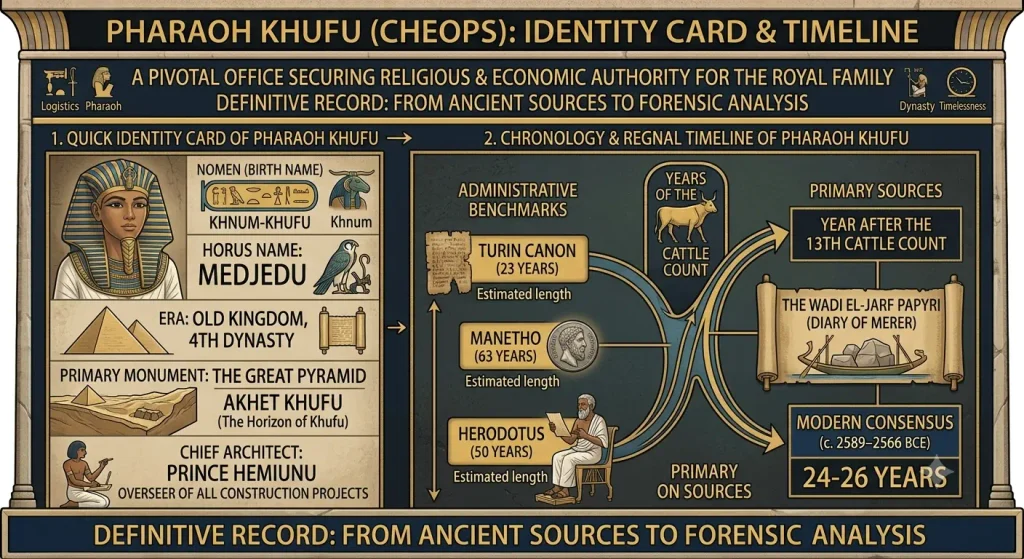
Quick Identity Card of Pharaoh Khufu
| Royal / Historical Parameter | Epigraphic & Archaeological Data |
| Nomen (Birth Name) | Khnum-Khufu (ẖnm-ḫw.f-wj — “The God Khnum Protects Me”), abbreviated as Khufu |
| Horus Name | Medjedu (Mḏdw — “The One Who Strikes / Crushes”) |
| Nebty Name | Nebty-r-Medjed (Nb.tj-r-mḏd) |
| Golden Horus Name | Bikwy-Nebu (Bjk.wj-nbw — “The Two Golden Falcons”) |
| Classical / Greek Names | Cheops (Herodotus), Suphis I (Manetho), Sofe (Eratosthenes) |
| Dynasty & Historical Era | Fourth Dynasty, Old Kingdom of Egypt |
| Regnal Period | c. 2589–2566 BCE (High Chronology: Shaw/Arnold) or c. 2551–2528 BCE (Low Chronology: von Beckerath) |
| Predecessor & Successor | Predecessor: King Sneferu (Father) $\rightarrow$ Successor: King Djedefre (Son) |
| Chief Royal Architect | Prince Hemiunu (Vizier and Overseer of All Construction Projects of the King) |
| Primary Monument | The Great Pyramid of Giza (Akhet Khufu) |
Chronology and Regnal Timeline of Pharaoh Khufu
Determining the exact length of Pharaoh Khufu’s reign has been a cornerstone of Egyptological debate, comparing ancient king lists against contemporary cattle-count records:
| Historical / Ancient Source | Recorded Reign Length | Egyptological Analysis & Historical Consensus |
| The Royal Canon of Turin (19th Dynasty, Ramesside) | 23 Years | Considered the primary ancient administrative benchmark; records a damaged entry generally reconstructed as 23 years. |
| Manetho’s Aegyptiaca (3rd Century BCE) | 63 Years | Significant chronological exaggeration typical of Ptolemaic compilations; likely conflated Khufu with later Fourth Dynasty successors. |
| Herodotus (Histories, Book II) (5th Century BCE) | 50 Years | Folkloric estimate influenced by local Egyptian guides in Memphis during the Late Period. |
| The Wadi el-Jarf Papyri (Contemporary 4th Dynasty) | Year of the 13th Cattle Count | In the Old Kingdom, livestock censuses occurred roughly every two years. The Diary of Merer dates to the “Year after the 13th Cattle Count”, confirming an absolute minimum reign of 26 to 27 full regnal years. |
| Modern Egyptological Consensus | 23–26 Years | Modern scholars (Lehner, Tallet, Verner, Hawass) align on a reign spanning approximately 24 to 26 years (c. 2589–2566 BCE). |
Lineage, Accession, and the Royal Court of Pharaoh Khufu
The accession of Pharaoh Khufu marked the consolidation of Egypt’s Fourth Dynasty into a centralized autocracy unmatched in Old Kingdom history. To comprehend Khufu’s administrative and architectural achievements, his reign must be examined through the network of royal lineage, marital alliances, and bureaucratic offices that bound the elite ruling class directly to his person.
Royal Genealogy of Pharaoh Khufu
Royal Lineage of Pharaoh Khufu: King Sneferu and Queen Hetepheres I
Pharaoh Khufu was the son of King Sneferu, the founding monarch of the Fourth Dynasty, and Queen Hetepheres I.
- The Architectural Precursor (Sneferu): Khufu’s father had revolutionized monumental stone architecture by constructing three massive pyramids: the Meidum Pyramid, the Bent Pyramid at Dahshur, and the Red Pyramid (the first true smooth-sided pyramid in history). Sneferu’s experimental engineering mobilized unprecedented logistical networks, directly providing Khufu with an experienced, highly skilled national labor force.
- The Royal Mother (Hetepheres I): Hetepheres I was a woman of supreme dynastic status, carrying the titles King’s Mother (Mwt-Nisut) and Daughter of the God (Sat-Netjer). Her ancestry likely linked the Third Dynasty line of Huni directly to Sneferu’s new royal house, cementing Khufu’s undisputed divine right to the throne.
- The Archaeological Treasure of Tomb G 7000X: In 1925, the Harvard University–Boston Museum of Fine Arts Expedition, directed by George Reisner, discovered the secret, unlooted cache of Hetepheres I near the northeast corner of Khufu’s pyramid at Giza (tomb G 7000X). The funerary assemblage included her gold-encased carrying chair, a gold-leaf canopy frame, an alabaster sarcophagus, and silver butterfly-inlaid bracelets containing imported Aegean and Levantine silver, attesting to the extreme wealth and international trade access of Khufu’s early court.
The Royal Queens and Children of Pharaoh Khufu
To maintain dynastic stability and prevent the emergence of rival provincial factions, Khufu concentrated executive, judicial, and religious power strictly within his nuclear family. He elevated multiple royal wives and fathered several sons and daughters who shaped the remainder of the Old Kingdom.
- Principal Royal Queens:
- Queen Meritites I: Titled “Great of Favor” and “Companion of Horus”. She served as a core dynastic bridge from Sneferu to Khufu and is traditionally associated with the northern subsidiary pyramid (G 1a) of the Giza east field.
- Queen Henutsen: Named as a King’s Daughter and King’s Wife. Later New Kingdom stelae (such as the Inventory Stela) associate her memory with the southern subsidiary pyramid (G 1c), dedicated in later periods to Isis, Mistress of the Pyramid.
- Notable Royal Sons and Daughters:
- Crown Prince Kawab: The eldest legitimate son and designated heir. Kawab held the high office of Wab-priest of Anubis and owned the colossal double-mastaba G 7110–7120 in the Eastern Cemetery, but predeceased his father before ascending the throne.
- Prince Radjedef (King Djedefre): Khufu’s immediate successor, who constructed his monumental pyramid complex north of Giza at Abu Rawash (Sejed Khufu) and became the first pharaoh to officially adopt the title Son of Ra (Sa-Ra) in his royal titulary.
- Prince Khafre (Chephren): Younger son of Khufu who later ascended the throne after Djedefre, building the Second Pyramid of Giza and the Great Sphinx complex.
- Prince Minkhaf: Served as supreme Vizier during the subsequent reign of his brother Khafre, overseeing the high judiciary and national treasury.
- Princess Hetepheres II: One of the longest-lived and most politically influential royal women of the Fourth Dynasty, marrying first Crown Prince Kawab and later King Djedefre.
Administrative Centralization Under Pharaoh Khufu and Vizier Hemiunu
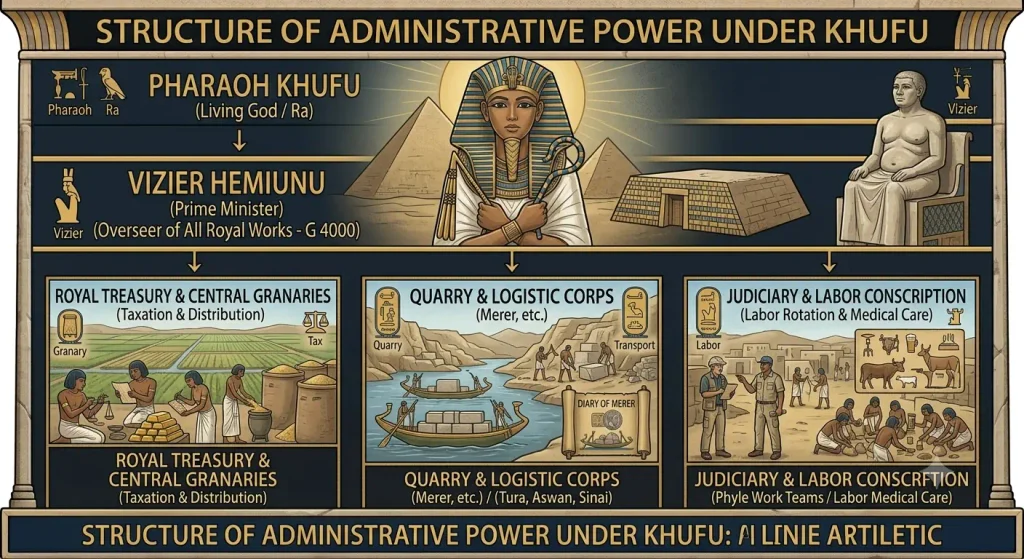
Under Pharaoh Khufu, the Egyptian state achieved complete administrative centralization. Provincial governors (nomarchs) and local rulers lost their administrative autonomy; every major institution of state—from public works and national tax collection to judicial trials—reported directly to the King’s chancellery via the royal office of the Vizier (Tjaty).
- Prince Hemiunu (The Master Builder):
- Hemiunu was Khufu’s nephew (son of Prince Nefermaat, the vizier of Sneferu).
- He bore the titles Hereditary Prince, Chief Justice and Vizier, and crucially: “Overseer of All Construction Projects of the King” (Jmj-r kꜣwt nbt nt niswt).
- As prime architect, Hemiunu coordinated the surveying, quarrying logistics, transportation flotillas, and daily labor distribution required to construct the Great Pyramid.
- The Statue of Hemiunu (Roemer- und Pelizaeus-Museum, Hildesheim – PM 1962):
- Discovered inside his massive western mastaba at Giza (G 4000), Hemiunu’s life-sized limestone statue represents a masterpiece of Old Kingdom realism.
- Unlike idealized athletic royal portraits, Hemiunu is rendered with realistic corpulence, pronounced chest folds, and a resolute expression—symbolizing supreme administrative abundance, administrative dignity, and control over state grain supplies.
3. The Great Pyramid Complex of Pharaoh Khufu (Akhet Khufu)
The defining achievement of Pharaoh Khufu’s reign was the construction of his monumental funerary landscape at Giza, named in ancient Egyptian as Akhet Khufu (Ꜣḫt-ḫw.f-wj, translating to “The Horizon of Khufu”). Conceived not merely as an isolated tomb, the complex represents an integrated cosmological machine designed to propel the deceased pharaoh directly into the eternal celestial cycle alongside the sun god Ra and the circumpolar stars (the Indestructibles).
Engineering Metrics and Orientation of Khufu’s Monument
The engineering precision achieved by Khufu’s royal planners remains unmatched in the pre-industrial world, establishing the apex of Old Kingdom monumental stone masonry:
- Mass and Volume: The monument originally contained approximately 2.3 million stone blocks, weighing an estimated combined mass of 5.75 million tons. The structural core was quarried directly from the local Giza plateau nummulitic limestone, while the exterior was clad in gleaming, fine white Tura limestone shipped across the Nile.
- Monumental Dimensions: The Great Pyramid rose to an original height of 146.6 meters (481 feet) with a base length of 230.34 meters (755.7 feet) on each side, sloping at an angle of 51°50’40”. It maintained its status as the world’s tallest man-made structure for over 3,800 years.
- Cardinal Alignment: Khufu’s surveyors oriented the pyramid’s four base corners to the true cardinal points with astronomical accuracy: the entire structure deviates from true north by less than four minutes of arc (3/60th of a degree), likely determined via the simultaneous transit method of northern circumpolar stars (Mizar and Kochab).
- Base Leveling Precision: Across a massive footprint covering 5.3 hectares (13 acres), the leveled bedrock platform exhibits a perimeter deviation of less than 1.5 centimeters, demonstrating sophisticated hydraulic and optical leveling techniques.
Internal Architecture and Chambers of Khufu’s Pyramid
Unlike previous Fourth Dynasty pyramids containing primarily subterranean vaults, the internal layout of Khufu’s monument underwent three distinct evolutionary phases during its multi-decade construction:
Internal Architecture of the Great Pyramid (Akhet Khufu)
The Subterranean Vault
Carved 30 meters beneath the bedrock. Cut directly into the plateau foundation, this unfinished chamber represented the initial subterranean burial plan.
The “Queen’s Chamber”
A misnomer coined by Arab travelers. Features a corbelled niche intended for the King’s Ka statue (Serdab) and sealed upward-pointing shafts.
The Grand Gallery
A corbelled stone masterpiece 47 meters long and 8.6 meters high, acting as an ascending acoustic ramp and housing the stone-plug release system.
The King’s Chamber
Lined in red Aswan granite. Features 5 relieving stress chambers, Khufu’s monolith sarcophagus, and celestial shafts targeted toward Orion and Thuban.
- The Relieving Chambers & Builder’s Quarry Marks: Above the flat granite ceiling of the King’s Chamber sit five stress-relieving compartments topped by a gabled limestone roof. Inside these upper chambers (named Davison’s, Wellington’s, Nelson’s, Lady Arbuthnot’s, and Campbell’s Chamber), British explorer Howard Vyse discovered red ochre quarry marks left by ancient construction gangs, explicitly reading “Friends of Khufu” and the royal cartouche of Khnum-Khufu—providing indisputable contemporary epigraphic proof of Khufu’s direct ownership.
- The Celestial Star Shafts: Unlike true ventilation passages, the narrow 20×20 cm shafts extending from the King’s and Queen’s chambers were oriented toward specific stellar constellations: the southern shaft targeted Orion (Sah, representing Osiris), while the northern shaft targeted the circumpolar star Thuban (Alpha Draconis), providing an astral conduit for the King’s soul to ascend into the heavens.
The Sacred Funerary Landscape and Khufu’s Solar Ships
The Great Pyramid did not exist in isolation; it formed the focal point of a sprawling ritual complex connected by processional architecture:
- The Mortuary and Valley Temples: The Eastern Mortuary Temple connected via an enclosed 700-meter paved limestone causeway to the Valley Temple at the edge of the Nile floodplain, where purification rituals (wab) and mummification rites were conducted.
- The Elite Mastaba Cemeteries: Flanking the pyramid, Khufu laid out orderly “cities of the dead”: the Western Cemetery (housing court officials, scribes, and high administrators) and the Eastern Cemetery (housing royal princes, queens, and viziers in massive stone mastabas).
- The Khufu Solar Ship Discovery (1954):
- In May 1954, Egyptian archaeologist Kamal el-Mallakh unearthed two hermetically sealed rectangular rock-cut pits along the southern base of the pyramid.
- Inside pit no. 1 lay 1,224 individual pieces of Lebanese cedar wood (Cedrus libani), completely preserved alongside ropes, oars, and copper fastenings.
- Reassembled over 14 years by master restorer Hag Ahmed Youssef Moustafa, the Khufu Ship measures 43.4 meters (142.4 feet) in length.
- Cosmological Function: The vessel was an intact solar barque (solar boat) intended to transport the deified spirit of Khufu across the celestial waters of the underworld alongside Ra during his diurnal journey through the sky (Mandjet) and nocturnal traversal through the realm of Duat (Mesketet).
Tabla Resumen: Componentes del Complejo Funerario de Khufu
| Componente Arquitectónico | Material Principal | Función Ritual / Simbólica |
| Pyramid Core (Akhet Khufu) | Nummulitic limestone (Giza) | Sede de ascensión cósmica y preservación eterna del monarca. |
| Outer Casing Cladding | Fine white Tura limestone | Reflejo solar resplandeciente encarnando el horizonte de Ra. |
| Burial Vault (King’s Chamber) | Red granite (Aswan quarries) | Protección del sarcófago monolítico y bóveda de transfiguración. |
| Relieving Roof Chambers | Megalithic granite beams | Distribución del peso estructural e inscripciones de cuadrillas (Friends of Khufu). |
| The Khufu Solar Boat | Cedar wood from Mount Lebanon | Transporte celeste del rey junto a Ra en la barca diurna y nocturna. |
| Subsidiary Pyramids (G 1a–c) | Local limestone | Enterramiento de las reinas Meritites I, Henutsen y princesas reales. |
Primary Epigraphic Sources and Archaeological Records of Pharaoh Khufu
A common misconception in popular history is that the reign of Pharaoh Khufu is devoid of contemporary written records. On the contrary, 21st-century excavations and epigraphic surveys have recovered extraordinary primary documentation: administrative logbooks, royal quarry decrees, and expeditionary graffiti spanning from the Red Sea coast to the remote desert mines of the Sinai and Nubia.
The Wadi el-Jarf Papyri: The Eyewitness Diary of Merer
Discovered in 2013 by the French-Egyptian archaeological mission directed by Pierre Tallet at the Red Sea port of Wadi el-Jarf, these documents represent the oldest inscribed papyri ever discovered in human history. Preserved inside man-made storage galleries cut into the limestone hills, the archive belonged to an elite maritime and transport squad.
Key Historical Revelations of the Diary of Merer
Direct Construction Link
Explicitly names Akhet Khufu (“The Horizon of Khufu”) as the final delivery destination for high-grade Tura limestone casing blocks.
Logistical Daily Timetable
Records precise journeys: loading stone at Tura in the morning, sailing downstream through canal basins, and unloading at Giza in 2-3 days.
Supreme Leadership
Identifies the supreme administrator overseeing works as Prince Ankhhaf, Khufu’s half-brother, who succeeded Hemiunu as Vizier in late regnal years.
- The Figure of Inspector Merer: Merer (jmj-r sꜣ) led a specialized naval contingent of approximately 200 to 300 skilled oarsmen and stone movers called “The Escort Team of Khnum-Khufu”.
- Chronological Anchor: The papyrus explicitly opens with the date: “Year after the 13th Cattle Count under the Majesty of the King of Upper and Lower Egypt, Khnum-Khufu, living forever and ever.” Because biennial cattle counts marked Old Kingdom administrative calendars, this entry confirms Khufu reigned for at least 26 to 27 full years.
- The Harbor Complex of Ro-She Khufu: The logbook details stone arriving at the artificial harbor basin Ro-She Khufu (“The Entrance to the Lake of Khufu”), located directly below the Giza plateau and interconnected with the Bahr el-Libeini Nile branch.
Expeditionary Graffiti and Mining Stelae of Pharaoh Khufu
Beyond the capital zone of Memphis and Giza, royal epigraphy demonstrates Khufu’s direct command over an expansive natural resource extraction network across the fringes of the Egyptian world:
                      KHUFU'S ROYAL EXTRACTION NETWORK

                         WADI MAGHAREH (Sinai)
                        [Turquoise & Copper Mines]
                                    ▲
                                    │
                                    │
    HATNUB QUARRIES ◄─────── MEMPHIS / GIZA ───────► WADI EL-JARF (Red Sea)
   [Travertine / Alabaster]    [Imperial Hub]          [Deep-Sea Naval Harbor]
                                    │
                                    │
                                    ▼
                          GEBEL EL-ASR (Nubia)
                         [Anorthosite Gneiss Diorite]
- Wadi Maghareh Rock Reliefs (Sinai Peninsula):
- Multiple rock-cut stelae depict Pharaoh Khufu performing the ritual smiting of the desert nomads (Semat Wadj-wr).
- Khufu is shown wearing the Double Crown (Pschent) and holding a mace, asserting crown ownership over the rich turquoise and copper veins of the Sinai.
- Hatnub Alabaster Inscriptions (Middle Egypt):
- The royal quarries at Hatnub contain red ochre graffiti recording high-ranking royal officials quarrying fine travertine (Egyptian alabaster) used for royal altars, offering tables, and Queen Hetepheres I’s sarcophagus.
- In 2018, the French-English mission (IFAO / University of Liverpool) identified an unprecedented steep haulage ramp system flanked by post-holes, dated directly by epigraphy to the reign of Khufu.
- Gebel el-Asr / “Chephren’s Quarries” (Lower Nubia):
- Located 65 km northwest of Abu Simbel in the southern desert, stelae bearing the cartouche of Khnum-Khufu prove that direct military-protected expeditions retrieved prized anorthosite gneiss (diorite), used for royal statuary and sacred vessels.
- The Dakhla Oasis Expedition Stela (Western Desert):
- Discovered at a site known as Gebel Halfayah or Khufu’s Hill, an inscription records an expedition sent in the “Year after the 13th Count” to collect mefat (a mineral powder/pigment), demonstrating state reach hundreds of kilometers into the deep Sahara.
Comparison of Contemporary Archaeological Records of Khufu
| Primary Record / Site | Material & Type | Archaeological Significance | Key Historical Finding |
| Diary of Merer (Wadi el-Jarf) | Papyrus scroll / Hieratic logbook | Oldest administrative papyrus archive in history. | Daily stone transports from Tura directly to Akhet Khufu. |
| Builders’ Inscriptions (Giza Relieving Chambers) | Red ochre graffiti on granite | Found in structural stress chambers above King’s Chamber. | Proves pyramid ownership via cartouche of Khnum-Khufu. |
| Wadi Maghareh Stelae (Sinai) | Rock-cut relief | Royal military/mining iconography. | Asserted crown monopoly over copper and turquoise routes. |
| Hatnub Quarry Inscriptions (Middle Egypt) | Red ink graffiti on bedrock | Earliest sled-ramp engineering evidence for heavy stones. | Dates the development of steep haulage ramps to Khufu. |
| Gebel el-Asr Stela (Nubia) | Inscribed diorite stele | Southern frontier mining administration. | Demonstrates trade and extraction expeditions into Upper Nubia. |
Sacred Cult, Solar Deification, and the Physical Image of Pharaoh Khufu
The religious and artistic record of Pharaoh Khufu presents one of the most intriguing paradoxes in ancient history: a ruler who fundamentally altered Egyptian solar theology and built the largest stone monument on Earth, yet is physically commemorated in the archaeological record by a single, miniature three-dimensional sculpture.
The Solar Transformation of Pharaoh Khufu as Living Ra
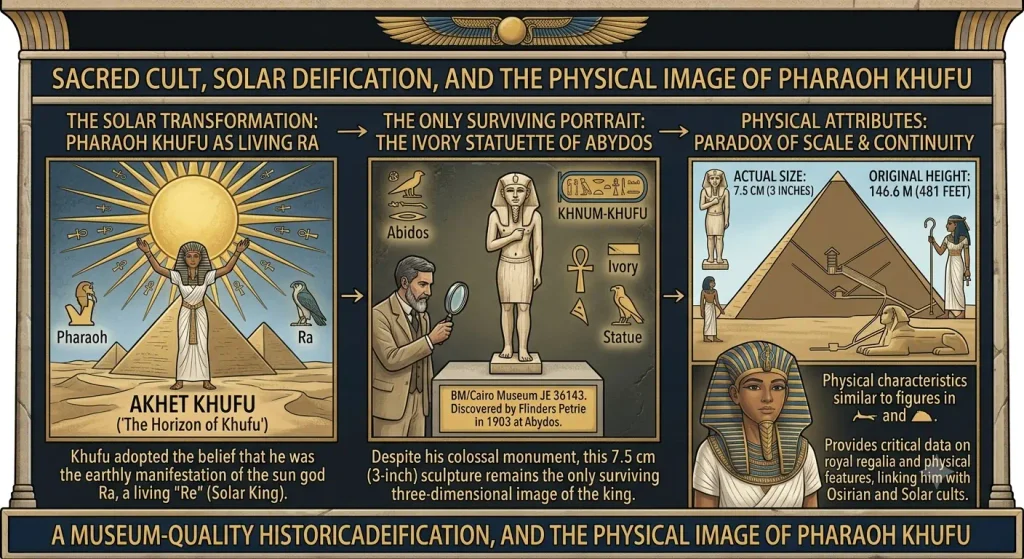
During the Fourth Dynasty, the relationship between the Pharaoh and the sun god underwent a profound theological revolution. Prior monarchs ruled primarily as the earthly manifestation of Horus. Under Khufu, however, the king did not merely worship the sun; he became fully assimilated into the solar deity itself.
- The Horizon of Khufu (Akhet Khufu): By naming his pyramid complex Akhet Khufu, the monument was framed as the literal horizon from which the sun god rises and sets. In life and death, Khufu was venerated not just as a king under divine protection, but as the living embodiment of Ra (the Sun God).
- Cosmic Centralization: This theological shift consolidated absolute sacerdotal authority in the crown. The pharaoh was no longer just an intermediary making offerings to distant deities; he was the primary cosmic engine maintaining Ma’at (cosmic order and truth), transforming the state administration into a divine apparatus.
- Legacy of the Solar Title: Khufu’s radical solar focus set the stage for his son and successor, Djedefre, who became the first king in Egyptian history to officially incorporate the title “Son of Ra” (Sa-Ra) into the standard fivefold royal titulary.
The Ivory Statuette of Abydos: The Only Intact Portrait of Khufu
Despite commanding an empire capable of quarrying and assembling over 2.3 million stone blocks at Giza, only one undisputed, intact three-dimensional portrait of Pharaoh Khufu has survived: the Ivory Statuette of Abydos (Cairo Museum, JE 36143).
- The Discovery by Flinders Petrie (1903): British archaeologist Sir William Matthew Flinders Petrie discovered the headless statuette within the temple ruins of Khenty-Amentiu (later Osiris) at Kom el-Sultan, Abydos. Recognizing its immense historical significance, Petrie halted excavations and had his team carefully sift tons of sand for three weeks until the tiny matching head was found.
- Dimensions and Material: Carved from hippopotamus ivory, the statuette stands a mere 7.5 cm (3 inches) high, 2.5 cm wide, and 2.9 cm deep—a striking paradox of scale compared to the 146.6-meter Great Pyramid.
- Epigraphy and Regalia: * The king is depicted seated upon a low-backed throne, wearing the Red Crown of Lower Egypt (Deshret) and a traditional pleated royal kilt.
- Inscribed in fine relief on the right side of the throne, adjacent to his left leg, is his royal Horus name: Medjedu (Mḏdw), providing definitive epigraphic attribution to Khufu.
- Artistic Realism: The miniature portrait exhibits exquisite craftsmanship. The face is sculpted with mature, distinctive features: a strong jawline, prominent cheekbones, wide-set eyes, and a determined, authoritative expression that reflects the focused administrative power of the early Fourth Dynasty.
Summary of Surviving Physical Depictions of Khufu
| Object / Inscription | Location / Museum | Material / Medium | Key Historical Feature |
| Ivory Statuette (JE 36143) | Egyptian Museum, Cairo | Hippopotamus Ivory (7.5 cm) | Only intact 3D portrait; discovered at Abydos. |
| Relief Fragment with Cartouche | Metropolitan Museum of Art | Fine Limestone Relief | Depicts Khufu with royal titularies from Lisht cache. |
| Wadi Maghareh Rock Relief | Egyptian Museum, Cairo | Sandstone / Rock Stela | Depicts Khufu smiting enemies in the Sinai Peninsula. |
| Builders’ Quarry Marks | Great Pyramid (Relieving Chambers) | Red Ochre Pigment | Names royal gangs: “Friends of Khufu” & cartouche. |
Historiographical Shift: Pharaoh Khufu in Classical Myths vs. Modern Archaeology
Few historical figures have suffered a greater distortion of historical memory than Pharaoh Khufu. For over two millennia, the popular image of the builder of the Great Pyramid was shaped not by contemporary Fourth Dynasty records, but by Middle Kingdom folkloric fiction and classical Greco-Roman propaganda. Modern bioarchaeology and the excavation of the Giza plateau have completely overturned the myth of the cruel despot, revealing an unprecedented national administrative project driven by free, skilled labor.
Egyptian Folkloric Tradition in the Westcar Papyrus
The earliest surviving literary reception of Pharaoh Khufu appears in the Westcar Papyrus (P. Berlin 3033), a Middle Kingdom literary composition (dating to the 12th to 17th Dynasties, c. 1800–1550 BCE). Titled “Tales of Wonder at the Court of King Khufu”, the text depicts the king being entertained by his sons with stories of ancient magicians.
- The Dialogue with Magician Djedi: In the fourth story, Prince Djedefhor introduces the centenarian magician Djedi of Djed-Sneferu, who is reputed to possess the power to attach severed heads and knows the number of secret chambers in the sanctuary of Thoth.
- Literary Portrayal of Khufu: Unlike later Greek accounts, the Egyptian literary tradition does not paint Khufu as a bloodthirsty tyrant. While the king initially suggests testing the magician’s power on a condemned prisoner, he immediately relents when Djedi protests (“Not to a human being, my lord O King! For it is not permitted to do such a thing to the noble cattle of God”). Khufu agrees and orders a goose, a waterfowl, and an ox to be used instead, portraying the monarch as an inquisitive, intellectually curious sovereign seeking divine knowledge.
The Tyrannical Despot Myth of Herodotus and Diodorus
The persistent cultural myth that Pharaoh Khufu was a tyrannical monster who built the Great Pyramid using 100,000 enslaved workers originated in the 5th century BCE with the Greek historian Herodotus (Histories, Book II, 124–128) and was later echoed by Diodorus Siculus (Bibliotheca Historica, Book I).
- The Herodotus Account: Writing two millennia after the Fourth Dynasty, Herodotus relied on stories recounted by local Hellenized dragomans and lower-tier priests at Memphis during the Persian Period:
- He claimed that Khufu barred all temples, prohibited sacrifices, and forced the entire population into servitude.
- He asserted that 100,000 men worked simultaneously in shifts of three months over 20 years to erect the pyramid.
- In a notorious piece of folkloric defamation, Herodotus claimed that running short of treasury funds, Khufu forced his own daughter into prostitution, demanding that each client contribute a single block of limestone, with which she allegedly built the middle subsidiary pyramid.
- Historiographical Deconstruction: Modern Egyptology recognizes these classical accounts as moralizing political folktales. In the Greco-Roman imagination, colossal architectural scale was inherently associated with oriental despotism and hubris, leading later authors to project their own political philosophies onto Old Kingdom monuments.
Archaeological Discovery of the Giza Pyramid Workers’ Town
The absolute refutation of the Greek slavery myth came through direct archaeological excavations conducted by Dr. Mark Lehner (Ancient Egypt Research Associates – AERA) and Dr. Zahi Hawass at the lost city of the pyramid builders: Heit el-Ghurab (“The Wall of the Crow”), located southeast of the Great Sphinx.
- A Permanent City of Skilled Craftsmen: Excavations revealed a sophisticated, planned urban complex spanning over 14 hectares, equipped with barracks, administrative offices, bakeries, breweries, and metal-processing workshops housing a permanent population of 10,000 to 20,000 workers and their families.
- Dietary and Bioarchaeological Evidence: Faunal analysis of animal bones recovered at the site proved that workers consumed an exceptionally rich, high-protein diet consisting of young male cattle (beef), sheep, and goats supplied directly from royal cattle-estates in the Nile Delta, alongside vast quantities of high-calorie barley beer and bread.
- Medical Care and Treatment: Skeletal analysis of worker burials in the adjacent Workers’ Cemetery revealed that injured builders received advanced medical attention: bone fractures were cleanly set with splints, and skeletons showed evidence of surviving brain trepanations and limb amputations that healed successfully, proving care that would never have been afforded to expendable slave labor.
- The Phyle System of National Mobilization: Workers were organized into rotational national service units called phyles (za), subdivided into smaller 20-man teams (knbt) with proud, self-chosen names like “Friends of Khufu” and “The Drunkards of Menkaure”. Conscription operated as a form of sacred labor tax (corvée), in which provincial agriculturalists contributed seasonally during the annual Nile inundation (Akhet) in exchange for food, clothing, tax exemptions, and participation in the cosmic resurrection of their living god.
Comparative Analysis: Greek Myths vs. Archaeological Reality
| Historical Dimension | Greek Accounts (Herodotus & Diodorus) | Modern Archaeological Evidence (Heit el-Ghurab & Wadi el-Jarf) |
| Workforce Status | 100,000 abused, enslaved captives. | 15,000–20,000 free, specialized, well-fed Egyptian citizens under seasonal corvée. |
| Living Conditions | Starvation, brutality, and forced labor. | Planned urban settlements, massive bakeries/breweries, and high-protein beef diet. |
| Healthcare | None; expendable laborers worked to death. | Advanced bone-setting, orthopedic splints, brain surgeries, and honored burial near the royal tombs. |
| Religious Policy | Closed sacred temples and banned offerings. | Reorganized and elevated the solar cult of Ra, centralizing national liturgy around the crown. |
| Motivation | Brutal coercion and tyrannical vanity. | Sacred civic duty participating in the cosmic maintenance of Ma’at and royal resurrection. |
Frequently Asked Questions About Pharaoh Khufu (Cheops)
Who was Pharaoh Khufu, and why is he important?
Pharaoh Khufu (known to the Greeks as Cheops) was the second ruler of Egypt’s Fourth Dynasty during the Old Kingdom period (c. 2589–2566 BCE). He is universally famous for commissioning the Great Pyramid of Giza (Akhet Khufu), the largest stone pyramid ever built and the only surviving wonder of the ancient world. Beyond his monumental architecture, Khufu established supreme administrative centralization in Egypt, organized far-reaching mining expeditions to Sinai and Nubia, and transformed royal theology by declaring himself the living manifestation of the sun god Ra.
Did slaves build the Great Pyramid of Giza for Pharaoh Khufu?
No. Direct archaeological excavations at the Heit el-Ghurab workers’ settlement at Giza have conclusively disproven the myth of slave labor. The Great Pyramid was constructed by a permanent workforce of 10,000 to 20,000 free, highly skilled Egyptian craftsmen supported by seasonal laborers fulfilling a sacred civic duty (corvée). Skeletal remains prove they received medical care (such as healed bone fractures) and consumed a high-protein diet of beef and beer supplied directly by the royal estate.
What does the name “Khufu” mean in ancient Egyptian?
The name Khufu is a shortened royal hypocorism of his full birth name (nomen), Khnum-Khufu (ẖnm-ḫw.f-wj), which translates to “The God Khnum Protects Me”. It references Khnum, the ram-headed creator deity who fashioned humanity on his potter’s wheel.
What is the Diary of Merer, and why is it crucial for Khufu’s reign?
The Diary of Merer is an eyewitness hieratic papyrus logbook discovered in 2013 at the Red Sea port of Wadi el-Jarf. Written by an inspector named Merer, it dates to the 26th/27th regnal year of Khufu (the Year after the 13th Cattle Count) and documents the daily transport of high-quality white limestone from the quarries of Tura across the Nile directly to the construction site of the Great Pyramid (Akhet Khufu). It is the oldest inscribed papyrus ever discovered and the only surviving eyewitness record of pyramid construction.
Why is there only one small statue of Pharaoh Khufu?
While Pharaoh Khufu built the largest stone structure in antiquity, only one undisputed, complete three-dimensional sculpture of him survives: a 7.5 cm (3-inch) ivory statuette discovered by Sir Flinders Petrie in 1903 at Kom el-Sultan, Abydos. Although life-sized granite and limestone statues undoubtedly populated his Giza temples, they were smashed, recycled, or burned for lime during centuries of tomb robbing and dynastic transitions throughout later Egyptian history.
How long did Pharaoh Khufu rule, and who succeeded him?
Modern Egyptological consensus places Khufu’s reign at approximately 23 to 26 years (c. 2589–2566 BCE). While later classical sources like Herodotus attributed 50 years and Manetho 63 years to his rule, contemporary records like the Diary of Merer (referencing the year after the 13th cattle count) corroborate a reign of just under three decades. Khufu was succeeded on the throne by his son, Pharaoh Djedefre, who built his pyramid complex at Abu Rawash.mids.
Further Readings & Academic Web Resources
- Digital Giza: The Giza Project at Harvard University (Khufu Records)
- Ancient Egypt Research Associates (AERA) – Feeding the Pyramid Workers
- Institut Français d’Archéologie Orientale (IFAO) – The Wadi el-Jarf Papyri
- Encyclopaedia Britannica – Khufu (Cheops): Biography & Reign
- World History Encyclopedia – The Great Pyramid of Giza (Akhet Khufu)