Of all the historical entrances to the Old City, the Zion Gate in Jerusalem is arguably the most visually striking, not because of its grand Ottoman ornamentation, but because of its violent modern history. Known historically as the Gate of Zion or simply Zion Gate, it stands on the southern wall of the city, serving as the primary passage between the Armenian and Jewish Quarters inside the walls and the sacred summit of Mount Zion outside. For modern visitors exploring the perimeter, Zion’s gate offers a profound physical testament to the city’s turbulent transition into the 20th century.
What is the Zion Gate? (The Wounded Gate)
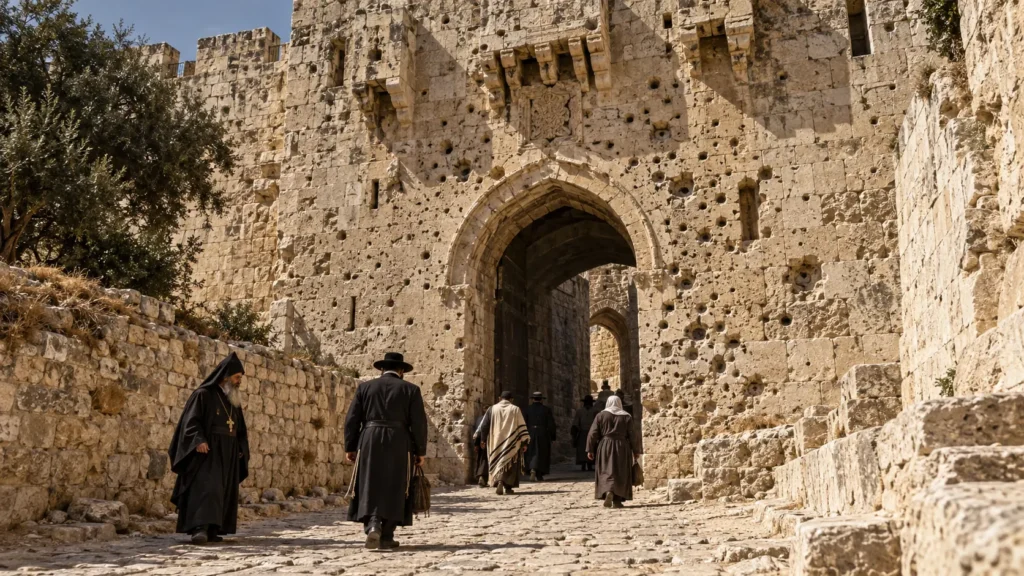
When tourists walk up the southern ridge and ask exactly what is the Zion Gate in Jerusalem, they are usually reacting to its dramatic, battle-scarred facade. Architecturally, it is a classic L-shaped portal built in 1540 by the Ottoman Sultan Suleiman the Magnificent. Much like the original design of the Jaffa Gate, this sharp right-angle turn immediately inside the doors was a deliberate defensive measure designed to halt charging enemy cavalry.
In Arabic, the portal is called Bab Nabi Dawud (Gate of the Prophet David) because it leads directly to the traditional site of King David’s Tomb. Today, the Zion Gate old city Jerusalem entrance serves as a vital pedestrian artery, but it is impossible to walk through its heavy wooden doors without noticing the severe, concentrated damage inflicted upon the surrounding limestone.
The 1948 Bullet Holes (Zion Gate Israel)
The defining feature of this entrance is the sheer density of bullet holes and artillery shrapnel pockmarking its outer facade. These deep scars are a direct result of the fierce, close-quarters fighting during the 1948 Arab-Israeli War (the War of Independence).
During the conflict, the Jewish Quarter inside the Old City was completely cut off and besieged by Jordanian forces. In May 1948, soldiers from the Palmach (the elite fighting force of the Haganah) launched a desperate, bloody assault on the gate in an attempt to relieve the trapped residents. Although they briefly breached the heavy wooden doors, they were ultimately forced to retreat, and the Old City fell under Jordanian control until 1967. Following the reunification of the city, the modern State of Israel consciously chose not to repair the facade. Today, when visitors look up at the Zion Gate Israel structure, the preserved bullet holes serve as a permanent, solemn memorial to the soldiers who fought to defend the Jewish Quarter.
The Biblical Debate: Are Zion and Jerusalem the Same?
Because the gate takes its name from the mountain it faces, it frequently sparks one of the most common geographical and theological questions among Bible readers. Search engines are constantly flooded with variations of the exact same query: are Zion and Jerusalem the same, or is Zion and Jerusalem the same place?
To answer whether is Zion Jerusalem or Israel, we have to understand that the definition has drastically shifted over three thousand years. The short answer is that while they are often used interchangeably today as synonyms for the Holy City, historically and topographically, they started as two very distinct concepts.
What is the Difference Between Zion and Jerusalem?
If you are looking for the exact difference between Zion and Jerusalem, the distinction lies in the evolution of the city’s borders.
When analyzing Jerusalem vs Zion in a strict archaeological and historical context, “Jerusalem” refers to the entire sprawling urban settlement. “Zion,” on the other hand, originally referred to one specific geographical feature: a highly fortified Jebusite stronghold on the southeastern hill. When King David conquered this specific fortress (2 Samuel 5:7), it became known as the City of David, and the hill itself was firmly established as Mount Zion. Therefore, what is the difference between Jerusalem and Zion topographically? Zion was originally just a small, fortified district within the much larger borders of the expanding capital city.
Why is Jerusalem Called Zion in the Bible?
If they were originally different, why is Jerusalem called Zion so frequently in scripture?
As the biblical narrative progresses, the name undergoes a massive theological expansion. When King Solomon built the First Temple on Mount Moriah (further north), the title of “Zion” migrated to this new, holier peak. By the time of the prophets, the name expanded again. So, is Zion another name for Jerusalem? Yes. In the poetic and prophetic books (like Psalms and Isaiah), the term encompasses the entire city and all its inhabitants.
When people ask, does Zion mean Jerusalem, the answer is a resounding yes in a spiritual context. In the study of Zion and Jerusalem in the Bible, the term “Zion” evolved from a physical limestone fortress into the ultimate theological metaphor for God’s chosen city, the spiritual kingdom of heaven, and the overarching covenant with the people of Israel.
Aquí tienes el bloque geográfico. Esta sección es muy interesante porque nos permite explicar un error histórico brutal (el Monte Sión actual no es el original de la Biblia), lo cual suma muchísimos puntos de autoridad.
Además, hemos aprovechado para absorber esas keywords genéricas de turismo (historical landmarks in jerusalem) enlazándolas con los monumentos literales que hay nada más cruzar la puerta (la Tumba de David y el Cenáculo).
Where is Zion Gate Located? (Map & Har Tsiyon)
If you are looking at a modern map and wondering exactly where is Zion in Jerusalem, the topography might actually confuse you if you are comparing it strictly to ancient biblical texts. The gate itself is positioned on the crest of the city’s southern wall, acting as the primary exit from the Jewish and Armenian Quarters directly onto the wide, flat plateau that dominates the southern landscape outside the walls.
Mount Zion (Zion Hill in Jerusalem)
In Hebrew, this prominent plateau is known as Har Tsiyon Jerusalem. However, there is a fascinating historical twist regarding this location. The modern Zion hill in Jerusalem that sits outside the gate today is actually the Western Hill of the ancient city.
How did this happen? In the 4th century CE, Byzantine Christian pilgrims arrived in the city and assumed that this taller, more imposing western peak simply had to be the location of King David’s ancient fortress. They incorrectly transferred the name to this hill, and the geographic label stuck for over 1,500 years. Today, regardless of its original Jebusite location, this western plateau is universally recognized (even appearing in international tourism searches as bukit sion israel) as the historical Zion hill Jerusalem, and the gate serves as its official northern entrance.
Landmarks Outside the Gate (David’s Tomb & The Last Supper)
Because it leads directly onto this sacred plateau, exiting through this portal immediately places you among some of the most important historical landmarks in Jerusalem.
Unlike other gates that open into modern commercial districts or bus stations, stepping outside this southern exit immerses pilgrims in a dense compound of religious history. Just a two-minute walk from the bullet-scarred walls are several Jerusalem famous landmarks revered by multiple faiths. These include the traditional Tomb of King David (a major pilgrimage site for Jewish worshippers), the Cenacle or Room of the Last Supper (a crucial site for Christian pilgrims), and the striking Dormition Abbey with its massive clock tower and blue dome. The gate acts as the physical bridge between the walled Old City and these monumental sites.
Study Guide & Quick Answers (FAQs)
What is the gate called in Spanish?
In Spanish-language tourism guides, academic literature, and theological texts, it is most commonly translated as la puerta de sion jerusalén. You may also see the surrounding area referenced simply as sion jerusalem on bilingual maps guiding international pilgrims to the southern plateau.
Why are there bullet holes on the Zion Gate?
The intense, visible scarring on the gate’s outer limestone facade is the direct result of heavy gunfire and artillery during the 1948 Arab-Israeli War. Specifically, these are the remnants of a fierce battle in May 1948 when Israeli Palmach soldiers desperately attempted to breach the gate to relieve the besieged Jewish Quarter.
What is inside the Zion Gate?
Entering through this southern portal leads you directly into the historic Armenian Quarter and the southern edge of the Jewish Quarter. From here, visitors can easily navigate the narrow, stone-paved streets to explore the ancient Roman Cardo or walk down toward the Western Wall.