Despite its unflattering name, the Dung Gate in Jerusalem is currently the most heavily trafficked route for worshippers heading directly to the Western Wall. Unlike the other historical gates of Jerusalem, which were built for trade or defense, this southern portal functioned in biblical antiquity as the city’s primary sanitation exit, funneling garbage and altar ashes down into the smoldering Valley of Hinnom (Gehenna). Today, it represents a profound historical contrast between ancient waste management and modern spiritual reverence.
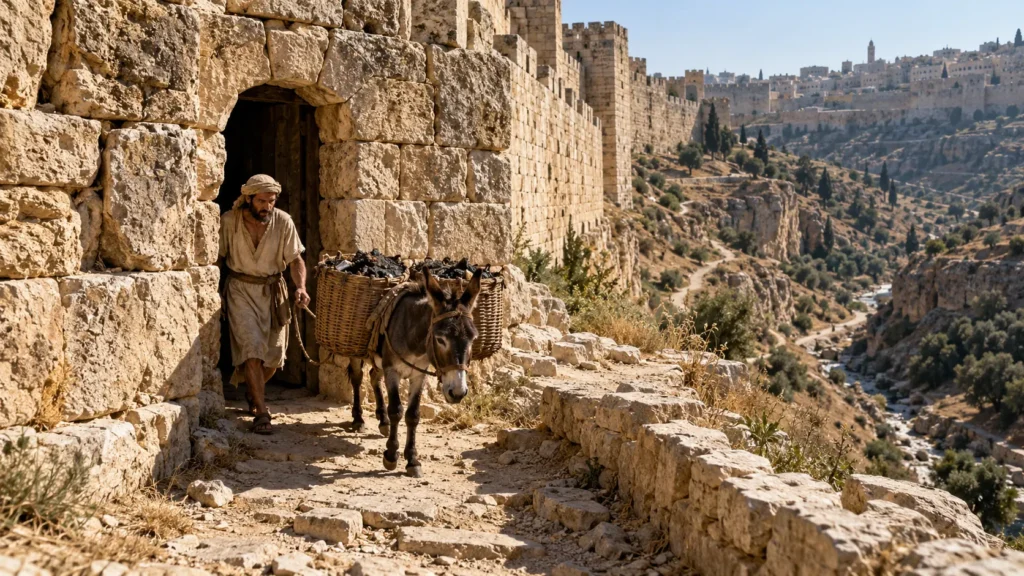
What is the Dung Gate? (Old City of Jerusalem)
If you are unfamiliar with the topography of the city, your first question is likely: exactly what is the Dung Gate, and where does it fit into the broader fortifications?
In modern terms, answering what is a Dung Gate requires looking at the 16th-century Ottoman walls built by Sultan Suleiman the Magnificent. The current Dung Gate of Jerusalem is a relatively small, arched stone portal located on the southern edge of the Old City. Unlike the grand, fortress-like structures of Damascus or Jaffa, the Dung Gate Old City Jerusalem entrance was originally built as a narrow postern (a secondary door) for pedestrians and pack animals. It wasn’t until 1952, under Jordanian rule, that the archway was significantly widened to allow vehicular traffic to pass through. Today, it is the primary gateway providing direct access to the Jewish Quarter and the sprawling Western Wall Plaza.
Why is it Called the Dung Gate? (Meaning & Purpose)
The most frequently asked question by curious visitors and Bible readers alike is: why is it called the Dung Gate?
To understand the Dung Gate meaning, we have to look at the ancient topography and the prevailing winds of the region. Jerusalem sits on a mountain, with the Kidron Valley to the east and the Valley of Hinnom to the south. Because the winds in Jerusalem predominantly blow from the northwest to the southeast, ancient city planners designated the southern and southeastern edges of the city as the waste disposal zones to keep bad odors away from residential areas.
So, what was the Dung Gate used for? Just as its name implies, it was the designated exit for the city’s waste. The purpose of the Dung Gate in Jerusalem was to serve as the main thoroughfare for servants, sweepers, and sanitation workers to cart out the city’s garbage, the ashes from the Temple sacrifices, and the animal manure (dung). All of this refuse was hauled out through this specific portal and dumped into the steep valleys below, keeping the sacred and residential precincts of the Holy City ritually pure and clean.
The Dung Gate in the Bible: Ancient Walls and the Trash Dump
When searching for references to the Dung Gate in the Bible, readers are transported back to the Old Testament era. To understand exactly what was the Dung Gate in the Bible, we have to look past the current 16th-century Ottoman structure. While the modern gate sits on the southern wall, the original biblical gate was located slightly further southeast, part of the ancient fortifications surrounding the City of David. As an integral part of the ancient walls of Jerusalem, the Dung Gate served the exact same sanitary and geographical purpose thousands of years ago as its name suggests today.
The Book of Nehemiah (Nehemiah Dung Gate)
The most famous biblical mentions of this entrance are found in the era of the Jewish return from Babylonian exile. If you are wondering what is the Dung Gate in Nehemiah, it plays a crucial role in the reconstruction of the ruined city.
In Nehemiah 2:13, the prophet takes a secret nighttime inspection of the broken walls, riding his animal specifically out through the Valley Gate and toward the Nehemiah Dung Gate to assess the damage caused by the Babylonians. Later, in Nehemiah 3:14, the text meticulously records the rebuilding effort: “The Dung Gate was repaired by Malkijah son of Rekab, ruler of the district of Beth Hakkerem. He rebuilt it and put its doors with their bolts and bars in place.” It was a priority to secure this exit to ensure the city could properly manage its waste during a time of intense siege and vulnerability.
The Ancient Jerusalem Trash Dump (Gehenna / Valley of Hinnom)
To fully grasp what it meant to walk out of this portal in antiquity, one must understand what lay immediately outside it. The gate opened directly toward the Valley of Hinnom (known in Hebrew as Gei Hinnom or Gehenna).
This valley was the ancient Jerusalem dump. Because it was the designated ancient Jerusalem trash dump, it was a place of perpetual decay and smoldering fires. All the city’s refuse, animal carcasses, and the ashes from the altar were tossed down here and constantly burned. In the New Testament, Jesus frequently used “Gehenna” as the ultimate metaphor for Hell—a place of unquenchable fire and weeping. Therefore, the gate was literally the threshold between the holy purity of the Temple Mount and the burning, unclean wasteland of the valley below.
Dung Gate Spiritual Meaning
Because of this stark contrast between the holy city and the burning trash dump, the entrance has taken on a profound metaphorical life in modern theology. Many believers search for the Dung Gate spiritual meaning when studying Nehemiah’s rebuilding of the walls.
In Christian and Jewish allegorical teachings, the Bible Dung Gate meaning represents the necessary process of spiritual cleansing, repentance, and sanctification. Just as a healthy physical city requires a dedicated exit to remove toxic waste and prevent disease, a healthy spiritual life requires a mechanism to remove “garbage”—sin, unhealthy habits, or emotional baggage. In these studies, repairing this specific gate symbolizes a believer’s commitment to eliminating toxic elements from their life to maintain spiritual purity.
History of the Dung Gate: From Ottoman Rule to Modern Times
While the biblical origins of the site date back millennia, the physical history of the Dung Gate we see today is firmly rooted in the 16th century. When Sultan Suleiman the Magnificent rebuilt the city walls between 1537 and 1541, he did not envision this southern portal as a major thoroughfare. Originally, the Ottoman architects designed it as a very narrow, low postern gate—barely wide enough for a pedestrian or a single loaded donkey to squeeze through.
For nearly 400 years, the gate retained this modest, unassuming shape. However, the mid-20th century brought radical changes to the city’s infrastructure. Following the 1948 Arab-Israeli War, the Old City fell under Jordanian control. In 1952, the Jordanian authorities made the pragmatic decision to heavily modify the ancient stonework, significantly widening the archway to allow modern cars and buses to pass through the southern wall. After the Six-Day War in 1967, the Israeli government assumed administration of the Old City and further renovated the gate, adding modern security infrastructure while preserving the widened arch to accommodate the massive influx of daily visitors.
Where is the Dung Gate Located? (Map & Directions)
Because it is much smaller than the monumental Jaffa or Damascus gates, travelers often need a Dung Gate map to pinpoint its exact location.
If you are looking at a Dung Gate Jerusalem map, you will find it positioned on the southern wall of the Old City, sitting at the lowest topographical point of the city’s perimeter. It is located just southwest of the Temple Mount (Haram al-Sharif) and directly adjacent to the sprawling City of David archaeological park and the Palestinian neighborhood of Silwan, which sit immediately outside the walls in the Kidron Valley.
The Closest Entrance to the Western Wall
For modern tourists and pilgrims, the historical name of the gate completely belies its current prestige. If you are booking a taxi or joining a tour group heading to the holiest accessible site in Judaism, you will inevitably be dropped off here.
This entrance is famous today for being the closest, most direct access point to the Western Wall (the Kotel). Upon walking through the arched stone portal, visitors immediately encounter the security checkpoints that lead directly into the expansive Western Wall Plaza. Rather than carrying out the city’s refuse, the gate now funnels millions of worshippers, Bar Mitzvah families, and international dignitaries directly to the sacred retaining wall of the ancient Temple Mount.
Study Guide & Quick Answers (FAQs)
What was the Dung Gate in Jerusalem used for?
In antiquity, it was used as the primary exit for sanitation workers and servants to remove the city’s garbage, animal waste, and temple ashes. All of this refuse was hauled out through this specific portal and dumped into the Valley of Hinnom (Gehenna) to be burned, keeping the city ritually clean.
What is the Spanish name for the gate?
In Spanish-speaking biblical studies and tourism guides, it is most commonly translated as la puerta de la basura jerusalén (The Gate of the Garbage) or La Puerta del Estiércol (The Gate of Dung).
Is the Jerusalem Dung Gate open to the public today?
Yes, the Jerusalem Dung Gate is completely open to the public. In fact, it is one of the most heavily trafficked entrances in the Old City because it serves as the closest and most direct access point for tourists, pilgrims, and vehicles heading to the Western Wall Plaza.