Of all the entrances piercing the ancient limestone walls of the Holy City, none is as visually imposing or culturally vibrant as the Damascus Gate in Jerusalem. Serving as the main northern access point, the Damascus Gate is a masterpiece of Ottoman architecture and a living, breathing hub of daily life. For anyone studying biblical geography or planning a historical pilgrimage, understanding the complex history of the Damascus Gate Jerusalem is essential to grasping the pulse of the city itself.
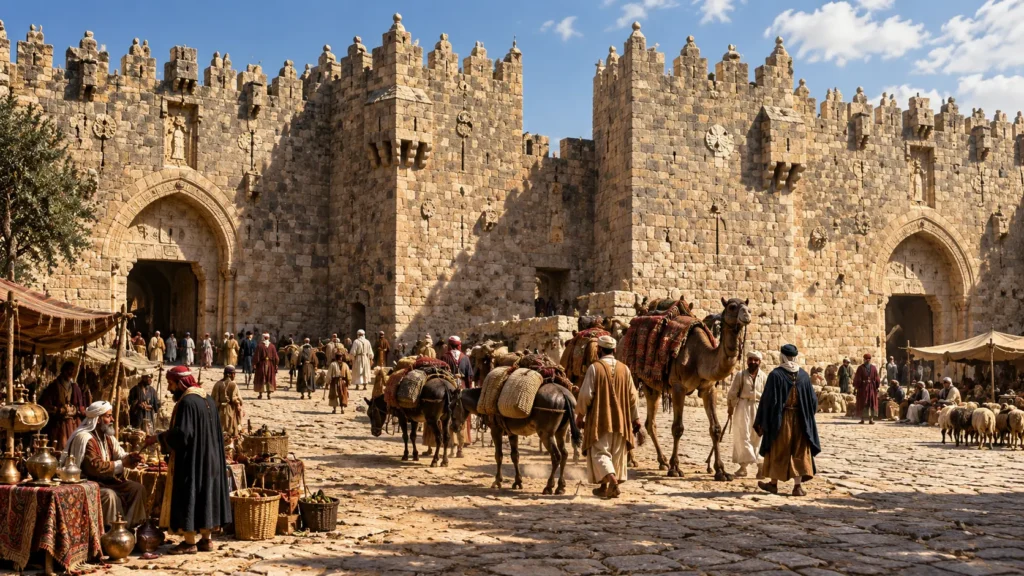
What is the Damascus Gate? (Old City of Jerusalem)
When first-time visitors look at the massive fortifications along the northern wall, they often ask: exactly what is the Damascus Gate, and why is the Damascus Gate important?
In simple terms, it is the largest, most heavily fortified, and most architecturally elaborate entrance to the Old City. Built in 1537 under the direct orders of the Ottoman Sultan Suleiman the Magnificent, the Damascus Gate of Jerusalem was designed to be the crown jewel of the city’s defenses. But answering what is Damascus Gate goes far beyond its impressive stonework. It is the primary geographical anchor connecting the modern commercial districts of East Jerusalem to the ancient Muslim and Christian quarters. Its heavy, crown-like crenellations (slit windows for archers) and machicolations make it a formidable fortress, yet its open doors lead directly into the bustling, labyrinthine souqs (markets) of the ancient city.
The Damascus Gate Plaza
Unlike other entrances that open directly onto a flat street, this portal is preceded by the sweeping, amphitheater-like Damascus Gate plaza.
To enter the old city Damascus Gate, pedestrians must descend a wide set of stepped stone terraces that funnel down toward the massive entryway. This plaza serves as a natural gathering place and a vibrant socio-cultural stage. It is constantly filled with the energy of locals and pilgrims, where merchants sell everything from fresh dates and sesame bread (ka’ak) to traditional wares. Standing in this plaza, looking up at the towering 16th-century facade, provides one of the most iconic and historically authentic atmospheres in the entire Middle East.
The Names of the Gate: Damascus Gate in Arabic and Hebrew
In Jerusalem, monuments rarely have just one name. Throughout history, conquering empires and diverse religious communities have layered their own languages and meanings onto the city’s architecture. While it is internationally recognized in English—and known across the Spanish-speaking world as la puerta de damasco—the local names for this monumental entrance reveal fascinating details about its geography and archaeological past.
To truly understand its significance, we must examine the Damascus Gate in Arabic and the Damascus Gate in Hebrew, as neither local language refers to the city of Damascus.
Bab al-Amud (The Gate of the Column)
If you ask a local Palestinian resident for directions, they will not use the term “Damascus Gate.” Instead, the Damascus Gate Arabic name is Bab al-Amud (often written in full context as باب العامود القدس, meaning “The Gate of the Column of Jerusalem”).
Where does this name come from? It preserves a 2,000-year-old architectural memory. During the 2nd century CE, the Roman Emperor Hadrian rebuilt Jerusalem as the pagan city of Aelia Capitolina. Just inside this northern gate, the Romans erected a massive, free-standing victory column topped with a statue of the Emperor. This pillar was the “kilometer zero” of the region, from which all distances to other cities were measured. Although the column was destroyed centuries ago, the famous 6th-century Madaba Map mosaic clearly depicts it standing inside the plaza. The Arabic name beautifully immortalizes this ancient Roman monument.
Sha’ar Shkhem (The Nablus Gate)
Conversely, the Damascus Gate in Hebrew is known as Sha’ar Shkhem. This translates directly to the “Shechem Gate” or “Nablus Gate.”
The reasoning behind this name is purely geographical. In antiquity, travelers exiting the city through this northern portal and following the main highway would arrive directly at the ancient biblical city of Shechem, which corresponds to the modern-day Palestinian city of Nablus. While the English name focuses on the final, distant destination of that northern road (Damascus, in Syria), the Hebrew name focuses on the most important immediate destination within the biblical heartland of Judea and Samaria.
Damascus Gate History: 2 Historical Facts You Need to Know
The Damascus Gate history is a masterclass in urban survival. This specific spot on the northern wall has been destroyed, rebuilt, and modified by almost every major empire that has conquered the Levant. For anyone studying the architectural evolution of the city, there are 2 historical facts about the Damascus Gate in Jerusalem that perfectly encapsulate its fascinating past: the visible Ottoman triumph above ground, and the hidden Roman ruins below.
Suleiman the Magnificent and the Ottoman Wall
The first crucial historical fact is that the towering, crenellated fortress we see today is relatively “modern” by Jerusalem’s standards. It was constructed between 1537 and 1541 CE by the great Ottoman Sultan, Suleiman the Magnificent.
Following the Ottoman conquest of the region, Suleiman initiated a massive rebuilding of the city’s dilapidated walls to secure it against potential Crusader threats and Bedouin raids. He designed this northern portal to be the most fortified and intimidating entrance in the city. Above the heavy wooden doors, you can still see the original defensive machicolations—small stone balconies with holes in the floor through which defenders could drop boiling oil or heavy stones on attacking armies. It stands today as one of the finest surviving examples of 16th-century Ottoman military architecture in the world.
Jerusalem Damascus Gate Archaeological Site (The Roman Era)
The second essential fact lies hidden just beneath the feet of the modern pedestrians. The Ottoman gate was actually built directly on top of ancient ruins, creating the fascinating Jerusalem Damascus Gate archaeological site.
In the 2nd century CE, the Roman Emperor Hadrian violently suppressed the Bar Kokhba revolt, expelled the Jewish population, and rebuilt Jerusalem as a pagan Roman colony called Aelia Capitolina. Here, Hadrian built a massive, free-standing triple-arched triumphal gate. Through meticulous excavations in the 20th century, archaeologists uncovered this Roman structure directly below the Ottoman plaza. Today, visitors can actually walk down into this subterranean Jerusalem Damascus Gate archaeological site and see the surviving eastern arch of Hadrian’s original gate, complete with its original Roman paving stones and the very threshold that pedestrians crossed nearly 2,000 years ago.
Where is the Damascus Gate Located? (Map & Directions)
For travelers planning their route or historians tracing ancient borders, a common starting question is where is the Damascus Gate in the modern layout of the city.
If you look at any standard Damascus Gate Jerusalem map, you will find it positioned prominently in the middle of the northern wall of the Old City. The exact Damascus Gate location marks the bustling boundary between the commercial district of East Jerusalem (outside the walls) and the labyrinthine Muslim Quarter (inside the walls). For anyone trying to pinpoint exactly where is the Damascus Gate in relation to other landmarks, it sits squarely between Herod’s Gate to the east and the New Gate to the west.
The Ancient Road from Jerusalem to Damascus
But why does a gate in Israel bear the name of the Syrian capital? To understand this, you have to look at a historical Damascus Jerusalem map.
In antiquity, city gates were often named after their primary geographic destinations. This northern portal opened directly onto the ancient road from Jerusalem to Damascus, the main highway leading out of the Judean highlands. This vital artery facilitated centuries of trade, military campaigns, and diplomatic communication between Jerusalem and Damascus. Furthermore, this highway connected to broader regional networks, intersecting with the ancient trade routes that linked the Mediterranean coast to the inland empires (often referred to as the Acre Jerusalem Damascus trade corridor). Exiting this gate meant you were on the direct path to the north.
Hotels and the Damascus Gate Bus Station
Today, the geography outside the gate serves a very practical purpose for locals and tourists alike. Because it is the main artery into the Muslim Quarter, the surrounding area in East Jerusalem is heavily developed.
There are numerous pilgrim guesthouses and hotels near Damascus Gate, offering travelers accommodations just steps away from the Old City walls. Additionally, just a short walk from the plaza is the East Jerusalem Damascus Gate bus station (specifically the Sultan Suleiman terminal). This transit hub is crucial for regional travel, providing local bus lines and connections to various Palestinian territories in the West Bank, ensuring the gate remains as important for modern transportation as it was in ancient times.
The Damascus Gate in the Bible and the Time of Jesus
When pilgrims search for references to the Damascus Gate in the bible, they often hit a wall. The specific term “Damascus Gate” does not appear in the Old or New Testaments, primarily because the current Ottoman structure and its Roman predecessor did not exist during the biblical eras.
However, this does not mean the location is irrelevant to scripture. Quite the opposite. During the 1st century CE, the northern boundary of Jerusalem was protected by what the historian Josephus called the “Second Wall.” Exactly where the modern plaza stands today, there was an ancient, highly fortified northern gate in that Second Wall. Therefore, when we look for the Damascus Gate in the bible, we are actually looking at the geographical threshold that separated the sacred, pure interior of Jerusalem from the untamed, unprotected world outside.
Did Jesus Walk Through the Damascus Gate?
The most profound theological connection to this site revolves around the crucifixion. This brings up a frequent question among pilgrims: what is the connection between the Damascus Gate, Jesus, and the events of Good Friday?
Jewish law strictly dictated that executions and burials had to take place outside the city walls to maintain ritual purity. Whether you follow the traditional Catholic and Orthodox site of the crucifixion (the Church of the Holy Sepulchre) or the Protestant site (Gordon’s Calvary and the Garden Tomb, located just a few hundred meters north of the modern gate), both locations were outside the city’s northern wall in 33 CE.
Historical and topographical consensus suggests that when Jesus was led away to be crucified at Golgotha, he had to cross the city limit. It is highly probable that Jesus, carrying the cross, walked through the ancient First-Century gate that stood on the exact same bedrock as the modern Damascus Gate. For this reason, the area just outside this gate is considered by many historians and theologians to be the literal ground zero of the crucifixion narrative.
Is Damascus Older Than Jerusalem? (City Age Comparison)
When discussing the ancient Levant, the names of these two great cities often invite a fascinating historical debate. Because this northern gate connects the two, visitors frequently ask: is Damascus older than Jerusalem?
From a strict archaeological standpoint, the answer is generally yes. While the first human settlements in Jerusalem (located around the Gihon Spring in the City of David) date back to the Chalcolithic period (circa 4500–3500 BCE), Damascus boasts evidence of widespread habitation in the wider Barada basin dating back as far as 9000 BCE. Furthermore, Damascus achieved significant, large-scale urban settlement by the 3rd millennium BCE. Today, it is widely cited by historians as the oldest continuously inhabited capital in the world, giving it a definitive chronological edge when comparing the ancient urban life of Jerusalem and Damascus.
Is Jericho or Damascus the Oldest City?
However, if we expand the scope of the debate to include the entire region, a third contender enters the arena and changes the conversation completely. Search engines are constantly flooded with queries asking is Damascus or Jericho older, or trying to settle the debate of is Jericho or Damascus the oldest city on earth.
The archaeological verdict here is definitive: Jericho wins. While Damascus claims the title for the oldest continuously inhabited capital, Jericho (located just a short drive east of Jerusalem near the Dead Sea) is widely recognized by historians as the oldest walled city ever discovered. Excavations at the site of Tell es-Sultan in Jericho have revealed massive defensive walls and a stone tower dating back to 9000–8000 BCE (the Pre-Pottery Neolithic period). So, while the Damascus Gate points the way to an incredibly ancient Syrian capital, it is Jericho that holds the ultimate crown for urban antiquity in the Middle East.
Study Guide & Quick Answers (FAQs)
Is Damascus in Jerusalem?
No. Damascus is the capital city of Syria, located roughly 135 miles (218 kilometers) northeast of Jerusalem. The Israel Damascus Gate is simply the name of the northern entrance in Jerusalem’s Old City walls because it historically opened onto the main ancient highway leading toward the Syrian capital.
What is the Spanish name for the gate?
In Spanish-speaking academic and tourism circles, it is widely known as la puerta de damasco. You will find this exact term used on official maps, guidebooks, and historical plaques throughout the Christian and Muslim quarters.
Can I take Damascus Gate photos safely?
Yes, taking Damascus Gate photos is generally safe and highly encouraged for tourists, as the plaza offers spectacular architectural views. However, because it is a heavily policed transit hub and a focal point for local demonstrations, visitors should remain respectful of the local merchants and aware of their surroundings, particularly on Fridays during midday prayers.
What is “A Beggar at Damascus Gate”?
When searching for the history of the gate, you might encounter the phrase a beggar at Damascus Gate. This usually refers to the critically acclaimed 1998 novel of the same name by author Dan Jacobson, or it is used as a cultural trope to describe the vibrant, chaotic, and ancient atmosphere of the plaza, where merchants, pilgrims, and beggars have interacted for centuries.