Of all the historical entrances piercing the limestone walls of the Holy City, the Jaffa Gate in Jerusalem is arguably the most famous and heavily trafficked. Situated prominently on the western wall, the Jaffa Gate serves as the primary bridge between the modern, bustling commercial districts of West Jerusalem and the ancient stone alleys of the city. Whether you are tracing the steps of 19th-century pilgrims, exploring the Tower of David, or simply standing in the vibrant Jerusalem Jaffa Gate plaza today, understanding the rich past of this portal is essential.
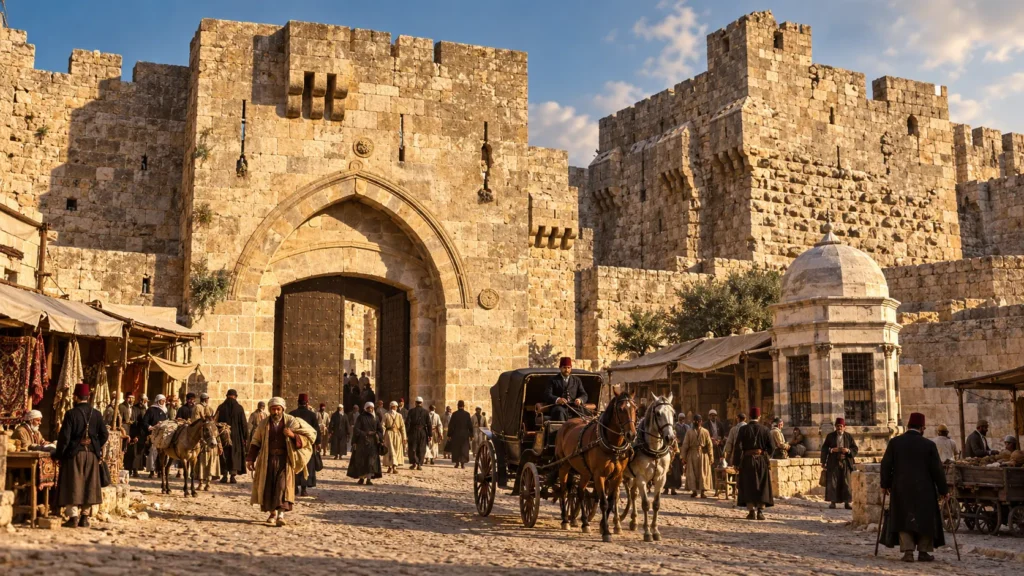
What is the Jaffa Gate? (Jerusalem Old City)
For visitors approaching the towering Ottoman fortifications for the first time, a common question arises: exactly what is the Jaffa Gate, and how does it function within the modern layout?
To answer what is Jaffa Gate, we must look at both its military design and its strategic placement. Built in 1538 by the Ottoman Sultan Suleiman the Magnificent, this monumental stone portal was designed to secure the vulnerable western flank of the city. Unlike straight-access portals such as the Damascus Gate, the original structure of the old city Jaffa Gate features a unique “L-shaped” right-angle turn immediately inside its wooden doors. This was a classic defensive architectural choice designed to slow down invading cavalry, forcing them to dismount or break formation, thereby preventing enemy troops from charging directly into the Jerusalem old city Jaffa Gate thoroughfares. Today, this gateway stands as the main pedestrian entryway into both the Christian and Armenian Quarters.
The Significance of the Jaffa Gate (Hebron Gate)
Beyond its military architecture, the true Jaffa Gate significance lies in its geographical orientation and its dual naming conventions. Just like other historical portals in the ancient world, its names point to the major destinations of the roads leading out of it.
In Hebrew, it is known as Sha’ar Yafo. This name was given because the ancient highway exiting this gate led directly to the Mediterranean port city of Jaffa (Joppa), which was the primary disembarkation point for Jewish and Christian pilgrims arriving in the Holy Land by sea.
However, the local Arabic name reveals a completely different geographical and theological focus. In Arabic, it is called Bab al-Khalil, which translates to the “Gate of the Friend.” This is a direct reference to the biblical patriarch Abraham, who is known in Islamic tradition as the “Friend of God.” Abraham is buried in the southern city of Hebron, and the ancient road extending south from this gate historically connected Jerusalem directly to the sacred Cave of the Patriarchs.
Jaffa Gate History & Facts
When studying the architectural evolution of the city, the Jaffa Gate history stands out because it is the only gate that underwent a massive, permanent structural alteration in modern times. There are many fascinating facts about the Jaffa Gate, but the most striking visual anomaly is the wide gap in the wall immediately to the right of the stone portal. Unlike the other gates where vehicles must squeeze through ancient stone arches, cars entering the Old City here drive through a wide, open breach in the fortifications.
This brings us to one of the most defining Jaffa Gate facts: that gap was not part of Suleiman’s original 16th-century design. It was created for a very specific, highly political European visitor.
Jaffa Gate 1897: The Breach for Kaiser Wilhelm II
As the 19th century drew to a close, the Ottoman Empire sought to strengthen its ties with Germany. While historical archives and popular searches often look for the events of Jaffa Gate 1897 as the period of intense planning and diplomatic negotiations, the actual defining moment occurred in the fall of 1898.
Kaiser Wilhelm II of Germany was scheduled to make a historic state visit to Jerusalem. The Kaiser insisted on entering the Holy City riding on his white horse and accompanied by his grand royal carriage. However, the original L-shaped, right-angle turn inside the gate was too narrow for a carriage to pass. To accommodate the German Emperor’s ego without forcing him to dismount, the Ottoman authorities made an unprecedented decision: they filled in the ancient moat that sat between the gate and the Tower of David Citadel, and they tore down a section of the 16th-century city wall. This created the wide road we see today, permanently altering the historical footprint of the site.
Christ Church Jaffa Gate Jerusalem
The 19th century also brought a wave of European religious and diplomatic influence to the area immediately surrounding the gate. Just steps inside the entrance, situated directly opposite the ancient Citadel (Tower of David), stands a crucial piece of this modern history: the Christ Church Jaffa Gate.
Consecrated in 1849, this unassuming stone building holds the title of the oldest Protestant church in the Middle East. Built by the Anglican Church (with significant British and Prussian backing), its architecture was intentionally designed to blend in with the local Jerusalem stone and synagogue-style seating so as not to provoke the ruling Ottoman authorities. Today, visiting the Christ Church Jaffa Gate Jerusalem compound—which includes a historic guesthouse and a heritage center—provides pilgrims with a unique window into the intense European diplomatic scramble for influence in the Holy Land during the Victorian era.
Where is Jaffa Gate Located? (Map & Directions)
If you examine any standard Jaffa Gate Jerusalem map, you will immediately spot this entrance on the central-western perimeter of the Old City walls. For travelers trying to figure out exactly where is Jaffa Gate, its precise Jaffa Gate location acts as the primary hinge connecting the modern, bustling center of West Jerusalem to the ancient walled city.
Whether you are navigating via GPS or a printed Jaffa Gate map, it is impossible to miss. It is situated right next to the towering minaret and massive stone walls of the Tower of David (the ancient Citadel). Because it sits at the intersection of the Mamilla outdoor mall and the Old City, it is by far the most accessible and heavily used entrance for modern visitors.
How Far is Jaffa from Jerusalem? (The Historic Route)
Because the gate is named after the coastal city it faces, it often prompts curious travelers to ask: exactly how far is Jaffa from Jerusalem?
Historically and geographically, the journey from the Mediterranean port of Jaffa to Jerusalem covers roughly 40 miles (about 65 kilometers). In antiquity, this was an arduous, multi-day trek across the flat coastal plain and up into the steep, treacherous Judean mountains. In the 19th century, this vital artery was modernized to accommodate carriages and, eventually, modern vehicles. The historical significance of this route is still honored today; for instance, the famous Jerusalem Boulevard Jaffa (Sderot Yerushalayim) in the coastal city of Tel Aviv-Yafo was built in the early 20th century as the grand starting point of this ancient, uphill pilgrimage to the Holy City.
Route: From Jaffa Gate to the Western Wall
For modern pilgrims, this specific gate serves as the ultimate starting point for exploring the holy sites. The most heavily trafficked walking route in the Old City is the path from the Jaffa Gate to Western Wall.
Upon entering the gate and passing the Tower of David, visitors walk straight ahead into the bustling David Street market (the souq). By following this descending, narrow, stone-paved street, travelers transition seamlessly from the borders of the Christian and Armenian Quarters down into the Jewish Quarter. The 10-to-15-minute walk from the Jaffa Gate to Western Wall plaza is a sensory journey through centuries of history, safely guiding pilgrims directly to the Kotel, the holiest accessible prayer site in Judaism.
If you decide to walk south from here along the exterior perimeter of the Armenian Quarter, your next historical stop will be the Zion Gate.
Jaffa Street Jerusalem (Yaffo Street) and the Railway
The influence of this gate extends far beyond the ancient Ottoman walls. It directly gave birth to the longest, oldest, and most important commercial thoroughfare in the modern city: Jaffa Street Jerusalem (also widely referred to by its transliterated Hebrew name, Yaffo Street Jerusalem).
Originally, the Jaffa road was little more than a dusty, unpaved trail used by camels and carts heading down to the coastal port. However, when the city began expanding outside the protective walls in the 1860s, this specific road became the main axis for modern development. Neighborhoods, hospitals, and consulates sprang up along its route. Today, it remains the vibrant, commercial backbone of West Jerusalem, leading travelers in a straight, historic line right to the foot of the Old City.
The Jaffa-Jerusalem Railway
The true modernization of this route occurred in the late 19th century, forever changing the Holy Land’s infrastructure. In 1892, the Ottoman authorities inaugurated the Jaffa Jerusalem railway, making it the very first railway line in the entire Middle East.
Before this engineering marvel, the uphill trek from the Mediterranean coast to the mountainous capital took days. The railway cut the journey down to just a few hours. This historic train line funneled a massive influx of European pilgrims, construction materials, and economic prosperity directly toward the gate. It essentially shifted the economic center of gravity of the city, pulling it outward from the cramped ancient alleyways into the booming new neighborhoods along Jaffa Street.
The Bus on Jaffa Road
For most of the 20th century, the street was notoriously loud, heavily polluted, and choked with traffic. The defining image of the modern era was the sight of the bus on Jaffa Road, with fleets of heavy public transit buses fighting through crowds of pedestrians and merchants.
However, in the early 21st century, the municipality executed a massive urban revitalization project. They permanently removed the heavy buses and cars, completely pedestrianizing the historic heart of the thoroughfare. In their place, they installed the sleek, modern Jerusalem Light Rail. Today, walking the route where the roaring buses once dominated offers a peaceful, café-lined promenade that beautifully bridges the modern 21st-century city with the 16th-century stones of the gate.
The Jaffa Gate in the Bible: Joppa and the Eye of the Needle
When readers search for the Jaffa Gate in the bible, they must navigate a fascinating blend of ancient geography and medieval urban legends. Because the current stone fortress was built in the 16th century, you will not find a direct bible verse about Jaffa Gate in the scriptures. However, the gate’s namesake city and the location upon which it stands are deeply intertwined with the biblical narrative, serving as the historical gateway to the New Testament world.
Distance from Jaffa to Joppa Judea
A frequent point of geographical confusion for Bible students is querying the distance from Jaffa to Joppa Judea. The historical and archaeological reality is that the distance is exactly zero—they are the exact same city.
“Joppa” is simply the Greek and biblical translation of the Hebrew name “Yafo” and the Arabic “Jaffa”. It was the primary ancient seaport for the region of Judea. When the prophet Jonah fled from the Lord, he took a ship from Joppa. Later, when the Apostle Peter raised Tabitha from the dead and had his famous vision of the clean and unclean animals (Acts 9 and 10), he was staying in this exact coastal city. Therefore, the western-facing gate in Jerusalem is literally pointing toward the ancient port where the early Christian church began its expansion into the Mediterranean world.
The “Eye of the Needle” Jaffa Gate Myth
One of the most persistent and famous urban legends in biblical tourism centers on the wooden doors of this specific entrance. Every year, thousands of online queries appear—often typed frantically into search engines with variations like eyye of the camel jaffa gate or the eyye of theneedle jaffa gate—trying to uncover a supposed archaeological secret.
The myth is tied to Jesus’ famous hyperbole in Matthew 19:24: “It is easier for a camel to go through the eye of a needle than for someone who is rich to enter the kingdom of God.” For centuries, well-meaning tour guides have claimed that the “Eye of the Needle” was not a literal sewing needle, but rather a small pedestrian wicket door cut into the massive main doors of the gate. The story goes that a camel could only pass through this small door at night if it was stripped of all its baggage and forced to crawl on its knees.
Historically and archaeologically, this is entirely false. This interpretation was invented in the 15th century by European commentators trying to soften the harshness of Christ’s teaching. While the 16th-century Ottoman doors do indeed feature a smaller pedestrian insert to allow people in after curfew without opening the heavy main gates, there was never an ancient First-Century entrance in Jerusalem called the “Eye of the Needle.” Jesus was using brilliant, literal absurdity to make a theological point, not referencing a physical gate.
Study Guide & Quick Answers (FAQs)
What is the Spanish name for the Jaffa Gate?
In Spanish-speaking academic literature, tourism guides, and historical texts, it is widely referred to as la puerta de jaffa jerusalem. You will frequently see this exact translation on municipal signs and multilingual maps navigating the Old City.
Are there historical Jaffa Gate images available?
Yes, because of its importance during the 19th and 20th centuries, there are thousands of historical Jaffa Gate images preserved in global archives. The most famous and heavily circulated photographs date back to 1898, capturing the exact moment the Ottoman authorities dismantled a section of the ancient wall to allow the German Emperor to enter in his carriage.
Is the Jaffa Gate in Israel?
The gate is located on the western wall of the Old City of Jerusalem. Following the Six-Day War in 1967, the entire Old City, including the Jaffa Gate Israel sector, came under Israeli administration. Today, it serves as the primary pedestrian bridge connecting the modern Israeli municipality of West Jerusalem with the historic Christian and Armenian Quarters.