The Battle of Plataea was the final and most decisive land engagement of the Greco-Persian Wars. Fought in the late summer of 479 BCE, this massive clash finally broke the back of the Persian military presence in Europe.
While the naval victory at the Battle of Salamis the previous year had crippled King Xerxes’ fleet, a massive Persian land army remained entrenched in mainland Greece. It took an unprecedented alliance of Hellenic city-states, marching together as a unified front, to finally destroy the invaders on the plains of Boeotia and secure the survival of a free Greece.
What Was the Battle of Plataea? (Summary & Quick Facts)
For a clear battle of plataea summary before diving into the complex troop movements, here is a quick overview of the most critical facts:
- What was the battle of plataea? It was the culminating land battle that permanently ended the Persian threat to the Greek mainland.
- When was the battle of plataea? The engagement took place in August of 479 BCE, almost exactly one year after the Greek defeats at Thermopylae and Artemisium.
- Where was it fought? On the plains just outside the city of Plataea in Boeotia, Greece.
- Who fought in the battle? The largest unified Greek hoplite army ever assembled (led primarily by Sparta, Athens, and Corinth) against the elite remnants of the Persian army and their Greek allies (such as the Thebans).
- Who won? The Greek alliance achieved a total and crushing victory, wiping out the majority of the Persian forces.
The Context: Why Did the Battle of Plataea Happen?
To understand why did the battle of plataea happen, we must look at the immediate aftermath of the battle of salamis and plataea’s role as the final chapter of the second invasion of Greece.
After the destruction of his navy at Salamis in 480 BCE, King Xerxes feared he would be trapped in Europe. He retreated to Asia with the bulk of his forces, but left his most trusted general, Mardonius, behind. Mardonius was given command of an elite, handpicked army (estimated at 70,000 to 120,000 men) to finish the conquest of Greece the following year.
After wintering in the north, Mardonius marched south in the spring of 479 BCE. He attempted to use diplomacy to break the Greek alliance, specifically offering Athens favorable terms to surrender. When Athens famously refused, Mardonius occupied and burned the ruined city of Athens for a second time.
Furious, the Athenians demanded that the Spartans finally march out of their beloved Peloponnese and engage the Persians in open battle. The Spartans agreed. Hearing that a massive, unified Greek army was marching north to meet him, Mardonius retreated to the flat, open plains of Boeotia near the city of Plataea. He chose this specific terrain because it was perfectly suited for his greatest military advantage: the devastating Persian cavalry.
Where Was the Battle of Plataea? (Location & Map)
To answer exactly where was the battle of plataea fought, we must look to the region of Boeotia in central Greece. Specifically, the battle lines were drawn near the small, ruined city of Plataea, which sat in the rugged foothills of Mount Cithaeron.
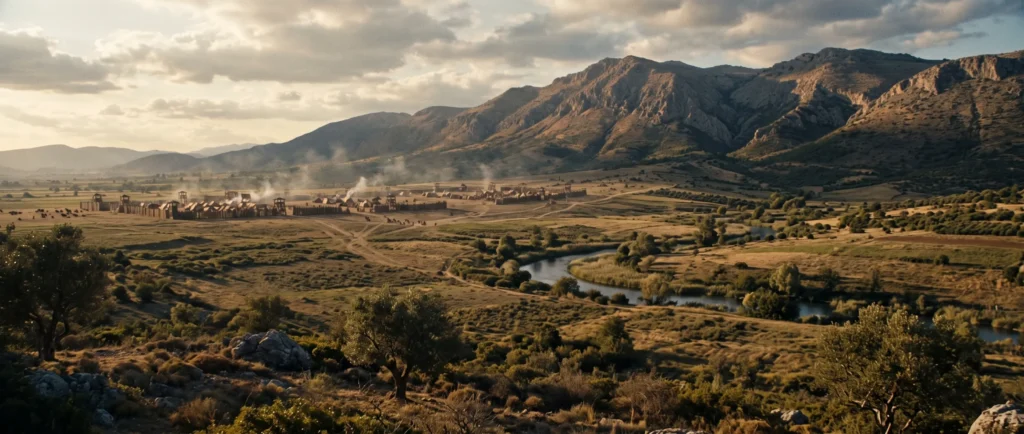
If you were to look at a map of the battle of plataea, you would see a very specific geographic stalemate. The Persian general Mardonius built a massive fortified camp along the north bank of the Asopus River. He chose this flat, open plain deliberately. While the Greeks preferred fighting in narrow chokepoints like the Battle of Thermopylae, Mardonius needed wide, open ground to unleash the full devastating power of his Persian cavalry.
For those searching for plataea on map today or wondering where is plataea in ancient greece, the ruins of the ancient city are located near the modern Greek village of Plataies, about 30 miles (50 kilometers) northwest of Athens. Any accurate battle of platea map will show the Greek forces initially holding the high ground on the ridges of Mount Cithaeron to the south. The Greeks refused to come down into the open plain where the cavalry could destroy them, leading to a tense, multi-day standoff across the river before the actual fighting began.
Who Fought in the Battle of Plataea? (The Armies & Commanders)
When analyzing exactly who fought in the battle of plataea, it is important to recognize that this was the largest land army the Greek world had ever assembled up to that point in history.
The Hellenic coalition was commanded by the Spartan regent Pausanias (acting on behalf of the young son of the fallen King Leonidas). The right wing and core of the Greek heavy infantry was formed by elite Spartan and Lacedaemonian hoplites. However, they were joined by thousands of allies of sparta during battle of plataea. This included a massive 8,000-strong Athenian contingent led by the general Aristides on the left wing, alongside tough veterans from Corinth, Tegea, and Megara in the center. Even the surviving citizens of the local area fought fiercely in the engagement, famously commanded by their local leader, Arimnestos of Plataea. In total, modern historians estimate the allied Greek force numbered roughly 80,000 to 100,000 men.
Facing them across the river was the handpicked army of the Persian Empire, commanded by the experienced general Mardonius. His forces consisted of the empire’s absolute best remaining troops: elite Persian infantry (including the remnants of the Immortals), heavily armored Medes, and Bactrians. Furthermore, Mardonius commanded a devastatingly effective force of horsemen and mounted archers.
Controversially, the invading army also included tens of thousands of “Medized” Greeks—Hellenic city-states like Thebes, Thessaly, and Macedonia that had previously surrendered to King Xerxes and now fought alongside the Persian Empire against their fellow Greeks.
Interactive Equipment Comparison
Primary Weapon
Dory (8-foot heavy wooden spear with an iron tip and bronze butt-spike).
Shield
Aspis (Massive, heavy wooden shield covered in bronze, 3 feet in diameter).
Armor
Heavy bronze cuirass (or linothorax), bronze greaves, and full Corinthian helmet.
Combat Style
Tight Phalanx formation. Relies on brutal crushing force and an impenetrable wall of bronze.
Primary Weapon
Short spear (around 6 feet), powerful composite bows, and a short dagger/sword (Akinakes).
Shield
Spara (A tall, rectangular shield made of interwoven wicker and leather).
Armor
Very light. Soft caps (tiaras), thick quilted tunics, and iron scale armor worn under clothing.
Combat Style
Mobile and ranged. Designed to shower enemies with arrows from behind a wicker shield wall.
What Happened at the Battle of Plataea? (The Land Engagement)
To truly answer what happened at the battle of plataea, we cannot look at it as a single morning of fighting. The ancient battle of plataea was actually the climax of a grueling, psychological two-week stalemate characterized by extreme logistical challenges, miscommunication, and a chaotic nighttime retreat.
Tactical Map: The Battle of Plataea
Interactive troop movements across the 3 critical phases of the battle.
1. The 12-Day Standoff
For almost two weeks, a tense stalemate holds. Mardonius and the Persian army occupy the flat plains north of the Asopus River, relying on their devastating cavalry. The unified Greek army holds the high ground on the Cithaeron foothills to the south, refusing to descend into the open plain where they would be vulnerable.
2. The Chaotic Night Retreat
After Persian cavalry poisons the Greek water supply (the Gargaphian Spring) and cuts off their food caravans, the Greeks attempt a nighttime retreat to a safer position. However, the maneuver turns to chaos in the dark. By dawn, the Greek army is fragmented into three isolated groups: the Athenians on the left, the Spartans on the right, and the center far out of position.
3. The Decisive Phalanx Clash
Seeing the Greeks divided, Mardonius orders his army across the river to destroy them. The Persian infantry catches the Spartan rear guard. The Spartans turn, form a heavy bronze phalanx, and brutally crush the lightly armored Persians. Mardonius is killed in the melee, causing the entire Persian army to collapse and rout, securing a total Greek victory.
The 12-Day Standoff and Persian Cavalry Harassment
For almost two weeks, neither army wanted to abandon their tactical advantage. The Greeks stayed on the high ground of the Cithaeron foothills, safe from cavalry but struggling to get food and water. Mardonius stayed on the flat plains behind the Asopus River, safe behind his palisades but unable to lure the heavy Greek infantry into the open.
To break the stalemate, Mardonius unleashed his Persian cavalry. They continuously harassed the Greek lines and, crucially, managed to poison and choke the Gargaphian Spring—the only source of fresh water for the massive Greek army. Simultaneously, Persian riders intercepted and destroyed a massive Greek supply convoy carrying food through the mountain passes. Dehydrated and starving, the Greek commander Pausanias realized his position was no longer tenable.
The Chaotic Night Retreat and Mardonius’s Fatal Mistake
Pausanias ordered a general retreat under the cover of darkness. The plan was to fall back closer to the city of Plataea to secure a new water source and protect the mountain passes. However, what happened in the battle of plataea that night was pure chaos.
The Greek center (mostly Corinthians and Megarians) retreated too far and got completely out of position. The Spartans on the right wing delayed their retreat due to internal arguments among their officers. The Athenians on the left wing also lost contact in the dark.
When the sun rose, Mardonius looked across the plain and saw the Greek army fragmented, retreating, and seemingly in full panic. Believing the Greek coalition was finally breaking, he made a fatal tactical error: he ordered his entire army to cross the Asopus River and charge the retreating Greeks to wipe them out before they could escape.
The Phalanx Strikes: How Did the Greeks Won the Battle of Plataea?
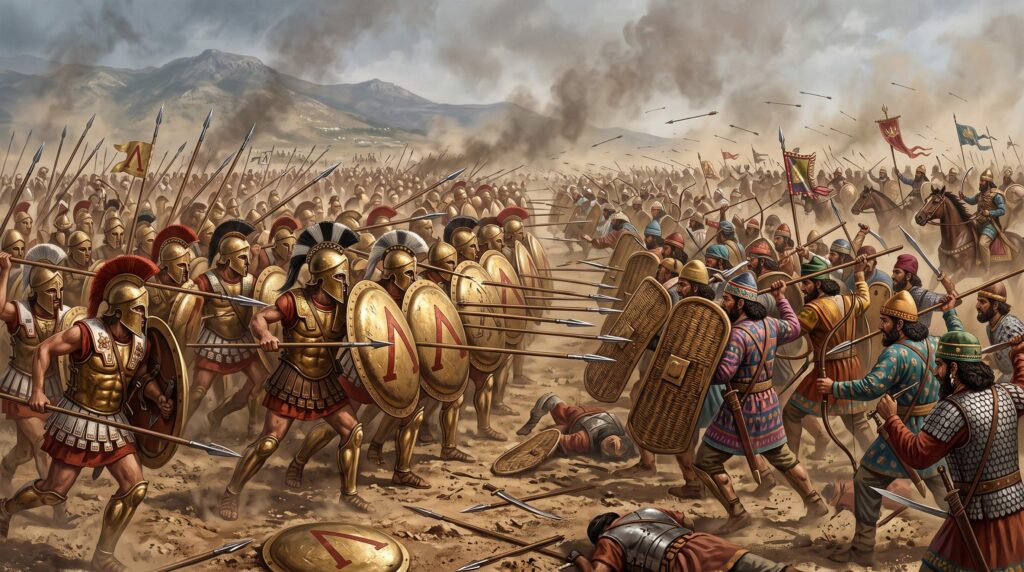
The Persian infantry, dropping their heavy shields to run faster, caught up to the Spartan rear guard. The Spartans, finally receiving favorable omens from their priests, turned around to face the massive Persian wave. They were soon joined by the Tegeans.
For those studying ancient military tactics, how did the greeks won the battle of plataea comes down to equipment and discipline in close-quarters combat. The Persian infantry was brave, but they were lightly armored, carrying short spears and wicker shields. They crashed head-on into the Spartan phalanx—a literal wall of bronze armor, heavy oak shields, and long thrusting spears.
The turning point of the battle of plataea facts occurred when the Persian general Mardonius, fighting bravely on a white horse on the front lines, was struck in the head by a Spartan rock or slingshot and killed. With their commander dead, the Persian center completely collapsed.
Simultaneously, on the other side of the battlefield, the isolated Athenians fought a brutal, grinding battle against the Thebans (the Greeks fighting for Persia), eventually breaking their lines. The fleeing Persian survivors retreated to their fortified wooden camp, but the Greeks relentlessly pursued them, breached the wooden walls, and initiated a historic slaughter.
The Outcome: Who Won the Battle of Plataea?
When resolving the ultimate question of who won the battle of plataea, the answer goes far beyond a simple tactical victory. The allied Greek city-states achieved a total, annihilating triumph that effectively erased the Persian field army from the European continent. Mardonius’s gamble had failed, and with his death on the battlefield, the invading force disintegrated.
But who won battle of plataea in terms of sheer survival and casualties? The numbers, even when adjusted from ancient exaggerations, are staggering. According to the ancient historian Herodotus, of the roughly 300,000 troops in the Persian camp (a number modern historians revise down to closer to 70,000-100,000), only a fraction escaped. A Persian commander named Artabazus, who had disagreed with Mardonius’s aggressive tactics, managed to retreat toward Thessaly and eventually back to Asia with around 40,000 men. The rest of the Persian army, trapped inside their wooden stockade, was systematically slaughtered by the advancing Greek hoplites.
By contrast, the Greek casualties were remarkably light for a battle of this scale. While exact figures are debated, ancient sources claim the Greeks lost only a few thousand men, primarily among the Spartans, Tegeans, and Athenians who bore the brunt of the heaviest fighting.
The Spoils of War and the Serpent Column
For anyone asking who won in the battle of plataea from a material standpoint, the looting of the Persian camp provided the Greeks with unimaginable wealth. The hoplites discovered tents filled with gold and silver furniture, gilded armor, jeweled weapons, and priceless tapestries. A portion of this immense plunder was melted down to create the famous Serpent Column—a massive bronze monument dedicated to the god Apollo at Delphi, which was inscribed with the names of all the Greek city-states that fought for freedom.
The Twin Victory at Mycale and the End of the Invasion
The victory at Plataea did not happen in isolation. According to historical tradition, on the exact same day that Pausanias shattered Mardonius’s army on the plains of Boeotia, the allied Greek navy launched an amphibious assault on the remnants of the Persian fleet across the Aegean Sea at the Battle of Mycale.
This simultaneous destruction of both the Persian land army and their remaining naval forces definitively ended King Xerxes’ invasion. The Greek mainland was permanently secured. This total victory shifted the Greco-Persian Wars from a desperate defense into an aggressive Greek counter-offensive, setting the geopolitical stage for the rise of the Delian League and the Classical Golden Age of Athens.
Frequently Asked Questions About the Battle of Plataea
How do you pronounce Plataea and why are there different spellings?
▼
The correct plataea pronunciation in English is generally “pluh-TEE-uh”. Because it is an ancient Greek word (Πλάταια) translated into English, you will frequently see it misspelled in historical searches as the battle of platea, the battle of platae, or the battle of plateae. You might also encounter it in French history books as the bataille de platée.
Were the 300 Spartans at the battle of Plataea?
▼
People often search for the 300 battle of plataea due to the movie “300”. However, the famous 300 Spartans commanded by King Leonidas all died at the Battle of Thermopylae in 480 BCE, one year prior. That said, the wider Spartan army (numbering roughly 10,000 heavy hoplites) formed the core of the Greek forces during the platea war in 479 BCE.
What was the Oath of Plataea?
▼
The oath of plataea refers to a famous pledge supposedly sworn by the allied Greek forces before the battle. According to historical tradition, the soldiers swore not to rebuild the temples and sanctuaries that the Persians had burned to the ground (such as the Acropolis in Athens), leaving them in ruins as a permanent memorial of the barbarian invasion.
How did the battle of Salamis and Plataea connect?
▼
They are the two decisive victories of the conflict. The naval victory at Salamis in 480 BCE destroyed the Persian fleet, cutting off Xerxes’ supply lines and forcing the King to flee. The victory at Plataea in 479 BCE destroyed the massive land army that Xerxes had left behind under his general Mardonius, permanently ending the invasion.