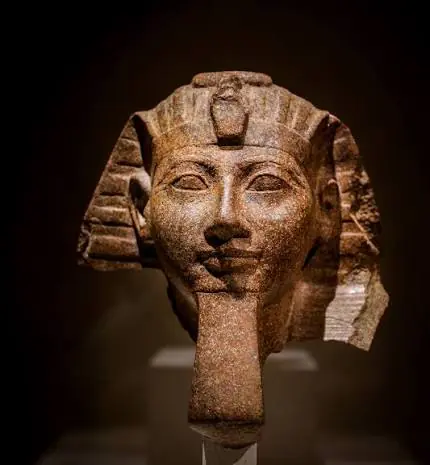
When visitors walk through the halls of the Egyptian Museum or explore her magnificent mortuary temple at Deir el-Bahari, they are often struck by a confusing visual puzzle: the statues of Queen Hatshepsut clearly depict her wearing the traditional royal nemes headdress, a male kilt, and, most surprisingly, a prominent false beard.
For early historians, this bizarre imagery led to wild theories. Some suggested that Hatshepsut was a master of disguise who cross-dressed to trick her subjects into believing she was biologically male. Others theorized she wore the beard out of deep-seated insecurity regarding her gender in a patriarchal society.
Modern Egyptology, however, has proven that the truth is far more complex and fascinating. Hatshepsut was not cross-dressing to hide her gender, nor was she trying to fool the Egyptian populace. Instead, her decision to wear the false beard and male clothing was a brilliant, calculated theological maneuver. To understand why Hatshepsut wore a false beard, we must look past our modern understanding of gender and dive into the ancient, unbending religious rules of the Egyptian kingship.
Did Hatshepsut Actually Pretend to Be a Man?
To set the record straight: No, Hatshepsut never pretended to be a man.
Her subjects, the royal court, and the powerful priesthood of Amun were perfectly aware that she was a biological woman. In fact, the texts carved onto her monuments frequently use feminine pronouns and refer to her as the “Daughter of Ra,” alongside her male titles like the “Son of Ra.” She did not attempt a physical disguise in her daily life.
The confusion stems from how ancient Egyptian art functioned. In ancient Egypt, royal statues and reliefs were not meant to be literal, photographic portraits of what the pharaoh actually looked like on a Tuesday afternoon. Instead, they were idealized, theological statements.
The office of the pharaoh (Nisut-Bity) was strictly male. According to Egyptian mythology, the ruling king was the earthly embodiment of Horus, the male falcon god. Therefore, the magic and religious authority of the kingship were inherently masculine. When Hatshepsut crowned herself pharaoh, she didn’t change her biological sex; she adopted the symbolic gender of the office. To legally and religiously occupy the throne, she had to be depicted with the traditional symbols of that office—which happened to be male clothing.
The Meaning of the Pharaoh’s False Beard (The Osiris Connection)
To truly understand why Hatshepsut wore a beard, we have to look at the grooming habits of ancient Egyptians. In reality, practically no one in the Egyptian royal court had a real beard. The ancient Egyptians were obsessed with hygiene and purity; in the sweltering heat of North Africa, body and facial hair were considered unclean and a breeding ground for lice. Priests and royals shaved themselves from head to toe using copper and bronze razors.
So, why did Egyptian pharaohs wear false beards if they hated real hair?
The answer lies in mythology. The false beard—often called a postiche—was an essential piece of divine regalia. It was typically made from tightly braided goat hair or wool and was strapped to the pharaoh’s chin with a ribbon tied around the ears.
This ceremonial beard was worn to directly connect the pharaoh to Osiris, the god of the afterlife and resurrection. In Egyptian mythology, the gods were believed to have hair made of lapis lazuli and gold, and Osiris was always depicted wearing a distinct, long braided beard. By wearing a replica of this beard, the pharaoh was essentially tapping into the divine power of the gods.
- The Straight Beard: Worn during the pharaoh’s lifetime in ceremonies and rituals, symbolizing their living authority.
- The Curved Beard: A beard curling upward at the tip was strictly reserved for the gods (like Osiris) or for pharaohs after they had died and become divine.
When you look at the definition of the false beard in ancient Egypt, it had absolutely nothing to do with biological masculinity. It was a holy prop. Just like the royal nemes headdress, the crook and flail, or the ceremonial bull’s tail attached to the pharaoh’s kilt, the beard was simply part of the “uniform” of the gods.
Therefore, Hatshepsut’s fake beard was not a disguise. By strapping it on, she was signaling to the priesthood and the gods that she held the supreme religious authority of the Nisut-Bity (King of Upper and Lower Egypt). It was a statement of theology, not biology.
This deep connection to Osiris was also reflected in her burial arrangements, where the mystery of Hatshepsut’s tomb and missing mummy would eventually be solved
The Evolution of Hatshepsut’s Royal Iconography
If you trace the statues of Hatshepsut chronologically throughout her 22-year reign, you can actually see the brilliant, calculated progression of her political propaganda. She did not instantly transform into a male king overnight; rather, her royal iconography evolved in three distinct phases to gently ease the Egyptian populace—and the conservative priesthood—into accepting a female pharaoh.
Phase 1: The Traditional Queen During the early years of her regency for her young stepson, Thutmose III, Hatshepsut was depicted exactly as expected. She wore the traditional sheath dress of a Queen Consort, feminine jewelry, and crowns associated with royal women. Her titles were “Great Royal Wife” and “God’s Wife of Amun.”
Phase 2: The Androgynous Ruler Around Year 7 of Thutmose III’s reign, when Hatshepsut officially claimed the kingship, her statues entered a fascinating transitional phase. Artists began carving statues that were uniquely androgynous. She was depicted wearing the male nemes headcloth and the royal kilt (shendyt), but she still retained distinctly female physical features, including breasts and a delicate, feminine facial structure. She was visually blending the biological reality of her sex with the theological symbols of male power.
Phase 3: The Fully Masculinized Pharaoh By the middle and end of her reign, all traces of femininity were completely erased from her official portraiture. The statues placed in her mortuary temple at Deir el-Bahari show her as a traditional, idealized male king. She is carved with a flat, muscular chest, broad shoulders, the royal kilt, and the prominent false beard.
Why the final shift? It was a matter of cosmic balance, known to the Egyptians as Ma’at.
Egyptian temple architecture and ritual art relied on strict traditional canons. The rituals required a male king to perform them in order to keep the universe from falling into chaos. To ensure her monuments and offerings to the gods were magically effective, Hatshepsut had to be portrayed as a male pharaoh in the official record. Her masculine depiction was not an act of deception, but the ultimate act of devotion to the Egyptian cosmic order.
Study Guide & Quick Answers
Why did Hatshepsut wear a false beard?
Hatshepsut wore a ceremonial false beard to adopt the traditional symbols of the pharaonic office. The beard connected the ruler to Osiris, the god of the afterlife, and was a statement of divine authority, not a physical disguise.
Did Hatshepsut actually dress as a man? I
n her official royal statues and reliefs, she is depicted wearing the male royal kilt (shendyt) and headdress because the office of the pharaoh was strictly masculine. However, she did not cross-dress in daily life to trick her subjects into thinking she was biologically male.
Why did Egyptian pharaohs wear false beards?
Ancient Egyptian royals shaved their real facial and body hair for hygiene and to prevent lice. The false beard was a religious prop, usually made of braided goat hair, worn during ceremonies to mimic the divine beards of the gods.
Why was Hatshepsut portrayed as a male?
She was portrayed as male in her later statues to maintain Ma’at (cosmic balance). Egyptian religious rituals required a male king to perform them. By using male iconography, Hatshepsut ensured her offerings to the gods were magically and traditionally effective.
Further Reading
To explore the complex gender dynamics and royal iconography of Hatshepsut’s reign, consider these academic sources:
- Roth, Ann Macy. “Models of Authority: Hatshepsut’s Predecessors in Power.” Hatshepsut: From Queen to Pharaoh, edited by Catharine H. Roehrig, The Metropolitan Museum of Art, 2005. (The definitive exhibition catalog on her royal art).
- Robins, Gay. Women in Ancient Egypt. Harvard University Press, 1993. (Essential reading on gender roles, queenship, and the theological requirements of the pharaoh).
- Tyldesley, Joyce. Hatchepsut: The Female Pharaoh. Penguin Books, 1998. (Offers a deep dive into the evolution of her statues at Deir el-Bahari).