Introduction: The Ancient Sumerian City of Larsa
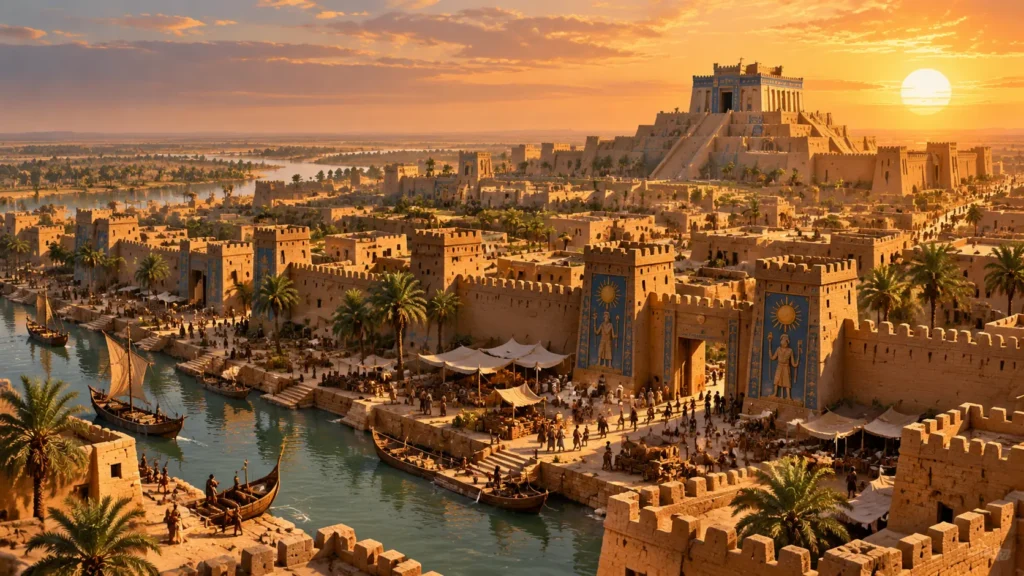
Larsa was one of the most important cities of ancient Mesopotamia, a historic urban center that played a significant role in the political, religious, and economic development of southern Sumer. Located in the fertile plains of modern-day Iraq, Larsa became especially influential during the periods that followed the collapse of the Ur III dynasty, when new city-states competed for control of southern Mesopotamia.
Unlike cities such as Uruk, known for the earliest developments of urban civilization, or Kish, remembered for early traditions of kingship, Larsa became famous for its religious importance and its later rise as the center of one of the most powerful kingdoms of the early second millennium BCE.
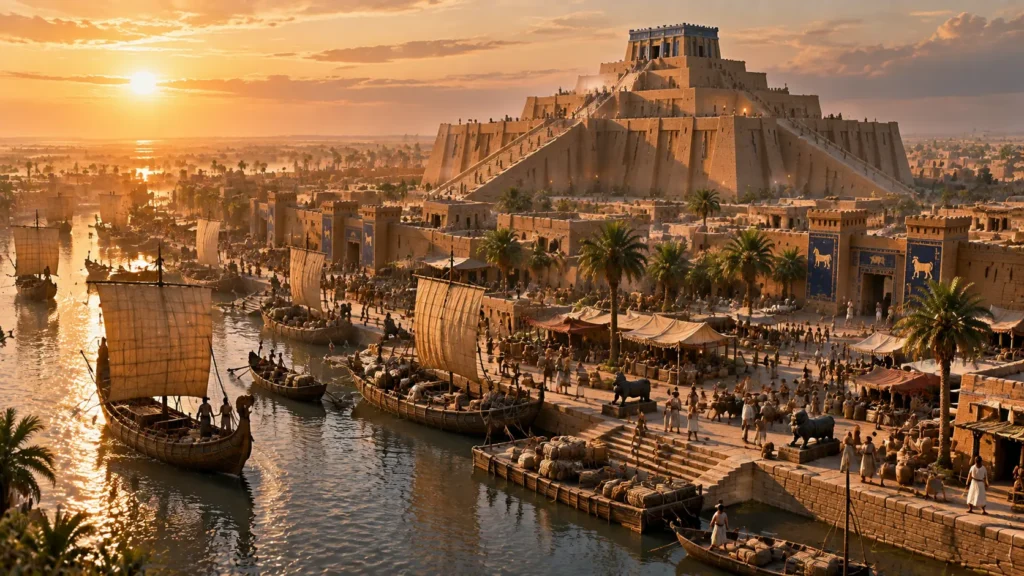
The city was closely associated with the worship of Utu (Shamash), the Mesopotamian sun god connected with justice, truth, and divine authority. Its famous E-babbar temple became one of the most important religious institutions in southern Mesopotamia and remained a symbol of Larsa’s importance for centuries.
Beyond its religious role, Larsa was also a major political power. During the Isin-Larsa period, the city became the heart of a powerful kingdom that controlled large parts of southern Mesopotamia. Under rulers such as Rim-Sin I, Larsa reached its greatest influence before eventually being conquered by Hammurabi of Babylon.
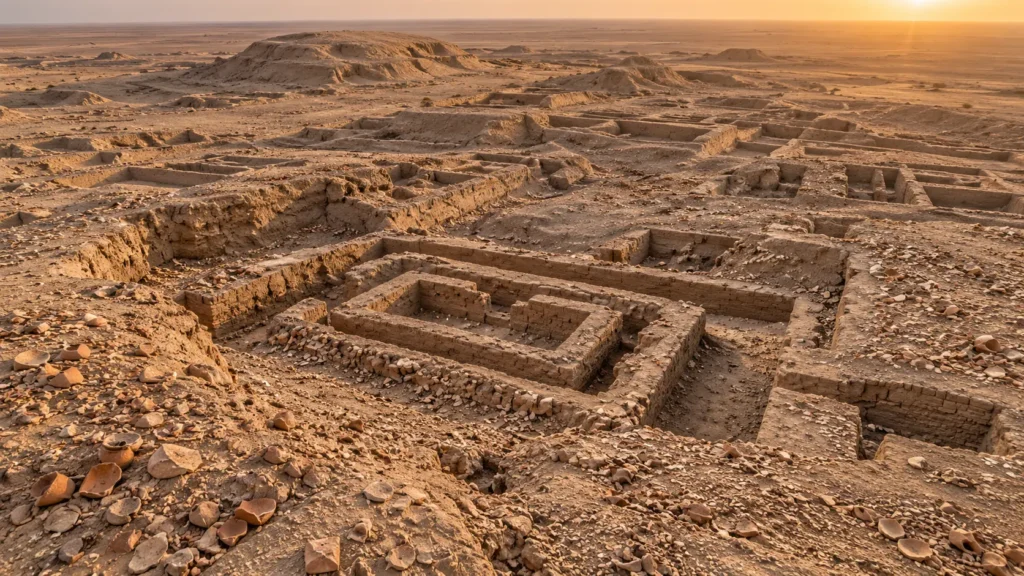
Archaeological discoveries at Larsa have revealed temples, administrative buildings, royal inscriptions, and thousands of artifacts that provide valuable insight into how ancient Mesopotamian cities developed, competed, and transformed over time.
Where Was Larsa Located in Ancient Mesopotamia?
Larsa was located in southern Mesopotamia, in the region historically known as Sumer, an area between the Tigris and Euphrates rivers that became one of the world’s earliest centers of urban civilization. The ancient city developed within the fertile plains of modern-day Iraq, where irrigation agriculture allowed cities to support large populations and complex political systems.
The archaeological remains of Larsa are located at Tell es-Senkereh, near the modern settlement of Al-Hillah in southern Iraq. The site lies approximately 25 kilometers southeast of the ancient city of Uruk and within the broader landscape of cities that shaped the history of southern Mesopotamia.
Its location gave Larsa several strategic advantages. The city was surrounded by productive agricultural land and connected to the network of canals that supported farming, transportation, and trade. In ancient Mesopotamia, controlling these resources was essential because agricultural production formed the economic foundation of every major city-state.
Larsa Within the Landscape of Ancient Sumer
Larsa existed within one of the most densely populated regions of the ancient world. Southern Mesopotamia was home to numerous powerful cities that competed and cooperated throughout history.
| Ancient City | Modern Location | Historical Importance |
|---|---|---|
| Larsa | Tell es-Senkereh, Iraq | Religious center of Shamash and later capital of the Kingdom of Larsa |
| Uruk | Warka, Iraq | One of the earliest large cities and center of early writing |
| Ur | Tell el-Muqayyar, Iraq | Royal city and capital of the Third Dynasty of Ur |
| Lagash | Near modern Al-Shatrah, Iraq | Important Early Dynastic city-state |
| Babylon | Near Hillah, Iraq | Later political center of Hammurabi’s empire |
This geographical environment placed Larsa near many of the most influential centers of Mesopotamian history. The city was not isolated but part of a network of urban powers that shaped the political development of the ancient Near East.
The Strategic Importance of Larsa’s Location
The importance of Larsa was closely connected to its control of agricultural resources and communication routes. Unlike regions with abundant rainfall, southern Mesopotamia depended heavily on irrigation systems to transform the river plains into productive farmland.
A successful city-state needed to manage:
- Irrigation canals.
- Agricultural fields.
- Grain production.
- Labor organization.
- Trade connections.
Larsa’s ability to control and administer these resources helped it survive political changes that affected the region for centuries.
During earlier periods of Sumerian history, cities such as Uruk, Ur, and Kish dominated different aspects of Mesopotamian civilization. However, after the decline of the Ur III dynasty, Larsa’s location allowed it to become one of the main centers competing for power in southern Mesopotamia.
Larsa as a Bridge Between Sumer and Babylon
One of the reasons Larsa is historically important is that it represents a transitional period between two major phases of Mesopotamian history.
During the early history of Sumer, cities operated mainly as independent city-states. Later, kingdoms such as Babylon began creating larger territorial states that united multiple cities under centralized rulers.
Larsa stood at this crossroads:
| Period | Role of Larsa |
|---|---|
| Early Sumerian periods | Important regional city connected with religious traditions |
| After Ur III collapse | Independent city-state competing for power |
| Isin-Larsa Period | Capital of a powerful southern Mesopotamian kingdom |
| After Hammurabi’s conquest | Incorporated into the Babylonian state |
Understanding Larsa’s location helps explain why the city became such an important political force. Its position in the heart of southern Mesopotamia allowed it to participate directly in the struggles that shaped the transition from the Sumerian world to the rise of Babylon.
The Rise of Larsa as a Sumerian City-State
Larsa developed as an important Sumerian city-state during the long history of southern Mesopotamia, growing within a region where cities competed for agricultural resources, political influence, and religious prestige. Like other Sumerian urban centers, Larsa was built around a combination of temples, administrative institutions, agricultural production, and skilled communities that supported a complex urban society.
During the early periods of Mesopotamian history, Larsa existed alongside other powerful cities such as Uruk, Ur, Lagash, and Kish. Although it was not always the dominant power in Sumer, the city’s strategic location and economic resources allowed it to remain an important regional center throughout changing political periods.
The foundation of Larsa’s strength came from the same factors that shaped many successful Mesopotamian cities: fertile agricultural land, organized irrigation systems, and the ability of its institutions to manage resources efficiently.
The Religious Importance of Larsa in Early Sumer
One of the defining characteristics of Larsa was its connection with the worship of the sun god Utu, later known as Shamash in Akkadian tradition.
In Mesopotamian belief, Shamash was associated with justice, truth, and divine order. The city’s close relationship with this deity gave Larsa a special religious status among the cities of southern Mesopotamia.
The temple dedicated to Shamash, known as the E-babbar temple, became the spiritual center of Larsa. Religious institutions in Sumer were not only places of worship; they also played important economic and administrative roles.
Temples controlled land, organized labor, managed resources, and supported large sections of the population. As a result, the religious importance of Larsa contributed directly to its political and economic influence.
Larsa During the Changing Political Landscape of Mesopotamia
The history of Larsa reflects the constant transformation of southern Mesopotamia. Over thousands of years, control of the region shifted between competing city-states and larger kingdoms.
During the period of the Third Dynasty of Ur, southern Mesopotamia was unified under a centralized state based in the city of Ur. Larsa functioned within this wider political system, contributing to the agricultural and administrative network that supported the kingdom.
After the collapse of Ur III around the end of the 21st century BCE, the political landscape changed dramatically. Former provincial centers and regional cities began competing for independence and influence.
This period marked the beginning of a new era in Mesopotamian history, known as the Isin-Larsa Period, when cities such as Isin and Larsa became the main powers competing for control of southern Mesopotamia.
From Regional City to Political Power
The decline of centralized Ur III rule created an opportunity for Larsa to expand its influence. The city’s agricultural wealth, religious importance, and strategic location allowed it to become one of the leading powers of the region.
Unlike earlier periods when cities competed mainly for local influence, Larsa emerged during a time when rulers sought to control larger territories and establish stronger kingdoms.
This transformation changed Larsa’s role in Mesopotamian history. It was no longer simply an important Sumerian city; it became the center of a kingdom that would play a major role in the political struggles of the early second millennium BCE.
The Kingdom of Larsa and the Isin-Larsa Period
The history of Larsa reached a new level of importance after the collapse of the Third Dynasty of Ur at the end of the 21st century BCE. The fall of Ur III ended the political unity that had dominated southern Mesopotamia and created a new era of competition between independent kingdoms.
This period, known as the Isin-Larsa Period (approximately 20th–18th centuries BCE), was defined by the rivalry between the cities of Isin and Larsa. Both cities attempted to inherit the political traditions of Sumer and establish control over the rich agricultural lands of southern Mesopotamia.
Larsa emerged as one of the most powerful states of this period, eventually becoming the dominant force in the region before the rise of Babylon under Hammurabi.
The Rise of the Kingdom of Larsa
Following the decline of Ur III, several local dynasties appeared across Mesopotamia. Larsa benefited from its strategic location, economic resources, and religious prestige, allowing its rulers to gradually expand their influence.
The kings of Larsa controlled important agricultural territories and maintained administrative systems that continued many traditions from earlier Sumerian states. The city’s institutions managed farmland, irrigation networks, temples, and economic activities that supported the kingdom’s growth.
Larsa’s power was also connected to its ability to present itself as a legitimate successor to earlier Sumerian traditions. By maintaining the worship of Shamash and preserving administrative practices inherited from previous periods, the city positioned itself as a major political and cultural center of southern Mesopotamia.
The Rivalry Between Larsa and Isin
The main political struggle of the period was between the kingdoms of Larsa and Isin.
After the fall of Ur III, both cities claimed authority over the legacy of Sumerian kingship. Their rivalry was not only military but also economic and ideological, as both rulers sought to control important territories, trade routes, and religious centers.
The competition between Isin and Larsa lasted for generations, with periods of expansion, conflict, and shifting alliances. Over time, Larsa gradually gained the advantage due to its stronger economic position and control over productive agricultural regions.
The rivalry illustrates an important transition in Mesopotamian history: the movement from independent Sumerian city-states toward larger territorial kingdoms.
Larsa as the Leading Power of Southern Mesopotamia
By the early second millennium BCE, Larsa had become one of the most influential political powers in the region. The kingdom controlled large areas of southern Mesopotamia and influenced many cities that had previously acted independently.
The strength of Larsa was based on several factors:
- Productive agricultural lands.
- A strong administrative system.
- The religious prestige of the E-babbar temple.
- Skilled officials and scribal traditions.
- Control over important economic networks.
During this period, Larsa represented the continuation of southern Mesopotamian traditions while adapting to a new political reality dominated by competing kingdoms.
Larsa’s Place in the Transition From Sumer to Babylon
The Kingdom of Larsa occupies an important position between two major phases of Mesopotamian history.
The city preserved many elements of Sumerian civilization, including its language, religious traditions, administrative practices, and urban culture. At the same time, it existed in a changing world where new powers, especially Babylon, were beginning to emerge.
This transitional role makes Larsa historically significant. The city was both a continuation of the ancient Sumerian tradition and a bridge toward the later Babylonian age.
The Temple of Shamash: The Religious Heart of Larsa
The religious identity of Larsa was closely connected with the worship of the sun god Utu, known as Shamash in Akkadian tradition. For centuries, the city was considered one of the most important centers dedicated to this deity, whose influence extended far beyond the borders of Larsa.
In Mesopotamian belief, Shamash represented justice, truth, and divine order. As the god associated with the sun, he was believed to illuminate the world and reveal what was hidden, making him closely connected with concepts of fairness and judgment.
The importance of Shamash gave Larsa a distinctive role among the cities of southern Mesopotamia. While some cities became famous for political power or military expansion, Larsa built part of its identity around religious authority and the relationship between kingship, justice, and divine legitimacy.
The E-babbar Temple of Larsa
The most important religious monument of Larsa was the E-babbar Temple, a sanctuary dedicated to Shamash.
The name E-babbar is commonly translated as “White House”, referring to the brilliance and sacred nature associated with the temple. Like other major temples in Mesopotamia, the E-babbar was not only a place of worship but also a major economic and administrative institution.
The temple complex played several roles within Larsa:
- A center of religious ceremonies.
- A symbol of the city’s connection with the gods.
- An institution involved in economic management.
- A place where rulers demonstrated their devotion and legitimacy.
In ancient Mesopotamia, temples were among the most powerful institutions in society. They controlled land, organized labor, stored resources, and connected the political authority of kings with divine approval.
Shamash, Justice, and the Power of Larsa’s Kings
The connection between Larsa and Shamash also influenced how the city’s rulers presented their authority.
Mesopotamian kings often claimed that their power came from the gods. A ruler who protected temples and honored divine traditions could present himself as a legitimate guardian of order.
The association with Shamash was especially meaningful because the god was connected with justice and law. This relationship helped strengthen the image of Larsa’s kings as rulers who maintained balance and stability.
This religious tradition also connects Larsa with the wider development of Mesopotamian ideas about law and kingship. Although later rulers such as Hammurabi of Babylon became more famous for legal traditions, the association between divine authority, justice, and kingship was already deeply established in earlier Mesopotamian cities.
The E-babbar Temple Through the History of Larsa
The E-babbar Temple remained central to Larsa’s identity throughout different periods of the city’s history.
During the rise of the Kingdom of Larsa, rulers invested in temples as a way to demonstrate their power and maintain the support of religious institutions. Restoring or expanding temples was considered one of the main responsibilities of a successful Mesopotamian king.
The temple continued to represent the connection between Larsa’s political ambitions and its religious traditions. Even as the city experienced conflicts with rival kingdoms and eventually became part of larger empires, the sanctuary of Shamash remained a symbol of Larsa’s historical importance.
Why the Temple of Shamash Matters in History
The E-babbar Temple shows that the importance of ancient cities was not based only on military power or territorial control. Religious institutions shaped the political and economic life of Mesopotamia and helped define the identity of each city.
For Larsa, the temple of Shamash represented much more than a place of worship. It embodied the city’s relationship with divine authority, justice, and royal power.
Through the E-babbar Temple, Larsa became one of the clearest examples of how religion and politics were deeply connected in the civilizations of the ancient Near East.
The Kings of Larsa and the Rise of Rim-Sin I
The political power of Larsa was built through a succession of rulers who strengthened the city’s economy, expanded its influence, and transformed it into one of the dominant kingdoms of southern Mesopotamia.
Unlike earlier Sumerian city-states, where rulers mainly controlled individual cities and nearby territories, the kings of Larsa governed during a period when larger territorial kingdoms were emerging. Their authority depended on controlling agricultural resources, maintaining administrative systems, supporting temples, and competing with rival powers.
The rulers of Larsa continued many traditions inherited from earlier Sumerian civilization while adapting to the changing political environment of the early second millennium BCE.
The Dynasty of Larsa
The Kingdom of Larsa was ruled by a series of dynasties that emerged after the collapse of Ur III. These rulers gradually expanded the city’s influence and positioned Larsa as one of the main political powers of southern Mesopotamia.
During this period, kings presented themselves as protectors of the city, supporters of temples, and guardians of justice. Royal inscriptions frequently emphasized:
- Temple construction and restoration.
- Military victories.
- Protection of agricultural lands.
- Divine support from the gods.
The connection between kingship and religion was especially important in Larsa because of the city’s relationship with Shamash, the god of justice and divine order.
Rim-Sin I: The Greatest King of Larsa
The most famous ruler of Larsa was Rim-Sin I, who brought the kingdom to the height of its power during the early second millennium BCE.
Rim-Sin ruled Larsa for more than 60 years, making his reign one of the longest in Mesopotamian history. Under his leadership, Larsa expanded its influence across much of southern Mesopotamia and became the strongest political power in the region.
His achievements included:
- Expanding Larsa’s territory.
- Defeating rival city-states.
- Strengthening administrative control.
- Supporting temples and religious institutions.
One of his greatest achievements was the defeat of the kingdom of Isin, Larsa’s main rival during the Isin-Larsa Period. This victory allowed Larsa to dominate southern Mesopotamia and marked the peak of the city’s political influence.
Larsa at the Height of Its Power
Under Rim-Sin I, Larsa represented one of the last great expressions of southern Mesopotamian political independence before the rise of Babylon.
The kingdom controlled important cities and agricultural regions, while its administrative system continued traditions that had developed over centuries of Sumerian civilization.
At its height, Larsa was characterized by:
| Aspect | Importance |
|---|---|
| Agriculture | Control of fertile lands and irrigation systems |
| Religion | The E-babbar Temple and worship of Shamash |
| Administration | Complex systems of taxation and resource management |
| Politics | Dominance over southern Mesopotamia |
The success of Larsa during this period demonstrates how ancient Mesopotamian cities could evolve from independent urban centers into powerful regional kingdoms.
The End of Larsa’s Independence
Despite its success under Rim-Sin I, Larsa’s dominance was eventually challenged by a new rising power: Babylon.
During the reign of Hammurabi, Babylon expanded its influence throughout Mesopotamia and confronted the remaining independent kingdoms of the south. In the early 18th century BCE, Babylon defeated Larsa, bringing an end to the city’s political independence.
The fall of Larsa marked an important transition in Mesopotamian history. The era of competing southern city-states and regional kingdoms gave way to the rise of larger territorial states controlled by powerful dynasties.
The Legacy of Larsa’s Kings
The rulers of Larsa left an important legacy in the history of Mesopotamia. They preserved many aspects of Sumerian culture while governing during a period of major political transformation.
Through their inscriptions, temples, and administrative records, the kings of Larsa provide valuable evidence about:
- How ancient kingdoms were organized.
- How rulers used religion to strengthen authority.
- How cities transitioned into larger political states.
The history of Larsa’s kings represents the final chapter of southern Sumerian independence before Babylon became the dominant power of Mesopotamia.
The Archaeology of Larsa: Tell es-Senkereh and Ancient Discoveries
The archaeological site of Larsa provides important evidence for understanding the development of southern Mesopotamian cities across thousands of years. Located at Tell es-Senkereh in modern Iraq, the remains of Larsa reveal the structures, institutions, and daily activities that supported one of the most influential cities of ancient Sumer.
Although Larsa is less visually famous than cities such as Babylon or Ur, archaeological research has shown that it was a complex urban center with temples, administrative buildings, residential areas, and economic institutions.
The discoveries from Larsa have helped historians reconstruct not only the history of the city itself, but also the broader transformation of Mesopotamian society from independent Sumerian city-states to larger kingdoms.
Excavations at Tell es-Senkereh
Modern archaeological research at Larsa began in the early 20th century, with later excavations revealing important remains from different periods of the city’s long history.
The site contains multiple layers of occupation, reflecting the continuous development of Larsa from its early Sumerian origins through its period as the capital of a powerful kingdom.
Archaeologists have uncovered evidence of:
- Religious structures.
- Administrative buildings.
- Royal inscriptions.
- Residential areas.
- Economic and agricultural activities.
These discoveries demonstrate that Larsa was not simply a political capital during the Isin-Larsa Period, but a living urban center with complex social and economic systems.
The Remains of the E-babbar Temple
One of the most significant archaeological discoveries at Larsa is the remains of the E-babbar Temple, the sanctuary dedicated to Shamash.
The temple complex reflects the importance of religion in Mesopotamian cities. Temples were not isolated religious buildings; they were institutions that managed land, resources, labor, and economic activities.
The remains of the E-babbar Temple provide evidence of:
- Monumental religious architecture.
- Royal restoration projects.
- The relationship between kings and divine authority.
- The importance of Shamash worship in southern Mesopotamia.
The temple’s history also reflects the changing fortunes of Larsa itself, as different rulers rebuilt and maintained the sanctuary to demonstrate their legitimacy and devotion.
Administrative Records and Daily Life in Larsa
Like other major Mesopotamian cities, Larsa produced a large number of written records that provide insight into everyday life.
Clay tablets discovered in connection with Larsa contain information about:
- Economic transactions.
- Agricultural management.
- Legal agreements.
- Temple activities.
- Government administration.
These records reveal the complexity of life in an ancient Mesopotamian city. Behind the stories of kings and wars existed a vast administrative system involving farmers, craftsmen, merchants, officials, and religious institutions.
The archives associated with Larsa allow historians to study how resources were managed and how the city’s institutions functioned over time.
Archaeological Discoveries and the History of Larsa
The discoveries at Larsa demonstrate that the city’s importance extended far beyond its political achievements.
Its archaeological remains show how a Mesopotamian city was built and maintained through the interaction of:
- Religion.
- Agriculture.
- Administration.
- Royal authority.
- Economic organization.
Through the remains of Tell es-Senkereh, Larsa provides a valuable connection between ancient written sources and the physical world of Mesopotamian civilization.
The archaeology of Larsa allows modern researchers to understand not only the rulers who controlled the city, but also the institutions and communities that made its history possible.
Larsa and Ancient Mesopotamian Mathematics
Beyond its political and religious importance, Larsa is also connected with the remarkable mathematical traditions developed in ancient Mesopotamia.
The city and its surrounding region have provided important evidence about the advanced administrative and scientific knowledge of Mesopotamian societies. Clay tablets associated with the Larsa period reveal sophisticated calculations related to measurement, geometry, trade, land management, and astronomy.
These documents demonstrate that mathematics in ancient Mesopotamia was not an abstract discipline separated from daily life. Instead, it was a practical tool used by scribes, administrators, merchants, and engineers to manage the complex systems that allowed cities like Larsa to function.
Mathematical Tablets From the Larsa Period
During the Old Babylonian period, which followed the rise of the Kingdom of Larsa, scribal schools produced numerous mathematical tablets that preserved advanced calculations and teaching exercises.
These tablets included problems involving:
- Area calculations.
- Volume measurements.
- Land surveying.
- Equations.
- Commercial transactions.
- Administrative planning.
The existence of these records shows the high level of education and organization achieved by Mesopotamian scribes.
For cities such as Larsa, mathematical knowledge was closely connected to administration. Managing agricultural land, calculating harvests, organizing labor, and recording economic exchanges all required precise systems of measurement.
Plimpton 322 and the Mathematical Tradition of Southern Mesopotamia
One of the most famous mathematical artifacts connected with the broader intellectual environment of southern Mesopotamia is Plimpton 322, a clay tablet containing a series of numerical relationships that demonstrate advanced mathematical knowledge.
Although the exact origin and purpose of the tablet remain debated among scholars, it is generally associated with the Old Babylonian mathematical tradition and reflects the sophisticated methods developed by Mesopotamian scribes.
The significance of artifacts like Plimpton 322 is that they reveal a society capable of complex mathematical reasoning thousands of years before many later scientific traditions emerged.
Why Larsa Matters in the History of Knowledge
The mathematical traditions connected with Larsa provide another perspective on the city’s historical importance.
Larsa was not only a place of kings, temples, and political conflicts. It was also part of a civilization that developed some of the earliest systems of writing, administration, mathematics, and scientific organization in human history.
The city’s archives and artifacts show how knowledge was created and applied to solve practical challenges:
- Managing farmland.
- Organizing economies.
- Building cities.
- Supporting large populations.
Through this connection with Mesopotamian mathematics, Larsa represents another aspect of ancient civilization: the development of intellectual systems that would influence human history for centuries.
Larsa Compared With Other Sumerian Cities
Ancient Sumer was not a single unified civilization ruled from one capital. Instead, it was a network of powerful city-states, each with its own traditions, rulers, religious institutions, and historical importance.
Cities such as Uruk, Ur, Kish, Umma, and Larsa contributed in different ways to the development of Mesopotamian civilization. While some became famous for early urban growth or royal dynasties, Larsa became one of the most important political and religious centers of southern Mesopotamia during the period between the decline of Ur III and the rise of Babylon.
Understanding these differences helps reveal why each ancient city occupies a unique place in history.
| Ancient City | Main Historical Importance |
|---|---|
| Larsa | Religious center of Shamash, capital of the Kingdom of Larsa, and major power during the Isin-Larsa Period |
| Kish | Associated with early traditions of Sumerian kingship and political authority |
| Umma | Known for agricultural power, administrative archives, and rivalry with Lagash |
| Ur | Famous for royal wealth, the Royal Cemetery, and the Third Dynasty of Ur |
| Uruk | One of the world’s earliest large cities and a center of early writing and urban development |
| Eridu | Associated with ancient religious traditions and early settlement history |
Larsa and Ur: Two Different Forms of Mesopotamian Power
Larsa and Ur were both major cities of southern Mesopotamia, but their historical importance developed during different periods.
Ur became one of the greatest cities of ancient Mesopotamia, especially during the Third Dynasty of Ur, when it controlled a large centralized kingdom. Its legacy is connected with royal monuments, the famous ziggurat, and the wealth of its rulers.
Larsa rose to prominence after the fall of Ur III. Instead of becoming famous as the center of a vast empire, Larsa became a regional power that preserved many Sumerian traditions while competing with new kingdoms emerging across Mesopotamia.
The relationship between these two cities reflects the transition from the age of Ur’s dominance to the political world of the Isin-Larsa Period.
Larsa and Uruk: Ancient Traditions and Changing Power
Uruk represents one of the earliest stages of urban civilization, with enormous influence on the development of cities, writing, and administrative systems.
Larsa emerged much later as a political power, but it inherited many traditions that originated in earlier Sumerian civilization. Its temples, scribal institutions, and administrative systems continued practices that had developed over centuries.
While Uruk represents the birth of large-scale urban society, Larsa represents the continuation and transformation of that civilization into competing kingdoms.
Larsa and Kish: From Early Kingship to Regional Kingdoms
Kish and Larsa represent different phases of Mesopotamian political development.
Kish became associated with early concepts of kingship in Sumerian tradition, especially through texts such as the Sumerian King List.
Larsa represents a later stage, when rulers no longer governed only individual city-states but competed to control wider territories and establish regional kingdoms.
Together, these cities illustrate the evolution of political organization in ancient Mesopotamia.
Why Larsa Remains Important in Mesopotamian History
Larsa’s importance comes from the combination of several historical roles:
- A major religious center dedicated to Shamash.
- A powerful kingdom during the Isin-Larsa Period.
- A continuation of Sumerian political traditions.
- A source of important archaeological and mathematical evidence.
Although cities such as Babylon and Ur often dominate popular discussions of Mesopotamia, Larsa provides a crucial link between the ancient Sumerian city-state world and the later age of territorial kingdoms.
The history of Larsa shows how ancient cities adapted, competed, and transformed as Mesopotamian civilization continued to evolve.