Introducción
Kish was one of the most important cities of ancient Sumer, a civilization that emerged in southern Mesopotamia more than 5,000 years ago. Located in present-day Iraq, near the modern city of Hillah and the ancient centers of Babylon and Babylonian civilization, Kish became a major political and cultural center during the early history of Mesopotamia.
Unlike cities remembered mainly for monumental architecture or later empires, Kish holds a unique place in history because of its association with the earliest traditions of kingship in Sumer. Ancient texts such as the Sumerian King List describe Kish as one of the first cities to receive kingship after the mythical flood, reflecting the city’s importance in Mesopotamian political memory.
Archaeological discoveries at Kish have revealed temples, palaces, residential areas, cemeteries, and thousands of artifacts that provide valuable insight into the development of one of the world’s earliest urban societies. Through its history, Kish represents the transition from early settlements to organized city-states that shaped the foundations of Mesopotamian civilization.
Where Was Kish Located in Ancient Mesopotamia?
Kish was located in southern Mesopotamia, in the region known as Sumer, near the eastern bank of the ancient Euphrates River. Today, the archaeological remains of Kish are found in modern-day Iraq, approximately 12 kilometers east of the city of Babylon and close to the modern city of Hillah in Babil Governorate.
The ancient city was part of the fertile plains between the Tigris and Euphrates rivers, an area that became one of the earliest centers of urban development in human history. The rich agricultural land surrounding Kish allowed its population to support large communities, develop complex institutions, and participate in long-distance trade networks across Mesopotamia.
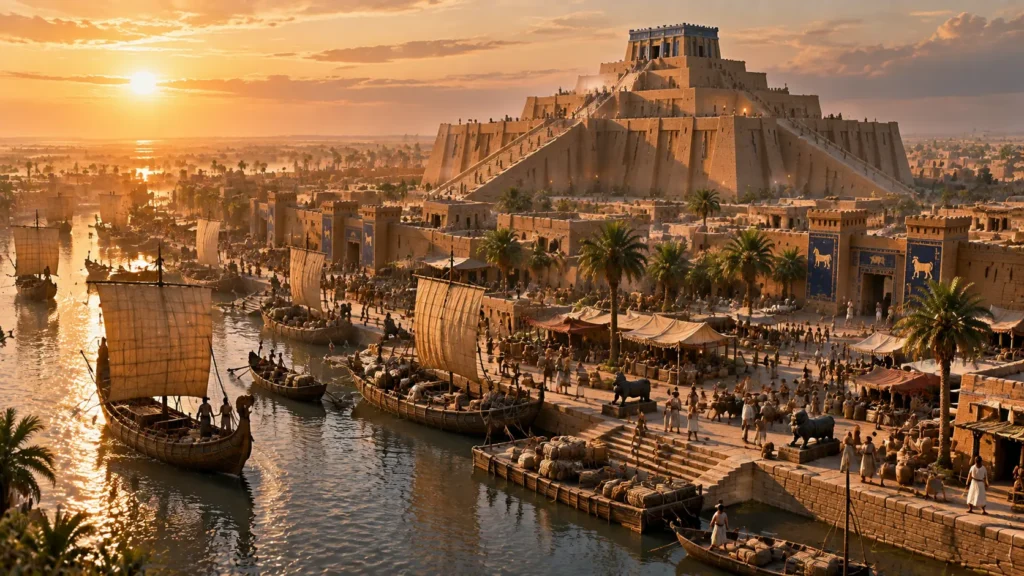
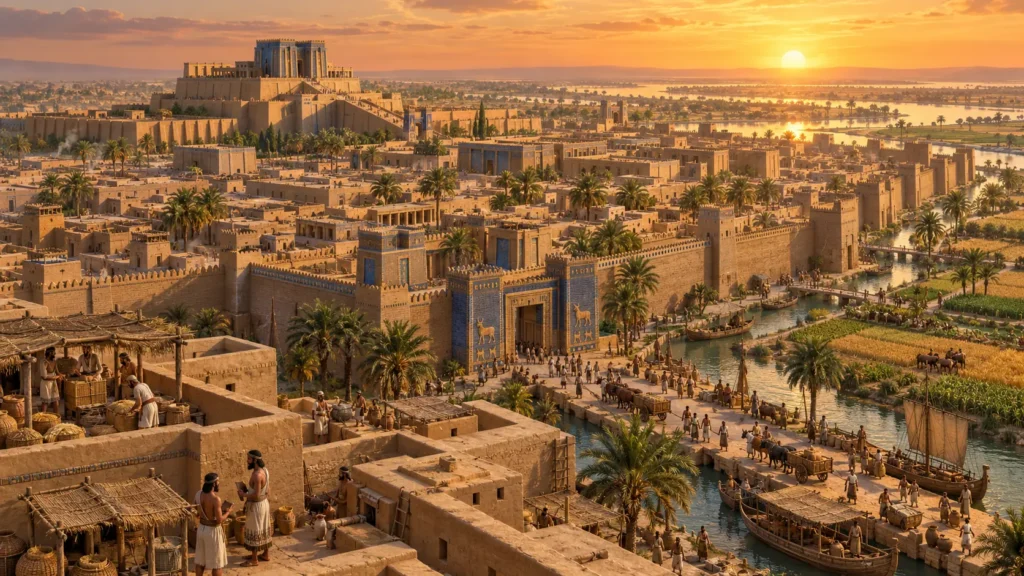
Unlike cities that grew around a single monumental structure, Kish developed as a large urban settlement composed of several interconnected areas, including religious complexes, administrative buildings, residential neighborhoods, and burial sites. Archaeologists commonly refer to the remains of Kish as a city complex rather than a single mound because the ancient settlement expanded across multiple archaeological sites.
Its location placed Kish at the crossroads of several important Sumerian cities. It was situated relatively close to other major urban centers such as:
- Babylon, which would become the dominant power of southern Mesopotamia many centuries later.
- Nippur, an important religious center of Sumer.
- Uruk, one of the largest and most influential cities of early Mesopotamia.
- Ur, a wealthy southern city famous for its royal cemetery and later political importance.
This strategic position helped Kish become an important political and economic center during the early development of Sumerian city-states.
Kish During the Early Development of Sumerian Cities
The history of Kish is closely connected with the emergence of urban society in ancient Sumer. During the Early Dynastic Period of Mesopotamia (approximately 2900–2350 BCE), southern Mesopotamia was divided into numerous independent city-states, each controlled by its own ruler, religious institutions, and administrative system.
Kish was among the most influential of these early cities. Its importance came not only from its size or wealth, but from its political role within the developing Sumerian world. Ancient Mesopotamian traditions associated Kish with the institution of kingship, suggesting that the city represented an early center of political authority.
The idea that “kingship descended upon Kish” appears in the Sumerian King List, a later literary composition that records a sequence of rulers and cities that supposedly held power before and after the flood. Although some figures in this tradition are considered legendary, the prominence of Kish in the text reflects how important the city remained in Mesopotamian cultural memory.
Archaeological evidence also confirms that Kish was a significant urban center during the early periods of Sumerian history. Excavations have uncovered evidence of monumental buildings, administrative activity, craft production, and connections with other regions of Mesopotamia.
Rather than being remembered for one single achievement, Kish represents an important stage in the development of civilization: the moment when early settlements evolved into organized cities with political institutions, social hierarchies, and complex economies.
The Archaeological Site of Kish: Discovering an Ancient Sumerian City
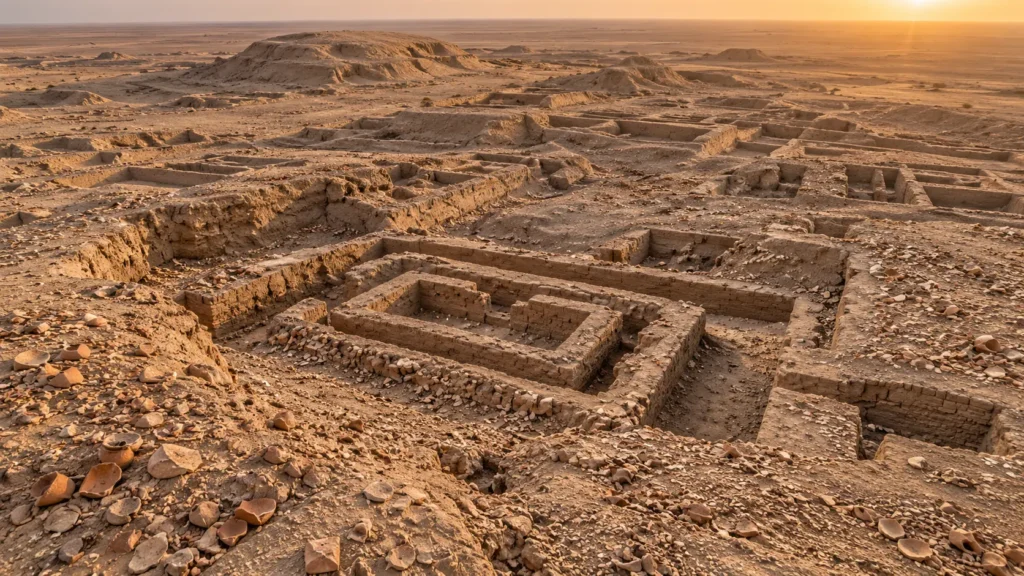
The ruins of Kish provide one of the most valuable archaeological windows into the early history of Mesopotamia. Excavations at the site have revealed a complex urban landscape containing temples, palaces, residential areas, workshops, and cemeteries spanning thousands of years of occupation.
The archaeological remains of Kish are spread across several tells, or artificial mounds created by successive layers of human settlement. Among the most important areas are Tell Uhaimir and Tell Ingharra, which have provided evidence from different periods of the city’s long history.
Early excavations at Kish began in the early 20th century, including major campaigns conducted by joint British and American archaeological teams. These excavations uncovered important discoveries related to Sumerian architecture, burial practices, administration, and early writing traditions.
Among the discoveries associated with Kish are:
- Temple remains dedicated to important Mesopotamian deities.
- Royal and elite burial areas containing valuable artifacts.
- Administrative tablets documenting aspects of ancient economic life.
- Examples of early artistic and technological development.
The discoveries from Kish demonstrate that the city was not simply a political name preserved in ancient texts, but a real urban center that played an active role in the formation of Mesopotamian civilization.
Kish and the Origins of Sumerian Kingship
Kish occupies a unique place in the history of ancient Mesopotamia because it became closely associated with the concept of kingship in early Sumerian tradition. While many ancient cities were remembered for their temples, trade networks, or military power, Kish was especially connected with the emergence of political authority and organized rule among the first city-states.
During the Early Dynastic Period, southern Mesopotamia was not controlled by a single empire. Instead, the region consisted of independent cities, each governed by its own ruler and supported by religious, administrative, and economic institutions. In this competitive environment, Kish developed a reputation as one of the most prestigious political centers in Sumer.
The importance of Kish is reflected in the later Sumerian King List, an ancient text that describes a sequence of rulers and cities that supposedly held kingship in early Mesopotamia. According to this tradition, “kingship descended upon Kish” after the flood, placing the city at the beginning of Sumer’s royal history.
Although the earliest rulers mentioned in the Sumerian King List include legendary figures whose historical existence cannot be confirmed, the prominence of Kish in this tradition reveals how later Mesopotamians viewed the city: as an ancient seat of authority and one of the foundations of political organization in Sumer.
Archaeological evidence supports the idea that Kish was a major urban center during this period. Excavations have revealed large buildings, administrative areas, and evidence of complex social organization, showing that the city had the infrastructure necessary to support an influential early state.
The Kings of Kish in Ancient Mesopotamian Tradition
The rulers associated with Kish appear among the earliest names preserved in Mesopotamian literature. However, it is important to distinguish between legendary rulers recorded in later traditions and kings supported by archaeological evidence.
The Sumerian King List presents Kish as the first city to hold kingship after the flood and names several rulers who supposedly governed from the city. These early figures became part of Mesopotamian mythology and political memory, reflecting the importance of Kish as a symbol of ancient authority.
Enmebaragesi of Kish
Among the rulers connected with Kish, Enmebaragesi is one of the most significant because he is considered one of the earliest Mesopotamian kings whose existence is supported by archaeological evidence.
Fragments of inscriptions bearing his name have been discovered, making him one of the earliest historically attested rulers from ancient Mesopotamia. His reign is generally placed around the early third millennium BCE, during the Early Dynastic Period.
Enmebaragesi’s importance lies not only in his position as a ruler of Kish, but also in what his evidence represents: the transition from legendary traditions about early kings to historically documented political figures.
Aga of Kish and the Tradition of Early Kings
Another ruler associated with Kish is Aga, who appears in Sumerian literary traditions as a king who interacted with Gilgamesh, the famous ruler of Uruk.
The story of Aga and Gilgamesh belongs mainly to Mesopotamian literary tradition rather than direct historical records. However, it reflects the rivalry and relationships that existed between powerful Sumerian city-states during early Mesopotamian history.
The connection between Kish and figures such as Aga demonstrates how the city remained important not only as a physical place but also as a central element in the stories and traditions that shaped Sumerian identity.
The Temples and Religious Life of Kish
Like other major Sumerian cities, Kish was built around important religious institutions that played a central role in political and social life. Temples were not only places of worship but also economic and administrative centers that controlled resources, organized labor, and supported the urban population.
One of the most important religious complexes at Kish was associated with the god Zababa, the city’s patron deity. The temple dedicated to Zababa reflected the close connection between religion and political authority in Sumerian society.
In ancient Mesopotamia, rulers often gained legitimacy through their relationship with the gods. A city’s religious institutions reinforced the authority of its rulers while also acting as centers of economic activity.
The remains discovered at Kish provide evidence of this connection between temples, administration, and urban organization, helping archaeologists understand how early Sumerian cities functioned.
The Archaeological Discoveries of Kish
The archaeological site of Kish provides some of the most valuable evidence for understanding the development of early Sumerian cities. Unlike ancient cities known mainly through written records, Kish has revealed a rich archaeological landscape containing temples, palaces, administrative buildings, residential areas, and burial sites that document thousands of years of occupation.
The remains of Kish demonstrate how early Mesopotamian cities evolved from relatively simple settlements into complex urban centers with organized governments, specialized workers, religious institutions, and long-distance connections.
The site is spread across several archaeological mounds, including Tell Uhaimir and Tell Ingharra, where excavations have uncovered evidence from different periods of Kish’s long history. These discoveries have helped researchers reconstruct daily life, political organization, and cultural developments in one of Sumer’s most influential cities.
Excavations at the Ancient City of Kish
Modern archaeological investigations at Kish began in the early 20th century, when British and American expeditions carried out extensive excavations at the site. These campaigns revealed important remains that showed the scale and complexity of the ancient city.
Archaeologists uncovered monumental architecture, including temple structures, administrative buildings, and elite residences that reflected Kish’s importance as a political center during the Early Dynastic Period.
One of the most significant discoveries was the evidence of large-scale urban planning. The remains found at Kish indicate that the city contained different areas dedicated to religious activities, administration, craftsmanship, and everyday life.
The excavations also revealed that Kish continued to be occupied for many centuries after its early period of prominence. Although its political influence changed over time, the city remained an important settlement throughout various phases of Mesopotamian history.
The Kish Tablet and Early Writing Traditions
Among the discoveries associated with Kish are early clay tablets that provide insight into the development of writing and administration in ancient Mesopotamia.
The so-called Kish Tablet is often discussed in relation to the early stages of written communication. These artifacts belong to a period when Mesopotamian societies were developing systems of recording information, especially for economic and administrative purposes.
The emergence of writing was closely connected to the needs of growing cities. As populations expanded and institutions became more complex, rulers and administrators required ways to track goods, labor, trade, and resources.
While cities such as Uruk are especially famous for their role in the earliest development of writing, discoveries from Kish contribute to the broader understanding of how literacy and administration spread across early Mesopotamia.
The Royal Cemeteries and Burial Discoveries of Kish
The cemeteries discovered at Kish provide important information about social organization, wealth, and cultural practices in early Sumerian society.
Burial areas contained a variety of objects, including pottery, jewelry, weapons, tools, and other artifacts that reveal differences in social status and the skills of ancient craftsmen.
These discoveries show that Kish had a complex society with specialized production, trade connections, and elites capable of commissioning valuable goods.
Although Kish is not as famous for its burials as the Royal Cemetery of Ur, the findings from Kish remain essential for understanding how early Mesopotamian communities expressed identity, power, and status through burial practices.
The Legacy of Kish in Mesopotamian History
Although Kish eventually lost its position as one of the dominant political centers of southern Mesopotamia, its historical importance continued for centuries.
The city’s association with early kingship, urban development, and the formation of Sumerian political traditions ensured that Kish remained part of Mesopotamian historical memory.
Kish represents a crucial stage in human history: the transformation of early settlements into organized cities with governments, religious institutions, writing systems, and complex economies.
Today, the archaeological remains of Kish continue to provide researchers with valuable information about the origins of urban civilization and the societies that shaped the ancient Near East.
Kish Compared With Other Sumerian Cities
Ancient Sumer was not a single unified kingdom during its early history. Instead, it was a landscape of powerful city-states, each with its own rulers, religious traditions, economic networks, and cultural identity.
Cities such as Kish, Uruk, Ur, and Eridu played different roles in the development of Mesopotamian civilization. Some became famous for writing, others for religion, trade, or royal power. Kish stands out because of its early association with political authority and the institution of kingship.
Understanding the differences between these cities helps explain how the first urban civilization developed in southern Mesopotamia.
Kish and Uruk: Political Power vs Urban Innovation
Kish and Uruk were among the most influential cities of early Mesopotamia, but they became important for different reasons.
Uruk is widely recognized for its enormous growth during the Uruk Period and its major role in the development of early writing, monumental architecture, and large-scale urban organization.
Kish, by contrast, became strongly associated with early political authority and kingship traditions. While Uruk represents the growth of complex urban society, Kish represents the emergence of organized political power among Sumerian city-states.
Rather than replacing one another, these cities represent different aspects of the same transformation: the rise of the first civilizations in Mesopotamia.
Internal link opportunity:
→ Explore the ancient city of Uruk
Kish and Ur: Two Different Centers of Sumerian Power
Kish and Ur both became important cities in Sumer, but their historical identities developed in different ways.
Ur is best known for its later prosperity during the Third Dynasty of Ur, its monumental ziggurat, and the famous Royal Cemetery discovered at the site.
Kish’s importance belongs mainly to the earlier stages of Sumerian political development, when city-states were competing for influence and rulers sought legitimacy through control of major urban centers.
While Ur became one of the great capitals of later Mesopotamian history, Kish remains significant as one of the earliest cities connected with the idea of Sumerian kingship.
Internal link opportunity:
→ Discover the ancient city of Ur
Kish and Eridu: The First Religious Traditions of Sumer
Eridu occupies a special place in Mesopotamian tradition because it was considered one of the oldest settlements and an important religious center associated with the god Enki.
Kish developed a different identity. Rather than being primarily remembered as a sacred center, it became associated with political organization and royal authority.
Together, Eridu and Kish represent two important foundations of early Mesopotamian civilization:
- Eridu reflects the religious and mythological traditions surrounding the origins of Sumer.
- Kish reflects the development of political institutions and kingship.
Internal link opportunity:
→ Learn about Eridu, one of the earliest cities of Mesopotamia
Why Kish Was Unique Among Sumerian Cities
The importance of Kish does not come from having the largest monuments or the longest-lasting empire. Its significance comes from its role in the early formation of political structures that would influence Mesopotamia for thousands of years.
Kish represents a moment when cities were becoming more than settlements. They were becoming centers of government, administration, religious authority, and social organization.
For this reason, Kish remains one of the key cities for understanding how the world’s first urban civilizations developed.
Frequently Asked Questions About Kish
Was Kish one of the first cities in Mesopotamia?
Kish was among the earliest major urban centers of ancient Sumer, although several cities, including Eridu and Uruk, are also associated with the earliest stages of Mesopotamian urban development.
What was Kish famous for?
Kish was famous for its early political importance and its association with kingship in Sumerian tradition. Archaeological discoveries also reveal its importance as a major urban and administrative center.
How is Kish different from Uruk?
Uruk is especially known for urban expansion, monumental architecture, and early writing traditions, while Kish is known for its association with early Sumerian political authority and kingship.
Where is the ancient city of Kish today?
The ruins of Kish are located in modern Iraq, near the city of Hillah and close to the ancient region of Babylon.