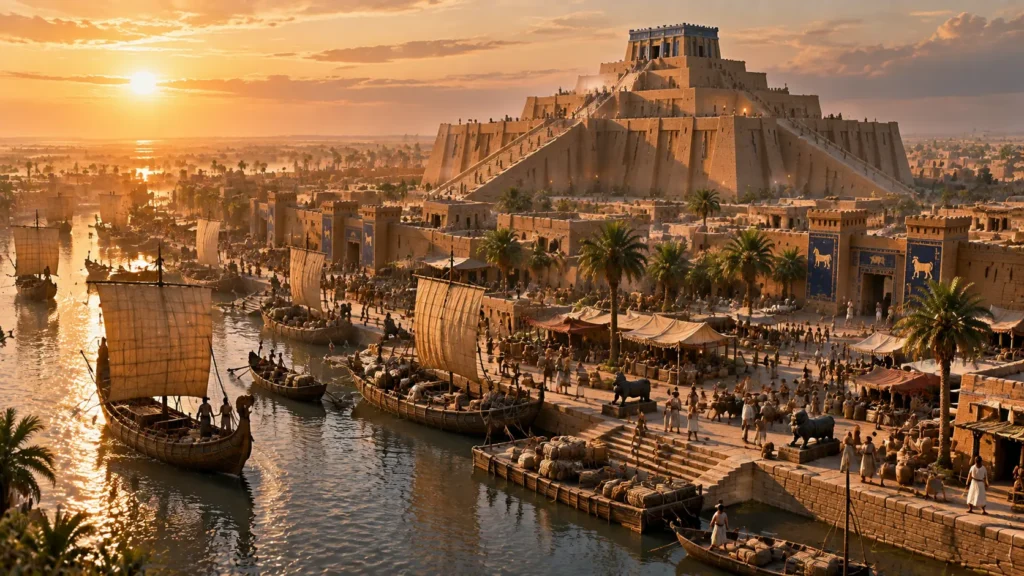
If Uruk represents the birth of the metropolis, the city-state of Ur represents the absolute zenith of Sumerian wealth, imperial power, and bureaucratic mastery. For centuries, Ur was the glittering jewel of southern Mesopotamia, a bustling commercial port where ships from as far away as the Indus Valley docked to trade exotic goods for Sumerian grain and textiles.
Known in the Hebrew Bible as “Ur of the Chaldees” and dedicated to the Sumerian moon god Nanna (later known as Sin in Akkadian), the city’s influence peaked during the Third Dynasty of Ur (the “Ur III” period, c. 2112–2004 BCE). During this Sumerian Renaissance, Ur ruled over a highly centralized empire, producing the world’s earliest known surviving code of law and undertaking monumental building projects that continue to define the Iraqi landscape today.
However, Ur is perhaps most famous not for its living empire, but for its dead. The discovery of the Royal Tombs of Ur in the 1920s shocked the world, revealing a staggering accumulation of gold, lapis lazuli, and the chilling evidence of massive human sacrifice. To study Ur is to look at a civilization operating at the absolute peak of its economic and religious fervor.
The Location and Excavation of Tell el-Muqayyar
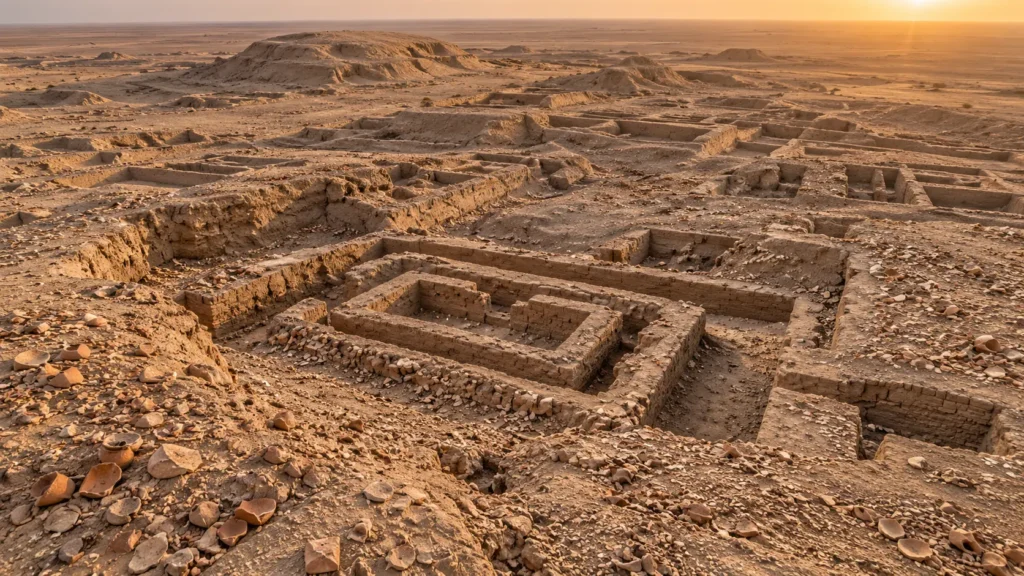
For modern travelers and geographers searching for Ur, the ancient city is located in the Dhi Qar Governorate of southern Iraq, approximately 16 kilometers (10 miles) southwest of the modern city of Nasiriyah. Today, it stands as a massive, dusty archaeological mound known in Arabic as Tell el-Muqayyar, meaning “Mound of Pitch” (referring to the bitumen used as mortar in its exposed brickwork).
The Shifting Coastline of the Persian Gulf
When looking at a modern map, Ur appears completely landlocked, sitting in the arid desert west of the Euphrates River. However, the geography of antiquity was vastly different.
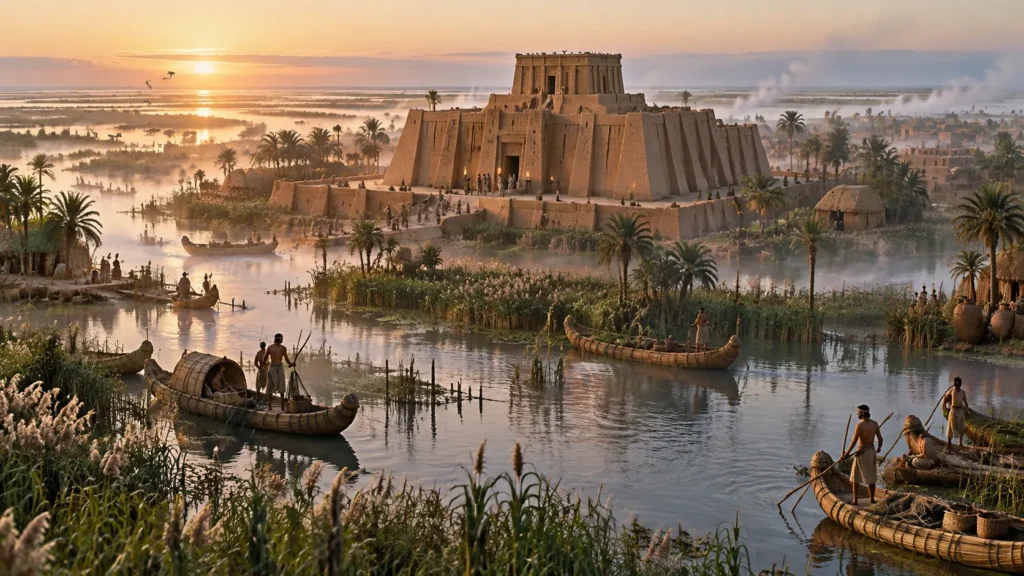
In the 3rd millennium BCE, the waters of the Persian Gulf extended much further inland. Ur was situated strategically at the very mouth of the Euphrates where it met the sea. It was a thriving maritime hub, complete with extensive harbors and canals, acting as the primary gateway for maritime trade flowing into the Mesopotamian alluvium from Dilmun (modern Bahrain), Magan (Oman), and Meluhha (the Indus Valley). The eventual silting of the river delta and the retreat of the coastline sealed the city’s economic doom millennia later.
Uncovering the City: Taylor and Woolley
The journey to uncover Ur began in 1854 when J.E. Taylor, a British consul in Basra working on behalf of the British Museum, began excavating the ruins of Tell el-Muqayyar. Taylor uncovered clay cylinders inscribed in cuneiform near the top of the ruined ziggurat. These texts, left by the Neo-Babylonian king Nabonidus (who restored the temple in the 6th century BCE), explicitly identified the site as the ancient city of Ur.
However, the true scale of Ur’s magnificence was not revealed until the 1920s. Between 1922 and 1934, a joint expedition funded by the British Museum and the University of Pennsylvania Museum of Archaeology and Anthropology (Penn Museum), led by the brilliant British archaeologist Sir Leonard Woolley, undertook one of the most meticulous and rewarding excavations in the history of Near Eastern archaeology.
Woolley’s team dug with unprecedented scientific rigor for the era. By carefully documenting stratigraphy and preserving fragile artifacts by pouring liquid wax into the cavities left by decayed wood, Woolley was able to reconstruct everything from the layout of ordinary residential neighborhoods to the towering Great Ziggurat. But his most legendary discovery lay hidden beneath the city’s ancient rubbish dumps—a discovery that would rival the tomb of Tutankhamun in its sheer archaeological impact.
The Royal Cemetery: Wealth, Artifacts, and the Great Death Pit
While excavating an ancient rubbish dump outside the city’s main precinct, Leonard Woolley’s team uncovered a vast burial ground dating to the Early Dynastic IIIa period (c. 2600 BCE). Of the more than 2,000 burials discovered, 16 stood out. These were stone and vaulted brick chambers containing wealth so staggering they were immediately classified as the “Royal Tombs.”
What made these tombs historically groundbreaking was not just the gold, but the chilling evidence of retainer sacrifice—a practice rarely seen in later Mesopotamian history. The rulers of Ur were not buried alone; they were accompanied into the afterlife by an entire retinue of guards, musicians, and court attendants.
The Great Death Pit and Retainer Sacrifice
The most macabre and fascinating example of this practice was found in the excavation trench designated as PG 1237 (Private Grave 1237), widely known as the “Great Death Pit.” Here, archaeologists uncovered the remains of 74 individuals—68 women and 6 men.
The scene Woolley reconstructed was not one of violent slaughter, but of a highly organized, ritualistic mass suicide or execution. The bodies were neatly arranged in rows. The women wore elaborate headdresses of gold ribbons, lapis lazuli, and carnelian beads. The armed guards lay at the entrance, and musicians died with their hands still resting on the strings of intricately decorated lyres. Small clay cups found near the bodies suggest the victims drank a sedative or poison before the tomb was sealed, ensuring the deceased royal would have a full court in the Netherworld.
The Unlooted Chamber of PG 800
Because grave robbing was as common in antiquity as it is today, finding an intact royal burial is extraordinarily rare. However, Tomb PG 800 was found completely unlooted.
By deciphering a lapis lazuli cylinder seal found near the main body, researchers identified the occupant as a high-ranking woman named Puabi, bearing the Sumerian title nin (meaning queen or high priestess). While her exact political role remains a subject of study, her burial goods demonstrate unimaginable wealth. Her body was covered in a cape of beads made from precious stones imported from across the known world (lapis lazuli from Afghanistan, carnelian from India). Her skull was adorned with an incredibly complex, heavy golden headdress featuring hammered gold leaves, rings, and large floral combs.
The Standard of Ur and Masterpieces of Craftsmanship
The Royal Cemetery proved that the artisans of Ur possessed a mastery of metallurgy, jewelry, and inlay work unmatched in the 3rd millennium BCE. Many of the artifacts recovered—now divided between the British Museum, the Penn Museum, and the Iraq Museum—are masterpieces of ancient art:
- The Standard of Ur (Found in PG 779): A hollow wooden box featuring intricate mosaics made of shell, red limestone, and lapis lazuli set in bitumen. Its two main panels depict the dual roles of a Sumerian ruler: the “War” panel shows infantry and four-wheeled battle wagons trampling enemies, while the “Peace” panel displays a banquet with musicians playing lyres, celebrating agricultural bounty.
- The Great Lyres: Several wooden lyres were recovered, famously featuring soundboxes decorated with magnificent, bearded bull heads crafted from hammered gold and lapis lazuli.
- The “Ram in a Thicket”: Two stunning statuettes depicting a goat rearing up against a rosette-leafed plant, crafted from gold leaf, copper, shell, and lapis lazuli.
The Third Dynasty (Ur III) and the Sumerian Renaissance
Following the collapse of the Akkadian Empire and a period of occupation by the Gutians (a nomadic mountain people), the city of Ur re-emerged to unite southern Mesopotamia. The period known as the Third Dynasty of Ur, or the “Ur III period” (c. 2112–2004 BCE), is widely regarded by historians as a “Sumerian Renaissance.”
During this century, Ur was not merely a wealthy city-state; it was the hyper-centralized capital of an empire. The administration of this era produced an astonishing volume of cuneiform documentation. To manage the vast territories, the rulers of Ur instituted the bala system—a complex, rotating taxation framework where different provinces supplied agricultural goods and livestock to the capital on a rotational basis. This required a colossal bureaucracy of scribes and accountants working from the temple precincts.
The Architecture of the Great Ziggurat (E-temen-nigur)
The most enduring legacy of the Ur III period is undoubtedly its monumental architecture. To assert the power of the new dynasty and honor the patron moon god, Nanna, a massive building program was initiated to construct the Great Ziggurat of Ur. Known in Sumerian as E-temen-nigur (“The house whose foundation creates terror”), this structure is the most well-preserved ziggurat in the Middle East.
The engineering behind the ziggurat was revolutionary. The structure originally measured 64 meters (210 feet) in length and 46 meters (150 feet) in width, rising in three massive, terraced levels to an estimated height of 30 meters (100 feet). To construct a mountain of this size in a land with no stone, the architects relied entirely on mud.
However, they anticipated the structural problems of massive mudbrick edifices. The core of the ziggurat was built using millions of unbaked, sun-dried mudbricks. To protect this fragile core from the harsh Mesopotamian rains, the exterior was encased in a thick shell of kiln-baked bricks. These outer bricks were meticulously set in bitumen (naturally occurring asphalt) acting as waterproof mortar. Furthermore, the architects engineered “weeper holes” (drainage shafts) piercing through the baked brick exterior. This genius addition allowed the moisture trapped inside the mudbrick core to evaporate, preventing the walls from expanding and collapsing under their own weight.
The Earliest Law Code in Human History
The Ur III period also marks a watershed moment in the history of human rights and jurisprudence. While the Babylonian Code of Hammurabi is more famous, the Code of Ur-Nammu, written in Sumerian at least 300 years earlier (c. 2100 BCE), is the oldest known surviving law code in the world.
Fragments of this code, discovered on clay tablets in Nippur and Ur, reveal a highly advanced legal philosophy. Unlike later Semitic legal traditions (like Hammurabi’s) that relied heavily on lex talionis (the principle of “an eye for an eye”), the Ur III legal system was surprisingly progressive. It primarily prescribed standardized financial compensation for bodily damage. For example, the code dictates that if a man knocks out another man’s eye, he must weigh and deliver a specific amount of silver (a mina), rather than losing his own eye. It codified the transition from blood feuds to a state-regulated justice system.
The Biblical Connection: Is this “Ur of the Chaldees”?
Beyond archaeological circles, the city of Ur is most famously known to the general public through the Hebrew Bible. According to the Book of Genesis (11:31), the patriarch Abraham (originally Abram) was born in a city called “Ur of the Chaldees” (Ur Kaśdim in Hebrew) before migrating to Canaan.
When Leonard Woolley excavated Tell el-Muqayyar in the 1920s, he brilliantly capitalized on this biblical connection. By declaring that he had found the hometown of Abraham, Woolley ensured constant media coverage and a steady stream of funding from his British and American sponsors. However, modern historical and linguistic scholarship paints a much more complicated picture.
The Anachronism of the Chaldeans
The primary scholarly issue with identifying Tell el-Muqayyar as Abraham’s birthplace is a chronological mismatch. The Chaldeans were a semi-nomadic Semitic people who did not migrate into southern Mesopotamia until the late 10th or 9th century BCE—nearly a thousand years after the era in which the biblical patriarchs are traditionally placed, and long after the Sumerian city of Ur had fallen from imperial power.
For the writers of Genesis (likely composing or compiling the text during the Babylonian exile in the 6th century BCE), calling the city “Ur of the Chaldees” was an anachronism—much like a modern writer referring to the Roman city of Londinium as “London, England.”
Because of this geographic and chronological discrepancy, some historians and biblical scholars argue that Abraham’s Ur might not be the Sumerian city in southern Iraq at all. Alternative theories suggest it could refer to a northern site closer to the traditional patriarchal migration routes, such as the ancient city of Urfa (modern Şanlıurfa in southeastern Turkey) or the city of Urkesh in Syria. Regardless of the historical accuracy, the association firmly cemented the Sumerian city of Ur in the Western cultural imagination.
The Fall of Ur and its Legacy
The collapse of the Ur III empire was not a sudden event, but the result of a catastrophic combination of environmental degradation, economic collapse, and foreign invasion.
Environmental Disaster: The Salinization of Sumer
The very irrigation systems that made Ur immensely wealthy eventually sowed the seeds of its destruction. The constant flooding of the agricultural fields with river water under the hot Mesopotamian sun led to rapid evaporation. This left behind microscopic layers of salt. Over centuries, this soil salinization reached toxic levels.
By the end of the Ur III period, the crop yields of southern Mesopotamia plummeted. Wheat, which is highly sensitive to salt, had to be completely abandoned in favor of the more salt-tolerant barley. Eventually, even the barley failed. With its agricultural surplus gone, the hyper-centralized bureaucracy of Ur could no longer feed its population or pay its soldiers.
The Elamite Sack and the Lament for Ur
Severely weakened by famine and the constant incursion of Amorite nomadic tribes from the west, the death blow to the empire came from the east. Around 2004 BCE, the Elamites (from the region of modern-day southwestern Iran) crossed the Zagros Mountains, sacked the city of Ur, and captured its last king, Ibbi-Sin.
The destruction of the city deeply traumatized the Sumerian psyche. It inspired one of the most famous pieces of ancient Near Eastern literature: the “Lamentation over the City of Ur.” This poetic text describes the city being abandoned by its gods, its people starving in the streets, and its temples burning.
A Long Twilight
Despite the catastrophic sack, the city of Ur was not immediately abandoned. Because of the immense religious prestige of the Great Ziggurat, subsequent Babylonian and Assyrian kings sponsored restoration projects to repair the temples of Nanna. Even the Neo-Babylonian king Nabonidus (ruled 556–539 BCE) famously ordered the top stages of the ziggurat to be rebuilt.
However, nature ultimately achieved what foreign armies could not. As the Euphrates River gradually shifted its course eastward, the life-giving waters moved too far from the city walls. Stripped of its river, Ur was finally abandoned during the Persian period (around 500 BCE), turning into the silent, pitch-stained mound of Tell el-Muqayyar, waiting millennia to be rediscovered.
Frequently Asked Questions (FAQ)
Where is the ancient city of Ur located?
The ruins of ancient Ur are located in the Dhi Qar Governorate of southern Iraq, near the modern city of Nasiriyah. The archaeological site is known today as Tell el-Muqayyar. While it is surrounded by desert today, in antiquity, it was a thriving port city near the mouth of the Euphrates River on the Persian Gulf.
Why is Ur historically important?
Ur was one of the most powerful and wealthy city-states in ancient Sumer. It is historically significant for its Royal Tombs, which contained unimaginable wealth and evidence of human sacrifice. During the Ur III period (c. 2100 BCE), it became the capital of a highly centralized empire and produced the world’s earliest known legal code, the Code of Ur-Nammu.
Is Ur the birthplace of the biblical Abraham?
According to the Book of Genesis, the patriarch Abraham originated from “Ur of the Chaldees.” While traditionally associated with the Sumerian city of Ur (Tell el-Muqayyar), many modern historians believe the label “Chaldees” is a later biblical anachronism, as the Chaldean people did not settle in the region until centuries after the patriarchal era.
Who built the Great Ziggurat of Ur?
The Great Ziggurat of Ur was commissioned by King Ur-Nammu during the Third Dynasty of Ur (c. 2100 BCE) and completed by his son, Shulgi. It was built as a monumental shrine dedicated to the Sumerian moon god, Nanna.
What caused the fall of the city of Ur?
The empire of Ur collapsed around 2004 BCE due to a combination of factors. The intensive irrigation of the surrounding fields caused severe soil salinization, leading to massive agricultural failure and famine. Severely weakened, the city was ultimately sacked and destroyed by invading Elamite forces from the east.
Further Reading and External Resources
To delve deeper into the artifacts, stratigraphy, and history of Ur, we highly recommend exploring the digital archives and collections of the institutions that originally excavated the site:
- The Penn Museum: The University of Pennsylvania Museum co-sponsored the excavations of Ur. Their dedicated digital exhibition provides incredible detail on Woolley’s methods, the Royal Tombs, and the story of Queen Puabi. Explore the exhibition: Iraq’s Ancient Past: Rediscovering Ur’s Royal Cemetery
- The British Museum: As the other half of the joint expedition, the British Museum houses many of the most famous artifacts from the city, including the Standard of Ur and the Ram in a Thicket. Explore the collection: The Standard of Ur
- World History Encyclopedia: For a comprehensive timeline of the city from the Ubaid period through its final abandonment in the Persian era. Read the entry: Ur