When asking, was Nippur an ancient city?, the word “city” barely captures its true magnitude. If Uruk was the birthplace of the metropolis and Ur was the seat of imperial wealth, Nippur was the undisputed Vatican of ancient Mesopotamia. It was the spiritual axis of the universe, the dwelling place of Enlil—the Lord of the Wind and the supreme king of the Sumerian pantheon.
What was the historical significance of Nippur? It lay in its absolute religious monopoly. Nippur never possessed a formidable army, nor did it forge an empire of its own. Yet, its political power was unparalleled. Any ambitious warlord, whether Sumerian, Akkadian, or Babylonian, who wished to legitimately rule the “Land of the Two Rivers” had to travel to Nippur to seek the blessing of Enlil’s priesthood. Kings would conquer cities with the sword, but they could only claim the title of “King of Sumer and Akkad” if they were crowned in the sacred precincts of Nippur. It was a city that conquered conquerors.
Where is Nippur Located Today? (Map & Geography)
To find Nippur on a map today, one must look toward the Al-Qādisiyyah Governorate of modern Iraq, roughly 30 kilometers east of the city of Al Diwaniyah.
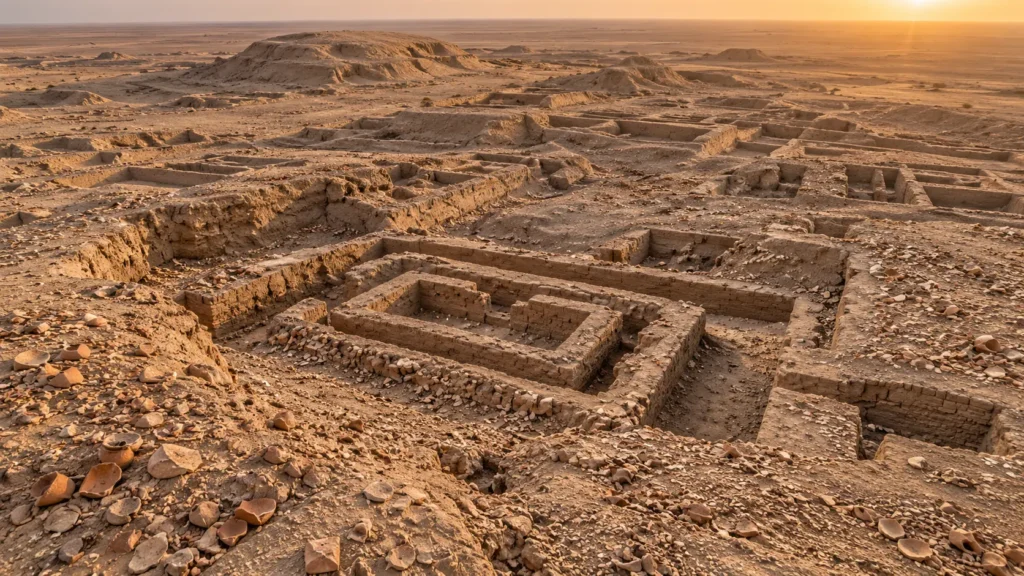
The Nippur archaeological site is known to local Iraqis as Nuffar (or Tell Nuffar). It rises from the flat, arid plains as a massive complex of dust-blown mounds, divided by a deep central depression. This dried, winding trench is the ghostly remnant of the ancient Shatt-en-Nil, a major canal branch of the Euphrates River that once bisected the city, providing the life-giving water that sustained its temples and scribal schools.
Geographically, Nippur was perfectly positioned to be a unifying religious center. It sat almost exactly on the cultural and linguistic border between Sumer in the south and Akkad in the north. If you are tracing the ruins of the ancient Near East, the distance between Nippur and Ur is approximately 160 kilometers (100 miles) to the southeast.
While it sits far from the coastal marshes of Eridu, Nippur’s central location made it a thriving crossroads of trade, theology, and diplomacy. It was a place where northern Semitic Akkadians and southern Sumerians could meet on neutral, sacred ground, bound together by the terrifying and awe-inspiring power of Enlil’s temple.
The Temple of Enlil and the Ziggurat of Nippur
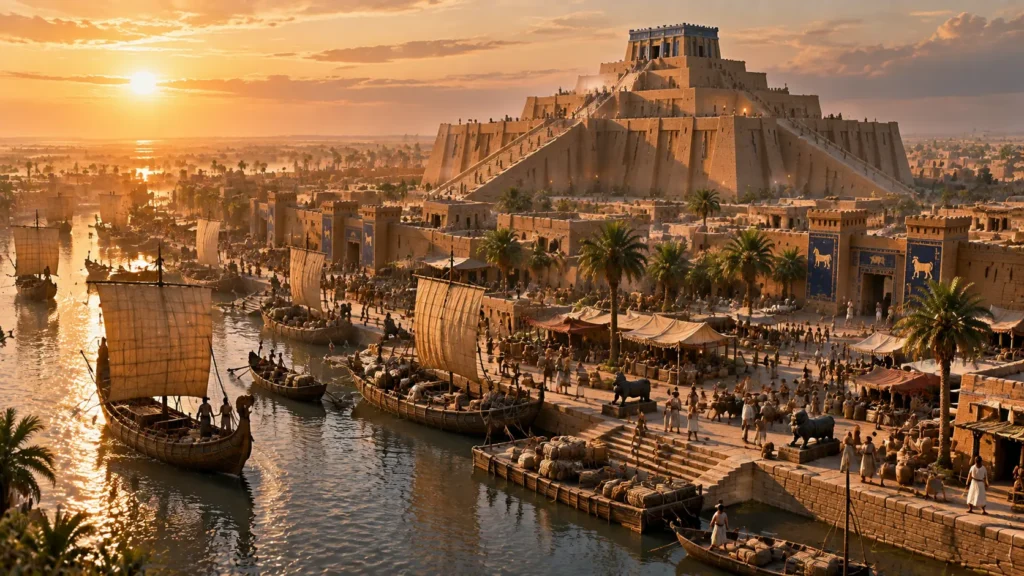
When visualizing the ancient world, people often wonder, what did Nippur look like at its peak? The city was a sprawling urban center, heavily fortified, and bisected by a sparkling canal. But its skyline was utterly dominated by a single, terrifyingly grand structure: the Ekur (Sumerian for “Mountain House”), the central temple at Nippur dedicated to Enlil.
To understand how old is Nippur, archaeologists have traced its earliest shrines back to the Ubaid period (c. 5000 BCE). However, the monumental architecture we associate with the city today was formalized much later. The towering ziggurat at Nippur, whose eroded core still dominates the ruins of Nuffar, was commissioned by King Ur-Nammu of the Third Dynasty of Ur (c. 2100 BCE). He built it as a massive, stepped mudbrick mountain, a stairway connecting heaven and earth, designed to inspire awe and fear in equal measure.
The spiritual gravity of the Ekur was so absolute that it offered a unique form of political immunity. This becomes evident when historians ask: did Sargon conquer Ur and Nippur? The Akkadian warlord Sargon the Great did indeed march his unstoppable armies through the south around 2334 BCE. While he violently crushed Ur and Uruk, tearing down their defensive walls and enslaving their kings, his approach to Nippur was entirely different. Sargon entered Nippur not as a destroyer, but as a pilgrim. He made lavish offerings at the Ekur, knowing that only the priests of Enlil could grant him the divine right to rule his newly forged Akkadian Empire. Nippur bowed to no king; kings bowed to Nippur.
Major Archaeological Discoveries: The Tablets of Nippur
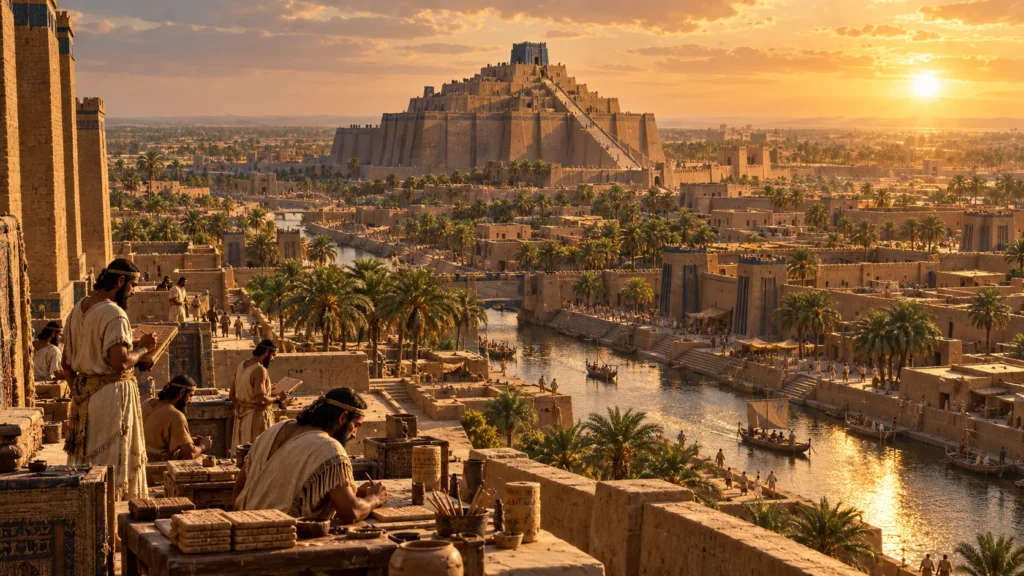
While cities like Ur yielded royal tombs filled with gold, the major archaeological discoveries at Nippur site were of a far more valuable material: clay. Nippur was the intellectual capital of the ancient world. It was home to the Eduba (the “Tablet House” or scribal school), where the brightest minds of Mesopotamia were trained in mathematics, administration, and literature.
The excavations at Nippur began in 1889 under the University of Pennsylvania, marking the first American archaeological expedition in the Middle East. Later, the project was taken over by the Oriental Institute of the University of Chicago, which conducted meticulously documented digs for decades. By referencing specific milestones—such as the highly productive eleventh season of excavations in the 1970s led by McGuire Gibson—scholars have reconstructed the stratigraphy of the city down to its prehistoric roots.
The Library of Sumer
During these campaigns, archaeologists discovered an overwhelming archive of over 30,000 cuneiform tablets. If you read a translation of a Sumerian myth today, there is a very high probability that the original tablet from Nippur provided the text.
The scribal quarters of the city yielded the oldest known versions of the Epic of Gilgamesh, the Sumerian Flood myth (the Eridu Genesis), hymns to the gods, complex mathematical treatises, and the earliest known legal and medical texts. By unearthing the Eduba, archaeologists did not just find the history of Nippur; they recovered the lost voice of the entire Sumerian civilization.
The Lament for Nippur and the Fall of the City
Despite its immense spiritual power, Nippur was not immune to the brutal realities of Mesopotamian geopolitics and environmental shifts. During the chaotic transition between the fall of the Ur III empire and the rise of the Isin-Larsa period (c. 2000–1900 BCE), the city suffered devastating water shortages, famine, and foreign incursions.
The trauma of seeing the “Vatican of Sumer” brought to its knees inspired the Lament for Nippur, a heartbreaking Sumerian poetic composition. Like the famous Lament for Ur, this text describes the city in ruins, its temples defiled, and its patron god Enlil seemingly abandoning his people to their doom. The poem captures the existential dread of a civilization watching its spiritual compass shatter.
However, Nippur was too important to stay dead. Subsequent empires—Babylonians, Kassites, and Assyrians—continuously poured resources into restoring the Ekur to appease the gods. Astoundingly, Nippur outlived almost all of its Sumerian sister cities. It remained heavily populated through the Persian, Hellenistic, and Parthian eras, and even hosted a Christian bishopric during the Sassanid period. It wasn’t until the 9th century CE, as the canal systems finally failed and the Islamic caliphates shifted trade routes elsewhere, that the holy city was truly swallowed by the desert.
Is Nippur Mentioned in the Bible? (The Babylonian Exile)
For readers interested in biblical history, a frequent question is: is Nippur mentioned in the Bible? While the name “Nippur” does not explicitly appear in English translations of the Old Testament, the city is actually the geographical epicenter of one of the most important events in biblical history: the Babylonian Exile.
When the Neo-Babylonian king Nebuchadnezzar II conquered Jerusalem in 586 BCE, he deported thousands of Jewish elites to the heartland of his empire. To understand this context, people often ask: What was Iraq called during Bible times? Depending on the era, the biblical authors referred to this region as Shinar (Sumer), Assyria, or Babylonia, while the Greeks later named it Mesopotamia (the land between the rivers).
Ezekiel and the River Chebar
According to the Book of Ezekiel (Ezekiel 1:1), the prophet experienced his famous visions of God while living among the exiles “by the river Chebar.” For centuries, this location was a mystery. However, excavations at Nippur provided the missing puzzle piece. Archaeologists discovered cuneiform tablets referencing the nar Kabari (the “Grand Canal”), a massive waterway that flowed directly through the agricultural districts surrounding Nippur.
The Murashu Archive
The connection between Nippur and the biblical exiles was cemented in 1893 when archaeologists excavating the city unearthed the Murashu Archive. This was a collection of over 700 clay tablets belonging to a wealthy family of bankers and agricultural brokers who operated in Nippur during the 5th century BCE (the Persian period).
These tablets are essentially ancient financial ledgers, recording loans, land leases, and tax payments. Crucially, they contain dozens of distinctively Hebrew names (identifiable by the suffix -yahu or -ia, referring to Yahweh). The Murashu texts prove that Jewish exiles who chose not to return to Jerusalem integrated deeply into the economy of Nippur, farming the land, conducting business, and thriving along the banks of the Chebar canal, right in the shadow of Enlil’s ancient ziggurat.
Further Reading and External Resources
To explore the archaeological data, cuneiform translations, and excavation reports of Nippur, we highly recommend consulting the archives of the institutions that physically unearthed the city:
- The Oriental Institute of the University of Chicago (ISAC): Chicago’s expedition (including the famous “eleventh season” led by McGuire Gibson) fundamentally shaped our understanding of Nippur’s stratigraphy and the Kassite period. Explore the Nippur Expedition Archives
- The Penn Museum: The University of Pennsylvania conducted the very first American excavations at Nippur in 1889, unearthing the massive tablet collections from the scribal schools. Explore Penn’s Nippur Collection
- ETCSL (Oxford University): Read the direct English translation of the Lament for Nippur and other Sumerian literature discovered in the city’s Eduba. Read the Lament for Nippur
Frequently Asked Questions (FAQ)
How do you pronounce Nippur?
In English, the city is generally pronounced as nih-POOR (with the emphasis on the second syllable). In its original Sumerian context, it was known as Nibru, and in Akkadian as Nibbur. Today, local Iraqis refer to the archaeological mound as Nuffar.
What are the most important facts about Nippur?
Key facts about Nippur include its status as the spiritual capital of ancient Mesopotamia, rather than a political one. It was the earthly home of Enlil, the supreme Sumerian god. Archaeologically, it is most famous for its Eduba (scribal schools), where archaeologists found over 30,000 cuneiform tablets containing the bulk of known Sumerian literature.
How old is Nippur?
The earliest settlement layers at Nippur date back to the Ubaid period, around 5000 BCE. It grew into a major religious center during the Early Dynastic period (c. 2900 BCE) and remained continuously occupied for thousands of years, only being completely abandoned around the 9th century CE during the Islamic Abbasid Caliphate.
Is the “Nippur Gate” open for travel and tourism?
While you may see references online to “Nippur Gate for travel and tourism” (which is the name of a modern Iraqi travel agency), visiting the actual archaeological ruins of Nippur (Tell Nuffar) is highly restricted. It is located deep in the Al-Qādisiyyah desert. There is no modern tourist infrastructure at the site, and access requires navigating strict security checkpoints and obtaining specialized archaeological permits from the Iraqi government.
Is Nippur mentioned in the Bible?
While the name Nippur is absent from the Bible, the city is the exact location of the Jewish exile described in the Book of Ezekiel. The prophet lived among the exiles by the “River Chebar,” which archaeologists have identified as the nar Kabari canal running through Nippur. The discovery of the Murashu Archive at Nippur confirmed that Jewish exiles lived, farmed, and traded in the city during the 5th century BCE.
Further Reading and External Resources
To explore the archaeological data, cuneiform translations, and excavation reports of Nippur, we highly recommend consulting the archives of the institutions that physically unearthed the city:
- The Oriental Institute of the University of Chicago (ISAC): Chicago’s expedition (including the famous “eleventh season” led by McGuire Gibson) fundamentally shaped our understanding of Nippur’s stratigraphy and the Kassite period. Explore the Nippur Expedition Archives
- The Penn Museum: The University of Pennsylvania conducted the very first American excavations at Nippur in 1889, unearthing the massive tablet collections from the scribal schools. Explore Penn’s Nippur Collection
- ETCSL (Oxford University): Read the direct English translation of the Lament for Nippur and other Sumerian literature discovered in the city’s Eduba. Read the Lament for Nippur