Persian art—most famously represented by the monumental and decorative achievements of the Achaemenid Empire (c. 550–330 BCE)—is an ancient artistic tradition renowned for its extraordinary relief sculpture, sophisticated gold and silver smithing, intricate cylinder seals, and animalier motifs. Rather than glorifying the violent destruction of enemies typical of earlier Near Eastern states, ancient Persian artistic expression emphasized imperial harmony, courtly dignity, and a synthesis of Mesopotamian, Egyptian, Anatolian, and Greek craftsmanship into a unified, cosmopolitan visual language.
Chronological Milestones: The Evolution of Ancient Persian Art
| Era & Date | Artistic Period | Craft Breakthroughs & Visual Expressions |
| c. 550–530 BCE | Early Imperial & Nomadic Synthesis | Fusion of native Iranian animal-style bronze traditions (such as Luristan metallurgy) with Near Eastern stone-carving techniques. |
| c. 520–486 BCE | The Monumental Relief Zenith | Formalization of the low-relief narrative style; creation of life-sized tribute processions depicting diverse imperial ethnic costumes, hairstyles, and gifts. |
| c. 486–404 BCE | Golden Age of Court Metalwork | Peak production of gold and silver rhytons (ceremonial drinking horns), armlets with griffin terminals, and cast bronze statuettes across royal workshops. |
| c. 404–330 BCE | Polychrome Glazing & Luxury Seals | Widespread adoption of vibrant polychrome glazed siliceous brick friezes, micro-carved chalcedony cylinder seals, and embroidered royal textiles. |
| 330 BCE – 651 CE+ | Transmission to Post-Ancient Traditions | Survival and revival of Persian animal motifs, silver plate engraving, and textile patterns in Parthian, Sasanian, and classical Islamic decorative arts. |
Defining Characteristics and Philosophy of Ancient Persian Art
The visual culture of the Persian Empire reflected a profound ideological shift in ancient Near Eastern state art. In contrast to Neo-Assyrian art—which prominently depicted the flaying of prisoners, impalements, and burning cities—Persian imperial art deliberately avoided graphic depictions of violence. Instead, royal workshops developed a visual language centered on order, universal balance, and imperial majesty.
[Near Eastern Monumental Tradition] + [Ionian Greek Drape Carving] + [Egyptian Proportions] ➔ [Unified Persian Court Style]
This artistic philosophy stood upon four distinct pillars:
- Symmetry and Repetition: Stone carvings and luxury metalwares prioritized rhythmic, mathematical repetition. Lines of courtiers and gift-bearers are arranged in orderly horizontal registers, conveying a stable, unshakeable cosmos.
- The Animalier Aesthetic: Animals were treated with a blend of anatomical realism and stylized geometric elegance. Lions, bulls, ibexes, and mythical creatures (such as winged griffins and horned lions) symbolized raw natural energy harnessed in service of the crown.
- Celebration of Cultural Diversity: Relief sculptures documented subject nations with extraordinary ethnographic accuracy. Rather than being portrayed as chained slaves, foreign delegates were depicted walking upright in their native traditional dress, carrying regional specialty gifts.
- Polychromatic Brilliance: Ancient Persian monuments were not the muted grey stone seen in archaeological ruins today. They were originally painted in vivid pigments of Egyptian blue, malachite green, cinnabar red, and yellow ochre, accented with gold foil sheets.
Monumental Stone Reliefs and Royal Iconography
The crowning achievement of Persian sculpture was the narrative low-relief (bas-relief). Carved into fine dark grey limestone, these reliefs flanked monumental staircases, ceremonial doorways, and rock-cut cliffside monuments.
[Delegation Approaching Court] ➔ [Guided by Median/Persian Usher] ➔ [Presenting Indigenous Crafts/Fauna] ➔ [Confirmation of Imperial Compact]
The Visual Ethnography of Imperial Delegations
The most famous sculptural programs depicted delegations representing the diverse provinces of the empire. Each group was carefully individualized through clothing, headdresses, and gifts:
| Subject Delegation | Distinctive Costume & Attire | Specialized Gifts & Tribute Carried |
| Medes & Armenians | Tight tunics, riding trousers (anaxyrides), soft felt caps, and rounded cloaks. | Fine riding gear, gold amphorae, and prize Nisaean stallions. |
| Babylonians & Syrians | Long fringed woolen robes, pleated turbans, and conical caps. | Embroidered textiles, bowls of woven cloth, and live humped bulls. |
| Lydians & Ionian Greeks | Draped mantles (himatia), short chitons, and strapped leather boots. | Fine metalwork vases, silver bowls, and rolls of spun dyed wool. |
| Egyptians & Kushites | Linen wrap-around skirts (shendyt) and broad collar necklaces. | Wild Okapis, jars of aromatic Nile ointments, and elephant tusks. |
| Bactrians & Sogdians | Heavy nomadic caftans with fur borders and high-peaked felt caps. | Two-humped Bactrian camels and vessels of refined gold dust. |
These carved registers served as permanent visual contracts: they reminded every visitor that the empire was a cooperative global federation rather than a tyrannical conquest.
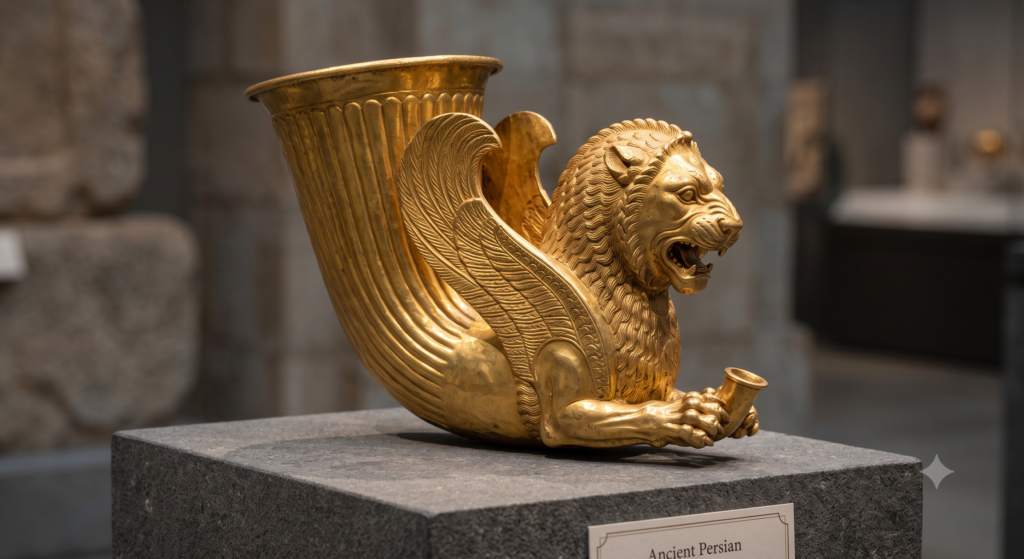
A museum-quality Achaemenid gold rhyton terminating in a winged griffin, symbolizing royal power and the fusion of animalier aesthetics, c. 5th century BCE.
Luxury Metalwork, Glyptic Arts, and Royal Crafts
Persian artisans were celebrated across the ancient Mediterranean for their unmatched mastery of precious metals. The royal court commissioned luxurious tableware, jewelry, and personal ornaments produced through complex casting, chasing, and repoussé techniques.
| Artistic Medium | Signature Persian Masterpiece | Technical Execution & Aesthetic Motif |
| The Gold/Silver Rhyton | Conical Horn Drinking Vessel | Features a curved horn ending in the sculpted protome of a winged griffin, lion, or mountain ram, with a pouring spout at the base. |
| Royal Armlets & Torques | Heavy Cast Gold Bracelets | Solid gold bands terminating in back-to-back animal heads inlaid with turquoise, lapis lazuli, and carnelian cloisonné. |
| Cylinder & Stamp Seals | Carved Chalcedony & Agate | Intaglios depicting the “Royal Hero” vanquishing cosmic monsters or hunting lions from two-wheeled war chariots. |
| Polychrome Glazed Friezes | Fired Siliceous Brickwork | Glazed wall revetments depicting the elite Royal Guard archers dressed in patterned flowing robes and holding golden spears. |
The Oxus Treasure and Courtly Luxury
Much of our knowledge of Persian goldsmithing comes from hoard discoveries such as the famous Oxus Treasure. These objects reveal an extraordinary standard of miniature craftsmanship: delicate gold chariots pulled by four horses, hollow-cast statuettes of nobles wearing pleated robes, and finely chased silver plates with concentric lotus medallions.
Step Into the Ancient World: Inside the Imperial Goldsmith’s Workshop
Imagine stepping into the royal artisan quarter of Susa on a humid afternoon in midsummer.
The workshop air is thick with the sulfurous scent of melting charcoal, hot beeswax, and the acrid bite of mineral pickling baths. Across the stone floor, dozens of master craftsmen from different corners of the world work side by side under the direction of an imperial master jeweler.
At the central furnace, a Babylonian metallurgist uses clay blowpipes to direct a roaring white-hot flame onto a terracotta crucible filled with melted Anatolian gold. Nearby, an Egyptian master carves a block of dark blue Afghan lapis lazuli into the shape of a falcon’s eye, fitting it precisely into the cloisonné socket of a heavy royal torque destined for a provincial governor.
At an oak workbench, an artisan works on a silver rhyton. Using fine bronze chasing tools and small wooden mallets, he carefully embosses the muscular shoulders of a leaping winged lion around the vessel’s base. Each hair of the creature’s mane is chased with rhythmic, mathematical precision.
In the corner, an Ionian stone engraver peers closely at a cylinder seal of translucent chalcedony no larger than a thumb. Working with fine quartz abrasive paste and a bow-drill, he carves the microscopic figure of the Great King standing between two rearing sphinxes under the winged celestial disc. When rolled across wet clay, this miniature masterpiece will authenticate royal tax decrees across three continents. In this room, art is not a detached hobby—it is the physical machinery through which the authority, wealth, and elegance of the empire are forged.
The Lasting Legacy of Persian Aesthetics
Following the fall of the Achaemenid dynasty, ancient Persian artistic conventions did not disappear. They formed the bedrock of Near Eastern visual traditions for centuries:
Transmission to Islamic Decorative Arts: The preference for non-figurative floral arabesques, rhythmic geometric repetition, and glazed architectural tiles in Islamic art directly evolved from ancient Persian palatial decoration.
Parthian & Sasanian Silverwork: Sasanian master metalworkers directly inherited the animal-head rhytons and chased silver royal hunting plates, refining them into classical Iranian court art.
Textile and Carpet Heritage: The complex geometric patterns, stylized lotus rosettes, and combat animal scenes (the lion and bull motif) established in Achaemenid textiles laid the foundation for the world-renowned tradition of Persian rugs and silks.
Key Takeaways
Enduring Aesthetic Influence: Achaemenid motifs—including the combat of lions and bulls, lotus bands, and stylized animals—directly shaped Sasanian metalwork, classical Persian carpets, and medieval Islamic decorative arts.
Ideology of Imperial Harmony: Persian art rejected graphic depictions of warfare and violence, focusing instead on themes of universal order, courtly dignity, and voluntary tribute.
Mastery of Narrative Bas-Relief: Monumental stone reliefs documented imperial delegations with photographic ethnographic precision, recording the native garments, hairstyles, and specialty gifts of dozens of subject nations.
Precious Metalwork & The Rhyton: Persian goldsmiths and silversmiths perfected the animalier style, creating iconic horn-shaped drinking vessels (rhytons) and animal-headed torque armlets inlaid with lapis lazuli and turquoise.
Glazed Polychrome Friezes: Walls were adorned with vibrant, weather-resistant glazed bricks depicting royal archers, winged sphinxes, and rosettes in brilliant shades of yellow, blue, and green.
Micro-Carved Glyptic Seals: Cylinder and stamp seals cut from gemstones (chalcedony, agate, hematite) served as both legal authentication devices and miniature masterpieces of royal iconography.
Frequently Asked Questions
What is Persian art?
Persian art, particularly during the ancient Achaemenid era (c. 550–330 BCE), refers to the visual arts, sculpture, luxury metalwork, glyptic seals, and decorative crafts produced in ancient Persia. It is recognized for its cosmopolitan synthesis of regional traditions, monumental stone reliefs, animalier motifs, and exceptional gold and silver craftsmanship.
What are the main characteristics of ancient Persian art?
Key characteristics include strict symmetry and rhythmic repetition, stylized animal figures (lions, bulls, griffins), ethnographic accuracy in depicting multicultural dress, the use of precious metal inlays (turquoise and lapis lazuli), and a deliberate avoidance of violent or chaotic battle scenes in favor of imperial harmony.
What is a Persian rhyton?
A rhyton is a luxury conical drinking horn or ceremonial libation vessel made of gold, silver, or terracotta. In Persian art, the lower end of the vessel typically terminates in the exquisitely sculpted forepart (protome) of an animal, such as a winged lion, horned griffin, ram, or bull.
How did ancient Persians dress as depicted in art?
Persian artistic reliefs show two primary styles of elite dress:
- The Persian Court Robe: A flowing, ankle-length pleated robe of fine wool or silk with wide, draped sleeves and a fluted headdress.
- The Median/Riding Costume: A practical, tight-fitting leather tunic paired with riding trousers (anaxyrides), a rounded overcoat with empty hanging sleeves (kandys), and a soft felt cap (tiara).
What materials were most commonly used in Persian art?
Ancient Persian artisans worked with local dark grey limestone for monumental stone reliefs, gold, silver, and bronze for luxury tableware and jewelry, chalcedony, agate, and lapis lazuli for seal carvings, and siliceous glazed clay bricks for colorful architectural murals.
What is the Oxus Treasure?
The Oxus Treasure is a famous collection of approximately 180 gold and silver metalwork objects and around 200 coins dating from the Achaemenid Persian period (550–330 BCE), discovered near the Oxus River. It includes miniature gold chariots, animal-headed armlets, statuettes, and chased vessels representing the pinnacle of ancient Persian goldsmithing.
Further Reading
- The British Museum – The Oxus Treasure and Achaemenid Metalwork Collection
- The Metropolitan Museum of Art – Ancient Near Eastern Art and Achaemenid Luxury Crafts
- Encyclopaedia Iranica – Achaemenid Art and Iconography
- World History Encyclopedia – Ancient Persian Art and Sculpture
- Louvre Museum – The Frieze of Archers and Susa Glazed Brickworks