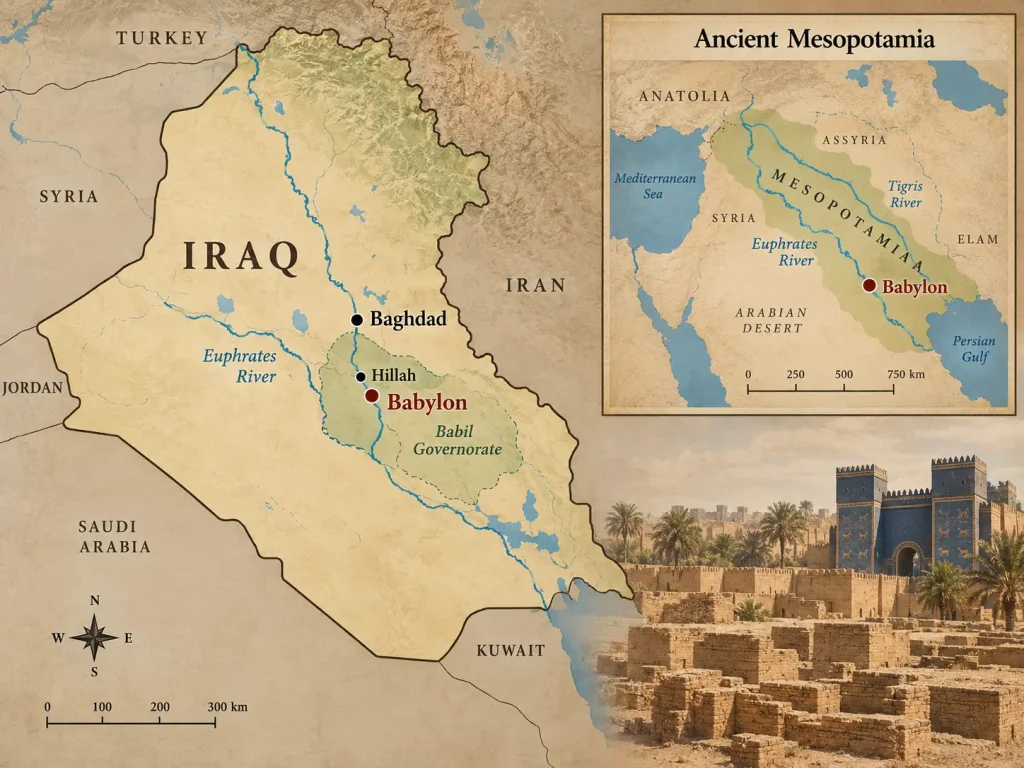
Ancient Babylon is located in present-day Iraq, approximately 85 kilometers (53 miles) south of Baghdad, near the modern city of Hillah in Babil Governorate. Once the political and cultural center of the Babylonian Empire, Babylon stood on the banks of the Euphrates River in the historical region of Mesopotamia, an area often described as one of the cradles of civilization.
Today, Babylon is no longer a thriving ancient metropolis, but its archaeological remains preserve evidence of one of the most influential cities of the ancient world. The site contains the remains of monumental structures associated with rulers such as Hammurabi and Nebuchadnezzar II, including the famous Ishtar Gate and parts of the ancient city walls.
Understanding where Babylon is today requires looking beyond its modern location: it is a place where archaeology, ancient texts, and the history of Mesopotamia reveal how a city that shaped human civilization continues to influence the world.
Where Is Babylon Today? Understanding Its Location in Ancient Mesopotamia
To understand the location of Babylon today, it is necessary to place the city within the wider landscape of ancient Mesopotamia. Babylon developed in the fertile plains between the Tigris and Euphrates rivers, a region that supported some of the earliest urban societies in human history.
Unlike many ancient cities whose locations remain uncertain, Babylon’s position is well documented through archaeological discoveries, cuneiform inscriptions, and historical records from different periods of Mesopotamian history. The remains identified as Babylon correspond to a large urban complex that expanded over centuries and became the political heart of the Babylonian kingdoms.
The city’s location was closely connected to the Euphrates River, which provided water, agricultural resources, and an important route for trade and communication. This strategic position helped Babylon grow from a regional settlement into one of the most influential cities of the ancient Near East.
During the reign of Hammurabi (c. 1792–1750 BCE), Babylon became the center of a powerful kingdom known for its administration, legal traditions, and cultural influence. Centuries later, under Nebuchadnezzar II (605–562 BCE), the city reached its greatest architectural and political prominence, with the construction of monumental buildings, temples, and defensive structures.
Today, the archaeological remains allow historians to connect the ancient city described in texts with a real geographical location. Babylon is therefore not only a name from ancient history but a physical site that can still be studied through archaeology, architecture, and surviving written evidence.
Babylon’s Location in Context
| Ancient Location | Modern Reference |
|---|---|
| Southern Mesopotamia | Iraq |
| Euphrates River region | Near modern Hillah |
| Babylonian capital | Archaeological site of Babylon |
| Ancient Near Eastern civilization center | UNESCO World Heritage archaeological area |
What Country Is Babylon In Today?
The ancient city of Babylon is located in Iraq, a modern country that occupies much of the territory historically known as Mesopotamia. While the name Babylon refers to an ancient city and civilization rather than a modern nation, its archaeological remains are found within the borders of present-day Iraq.
The connection between Babylon and Iraq reflects the continuity of the Mesopotamian landscape, where several of the world’s earliest civilizations developed, including the Sumerians, Akkadians, Babylonians, and Assyrians. Modern Iraq contains many of the most important archaeological sites from this ancient region, including Babylon, Ur, Nineveh, and other major urban centers.
It is important to distinguish between ancient Babylonia and the modern state of Iraq. Babylonia was a historical kingdom that existed thousands of years before modern borders were created. Its territory changed over time and included different parts of southern Mesopotamia, but the heart of the Babylonian civilization was located in what is now central-southern Iraq.
Today, visitors and researchers studying Babylon are exploring an archaeological site within Iraq rather than a surviving ancient city. The remains of Babylon provide evidence of a civilization that influenced law, literature, astronomy, mathematics, and political organization throughout the ancient Near East.
Quick Answer: What Country Is Babylon In Today?
Babylon is located in modern-day Iraq. The ancient city was part of Mesopotamia, a historical region that corresponds mainly to present-day Iraq and parts of neighboring countries.
What Is Babylon Called Today?
Babylon does not have a modern city name that replaced the ancient one. Today, the name Babylon refers primarily to the archaeological site of the ancient city in Iraq rather than to a continuously inhabited metropolis like many other ancient cities.
The ancient name of Babylon comes from the Akkadian Bāb-ilim, meaning “Gate of the God” or “Gate of the Gods.” The city remained known as Babylon throughout different periods of Mesopotamian history, including during the rise of the Babylonian Empire and the reign of famous rulers such as Hammurabi and Nebuchadnezzar II.
In modern geographical terms, the remains of Babylon are located near the city of Hillah, which developed close to the ancient site. For this reason, Babylon is sometimes associated with Hillah or Iraq’s Babil Governorate, but the archaeological remains themselves continue to be identified by their historical name: Babylon.
The word Babylon therefore represents more than a physical location. It refers to both an ancient city and the civilization that developed around it, leaving a lasting legacy in areas such as law, literature, astronomy, mathematics, and architecture throughout the ancient Near East.
Is Babylon Still Called Babylon Today?
Yes. The archaeological site is still known as Babylon, but it no longer functions as the major urban center that it was during the height of the Babylonian Empire. Today, the name refers to the remains of the ancient city and its surrounding archaeological landscape.
Babylon Today: Ancient Name vs Modern Reference
| Historical Term | Modern Meaning |
|---|---|
| Babylon | Archaeological site of the ancient city in Iraq |
| Babylonia | Historical kingdom and cultural region of ancient Mesopotamia |
| Hillah | Modern city located near the ruins of Babylon |
| Babil Governorate | Modern administrative region where Babylon is located |
Does Babylon Still Exist Today?
Babylon still exists today as an archaeological site in Iraq, but it is no longer a living city in the way it was during the height of the Babylonian Empire. The remains of the ancient metropolis preserve evidence of its temples, palaces, streets, defensive walls, and monumental architecture, allowing researchers to study one of the most important urban centers of the ancient Near East.
Unlike cities that have continued to develop over thousands of years, ancient Babylon gradually declined after losing its political importance. Following the fall of the Babylonian Empire and the rise of later powers, including the Achaemenid Persian Empire, the city lost its role as a major imperial capital. Over centuries, parts of Babylon were abandoned, reused, or covered by accumulated layers of soil.
Today, visitors can explore the archaeological remains of Babylon, including sections of the ancient city walls, the Processional Way, reconstructed elements of the Ishtar Gate, and the remains of important religious and royal buildings. These discoveries provide insight into Babylon’s urban planning, religious practices, and political power.
The site has also become an important symbol of cultural heritage. In 2019, Babylon was designated a UNESCO World Heritage Site, recognizing its exceptional historical importance and its contribution to the understanding of ancient Mesopotamian civilization.
Is Babylon Still a City Today?
No. Babylon is not a modern city with a large permanent population like it was in antiquity. The ancient city survives today as an archaeological and historical site located near the modern city of Hillah in Iraq.
What Remains of Babylon Today?
The archaeological site of Babylon contains remains and reconstructions associated with the ancient city, including:
- The Ishtar Gate, one of the most famous monuments connected with Babylon.
- The Processional Way, the ceremonial route used for important religious and royal events.
- The ancient city walls, which protected Babylon during its period of greatest power.
- Palaces and temple areas, including structures connected with the worship of major Babylonian deities.
These remains demonstrate that Babylon was not only a legendary city from ancient texts but a real urban center with remarkable architectural and cultural achievements.
What Does Babylon Look Like Today?
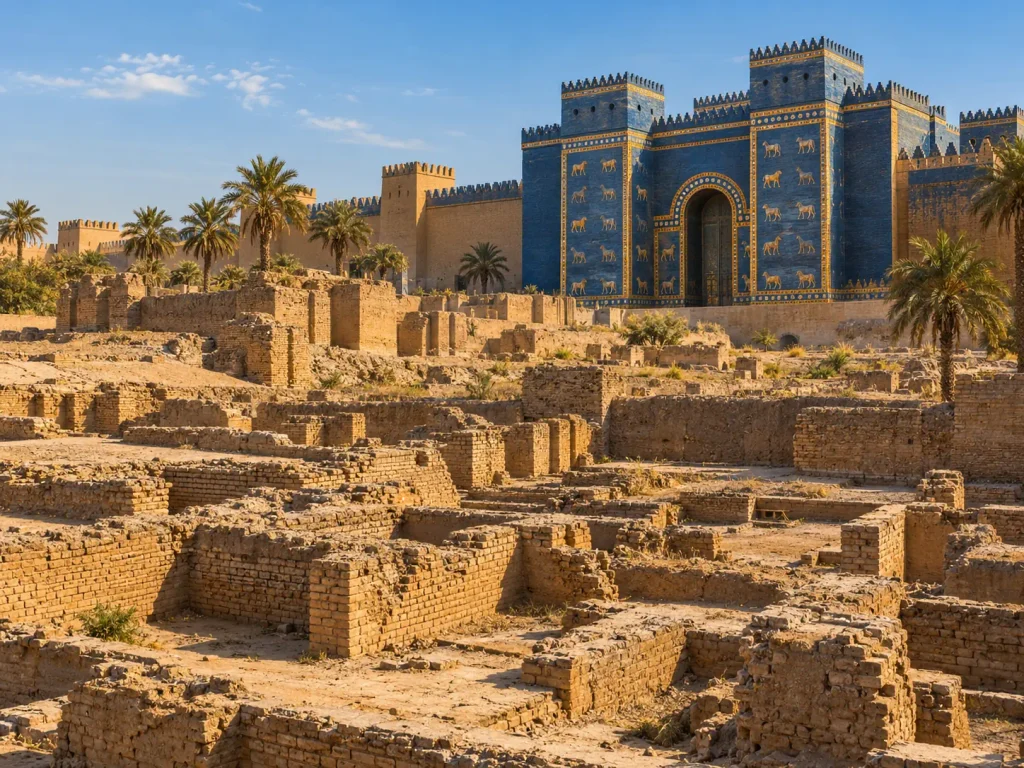
Today, Babylon looks very different from the magnificent imperial capital described in ancient texts. Rather than a pristine archaeological site, visitors encounter a complex and sometimes controversial patchwork of authentic ancient ruins and modern interventions.
While archaeologists have uncovered essential foundations, including parts of the Processional Way and the original base of the Ishtar Gate, the visual landscape is heavily dominated by 20th-century alterations. During the 1980s, former Iraqi President Saddam Hussein ordered a massive and highly controversial reconstruction of Babylon. Seeking to connect his own legacy with the greatness of the Babylonian Empire, he rebuilt the ancient city’s walls and palaces directly on top of the original ruins.
In a direct imitation of Nebuchadnezzar II, Saddam even had his own name inscribed on millions of the new yellow bricks used in the reconstruction, with inscriptions reading: “Built by Saddam Hussein, son of Nebuchadnezzar, to glorify Iraq.” Furthermore, overlooking the ancient site is a massive, modern palace built for Saddam Hussein on an artificial hill, which now stands empty as a surreal monument to recent political history.
As a result, Babylon today looks like a collision of eras. The authentic archaeological layers, foundations, and structural fragments from 600 BCE sit directly beneath modern 1980s brickwork, creating a landscape that tells the story not only of ancient Mesopotamia, but also of how modern rulers have attempted to use its legacy for propaganda.
What Can Visitors See at Babylon Today?
Visitors exploring Babylon today may encounter:
- The reconstructed Ishtar Gate, featuring the famous blue-glazed brick style associated with Babylonian architecture.
- The Processional Way, the ceremonial avenue that connected important religious and royal areas.
- The remains of palaces and temples, showing the scale of Babylon’s urban development.
- Sections of ancient defensive walls, demonstrating the importance of the city’s protection and planning.
Babylon today is therefore not a preserved ancient city frozen in time, but an archaeological site where ruins, reconstructions, and historical evidence reveal the legacy of one of the ancient world’s most influential civilizations.
Can You Visit Babylon Today?
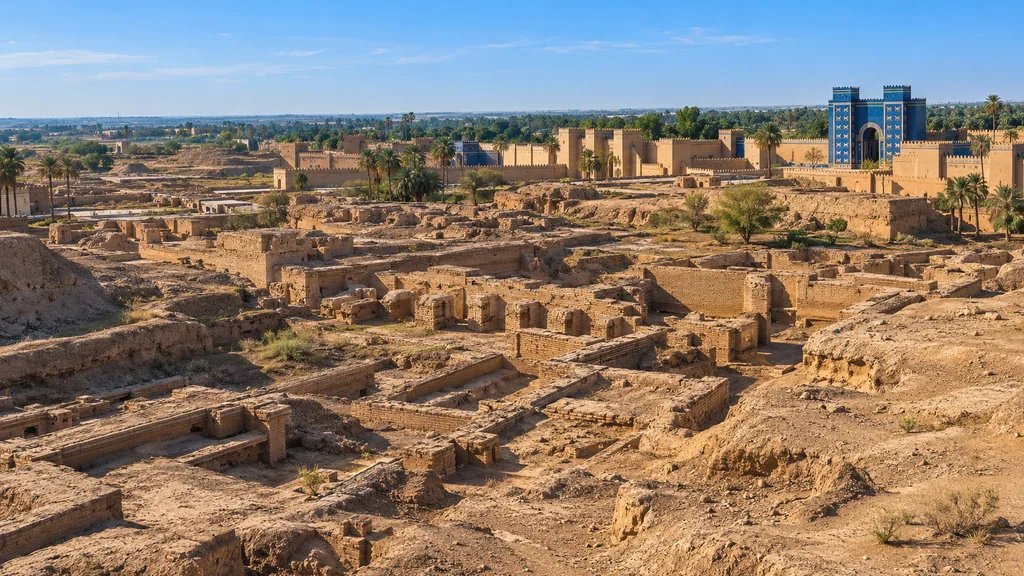
Yes, you can visit Babylon today. Although it is no longer a functioning urban center, it is an accessible and increasingly popular destination for history enthusiasts and archaeological tourists traveling to Iraq.
For many years, accessing the site was difficult due to the geopolitical situation. In the immediate aftermath of the 2003 Iraq War, the ruins of Babylon suffered significant damage when coalition forces (primarily US and Polish military units) established “Camp Alpha,” a military base located directly on top of the ancient city. Heavy armored vehicles crushed 2,600-year-old brick pavements, trenches were dug through pristine archaeological layers, and vibrations from helicopters damaged the fragile Ishtar Gate structures.
Fortunately, the site was eventually returned to the Iraqi State Board of Antiquities and Heritage. In 2019, following extensive conservation efforts and international lobbying, Babylon was officially designated as a UNESCO World Heritage Site.
Today, visiting Babylon is considered highly safe for international tourists. The site is located in the Babil Governorate, which is one of the more stable and secure regions of modern Iraq. Most visitors access the ruins via guided day tours departing from Baghdad, located just 85 kilometers (53 miles) to the north. Visitors can walk the original Processional Way, touch the original bricks featuring ancient reliefs of dragons (the Mušḫuššu), explore Saddam Hussein’s reconstructed maze-like palaces, and look out over the Euphrates River, standing exactly where the cradle of civilization once thrived.l site where visitors can explore the remains and historical evidence of one of the world’s most influential civilizations.
Why Is Babylon Important Today?
Babylon remains important today because it represents one of the most influential civilizations in the history of the ancient Near East. Although the city is no longer a political capital or a major urban center, its discoveries continue to provide valuable information about the development of human society, government, science, and culture.
As the center of the Babylonian civilization, the city played a major role in the development of writing, administration, law, mathematics, astronomy, and literature. Babylonian scholars created detailed records using cuneiform writing, preserving information about trade, religious practices, astronomical observations, and daily life.
Babylon is also remembered through the achievements of rulers such as Hammurabi, whose famous law code provides one of the earliest examples of a written legal system, and Nebuchadnezzar II, under whose reign Babylon became one of the most impressive cities of the ancient world.
Beyond its historical achievements, Babylon continues to influence modern culture. The city appears in religious texts, literature, archaeology, and popular discussions about ancient civilizations. Its name has become a symbol of both human creativity and the complexity of early urban societies.
Today, the importance of Babylon lies not only in the ruins that remain in Iraq but also in what the city represents: the achievements of a civilization that helped shape many aspects of the modern world.
Why Does Babylon Matter in History?
Babylon is significant because it demonstrates how ancient societies developed:
- Complex cities and governments capable of managing large populations.
- Written legal traditions that influenced later systems of law.
- Scientific knowledge, including advances in mathematics and astronomy.
- Literary traditions, including some of the earliest recorded works of human history.
The study of Babylon allows historians and archaeologists to better understand the origins of urban civilization and the cultural achievements of ancient Mesopotamia.
Study Guide & Quick Answers
These short answers address common study questions about Babylon’s modern location, historical identity, and archaeological significance.
Where Is Babylon Today?
Babylon is located in present-day Iraq, near the modern city of Hillah. The ancient city was part of Mesopotamia, one of the world’s earliest centers of urban civilization.
Is Babylon a Real Place or Only a Historical Name?
Babylon was a real ancient city, not only a legendary place. Archaeological excavations in Iraq have revealed the remains of its walls, buildings, temples, and urban structures.
What Happened to the Ancient City of Babylon?
Babylon gradually declined after losing its political importance as new empires rose in the region. Over time, the city was abandoned, but its archaeological remains survived.
Why Is Babylon Important in History?
Babylon influenced human history through its achievements in law, writing, astronomy, mathematics, architecture, and literature. It remains one of the most studied cities of the ancient Near East.
Where Was Babylon in Biblical and Ancient Sources?
Ancient texts often refer to Babylon as a major city of Mesopotamia. Its historical location corresponds to the archaeological site in modern Iraq near the Euphrates River.