What Were the Greco-Persian Wars?
The Greco-Persian Wars were a series of monumental military conflicts fought between the Achaemenid Persian Empire—the undisputed superpower of the ancient world—and a decentralized coalition of independent Greek city-states (poleis). Spanning half a century, from 499 BCE to 449 BCE, this clash of civilizations defined the geopolitical landscape of the ancient Mediterranean.
To define the Greco-Persian Wars accurately, it is essential to understand them not as a single, uninterrupted war, but as a sequence of distinct rebellions, punitive expeditions, and full-scale invasions. The primary historical narrative for these events survives through the writings of the ancient Greek historian Herodotus of Halicarnassus. In his seminal work, The Histories, Herodotus documented the conflict so that “human achievements may not become forgotten in time.”
At its core, the conflict was an ideological and political collision. The Achaemenid kings, ruling by divine mandate from Ahura Mazda, sought to incorporate the fractious Greek world into their highly centralized and efficiently governed empire. In contrast, the leading Greek states, particularly democratic Athens and oligarchic Sparta, fought for their political autonomy (autonomia) and freedom (eleutheria). Ultimately, the Greek victory halted Persian expansion into Europe and directly catalyzed the cultural explosion known as the Athenian Golden Age.
The Origins: What Caused the Greco-Persian Wars?
The Greco-Persian Wars were not the result of a sudden misunderstanding, but the inevitable consequence of decades of geopolitical expansion.
Read more: For a complete breakdown of the political and economic triggers of this conflict, read our full analysis of The Causes of the Greco-Persian Wars and the Ionian Revolt.
The Expansion of the Achaemenid Empire
The roots of the war trace back to 546 BCE, when Cyrus the Great conquered the wealthy Lydian Empire in Asia Minor (modern-day Turkey). By defeating King Croesus, the Persians absorbed the Greek city-states of Ionia located on the eastern coast of the Aegean Sea. To maintain control, the Persian administration imposed strict tributes and installed pro-Persian local dictators, known as tyrants, to govern the Greek cities. Over the next fifty years, the Ionian Greeks chafed under this heavy-handed autocratic rule.
The Ionian Revolt (499–493 BCE)
What started the Greco-Persian Wars was the Ionian Revolt. In 499 BCE, Aristagoras, the tyrant of Miletus, orchestrated a massive rebellion against King Darius I. Realizing he could not defeat the Persian war machine alone, he sought help from mainland Greece. Athens and Eretria responded, sending a fleet of twenty-five ships.
In 498 BCE, this combined Greek force marched inland and burned Sardis, the regional Persian capital. Although the Persian army eventually crushed the revolt at the Battle of Lade in 494 BCE, the involvement of Athens could not be forgiven. According to Herodotus, Darius I shot an arrow into the sky, demanding vengeance, and commanded a servant to repeat to him daily: “Master, remember the Athenians.”
The First Invasion of Greece: Darius I (492–490 BCE)
The suppression of the Ionian Revolt seamlessly transitioned into a premeditated punitive campaign to subjugate mainland Greece.
Read more: Discover the exact naval routes and geopolitical maneuvers in our detailed guide to The First Persian Invasion of Greece.
The Battle of Marathon and the Greek Defense
In 490 BCE, Darius launched a direct amphibious assault across the Aegean Sea, commanded by Datis and Artaphernes. After successfully besieging and burning Eretria, the Persian armada landed on the coastal plain of Marathon, just 26 miles from Athens.
The Athenians, aided only by a small contingent from Plataea, faced a significantly larger force. In a brilliant tactical maneuver led by the general Miltiades, the heavily armored Greek hoplites executed a devastating double envelopment (pincer movement). The Persian infantry, unaccustomed to the disciplined shock combat of the Greek phalanx, broke formation and fled to their ships. The Battle of Marathon was a watershed moment: it proved the Persian war machine was not invincible and secured the survival of the nascent Athenian democracy.
The Second Invasion of Greece: Xerxes I (480–479 BCE)
Following the death of Darius, his son Xerxes I spent years assembling one of the largest ancient armies ever recorded, drawing conscripts from every corner of the empire—from Egypt to India. His goal was the total conquest of Greece.
Read more: Explore the logistics and scale of Xerxes’ massive campaign in The Second Persian Invasion of Greece.
The Stand at Thermopylae and Artemisium
In 480 BCE, the Persian army crossed the Hellespont using engineering marvels (pontoon bridges). A small Greek coalition, led by the Spartan King Leonidas and his 300 royal bodyguards, chose to block the narrow coastal pass of Thermopylae. For three days, they held off the massive Persian army, inflicting heavy casualties until they were outflanked and annihilated. Simultaneously, the allied Greek fleet fought the Persian navy to a bloody stalemate at the Battle of Artemisium.
The Turning Point: The Battle of Salamis
With Thermopylae lost, central Greece fell. Xerxes marched into Attica and burned Athens to the ground. However, the Athenian general Themistocles lured the superior Persian navy into the narrow straits of Salamis. The cramped waters nullified the Persian numerical advantage, allowing the heavier, ram-equipped Greek triremes to destroy the Persian fleet. Fearing he would be trapped in Europe, Xerxes retreated to Asia with the bulk of his army, leaving his general Mardonius to finish the campaign.
The Final Clash: Plataea and Mycale
In the summer of 479 BCE, the largest Greek hoplite army ever assembled, led by the Spartan regent Pausanias, met Mardonius’s forces at the Battle of Plataea. The Greeks achieved a decisive victory, killing Mardonius and shattering the Persian land forces. On the very same day, according to tradition, the Greek fleet destroyed the remnants of the Persian navy at the Battle of Mycale on the coast of Ionia, permanently ending the invasion.
Read more: Delve into the specific tactics, weapons, and troop movements in our comprehensive guide to The Major Battles of the Greco-Persian Wars.
Map of the Greco-Persian Wars
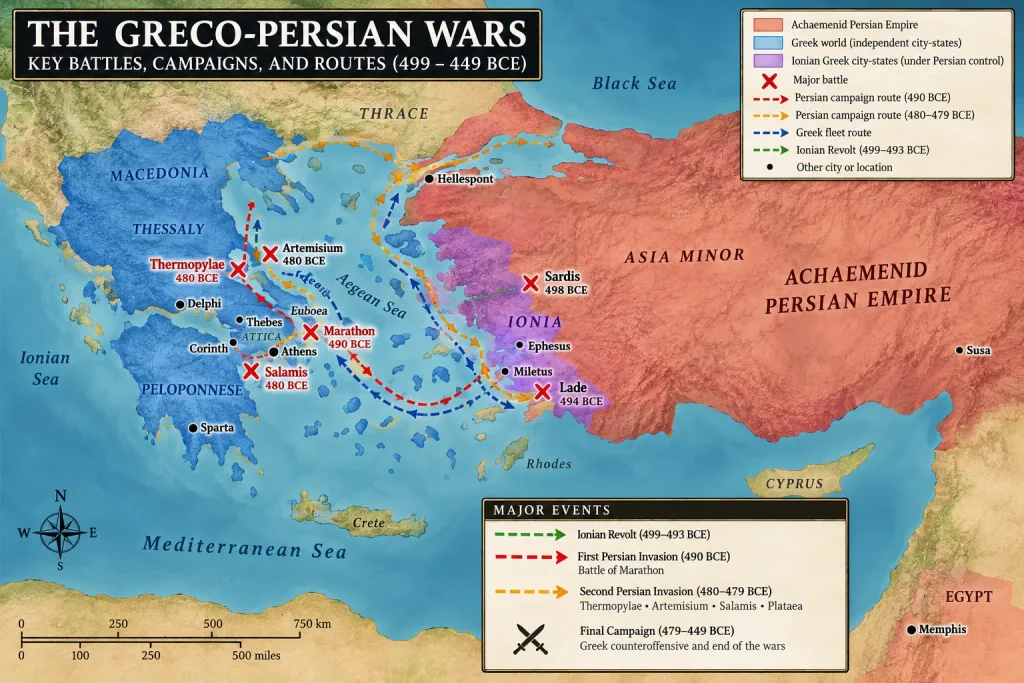
The Greek Counterattack and the Delian League
The war did not end at Plataea. Realizing that the best defense was a strong offense, Athens formed the Delian League in 478 BCE—a military and financial alliance of Aegean city-states. Under the leadership of the Athenian general Cimon, the League launched a highly successful counterattack. For the next thirty years, Greek forces systematically drove Persian garrisons out of Thrace, Macedon, and the Ionian islands, eventually taking the fight to Persian territories in Cyprus and Egypt.
Who Won the Greco-Persian Wars? (Outcome and Effects)
Ultimately, the Greek coalition won the Greco-Persian Wars. By successfully defending their homeland and subsequently pushing Persian influence out of the Aegean basin, the Greeks achieved a definitive strategic victory.
Read more: Analyze the geopolitical aftermath and the shift in power in The Outcome and Effects of the Greco-Persian Wars.
The Peace of Callias
After decades of protracted warfare, the conflict officially ended around 449 BCE with the Peace of Callias. The Achaemenid King Artaxerxes I agreed to recognize the autonomy of the Ionian Greek cities and prohibited Persian warships from entering the Aegean Sea.
Consequences for the Persian Empire
While the defeat was a humiliation, the Persian Empire remained the dominant superpower in the Near East. The Achaemenids simply changed their strategy. Instead of direct military invasion, they began using their vast wealth (Persian gold) to fund different Greek factions, pitting Athens and Sparta against each other in the Peloponnesian War, thereby keeping Greece divided and weak.
The Rise of the Athenian Golden Age
The effects of the Greco-Persian Wars on Greece were profound. The victory unleashed an unprecedented wave of cultural confidence. The wealth accumulated through the Delian League funded the Athenian Golden Age under Pericles, leading to the construction of the Parthenon and groundbreaking advancements in philosophy, theater, and political theory.
Greco-Persian Wars Timeline
The Greco-Persian Wars spanned fifty years. Below are the pivotal start dates and events of the conflict:
- 499 BCE: The Ionian Revolt begins in Miletus.
- 498 BCE: Athens and Eretria burn the Persian provincial capital of Sardis.
- 494 BCE: Persians crush the revolt at the Battle of Lade.
- 492 BCE: Mardonius’s fleet is destroyed by a storm off Mount Athos.
- 490 BCE: The First Invasion. Persians sack Eretria but are defeated by Athenians at the Battle of Marathon.
- 480 BCE: The Second Invasion. The Battles of Thermopylae and Artemisium. Athens is burned, but the Greek navy triumphs at the Battle of Salamis.
- 479 BCE: The Greeks defeat the Persian land army at Plataea and the navy at Mycale.
- 478 BCE: Athens forms the Delian League to continue the war.
- 466 BCE: Greeks achieve a decisive victory at the Battle of the Eurymedon.
- 449 BCE: The Peace of Callias officially ends the Greco-Persian Wars.
Read more: For a highly detailed, year-by-year chronological breakdown, visit our complete [Greco-Persian Wars Timeline] (Enlace al Hijo 6).
Frequently Asked Questions About the Greco-Persian Wars
What is the definition of the Greco-Persian Wars?
▼
The Greco-Persian Wars were a series of military conflicts fought between the Achaemenid Persian Empire and a coalition of ancient Greek city-states. The wars lasted for half a century, defining the geopolitical power struggle of the ancient Mediterranean.
When did the Persian War take place? (Start Date)
▼
The Greco-Persian Wars started in 499 BCE with the outbreak of the Ionian Revolt. The hostilities officially ended 50 years later, in 449 BCE, with the signing of the Peace of Callias.
Where did the Persian War take place?
▼
The conflicts took place across the Eastern Mediterranean. Key theaters of war included mainland Greece (Attica, Boeotia, and the Peloponnese), Thrace, Macedonia, the Aegean Islands, the Ionian coast of Asia Minor (modern-day Turkey), and even reaching Cyprus and Egypt during later Greek counterattacks.
Who was involved in the Persian War?
▼
The primary combatants were the massive Achaemenid Persian Empire (led first by King Darius I, and later by his son Xerxes I) and an alliance of independent Greek city-states, most notably Athens and Sparta. However, many other Greek cities, such as Thebes, actually surrendered and fought alongside the Persians.
Who started the Greco-Persian Wars and why?
▼
The conflict was sparked by the Ionian Revolt (499 BCE). Greek city-states on the coast of Asia Minor rebelled against oppressive Persian rule, and mainland cities like Athens sent military aid. King Darius I launched the first invasion of Greece to punish Athens for this interference and to expand his empire into Europe.
What were the major battles of the Greco-Persian Wars?
▼
The conflict is defined by several legendary land and naval battles, including:
- The Battle of Marathon (490 BCE): A decisive Athenian victory that repelled the first invasion.
- The Battle of Thermopylae (480 BCE): The famous last stand of the 300 Spartans against Xerxes’ massive army.
- The Battle of Salamis (480 BCE): A critical naval victory where the Greek fleet destroyed the Persian armada.
- The Battle of Plataea (479 BCE): The final land battle that effectively ended the Persian threat to mainland Greece.
Who won the Greco-Persian Wars?
▼
The coalition of Greek city-states won the wars. By successfully defending mainland Greece and launching decades of counter-offensives via the Athenian-led Delian League, they permanently pushed the Persian Empire out of the Aegean basin.
What were the effects of the Greco-Persian Wars?
▼
The Greek victory secured the independence of the city-states, halted Persian military expansion into Europe, and directly catalyzed the Athenian Golden Age. The wealth and confidence gained from the victory led to a period of massive cultural, political, and philosophical development in Athens that laid the foundation for Western civilization.
Recommended Books and Primary Sources
To truly understand the Greco-Persian Wars, engaging with both primary texts and rigorous modern scholarship is essential:
Primary Sources:
- Herodotus, The Histories: Often called the “Father of History,” Herodotus is our primary and most comprehensive ancient source for the conflict.
- Aeschylus, The Persians: An ancient Greek tragedy written by a veteran of the Battle of Salamis, offering a unique contemporary perspective on the Persian defeat.
- Thucydides, History of the Peloponnesian War: Crucial for understanding the aftermath of the Persian retreat and the rise of the Delian League.
Modern Academic Books:
- Persian Fire: The First World Empire and the Battle for the West by Tom Holland (An excellent, accessible narrative history).
- The Greco-Persian Wars by Peter Green (A highly regarded, academically rigorous military history).
- Thermopylae: The Battle That Changed the World by Paul Cartledge.