Akkadian Society: Social Structure, Daily Life, and Culture
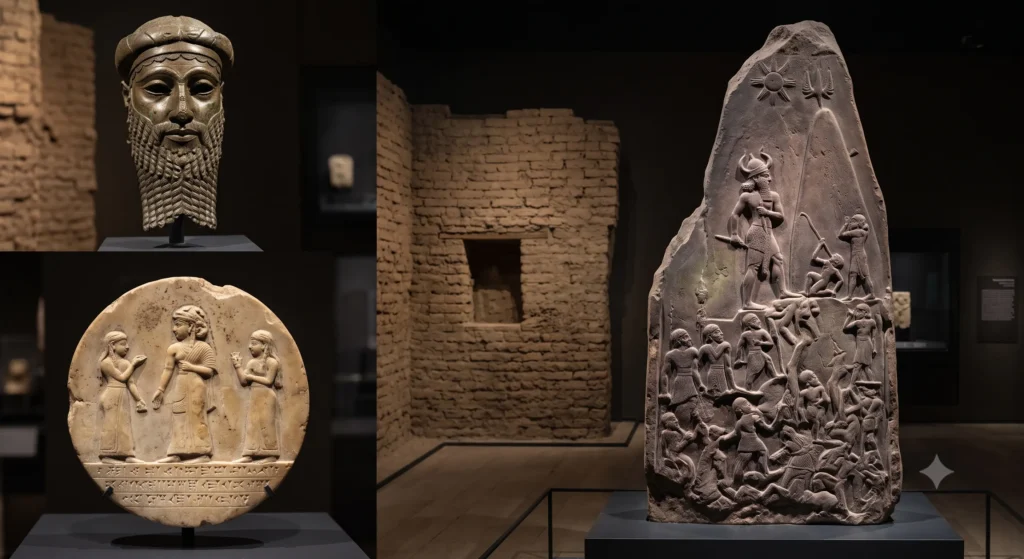
Akkadian society was a strictly stratified, patriarchal civilization structured around a centralized monarchy, divine temple institutions, and a multi-tiered legal hierarchy. Dominating ancient Mesopotamia during the 24th to 22nd centuries BCE under Sargon of Akkad and his successors, the social pyramid was divided into three primary legal and economic classes: free landed citizens (awīlu), state-dependent tenant laborers (muškēnu), and chattel slaves (wardu / female amtu). While the royal palace (É.GAL) and the priesthood controlled agricultural estates, irrigation networks, and long-distance trade, daily life for the vast majority of the population centered on subsistence farming, textile manufacturing, and community family obligations.
Akkadian society was a hierarchical and highly organized society in which the king and royal elite occupied the highest levels, followed by officials, priests, administrators, merchants, craftsmen, farmers, laborers, and enslaved people. Social position was closely connected to political authority, religion, occupation, and access to resources.
The society of the Akkadian period was shaped by both earlier Mesopotamian traditions and the political expansion of the Akkadian state. Although the hierarchy created significant differences between social groups, most people were involved in everyday activities such as farming, craft production, household work, trade, and religious life.
Understanding Akkadian society therefore means looking beyond kings and military campaigns to the people and institutions that sustained everyday life.
- Read our article: Women in Ancient Persia
Social Hierarchy in the Akkadian Empire at a Glance
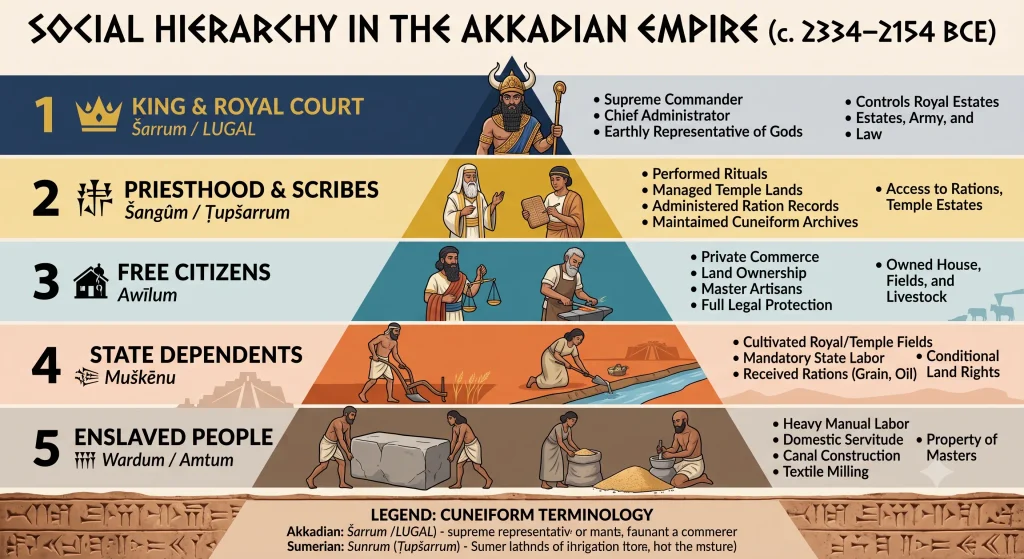
The social structure of the Akkadian period blended ancient Sumerian urban administration with a centralized Semitic imperial bureaucracy, categorizing individuals by legal status, land tenure, and institutional dependency:
| Social Class & Title (Akkadian / Sumerian) | Institutional Role & Legal Status | Primary Economic Activity & Rights | Access to Land & Resources |
| The King & Royal Court (Šarrum / LUGAL) | Supreme military commander, chief administrator, and earthly representative of the gods. | Direct command over royal estates (dastakart), taxation, and military campaigns. | Total control over conquered lands and state storehouses. |
| Priesthood & Scribes (Šangûm / Ṭupšarrum) | Religious leaders, temple overseers, and bureaucratic scribes recording rations and laws. | Performed daily cultic rituals, managed temple lands, and administered state cuneiform archives. | High-status institutional allocations, ration allowances, and hereditary temple estates. |
| Free Citizens (Awīlum) | Legally free upper and middle-class landholders, merchants (tamkārum), and master craftsmen. | Full civil protection under customary law; engaged in private commerce, metallurgy, and civic governance. | Owned private residential property, agricultural fields, and livestock. |
| State Dependents (Muškēnum) | Free-born commoners and rural laborers lacking inherited private land. | Cultivated royal and temple fields in exchange for grain, oil, and wool rations (šukunnū). | Held conditional, non-transferable usufruct rights to institutional plots. |
| Enslaved People (Wardum / Amtum) | Chattel slaves acquired through military conquest, foreign trade, or insolvency debt servitude. | Performed heavy manual labor, domestic servitude, canal excavation, and textile milling. | Property of individuals, temples, or the crown; held limited rights to purchase freedom. |
Key Questions About Akkadian Society
What was the social structure of Akkadian society? ▼
Akkadian society was organized into a rigid hierarchical pyramid:
- The Monarch and Royal Dynasty: Held ultimate political, judicial, and religious authority.
- Palace and Temple Elites: Scribes, provincial governors (ensi), high priests, and military generals.
- Free Citizens (Awīlu): Private landowners, foreign traders, and skilled artisans.
- Dependent Working Class (Muškēnu): Tenant farmers, canal diggers, and state laborers reliant on institutional rations.
- Enslaved Population (Wardu): War captives and debt slaves performing compulsory labor.
What was the role of women in ancient Akkad? ▼
While Akkadian society was primarily patriarchal, elite women held substantial religious, economic, and administrative authority. The most prominent example was Enheduanna, daughter of Sargon of Akkad, who served as High Priestess of the moon god Nanna at Ur and became history’s first recorded named author. Non-elite women worked in textile workshops, agriculture, and household production, and possessed legal rights to own property, engage in business, and appear in legal disputes.
What was daily life like for ordinary Akkadian people? ▼
Daily life for the majority of ordinary people revolved around the agricultural calendar along the Tigris and Euphrates floodplains. Families lived in sun-dried mudbrick homes, cultivating barley, wheat, onions, and date palms while maintaining community irrigation channels. Daily diet consisted largely of unleavened barley bread, vegetable stews, dried fish, and low-alcohol barley beer, supplemented by woolen textile weaving and domestic religious rituals.
How did the Akkadian Empire change Mesopotamian society? ▼
The Akkadian Empire transformed Mesopotamia from a network of independent, rival Sumerian city-states into the world’s first centralized territorial state. It introduced a unified bilingual administrative system (Akkadian and Sumerian), standardized weights and measures across trade corridors, established a standing imperial military garrison network, and elevated the divine status of kingship (as exemplified by Naram-Sin claiming living godhood).
Timeline of Akkadian Society
Akkadian society developed from earlier Mesopotamian traditions and changed as political authority expanded and connected different communities.
| Period | Social Development |
|---|---|
| Before c. 2334 BC | Mesopotamian communities already have established social hierarchies, occupations, religious institutions, and agricultural households. |
| c. 2334 BC | The rise of Sargon of Akkad creates a larger political framework in which existing communities and social institutions become connected to Akkadian rule. |
| 23rd century BC | Royal officials, administrators, priests, craftsmen, farmers, and laborers participate in an increasingly complex society shaped by imperial administration. |
| Under Naram-Sin | Royal authority becomes particularly prominent, while political expansion connects different populations and cultural traditions. |
| Late 23rd century BC | The scale of political administration increases the complexity of managing diverse communities, labor, resources, and institutions. |
| c. 22nd century BC | The weakening of central authority brings political instability and changes the conditions in which Akkadian communities and institutions operate. |
| After the Akkadian period | Many social, administrative, religious, and cultural traditions continue to influence later Mesopotamian societies. |
From Local Communities to an Imperial Society
The formation of the Akkadian state did not create Mesopotamian society from scratch.
Many social roles and institutions already existed before Akkadian political expansion. What changed was the scale of political integration.
Existing farmers, craftsmen, priests, administrators, merchants, and local elites increasingly became part of a wider political system.
This created new forms of interaction between communities while preserving many older Mesopotamian traditions.
The result was a society that combined continuity with political and cultural change.
Social Hierarchy in Akkadian Society
Akkadian society was organized around a clear hierarchy, with political authority, religious institutions, administration, specialized occupations, and agricultural labor occupying different positions within society.
The hierarchy was not simply a division between rich and poor. A person’s position could also depend on occupation, political connections, religious responsibilities, household status, and access to resources.
The King and Royal Elite
At the highest level stood the king and the royal household.
The king combined several forms of authority:
- Political leadership
- Military command
- Administrative authority
- Religious responsibilities
The royal family and people closely connected to the palace could therefore occupy privileged positions within society.
Officials and Administrators
Below the royal elite were officials and administrators responsible for helping the state function.
Their responsibilities could include:
- Managing resources
- Organizing labor
- Administering institutions
- Carrying out royal orders
- Maintaining records
These positions became increasingly important as political authority extended across different communities.
Priests and Religious Specialists
Priests occupied an important position because temples were major institutions within Mesopotamian society.
Religious specialists performed rituals and helped maintain relationships between communities and their gods.
Religion therefore formed part of the social structure rather than existing separately from everyday life.
Merchants and Skilled Craftsmen
Merchants and craftsmen occupied important intermediate positions.
Specialized workers could include:
- Metalworkers
- Potters
- Builders
- Textile workers
- Other skilled producers
Their work contributed to the functioning of households, institutions, and communities.
Farmers and Laborers
Farmers made up a large part of the population.
Agricultural work required continuous labor and supported the food supply on which communities depended.
Other laborers participated in activities such as construction, transport, agriculture, and institutional work.
Although these groups occupied lower positions in the social hierarchy, their labor was fundamental to the functioning of society.
Enslaved People
Enslaved people occupied a particularly vulnerable position.
Their status could involve restricted freedom and dependence on other individuals or institutions.
However, it is important not to treat all people outside the elite as belonging to one identical social category. Mesopotamian society contained different forms of dependence, labor, household status, and legal position.
A Hierarchy with Different Roles
The Akkadian social structure was therefore a system of interdependent groups.
The palace depended on administrators. Temples depended on religious specialists and workers. Cities and communities depended on farmers and craftsmen. Households depended on different forms of labor and production.
From my perspective, this is what makes the Akkadian social hierarchy more interesting than a simple pyramid: each level had a different function, but all were connected to the wider organization of society.
Everyday Life in Akkadian Society
For most people, life in Akkadian society was shaped by work, family, agriculture, household responsibilities, and the rhythms of the local community.
The royal court and military campaigns are among the best-known aspects of the Akkadian period, but they represented only a small part of everyday experience. Most people spent their lives working, raising families, producing food or goods, and participating in their communities.
Farming and Daily Work
For a large part of the population, agricultural work determined the rhythm of everyday life.
Farmers were involved in activities such as:
- Preparing fields
- Sowing and cultivating crops
- Managing irrigation
- Harvesting
- Processing agricultural products
- Caring for livestock
Agricultural work was demanding and closely connected to the seasonal cycle.
Crafts and Specialized Work
Not everyone worked directly in agriculture.
Skilled workers produced goods needed by households and institutions, including pottery, textiles, tools, metal objects, and construction materials.
Specialization allowed communities to depend on different occupations and created connections between agricultural producers, craftsmen, merchants, and institutions.
The Household
The household was one of the fundamental units of Akkadian society.
Families were responsible for much of the organization of everyday life, including:
- Food preparation
- Childcare
- Domestic work
- Production and storage
- Care of household property
The household was therefore both a social and economic unit.
Food and Material Life
What people ate and the objects they used depended heavily on their social position and occupation.
Agricultural products provided the basic food supply, while craft production supplied clothing, pottery, tools, and other necessities.
People with greater access to resources could enjoy different material conditions from ordinary workers and agricultural households.
Family and Community
Family relationships were important for maintaining households and transmitting property, responsibilities, and social connections.
People also lived within wider communities in which neighbors, workers, craftsmen, religious institutions, and administrative authorities interacted with one another.
Daily life was therefore not isolated within individual households. It was part of a wider network of social relationships.
Different Experiences of Daily Life
There was no single experience of being an Akkadian.
A member of the royal household, a priest, a craftsman, a farmer, and an enslaved person could experience society very differently.
Social position influenced access to resources, work, authority, and security.
From my perspective, this is essential when thinking about Akkadian society: the people who lived under the same political system did not necessarily experience that society in the same way.
Understanding these differences gives us a much more realistic picture of life in the Akkadian period.
Family and Gender Roles
The family and household were important foundations of Akkadian society. Much of everyday life was organized around households, where people shared responsibilities, property, work, and family relationships.
Marriage and household organization were therefore not simply private matters. They were connected to the wider social structure and could influence a person’s position and responsibilities within the community.
The Household as a Social Unit
The household brought together many aspects of daily life.
It could function as a place for:
- Raising children
- Preparing and storing food
- Managing household property
- Organizing work
- Passing responsibilities between generations
Family relationships also helped maintain continuity between generations.
Marriage and Social Relationships
Marriage was an important institution within Mesopotamian society.
It could connect families as well as establish responsibilities between individuals.
Households were therefore shaped not only by personal relationships but also by questions of property, inheritance, work, and social status.
The Roles of Men and Women
Men and women could have different responsibilities within the household and wider community.
Men were commonly associated with activities such as agriculture, administration, craft production, and other forms of public or economic work.
Women also participated in productive and domestic activities and could have responsibilities connected with household management, textiles, food preparation, and family life.
The exact experience of women and men varied according to their social position and circumstances.
Gender and Social Status
Gender did not operate independently from the rest of the social hierarchy.
A person’s experience could also be influenced by:
- Wealth
- Occupation
- Household status
- Legal position
- Relationship to institutions
- Social connections
This means that it is difficult to describe Akkadian gender roles as a single experience shared by everyone.
Family and Social Continuity
Families helped transmit property, occupations, responsibilities, and social relationships from one generation to another.
This made the household an important mechanism for maintaining social stability.
From my perspective, this is why family belongs at the center of any discussion of Akkadian society: social hierarchy was not experienced only through institutions such as the palace or temple, but also through everyday relationships within the household.
Religion and Society
Religion was deeply integrated into Akkadian society and influenced many aspects of everyday life. Temples, priests, rituals, and religious beliefs were part of the institutions through which communities understood their world and organized collective life.
Religion was therefore not separate from society. It was connected to political authority, family life, work, and ideas about social order.
Temples as Social Institutions
Temples were important institutions within Mesopotamian communities.
They could serve as places for:
- Religious rituals
- Administrative activities
- Managing resources
- Organizing workers
- Community gatherings
Their importance meant that religious institutions could also have a significant social and economic presence.
Priests and Religious Specialists
Priests occupied an important position within the social hierarchy.
Their responsibilities included performing rituals and maintaining relationships with the gods on behalf of the community.
Their position also gave religious specialists influence within institutions and helped connect religious beliefs with everyday social practices.
Religion and Political Authority
Religion was closely connected to political authority.
Kings presented their rule within a religious framework and could associate their authority with the will and protection of the gods.
This helped reinforce ideas of legitimate leadership and social order.
However, religion did not simply exist to justify political power. Religious institutions had their own traditions, responsibilities, and activities within Mesopotamian society.
Religion in Everyday Life
Religious beliefs could influence everyday practices, including rituals, offerings, festivals, and household traditions.
People interacted with the religious world at different levels depending on their social position and responsibilities.
For ordinary families, religion could therefore be part of everyday life rather than something experienced only inside major institutions.
A Shared Cultural Framework
Religion also helped provide communities with a shared framework for understanding the world.
Common religious traditions could connect people from different communities while also preserving local practices.
This became particularly significant within a political system that brought together populations with different backgrounds.
From my perspective, religion was one of the mechanisms through which Akkadian society created a sense of order, continuity, and shared cultural identity.
A Step Into the Ancient World
Imagine waking up in an Akkadian community more than four thousand years ago.
Your experience of society would depend heavily on who you were.
If you were a farmer, much of your day would revolve around fields, water, crops, livestock, and the needs of your household. A skilled craftsman might spend the day producing pottery, textiles, tools, or other goods. A priest would have responsibilities connected with a temple and its rituals, while an administrator might deal with records, resources, workers, or official responsibilities.
For people closer to the royal court, life could look very different again.
A Society of Different Experiences
There was no single way of experiencing Akkadian society.
Social position influenced:
- The work a person performed
- Access to resources
- Responsibilities within the household
- Relationship with political and religious institutions
- Degree of authority and independence
This is why looking only at kings and officials gives us an incomplete picture of the Akkadian world.
Everyday Connections
Despite these differences, people were connected through the communities in which they lived.
Farmers produced food. Craftsmen transformed materials into useful goods. Administrators organized institutions. Priests maintained religious traditions. Families passed responsibilities and knowledge from one generation to another.
Each group formed part of a wider social system.
Seeing Akkadian Society from the Ground Up
From my perspective, this is one of the most useful ways to understand the Akkadians.
Instead of imagining the period only through royal inscriptions and military campaigns, we can look at it from the perspective of ordinary people and ask a much simpler question:
What did it mean to live inside this society?
That perspective reveals a complex world in which hierarchy and inequality existed alongside family relationships, specialized work, religious traditions, and everyday cooperation.
Law, Status, and Social Inequality
Akkadian society was not an equal society. A person’s position within the social hierarchy could affect their responsibilities, access to resources, legal status, and relationship with institutions.
Social differences were therefore part of everyday life and helped define how individuals interacted with one another.
Social Status and Legal Position
People could occupy different positions within society, and those positions carried different responsibilities and levels of authority.
Royal officials, priests, craftsmen, farmers, dependent workers, and enslaved people did not have identical social circumstances.
Status could be influenced by factors such as:
- Occupation
- Family background
- Wealth
- Relationship to institutions
- Legal condition
- Political connections
This meant that social identity was more complex than simply being an elite or a commoner.
Authority and Social Order
Political and religious institutions helped maintain social order.
The palace represented royal authority, while temples played important religious and institutional roles. Families and local communities also contributed to maintaining established social relationships.
Together, these structures created a society in which individuals were expected to fulfil particular responsibilities.
Inequality in Everyday Life
Social inequality could affect material conditions and opportunities.
People with greater wealth, authority, or institutional connections could have access to resources and forms of influence that were unavailable to ordinary workers.
At the same time, farmers, laborers, craftsmen, and other working groups performed the activities that allowed households and institutions to function.
The existence of hierarchy did not mean that lower-status groups were socially irrelevant. Their labor was essential to the entire system.
Enslavement and Dependency
Enslaved people occupied one of the most vulnerable positions in Akkadian society.
However, it is important to distinguish between enslavement and other forms of dependency. Not everyone who worked for an institution or depended on a household had the same legal or social status.
The ancient Mesopotamian world contained different relationships of obligation, employment, household dependence, and servitude.
A Structured but Interdependent Society
Akkadian society was therefore both hierarchical and interconnected.
Those at the top depended on the work of people further down the social hierarchy, while institutions relied on networks of households, workers, specialists, and administrators.
From my perspective, this tension between inequality and interdependence is one of the most important features of Akkadian society. The hierarchy created different levels of power and privilege, but the society could function only because its different groups were connected.
Akkadian Society and Political Expansion
The expansion of Akkadian political authority brought different communities into a more closely connected social and administrative system.
Rather than replacing every existing tradition, Akkadian rule often operated alongside local customs, institutions, languages, and religious practices. This created a society in which older Mesopotamian traditions coexisted with new forms of political organization.
Connecting Different Communities
Political expansion increased interaction between communities across Mesopotamia and beyond.
This could involve:
- Movement of officials
- Relocation of workers and families
- Increased contact between different communities
- New administrative relationships
- Greater interaction between local and central authorities
These connections made Akkadian society more diverse and administratively complex.
Continuity and Cultural Exchange
Akkadian society inherited many traditions from earlier Mesopotamian communities.
Rather than creating an entirely new culture, Akkadian rulers and populations adopted and adapted existing practices.
This was particularly visible in:
- Religious traditions
- Writing and administration
- Social institutions
- Artistic practices
- Urban customs
The result was a society shaped by both continuity and cultural exchange.
Local Traditions and New Authority
Local communities did not necessarily lose their existing identities when they came under Akkadian political control.
Local institutions and traditions could continue while new administrative structures were introduced.
This created a layered social system in which people could identify with their household, city, local traditions, and the wider political order at the same time.
Movement of People
Political expansion could also affect where people lived and worked.
Officials might be assigned to different regions, while workers and other populations could move as part of economic, administrative, or political processes.
Such movement increased contact between communities and contributed to the cultural diversity of the Akkadian period.
A More Connected Society
The Akkadian period therefore brought together communities that had previously operated within more localized political environments.
From my perspective, one of the most interesting consequences was not simply the extension of political authority, but the social connections created between different populations.
Akkadian society was consequently shaped by movement, cultural exchange, existing traditions, and new forms of political organization.
The Legacy of Akkadian Society
The social organization that developed during the Akkadian period influenced the way later Mesopotamian societies understood political authority, administration, social hierarchy, and community life.
The Akkadians inherited many traditions from earlier Mesopotamian cultures, but their period also demonstrated how these traditions could function within a larger and more connected political system.
Social and Administrative Continuity
Later Mesopotamian societies continued to rely on structured relationships between rulers, officials, religious institutions, households, and workers.
The Akkadian period therefore forms part of a longer development rather than representing a completely isolated social model.
Cultural Continuity
Many earlier Mesopotamian traditions continued alongside Akkadian political and cultural practices.
Writing, religious traditions, artistic conventions, and social institutions provided links between different periods of Mesopotamian history.
This continuity helps explain why the Akkadian period is important for understanding the development of later societies.
A Model of Complex Society
Akkadian society also provides an early example of how different groups could be organized within a complex political structure.
Kings, administrators, priests, craftsmen, farmers, laborers, families, and dependent people all occupied different positions while remaining connected through institutions and communities.
From my perspective, this is one of the most valuable lessons of Akkadian history: complex societies are sustained not only by political authority, but by the relationships between the people who live within them.
Beyond Kings and Conquests
The legacy of Akkadian society is therefore not limited to its rulers.
Its importance also lies in what it reveals about:
- Social hierarchy
- Family life
- Specialized work
- Cultural exchange
- Political organization
- Everyday relationships
Looking at these elements allows us to understand the Akkadian period from the perspective of the people who actually lived within it.societies.
Why Akkadian Society Matters
Studying Akkadian society allows us to look beyond rulers, wars, and political events and understand how one of the earliest complex states was experienced by the people who lived within it.
The period is particularly important because it brings together several elements of Mesopotamian life: social hierarchy, family organization, specialized work, religious institutions, cultural traditions, and political authority.
Understanding Social Hierarchy
Akkadian society shows how different groups could occupy distinct positions within a highly organized social system.
Kings and elites held authority, while administrators, priests, craftsmen, farmers, laborers, and dependent people performed different roles.
This hierarchy helps us understand how responsibilities and power were distributed throughout society.
Understanding Everyday Life
The Akkadian period also reminds us that most historical change was experienced by ordinary people.
Farmers worked the land, craftsmen produced goods, families managed households, and communities maintained traditions across generations.
These everyday activities provided the foundation on which larger political and religious institutions depended.
Understanding Cultural Continuity
Akkadian society did not develop in isolation.
Earlier Mesopotamian traditions remained important, while contact between different communities encouraged cultural exchange and adaptation.
This combination of continuity and change helps explain the broader development of Mesopotamian civilization.
Understanding the People Behind the History
Perhaps the most important reason to study Akkadian society is that it puts people back at the center of the story.
Political systems may be created by rulers, but they depend on families, workers, specialists, administrators, and communities to function.
From my perspective, this is what makes Akkadian society so valuable to study: it transforms an ancient political history into a human story.erse populations into one system.
❓ Frequently Asked Questions About Akkadian Society
How was Akkadian society structured?
Akkadian society was an early hierarchical territorial state organized into distinct social tiers:
- The Royal and Bureaucratic Elite: Royal family members, provincial governors (Ensi), military commanders, and senior scribes managing the centralized palace economy.
- Free Citizens (Awīlum): Independent property owners, master artisans, merchants, and priests with full legal protections under royal law.
- Semi-Free Dependents (Muškēnum): State and temple laborers who worked on public land parcels in exchange for seasonal barley and oil rations (gur system).
- Enslaved Population (Wardum / Amtum): Individuals acquired through foreign military campaigns, debt servitude, or commercial purchase, possessing limited legal recognition to hold certain movable property.
What was the role of women in Akkadian society?
Although ancient Mesopotamian culture was patriarchal, Akkadian women held significant legal and economic autonomy compared to many contemporary Bronze Age civilizations:
- Economic & Legal Rights: Women could purchase, inherit, and sell real estate, operate commercial brewing or textile enterprises, borrow silver, initiate contract litigation, and act as official witnesses on legal cuneiform deeds.
- High Political & Sacred Offices: Elite women exercised immense geopolitical power, most notably demonstrated by Sargon’s daughter Enheduanna, who was appointed as the High Priestess (En-Priestess) of the moon god Nanna at Ur and became humanity’s first recorded named author.
What was the economic basis of the Akkadian Empire?
The economic backbone of Akkadian society rested on a dual foundation of intensive irrigation agriculture and international maritime/overland trade:
- Alluvial Agriculture: Massive cultivation of two-row barley, emmer wheat, date palm orchards, and flax along the Tigris and Euphrates river basins, managed via canal networks and royal granaries.
- State-Controlled Long-Distance Trade: Because central Mesopotamia lacked domestic mineral wealth, the crown organized trade monopolies importing copper and diorite from Magan (Oman), raw timber and silver from the Levant and Taurus Mountains, and lapis lazuli and carnelian from Meluhha (Indus Valley).
Did the Akkadians have a written legal code?
While no standalone, comprehensive legal code tablet (like the later Code of Hammurabi or Code of Ur-Nammu) has survived from the Old Akkadian period, society was governed by formal royal jurisprudence:
- Legal transactions—including land sales, loans, marriages, and slave transfers—required sealed cuneiform clay contracts notarized by witnesses.
- Disputes were formally adjudicated in local civic assemblies (Puḫrum) and royal courts presided over by imperial judges (Dayyānum) acting under royal authority.
What language was spoken in Akkadian society?
Akkadian society was functional in a rich bilingual environment:
Old Akkadian: An East Semitic language that served as the primary spoken vernacular across central and northern Mesopotamia and the official administrative language for royal decrees, tax rolls, and diplomatic correspondence.
Sumerian: An agglutinative linguistic isolate preserved as the prestigious language of sacred cultic liturgies, temple hymnography, and classical scribal training.
Further Reading
- World History Encyclopedia – Daily Life in Mesopotamia
- The British Museum – Mesopotamia Collection
- Penn Museum – Mesopotamia
- ORACC – Open Richly Annotated Cuneiform Corpus
- University College London – Institute of Archaeology
- Metropolitan Museum of Art – Ancient Near Eastern Art