When Did the Persian Wars Begin and End?
When studying this monumental clash of civilizations, one of the most common questions is exactly when the conflict took place. The Greco-Persian Wars officially began in 499 BCE with the outbreak of the Ionian Revolt, and formally ended in 449 BCE with the signing of the Peace of Callias.
Rather than a single, continuous fifty-year battle, the conflict was punctuated by brief, intensely violent military campaigns—most notably the First Persian Invasion in 490 BCE and the massive Second Persian Invasion in 480 BCE—separated by years of cold war, tense diplomacy, and frantic military preparations.
Where Did the Persian Wars Take Place?
The geographical scope of the Greco-Persian Wars was massive, spanning the entire eastern Mediterranean basin. To understand the timeline of the conflict, you must first understand the theater of war, which was divided into three primary zones:
- Ionia (The Coast of Asia Minor): Located in modern-day western Turkey, this region of wealthy Greek city-states (such as Miletus and Ephesus) was the flashpoint of the entire war.
- The Aegean Sea: The body of water separating Asia from Europe. Its scattered islands, known as the Cyclades (including Naxos and Delos), served as the “stepping stones” for the Persian amphibious invasions.
- Mainland Greece: The primary defensive zone, encompassing the northern regions of Thrace and Macedonia, the central plains of Thessaly and Boeotia, the peninsula of Attica (home to Athens), and the southern Peloponnese (home to Sparta).
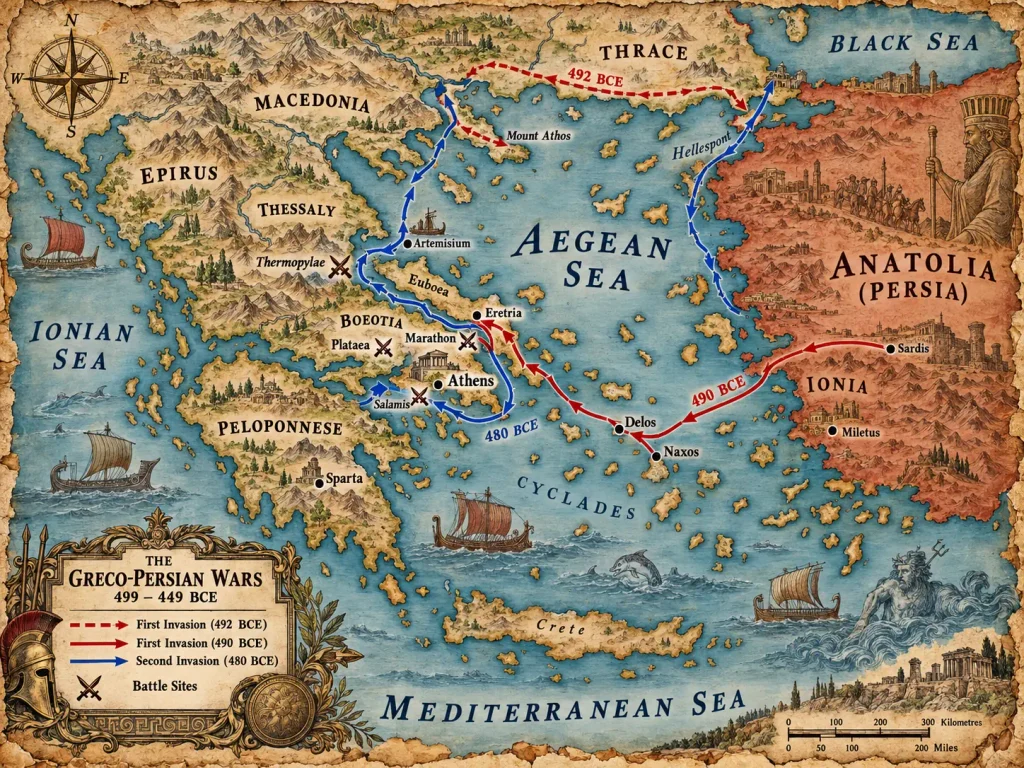
Chronological Timeline of the Greco-Persian Wars
1. The Ionian Revolt (499–493 BCE)
The prelude to the wars, triggered when Greek colonies in Asia Minor rebelled against Achaemenid rule with the help of Athens.
- 499 BCE: Aristagoras of Miletus initiates the Ionian Revolt against King Darius I. Athens and Eretria agree to send military aid.
- 498 BCE: The allied Greek forces march inland and burn Sardis, a major Persian regional capital, angering Darius.
- 494 BCE: The Persian navy decisively defeats the rebel fleet at the Battle of Lade.
- 493 BCE: The Persian Empire fully crushes the revolt, and Darius I vows revenge against the mainland Greeks who intervened.
Learn more: Read our detailed breakdown of the causes and events of The Ionian Revolt.
2. The First Invasion: Darius I (492–490 BCE)
Darius I launches his punitive campaign against mainland Greece to secure his borders and punish Athens.
- 492 BCE: Persian general Mardonius secures Thrace and Macedonia, but his supply fleet is destroyed by a violent storm off Mount Athos.
- 490 BCE: A second Persian amphibious task force island-hops across the Aegean, conquering Naxos and burning Eretria to the ground.
- September 490 BCE: The Athenian hoplite phalanx miraculously defeats the Persian expeditionary force at the Battle of Marathon, ending the first invasion.
Learn more: Explore Darius’s campaign in our guide to The First Persian Invasion.
3. The Interwar Period (489–481 BCE)
A decade of uneasy peace, marked by Persian logistical preparations and a massive Greek naval build-up.
- 486 BCE: King Darius I dies; his son, Xerxes I, ascends the Achaemenid throne and begins preparing an overwhelmingly large invasion force.
- 483 BCE: A massive vein of silver is discovered in the Athenian mines at Laurion. General Themistocles convinces the Athenian assembly to use the wealth to build a state-of-the-art fleet of 200 triremes.
- 481 BCE: The Hellenic League is formed at Corinth, temporarily uniting around thirty Greek city-states under Spartan military command to resist the incoming invasion.
4. The Second Invasion: Xerxes I (480–479 BCE)
The largest military operation of antiquity, designed to completely subjugate the Greek world.
- Spring 480 BCE: Xerxes’ colossal army crosses the Hellespont into Europe via engineering marvels (pontoon bridges).
- August 480 BCE: A small Greek vanguard led by Spartans holds the pass at the Battle of Thermopylae for three days before being outflanked. Simultaneously, the naval Battle of Artemisium ends in a strategic retreat for the Greeks.
- September 480 BCE: Athens is evacuated and subsequently burned by the Persians. Weeks later, the Greek navy destroys the Persian fleet in the narrow straits at the Battle of Salamis.
- Summer 479 BCE: The united Greek heavy infantry annihilates the remaining Persian land army at the Battle of Plataea.
- Summer 479 BCE: The Greek navy destroys the remnants of the Persian fleet at the Battle of Mycale, definitively crushing the second invasion.
Learn more: Dive deep into Xerxes’ logistics in The Second Persian Invasion or explore the combat tactics in our Major Battles Hub.
5. The Greek Counter-Offensive (478–449 BCE)
The Greeks transition from desperate mainland defense to aggressive empire-building across the Aegean.
- 478 BCE: Athens forms the Delian League to continue the war and liberate remaining Greek territories from Persian control.
- 466 BCE (approx.): The Delian League scores a massive dual victory (land and sea) over Persian forces at the Battle of the Eurymedon in Asia Minor.
- 449 BCE: The Peace of Callias is allegedly signed, formally ending hostilities between the Achaemenid Empire and the Greek city-states.
Learn more: Discover the political fallout and the rise of the Athenian Empire in The Outcome and Consequences of the Wars.
Frequently Asked Questions About the Timeline
What are the exact dates of the Persian Wars?
▼
The wars officially spanned exactly 50 years. They began in 499 BCE with the outbreak of the Ionian Revolt against King Darius I, and formally concluded in 449 BCE with the signing of the Peace of Callias during the reign of King Artaxerxes I.
How long did the Greco-Persian War last?
▼
The entire conflict lasted for half a century (50 years). However, this period was not one continuous battle. It consisted of brief, intense military campaigns (such as the invasions of 490 BCE and 480 BCE) separated by long periods of cold war, diplomatic tension, and smaller regional skirmishes.