The Battle of Marathon is arguably one of the most famous and significant military engagements in ancient history. Fought in 490 BCE (or BC), this monumental clash between the defending army of Athens and the invading forces of the Achaemenid Persian Empire not only shaped the geopolitical future of ancient Greece but also left an enduring legacy that gave the modern world the marathon footrace.
To understand what caused the battle of marathon and how it started, it must be viewed as the climax of the First Persian Invasion. King Darius I of Persia dispatched a naval task force across the Aegean Sea to punish Athens for supporting a previous rebellion against his empire. The resulting battle at the Bay of Marathon would shatter the myth of Persian invincibility and define Western civilization for centuries.
What Was the Battle of Marathon? (Summary & Facts)
For a quick summary of the battle of marathon, the most crucial historical facts, and the core details of the engagement, review the breakdown below:
- When was the Battle of Marathon? The battle took place in the late summer (likely August or September) of 490 BCE.
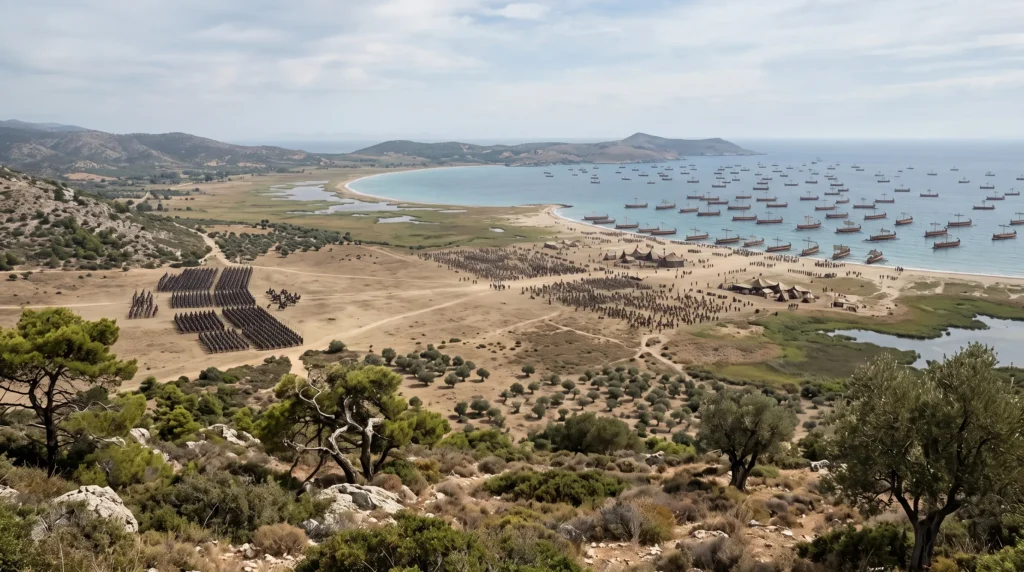
- Where did the battle take place? It was fought on the coastal plain bordering the Bay of Marathon, located approximately 26 miles (42 kilometers) northeast of the city of Athens in ancient Greece.
- Who fought in the battle? The combatants were the heavily armored citizen-militia of Athens (supported by a small, loyal contingent from the city of Plataea) against the light infantry and cavalry of the Persian Empire, commanded by the generals Datis and Artaphernes.
- Who won the Battle of Marathon? The Greeks (the Athenians and Plataeans) won a stunning and decisive victory, completely routing the Persian forces and forcing them to flee back to their ships.
- How long did the battle last? While the two armies faced each other in a tense standoff that lasted for nearly five days, the actual combat of the battle ended in just a few hours during a single morning.
- How many died in the battle? According to the ancient Greek historian Herodotus, the casualties were heavily skewed: approximately 6,400 Persians died in the slaughter, while only 192 Athenians and 11 Plataeans lost their lives.
Tactics and Combat: How Did the Greeks Win at Marathon?
To truly describe the battle of marathon and understand exactly how the Greeks defeated the Persians at Marathon, we must examine the brilliant tactical mind of the Athenian general Miltiades. The Greek forces were heavily outnumbered, facing an estimated 25,000 Persian light infantry and archers with a force of only 10,000 Athenian and 1,000 Plataean hoplites (heavy infantry).
So, how did the battle of marathon start after a tense five-day stalemate? The engagement was triggered when Miltiades realized that the Persian commanders, Datis and Artaphernes, had begun loading their most dangerous unit—the cavalry—back onto their ships, likely planning to sail around the peninsula and attack an undefended Athens directly. Seizing this brief window of opportunity where the Persian cavalry was absent, Miltiades ordered the Greek phalanx to attack.
If you are wondering what happened during the battle of marathon, the defining moment was a radical change in traditional Greek military formations. To prevent his smaller army from being outflanked by the massive Persian line, Miltiades intentionally thinned out the center of his hoplite formation to only a few ranks deep, while heavily reinforcing the troops on his left and right flanks.
As the Greeks advanced, they did something unprecedented: they broke into a run (or a very rapid march) for the final 200 meters. This swift, heavily armored charge allowed them to quickly pass through the deadly barrage of Persian arrows and force brutal, close-quarters combat.
This strategic maneuver explains exactly how the Athenians won the battle of marathon. When the two armies clashed, the weakened Greek center was predictably pushed backward by the elite Persian infantry. However, the heavily reinforced Greek wings absolutely crushed the lighter Persian conscripts on the flanks. Instead of pursuing the fleeing enemy wings, the Greek flanks turned inward, executing a devastating “double envelopment” (a pincer movement). They trapped the Persian center, turning the battle into a slaughter.
Tactical Map: The Double Envelopment
1. The Thinned Center
To avoid being outflanked by the larger Persian army, General Miltiades intentionally stretched his line. He thinned out the center of the Greek hoplite formation to just a few ranks deep, while heavily reinforcing the troops on his left and right flanks.
2. The Phalanx Charge
The Greeks sprinted the final 200 meters. When the armies clashed, the elite Persian infantry in the middle pushed the weakened Greek center backward. However, the heavily reinforced Greek wings easily crushed the lighter Persian conscripts on the flanks.
3. The Double Envelopment
Instead of chasing the fleeing Persian flanks, the Greek wings turned inward. They executed a devastating “double envelopment” (pincer movement), trapping the Persian center in a brutal slaughter before routing them back to their ships.
Finally, how did the battle of marathon end? Realizing they were surrounded, the surviving Persian forces broke formation and fled in complete panic toward their ships in the bay. The heavily armored Greeks chased them right to the water’s edge, cutting down thousands of retreating soldiers and capturing seven Persian ships before the rest of the Achaemenid fleet managed to escape. This tactical masterpiece is the definitive answer to how Athens won the battle of marathon.
The Outcome: Why Was the Battle of Marathon So Important?
When evaluating what was the outcome of the battle of marathon, it is important to look beyond the immediate tactical victory on the beach. After the slaughter at the bay, the surviving Persian fleet attempted one final desperate maneuver: they sailed south around Cape Sounion to attack the city of Athens directly, hoping to capture it while its army was still 26 miles away. However, the exhausted Athenian hoplites executed a legendary, rapid forced march back to their city, arriving just in time to block the Persian landing. Realizing the element of surprise was lost, the Persian fleet abandoned the campaign and sailed back to Asia Minor.
So, what is the significance of the battle of marathon in the broader context of ancient history? Prior to 490 BCE, the Achaemenid Persian Empire was widely considered invincible. They had conquered virtually every kingdom and city-state they encountered from the borders of India to Egypt.
The true answer to why was the battle of marathon so important lies in its immense psychological impact. For the very first time, a Greek citizen-militia had stood face-to-face with the dreaded Persian army and utterly destroyed them in a pitched land battle. This victory proved that the heavily armored Greek hoplite phalanx was vastly superior to the lightly armored Persian infantry in close-quarters combat.
Furthermore, a major result of the battle of marathon was the precious gift of time. By halting King Darius I’s first invasion, the Athenians bought the Greek world a crucial ten-year interwar period. This decade allowed Athens to discover new silver veins and build the massive naval fleet that would eventually save all of Greece during Xerxes’ second invasion in 480 BCE. Without the victory at Marathon, the Classical Golden Age of Athens—and the early foundations of Western democratic ideals—would likely have been erased before it even began.
Pheidippides and the Origins of the Marathon Race
Beyond the military textbooks, the most enduring legacy of the battle is its connection to the modern 26.2-mile sporting event. But what is the story of the marathon, and how did the marathon get its name?
To answer what did the word marathon originally refer to (and what does marathon mean in greek), we must look at the local geography. The name comes from the Greek word marathon (μάραθον), which translates to “fennel.” Thus, the original location was simply a coastal plain where fennel plants grew abundantly. It only became synonymous with endurance running due to a legendary historical tale.
The Pheidippides Run
Route: Marathon to Athens. Legend says the messenger Pheidippides sprinted from the battlefield to Athens to announce the victory, yelled “Rejoice, we conquer!”, and died of exhaustion. This romantical myth is the basis for the modern 26.2-mile Olympic race invented in 1896.
Route: Athens to Sparta. The ancient historian Herodotus records that Pheidippides actually ran a much longer distance before the battle to beg Sparta for help. It was a grueling, multi-day ultramarathon across extremely mountainous terrain, far exceeding the modern race.
The Legend of the Run to Athens
If you are wondering how did the marathon distance originate and how far did Pheidippides run from Marathon to Athens, the myth centers around a Greek messenger. According to popular legend, after the Greeks defeated the Persians on the beach, an Athenian herald named Pheidippides (or Philippides) was dispatched to run the roughly 26 miles (42 kilometers) back to Athens.
His mission was to announce the miraculous victory and warn the defenseless city that the Persian fleet was sailing their way. According to this dramatic tale, Pheidippides is the famous Greek runner who yelled “rejoice, we conquer” then he died (collapsing from sheer exhaustion immediately after delivering the news). As for how long did it take Pheidippides to run the marathon, legends suggest he sprinted the distance in just a few hours under the blazing late-summer sun, possibly still wearing elements of his heavy armor.
Fact vs. Myth: Is the Story of Marathon True?
Is the story of marathon true? The strict historical truth is a bit more complicated. The primary ancient source for the war, Herodotus, never mentions Pheidippides running from Marathon to Athens after the battle. Instead, Herodotus records that Pheidippides ran a much longer, more grueling distance: from Athens to Sparta (nearly 150 miles) before the battle to beg for Spartan military assistance. The famous story of the fatal 26-mile run after the victory was actually blended together and popularized by writers like Plutarch and Lucian hundreds of years later.
Furthermore, to answer the common question—was the marathon an event in ancient Greece?—the answer is strictly no. While ancient Greeks had Olympic footraces like the stadion, long-distance endurance running was never part of their athletic competitions. It was reserved entirely for military messengers (known as hemerodromoi).
How Was the Marathon Invented?
So, if it wasn’t an ancient sport, how was the marathon created and where did the marathon originate? The concept of the modern race was born in the late 19th century.
When analyzing how the marathon started as a global sporting event, the credit goes to Michel Bréal, a French philologist and friend of Pierre de Coubertin (the founder of the modern Olympics). Bréal suggested hosting a long-distance race to commemorate the ancient legend of Pheidippides during the inaugural modern Olympic Games.
Thus, the first marathon started in Athens in 1896. The runners traced the exact historic route from the ancient battlefield in the Bay of Marathon to the Panathenaic Stadium in Athens. The event was a massive success, famously won by a Greek water-carrier named Spyridon Louis, forever cementing exactly how the marathon came to be the ultimate test of human endurance worldwide.
Frequently Asked Questions About the Battle of Marathon
What year was the battle of marathon?
▼
The battle was fought in the late summer (likely August or September) of 490 BCE during the First Persian Invasion of Greece.
Who was involved in the battle of marathon?
▼
The engagement involved the defending Greek hoplite armies of Athens and Plataea, who fought against the invading forces of the Achaemenid Persian Empire commanded by Datis and Artaphernes.
What army was defeated by the Athenians at Marathon?
▼
The Athenians, alongside their Plataean allies, defeated the expeditionary force of the Persian Army (sent by King Darius I), which primarily consisted of light infantry, archers, and cavalry.
How long did the battle of marathon last?
▼
While the two armies camped opposite each other in a tense stalemate for about five days, the actual physical combat of the battle was highly intense and lasted only a few hours during a single morning.
How many people died in the battle of marathon?
▼
According to ancient sources, the casualties were heavily one-sided. Approximately 6,400 Persian soldiers were killed, while the Greeks lost only 192 Athenians and 11 Plataeans.
What phrase best describes the battle of marathon?
▼
Historically, it is often described as a “turning point in Western civilization” or an ancient “David vs. Goliath” scenario. Mythologically, it is tied to the famous phrase “Rejoice, we conquer” (Nenikēkamen), allegedly shouted by the runner Pheidippides.
How fast did Pheidippides run the first marathon?
▼
The ancient legends do not record an exact time, only that he ran the approximately 26 miles as fast as humanly possible, collapsing upon arrival. For comparison, elite modern marathon runners complete this distance in just over two hours.
Is there a marathon in Marathon, Greece?
▼
Yes! The Athens Authentic Marathon is held annually. Runners start at the ancient battlefield in the town of Marathon and follow the legendary route all the way to the Panathenaic Stadium in modern Athens.