What Was the Akkadian Empire?
The Akkadian Empire was an ancient Mesopotamian empire founded by Sargon of Akkad around 2334 BCE. It brought large parts of Mesopotamia under the authority of a single ruler and replaced the political fragmentation of competing city-states with a much broader system of territorial rule.
The empire emerged in the 3rd millennium BCE, when southern Mesopotamia was dominated by powerful Sumerian city-states such as Ur, Uruk, Lagash, and Kish. Sargon defeated these rival centers and created a political system capable of extending royal authority well beyond a single city.
The Akkadian Empire is widely regarded as the world’s first empire, although the precise definition of empire and the question of what should count as the first empire remain matters of historical debate. What makes Akkad particularly significant is the combination of large-scale territorial expansion, centralized royal authority, and the incorporation of multiple cities and populations into a single political structure.
From my perspective as a historian of the ancient Near East, this distinction is important. Sargon’s achievement was not simply that he conquered many cities. His importance lies in the transformation of Mesopotamian political organization: power was no longer centered exclusively on individual city-states but was projected across a much larger territorial system.
When Did the Akkadian Empire Exist?
The Akkadian Empire traditionally dates from approximately 2334 to 2154 BCE, although dates for the third millennium BCE remain approximate because Mesopotamian chronology depends on different chronological reconstructions.
The empire lasted for roughly two centuries and was ruled by a succession of Akkadian kings. Sargon established the dynaFsty, while later rulers—including Rimush, Manishtushu, Naram-Sin, and Shar-Kali-Sharri—expanded, consolidated, or struggled to maintain its territorial power.
A simplified timeline is:
| Period | Event |
|---|---|
| c. 2334 BCE | Sargon establishes the Akkadian Empire |
| c. 23rd century BCE | Akkadian power expands across Mesopotamia |
| c. 2254 BCE | Naram-Sin begins his reign |
| Late 22nd century BCE | Imperial authority weakens |
| c. 2154 BCE | The Akkadian Empire collapses |
These dates should be treated as approximate rather than as precise modern calendar dates.
Where Was the Akkadian Empire?
The Akkadian Empire was centered in Mesopotamia, the region between the Tigris and Euphrates rivers. Its political heartland included much of the territory that corresponds broadly to modern Iraq.
At its greatest extent, Akkadian authority reached beyond the immediate Mesopotamian core into neighboring regions. The empire therefore controlled a territory considerably larger than the individual city-states that had dominated Mesopotamia before Sargon’s rise.
The exact location of the imperial capital, Akkad, remains uncertain. Despite its enormous historical importance, archaeologists have not securely identified the site of the city. Much of what we know about the empire therefore comes from inscriptions, administrative texts, archaeology, and evidence from other Mesopotamian centers.
This is an important reminder when studying the Akkadian Empire: our picture of the period is substantial, but it is not complete.
Akkadian Empire vs. Earlier Mesopotamian City-States
Before the rise of Akkad, political authority in Mesopotamia was largely organized around independent city-states. Each major city could have its own ruler, institutions, territory, military forces, and political interests.
Sargon changed this pattern.
Instead of simply becoming the ruler of another powerful city, he built a state in which several previously independent centers were brought under a common imperial authority.
| Earlier Mesopotamian City-States | Akkadian Empire |
|---|---|
| Independent political centers | Multiple territories under one ruler |
| Local kings | Central royal authority |
| Primarily regional power | Large territorial state |
| Rival city-states | Integrated imperial territories |
| Local political control | Wider administrative network |
The difference was therefore not simply geographical size. It was also political organization.
Why Is the Akkadian Empire Called the First Empire?
The Akkadian Empire is commonly described as the first empire because it represents an early and unusually clear example of a ruler extending political authority across numerous previously independent territories.
Its importance can be summarized through several characteristics:
- Territorial expansion: Akkadian rulers controlled a territory far larger than a traditional city-state.
- Centralized kingship: Political authority was concentrated around the king and royal court.
- Imperial administration: Officials and governors helped maintain authority beyond the imperial center.
- Military integration: Military power supported both expansion and the maintenance of conquered territories.
- Cultural diversity: The empire incorporated populations with different local identities and traditions.
- Long-distance control: Akkadian rulers attempted to maintain authority across territories separated by considerable distances.
Calling Akkad the first empire should not imply that earlier rulers never conquered territories or dominated neighboring states. Mesopotamian rulers had been expanding their influence long before Sargon. The significant change was the scale and organization of political control.
Who Were the Akkadians?
The Akkadians were a Semitic-speaking population living within the wider cultural world of Mesopotamia. They were not an isolated civilization appearing suddenly from outside the region. Akkadian-speaking communities had existed alongside Sumerian-speaking populations before the formation of the empire.
The Akkadian Empire consequently developed within an already complex Mesopotamian environment.
Sargon’s state inherited institutions, traditions, writing practices, religious traditions, and political concepts from earlier Mesopotamian societies while introducing a new imperial framework. Akkadian and Sumerian cultural traditions continued to interact throughout the period.
This is why it is misleading to imagine a simple opposition between “Akkadians” and “Sumerians.” The history of third-millennium Mesopotamia was characterized by interaction, adaptation, conflict, and cultural exchange.
Why Does the Akkadian Empire Matter?
The Akkadian Empire represents a major turning point in the political history of ancient Mesopotamia.
Its significance lies in the transition from a landscape dominated by competing city-states toward a form of territorial rule capable of incorporating numerous political communities under a single dynasty.
The empire did not create every institution associated with later empires, nor should every later imperial practice be attributed directly to Akkad. Nevertheless, the Akkadian experience demonstrated that Mesopotamian political power could operate on a much larger territorial scale.
That makes the Akkadian Empire essential for understanding the development of later Mesopotamian states and the broader history of empire in the ancient Near East.
In short, the Akkadian Empire was much more than a powerful kingdom founded by Sargon. It was an early experiment in territorial empire-building, and its rise fundamentally changed the political landscape of Mesopotamia.
Where Was the Akkadian Empire Located?
The Akkadian Empire was located in ancient Mesopotamia, primarily across the lands between the Tigris and Euphrates rivers. Its political center was in central Mesopotamia, while its territories extended across much of the region that corresponds broadly to modern Iraq and into neighboring areas of the Near East.
The empire emerged from the political landscape of Mesopotamia during the 24th century BCE. Before Sargon’s rise, the region was divided among numerous independent city-states, particularly in southern Mesopotamia. Sargon of Akkad gradually brought these competing centers under his authority and created a state whose territory was much larger than that of any individual city-state.
This geographical expansion is one of the reasons the Akkadian Empire occupies such an important place in the history of Mesopotamia. Akkadian rulers did not simply control a single urban center and its immediate surroundings. They attempted to project royal authority across a wide and politically diverse territory.
The Akkadian Empire in Mesopotamia
Mesopotamia was the heartland of the Akkadian Empire.
The name Mesopotamia comes from a Greek expression meaning “land between rivers,” referring to the Tigris and Euphrates. These rivers supported some of the earliest large-scale urban societies in the ancient Near East and provided the agricultural base on which Mesopotamian states depended.
The Akkadian state developed within this established environment rather than replacing Mesopotamian civilization with an entirely new culture.
Its territory included important cities and regions that had previously belonged to independent political communities. Southern Mesopotamia was particularly important because of its dense concentration of Sumerian cities and agricultural settlements.
Rather than drawing a simple geographical boundary around the empire, it is more accurate to think of Akkadian territory as a changing political zone. The degree of royal control could vary from one region to another, and military campaigns, revolts, local rulers, and administrative arrangements all affected how effectively the central government could exercise authority.
Where Was Akkad?
One of the most intriguing geographical questions is the location of Akkad, the city from which the empire took its name.
Unlike cities such as Ur, Uruk, and Babylon, the ancient capital of Akkad has not been securely identified by archaeologists.
Its exact location remains uncertain.
This creates an unusual situation for historians. We have extensive textual evidence for the importance of Akkad and its rulers, yet the physical remains of the imperial capital have not been conclusively located.
The city was probably situated somewhere in central Mesopotamia, but its precise position remains one of the major unresolved questions surrounding the Akkadian Empire.
The absence of a securely identified capital does not mean that the empire itself is poorly understood. Archaeologists and historians have recovered evidence from numerous other Mesopotamian sites, including administrative centers, temples, settlements, inscriptions, seals, and written records associated with the Akkadian period.
Akkadian Territory and the Sumerian Heartland
The Akkadian Empire included much of the territory that had previously been dominated by Sumerian city-states.
Sumer was located in southern Mesopotamia, roughly corresponding to the southern part of modern Iraq. Cities such as Uruk, Ur, Lagash, and Nippur formed powerful political and religious centers before and during the rise of Akkad.
Sargon’s conquests changed the political relationship between these cities.
Instead of remaining independent states competing with one another, many became part of a larger political system dominated by the Akkadian dynasty.
This did not erase Sumerian culture. Sumerian language, religious traditions, institutions, and literary traditions remained enormously important. Akkadian and Sumerian traditions continued to interact throughout Mesopotamian history.
For that reason, the geography of the Akkadian Empire should not be understood as a simple division between an “Akkadian north” and a “Sumerian south.” The empire operated across a culturally interconnected landscape in which populations, languages, institutions, and political loyalties overlapped.
How Large Was the Akkadian Empire?
The exact size of the Akkadian Empire is difficult to calculate.
Ancient imperial boundaries were not surveyed or mapped in the same way as modern national borders. Control could also change over time, particularly when distant territories rebelled or when military campaigns temporarily extended royal influence.
At its greatest extent, however, Akkadian power reached far beyond the immediate territory surrounding its Mesopotamian core.
Akkadian rulers campaigned in regions to the north and west of Mesopotamia and established political influence over territories outside the traditional Sumerian heartland.
The empire therefore represented a significant expansion of the geographical scale of Mesopotamian kingship.
Rather than focusing on a single maximum boundary, it is more useful to distinguish between the imperial core, where royal institutions were more firmly established, and more distant regions where Akkadian authority could depend heavily on military power, local administrators, tribute, or political alliances.
Akkadian Empire Location: Modern Geography
For a modern reader, the easiest way to locate the Akkadian Empire is to place its core in present-day Iraq.
Its territory, however, cannot be mapped precisely onto modern national borders.
The ancient Mesopotamian political landscape extended across areas that today form parts of several modern countries. Akkadian campaigns and political influence reached beyond the Mesopotamian heartland into neighboring parts of the Near East.
A simplified geographical framework is:
| Ancient Region | Modern Geographic Reference | Importance |
|---|---|---|
| Southern Mesopotamia | Southern Iraq | Sumerian urban heartland |
| Central Mesopotamia | Central Iraq | Core area of Akkadian power |
| Northern Mesopotamia | Northern Iraq and surrounding regions | Important for expansion and political control |
| Upper Euphrates and neighboring areas | Parts of Syria and the wider Near East | Reached by Akkadian campaigns and influence |
These modern comparisons are only approximate. Ancient political territories rarely correspond neatly to contemporary borders.
Why Was the Location of the Akkadian Empire Important?
Geography played a major role in the development of Akkadian power.
Mesopotamia contained fertile agricultural zones, major river systems, densely populated urban centers, and established trade routes. Control over these resources gave rulers considerable economic and political advantages.
At the same time, governing such a large territory created serious logistical challenges.
A king based in Mesopotamia needed to communicate with officials in distant cities, collect resources, maintain political loyalty, and respond to rebellions across territories that could be hundreds of kilometers apart.
This geographical problem helps explain why the Akkadian Empire was historically significant. Creating an empire was one challenge; maintaining political authority across such a large territory was another.
In my view, this is one of the most useful ways to understand Akkadian imperialism: territorial expansion transformed geography itself into a political problem. Once royal authority extended beyond the traditional city-state, distance, communication, administration, and military mobility became central to the survival of the state.
Akkadian Empire Map
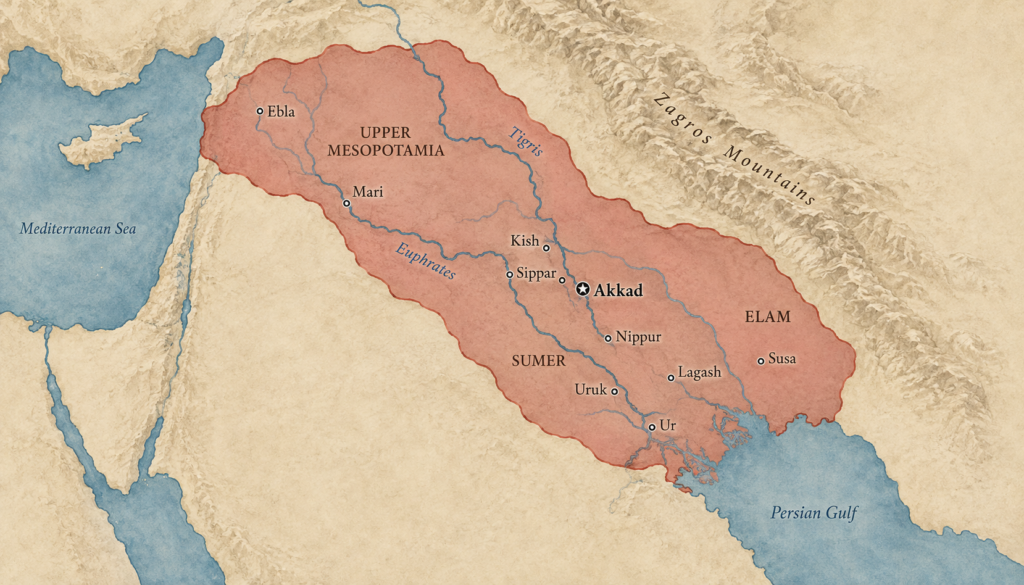
A map of the Akkadian Empire is particularly useful because the empire’s territory changed over time and its maximum extent remains difficult to define with absolute precision.
A good historical map should therefore distinguish between the core territory of the empire, regions under stronger administrative control, and areas reached by military campaigns or political influence.
It should also identify the major rivers and important Mesopotamian cities, particularly those that help readers understand the relationship between Akkad and the earlier Sumerian urban centers.
When looking at an Akkadian Empire map, the most important geographical point is not a perfectly fixed border. It is the dramatic increase in the scale of political authority compared with the fragmented city-state system that preceded Sargon.
The empire’s location in the heart of Mesopotamia gave its rulers access to the region’s major agricultural and urban centers, while its wider campaigns connected Akkadian kingship to a much broader Near Eastern political landscape.
That combination of a strong Mesopotamian core and expanding territorial influence is essential for understanding how the Akkadian Empire became one of the defining political formations of the Bronze Age Near East.
From Sumerian City-States to the Akkadian Empire
To understand the rise of the Akkadian Empire, it is essential to begin with the political landscape that existed before Sargon. Mesopotamia was not originally organized as a single state. Instead, southern Mesopotamia was dominated by a collection of independent city-states, each with its own ruler, institutions, religious centers, territory, and political interests.
Cities such as Uruk, Ur, Lagash, Kish, and Nippur could function as powerful regional centers. Their rulers competed for agricultural land, trade routes, political influence, and access to strategic resources.
This fragmented political environment provided the setting in which Sargon of Akkad eventually built a much larger territorial state.
The World Before Akkad
During the Early Dynastic period, political power in southern Mesopotamia was concentrated in individual cities and their surrounding territories.
A city-state was more than simply a city. It controlled agricultural land, irrigation systems, settlements, temples, and communities outside the urban center. Its ruler depended on these resources to maintain political authority and support the institutions of the state.
Competition between these cities was therefore inevitable.
Wars between Mesopotamian rulers were not unusual, and political dominance could shift from one city to another. A successful king might impose his authority over neighboring territory, but this did not necessarily create a permanent empire in the later sense of the term.
This distinction matters when discussing the Akkadian Empire. Earlier Mesopotamian rulers had already exercised power beyond their own cities. What changed with Sargon was the scale and ambition of territorial integration.
Sumerian Civilization and the Akkadians
The Akkadians did not emerge outside Mesopotamian civilization. They developed within the same broader cultural world as the Sumerians.
The populations of Mesopotamia spoke different languages, with Sumerian and Akkadian becoming particularly important. Akkadian belonged to the Semitic language family, while Sumerian was unrelated to it.
Despite these linguistic differences, the two traditions interacted closely.
The Akkadian rulers adopted and adapted many established Mesopotamian institutions. Writing, administration, religious traditions, royal ideology, and urban political structures had already developed before Sargon’s rise.
The emergence of Akkad should therefore not be understood as a sudden replacement of Sumerian civilization by an entirely separate culture.
Instead, Akkadian political power became deeply embedded in an already sophisticated Mesopotamian civilization.
This interaction would have lasting consequences. Akkadian eventually became one of the major languages of written culture and administration in the ancient Near East, while Sumerian continued to hold an important religious and literary role for centuries.
The Rise of Regional Powers
Before the formation of the Akkadian Empire, some Mesopotamian rulers had already attempted to establish dominance over multiple cities.
One particularly important figure was Lugal-zage-si of Uruk, who controlled a substantial part of southern Mesopotamia shortly before Sargon’s rise.
His kingdom demonstrates that the political world of Mesopotamia was already moving beyond purely local city-state politics.
However, the political system remained unstable. Dominance depended heavily on the military and personal authority of individual rulers, while conquered cities could retain their own institutions and political identities.
Sargon would take this process considerably further.
Why Was Sargon’s Achievement Different?
Sargon’s achievement was not simply that he conquered another Mesopotamian city.
His significance lies in the creation of a political structure capable of extending royal authority across a territory containing numerous previously independent communities.
Instead of treating each conquered city as an isolated possession, Akkadian rulers developed mechanisms for maintaining authority over a broader territorial state.
This required more than military victories.
It required officials, administrators, communication, resource collection, political loyalty, and a system capable of connecting distant communities to the royal center.
The resulting state was therefore fundamentally different in scale from the traditional Mesopotamian city-state.
From City-State Politics to Territorial Rule
The transition from city-state politics to imperial rule was not instantaneous.
Sargon’s conquests created a territorial framework, but maintaining that framework was a continuing political challenge. Revolts, competing local interests, geographical distance, and the difficulty of communication all placed pressure on the new state.
The Akkadian rulers consequently had to develop ways of projecting royal authority beyond their immediate surroundings.
Governors and other officials could represent the king in important centers, while military force remained available when political loyalty broke down.
This combination of administration and coercive power became one of the defining characteristics of Akkadian rule.
The Importance of Kish and Akkad
The political geography of northern and central Mesopotamia was particularly important to the rise of Sargon.
According to later traditions, Sargon was associated with Kish before establishing his own imperial center at Akkad. The historical details surrounding his early career are difficult to separate from later legendary traditions, but the connection reflects the importance of Kish within the political landscape of Mesopotamia.
Akkad itself eventually became the name associated with the dynasty and the empire.
The precise location of the ancient city remains unknown, making the archaeology of the imperial capital one of the most intriguing unresolved questions in Mesopotamian history.
Yet its political importance is clear from the textual record. Akkad became the symbolic center of a new form of kingship whose influence extended far beyond a single city.
A New Political Model
The Akkadian Empire emerged from the world of Sumerian city-states, but it transformed that political landscape.
The fundamental change was the move from a system dominated by competing urban kingdoms toward a state in which one royal dynasty claimed authority over a much broader territory.
That transformation did not eliminate local identities. Sumerian cities continued to exist, and their traditions remained influential.
Instead, the Akkadian rulers placed these communities within a wider political hierarchy.
This is one of the reasons the Akkadian Empire is so important when studying the origins of empire. It demonstrates how existing urban institutions could be incorporated into a much larger territorial system without simply disappearing.
From my perspective as a historian of the ancient Near East, this transition is more revealing than the simple statement that Sargon “conquered Mesopotamia.” The real historical significance lies in what followed the conquest: the attempt to turn military dominance into a durable political structure.
The Akkadian Empire was therefore not created in an empty political landscape. It emerged from centuries of Mesopotamian urban development, competition, warfare, administration, and cultural exchange—and transformed those existing traditions into something operating on an unprecedented scale.
The Rise of Akkadian Power
The rise of Akkadian power marked a major transformation in the political history of ancient Mesopotamia. For centuries, power had been concentrated in competing city-states, each controlling its own territory, institutions, and agricultural resources. During the 24th century BCE, however, this political landscape began to change as rulers sought to extend their authority across much larger areas.
The emergence of the Akkadian Empire was the result of this changing political environment. Military conquest provided the initial means of expansion, but conquest alone could not create a lasting empire. The new Akkadian state also needed to establish mechanisms for governing cities and territories that had previously belonged to independent political communities.
This distinction is important. The creation of an empire was not simply a matter of winning battles. It involved transforming military success into a system of territorial rule.
A Changing Mesopotamian Political Landscape
Before the Akkadian period, southern Mesopotamia was dominated by powerful city-states. Political authority was closely associated with individual urban centers, and rulers regularly competed for control over land, trade routes, agricultural resources, and strategic locations.
The balance of power could change rapidly.
A ruler who defeated a neighboring city might gain territory and prestige, but maintaining that control was considerably more difficult. Local institutions remained powerful, and conquered communities could resist outside authority.
By the time Akkadian power emerged, Mesopotamian rulers had therefore already developed considerable experience with warfare and political expansion.
What changed was the scale at which these practices were applied.
The new imperial system sought to connect multiple cities and regions under a single royal authority rather than allowing each major urban center to remain an independent political power.
The Defeat of Lugal-zage-si
One of the decisive moments in this transformation was the conflict between Sargon of Akkad and Lugal-zage-si of Uruk.
Lugal-zage-si had already established extensive political control in southern Mesopotamia. His position demonstrates that the region was moving toward larger territorial kingdoms even before the Akkadian Empire reached its full development.
Sargon’s victory over him provided a crucial opportunity to extend Akkadian authority across the Sumerian heartland.
The importance of this event goes beyond the defeat of one ruler.
It allowed the emerging Akkadian dynasty to take control of a political landscape that already contained powerful cities, established institutions, and long-standing rivalries. These existing structures could then be incorporated into a broader system of royal authority.
The resulting transformation was therefore both military and administrative.
From Conquest to Territorial Rule
Military victories created the territorial foundation of Akkadian power, but the empire could not survive through conquest alone.
A ruler controlling distant cities needed to ensure that taxes or tribute were collected, agricultural production continued, communications remained functional, and local authorities accepted the authority of the central government.
This required a different approach to kingship.
Instead of being primarily the ruler of one city and its immediate territory, the Akkadian king increasingly presented himself as the ruler of a much larger political domain.
Officials could represent royal authority in important settlements, while military forces provided a means of responding to rebellion and protecting the empire’s frontiers.
The combination of administration and military power became essential to maintaining the new territorial state.
Integrating Sumerian Cities
The incorporation of Sumerian cities was one of the most important aspects of the rise of Akkadian power.
Cities that had previously operated as independent political units were brought into a wider imperial framework. Their institutions did not simply disappear, however.
Temples continued to play important economic and religious roles, local communities retained their identities, and Sumerian cultural traditions remained influential.
The Akkadian rulers therefore governed a society that was culturally diverse but politically connected.
This integration helps explain why the Akkadian Empire cannot be reduced to a simple conflict between “Akkadians” and “Sumerians.” Akkadian political power developed within Mesopotamian civilization and absorbed many of the institutions and traditions that had existed before the dynasty’s rise.
The result was a complex imperial society in which Akkadian and Sumerian traditions interacted continuously.
A New Scale of Kingship
The expansion of Akkadian territory also changed the meaning of kingship.
A traditional Mesopotamian ruler was closely associated with a particular city and its patron deity. Imperial kingship required a broader political identity.
The king now had to present himself as the legitimate ruler of multiple communities, including populations that did not necessarily share the same local traditions or political interests.
This encouraged the development of new forms of royal ideology.
Royal inscriptions emphasized military victories, territorial authority, and the king’s relationship with the gods. Such messages helped communicate the idea that the ruler’s authority extended beyond his original political base.
This was one of the foundations of Akkadian imperial ideology.
Governing a Larger Territory
Distance created one of the greatest challenges for the emerging empire.
A king in central Mesopotamia could not personally supervise every city, agricultural district, or frontier. The state therefore depended on representatives and administrative systems capable of transmitting royal decisions and managing resources.
The Akkadian rulers developed a network of officials and governors to help maintain control.
These administrators could oversee local affairs, collect resources, supervise agricultural production, and represent the interests of the royal government.
Their presence also allowed the king to maintain authority without completely dismantling existing urban institutions.
The system was not necessarily uniform everywhere. The degree of direct control could vary depending on a region’s strategic importance, distance from the imperial center, and willingness to cooperate.
This flexibility was important because the Akkadian Empire covered a politically and geographically diverse territory.
The Role of Military Power
Military force remained fundamental to the expansion and survival of Akkadian power.
Campaigns could suppress rebellions, secure strategic territories, protect trade routes, and demonstrate the authority of the king.
But military power had another political function: it reinforced the credibility of the imperial system.
A newly conquered city had to recognize that resistance could bring a military response. At the same time, successful campaigns could provide access to resources and strengthen the prestige of the ruling dynasty.
The empire therefore operated through a combination of military coercion, political administration, economic control, and royal ideology.
None of these elements worked entirely in isolation.
The Emergence of an Imperial System
The significance of the Akkadian period lies in the development of a political system that operated on a scale larger than the traditional Mesopotamian city-state.
The state still depended on cities, agricultural communities, temples, and local institutions. What changed was their position within the political hierarchy.
They were increasingly connected to a central royal authority.
This did not mean that Akkadian control was equally strong everywhere. Ancient empires were rarely uniform political structures. Authority could be strongest in the imperial heartland and more dependent on military intervention or local cooperation in distant regions.
Nevertheless, the attempt to maintain political integration across such a broad territory represented a major development in Mesopotamian history.
Why the Rise of Akkadian Power Matters
The rise of Akkadian power matters because it illustrates how empire could emerge from an existing urban civilization.
The Akkadian rulers did not invent cities, writing, taxation, warfare, long-distance trade, or royal ideology. These institutions and practices already existed in Mesopotamia.
What they did was combine and extend them within a much larger territorial framework.
From my perspective as a historian of the ancient Near East, this is the most useful way to understand the formation of the Akkadian Empire. Its importance does not rest solely on the conquests traditionally attributed to Sargon. The deeper transformation was the creation of a political system capable of linking previously independent communities under a single dynasty.
That experiment in territorial government would become one of the defining developments of the Akkadian period.
It also explains why the empire is so important to the history of Mesopotamia. The political problems that emerged with its expansion—distance, communication, local resistance, administration, economic integration, and royal legitimacy—would remain fundamental problems for later imperial states throughout the ancient Near East.
How Did the Akkadian Empire Expand?
The **Akkadian Empire expanded from its Mesopotamian heartland into a much wider political sphere through a combination of military campaigns, political submission, administrative control, and the strategic use of tribute.
Its expansion represented a major change in the scale of Mesopotamian politics. Earlier rulers had certainly conquered neighboring cities and territories, but the Akkadian dynasty sought to maintain authority across a far broader geographical area.
The empire’s core remained in Mesopotamia, where its rulers could draw on established agricultural systems, urban centers, temples, and administrative institutions. From this base, Akkadian armies and officials extended royal influence into northern Mesopotamia and beyond the traditional Sumerian heartland.
It is important, however, not to imagine the Akkadian Empire as a modern state with perfectly defined borders. Imperial control was uneven and could change over time. Some regions were incorporated more directly into the political system, while others may have been subject primarily to military pressure, tribute, or temporary political submission.
Expansion Beyond the Sumerian Heartland
The first major phase of Akkadian expansion involved bringing the cities of southern Mesopotamia into a single political system.
This was a fundamental transformation.
Cities that had previously competed for regional dominance were now connected to an imperial monarchy. Their agricultural resources, labor, institutions, and strategic positions became part of a much larger political network.
The incorporation of these cities provided the Akkadian state with the economic and demographic foundation required for further expansion.
The empire could then look beyond southern Mesopotamia toward the north and west, where access to trade routes, raw materials, and strategically important territories offered additional advantages.
Northern Mesopotamia and the Upper Tigris
Akkadian power extended northward into regions beyond the traditional Sumerian political zone.
Northern Mesopotamia was important for several reasons. It connected the southern plains with the upper Tigris and Euphrates regions and provided routes toward areas farther west and north.
Control over these regions could strengthen the empire’s access to trade networks and strategic corridors.
Akkadian rulers therefore had an interest in maintaining political influence beyond the densely urbanized cities of southern Mesopotamia.
Archaeological and textual evidence from the Akkadian period indicates that imperial authority reached a number of northern centers. The nature of that authority, however, was not necessarily identical everywhere.
Some areas were more closely integrated into the administrative structure, while distant territories could remain politically dependent on the strength of the royal military.
Expansion Toward Syria
Akkadian expansion also reached westward toward Syria and the northern Levant.
This brought the empire into contact with regions containing important settlements and long-distance trade routes.
The western territories were especially significant because they connected Mesopotamia with the wider Near East.
Goods, people, technologies, and political ideas moved along these networks, making control over strategic routes valuable even when direct administration of distant regions was difficult.
The Akkadian rulers’ western campaigns should therefore be understood not simply as attempts to acquire land.
They were also connected to the political and economic logic of controlling access between different parts of the Near East.
The Importance of Trade Routes
Trade was closely connected to imperial expansion.
Mesopotamia lacked many of the raw materials required by its growing urban societies, including high-quality timber and important mineral resources. Long-distance exchange therefore played an important role in the economic life of Mesopotamian states.
Expanding Akkadian political influence could help protect or control routes connecting the Mesopotamian heartland with resource-producing regions.
This does not mean that every military campaign was motivated exclusively by economic interests. Ancient royal inscriptions often emphasized military victory, royal glory, and divine support rather than providing straightforward explanations of economic strategy.
Nevertheless, geography and access to trade networks were important elements of the wider imperial system.
Military Campaigns and Imperial Reach
The Akkadian army was essential to maintaining the empire’s expanding political network.
Campaigns could be used to conquer territory, suppress revolts, compel rulers to recognize Akkadian authority, or demonstrate the power of the dynasty.
Military success also had an ideological function.
An expanding king could present victory as evidence of divine favor and legitimate rule. Royal inscriptions celebrated conquered peoples and territories as proof of the ruler’s power.
This created a feedback loop between warfare and political legitimacy: successful campaigns strengthened royal prestige, while royal prestige could help justify further expansion.
Was the Whole Territory Directly Controlled?
Not necessarily.
This is one of the most important points to understand when looking at an Akkadian Empire map.
Ancient imperial control was rarely uniform. A region close to the political center could be governed through officials and regular administrative mechanisms, while a distant territory might recognize the king primarily through tribute or military submission.
Political control could also weaken over time.
A territory might accept Akkadian authority after a successful campaign and later rebel when the central government became weaker. Maintaining distant possessions therefore required repeated demonstrations of power.
For this reason, maps showing the maximum extent of the Akkadian Empire should be treated as reconstructions of political reach rather than precise representations of permanently administered territory.
The Empire as a Network of Political Centers
The Akkadian Empire can be better understood as a network connecting multiple political and economic centers.
The imperial heartland contained major Mesopotamian cities and agricultural regions. Beyond it were areas connected through administration, tribute, military presence, trade, or political allegiance.
This network allowed Akkadian rulers to project authority over a much larger geographical space than any individual Mesopotamian city-state could normally command.
It also created new challenges.
The farther the empire expanded, the greater the problems of communication, transportation, military logistics, and political loyalty became.
A victory hundreds of kilometers from the imperial center might demonstrate enormous royal power, but keeping that territory loyal required continuing resources.
How Far Did Akkadian Influence Reach?
At its greatest extent, Akkadian power reached well beyond southern Mesopotamia.
The empire’s sphere of influence extended across much of Mesopotamia and into neighboring regions of the Near East. Campaigns and political contacts reached toward northern Mesopotamia, Syria, and areas farther north and west.
However, historians must be careful when describing this maximum extent.
Ancient sources were produced partly to celebrate royal achievement. A ruler’s claim to have conquered a particular region does not automatically tell us how long that territory remained under direct Akkadian administration.
The safest approach is therefore to distinguish between military reach, political influence, tribute relationships, and sustained administrative control.
This distinction makes the geography of the Akkadian Empire much more understandable.
Expansion and the Limits of Imperial Power
Expansion created the strength of the Akkadian Empire, but it also contributed to the difficulties of governing it.
A larger territory required more administrators, soldiers, supplies, communication, and political coordination.
Every new region added another potential point of resistance.
The empire therefore faced a fundamental problem: the same military success that increased the prestige and resources of the Akkadian monarchy also increased the cost of maintaining imperial authority.
This tension would become particularly important in the later history of the dynasty.
From my perspective as a historian of the ancient Near East, this is one of the central lessons of Akkadian expansion. The empire’s significance lies not simply in how far its armies traveled, but in the attempt to transform those victories into a functioning political system across a geographically diverse landscape.
Expansion was therefore both an achievement and a structural challenge.
Understanding the Akkadian Empire on a Map
When studying the Akkadian Empire location and territorial extent, it is useful to keep three geographical layers in mind.
First, there was the imperial core in Mesopotamia, where Akkadian institutions and royal authority were most firmly established.
Second, there were regions under varying degrees of political control, including areas where local authorities operated within an imperial framework.
Finally, there were distant regions reached through campaigns, tribute relationships, or temporary political submission.
These categories help explain why different historical maps of the Akkadian Empire can show somewhat different boundaries without necessarily contradicting one another.
The empire was not static.
Its territory and political influence changed according to military success, rebellion, administrative capacity, and the strength of individual rulers.
Seen in this way, Akkadian expansion was not simply a process of coloring larger and larger areas on a map. It was the creation of a new political geography in which distant communities became connected, sometimes directly and sometimes indirectly, to the royal center of Akkadian power.
Why Was the Akkadian Empire Considered the First Empire?
The Akkadian Empire is widely regarded as the world’s first empire, although the precise meaning of the word “empire” remains debated among historians. The distinction matters because earlier Mesopotamian rulers had already conquered neighboring cities and controlled territories beyond their immediate political centers.
What made the Akkadian state different was the combination of large-scale territorial expansion, centralized kingship, political integration, and the attempt to maintain authority over multiple communities and regions.
The Akkadian rulers inherited a political landscape dominated by independent Mesopotamian city-states. Under the new imperial system, many of these communities became part of a wider territorial state governed by a single dynasty.
This represented a fundamental change in the scale of political organization.
An Akkadian king was no longer simply the ruler of one dominant city. His authority was presented as extending across numerous cities and territories, including populations with different local traditions and linguistic backgrounds.
That transformation is the main reason the Akkadian Empire occupies such a prominent position in discussions about the origins of empire.
What Makes a State an Empire?
There is no single definition of an ancient empire accepted by every historian.
The term generally describes a state that exercises political authority over multiple territories or peoples, often beyond the original homeland of its ruling dynasty.
This can involve conquest, tribute, military occupation, administrative integration, political dependency, or some combination of these mechanisms.
The problem is that ancient states rarely fit neatly into modern political categories.
A powerful kingdom could control neighboring territories without administering them directly. A city-state could dominate several other cities for a period without creating a durable territorial system. Likewise, an empire could exercise strong control in its core regions while relying more heavily on tribute or military pressure in distant areas.
The Akkadian case therefore needs to be examined according to the political realities of the Bronze Age rather than according to modern assumptions about national borders or centralized states.
From City-State to Empire
The political system of southern Mesopotamia before Akkad was dominated by city-states.
Each major city could possess its own ruler, religious institutions, agricultural territory, administrative structures, and political identity.
These states could fight one another, form alliances, and temporarily dominate neighboring communities.
The Akkadian transformation was different in scale.
Instead of allowing several major cities to remain independent centers of political power, the Akkadian dynasty established a system in which these communities were subordinated to a wider royal authority.
This did not mean that local institutions disappeared.
Temples continued to operate, cities retained their identities, and Sumerian traditions remained deeply embedded in Mesopotamian culture.
What changed was the political hierarchy.
The city was no longer necessarily the highest level of political authority. The imperial dynasty stood above multiple urban communities and claimed authority over a much larger territorial space.
Centralized Royal Authority
One of the strongest arguments for describing Akkad as an empire is the role of centralized kingship.
The Akkadian rulers presented themselves as sovereigns whose authority extended beyond a single city.
This was supported by military power, administration, royal ideology, and systems for managing resources.
Officials could act on behalf of the king in different parts of the empire, while military forces provided a means of enforcing royal authority when necessary.
The system was not perfectly uniform. The degree of central control could vary between regions, and political authority could weaken when local resistance or external pressure increased.
Nevertheless, the attempt to maintain a single dynasty’s authority across a broad territorial state was a major development in Mesopotamian political history.
Control Over Multiple Peoples and Cities
Another important feature was the diversity of the communities incorporated into Akkadian rule.
The empire emerged within a region where Akkadian and Sumerian languages and cultural traditions interacted closely. Its territorial expansion also brought the dynasty into contact with populations beyond the southern Mesopotamian heartland.
The imperial system therefore had to operate across communities that did not necessarily share the same local political traditions.
This is an important characteristic of imperial rule.
An empire is not simply a large kingdom. Its rulers must manage relationships between a central authority and populations with different regional identities and interests.
The Akkadian dynasty attempted to solve this problem through a combination of administration, military force, political hierarchy, and royal ideology.
Provincial Administration
Territorial expansion created a need for officials who could represent the king beyond the imperial center.
Akkadian administration relied on officials and governors to manage important areas and help connect local communities with the central government.
These officials could oversee economic resources, agricultural production, political affairs, and the collection of goods or tribute.
The exact organization of the administration varied, and our evidence does not allow every aspect of the imperial system to be reconstructed with certainty.
Even so, the existence of administrative mechanisms for governing territories beyond the royal center is an important part of the argument for considering Akkad an early empire.
Military Power and Imperial Authority
Military force was another essential component.
The Akkadian rulers used armies to expand their territory, suppress resistance, and reinforce the authority of the dynasty.
Military victories also carried political and ideological significance.
A king who could defeat rival rulers and compel distant communities to submit demonstrated that his authority extended beyond his immediate homeland.
This created an important distinction between temporary military success and sustained imperial power.
A single campaign could produce a spectacular victory without creating a lasting political system. The Akkadian achievement is historically significant because military expansion was combined with efforts to maintain authority over the resulting territorial network.
A Multiethnic and Multilingual Political World
The Akkadian Empire also developed within a culturally diverse Mesopotamian environment.
Akkadian became an important language of administration and royal power, while Sumerian remained deeply important in religious and literary contexts.
The coexistence of these traditions demonstrates that political integration did not require complete cultural uniformity.
This is another useful characteristic of ancient empire.
The goal was not necessarily to make every subject identical. Imperial governments could instead maintain political hierarchy while allowing different languages, religious practices, local institutions, and traditions to continue.
The Akkadian state provides an early example of this type of political integration.
The “First Empire” Debate
Calling Akkad the “first empire” should therefore be understood as a historical convention rather than an unquestionable fact.
The difficulty begins with the definition of empire itself.
Earlier Mesopotamian rulers had conquered territory and exercised power beyond their own cities. Some scholars may therefore identify earlier political formations as possible candidates for the title of first empire, depending on the criteria they use.
The Akkadian case is particularly prominent because the scale of territorial expansion and the effort to organize conquered regions under a single dynasty provide unusually strong evidence for an early imperial model.
For that reason, descriptions such as “the world’s first empire” or “the first empire in Mesopotamia” are common in historical writing.
A more precise formulation is that the Akkadian Empire is widely regarded as the earliest clearly attested territorial empire in Mesopotamian history, while acknowledging that the terminology remains debated.
Why Akkad Was Different From Earlier Kingdoms
The most useful comparison is not between Akkad and a hypothetical modern empire.
It is between Akkad and the political structures that preceded it.
| Feature | Earlier Mesopotamian City-States | Akkadian Imperial Model |
|---|---|---|
| Political center | Individual city | Central royal dynasty |
| Territorial scale | Primarily local or regional | Much broader territorial network |
| Political authority | Multiple competing rulers | One dominant dynasty |
| Military role | Inter-city warfare | Expansion and imperial enforcement |
| Administration | Primarily city-based | Extended across multiple territories |
| Cultural environment | Strong local identities | Diverse communities under one political system |
| Royal ideology | Linked strongly to individual cities | Emphasized wider territorial kingship |
The table should not be interpreted as an absolute division.
Earlier rulers could control territories beyond their own cities, and Akkadian rulers still depended heavily on existing urban institutions.
The important difference is the scale and political framework of integration.
Was Akkad Really the First Empire in History?
If “empire” means any state that conquered territory beyond its original homeland, then Akkad may not necessarily be the first possible example.
If the term refers to a large territorial state that systematically sought to maintain political authority over multiple previously independent communities, however, the Akkadian Empire becomes a particularly strong candidate.
This distinction allows us to answer the question without oversimplifying the evidence.
The safest historical conclusion is that Akkad represents one of the earliest—and generally the earliest securely documented—examples of imperial state formation in Mesopotamia.
The debate over terminology does not diminish its importance.
On the contrary, it reveals why the Akkadian Empire matters so much. It forces historians to examine how political authority changed when Mesopotamian rulers moved from controlling individual cities to governing a much wider territorial system.
Why the First Empire Matters
The significance of Akkad is therefore not simply that it was “first.”
Its importance lies in the political experiment it represents.
The Akkadian rulers demonstrated that a Mesopotamian dynasty could extend its authority across a territory far larger than the traditional city-state and attempt to hold that territory through a combination of military power, administration, economic control, and royal ideology.
That experiment created new possibilities for political organization.
Later Mesopotamian states would develop their own forms of territorial rule, and the memory of Akkadian kingship remained important in Mesopotamian political and literary traditions.
From my perspective as a historian of the ancient Near East, the most useful question is therefore not simply Was Akkad the first empire? It is What changed when Mesopotamian kingship became territorial and imperial?
The answer is that political authority acquired a new geographical scale.
A ruler could now claim sovereignty over multiple cities, populations, and regions rather than defining his power primarily through one urban center.
That transformation makes the Akkadian Empire a crucial milestone in the history of ancient state formation and one of the most important political developments of Bronze Age Mesopotamia.
How Was the Akkadian Empire Governed?
The Akkadian Empire was governed through a combination of centralized royal authority, provincial administration, military power, and control over economic resources.
This represented a significant development beyond the traditional political structure of Mesopotamian city-states. Instead of allowing each major city to function as an independent political center, the Akkadian dynasty placed multiple communities within a broader hierarchy headed by the king.
The system was not a modern centralized bureaucracy, and Akkadian control was not equally strong everywhere. The empire covered a large and geographically diverse territory, making direct administration of every settlement impossible.
Instead, the Akkadian rulers relied on a combination of royal officials, local institutions, tribute, military force, and political loyalty.
This flexible structure allowed the dynasty to govern territories that differed considerably in language, culture, geography, and political tradition.
The King at the Center of Power
The Akkadian king stood at the top of the political system.
Royal authority was presented as extending across the territories incorporated into the empire, rather than being limited to a single city.
This was one of the most important changes introduced by Akkadian imperial rule.
In earlier Mesopotamian politics, a ruler’s authority was closely associated with his city. Under the Akkadian system, the king claimed authority over numerous cities and regions.
The king therefore had several interconnected responsibilities.
He was responsible for military campaigns, the protection of the empire, the appointment or supervision of officials, the management of political relationships, and the maintenance of royal legitimacy.
The monarchy also relied heavily on ideology.
Royal inscriptions portrayed the king as a successful military leader whose victories demonstrated divine favor. Political authority was therefore supported not only by practical institutions but also by religious and ideological claims.
Governors and Imperial Officials
A territory as large as the Akkadian Empire could not be governed personally by the king.
Officials and governors therefore played an important role in connecting the royal center with individual cities and regions.
These representatives could oversee local administration, manage resources, communicate royal decisions, and help maintain political loyalty.
Their precise responsibilities probably varied according to the location and importance of the territory they administered.
This is important because the Akkadian state should not be imagined as a perfectly standardized administrative machine.
Some cities had long-established institutions that continued to function under Akkadian authority. Other areas may have required more direct supervision because of their strategic or political importance.
The imperial government therefore had to work with existing structures while ensuring that ultimate political authority remained associated with the Akkadian dynasty.
Controlling the Cities
The cities of Mesopotamia remained essential to the empire.
They contained temples, administrative institutions, agricultural communities, craftsmen, merchants, and populations whose labor and resources supported the wider state.
The Akkadian government did not need to eliminate these institutions.
Instead, it placed them within a larger political hierarchy.
A city could retain its religious traditions and many aspects of its local organization while acknowledging the authority of the imperial king.
This arrangement was particularly important in southern Mesopotamia, where Sumerian cities possessed deep political and religious traditions that predated Akkadian rule.
The empire therefore depended on integration rather than simple destruction of local institutions.
Tribute and the Flow of Resources
Economic resources were another foundation of Akkadian government.
Agricultural production provided the material basis of Mesopotamian political power. Grain, livestock, labor, and other resources could support temples, administrative centers, armies, and royal projects.
The imperial system needed mechanisms for moving resources from local communities toward centers of political authority.
Tribute and other forms of resource collection helped connect conquered territories to the wider imperial economy.
The exact forms of taxation and tribute could vary, and the surviving evidence does not allow every mechanism to be reconstructed with certainty.
Nevertheless, the political principle was straightforward: territorial control had to produce material resources if the state was to maintain its officials, armies, institutions, and royal household.
Communication Across the Empire
Distance was one of the greatest administrative challenges facing the Akkadian rulers.
A royal decision was useful only if it could reach the people responsible for implementing it.
Messages, officials, merchants, military units, and other travelers connected different parts of the empire.
Written records were especially important because Mesopotamian governments had already developed sophisticated traditions of record keeping before the Akkadian period.
Writing allowed administrators to document economic transactions, resources, obligations, and political information.
The Akkadian state therefore benefited from administrative technologies that had developed over centuries in Mesopotamia.
The empire did not invent writing or bureaucracy from nothing. It expanded the geographical scale at which these existing practices could be used.
Military Force as a Political Tool
Military power was closely connected to administration.
An empire could appoint governors and demand tribute, but those arrangements ultimately depended on the ability of the central government to enforce its authority.
The Akkadian army therefore had a role beyond territorial expansion.
Military forces could suppress rebellions, protect strategic regions, reinforce royal decisions, and discourage local rulers from challenging the dynasty.
This created a relationship between administration and coercion.
Officials represented the king’s authority during normal circumstances, while military intervention could be used when political arrangements broke down.
The need for such force also reveals a fundamental weakness in ancient imperial government: loyalty could never be taken completely for granted.
Managing a Diverse Population
The Akkadian Empire governed communities with different languages, traditions, and regional identities.
This diversity was particularly visible in the relationship between Akkadian and Sumerian culture.
Akkadian political authority did not require the complete disappearance of Sumerian traditions. Sumerian remained important in religious and literary contexts, while Akkadian became increasingly prominent as a language of political power and administration.
This coexistence demonstrates that imperial government could operate without requiring cultural uniformity.
The central political requirement was recognition of the dynasty’s authority.
Local identities could survive as long as they did not fundamentally challenge the imperial political order.
Religion and Royal Legitimacy
Government and religion were closely connected in ancient Mesopotamia.
Kingship was understood within a religious framework, and rulers presented their authority as compatible with divine will.
Akkadian kings used religious ideology to reinforce their political position.
Military victories could be presented as evidence of divine support, while royal inscriptions emphasized the king’s special relationship with the gods.
This helped transform political authority into something more than military domination.
A ruler who was portrayed as divinely favored possessed an ideological justification for governing territories and populations beyond his original homeland.
The connection between kingship and religion would become an enduring characteristic of Mesopotamian political culture.
Maintaining Loyalty
One of the central problems of Akkadian government was maintaining loyalty across a large territory.
A city might submit after a military defeat but later attempt to regain its independence.
A distant province might recognize the authority of the king while the imperial center was strong and challenge it when central power weakened.
The Akkadian rulers therefore needed to maintain a continuing balance between cooperation and coercion.
Officials, tribute, royal ideology, military campaigns, and political relationships all contributed to this process.
Imperial government was consequently not a one-time achievement.
Every generation of rulers had to maintain the political connections that held the territory together.
The Limits of Centralization
It would be misleading to describe the Akkadian Empire as completely centralized in the modern sense.
The king occupied the center of the political system, but he still depended on local officials, existing urban institutions, agricultural communities, temples, and regional networks.
Nor was the empire governed identically from one end to the other.
The further a region was from the Mesopotamian core, the more difficult communication and direct supervision became.
This meant that imperial government probably existed along a spectrum.
Some territories could be closely integrated into the political system, while others depended more heavily on tribute, military pressure, or the cooperation of local authorities.
Recognizing this variation provides a more realistic picture of how ancient empires functioned.
How the Akkadian Government Worked as a System
The strength of Akkadian government came from the interaction of several different mechanisms.
Royal authority provided the political center.
Officials and governors connected the center with individual territories.
Economic administration moved resources through the imperial system.
Writing and communication allowed information and decisions to circulate.
Military power protected and enforced royal authority.
Religious ideology provided legitimacy for the king’s position.
None of these elements was sufficient by itself.
An army could conquer territory without being able to administer it. Officials could collect resources only if local communities accepted their authority. Royal ideology could strengthen legitimacy but could not eliminate rebellion.
The Akkadian Empire therefore depended on a combination of institutions and practices that had to reinforce one another.
Why Akkadian Government Was Historically Important
The importance of Akkadian government lies in the attempt to administer a territory substantially larger than the traditional Mesopotamian city-state.
This created political problems that did not exist on the same scale when a ruler controlled a single city and its surrounding agricultural lands.
The king now had to think about distant provinces, communication, military logistics, resource distribution, political loyalty, and cultural diversity.
In this sense, the Akkadian Empire was not simply larger than the states that preceded it.
It required a different approach to political organization.
From my perspective as a historian of the ancient Near East, this is one of the most important aspects of Akkadian imperial history. The achievement was not merely placing conquered cities under a victorious ruler. The real challenge was creating enough administrative and political connectivity to make that territorial authority meaningful.
The resulting system was imperfect and often vulnerable, but it established an important model of imperial government in Mesopotamia.
Later states would face many of the same fundamental problems: how to govern distant territories, how to balance local autonomy with central authority, how to collect resources without destroying the productive base, and how to maintain loyalty when military force could not be everywhere at once.
The Akkadian Empire provides one of the earliest large-scale examples of these problems in recorded Mesopotamian history.
The Kings of the Akkadian Empire
The history of the Akkadian Empire is closely connected to the dynasty that ruled it. From the foundation of the empire in the 24th century BCE to its eventual collapse roughly two centuries later, a succession of kings attempted to preserve, expand, and reorganize the political system created during the dynasty’s rise.
The most important rulers were Sargon, Rimush, Manishtushu, Naram-Sin, and Shar-Kali-Sharri. Later rulers continued to claim the Akkadian throne, although the political strength of the empire had already begun to decline.
The sequence of rulers is important because the empire was never a static political entity. Its territory, administrative structures, military strength, and royal ideology changed from one reign to another.
The Akkadian Dynasty
The Akkadian dynasty is traditionally associated with a sequence of rulers beginning with Sargon and continuing through the later kings of Akkad.
| King | Approximate Period | Historical Significance |
|---|---|---|
| Sargon | c. 2334–2279 BCE | Established the Akkadian imperial state |
| Rimush | c. 2278–2270 BCE | Faced major rebellions and defended the empire |
| Manishtushu | c. 2269–2255 BCE | Continued imperial consolidation and expansion |
| Naram-Sin | c. 2254–2218 BCE | Presided over the empire at or near its political peak |
| Shar-Kali-Sharri | c. 2217–2193 BCE | Ruled during a period of increasing instability |
| Dudu | c. 2189–2169 BCE | Represented the later phase of Akkadian political power |
| Shu-turul | c. 2168–2154 BCE | Traditionally regarded as the final king of Akkad |
The dates are approximate and should not be treated as exact modern chronological markers. Ancient Mesopotamian chronology involves different chronological systems and incomplete evidence, so the precise length of individual reigns remains uncertain.
Sargon and the Foundation of the Dynasty
Sargon of Akkad established the dynasty that would dominate Mesopotamian politics for generations.
His significance for the history of the Akkadian Empire lies primarily in the political transformation associated with his reign. The new dynasty brought numerous Mesopotamian cities under a common royal authority and established the territorial foundation for the imperial state.
Sargon’s reign therefore represents the beginning of the Akkadian imperial experiment.
His individual biography, origins, legends, and military career are treated in greater detail in the dedicated Sargon of Akkad section of the Akkadian historical corpus. For the history of the empire itself, the important point is that his reign created the political framework inherited by his successors.
Rimush and the Problem of Rebellion
The transition from one ruler to another immediately demonstrated one of the fundamental weaknesses of ancient empire: conquest did not automatically guarantee permanent loyalty.
Rimush, Sargon’s successor, faced resistance from territories that had been brought under Akkadian authority.
His reign is therefore important for understanding the difference between creating an empire and maintaining one.
The new dynasty had to demonstrate that the political system established under Sargon could survive beyond the lifetime of its founder. Military campaigns and the suppression of rebellions became essential elements of this process.
Rimush’s reign shows that the Akkadian Empire was already dealing with the recurring problem of imperial cohesion: local political interests could re-emerge whenever central authority appeared vulnerable.
Manishtushu and Continued Consolidation
Manishtushu succeeded Rimush and continued the dynasty’s efforts to maintain and strengthen Akkadian authority.
His reign is associated with continued military activity and the management of territories extending beyond the empire’s Mesopotamian core.
The importance of Manishtushu lies less in a single defining event than in the continuity of the imperial system.
The Akkadian state survived the death of its founder and continued to function as a territorial monarchy under successive rulers.
This continuity is significant because it suggests that the empire was more than a temporary personal kingdom created entirely around one exceptionally successful monarch.
The dynasty had developed institutions and political relationships capable of sustaining imperial rule across multiple generations.
Naram-Sin and the Imperial Peak
The reign of Naram-Sin represents one of the most important periods in the history of the Akkadian Empire.
Under Naram-Sin, Akkadian political power reached an impressive level of territorial and ideological development. His reign is associated with military campaigns, imperial expansion, and a particularly powerful expression of royal ideology.
Naram-Sin also became famous for presenting himself in a manner that went beyond the traditional image of the Mesopotamian king.
His royal ideology emphasized an exceptional relationship between the ruler and the divine world. This development can be seen in surviving monuments and inscriptions and became one of the most distinctive features of his reign.
The significance of Naram-Sin will therefore be considered separately when examining the height of Akkadian power, rather than treating his reign simply as another entry in the dynastic succession.
Shar-Kali-Sharri and Growing Instability
After Naram-Sin, the empire entered a more difficult political phase.
Shar-Kali-Sharri inherited a state that still possessed substantial territory but faced increasing challenges to its cohesion.
The political environment became more unstable, with pressure from external groups and internal difficulties making the empire harder to govern.
This does not mean that the Akkadian state immediately disappeared after Naram-Sin.
Imperial institutions continued to operate, and the dynasty remained in power.
However, the balance between central authority and the demands of governing a large territory was becoming increasingly difficult to maintain.
Shar-Kali-Sharri’s reign therefore provides an important bridge between the period of imperial strength and the later fragmentation of Akkadian political power.
The Later Kings of Akkad
After Shar-Kali-Sharri, the political history of the dynasty becomes more difficult to reconstruct.
Later rulers, including Dudu and Shu-turul, continued to claim the Akkadian kingship, but the empire no longer possessed the same political strength associated with its earlier rulers.
The existence of these later kings is important because it demonstrates that the collapse of Akkadian imperial power was not an instantaneous event.
Political authority declined over time.
The dynasty continued to exist even as its ability to control the wider territorial system weakened.
This distinction is particularly important when discussing the fall of the Akkadian Empire. The end of imperial dominance should not be confused with the precise moment when the last Akkadian king ceased to rule.
A Dynasty Facing the Problems of Empire
The succession of Akkadian kings reveals a recurring pattern.
The early rulers had to establish and defend the empire. Later rulers had to maintain a system that had become increasingly complex.
Every succession created an opportunity for rebellion.
Every expansion increased the cost of administration.
Every distant territory presented new logistical and military challenges.
The dynasty therefore had to balance expansion with consolidation.
This is one reason the sequence of rulers is useful for understanding Akkadian history. The empire’s political development cannot be explained solely through the achievements of its most famous king.
The dynasty was a multi-generational political institution.
Why the Akkadian Kings Matter
The Akkadian kings matter because they demonstrate that the empire was not simply the personal creation of one ruler.
Sargon established the imperial framework, but his successors had to defend it, adapt it, and attempt to preserve it.
Rimush faced rebellion.
Manishtushu continued consolidation.
Naram-Sin presided over a powerful phase of expansion and royal ideology.
Shar-Kali-Sharri confronted growing instability.
The later kings inherited a political system whose territorial reach and central authority were increasingly difficult to sustain.
The sequence therefore tells us something fundamental about ancient empire: imperial power had to be reproduced from one generation to the next.
A successful conquest could create a large state, but only continuing political, military, economic, and ideological work could keep that state together.
The Akkadian Dynasty in Historical Perspective
The dynasty’s history also helps explain why the Akkadian Empire occupies such an important place in Mesopotamian history.
The empire survived several royal successions, demonstrating a degree of institutional continuity that went beyond the lifetime of its founder.
At the same time, the increasingly difficult reigns of the later kings show the limits of that system.
The dynasty could maintain a territorial state for generations, but it could not completely eliminate the problems created by distance, rebellion, external pressure, and political fragmentation.
From my perspective as a historian of the ancient Near East, the succession of Akkadian kings is therefore best understood not as a simple list of names and dates, but as a record of the changing capacity of the imperial state.
The early rulers expanded and consolidated Akkadian authority. The middle of the dynasty demonstrated the possibilities of imperial power. The later kings reveal how difficult it was to preserve that political structure once the mechanisms holding it together began to weaken.
The history of the Akkadian dynasty is consequently inseparable from the history of the empire itself.
Akkadian Identity, Language, and Culture
The Akkadian Empire was not simply a political structure imposed over Mesopotamia. It was also a cultural world in which Akkadian-speaking populations interacted constantly with older Sumerian traditions. This interaction produced one of the most important cultural transformations of the Bronze Age.
The people associated with the Akkadian Empire spoke Akkadian, a Semitic language that became one of the major written languages of ancient Mesopotamia. At the same time, Sumerian remained deeply important in administration, religion, literature, and scholarly traditions.
This combination is essential for understanding the Akkadian civilization. The empire did not erase the culture that existed before it. Instead, Akkadian rulers adopted, transformed, and incorporated many established Mesopotamian traditions while introducing their own language and political ideology.
From my perspective as a historian of the ancient Near East, this cultural interaction is one of the most interesting aspects of the Akkadian period. The empire’s importance was not limited to the territory controlled by its kings. Its influence also survived through language, writing, literature, art, religion, and political traditions that continued to shape Mesopotamia long after the empire itself disappeared.
Akkadian Identity and the Mesopotamian World
The term “Akkadian” can be misleading if it is understood as describing a completely separate and uniform population.
The Akkadian Empire emerged within a Mesopotamian environment that had already developed complex cities, institutions, religious traditions, writing systems, and economic networks. Akkadian-speaking populations therefore became part of an existing cultural landscape rather than replacing it completely.
This is particularly visible in the relationship between Akkadian and Sumerian traditions.
Sumerian civilization had already produced major urban centers such as Ur, Uruk, Lagash, Nippur, and Kish. These cities possessed long-established religious institutions and administrative traditions. When Akkadian rulers brought them under imperial authority, they inherited much of this institutional and cultural infrastructure.
The result was a highly interconnected cultural world.
Akkadian rulers could present themselves using Mesopotamian concepts of kingship while promoting Akkadian as a major language of administration. Royal inscriptions could communicate imperial authority while drawing on older traditions of Mesopotamian kingship.
This mixture makes the Akkadian period particularly important. Rather than representing a clean break between “Sumerian” and “Akkadian” civilization, it demonstrates how cultures could merge, adapt, and influence one another within a growing political system.
The Akkadian Language
One of the most important contributions of the Akkadian period was the growing importance of the Akkadian language.
Akkadian was a Semitic language written using the cuneiform writing system that had originally developed for Sumerian. This was a major cultural development because it allowed Akkadian-speaking rulers and administrators to use an established Mesopotamian writing tradition for their own language.
The Akkadian language eventually became one of the principal languages of written communication throughout the ancient Near East.
Its importance extended far beyond the political lifetime of the Akkadian Empire.
Later Babylonian and Assyrian traditions continued to use forms of Akkadian, and Akkadian remained an important written language in Mesopotamia for centuries.
This is one reason the Akkadian Empire should not be viewed only as a short-lived political experiment. Its cultural legacy lasted much longer than its imperial institutions.
The relationship between language and political power is especially significant. As the empire expanded, communication between different cities and regions became increasingly important. A common administrative language could help rulers, officials, and scribes operate across a large territory.
At the same time, Sumerian did not simply disappear. Both languages could occupy important roles, creating a bilingual cultural environment.
This bilingualism is a recurring feature of Mesopotamian civilization and became particularly important for the transmission of literature, religion, administration, and scholarship.
Cuneiform and Written Culture
The Akkadian period inherited the cuneiform writing system and adapted it to Akkadian.
Cuneiform was not an alphabet in the modern sense. It consisted of signs impressed into clay tablets, and scribes used the system for administrative records, royal inscriptions, legal and economic documents, religious texts, and literature.
The survival of thousands of Mesopotamian tablets from different periods gives historians an unusually detailed window into ancient Near Eastern civilization.
For the Akkadian period, however, the evidence has important limitations.
The imperial capital of Akkad itself has not been securely identified archaeologically. Much of what we know about the empire therefore comes from other cities, inscriptions, administrative documents, archaeological contexts, and later Mesopotamian traditions.
This matters because the surviving evidence is uneven. Historians cannot simply reconstruct every aspect of Akkadian life from a single archive.
Instead, the Akkadian world has to be reconstructed by comparing different types of evidence.
That includes:
- royal inscriptions
- administrative tablets
- archaeological remains
- cylinder seals
- monumental art
- religious texts
- later literary traditions
- evidence from cities incorporated into the empire
The written record therefore tells us not only about the Akkadian rulers themselves but also about the broader cultural environment in which the empire operated.
Akkadian and Sumerian Cultural Interaction
The relationship between Akkadian and Sumerian culture is one of the defining characteristics of the period.
Akkadian rulers adopted many established Sumerian political and religious traditions while developing their own imperial ideology. Sumerian continued to have prestige, particularly in religious and literary contexts, while Akkadian became increasingly important as a language of administration and political communication.
This interaction can be seen in Mesopotamian writing.
Scribes could work with both languages, and later scholars preserved Sumerian compositions alongside Akkadian texts. The result was not a simple replacement of one civilization by another.
Instead, the Akkadian period contributed to the development of a broader Mesopotamian cultural tradition.
This distinction is important when discussing the phrase “Akkadian civilization.”
The Akkadians were not isolated from the Sumerians. Their civilization developed through continuous interaction with the cities, institutions, religious traditions, and intellectual practices that already existed in southern Mesopotamia.
In practical terms, this means that many features associated with later Mesopotamian civilization cannot be assigned exclusively to either the Sumerians or the Akkadians.
The Akkadian period represents an important stage in the transmission and transformation of those traditions.
Art and Royal Representation
Akkadian art is particularly important because it provides evidence for how imperial power was represented visually.
Royal images from the period often emphasize strength, victory, hierarchy, and the relationship between the ruler and the divine world.
One of the most famous examples is the victory monument associated with Naram-Sin. Its composition presents the king in a dramatically elevated position as he leads his forces toward victory.
The visual language is significant because it communicates more than the outcome of a military campaign.
It presents the king as an exceptional figure whose authority extends beyond the ordinary scale of city-state politics. The ruler becomes the central figure in an imperial narrative of conquest and legitimacy.
Cylinder seals also played an important role in Akkadian culture.
These small objects could carry images and inscriptions and were used in administrative and economic contexts. Their designs provide evidence for artistic conventions, religious imagery, and the importance of written identification.
Together, monumental art and smaller objects such as seals demonstrate that Akkadian culture communicated political and religious ideas through visual representation as well as through written texts.
Enheduanna and Akkadian Cultural Life
The cultural history of the Akkadian period is also associated with Enheduanna, a major figure in Mesopotamian literary history.
Traditionally identified as a daughter of Sargon and a high priestess of the moon god Nanna at Ur, Enheduanna is associated with important religious compositions written in Sumerian.
Her importance extends beyond her connection to the royal family.
Enheduanna provides evidence for the interaction between political authority, religious institutions, and literary production during the Akkadian period.
Her compositions also demonstrate that the cultural world of the Akkadian Empire could operate across linguistic boundaries. Although Akkadian was the language associated with the imperial ruling tradition, Sumerian remained a major language of religious and literary expression.
This is an important reminder that political dominance and cultural dominance are not necessarily the same thing.
The Akkadian Empire could promote new forms of political authority while preserving older intellectual and religious traditions.
Religion as Part of Akkadian Culture
Religion was deeply integrated into Mesopotamian culture during the Akkadian period.
Akkadian rulers operated within a religious environment inherited from earlier Mesopotamian traditions. Major deities continued to receive worship, temples remained important institutions, and royal authority was frequently presented in relationship to the divine world.
The political importance of religion was particularly visible in royal ideology.
Kings could describe military victories as occurring with divine support, while religious institutions helped connect rulers with established traditions of Mesopotamian kingship.
The reign of Naram-Sin pushed this relationship further by presenting the king with an unusually elevated divine status.
This development illustrates an important change in the political culture of the empire: royal authority could be represented not merely as legitimate but as having a special relationship with the gods.
The religious dimension of Akkadian culture therefore cannot be separated completely from the development of imperial kingship.
For a deeper examination of Mesopotamian religious traditions, however, it is better to treat Akkadian religion as a specialized topic rather than repeat the full subject here.
Urban and Regional Cultural Connections
The Akkadian Empire connected cities and regions that had previously operated within more fragmented political systems.
This political integration also created opportunities for cultural exchange.
Merchants, administrators, soldiers, scribes, priests, and other travelers could move between different parts of the empire. Goods, ideas, administrative practices, artistic styles, and written traditions could therefore circulate over considerable distances.
Not every region was culturally identical, and imperial control should not be confused with complete cultural uniformity.
The empire contained cities with their own histories and traditions. Local religious practices and established institutions could continue even when political authority shifted toward the imperial center.
What changed was the scale of interaction.
The Akkadian Empire brought different communities into a political network that was larger than the traditional city-state system.
This is one of the reasons its cultural history is so important. The empire helped create conditions in which Mesopotamian traditions could circulate across a wider geographic and political space.
What Made Akkadian Culture Distinct?
Akkadian culture is best understood as a combination of innovation and continuity.
Its distinctive features included:
| Cultural feature | Importance |
|---|---|
| Akkadian language | Became a major written language of Mesopotamia |
| Cuneiform writing | Adapted to Akkadian while preserving an established writing tradition |
| Sumerian-Akkadian interaction | Created a bilingual and culturally interconnected environment |
| Imperial art | Developed powerful visual representations of royal authority |
| Royal inscriptions | Communicated conquest, legitimacy, and political ideology |
| Cylinder seals | Combined administration, identification, art, and religious imagery |
| Enheduanna | Demonstrates the connection between royal, religious, and literary culture |
| Religious traditions | Linked imperial authority with established Mesopotamian beliefs |
The important point is that these developments did not exist independently.
Language supported administration. Writing preserved political and religious ideas. Art communicated royal ideology. Religious institutions helped legitimize political authority. Cultural exchange connected different regions of the empire.
Together, these elements formed part of a broader Akkadian cultural system.
Akkadian Contributions to Mesopotamian Civilization
The legacy of the Akkadian period becomes clearer when viewed over the long term.
The empire itself eventually collapsed, but many of the cultural developments associated with its period continued.
Akkadian remained an important language of Mesopotamian civilization. Later Babylonian and Assyrian states inherited traditions of writing, kingship, administration, and imperial ideology that had developed or been transformed during earlier periods.
The Akkadian period therefore occupies an important place in the history of the ancient Near East not simply because it produced a powerful empire, but because it contributed to the formation of cultural traditions that survived political collapse.
This distinction is worth emphasizing.
Empires often disappear faster than the cultures they help shape.
The Akkadian imperial state lasted for only a few generations, but its language and cultural traditions remained influential for centuries. In that sense, the Akkadian period had a cultural lifespan much longer than its political lifespan.
Why Akkadian Culture Matters
Understanding Akkadian culture helps explain why the Akkadian Empire remains important long after its political collapse.
The empire brought together populations that spoke different languages and inherited different local traditions. Instead of creating a completely new culture from nothing, Akkadian rulers operated within an existing Mesopotamian civilization and transformed it on a larger political scale.
That transformation affected language, writing, art, royal ideology, religion, and the transmission of literary traditions.
The Akkadian period also demonstrates that cultural change is rarely simple.
The rise of Akkadian political power did not mean the disappearance of Sumerian culture. Instead, Akkadian and Sumerian traditions became increasingly intertwined.
That relationship would remain fundamental to Mesopotamian civilization for centuries.
For me, this is one of the most useful ways to understand the Akkadian legacy: the empire was temporary, but the cultural system that developed around it proved remarkably durable.
Its political institutions eventually fragmented. Its rulers disappeared. Its capital remains unidentified.
Yet the language, written traditions, artistic conventions, and ideas about kingship associated with the Akkadian period continued to influence later civilizations of Mesopotamia.
That is why the Akkadian Empire should be studied not only as an early experiment in imperial government, but also as a major stage in the development of ancient Mesopotamian civilization.
Imperial Resources, Trade, and Connectivity
Controlling a large territory was only the beginning of the Akkadian imperial project. The more difficult challenge was keeping distant cities, agricultural regions, trade routes, and political centers connected to the imperial system.
The Akkadian Empire therefore depended on more than military conquest. Its rulers needed ways to move resources, communicate decisions, maintain relationships with local authorities, and keep important routes open across Mesopotamia and beyond.
This is where connectivity becomes one of the most useful ways to understand the Akkadian Empire.
A city that had been conquered but remained completely disconnected from the political center would be difficult to control for very long. Imperial power required continuous movement: people moved between cities, goods moved along established routes, officials transmitted orders, and resources were redirected toward institutions and centers of authority.
The surviving evidence does not allow us to reconstruct every imperial supply route in detail. Nevertheless, administrative records, archaeological evidence, inscriptions, and the geographical distribution of important settlements provide a picture of a political system that depended heavily on communication and movement.
From my perspective as a historian of the ancient Near East, this is an important distinction. An empire was not simply a large area colored on a map. It was a network that had to function in practice.
Why Connectivity Was Essential to the Akkadian Empire
The Akkadian Empire covered a much larger political space than the individual city-states that had dominated southern Mesopotamia.
That created a fundamental logistical problem.
The imperial authorities had to maintain relationships with communities that could be separated by considerable distances. The farther the political center was from a particular region, the more difficult it became to rely on direct supervision.
The solution was not necessarily to administer every settlement in exactly the same way.
Instead, imperial rule could operate through a combination of:
- provincial officials
- local administrators
- military forces
- tribute and resource transfers
- established roads and waterways
- scribal communication
- strategic urban centers
- political alliances and obligations
This created a system in which the imperial center depended on many local institutions while attempting to keep them within a broader political framework.
The result was an interconnected empire rather than a completely uniform state.
Moving Resources Across Imperial Territory
An expanding state required resources.
Agricultural regions produced food and raw materials. Cities contained workshops, temples, administrative institutions, and populations that depended on regular supplies. Military campaigns also required provisions, equipment, animals, and human labor.
Resources therefore had to move between different parts of the political system.
The precise mechanisms varied depending on location and circumstance, but the general principle was straightforward: imperial authority depended partly on the ability to redirect resources toward places where they were needed.
This could involve the movement of agricultural produce, valuable materials, manufactured objects, animals, or other forms of wealth.
Such transfers were not necessarily equivalent to modern taxation.
Ancient Mesopotamian states operated through systems of tribute, obligations, institutional collection, redistribution, and local production that do not map neatly onto modern economic categories.
That distinction matters when discussing the Akkadian Empire.
The important point for the imperial system was not simply how much wealth existed. It was whether political authorities could gain access to resources and move them through the network of cities and institutions under their control.
Waterways and the Geography of Mesopotamia
The geography of Mesopotamia made rivers particularly important.
The Tigris and Euphrates and their associated waterways provided major corridors through which people and goods could move. Settlements were often connected to these river systems, while agriculture itself depended heavily on access to water.
This meant that geography and imperial administration were closely connected.
Control over strategically located cities could provide access to important agricultural zones and transportation routes. Likewise, control over river corridors could make it easier to connect different parts of the imperial territory.
Mesopotamian geography was not simply a backdrop to Akkadian history.
It shaped the possibilities and limitations of political power.
A ruler could conquer a distant region, but maintaining influence there required practical connections between that region and the rest of the state.
This helps explain why important urban centers remained essential even after the expansion of Akkadian power.
Trade Routes and Imperial Expansion
Long-distance exchange existed in Mesopotamia long before the Akkadian Empire.
The Akkadian rulers therefore inherited an already developed network of connections linking different regions.
What changed during the imperial period was the political environment in which some of these connections operated.
Expansion brought more territories and strategic routes into the orbit of the Akkadian state. Access to northern Mesopotamia and regions farther west could provide opportunities to obtain materials that were scarce or unavailable in southern Mesopotamia.
Among the resources important to Mesopotamian societies were timber, stone, metals, and other materials that were not equally available throughout the region.
This helps explain why long-distance connections mattered politically as well as economically.
A ruler who could influence important routes could strengthen the position of the imperial center while potentially limiting the ability of rival powers to control the same networks.
Trade and imperial expansion were therefore related, but they were not identical.
The Akkadian Empire did not necessarily control every merchant, caravan, or exchange taking place within its sphere. Instead, political authority could intersect with pre-existing commercial networks.
This distinction prevents us from imagining the empire as a perfectly controlled economic machine.
Tribute and the Political Meaning of Resources
Resources acquired from different regions could also have political significance.
When subordinate cities or territories provided goods to the imperial authorities, the transfer demonstrated more than material dependence. It could also represent recognition of imperial authority.
Tribute therefore belonged to the political language of empire.
The imperial center could receive resources from territories that had previously operated under their own rulers. The movement of those resources reinforced the relationship between the center and its subordinate regions.
At the same time, tribute could become a source of tension.
A city that had recently lost its independence might resist the obligations imposed by the new political order. Rebellions were therefore not simply military events. They could also challenge the flow of resources that sustained imperial authority.
This helps explain why military campaigns and administration were closely connected.
Conquest created obligations, but maintaining those obligations required continuing political and military pressure.
Imperial Centers and Redistribution
Large political systems require places where resources can be collected, recorded, stored, and redistributed.
Mesopotamian cities were particularly important in this regard.
Temples, palaces, administrative institutions, and other organizations already possessed mechanisms for managing agricultural products and other resources. Imperial authorities could therefore make use of established urban institutions rather than creating an entirely new administrative system everywhere.
This is another example of continuity between earlier Mesopotamian political traditions and Akkadian imperial rule.
The Akkadian Empire did not have to invent every administrative practice from scratch.
Instead, its rulers could place older institutions within a new political hierarchy.
The result was a combination of central authority and local administration.
Some resources remained within the communities that produced them, while others could be transferred to institutions, officials, military units, or centers connected with the imperial administration.
The system was therefore more complicated than a simple movement of wealth from conquered territories to one capital.
Communication Across a Large Empire
Resources were not the only things that had to move.
Information was equally important.
Imperial government required communication between rulers and officials. Orders needed to be transmitted, administrative information recorded, and political developments reported.
Writing played a crucial role in this process.
Cuneiform tablets allowed administrators to record transactions, inventories, deliveries, personnel, and other information. Royal inscriptions communicated the authority and achievements of rulers, while administrative documents provided the practical side of government.
The existence of written communication did not mean that the Akkadian Empire had a modern bureaucratic system.
Distances remained significant, travel was slow by modern standards, and local officials still had considerable importance.
Nevertheless, writing gave imperial authorities a powerful method for extending political coordination beyond the immediate presence of the king.
This is one reason the spread of Akkadian as an administrative language was historically significant.
The Role of Officials and Local Administration
Imperial connectivity depended heavily on people.
A king could not personally supervise every city, agricultural region, or strategic route. Officials therefore acted as intermediaries between central authority and local communities.
Their responsibilities could include collecting resources, overseeing institutions, transmitting orders, organizing labor, and supporting the interests of the imperial administration.
The exact organization varied from place to place, and the surviving evidence is incomplete.
We should therefore avoid imagining a perfectly standardized provincial bureaucracy covering every part of the empire.
A better model is a hierarchy of political relationships.
Some locations could be more directly integrated into imperial administration, while others depended more heavily on local authorities and negotiated relationships.
This flexible structure could make expansion possible, but it also created vulnerabilities.
If local officials stopped cooperating, if communication failed, or if military support could not arrive quickly enough, imperial authority could weaken.
Military Protection of Imperial Networks
Military power was essential to maintaining connectivity.
Routes, cities, agricultural zones, and strategic regions could not simply be assumed to remain loyal because they had once been conquered.
Rebellions could interrupt the movement of resources. Rival political powers could challenge imperial influence. Distant regions could become difficult to control when central authority weakened.
The army therefore had a dual function.
It could expand the empire, but it could also protect the political and logistical network created by that expansion.
This helps explain why military campaigns continued even after major territorial gains had been achieved.
The objective was not always to conquer an entirely new region.
Sometimes the purpose was to suppress resistance, secure a strategic area, reinforce political authority, or restore control over a previously integrated territory.
From this perspective, military activity was part of the infrastructure of imperial government.
Mesopotamia and Connections Beyond the Empire
The Akkadian Empire existed within a much larger Near Eastern world.
Its political and economic connections extended beyond the core regions of southern Mesopotamia. Northern Mesopotamia, Syria, and areas farther west became increasingly relevant during the period of Akkadian expansion.
These regions were important not only because of their political significance but also because they formed part of wider networks connecting Mesopotamia with other parts of the Near East.
However, imperial influence should not automatically be interpreted as complete political control.
An inscription celebrating a campaign does not necessarily demonstrate that an entire distant region was permanently incorporated into the empire.
This is especially important when interpreting claims about the maximum extent of Akkadian power.
Ancient rulers naturally emphasized victories and imperial reach. Historians must therefore compare royal claims with archaeological and administrative evidence.
The result is a more cautious picture in which political control, military influence, and economic connection could exist at different levels.
Was Akkadian Trade Fully Controlled by the Empire?
Probably not in the sense implied by a modern centralized economy.
The Akkadian rulers could influence important routes and demand resources from subordinate territories, but this does not mean that every exchange was directed by the imperial government.
Merchants, local institutions, temples, households, and regional authorities all participated in the movement of goods.
The imperial state operated within this existing network.
This distinction is important because it prevents an overly simplistic picture of Akkadian power.
The empire was powerful precisely because it could connect political authority with existing institutions and networks. It did not need to control every individual transaction to benefit from wider regional connectivity.
In other words, imperial power could be exercised through networks rather than through total direct supervision.
The Imperial Network and the Problem of Distance
Distance was one of the permanent challenges facing the Akkadian state.
The larger the empire became, the greater the potential gap between imperial decisions and local realities.
A king in central Mesopotamia might issue an order, but implementing it in a distant region depended on officials, communication, transportation, and military capacity.
This created a basic tension.
Expansion increased imperial resources and prestige, but expansion also increased the cost of maintaining control.
The same routes that allowed the empire to grow could become difficult to protect. The same distant territories that provided access to valuable resources could become difficult to administer.
This tension would become increasingly important as the Akkadian political system entered periods of instability.
Why Imperial Connectivity Matters
The history of the Akkadian Empire is often presented through conquest and territorial expansion.
That is understandable. Military victories are among the most visible elements of royal inscriptions, and the scale of Akkadian expansion was historically remarkable.
But conquest alone does not explain how the empire functioned.
The more useful question is what happened after a territory had been brought under imperial authority.
How were resources moved?
How were orders communicated?
How were local officials integrated?
How were strategic routes maintained?
How could military forces respond to rebellion?
How could distant regions remain connected to the political center?
These questions reveal the infrastructure behind imperial power.
The Akkadian Empire was not simply a collection of conquered territories. It was a political network that depended on the movement of people, resources, information, and military power.
That network was never perfectly centralized, and its effectiveness varied across regions.
Yet its existence helps explain why the Akkadian state represented such a major transformation in Mesopotamian political history.
The Limits of Imperial Connectivity
The same system that made large-scale rule possible also exposed the empire to serious risks.
A centralized political system could become vulnerable when communication broke down or when local authorities no longer accepted imperial demands.
Military pressure could suppress rebellion, but repeated campaigns required resources.
Long-distance administration could connect regions, but distance also made supervision more difficult.
The empire’s ability to move resources and information therefore had practical limits.
These limits are important when thinking about the eventual collapse of Akkadian political power.
The empire did not necessarily fail because its rulers suddenly lost the ability to conquer territory. More fundamentally, the political network became increasingly difficult to maintain under conditions of internal instability and external pressure.
The Akkadian experience demonstrates a recurring problem in imperial history:
the larger the political network becomes, the more resources are required to keep that network functioning.
A Network Rather Than a Uniform State
The best way to visualize Akkadian imperial connectivity is therefore not as a perfectly controlled block of territory.
It was closer to a network.
At its center stood the royal authority of the Akkadian dynasty. Around it were cities, provincial centers, agricultural regions, military forces, religious institutions, officials, and long-distance routes.
Some connections were stronger than others.
Some territories were more closely integrated than others.
Some regions could be influenced militarily without being administered in the same way as the imperial heartland.
This model explains why the Akkadian Empire could project power over such a large area without requiring identical institutions everywhere.
It also explains why maintaining the empire was a continuing process rather than a one-time achievement.
Why This Connectivity Was Historically Important
The importance of Akkadian imperial connectivity extends beyond the Akkadian period itself.
Later Mesopotamian states faced many of the same problems.
They too had to connect distant cities with central political authority, manage resources, maintain communication, protect strategic routes, and balance direct administration with local institutions.
The Akkadian period therefore offers an early example of a problem that would define imperial government throughout the ancient Near East.
An empire needed more than territory.
It needed connections.
The Akkadian rulers created a political system in which cities and regions that had previously belonged to different political communities became part of a larger network of authority.
That transformation was one of the defining achievements of the Akkadian period.
The empire’s legacy was therefore not simply the amount of territory conquered.
It was also the creation of a political and logistical framework capable of connecting that territory.
That framework was imperfect, sometimes fragile, and heavily dependent on royal authority. But it represented a major step in the development of large-scale territorial states in Mesopotamia.
Akkadian Empire Timeline and Historical Period
The history of the Akkadian Empire can be understood as a sequence of political transformations rather than simply a list of kings and dates.
The empire emerged in the twenty-fourth century BCE from a Mesopotamian world dominated by competing city-states. It expanded rapidly, incorporated large parts of southern and northern Mesopotamia, projected power toward regions farther west, and eventually developed into one of the most influential political systems of the Bronze Age.
Its history was relatively short when measured against the much longer history of Mesopotamian civilization. The Akkadian Empire is generally dated to approximately 2334–2154 BCE, although the exact chronology remains approximate because ancient king lists and modern reconstructions do not always provide precise dates.
What makes the period historically important is the speed and scale of the transformation.
Within a relatively limited period, Mesopotamia moved from a political landscape dominated by independent cities toward a territorial state capable of exercising authority across a much wider area.
The timeline is therefore more useful when treated as a sequence of stages:
- the political world before imperial unification
- the formation of Akkadian power
- rapid territorial expansion
- imperial consolidation
- the height of Akkadian authority
- increasing instability
- political fragmentation and collapse
From my perspective as a historian of the ancient Near East, this sequence is more revealing than memorizing individual reigns. It shows how an empire was built, how it functioned at its greatest extent, and why maintaining such a large political system was difficult.
The Mesopotamian World Before the Akkadian Empire
Before the rise of Akkadian imperial power, Mesopotamia was politically fragmented.
Southern Mesopotamia was dominated by independent city-states, each with its own ruler, institutions, religious centers, agricultural territory, and political interests.
Cities such as Uruk, Ur, Lagash, Kish, and Nippur could become powerful regional centers, but their political authority generally remained connected to specific territories and urban communities.
This does not mean that Mesopotamia was completely isolated into separate states.
Cities competed with one another, formed alliances, fought wars, exchanged goods, and interacted through diplomatic and religious networks.
The political system was therefore highly interconnected, but it lacked the kind of territorial integration that would later characterize Akkadian rule.
The emergence of an imperial state changed this balance.
Instead of simply becoming the strongest city in southern Mesopotamia, Akkadian power expanded across multiple political communities.
That distinction is crucial for understanding the beginning of the Akkadian period.
c. 2334 BCE: The Formation of Akkadian Imperial Power
The traditional starting point of the Akkadian Empire is placed around 2334 BCE, when Sargon established a new center of political authority.
The exact historical process was probably more complicated than the simplified story of a single ruler suddenly creating an empire.
The political environment had already been changing, and regional powers were competing for influence.
Nevertheless, the emergence of Sargon’s rule represents a major turning point.
Akkadian forces defeated important southern rivals and brought several major Mesopotamian cities into a new political framework.
The significance of this development was not simply that one ruler won a series of battles.
The more important change was the creation of a political system in which conquered territories were connected to a wider imperial authority.
This marked the beginning of the Akkadian imperial period.
c. 2334–2279 BCE: From Conquest to Imperial Rule
The first phase of the empire was characterized by rapid expansion and consolidation.
Military victories extended Akkadian authority over much of southern Mesopotamia. The imperial system also projected power toward northern regions and areas beyond the traditional Sumerian heartland.
The political consequences were significant.
Cities that had previously maintained their own rulers increasingly became part of a hierarchy centered on the Akkadian dynasty.
The empire therefore developed through a combination of conquest and administration.
Military force could bring a city under imperial authority, but maintaining that authority required officials, resources, communication, and political relationships.
This was the beginning of the process that transformed Akkadian power from a successful regional kingdom into an imperial system.
The Early Imperial Consolidation
The period following the initial expansion was not simply a continuation of conquest.
The new political structure had to survive resistance.
Some cities and regions opposed Akkadian authority, requiring military campaigns to suppress rebellions and reinforce imperial control.
This phase demonstrates an important characteristic of early empires: conquest and consolidation often happen simultaneously.
A ruler might expand into a new region while dealing with rebellion in territory conquered previously.
The empire was therefore constantly being reinforced.
This helps explain why the Akkadian state required a substantial military presence and a network of officials.
The political map could change quickly, but transforming military victories into lasting imperial rule was a much slower process.
c. 2279–2254 BCE: Continued Expansion and Internal Challenges
After the first phase of imperial expansion, the Akkadian state continued to face political challenges.
The transition between rulers could create opportunities for rebellion, particularly in regions that had only recently been incorporated into the empire.
Military campaigns therefore remained important.
At the same time, the dynasty continued to maintain the broader imperial system created during the earlier period.
This stage is useful because it shows that the Akkadian Empire was not dependent on a single uninterrupted sequence of victories.
Its survival required the continuation of institutions and political relationships beyond the reign of its founder.
The empire was becoming an established political system rather than merely the personal domain of one successful ruler.
c. 2254–2218 BCE: The Height of Akkadian Power
The reign of Naram-Sin is generally associated with the high point of Akkadian imperial power.
During this period, the empire projected authority across an exceptionally broad area.
Military campaigns extended the reach of the state, while royal ideology emphasized the extraordinary status of the ruler.
The political significance of this phase went beyond territorial size.
The Akkadian monarchy had become capable of presenting itself as a power operating across multiple regions and peoples.
Royal art and inscriptions reinforced this image.
The empire could now be represented not simply as one Mesopotamian kingdom among many, but as a dominant political force.
This period is often described as the peak of Akkadian power because several elements of the imperial system converged:
- extensive territorial influence
- strong royal authority
- military capacity
- administrative organization
- long-distance political connections
- an increasingly developed imperial ideology
The height of the empire was therefore both territorial and ideological.
The Transformation of Royal Authority
The imperial period also changed the way kingship could be represented.
Earlier Mesopotamian rulers had already claimed divine support, military success, and authority over cities.
The Akkadian period pushed these ideas to a new scale.
The king increasingly appeared as the central figure in an empire that extended beyond the traditional boundaries of a city-state.
Under Naram-Sin, royal ideology became particularly prominent.
This development should not be understood simply as an isolated religious innovation.
It reflected a broader political transformation.
A ruler governing multiple territories required a political language capable of explaining why distant communities should recognize his authority.
Imperial ideology provided part of that answer.
The ruler was presented as the central figure capable of maintaining order across a much larger political world.
c. 2218–2193 BCE: Growing Pressure on the Imperial System
After the height of Akkadian power, maintaining imperial cohesion became increasingly difficult.
The political system faced the normal problems of territorial states: rebellion, succession disputes, military pressure, administrative challenges, and the difficulty of maintaining authority across distant regions.
The empire’s size could become a weakness as well as a strength.
A large territory offered access to resources and strategic routes, but it also required greater military and administrative effort.
The farther regions were from the imperial center, the more difficult it could become to respond quickly to political instability.
This does not mean that the empire suddenly ceased to function.
Rather, the balance between imperial authority and local resistance became increasingly difficult to maintain.
The later Akkadian period should therefore be understood as a gradual weakening of political cohesion rather than as one clearly defined moment of failure.
The Later Akkadian Period
The final phase of the Akkadian Empire was characterized by increasing instability.
The dynasty continued to rule, but the political environment became less secure.
Regional authorities could challenge central power, while external groups and neighboring regions placed additional pressure on the state.
The empire’s political network became harder to maintain.
This period is particularly difficult to reconstruct in detail because the surviving evidence is uneven.
Later Mesopotamian traditions sometimes describe the collapse of Akkad in dramatic terms, while archaeological evidence provides a more complicated picture of political and environmental change.
It is therefore important not to treat every later literary account as a straightforward contemporary historical record.
Instead, historians compare different types of evidence to reconstruct the final stages of the empire.
c. 2154 BCE: The End of the Akkadian Period
The traditional end date of the Akkadian Empire is approximately 2154 BCE.
By this point, the centralized political system associated with the Akkadian dynasty had broken down.
The empire no longer functioned as the same unified territorial state that had emerged more than a century earlier.
This did not mean that Akkadian culture or the Akkadian language disappeared.
Political collapse and cultural disappearance were very different processes.
The end of the empire marked the breakdown of a particular imperial political system, not the end of Akkadian influence in Mesopotamia.
Later Mesopotamian civilizations continued to use Akkadian as an important written language and inherited political and cultural traditions associated with the broader Akkadian period.
The Akkadian Empire Timeline at a Glance
| Approximate date | Historical stage | What happened |
|---|---|---|
| Before c. 2334 BCE | Pre-imperial Mesopotamia | Independent city-states competed for regional power |
| c. 2334 BCE | Imperial formation | Akkadian power emerged under Sargon |
| c. 2334–2279 BCE | Early expansion | Southern Mesopotamia was brought under wider imperial authority |
| Late 23rd century BCE | Consolidation | Rebellions and political resistance challenged the new system |
| c. 2254–2218 BCE | Imperial peak | Akkadian power reached its greatest political prominence |
| c. 2218–2193 BCE | Increasing pressure | Maintaining territorial cohesion became more difficult |
| Late 22nd century BCE | Fragmentation | Central authority weakened and regional pressures increased |
| c. 2154 BCE | Political collapse | The Akkadian imperial system ceased to function as a unified state |
These dates should be treated as approximate rather than absolute.
Ancient chronological systems are not equivalent to modern historical dating, and different scholarly reconstructions can produce slightly different dates.
How Long Did the Akkadian Empire Last?
Using the conventional chronology of approximately 2334–2154 BCE, the Akkadian Empire lasted for roughly 180 years.
That is a relatively short period when compared with the thousands of years of Mesopotamian history.
Yet its historical importance was much greater than its duration might suggest.
The empire demonstrated that political authority could be projected across a territory much larger than a traditional city-state.
It also established patterns of imperial administration, military organization, royal ideology, and cultural interaction that would remain important in later Mesopotamian history.
Its short duration therefore should not be confused with limited influence.
Why the Akkadian Period Was a Turning Point
The Akkadian period represents a major transition in Mesopotamian political history.
Before the empire, political authority was strongly associated with individual cities and their surrounding territories.
After the rise of Akkadian power, Mesopotamia had experienced a new model of territorial rule in which multiple cities and regions could be incorporated into a single imperial system.
This did not permanently eliminate political fragmentation.
Indeed, Mesopotamia would repeatedly return to periods of competing kingdoms and city-states.
But the imperial experiment had demonstrated what was politically possible.
The idea of ruling over multiple territories from a central royal authority would remain an important feature of later Mesopotamian history.
Timeline vs. Akkadian Kings
It is useful to distinguish between the history of the empire and the history of its kings.
A list of rulers tells us who occupied the throne and approximately when they ruled.
A historical timeline tells us what was happening to the political system itself.
That distinction matters because the empire did not simply move from one ruler to another.
Each transition could affect stability, military policy, territorial control, administration, and relations with local communities.
For that reason, the most useful way to understand the Akkadian period is to combine chronology with broader historical processes.
The main stages were:
formation → expansion → consolidation → imperial peak → pressure → fragmentation → collapse
This sequence provides a framework for understanding the Akkadian Empire without reducing its history to a list of royal names.
What Changed After the Akkadian Empire?
The end of the Akkadian imperial system did not leave Mesopotamia politically empty.
Regional powers continued to exist, and new political formations emerged in the centuries that followed.
The decline of Akkadian centralized authority therefore represents a transition rather than a complete historical break.
Some political institutions disappeared, while others survived or were adapted.
Akkadian remained an important language.
Mesopotamian scribal traditions continued.
Ideas about kingship and territorial authority survived.
The memory of Akkadian power also became part of later Mesopotamian historical traditions.
In this sense, the end of the empire was the end of one political phase rather than the end of the broader cultural world associated with Akkad.
Understanding the Akkadian Period as a Whole
The Akkadian Empire’s timeline reveals a pattern that appears repeatedly in the history of large territorial states.
First comes political concentration.
Then expansion.
Expansion creates new administrative and military challenges.
The state develops mechanisms to manage those challenges.
At its peak, the system can project power across a very large territory.
Eventually, however, the costs and pressures of maintaining that system can become increasingly difficult to manage.
The Akkadian experience illustrates this pattern unusually early in Mesopotamian history.
Its rulers created a political structure that was considerably larger than the city-state systems that had dominated the region.
They developed ways to connect distant communities to central authority.
They created an imperial ideology capable of presenting the ruler as the center of a much larger political order.
But the same scale that made the empire impressive also created vulnerabilities.
The Akkadian Empire therefore should not be remembered simply as the first empire or as a sequence of famous kings.
Its timeline tells a larger story about how territorial power emerges, expands, reaches a peak, and eventually becomes difficult to sustain.
That historical cycle is one of the main reasons the Akkadian period remains so important for understanding the development of the ancient Near East.
How Do We Know About the Akkadian Empire?
Much of what we know about the Akkadian Empire comes from a combination of written records, archaeological evidence, royal inscriptions, administrative documents, artwork, cylinder seals, and later Mesopotamian traditions.
Unlike modern states, the Akkadian Empire did not leave behind a single archive containing a complete account of its history. There is no surviving historical book written by an Akkadian historian that tells us exactly how the empire was founded, how it was governed, and why it eventually disappeared.
Instead, historians reconstruct the Akkadian period by bringing together many different pieces of evidence.
This makes the study of the Akkadian Empire both fascinating and challenging.
A royal inscription might describe a military victory, while an administrative tablet can reveal something about the practical operation of an institution. Archaeological remains can show patterns of settlement and political change, while artistic representations can provide evidence about royal ideology.
Each source tells us something different.
Each source also has limitations.
From my perspective as a historian of the ancient Near East, this is essential when studying Akkadian history. The strongest reconstruction is rarely based on one spectacular inscription or famous monument. It emerges when independent types of evidence point toward the same historical interpretation.
Written Sources and Cuneiform Tablets
Cuneiform tablets are among the most important sources for understanding the Akkadian period.
Mesopotamian scribes had been using cuneiform for centuries before the rise of Akkadian political power. During the Akkadian period, the writing system was adapted for the Akkadian language while continuing to be used for Sumerian.
This produced a substantial written record.
Cuneiform could be used for many different purposes, including:
- administrative records
- inventories
- economic transactions
- royal inscriptions
- correspondence
- religious texts
- literary compositions
- legal and institutional documents
- records concerning officials and resources
These documents provide evidence for the practical functioning of Mesopotamian institutions.
An administrative tablet may appear less dramatic than a royal monument, but it can sometimes tell historians more about how a state actually worked.
For example, records concerning deliveries, personnel, resources, or institutions can help reconstruct relationships between political centers and local communities.
The written record is therefore not simply a collection of ancient stories.
It is also evidence of the everyday administrative processes that supported large-scale political organization.
Royal Inscriptions
Royal inscriptions are particularly important for reconstructing Akkadian political history.
Akkadian rulers recorded military campaigns, territorial conquests, building activities, religious relationships, and claims to royal authority.
These inscriptions help historians identify the ambitions of the ruling dynasty and understand how Akkadian kings wanted their power to be remembered.
They also provide information about geography.
When a ruler describes campaigns against particular cities or regions, historians can compare those claims with archaeological evidence and other written sources to reconstruct the approximate extent of Akkadian political activity.
However, royal inscriptions must be interpreted carefully.
A king’s inscription was not intended to provide a neutral modern historical account.
Its purpose was often to demonstrate power, victory, legitimacy, and divine support.
A ruler could emphasize successful campaigns while saying little about setbacks or failures.
This does not make royal inscriptions unreliable.
It means that they must be read according to their historical purpose.
A victory inscription is evidence not only of what a king claimed to have achieved but also of how imperial power was presented to the people who encountered the text.
Administrative Evidence
Administrative documents provide a different perspective.
Rather than focusing primarily on royal achievements, they can reveal how institutions handled resources, personnel, and organizational responsibilities.
This evidence is particularly valuable because an empire had to function beyond the battlefield.
Military conquest could establish political authority, but administration was required to maintain it.
Administrative tablets can therefore help historians investigate questions such as:
- How were resources recorded?
- Which institutions received goods?
- Which officials were involved?
- How were obligations organized?
- Which cities participated in imperial administration?
- How were different regions connected?
The surviving administrative evidence is incomplete, however.
It does not represent every city, every social group, or every year of the Akkadian Empire.
Some regions are much better documented than others.
This uneven survival of evidence means that historians must avoid assuming that what survives represents the entire empire.
Archaeology and the Akkadian Empire
Archaeology provides another essential source of information.
Excavations at Mesopotamian sites have revealed buildings, pottery, seals, inscriptions, administrative materials, settlement patterns, and other remains associated with the Akkadian period.
Archaeology is particularly important because written sources tend to reflect the concerns of literate institutions.
Material evidence can provide a different perspective.
Buildings and settlement patterns can reveal changes in urban organization. Objects can demonstrate cultural connections. Administrative centers can provide evidence for political integration.
Archaeological evidence can also help test written claims.
If a royal inscription describes extensive activity in a particular region, archaeologists can investigate whether the material record supports evidence of Akkadian presence or influence.
The relationship between texts and archaeology is therefore extremely important.
Neither should automatically be treated as more truthful than the other.
Instead, they can be compared to build a more reliable historical reconstruction.
The Mystery of Akkad
One of the most important limitations in our knowledge of the Akkadian Empire is also one of its greatest archaeological mysteries.
The exact location of the ancient city of Akkad, the imperial capital, has not been securely identified.
This is remarkable.
The empire takes its name from a city that remains archaeologically elusive.
The capital was clearly important in ancient Mesopotamian traditions, and historical sources preserve its name. Yet archaeologists have not been able to identify its remains with sufficient certainty to establish its location conclusively.
This creates an unusual situation for historians.
Much of the evidence for the empire comes from cities other than its namesake capital.
Sites throughout Mesopotamia and beyond have therefore become essential for reconstructing Akkadian political history.
The absence of a securely identified capital does not mean that Akkadian history is unknowable.
It does mean that some questions about the central institutions of the empire remain more difficult to answer than they would be if the capital had been excavated and its archives preserved.
Cylinder Seals
Cylinder seals are another valuable source of evidence.
These small objects were rolled across soft clay to leave a distinctive image or inscription. They could be associated with administrative, economic, and institutional activities.
Their designs also provide information about Akkadian art and ideology.
Images could depict rulers, divine figures, animals, mythological scenes, or other symbolic motifs.
Because seals were used in practical contexts, they can provide evidence that complements monumental art.
A large royal monument tells us how power was publicly represented.
A cylinder seal can show how written identification and visual imagery were integrated into administrative practices.
The combination of these sources helps historians understand that Akkadian culture was not expressed only through monumental architecture.
It was also present in small objects that participated in everyday institutional life.
Art as Historical Evidence
Akkadian art is particularly useful for studying royal ideology.
Monuments and sculptures associated with the period often portray kings as powerful military figures and connect royal authority with divine approval.
One of the best-known examples is the victory monument associated with Naram-Sin.
Its composition places the ruler in a dominant position within the scene and communicates ideas about military success, hierarchy, and royal authority.
Such imagery is valuable historical evidence, but it must be interpreted carefully.
An artistic representation is not a photograph of an event.
It is a constructed political message.
The way a ruler is represented tells us how the royal court wanted power to be understood.
This makes art particularly valuable for studying ideology.
It allows historians to investigate not only what rulers did but also how they wanted their achievements and status to be perceived.
Sumerian and Akkadian Texts
The Akkadian period cannot be studied exclusively through texts written in Akkadian.
Sumerian remained an important language during the period, particularly in religious and literary contexts.
This means that historians often have to work across both linguistic traditions.
The relationship between the two languages is itself historically significant.
Akkadian rulers operated within a cultural world that had already developed a sophisticated scribal tradition in Sumerian. Rather than abandoning this tradition, Akkadian political culture interacted with it.
This produced a complex bilingual environment.
The survival of both languages allows historians to study cultural continuity as well as political change.
It also reminds us that political conquest does not automatically produce cultural replacement.
The Akkadian Empire transformed the political structure of Mesopotamia while remaining deeply connected to older Mesopotamian intellectual and religious traditions.
Later Mesopotamian Traditions
Not all evidence about the Akkadian Empire comes from the period itself.
Later Mesopotamian scribes preserved stories, traditions, king lists, and literary compositions that referred to earlier rulers and events.
These later sources can be extremely valuable.
They sometimes preserve information that would otherwise have disappeared.
At the same time, they must be treated differently from contemporary evidence.
A text written centuries after an event may preserve an older tradition, but it can also reflect the concerns, political ideas, and literary conventions of the later period in which it was copied.
This is particularly important when studying the reputation of rulers such as Sargon.
Later Mesopotamian literature transformed historical figures into legendary characters whose stories could acquire meanings far beyond the events of their original period.
Historians therefore distinguish, whenever possible, between contemporary evidence and later literary tradition.
The Difference Between Evidence and Tradition
The history of the Akkadian Empire contains both evidence and tradition.
Evidence includes objects, inscriptions, archaeological remains, tablets, and other surviving material from the ancient world.
Tradition includes later stories, literary compositions, historical narratives, and interpretations transmitted by subsequent generations.
Both are useful, but they answer different questions.
An inscription created during the Akkadian period can provide direct evidence for how a ruler presented himself.
A later story about that ruler can reveal how subsequent Mesopotamian societies remembered him.
Neither source should automatically be discarded.
Instead, historians ask:
When was this source created?
Who created it?
Why was it created?
What information does it preserve?
What might it leave out?
These questions are fundamental to historical interpretation.
How Historians Reconstruct Akkadian History
Reconstructing Akkadian history is therefore a process of comparison.
Suppose a royal inscription claims that an Akkadian ruler conquered a particular region.
A historian does not necessarily accept the statement at face value.
Instead, the claim can be compared with archaeological remains, administrative documents, inscriptions from other sites, geographical evidence, and later traditions.
When several different forms of evidence support the same interpretation, confidence increases.
When the evidence conflicts, the historical conclusion may need to remain cautious.
This approach is particularly important for the Akkadian Empire because the evidence is incomplete and unevenly distributed.
Some parts of the imperial system are relatively well documented.
Others remain poorly understood.
The historian’s task is therefore not to eliminate uncertainty but to identify what can reasonably be established and what remains hypothetical.
What We Know With Greater Confidence
Some aspects of Akkadian history are supported by multiple lines of evidence.
We can establish with considerable confidence that an Akkadian dynasty emerged in Mesopotamia during the twenty-fourth century BCE and created a political system extending well beyond a single city.
We can also establish the importance of Sargon as the founder of the imperial dynasty and the major role played by later rulers in maintaining and expanding Akkadian power.
The Akkadian language is well documented in cuneiform sources, while archaeological evidence demonstrates the existence of Akkadian-period settlements and administrative activity across multiple regions.
The period also left an important artistic and literary legacy.
These broad conclusions are supported by different categories of evidence rather than by one isolated source.
What Remains Uncertain
Other questions remain much harder to answer.
The precise location of Akkad is still unresolved.
The exact boundaries of the empire at every point in its history are uncertain.
It is also difficult to determine how directly the imperial center controlled every distant region.
Ancient royal inscriptions sometimes describe extensive conquests, but political influence, military expeditions, tribute relationships, and permanent administration were not necessarily the same thing.
The precise causes and chronology of the empire’s final collapse also remain subjects of scholarly discussion.
These uncertainties should not be viewed as weaknesses in the study of ancient history.
They are a normal consequence of working with incomplete evidence.
The important distinction is between saying “we do not know” and assuming an answer simply because a plausible explanation exists.
Why the Evidence Matters
The surviving evidence is what allows the Akkadian Empire to move from legend into history.
Without inscriptions, tablets, archaeological remains, seals, artworks, and later textual traditions, our understanding of Akkad would be far more limited.
At the same time, the evidence teaches us to be cautious.
A royal inscription does not tell us everything.
An archaeological site does not explain itself.
A later literary tradition is not necessarily a contemporary historical account.
Each source represents one perspective on the ancient world.
The Akkadian Empire can therefore be understood most effectively when these perspectives are combined.
Reconstructing a Lost Empire
There is something remarkable about the process of reconstructing Akkadian history.
The political system disappeared more than four thousand years ago. Its capital has not been securely located. Its rulers left behind no surviving historical narrative equivalent to a modern chronicle.
And yet we can still reconstruct a surprisingly detailed picture of its rise and development.
We know about the political environment in which it emerged.
We can trace the expansion of Akkadian power.
We can study the administrative systems that supported imperial rule.
We can examine the language used by its scribes.
We can analyze the art used to represent its kings.
We can investigate its relationships with Sumerian traditions.
We can also compare evidence from different parts of Mesopotamia to understand how far Akkadian political influence reached.
This reconstruction is possible because the ancient Near East left behind many different kinds of evidence.
No single source provides the entire story.
Together, however, they allow us to recover much of it.
Why Historical Uncertainty Is Important
One of the most common problems in popular accounts of the Akkadian Empire is presenting uncertain interpretations as established facts.
This can happen particularly with questions about the empire’s exact size, the location of Akkad, the precise organization of provincial administration, and the reasons for its collapse.
A responsible historical account should distinguish between what the sources demonstrate, what they strongly suggest, and what remains debated.
That distinction does not make Akkadian history less interesting.
Quite the opposite.
It shows how historians actually work.
When evidence is incomplete, interpretation becomes part of the historical process.
For me, this is one of the most rewarding aspects of studying the ancient Near East. The objective is not to create an illusion of complete certainty. It is to construct the most convincing explanation possible from the evidence that has survived.
What the Sources Tell Us About the Akkadian Empire
Taken together, the evidence reveals an empire that was politically ambitious, administratively complex, culturally interconnected, and deeply embedded in the older traditions of Mesopotamia.
The sources show rulers who presented themselves as conquerors and legitimate authorities.
They reveal administrators who recorded resources and institutional activities.
They preserve languages that allow us to study the interaction between Akkadian and Sumerian traditions.
They provide artistic representations of kingship and military power.
They reveal connections between cities and regions across a broad geographical area.
And they preserve memories of the Akkadian period that continued long after the empire itself had disappeared.
The evidence is incomplete, but it is remarkably rich.
That combination of richness and uncertainty is precisely what makes the Akkadian Empire such an important subject for historical study.From my perspective, overexpansion played a significant role in its decline.
What Was the Akkadian Empire Known For?
The Akkadian Empire is best known for creating one of the earliest large territorial states in recorded history and for transforming the political landscape of ancient Mesopotamia.
Its importance, however, goes beyond the traditional claim that it was the world’s first empire. The Akkadian period brought together political authority, military expansion, administration, language, writing, and cultural traditions on a scale that had not previously been seen in Mesopotamia.
The empire was relatively short-lived, but its historical importance was considerable. Later Mesopotamian states inherited or adapted several political and cultural traditions associated with the Akkadian period.
From my perspective as a historian of the ancient Near East, the most significant achievement was not simply territorial conquest. It was the creation of a new model of political organization in which multiple cities and regions could be connected to a single imperial authority.
The Creation of a Territorial Empire
The most famous achievement of the Akkadian Empire was the creation of a state that extended far beyond the traditional boundaries of a Mesopotamian city-state.
Earlier rulers had exercised considerable regional influence, but political authority was generally centered on individual cities and their surrounding territories.
The Akkadian period changed the scale of that political system. Multiple cities and regions were brought into a broader framework of royal authority, creating a territorial state that could project power over a much larger geographical area.
This transformation is one of the main reasons the Akkadian Empire is widely regarded as the first empire in history, although the precise definition of “empire” remains debated among historians.
Unifying Previously Independent Cities
The Akkadian rulers are also known for bringing numerous previously independent Mesopotamian cities into a single political system.
Cities in southern Mesopotamia had long competed for regional dominance. Their rulers could fight wars, form alliances, control agricultural territory, and compete for influence over important religious and economic centers.
Akkadian expansion created a different political relationship.
Instead of allowing these cities to remain independent rivals, the imperial system placed them within a hierarchy centered on the Akkadian dynasty.
This did not eliminate local traditions or institutions. Many cities continued to preserve their own religious and cultural identities, but their political position had changed.
The distinction between local identity and imperial authority is important for understanding the Akkadian achievement.
Expanding the Scale of Kingship
Akkadian rulers helped transform the political image of the Mesopotamian king.
A traditional city-state ruler could present himself as the protector of a particular city and its territory. An imperial ruler needed to justify authority over many cities and populations.
The Akkadian monarchy developed a more expansive political ideology to meet this challenge.
Royal inscriptions and artistic representations presented the king as a conqueror whose authority extended across a much larger political world.
This new scale of kingship became one of the defining features of the Akkadian period.
It also created a model that later Mesopotamian rulers could adapt to their own imperial ambitions.
Developing Imperial Administration
Another major achievement was the development of administrative mechanisms capable of supporting territorial rule.
The empire could not function through military conquest alone. Distant cities required officials, communication, resource management, and systems for maintaining relationships with the imperial center.
Akkadian rulers therefore relied on officials and local institutions to extend royal authority beyond the immediate presence of the king.
The exact organization varied across the empire, and the surviving evidence does not justify imagining a completely uniform bureaucracy.
Nevertheless, the period demonstrates an important historical development: political authority could be organized across a network of cities and regions rather than being confined to one urban center.
Using Military Power on an Imperial Scale
Military expansion was central to Akkadian power.
The empire’s rulers conducted campaigns across Mesopotamia and into regions beyond the southern Mesopotamian heartland. These campaigns extended political influence, secured strategic areas, and helped maintain authority over territories that had already been incorporated.
The significance of the Akkadian military therefore lies not only in the number of campaigns.
It lies in the relationship between military power and territorial government.
The army helped create the empire, but it also had to protect the political network that conquest had produced.
This created a recurring imperial challenge: the larger the territory became, the more difficult it was to maintain political cohesion across distant regions.
Connecting Different Regions of the Near East
The Akkadian Empire is also known for expanding Mesopotamian political connections beyond the traditional Sumerian heartland.
Akkadian rulers interacted with regions of northern Mesopotamia, Syria, and areas farther west and north.
These connections were important because Mesopotamia depended on long-distance access to materials that were not equally available in the southern plains.
The empire therefore operated within a wider Near Eastern network of political, military, and commercial relationships.
It is important, however, to distinguish between imperial influence and permanent political control.
A military campaign into a distant region does not necessarily mean that the entire region became a permanently administered province.
This distinction helps produce a more accurate picture of Akkadian achievements.
Making Akkadian a Major Written Language
The Akkadian language became one of the most important cultural developments associated with the empire.
Akkadian was a Semitic language, but it was written using the cuneiform tradition that had developed in Mesopotamia before the rise of Akkadian political power.
This created a particularly important cultural combination.
The Akkadian rulers did not need to replace the existing writing system. Instead, their language was incorporated into an established scribal tradition.
Akkadian subsequently became one of the major written languages of the ancient Near East and remained important long after the Akkadian Empire itself had disappeared.
This makes language one of the clearest examples of an Akkadian contribution whose importance extended far beyond the political lifetime of the empire.
Preserving and Transforming Sumerian Traditions
The Akkadian period is also known for the interaction between Akkadian and Sumerian culture.
The rise of Akkadian political authority did not simply result in the disappearance of Sumerian traditions.
Sumerian remained important in religious, literary, and scholarly contexts, while Akkadian became increasingly prominent as a language of administration and political communication.
This interaction produced a cultural environment in which older and newer traditions could coexist.
The Akkadian Empire therefore contributed to Mesopotamian civilization not by creating an entirely separate culture but by transforming an existing one.
This is an important point when discussing Akkadian accomplishments.
Cultural influence often comes from adaptation and combination rather than complete replacement.
Developing New Forms of Royal Art
Akkadian art is particularly famous for its representation of royal authority.
Images associated with the period emphasize military victory, royal strength, hierarchy, and the relationship between rulers and the divine world.
The victory monument associated with Naram-Sin is one of the clearest examples.
Its composition places the king in a dominant position and presents his military success within a larger ideological framework.
The importance of such art lies in the message it communicates.
Akkadian rulers were not merely recording events. They were constructing a visual language of empire.
Royal art could therefore help explain the political transformation taking place across Mesopotamia.
Strengthening the Relationship Between Kingship and Religion
Akkadian rulers also developed powerful connections between royal authority and religious legitimacy.
Mesopotamian kings had long associated political power with the gods, but imperial rule created new opportunities to emphasize the special status of the monarch.
Royal victories could be presented as occurring with divine support, while the ruler’s authority could be connected with established religious traditions.
During the reign of Naram-Sin, this relationship became particularly pronounced.
The king’s elevated status reflected the broader transformation of Mesopotamian kingship during the imperial period.
Religion was therefore not simply a separate area of Akkadian life. It formed part of the political language through which imperial authority was explained and legitimized.
Creating a Wider Political Network
The Akkadian Empire is also known for connecting regions that had previously existed within a more fragmented political environment.
The imperial system linked cities, administrative centers, military forces, agricultural regions, and long-distance routes.
These connections allowed the state to move resources and information across a broader territory.
The system was never perfectly centralized, and the strength of imperial authority varied from one region to another.
Nevertheless, the political network itself represented a major development.
The Akkadian experience demonstrated that imperial government could depend on connections between multiple centers rather than requiring every part of a territory to be administered identically.
Establishing a Model for Later Mesopotamian States
One of the most important Akkadian accomplishments becomes visible only when looking beyond the empire itself.
Later Mesopotamian states repeatedly faced the same fundamental problems: how to govern large territories, maintain military power, control strategic regions, communicate with distant officials, and justify royal authority over different populations.
The Akkadian period provided an early example of how these problems could be addressed.
Later Babylonians and Assyrians developed their own systems under very different historical circumstances, but the Akkadian experience remained an important part of the wider Mesopotamian political tradition.
The significance therefore lies less in claiming that later empires simply copied Akkad and more in recognizing the Akkadian period as an early demonstration of what large-scale territorial government could look like.
The Akkadian Empire and Cultural Integration
Another important feature was the ability of Akkadian political power to operate within a culturally diverse environment.
The empire incorporated communities with different local histories and traditions.
Rather than requiring complete cultural uniformity, imperial authority could coexist with local religious practices, urban institutions, and established traditions.
This made the empire culturally complex.
Akkadian and Sumerian traditions interacted continuously, while connections with regions beyond Mesopotamia introduced additional influences.
The result was not a single homogeneous “Akkadian culture.”
It was a political and cultural environment in which different traditions were brought into closer contact.
Enheduanna and Literary Culture
The Akkadian period is also associated with Enheduanna, traditionally identified as a daughter of Sargon and a high priestess of Nanna at Ur.
She is particularly important in the history of Mesopotamian literature and demonstrates the close relationship between royal authority, religious institutions, and literary production.
Her importance also illustrates the complexity of Akkadian culture.
Although Akkadian political power dominated the empire, Sumerian continued to play an important role in literary and religious life.
Enheduanna therefore provides a valuable example of how political transformation and cultural continuity could occur simultaneously.
Why the Akkadian Empire Was More Than a Conquest State
It is tempting to summarize Akkadian achievements as military conquest.
That explanation is incomplete.
The empire’s rulers had to create institutions capable of maintaining authority after conquest. They needed officials, communication networks, resource transfers, military forces, and political relationships with cities and regions.
They also developed a powerful language of kingship and imperial legitimacy.
At the same time, the period produced important developments in language, writing, art, and the interaction between Akkadian and Sumerian traditions.
The empire was therefore both a military achievement and an institutional experiment.
Its importance lies in the combination of these elements.
The Most Important Akkadian Contributions
The principal achievements associated with the Akkadian period can be summarized as follows:
| Contribution | Historical importance |
|---|---|
| Territorial empire | Demonstrated that multiple cities and regions could be governed within one imperial system |
| Centralized royal authority | Expanded the political role and ideological power of the Mesopotamian king |
| Imperial administration | Connected local institutions and officials to a wider political hierarchy |
| Military expansion | Extended Akkadian authority far beyond the traditional city-state model |
| Regional connectivity | Linked Mesopotamia with northern and western regions of the Near East |
| Akkadian language | Became a major written language that survived long after the empire |
| Sumerian-Akkadian interaction | Helped shape the bilingual cultural tradition of Mesopotamia |
| Royal art | Developed powerful visual representations of conquest and kingship |
| Imperial ideology | Provided new ways to justify authority over multiple peoples and territories |
| Literary culture | Connected political, religious, and intellectual traditions during the Akkadian period |
These contributions should not be understood as isolated inventions.
Many had roots in earlier Mesopotamian traditions, while others developed through the combination of existing institutions with the new political conditions created by imperial expansion.
That is precisely what makes the Akkadian period historically significant.
Was the Akkadian Empire Really the First to Do These Things?
The phrase “first empire” should not be interpreted as meaning that every Akkadian institution was invented from nothing.
Mesopotamian rulers before Akkad had already conquered neighboring cities, formed regional kingdoms, organized armies, collected resources, and exercised political authority beyond their immediate urban centers.
What changed was the combination and scale of these practices.
The Akkadian Empire brought together territorial expansion, centralized kingship, administration, military power, and imperial ideology within a political system that extended across a remarkably large area.
This is why the empire occupies such an important place in discussions of early imperialism.
The achievement was not necessarily the invention of every individual practice.
It was the creation of a new political configuration from practices that had already been developing in Mesopotamia.
What Was the Akkadian Empire Known For?
If the question is reduced to its essentials, the Akkadian Empire is best known for creating an early territorial empire in Mesopotamia and developing a political model capable of connecting multiple cities and regions under centralized royal authority.
It is also remembered for the expansion of Akkadian as a major written language, the transformation of royal ideology, the interaction between Akkadian and Sumerian traditions, and the impressive art associated with its rulers.
Its military achievements made the empire famous, but its institutional and cultural consequences explain why historians continue to study it.
The empire itself eventually disappeared.
The political experiment did not.
Ideas about territorial kingship, imperial administration, military authority, written communication, and cultural integration remained important features of Mesopotamian civilization for centuries.
That is the deeper significance of the Akkadian accomplishments.
The empire was not simply successful because it conquered a large territory. It was historically important because it demonstrated how political power, administration, military force, language, and ideology could operate together on an imperial scale.
Why Did the Akkadian Empire Fall?
The Akkadian Empire did not disappear because of a single event. Its collapse was the result of several pressures that gradually weakened the political system that had held a large part of Mesopotamia together.
By the end of the Akkadian period, the empire faced internal instability, difficulties maintaining control over distant regions, economic and environmental pressures, and attacks from groups outside its political system. These problems reinforced one another until central authority could no longer maintain the empire.
From my perspective as a historian of the ancient Near East, this is one of the most important points to understand about the Akkadian collapse: the empire’s greatest strength—its enormous territorial reach—also created some of its greatest vulnerabilities.
The Limits of Imperial Expansion
The Akkadian Empire controlled a territory far larger than the individual city-states that had dominated southern Mesopotamia before it. That expansion created enormous political and logistical demands.
An imperial government had to maintain armies, appoint officials, collect resources, suppress revolts, and communicate with distant territories. The farther imperial authority extended from the political center, the more difficult these tasks became.
Expansion therefore created a problem that many later empires would also face. Conquest could be relatively rapid, while maintaining political control over conquered territories required continuous resources and military pressure.
Rebellion and Internal Instability
The empire was not a perfectly unified state in which every population accepted central authority permanently. Many cities and regions had their own political traditions, local elites, economic interests, and religious institutions.
When central power weakened, those local interests could become more independent. Rebellion was therefore not simply an isolated military problem; it could reveal deeper weaknesses within the imperial system.
The repeated need to suppress revolts placed additional pressure on the rulers and their administration. An empire that constantly had to reconquer its own territories could spend enormous resources simply maintaining the political order it had already created.
Problems of Communication and Distance
Distance was another major challenge.
The Akkadian Empire covered different ecological zones and included communities separated by considerable geographical distances. Communication depended on human messengers, administrative networks, roads, rivers, and other practical connections.
This meant that political decisions made at the imperial center could take time to reach distant territories. Local officials consequently had considerable importance, but their autonomy could also become a problem when central authority declined.
The empire therefore depended on a delicate balance between centralized royal authority and cooperation from local political structures.
Environmental and Agricultural Pressures
Environmental change is often discussed as one factor in the collapse of the Akkadian Empire, particularly in relation to agriculture in northern Mesopotamia.
Mesopotamian states depended heavily on agricultural production. Changes in rainfall, soil conditions, water availability, or regional climate could therefore affect food production and the resources available to the state.
However, environmental explanations should not be treated as a complete answer.
A difficult climate does not automatically destroy an empire. Political institutions, economic resilience, population movements, regional differences, and the ability of governments to respond all influence how societies experience environmental stress.
In the Akkadian case, environmental pressure may have intensified problems that were already affecting the imperial system.
The Problem of Maintaining Food and Resources
A large centralized state required a reliable flow of resources.
Agricultural production supported urban populations, administrators, religious institutions, and military forces. Tribute and redistribution helped connect different parts of the imperial system.
If production declined or transportation became more difficult, the effects could spread beyond individual communities.
This is particularly important because the Akkadian state depended on connections between different regions. A disruption in one part of the system could therefore create pressure elsewhere.
The same networks that had helped the empire expand could become sources of vulnerability when political and economic conditions deteriorated.
The Gutians and External Pressure
The Gutians are traditionally associated with the collapse of Akkadian political power and the later instability of Mesopotamia.
They appear in Mesopotamian historical traditions as a group that entered the region and became associated with the period following the decline of Akkadian authority. Later sources often portray them as destructive outsiders, although these accounts were written from a Mesopotamian perspective and should be treated critically.
The important point is that external pressure probably interacted with existing internal weaknesses.
An empire with strong central authority could respond to military threats more effectively. Once that authority weakened, external groups could take advantage of political fragmentation and contested territory.
The Gutians therefore should not be understood as the sole explanation for the fall of the Akkadian Empire.
Was the Akkadian Empire Destroyed by the Gutians?
The short answer is that the Gutians were associated with the political disruption that followed the collapse, but it is too simplistic to say that they alone destroyed the Akkadian Empire.
The evidence suggests a more complicated process.
Akkadian authority had already become increasingly difficult to maintain. Political instability, regional pressures, economic problems, and environmental challenges created conditions in which external groups could play a greater role.
This distinction matters because ancient empires rarely collapse for just one reason. Military attacks can accelerate a collapse, but they are often most successful when institutions are already under severe pressure.
The Decline of Central Authority
The most important development was probably the gradual weakening of the political system itself.
As imperial authority declined, distant territories became harder to control. Local rulers and regional powers gained greater freedom, while the central government became less capable of coordinating the empire as a whole.
Eventually, the Akkadian political system ceased to function as a unified imperial structure.
This does not mean that every Akkadian city was suddenly abandoned or destroyed. Political collapse and the disappearance of a civilization are not the same thing.
Akkadian language, traditions, institutions, and populations continued to exist within the wider Mesopotamian world after the empire itself had disappeared.
The End of the Akkadian Imperial System
By the late third millennium BCE, the Akkadian Empire had lost the political cohesion that had distinguished it from the earlier city-state system.
The last Akkadian rulers struggled to maintain authority while competing regional powers became increasingly important. The imperial structure eventually gave way to a more fragmented political landscape.
The exact chronology of the final stages remains difficult to reconstruct, and dates for individual events are approximate.
What is clearer is the larger historical transformation: the empire that had once connected much of Mesopotamia under a single royal authority was no longer capable of maintaining that level of political integration.
Why Did the Akkadian Empire Collapse?
Rather than looking for one definitive cause, it is more useful to think of the collapse as the interaction of several pressures:
- Political instability weakened central authority.
- Rebellion increased the cost of maintaining imperial control.
- Territorial distance made administration and communication more difficult.
- Economic and agricultural pressures reduced the resources available to the state.
- Environmental changes may have intensified regional difficulties.
- External groups, including the Gutians, added military and political pressure.
- Regional fragmentation made it increasingly difficult to preserve a unified empire.
None of these factors needs to explain the entire collapse on its own.
Together, however, they help explain why the Akkadian imperial system became increasingly fragile.
A Collapse That Was Also a Transformation
The end of the Akkadian Empire was not simply the disappearance of Akkadian influence.
Many elements of the Akkadian political and cultural system survived. Akkadian remained an important language of Mesopotamian civilization, while administrative practices, royal traditions, artistic conventions, and political ideas continued to influence later states.
The political map changed, but the wider Mesopotamian cultural world continued.
This is why I find the collapse of Akkad particularly important when studying the ancient Near East. It demonstrates that the fall of an empire does not necessarily erase the institutions and cultural traditions that the empire helped develop.
Why the Fall of the Akkadian Empire Matters
The collapse of Akkadian power provides an early example of the structural problems faced by territorial empires.
The Akkadian state had demonstrated that a ruler could extend political authority far beyond the traditional city-state. Its decline demonstrated the opposite problem: maintaining that authority over a large and diverse territory could be extraordinarily difficult.
The lesson is not simply that the empire became too large.
The more useful conclusion is that imperial power depended on a combination of military strength, economic resources, administrative coordination, political legitimacy, and regional stability. When several of those foundations weakened at the same time, the entire system became vulnerable.
That makes the fall of the Akkadian Empire just as historically significant as its rise.
The empire was one of the earliest large-scale experiments in territorial rule, and its collapse provides some of the earliest evidence for the challenges involved in maintaining such a political system.
Legacy of the Akkadian Empire
The Akkadian Empire disappeared as a unified political state, but its influence did not disappear with it.
Its rulers had introduced a new scale of political organization to Mesopotamia, connecting cities, regions, languages, and economic networks under centralized royal authority. Later Mesopotamian states inherited and transformed many of these traditions.
The legacy of Akkad can therefore be understood less as a single institution that survived unchanged and more as a collection of political, cultural, linguistic, and administrative ideas that continued to shape Mesopotamian history.
A New Model of Territorial Rule
One of the most important contributions of the Akkadian Empire was the development of territorial rule on a scale that went far beyond the traditional city-state.
Earlier Mesopotamian rulers could dominate neighboring cities, but the Akkadian imperial system attempted to maintain authority across a much larger and more diverse territory.
This created a political model in which the king was not simply the ruler of one city and its immediate surroundings. Royal authority could extend across multiple regions and communities.
That distinction became one of the most important developments in the political history of ancient Mesopotamia.
The Expansion of Imperial Kingship
Akkadian rulers also helped transform the image and political role of the Mesopotamian king.
Kingship increasingly became associated with military conquest, territorial control, divine favor, and the ability to maintain order across distant lands.
Royal inscriptions and artistic representations presented rulers as powerful figures whose authority extended beyond a single urban community.
Later Mesopotamian rulers would develop their own versions of this ideology, but the Akkadian period represents an important early stage in that transformation.
Akkadian and the Mesopotamian Linguistic World
The Akkadian language became one of the most important long-term elements of the empire’s legacy.
Akkadian was written in cuneiform and existed alongside Sumerian, creating a multilingual written environment. Over time, Akkadian became a major language of administration, political communication, literature, and scholarship in Mesopotamia.
Its importance continued long after the Akkadian Empire itself had collapsed.
This is particularly significant because political power and linguistic influence do not always disappear at the same time. A state can fall while the language associated with its institutions continues to be used by later societies.
Sumerian and Akkadian Cultural Interaction
The Akkadian period was not simply a replacement of Sumerian culture by Akkadian culture.
Instead, the two traditions became deeply interconnected.
Akkadian rulers adopted elements of established Mesopotamian religious traditions, writing practices, administrative customs, artistic conventions, and royal symbolism. At the same time, Akkadian political culture introduced new ways of expressing kingship and territorial authority.
The result was a cultural synthesis that became an important foundation for later Mesopotamian civilization.
The Influence on Later Mesopotamian States
The political traditions associated with Akkad continued to matter after the empire’s collapse.
Later states in Mesopotamia faced many of the same questions that Akkadian rulers had confronted: how to control multiple cities, how to organize provincial territories, how to maintain military power, and how to present royal authority as legitimate.
The later Babylonian and Assyrian states developed very different political systems in different historical circumstances, so they should not be described simply as copies of Akkad.
Nevertheless, the Akkadian experience formed part of the longer Mesopotamian tradition of territorial kingship and imperial government.
Akkad and the Idea of Empire
The Akkadian Empire also left an important legacy in the history of political thought.
It demonstrated that Mesopotamian political power could be organized around a territorial state that incorporated numerous cities and populations rather than around a single independent city-state.
That experiment had enormous historical significance.
Later rulers could draw on an established Mesopotamian tradition in which military expansion, royal authority, administration, tribute, and political integration were connected.
From my perspective as a historian of the ancient Near East, this is one of the most useful ways to understand Akkad’s importance: its legacy was not simply the territory it once controlled, but the political possibilities it demonstrated.
Imperial Administration as a Historical Legacy
The Akkadian system also provides an early example of the challenges involved in governing a large territorial state.
Central authority had to work through local officials, established cities, resource networks, and military structures. The empire therefore required more than conquest; it required mechanisms for maintaining authority after conquest had taken place.
These administrative problems did not disappear after Akkad.
They remained central to the development of later Mesopotamian states, which continued to experiment with different ways of combining central government with local institutions.
The Legacy of Imperial Connectivity
Akkad connected regions that had previously operated with greater political independence.
These connections involved more than armies. Goods, people, written information, administrative practices, and cultural traditions could move across the imperial sphere.
The result was a wider political and economic network linking different parts of the Near East.
Even though the exact nature and intensity of these connections varied from region to region, the Akkadian period demonstrates the importance of connectivity to early territorial states.
Royal Art and Imperial Representation
Akkadian art also contributed to the visual language of Mesopotamian kingship.
Royal monuments, seals, and other representations emphasized military success, royal authority, divine associations, and the relationship between ruler and empire.
These images were not simply decorative.
They communicated political messages to audiences within a society where visual representation could reinforce ideas about power, legitimacy, victory, and hierarchy.
The artistic traditions of the Akkadian period therefore form an important part of the broader history of Mesopotamian royal representation.
Enheduanna and the Cultural Legacy
The Akkadian period is also associated with Enheduanna, a major figure in the history of Mesopotamian literature.
Her position connected political authority, religious institutions, and literary culture. Texts attributed to her have made her an especially important figure for understanding the intellectual and religious world of the Akkadian period.
Her importance also demonstrates that the legacy of Akkad was not limited to military conquest or government.
The period contributed to a wider cultural environment in which political power, religious institutions, writing, and literary production were closely connected.
What Survived After the Empire?
The Akkadian Empire itself eventually disappeared, but several elements of its wider legacy continued:
- Akkadian remained an important language of Mesopotamian civilization.
- Cuneiform writing continued to develop across later periods.
- Territorial kingship remained an important political model.
- Royal ideology continued to connect military success with legitimate rule.
- Administrative traditions continued to evolve.
- Mesopotamian cultural traditions continued to combine Sumerian and Akkadian elements.
- Political connections between different regions remained important to later states.
These continuities should not be interpreted as evidence that later civilizations simply reproduced the Akkadian system.
Historical influence is rarely that straightforward.
Later Mesopotamian societies adapted earlier traditions to new political circumstances, technologies, economies, and cultural environments.
Akkadian Influence on Babylonian Civilization
The later Babylonian world developed centuries after the Akkadian Empire and cannot be reduced to an extension of Akkadian rule.
Nevertheless, Babylonian civilization emerged within a Mesopotamian cultural environment that had already been profoundly shaped by the interaction between Sumerian and Akkadian traditions.
Akkadian language, cuneiform writing, royal traditions, religious concepts, and administrative practices remained part of this wider cultural inheritance.
The connection is therefore best understood as historical continuity and transformation rather than direct political succession.
Akkadian Influence on Assyrian Civilization
Assyrian civilization also developed its own political and cultural identity over many centuries.
However, Assyrian rulers operated within a Mesopotamian tradition in which Akkadian was an established written language and territorial kingship had a long history.
The Assyrians eventually created an empire vastly different from the Akkadian state in scale, organization, and historical context.
Even so, the Akkadian period belongs to the deeper political history from which later Mesopotamian imperial traditions developed.
The Akkadian Empire and the History of Empire
The Akkadian Empire is particularly important when viewed within the much longer history of imperial states.
It provides an early example of the opportunities and problems created when political authority expands beyond traditional city-state boundaries.
Its rulers demonstrated the possibilities of military expansion and centralized government, but the eventual collapse of the imperial system also revealed the difficulties of maintaining political integration over a large and diverse territory.
This combination of achievement and vulnerability makes Akkad historically valuable.
It was not a perfect model of empire, nor was it simply a failed experiment. It was an early and influential example of how territorial power could be constructed and maintained.
Why Does the Akkadian Empire Still Matter?
The Akkadian Empire matters because it represents a major turning point in the history of Mesopotamia.
Before Akkad, political life was strongly organized around independent cities and competing regional powers. During the Akkadian period, a new political structure attempted to bring many of those communities into a single imperial system.
The empire eventually collapsed, but the political and cultural world it helped create continued to evolve.
That is why the legacy of Akkad should not be measured only by how long the empire survived.
Its deeper importance lies in the changes it introduced to Mesopotamian ideas about kingship, territory, administration, language, cultural integration, and political power.
The Long-Term Significance of Akkad
The Akkadian Empire was relatively short-lived when compared with the full history of Mesopotamian civilization.
Its political system did not survive indefinitely, and later societies did not simply reproduce it.
Yet the Akkadian period remains one of the foundational chapters in the development of ancient Near Eastern states.
Its legacy can be seen in the continued importance of Akkadian language and cuneiform, the evolution of territorial kingship, the interaction of Sumerian and Akkadian traditions, and the continuing Mesopotamian fascination with powerful rulers and expansive states.
In that sense, Akkad’s greatest legacy may have been the demonstration that Mesopotamia could be politically imagined on a much larger scale.
The empire fell.
The idea of large-scale territorial rule did not.
Key Takeaways
The Akkadian Empire was one of the most important political developments of ancient Mesopotamia. It transformed a landscape dominated by independent cities into a much larger territorial state.
- The Akkadian Empire existed during the 24th and 22nd centuries BCE, traditionally dated to approximately 2334–2154 BCE.
- It was centered in Mesopotamia, with its political heartland in the region of modern Iraq. The exact location of the capital city of Akkad remains unknown.
- The empire is widely regarded as the world’s first empire, although historians debate how precisely the term “empire” should be defined and whether earlier states might qualify.
- The Akkadian state emerged from the political world of Sumerian city-states, eventually bringing numerous cities and regions under a centralized royal authority.
- The rise of Akkadian power changed the scale of Mesopotamian kingship, making territorial conquest and the administration of multiple communities central features of imperial rule.
- Akkadian expansion reached well beyond southern Mesopotamia, creating political and economic connections with northern Mesopotamia and regions farther west.
- Imperial government depended on centralized royal authority, local officials, military power, tribute, communication, and resource redistribution.
- The Akkadian Empire was culturally interconnected rather than culturally uniform. Akkadian and Sumerian traditions influenced one another, while both remained important to Mesopotamian civilization.
- Akkadian became a major written language of the ancient Near East, while cuneiform continued as the principal writing system of Mesopotamian scholarship and administration.
- The empire’s economy depended heavily on agriculture, resource movement, tribute, and regional connectivity, making reliable communication and transportation essential to imperial stability.
- The Akkadian kings included Sargon, Rimush, Manishtushu, Naram-Sin, and Shar-Kali-Sharri, followed by later rulers during a period of increasing instability.
- The empire reached a major political and ideological high point during the reign of Naram-Sin, when royal authority and claims of divine status became especially prominent.
- The Akkadian Empire did not collapse because of one clearly identifiable event. Political instability, rebellion, administrative difficulties, economic pressures, environmental challenges, and external groups all form part of the historical discussion.
- The Gutians became associated with the period of political disruption that followed the decline of Akkadian power, but describing them as the single cause of the empire’s collapse oversimplifies the evidence.
- The fall of the Akkadian Empire did not end Akkadian culture. Its language, writing traditions, political ideas, artistic conventions, and cultural practices continued within the wider Mesopotamian world.
- Later Babylonian and Assyrian states developed within this broader Mesopotamian inheritance, adapting earlier traditions to very different political and historical circumstances.
- Akkad’s greatest historical importance lies in the scale of its political experiment. It demonstrated both the possibilities and the difficulties of governing a large, diverse territorial state.
In short, the Akkadian Empire was more than an early kingdom that conquered neighboring cities. It represented a major transformation in the political history of Mesopotamia and became an important part of the longer development of territorial states in the ancient Near East.
Frequently Asked Questions About the Akkadian Empire
What was the Akkadian Empire?
▼
The Akkadian Empire was the world’s first territorial empire. It was an ancient Mesopotamian state that successfully conquered and united multiple independent Sumerian city-states and different cultural groups under a single, centralized administration.
Who founded the Akkadian Empire?
▼
Sargon of Akkad (often called Sargon the Great) founded the Akkadian Empire. Through military conquest, he united the fertile crescent under his centralized rule, establishing the first multi-ethnic territorial empire in human history.
How did Sargon build the Akkadian Empire?
▼
Sargon built his empire by creating the world’s first permanent standing army (consisting of 5,400 elite soldiers). He used this highly trained force to systematically conquer the independent Sumerian city-states of southern Mesopotamia before expanding into Elam, Syria, and Anatolia.
When was the Akkadian Empire and how long did it last?
▼
The Akkadian time period falls within the Early Bronze Age. The empire was founded circa 2334 BCE and lasted for approximately 180 years (often referred to as the “Age of Akkadia”) before ultimately collapsing around 2154 BCE.
Where was the Akkadian Empire located and how big was it?
▼
The empire was located in ancient Mesopotamia (modern-day Iraq, Syria, and parts of Iran and Turkey). At its peak, its geographic boundaries extended for hundreds of miles, stretching from the Persian Gulf in the south to the Mediterranean Sea and the Taurus Mountains in the north and west.
What was the capital city of the Akkadian Empire?
▼
The capital was the city of Agade (Akkad). Its exact archaeological location remains one of the greatest unsolved mysteries of Assyriology, though texts indicate it was strategically situated in central Mesopotamia, likely near the confluence of the Tigris and Diyala rivers.
What were the achievements of the Akkadian Empire?
▼
The Akkadian Empire is celebrated for several major contributions to human civilization:
- Pioneering a centralized political administration.
- Creating the first permanent standing army.
- Standardizing weights and measures to facilitate commerce.
- Initiating massive trans-regional trade routes.
- Establishing a bilingual society (Old Akkadian and Sumerian).
- Producing highly realistic bronze and stone relief sculptures.
How did Sargon establish and govern his large empire?
▼
Sargon governed through a highly centralized monarchy. To maintain control over such a vast territory and win loyalty, he appointed trusted Akkadian governors (often royal family members) to oversee conquered city-states, manage local economies, and ensure tribute was paid. He also appointed his daughter, Enheduanna, as High Priestess in Ur to consolidate religious authority.
What was the Akkadian social structure?
▼
The society was strictly hierarchical. The king and royal family were at the apex, followed by elite administrators and powerful priests. The middle tier consisted of specialized artisans, scribes, and merchants. The base of the pyramid included free laborers and farmers, with enslaved people (often prisoners of war) at the very bottom.
What was the Akkadian religion?
▼
The Akkadian religion was polytheistic, deeply blending their own Semitic gods with the existing Sumerian pantheon. They worshipped nature-based deities like Anu (sky) and Enlil (storms), while Ishtar became a prominent goddess of love and war. Under Naram-Sin, the king himself was declared a living god.
What was a negative consequence of the size of the Akkadian Empire?
▼
A major negative consequence of the empire’s massive size was that the territory became extremely difficult to protect and manage. The vast distances strained communication, military logistics, and administrative control, making the empire highly vulnerable to constant internal rebellions and border invasions.
Who were the Akkadians in the Bible?
▼
In the Hebrew Bible (Genesis 10:10), the city of Accad (Akkad) is listed alongside Babel (Babylon) and Erech (Uruk) as the initial realm founded in the land of Shinar by the legendary hunter-king Nimrod. Although the empire had long dissolved, the memory of Akkad remained a primeval biblical symbol of early imperial statehood.
Which is older, Akkadian or Egyptian civilization?
▼
As written languages, Egyptian hieroglyphs (c. 3250 BCE) predate the earliest written Akkadian texts (c. 2600 BCE). However, while Egypt unified earlier into a cohesive nation-state (c. 3100 BCE), the Akkadian Empire (c. 2334 BCE) is recognized by historians as the world’s first multi-ethnic territorial empire.
Further Reading
- Encyclopaedia Britannica – Akkad
- World History Encyclopedia – Akkadian Empire
- The British Museum – Mesopotamia Collection
- The Oriental Institute – University of Chicago
- Penn Museum – Mesopotamia Collections
- Louvre Museum – Near Eastern Antiquities