Biographical Overview, Royal Titulary, and Historical Context
Sennacherib (Neo-Assyrian cuneiform: 𒀭𒌍𒉽𐎹𐎺𐎵, Sîn-aḫḫē-erība, meaning “Sîn has replaced the brothers for me”; pronounced /səˈnækərɪb/) was the king of the Neo-Assyrian Empire, reigning from 705 BCE to 681 BCE. He is widely recognized by historians as one of the most formidable, technically innovative, and ruthlessly effective monarchs of ancient Mesopotamia.
Sennacherib’s reign marked a pivotal turning point in Near Eastern history. Inheriting a sprawling empire forged by his father, Sargon II, Sennacherib spent much of his 24-year rule executing massive military operations to suppress rebellions in Babylonia, Elam, and the Levant, while executing an unprecedented urban transformation of Nineveh, turning it into the cultural and architectural capital of the ancient world.
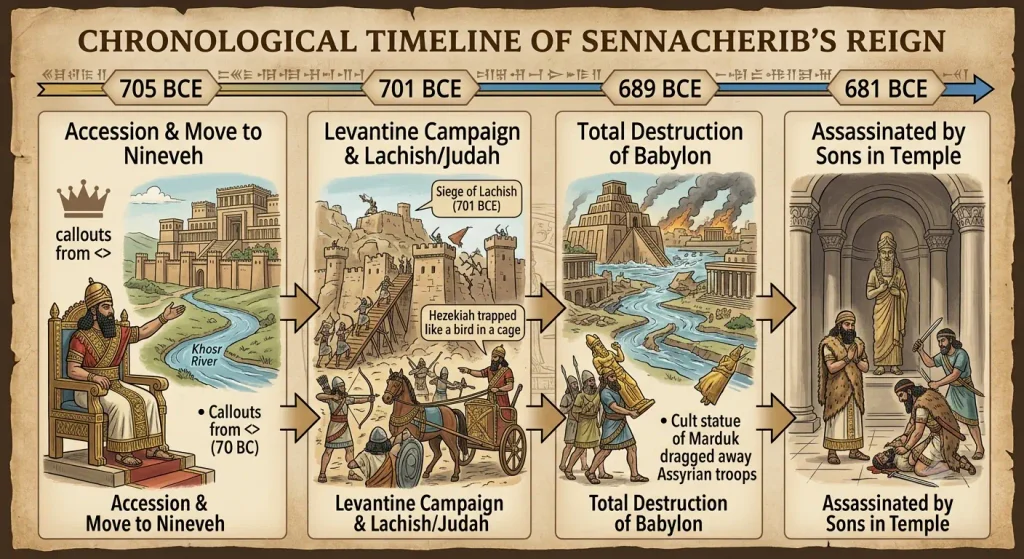
Royal Profile & Epigraphic Data
| Historical & Epigraphic Parameter | Primary Inscription Data |
| Royal Name | Sîn-aḫḫē-erība (Akkadian); Sanḥērev (Hebrew: סַנְחֵרִיב); Senacherib (Greek: Σεναχηρείμ) |
| Dynasty | Sargonid Dynasty (722–609 BCE) |
| Reign Dates | 705 – 681 BCE (Assassinated in month of Tebet) |
| Predecessor | Sargon II (Father, killed in Tabal, central Anatolia) |
| Successor | Esarhaddon (Aššur-aḫa-iddina, youngest designated son) |
| Primary Consort | Queen Naqi’a / Zakutu (influential West Semitic queen mother) |
| Royal Capital | Nineveh (relocated from Dur-Sharrukin in 705 BCE) |
| Key Primary Inscriptions | The Taylor Prism (British Museum), Oriental Institute Prism (Chicago), Jerwan Inscriptions, Bavian Inscriptions |
The Crisis of 705 BCE: The Death of Sargon II and the Curse of Tabal
Sennacherib’s accession to the imperial throne occurred amid profound existential and theological panic. In 705 BCE, King Sargon II fell in battle against an obscure local ruler in Tabal (central Anatolia). Uniquely for an Assyrian monarch, Sargon’s corpse was never recovered from the battlefield, denying him a sacred royal burial.
In Mesopotamian religious cosmology, dying unburied in a foreign land signified that the ruler had suffered the direct, wrathful curse of the great gods. This disaster left deep psychological and political marks on Sennacherib:
Abandonment of Dur-Sharrukin: Sennacherib immediately abandoned his father’s newly inaugurated capital of Dur-Sharrukin (Khorsabad), viewing it as spiritually tainted and cursed.
Theological Reorientation: Sennacherib deliberately avoided naming his father in his monumental public annals, attributing his own legitimacy directly to the national god Ashur and the moon god Sîn.
Capital Relocation to Nineveh: He moved the royal court, central bureaucracy, and military high command to Nineveh, initiating an aggressive urban campaign to eclipse all previous royal cities in size, hydraulic engineering, and artistic splendor.umental architecture.
The Levantine Campaign (701 BCE): Hezekiah, Jerusalem, and the Siege of Lachish
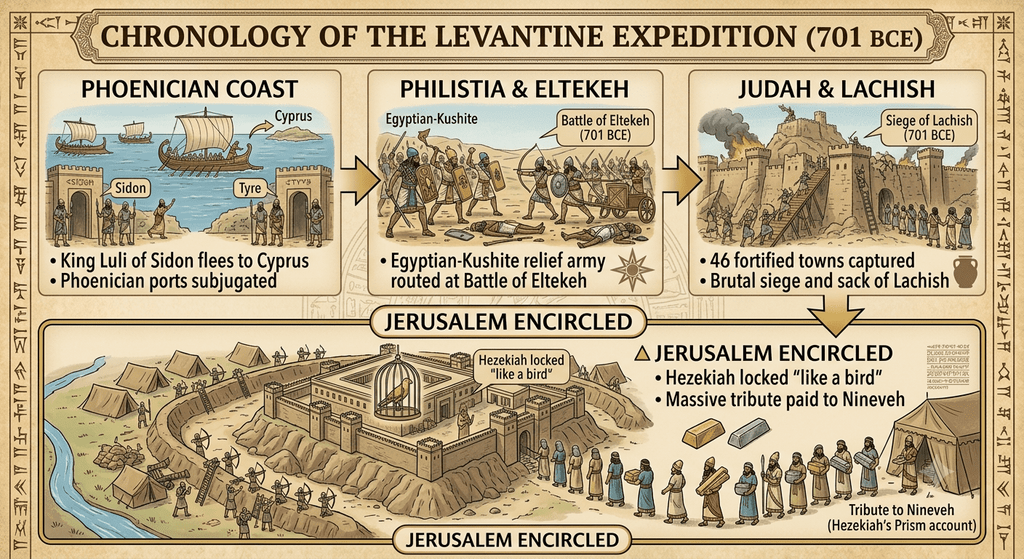
In 701 BCE, Sennacherib launched his famous third military campaign (The Western Campaign), marching his veteran army into the Levant to suppress a widespread, anti-Assyrian coalition supported by Kushite-ruled Egypt (25th Dynasty) and led by King Hezekiah of Judah.
The campaign became one of the most thoroughly documented military operations in ancient history, recorded simultaneously in Assyrian royal annals, monumental stone reliefs at Nineveh, the Hebrew Bible (2 Kings 18–19, Isaiah 36–37, 2 Chronicles 32), and confirmed by modern field archaeology.
The Siege and Fall of Lachish
Before advancing on Jerusalem, Sennacherib concentrated his imperial forces against Lachish (Tel Lachish), the strongest fortified citadel guarding the southwestern approaches to the Kingdom of Judah.
- Archaeological Evidence: Excavations at Tel Lachish revealed the only preserved Assyrian stone siege ramp in the Near East, constructed from thousands of tons of boulders and lime mortar against the city wall, alongside hundreds of iron arrowheads, slingstones, and bronze scale armor.
- The Lachish Reliefs (Nineveh): Sennacherib was so proud of this victory that he dedicated Room XXXVI of the Southwest Palace in Nineveh to a monumental multi-panel wall relief depicting the battle in graphic detail:
- Assyrian battering rams equipped with wooden sheds and water throwers to extinguish defensive fire torches.
- Captive Judean soldiers being impaled on wooden stakes, flayed alive, and led into mass deportation.
- Sennacherib seated upon an ornate ivory throne outside the city, receiving the surrender of Lachish’s elite.
The Blockade of Jerusalem: “Like a Bird in a Cage”
Following the fall of Lachish and the defeat of an Egyptian-Kushite vanguard at Eltekeh, Sennacherib dispatched his high officials—the Tartan (field commander), the Rab-saris (chief officer), and the Rabshakeh (chief cupbearer)—with a heavy military detachment to intimidate King Hezekiah into unconditional surrender at the walls of Jerusalem.
In the Taylor Prism and Oriental Institute Prism, Sennacherib recorded his encirclement of the Judean capital:
“As for Hezekiah the Judean, who had not submitted to my yoke, I besieged forty-six of his strong walled cities… I brought out from them 200,150 people, young and old, male and female, horses, mules, donkeys, camels, cattle, and sheep without number, and counted them as spoil. Himself, like a caged bird, I shut up in Jerusalem, his royal city. I erected earthworks against him to prevent anyone coming out of his city gate.”
The Two Perspectives: Cuneiform Annals vs. The Biblical Record
While both accounts agree on the broad political outcome—the total devastation of rural Judah and the payment of a crushing tribute by Hezekiah—they diverge dramatically regarding the final resolution of the siege of Jerusalem.
| Analytical Dimension | Assyrian Royal Annals (Prisms of Sennacherib) | Biblical Narrative (2 Kings 18–19 / Isaiah 37) |
| Initial Assessment | 46 Judean towns conquered; Hezekiah trapped inside Jerusalem. | All fortified cities of Judah taken; Hezekiah prepares defenses. |
| Jerusalem’s Surrender | City was not stormed; Hezekiah submitted as a tribute-paying vassal. | City was not stormed; spared by miraculous divine intervention. |
| Why the Siege Ended | Strategic objective achieved: heavy tribute delivered, regional rebellion broken. | The Angel of the Lord struck down 185,000 Assyrian soldiers in a single night. |
| Tribute Paid to Nineveh | 30 talents of gold, 800 talents of silver, precious gems, couches of ivory, and royal daughters. | 30 talents of gold, 300 talents of silver, stripped temple door overlays. |
| Fate of King Hezekiah | Remained on his throne as a diminished, humiliated Assyrian vassal. | Remained on his throne, celebrated for trusting in Yahweh. |
The Babylonian Problem and the Total Sacking of Babylon (689 BCE)
Throughout his reign, Sennacherib faced a chronic crisis in Babylonia. Unlike earlier Assyrian monarchs who sought to appease the ancient religious sensibilities of the south by ruling through dual kingship or taking the hand of the god Marduk during the Akitu New Year festival, Sennacherib’s relationship with Babylon descended into relentless warfare and culminated in one of the ancient world’s most radical acts of cultural and religious devastation.
                    THE PATH TO BABYLON'S DESTRUCTION

    CHRONIC REBELLION             TRAGEDY AT THE GULF             TOTAL RETRIBUTION (689 BCE)
 ┌──────────────────────┐       ┌──────────────────────┐        ┌──────────────────────┐
 │ • Merodach-baladan II│       │ • Elamites capture   │        │ • 15-month brutal    │
 │   sparks revolts     │─────► │   Assyrian crown     │──────► │   siege of Babylon   │
 │ • Chaldean-Elamite   │       │   prince (murdered)  │        │ • Temples looted and │
 │   military alliances │       │ • Battle of Halule   │        │   city submerged     │
 └──────────────────────┘       └──────────────────────┘        └──────────────────────┘
Merodach-baladan II and the Elamite Coalitions
The primary architect of Babylonian resistance was the Chaldean chieftain Merodach-baladan II (Marduk-apla-iddina II), who repeatedly seized the Babylonian throne with the financial and military backing of the Kingdom of Elam.
- The First Campaign (703 BCE): Sennacherib crushed Merodach-baladan’s allied army near Kish, forcing the Chaldean leader to flee into the impenetrable marshes of the Sealand (the Persian Gulf coastline).
- The Puppet King Experiment: Sennacherib installed a pro-Assyrian native Babylonian noble, Bel-ibni, on the southern throne. However, Bel-ibni proved incompetent or disloyal, collaborating with southern rebels.
- The Installation of Prince Ashur-nadin-shumi (700 BCE): Realizing that local puppets were unreliable, Sennacherib placed his own eldest son and designated heir, Ashur-nadin-shumi, directly on the throne of Babylon.
The Tragic Escalation: The Amphibious Gulf Campaign (694 BCE)
To eliminate the Chaldean insurgent bases once and for all, Sennacherib executed an unprecedented amphibious military expedition:
- Shipbuilding on the Tigris and Euphrates: Sennacherib commissioned Phoenician and Syrian shipwrights to build a fleet of Mediterranean-style warships (biremes) at Nineveh and Til-Barsip.
- The Gulf Crossing: The fleet sailed down the rivers to the Persian Gulf, landed on the Elamite coast, and burned Chaldean settlements.
- The Fatal Counter-Strike: While the Assyrian army was engaged in the south, the King of Elam launched a swift surprise invasion of northern Babylonia. The citizens of Babylon betrayed Prince Ashur-nadin-shumi, handing him over to the Elamites. The Assyrian heir was dragged in chains to Elam and executed.
The murder of his beloved eldest son and heir transformed Sennacherib’s Babylonian policy from imperial governance to a personal, merciless vendetta.
The Sacking and Deliberate Flooding of Babylon (689 BCE)
After fighting the bloody and indecisive Battle of Halule (691 BCE) against a massive combined coalition of Babylonians, Chaldeans, Arameans, and Elamites, Sennacherib marched directly on Babylon in 689 BCE, laying siege to the sacred city for fifteen months:
- Breaching and Mass Plunder: When the defenses collapsed, Assyrian troops systematically looted the great temples—including Esagila, the sacred sanctuary of Marduk. The colossal golden cult statue of Marduk was dismantled and dragged away as a captive trophy to Nineveh.
- The Weaponization of the Euphrates (The Deliberate Deluge): Sennacherib ordered the total physical erasure of the metropolis. Royal engineers dug massive trenches and canals through the urban core, diverted the waters of the Arakhtu Canal (Euphrates River) directly into the city, and washed the mudbrick houses, palaces, and temple foundations into the riverbed:“The city and its houses, from foundation to roof, I destroyed, devastated, and burned with fire. I pulled down the inner and outer walls, the temples, and the temple tower of brick and earth, and dumped them into the Arakhtu canal. I dug canals through the middle of that city, leveled it with water, destroyed its very foundations, and made its destruction worse than that of the Great Deluge.”
- The Symbolic Soil to Nineveh: To ensure the city could never rise again, Sennacherib had tons of sacred Babylonian topsoil loaded onto ships and carried to Nineveh, scattering it outside the city gates as a ritual sign of ultimate desecration.
Theological Repercussions Across Mesopotamia
Sennacherib’s destruction of Babylon was unprecedented in Near Eastern history. Babylon was not merely an administrative capital; it was the revered holy city and cultural mother of Mesopotamian civilization.
- Assyrian Unease: Even within Nineveh and Assur, many priests and scholars viewed the destruction of Marduk’s shrines as dangerous sacrilege (hibiltu).
- The Ashur-Marduk Theological Reform: To justify his actions, Sennacherib launched an aggressive religious reform: he elevated the national god Ashur above Marduk, rewriting the Babylonian creation epic (Enuma Elish) to replace Marduk with Ashur as the cosmic creator who slew Tiamat.
- Prophetic Portents: When Sennacherib was assassinated eight years later (681 BCE), Babylonian chroniclers recorded his violent death as the direct divine vengeance of Marduk against the sacrilegious king.
Aquí tienes el cuarto bloque, centrado en la faceta de Senaquerib como maestro constructor, el desarrollo urbano de Nínive, las innovaciones en fundición de bronce a la cera perdida y la ingeniería hidráulica del acueducto de Jerwan:
Master Builder: The Transformation of Nineveh and Hydraulic Engineering
Beyond his relentless military expeditions, Sennacherib considered his greatest legacy to be his revolutionary architectural and civil engineering accomplishments. By designating Nineveh as the permanent capital of the Neo-Assyrian Empire in 705 BCE, he initiated a massive urban redesign project that eclipsed all previous Mesopotamian building programs in technical complexity and aesthetic ambition.
                    SENNACHERIB'S URBAN & HYDRAULIC MASTER PLAN

    METROPOLITAN REDESIGN           MONUMENTAL PALACE              THE 150 KM HYDRAULIC WEB
 ┌─────────────────────────┐     ┌─────────────────────────┐     ┌─────────────────────────┐
 │ • Urban area tripled to │     │ • "Palace Without Rival"│     │ • Zagros mountain canals│
 │   750 hectares          │───> │ • Cire-perdue bronze    │───> │ • World's oldest stone  │
 │ • Double defensive walls│     │   casting innovations   │     │   aqueduct at Jerwan    │
 │ • 15 fortified gates    │     │ • 3 km of carved stone  │     │ • Terraced royal gardens│
 └─────────────────────────┘     └─────────────────────────┘     └─────────────────────────┘
“The Palace Without Rival” (Egalzagedilu) and Technological Innovations
Constructed on the southwestern terrace of the Kuyunjik citadel mound, Sennacherib’s imperial palace—named in Akkadian Egalzagidilu (“The Palace Without Rival”)—symbolized the centralization of absolute imperial power:
- Foundation and Dimensions: Built upon a massive, elevated terrace of limestone and sun-dried mudbrick measuring over 500 meters in length and 242 meters in width, the palace rose nearly 20 meters above the plain to protect against seasonal Tigris river floods.
- Monumental Wall Architecture: The palace comprised over 80 major state apartments, throne rooms, and courtyards lined with more than 3,000 meters of continuous narrative gypsum wall reliefs, detailing royal military victories, state rituals, and logistical engineering feats.
- Technological Breakthrough in Metallurgy (Cire-Perdue): In his foundation prisms, Sennacherib explicitly boasted of inventing a novel method for casting monumental bronze sculptures using the lost-wax technique (cire-perdue). Instead of beating metal sheets over wooden armatures, Assyrian metalsmiths poured molten bronze into giant clay molds to cast colossal, hollow bronze lions and tree-columns weighing up to 20 tons, a metallurgical feat previously thought impossible on such a scale:“I fashioned clay molds for great pillars and colossal lions… and poured copper into them over and over again, making their casting as perfect as if they were half-shekel coins.”
Urban Expansion and Fortifications
Sennacherib expanded the inhabited area of Nineveh from a modest provincial town into a sprawling metropolis of 750 hectares (1,850 acres):
- The Double Defensive Circuit: The city was encircled by an outer stone wall fronted by a deep ditch, backed by a massive inner mudbrick wall standing 25 meters high and 15 meters thick.
- The Royal Processional Avenue: Inside the city, Sennacherib laid out a monumental paved royal road measuring over 30 meters wide, flanked by boundary stones inscribed with a severe decree: anyone whose private construction encroached upon the royal avenue would be impaled on a stake in front of their home.
- 15 Fortified City Gates: Regulated entry points—such as the Nergal Gate, Shamash Gate, and Halzi Gate—were constructed with multi-chambered defensive bastions and guarded by monolithic winged bull colossi (lamassu).
The Jerwan Aqueduct and the 150-Kilometer Water System
To supply freshwater to Nineveh’s growing population, support extensive palace orchards, and sustain the royal cavalry corps, Sennacherib designed an intricate regional hydraulic infrastructure spanning more than 150 kilometers:
- Diversion of Northern Mountain Rivers: Sennacherib channeled water from rushing streams in the Zagros Mountains (including the Gomel and Atrush rivers) through a network of 18 separate rock-cut canals.
- The Jerwan Aqueduct (c. 690 BCE): To carry the canal water across a 300-meter-wide valley near Khenis, royal engineers built the Jerwan Aqueduct. Constructed with over two million dressed limestone blocks bound by waterproof mortar, it featured five corbelled arches spanning the riverbed. Cuneiform inscriptions carved along its stone piers proclaim:“Sennacherib, King of the World, King of Assyria: Over a vast valley, I built a bridge of white limestone blocks; over those stones, I made those waters pass.”
- The World’s Earliest Known Stone Aqueduct: The Jerwan structure predates classical Roman stone aqueducts by more than 500 years, standing as a landmark of ancient hydraulic civil engineering.
The Terraced Botanical Gardens: The True “Hanging Gardens”?
The abundant water transported by the Jerwan canal system allowed Sennacherib to cultivate sprawling botanical gardens designed to recreate the diverse ecosystems of his conquered territories:
- Exotic Flora and Fauna: The gardens contained rare botanical species brought from distant provinces, including cedar trees from Lebanon, olive groves from the Mediterranean, frankincense trees from Arabia, and cotton plants (“trees that bear wool”, which the palace scribes noted were harvested and woven into royal garments).
- Screw-Pump Water-Lifting Devices: Sennacherib recorded the installation of early bronze spiral water-lifting mechanisms (closely resembling the Archimedean screw, invented centuries before Archimedes) to elevate water to high-terrace garden levels.
- The Scholarly Hypothesis of Stephanie Dalley: Renowned Oxford Assyriologist Dr. Stephanie Dalley posits that the famous Hanging Gardens of the World, traditionally associated with King Nebuchadnezzar II of Babylon in Greek and Roman texts, were actually the terraced royal mountain-gardens built by Sennacherib at Nineveh. Classical writers frequently conflated Nineveh with Babylon after Nineveh’s destruction in 612 BCE.
The Assassination of Sennacherib and the Succession Crisis (681 BCE)
Despite his military dominance and transformative urban achievements, Sennacherib’s life ended in a violent palace conspiracy orchestrated by his own family. In the winter of 681 BCE, after ruling for twenty-four years, the king was assassinated in Nineveh—an event that sparked an immediate dynastic civil war and generated theological shockwaves across the ancient Near East.
                    THE 681 BCE SUCCESSION CRISIS & COUP

    DYNASTIC RESHIGHTING           THE TEMPLE ASSASSINATION        THE SWIFT RETRIBUTION
 ┌─────────────────────────┐     ┌─────────────────────────┐     ┌─────────────────────────┐
 │ • Elder sons bypassed   │     │ • King struck down in   │     │ • Esarhaddon marches on │
 │ • Esarhaddon named crown│───> │   the temple of Nabu/   │───> │   Nineveh from West     │
 │   prince by Naqi'a      │     │   Nisroch (Tebet 681 BCE│     │ • Conspirators flee to  │
 └─────────────────────────┘     └─────────────────────────┘     └─────────────────────────┘
The Root of the Conspiracy: The Succession Decree
The seeds of the conspiracy were planted following the tragic loss of Sennacherib’s eldest son and original heir, Ashur-nadin-shumi, who had been executed by the Elamites in 694 BCE.
- The Rise of Esarhaddon: Around 684 BCE, Sennacherib bypassed his older surviving sons—most notably Arda-Mulissu (known in the Bible as Adrammelech)—and formally proclaimed his younger, sickly son Esarhaddon (Aššur-aḫa-iddina) as the designated Crown Prince of Assyria.
- The Influence of Queen Naqi’a: This unexpected appointment was heavily driven by Esarhaddon’s mother, Queen Naqi’a (also known by her Akkadian name Zakutu), a West Semitic consort of immense political acumen who wielded unprecedented influence within the royal court.
- The Royal Loyalty Oath (Adê): Sennacherib forced his older sons, nobles, and provincial governors to swear binding religious oaths before the great gods to respect Esarhaddon’s succession.
- Exile for Safety: As court tensions escalated and Arda-Mulissu’s faction openly schemed against the crown prince, Sennacherib sent Esarhaddon away to the western provinces (near the upper Euphrates in Hanigalbat) to protect him from assassination.
The Assassination: 20th Day of Tebet, 681 BCE
Deprived of their dynastic birthright and fearing for their futures once Esarhaddon took power, the elder brothers struck:
- The Violent Regicide: On the 20th day of the month of Tebet (January 681 BCE), while King Sennacherib was praying inside a temple at Nineveh—identified in Neo-Babylonian chronicles as the Temple of Nabu (and in biblical texts as the Temple of the god Nisroch, likely a scribal corruption of Nimrod, Nabu, or Nusku)—he was ambushed and crushed to death by his older sons, led by Arda-Mulissu and Sarezer (Nabu-shar-usur).
- The Cuneiform Record: The Babylonian Chronicle tersely records the regicide:“On the twentieth day of the month of Tebet, Sennacherib king of Assyria was killed by his son in a rebellion. On the twenty-fourth day of the month of Addaru, Esarhaddon his son sat on the throne.”
The Hebrew Bible on Sennacherib’s Death
The biblical account in 2 Kings 19:36–37 (and paralleled in Isaiah 37:37–38) connects Sennacherib’s death directly to divine retribution for his siege of Jerusalem and his blasphemy against Yahweh:
“So Sennacherib king of Assyria departed, and went and returned, and dwelt at Nineveh. And it came to pass, as he was worshipping in the house of Nisroch his god, that Adrammelech and Sharezer his sons smote him with the sword: and they escaped into the land of Armenia [Urartu]. And Esarhaddon his son reigned in his stead.”
The Six-Week Civil War and Esarhaddon’s Triumph
The conspirators failed to secure the loyalty of the core imperial army or the citizenry of Nineveh:
- Esarhaddon’s Rapid Counter-Offensive: Receiving word of his father’s murder in the western provinces, Esarhaddon acted swiftly. Consulting the oracles of the goddess Ishtar of Arbela, he mobilized his loyal western divisions and marched directly toward Nineveh through harsh winter snowstorms.
- The Defection at the Tigris: When the rebel forces sent by Arda-Mulissu encountered Esarhaddon’s approaching vanguard in the region of Hanigalbat, the rank-and-file soldiers mutinied, defected en masse, and hailed Esarhaddon as their rightful sovereign.
- Flight into Urartu: The assassin brothers fled northward across the frontier into the mountainous kingdom of Urartu (modern Armenia), where they were granted political asylum.
- Purge and Consolidation: Entering Nineveh in March 681 BCE, Esarhaddon ascended the throne. He immediately executed everyone implicated in his father’s murder and purged the palace administration, inaugurating his own transformative reign under the strategic guidance of the Queen Mother, Naqi’a.
Sennacherib vs. Nebuchadnezzar: Key Historical Differences
Because both monarchs played pivotal, destructive roles in the history of the ancient Near East and feature prominently in the Hebrew Bible, Sennacherib of Assyria and Nebuchadnezzar II of Babylon are frequently conflated. However, they ruled distinct empires, lived more than a century apart, and executed very different imperial strategies.
                  CHRONOLOGICAL & IMPERIAL COMPARISON

     SENNACHERIB (705–681 BCE)                   NEBUCHADNEZZAR II (605–562 BCE)
 ┌──────────────────────────────────────┐     ┌──────────────────────────────────────┐
 │ • Empire: Neo-Assyrian               │     │ • Empire: Neo-Babylonian (Chaldean)  │
 │ • Capital: Nineveh                   │     │ • Capital: Babylon                   │
 │ • 701 BCE: Besieged Jerusalem        │───> │ • 587/586 BCE: Destroyed Jerusalem   │
 │   (spared city, took tribute)        │     │   (burned Solomon's Temple, exile)   │
 │ • Destroyed Babylon in 689 BCE       │     │ • Rebuilt Babylon into world wonder  │
 └──────────────────────────────────────┘     └──────────────────────────────────────┘
Side-by-Side Comparison of Sennacherib and Nebuchadnezzar II
| Comparison Parameter | Sennacherib (King of Assyria) | Nebuchadnezzar II (King of Babylon) |
| Imperial State | Neo-Assyrian Empire (Sargonid Dynasty) | Neo-Babylonian Empire (Chaldean Dynasty) |
| Reign Dates | 705 – 681 BCE | 605 – 562 BCE (over a century later) |
| Imperial Capital | Nineveh (modern Mosul, northern Iraq) | Babylon (near modern Hillah, central Iraq) |
| Campaign against Judah | 701 BCE (under King Hezekiah) | 597 & 587/586 BCE (under Kings Jehoiakim & Zedekiah) |
| Fate of Jerusalem | Encircled the city, took massive tribute, but left the city and Temple standing. | Breached the walls, destroyed Jerusalem, burned Solomon’s Temple, and deported the population. |
| Treatment of Babylon | Sacked and submerged Babylon under floodwaters in 689 BCE. | Transformed Babylon into the largest metropolis in the world, constructing the Ishtar Gate and Processional Way. |
| Hanging Gardens | Engineered the vast mountain aqueduct/garden complex at Nineveh (proposed true site). | Traditionally credited by classical Greek writers with building the gardens for Queen Amytis. |
| Biblical Portrayal | The arrogant invader struck down by divine judgment outside Jerusalem (2 Kings 18–19). | The “Servant of God” used to execute judgment on Judah, later humbled in the Book of Daniel. |
10 Essential Facts About King Sennacherib
- 1. His name reflects divine restoration: In Akkadian, Sîn-aḫḫē-erība translates to “The Moon God Sîn has replaced the brothers for me”, likely indicating that his older brothers died in infancy prior to his birth.
- 2. He relocated the capital after a divine omen: When his father Sargon II died in battle and was denied a royal burial in 705 BCE, Sennacherib abandoned Dur-Sharrukin as a cursed city and made Nineveh the imperial capital.
- 3. He built the massive “Palace Without Rival”: The Southwest Palace at Nineveh contained over 80 state rooms, colossal 30-ton lamassu gate keepers, and more than 3 kilometers of continuous carved stone wall reliefs.
- 4. He constructed the world’s oldest stone aqueduct: Around 690 BCE, Sennacherib built the Jerwan Aqueduct using over two million limestone blocks to carry mountain water 300 meters across a valley into Nineveh.
- 5. He besieged Jerusalem but spared the city: In 701 BCE, Sennacherib encircled King Hezekiah inside Jerusalem “like a caged bird”, taking 30 talents of gold and 800 talents of silver in tribute without storming the citadel.
- 6. His victory at Lachish is permanently carved in stone: Sennacherib celebrated his Levantine campaign by dedicating an entire throne room at Nineveh to the graphic narrative of the Siege of Lachish, now preserved in the British Museum.
- 7. He pioneered hollow bronze metal casting: Sennacherib recorded the earliest known industrial use of the lost-wax method (cire-perdue) to cast monolithic 20-ton bronze lions and structural columns.
- 8. He flooded and wiped out sacred Babylon in 689 BCE: After rebels killed his eldest son, Sennacherib diverted the waters of the Euphrates River through Babylon, dismantling its great temples and carrying off the sacred cult statue of Marduk.
- 9. He may be the true architect of the “Hanging Gardens”: Assyriological research suggests the legendary Hanging Gardens were not in Babylon, but were the terraced, mountain-fed botanical gardens built by Sennacherib at Nineveh.
- 10. He was assassinated by his own sons in a temple: In 681 BCE, his older sons Arda-Mulissu and Sarezer crushed the king to death inside the Temple of Nabu after he chose his younger son, Esarhaddon, as his successor.
Frequently Asked Questions About Sennacherib
How do you pronounce Sennacherib?
Sennacherib is pronounced /səˈnækərɪb/ (suh-NAK-uh-rib). In ancient Akkadian, his royal name was vocalized as Sîn-aḫḫē-erība (seen-akh-khay-ay-ree-ba), meaning “The Moon God Sîn has replaced the brothers for me.”
What is Sennacherib famous for in ancient history?
Sennacherib is famous for two monumental achievements: transforming Nineveh into the ancient world’s largest, most fortified capital (featuring the “Palace Without Rival” and the Jerwan Aqueduct) and conducting massive military campaigns across the Near East, most notably the 701 BCE Levantine campaign against Judah and the total destruction of Babylon in 689 BCE.
How did Sennacherib die and who killed him?
Sennacherib was assassinated on the 20th day of the month of Tebet in 681 BCE inside a temple at Nineveh (identified as the temple of Nabu/Nisroch). He was killed by his elder sons, led by Arda-Mulissu (biblical Adrammelech) and Sarezer, after Sennacherib bypassed them to appoint his younger son, Esarhaddon, as crown prince.
What happened between Sennacherib and King Hezekiah in the Bible?
In 701 BCE, Sennacherib invaded Judah to crush a regional rebellion. He captured 46 fortified Judean cities (including the major fortress of Lachish) and encircled King Hezekiah in Jerusalem “like a caged bird.” While the biblical account (2 Kings 18–19, Isaiah 37) credits the city’s salvation to the Angel of the Lord slaying 185,000 Assyrian troops overnight, Assyrian cuneiform annals state that Hezekiah submitted as a vassal and paid an enormous tribute of 30 talents of gold and 800 talents of silver to lift the siege.
Did Sennacherib destroy Babylon?
Yes. Following decades of southern revolts led by Chaldean chieftain Merodach-baladan II and the murder of Sennacherib’s crown prince Ashur-nadin-shumi, Sennacherib besieged Babylon in 689 BCE. Upon taking the city, he systematically looted the temples, dragged off the golden statue of Marduk, and diverted the Euphrates River through the urban core to wash away its brick foundations.
What is the difference between Sennacherib and Nebuchadnezzar II?
Sennacherib was a Neo-Assyrian king (reigned 705–681 BCE) ruling from Nineveh who besieged Jerusalem in 701 BCE but left the city and temple intact. Nebuchadnezzar II was a Neo-Babylonian king (reigned 605–562 BCE) ruling from Babylon over a century later, who captured Jerusalem in 587/586 BCE, burned Solomon’s Temple, and initiated the Babylonian Captivity.
Did Sennacherib build the Hanging Gardens?
Assyriologist Dr. Stephanie Dalley and other Near Eastern scholars propose that the legendary Hanging Gardens were actually built by Sennacherib at Nineveh, rather than by Nebuchadnezzar II at Babylon. Sennacherib’s royal inscriptions describe terraced mountain-gardens containing exotic flora irrigated by stone aqueducts (the Jerwan Aqueduct) and early bronze screw water-lifting mechanisms.
Further Readings & Primary Archaeological Sources
- The British Museum – The Taylor Prism: Royal Inscription of Sennacherib (Object 91032)
- The Oriental Institute of the University of Chicago – The Sennacherib Prism and the Levantine Annals
- Cuneiform Digital Library Initiative (CDLI) – Royal Inscriptions of the Neo-Assyrian Period: Sennacherib (RINAP 3)
- Encyclopaedia Britannica – Sennacherib: Assyrian King, Military Campaigns, & Facts
- World History Encyclopedia – Sennacherib: Reign, Campaigns, and the Transformation of Nineveh
Pingback: Nineveh: The Great Capital of the Assyrian Empire - ancientneareast.site