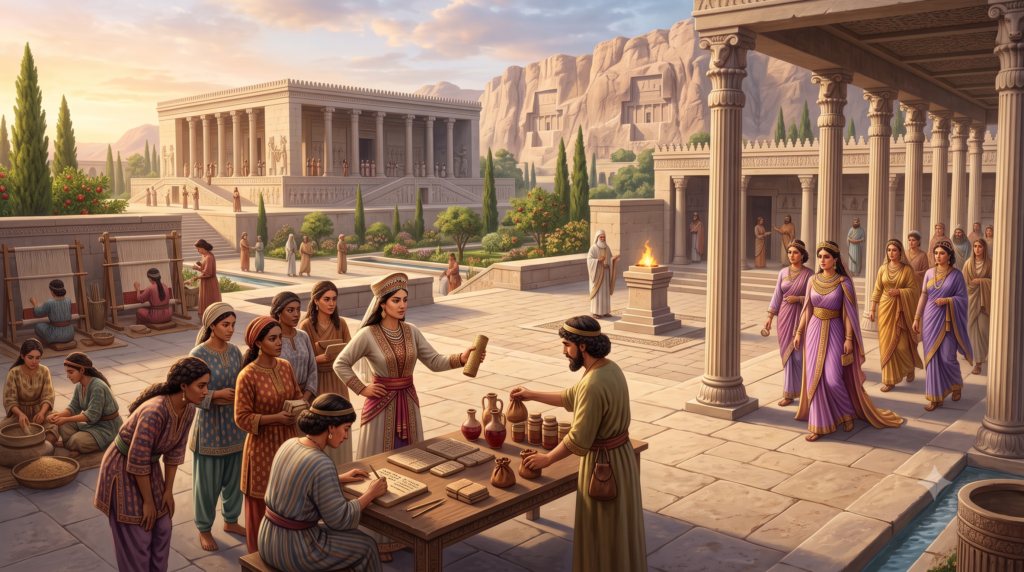
For centuries, Western historical imagination has reduced the women of the ancient Persian court to silent, exoticized figures confined behind palace walls—a biased literary trope primarily inherited from classical Greek playwrights and historians like Herodotus, Ctesias, and Xenophon.
However, twentieth-century archaeological excavations in southwestern Iran completely shattered this narrative. The discovery and translation of thousands of administrative clay tablets at Persepolis revealed a radically different reality: under the Achaemenid Empire (c. 550–330 BCE), women owned vast agricultural estates, commanded international trade networks, managed multi-ethnic labor forces, and received state-regulated maternity benefits more than 2,500 years ago.
       GREEK LITERARY BIAS              VS.       PERSEPOLIS CUNEIFORM EVIDENCE
 ──────────────────────────────────             ───────────────────────────────────
 • Secluded inside royal harems                  • Independent legal property owners
 • Politically voiceless pawns                   • Traveled with personal armed escorts
 • Complete economic dependency                  • Managed industrial workshops & estates
 • Treated as domestic property                  • Received state maternity & wage rations
The Persepolis Fortification Archive: Hard Economic Evidence
The primary source that dismantled the “harem myth” is the Persepolis Fortification Archive (PFA)—a corpus of tens of thousands of Elamite cuneiform tablets unearthed by the University of Chicago’s Oriental Institute in the 1930s.
Unlike Greek literary texts written decades or centuries after the events, these tablets are daily bureaucratic accounting records produced by imperial accountants between 509 and 493 BCE (during the reign of Darius I). They record real-time food disbursements, travel rations, land allocations, and state-mandated compensation. Within these clay ledgers, women appear constantly—not as dependents, but as autonomous economic actors.
«To understand how this society evolved over millennia, see our breakdown on whether Persian civilization is truly 7,000 years old.»
1. Royal Matriarchs and Independent Aristocratic Power
At the top of the social pyramid, Persian royal and noble women enjoyed extraordinary financial and legal autonomy. They maintained private treasuries, owned sprawling agricultural villages (paradeisoi), and wielded their own official cylinder seals (muššin) to authorize financial transactions.
                         ┌─────────────────────────────┐
                         │   PROMINENT ACHAEMENID      │
                         │      NOBLEWOMEN             │
                         └──────────────┬──────────────┘
                ┌───────────────────────┴───────────────────────┐
                ▼                                               ▼
     ┌──────────────────────┐                       ┌──────────────────────┐
     │   IRTYŠDONA (Artystone) │                       │       IRDABAMA       │
     │  Wife of Darius I    │                       │ Powerful Business    │
     │ • Owned 4+ major     │                       │   Tycoon             │
     │   estates & villages │                       │ • Controlled massive │
     │ • Personal chancellery│                       │   workforces & seals │
     └──────────────────────┘                       └──────────────────────┘
- Queen Artystone (Irtyšdona): The favorite wife of Darius the Great and daughter of Cyrus the Great, Artystone held vast private properties across Fars and modern Khuzestan. The tablets show her dispatching personal written orders to state officials to transport hundreds of liters of wine and grain from her estates to supply her personal retinues.
- Irdabama (The Non-Royal Business Magnate): Perhaps the most remarkable woman in the Persepolis tablets is Irdabama. Not verified as a queen, she was an independent aristocrat and business tycoon who commanded hundreds of workers across several manufacturing centers. She held her own elite cylinder seal, authorized travel passports for her administrative couriers, and possessed wealth rivaling the highest satraps of the empire.
To understand how these noble houses fit into the broader imperial hierarchy, explore our complete guide to Ancient Persian Civilization: Origins, Ethnogenesis, and Social Hierarchy.
2. Skilled Female Workers and the State Wage System
The economic autonomy of ancient Persian women was not limited to the royal court. In the state-managed labor system (the kurtaš workforce), female artisans and laborers were integrated into regular payroll registries alongside men.
               ACHAEMENID WORKFORCE HIERARCHY

                 [ Arad / Kurtaš Laborers ]
                             │
            ┌────────────────┴────────────────┐
            ▼                                 ▼
    MALE ARTISANS                     FEMALE ARTISANS
   (Stone, Timber)                  (Textiles, Wine, Grain)
            │                                 │
            ▼                                 ▼
   [ Headman / Chief ]               [ ARAŠŠARA (Female Chief) ]
   (Supervised Crews)                (Earned Highest Grade Rations)
- Equal Rations Based on Skill: Wage rations (paid in standardized quantities of barley, wine, beer, and meat) were determined by the technical difficulty of the craft and the worker’s output, rather than their gender alone.
- The Araššara (Female Workshop Chiefs): High-skilled female supervisors in charge of large weaving, grain processing, and textile manufacturing operations were designated as araššara. These women managed mixed-gender workforces and received significantly higher food and beverage allowances than ordinary male laborers.
3. Maternity Leave and Newborn Benefits in 500 BCE
One of the most astonishing discoveries within the Persepolis Fortification Archive is the existence of institutionalized state maternity compensation.
When female workers in the imperial workshops gave birth, the Achaemenid state recorded specific extra rations designed to ensure maternal and infant survival:
| Beneficiary / Event | Extra Monthly State Ration | Historical Significance |
| New Mother (Birth of a Boy) | 1 bar (approx. 10 liters) of wine/beer + 20 liters of grain | First historically documented state-funded postpartum nutritional supplement in the Near East. |
| New Mother (Birth of a Girl) | 0.5 bar (approx. 5 liters) of wine/beer + 10 liters of grain | While reflecting patriarchal gender preference in quantity, it guaranteed baseline maternal support regardless of infant sex. |
| Postpartum Rest Period | Temporary relief from heavy physical textile and agricultural duties | Female artisans were systematically protected by state accounting during recovery. |
These legal provisions demonstrate an administrative state that viewed skilled female labor not as disposable property, but as a vital civic and industrial asset worthy of legal protection.
4. Military Command and High Diplomacy
Beyond economic life, Persian noblewomen frequently influenced high-level statecraft, military strategy, and regional governance:
- Artemisia I of Caria: While culturally Greek from Caria, Artemisia ruled as an Achaemenid client monarch and admiral in the Persian imperial navy during the Persian Wars (480 BCE). King Xerxes I valued her naval counsel so highly that she was among the few commanders invited to the supreme war council prior to the Battle of Salamis.
- Royal Travel and Diplomatic Autonomy: Imperial passport tablets (miyatukqa) demonstrate that elite women regularly traveled across the vast Royal Road network from Susa to Sardis and Persepolis, accompanied by their personal armed guards, scribes, and food supply caravans.
Summary: Shattering the Western Harem Cliché
The archaeological record preserved in the clay of southwestern Iran paints a clear and compelling picture:
- Persian women owned, inherited, and leased private real estate independently.
- Female workshop masters (araššara) commanded mixed-gender industrial teams.
- The Achaemenid chancellery implemented institutionalized maternity rations for working-class mothers.
- Aristocratic women directed international trade routes and commanded personal retinues across the empire.
Far from being passive shadows in classical historiography, women formed an active, legally protected, and foundational pillar of ancient Persian civilization.