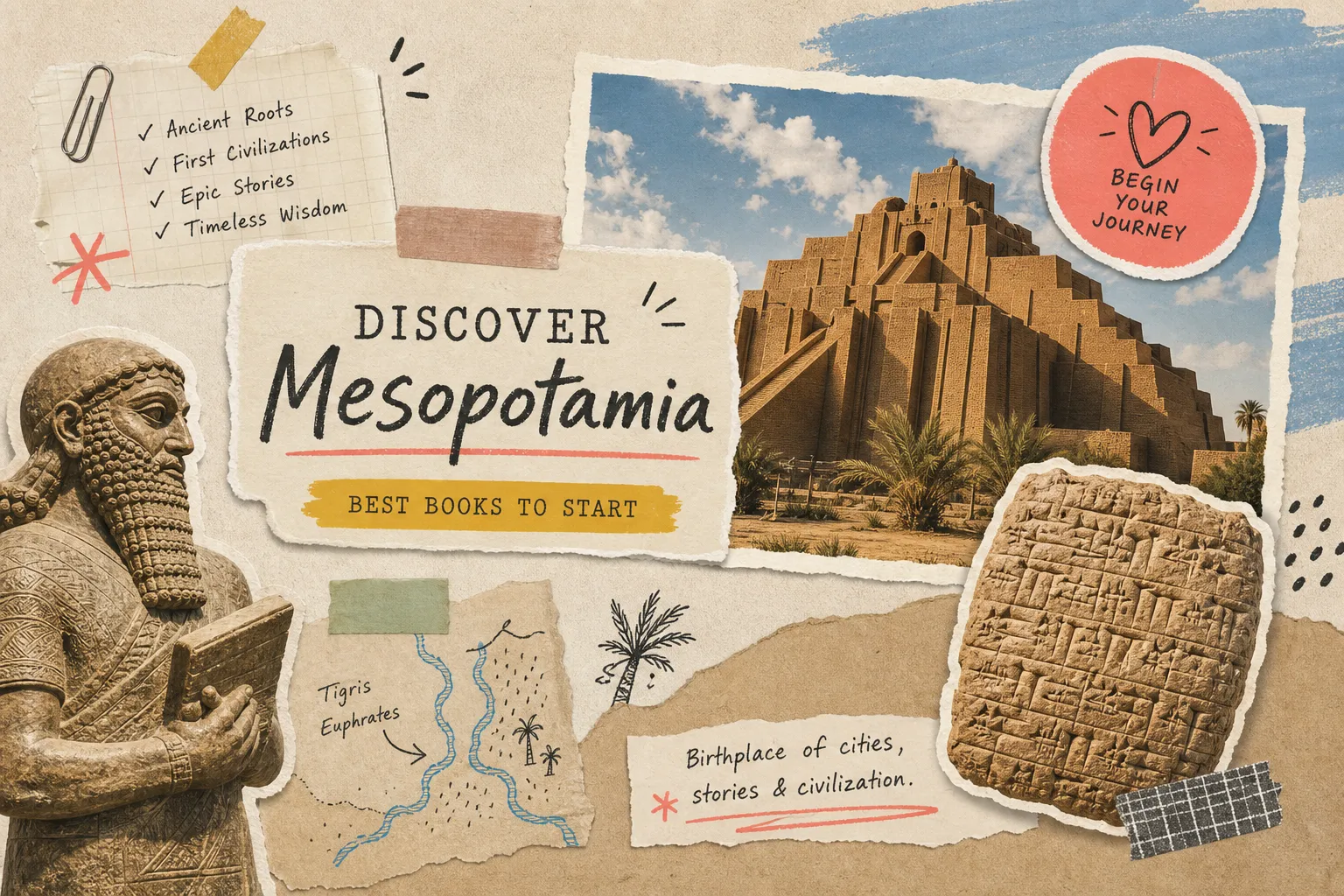
Diving into the history of ancient Mesopotamia can feel like stepping into a labyrinth. You are dealing with more than 3,000 years of history, a dizzying succession of empires—Sumerians, Akkadians, Babylonians, and Assyrians—and cities that have been buried under the sands of Iraq for millennia.
Because the subject is so vast, finding the right book is notoriously difficult. The Mesopotamian bookshelf usually falls into two frustrating extremes: heavily academic monographs filled with untranslated cuneiform jargon that feel like a chore to read, or overly simplified surveys that skip the rich, fascinating details of how these people actually lived.
If you choose the wrong entry point, the cradle of civilization can feel like dry homework. But with the right book, the ancient Near East becomes exactly what it was: a thrilling, vibrant world where humanity invented writing, law, monumental architecture, and astronomy.
To save you the headache of navigating university reading lists, we have curated the definitive guide to the best books on ancient Mesopotamia. Whether you are an absolute beginner looking for a gripping narrative or a serious history buff wanting to deepen your knowledge, these are the essential titles that deserve a spot on your shelf.
Where to Start: The Best Narrative Histories (For Absolute Beginners)
If you are new to the subject, do not start with a dense academic textbook. You need a narrative history—a book that pieces together the archaeological fragments and clay tablets into a compelling, chronological story. These two books are the absolute best entry points into the ancient Near East.
1. Babylon: Mesopotamia and the Birth of Civilization (by Paul Kriwaczek)
If you only ever read one book about ancient Mesopotamia, make it this one. Despite the title focusing on “Babylon,” Paul Kriwaczek actually covers the entire arc of Mesopotamian history, starting from the earliest Sumerian settlements in the deep south all the way to the fall of the Neo-Babylonian empire.
What makes Kriwaczek’s work the gold standard for beginners is his prose. He writes with the rhythm of a storyteller and the precision of a historian. Instead of just listing kings and battles, he explains how the civilization functioned: how early river irrigation forced humans to invent bureaucracy, how trade networks spanned from India to Egypt, and how ancient legal systems evolved. It is a wildly engaging read that makes 5,000-year-old history feel immediate and relevant.
- Best for: The absolute beginner who wants a comprehensive, page-turning overview of the entire civilization.
2. Weavers, Scribes, and Kings: A New History of the Ancient Near East (by Amanda H. Podany)
While Kriwaczek gives you the grand, sweeping narrative, Amanda H. Podany offers something entirely fresh. Published in 2022, this is the most current and up-to-date introductory history available, reflecting the latest archaeological discoveries.
Podany’s brilliant approach is “microhistory.” Instead of just focusing on massive empires and unapproachable kings, she grounds each era in the lives of real, documented individuals. Through translated cuneiform letters and receipts, you will meet a female weaver struggling in a royal workshop, a merchant traveling dangerous roads, a dedicated scribe, and queens managing vast estates. It is a masterful achievement that strips away the mythological dust and shows you the ancient Near East through the eyes of the everyday people who built it.
- Best for: Readers looking for modern, up-to-date scholarship that focuses on the human element and daily life in antiquity.
Going Deeper: Foundational Classics for Serious Readers
Once you have a grasp of the basic timeline and the narrative flow of Mesopotamian history, you will likely find yourself wanting more detail. The following two books are considered foundational texts in Assyriology and Sumerology. They are denser and more scholarly than the introductory narratives, but they are absolutely essential for anyone looking to build a serious historical library.
3. Ancient Iraq (by Georges Roux)
If Kriwaczek’s book is a cinematic documentary, Georges Roux’s Ancient Iraq is the ultimate encyclopedia. For decades, this book has been universally recognized as the most comprehensive, single-volume history of Mesopotamia ever written for a general audience.
Roux covers an astonishing span of time—from the prehistoric paleolithic settlements all the way through the Sumerian, Akkadian, Babylonian, and Assyrian periods, right down to the conquest by the Persian Empire and the Hellenistic era. What sets this book apart is its rigorous detail regarding political history, shifting borders, and chronological king lists. It is heavier and more academic in tone, but Roux manages to keep the text accessible. This is the book you buy to keep on your desk as a lifelong reference guide.
- Best for: The serious history buff, university student, or anyone who wants a comprehensive reference volume to return to again and again.
4. The Sumerians: Their History, Culture, and Character (by Samuel Noah Kramer)
If your historical curiosity is specifically drawn to the very beginning—the invention of writing, the first city-states like Uruk and Eridu, and the birth of organized religion—then you must read Samuel Noah Kramer.
First published in 1963, this book remains the undisputed classic on the first civilization of Mesopotamia. Kramer was not just an author; he was one of the foremost Sumerologists of the twentieth century. He spent his life personally deciphering and translating ancient clay tablets. When you read this book, you are learning directly from the man who helped the modern world rediscover Sumerian literature. Kramer’s genuine passion for the subject bleeds through every page, making complex topics like the Sumerian pantheon, educational systems (the edubba), and early legal codes incredibly fascinating.
- Best for: Readers fascinated by the origins of civilization, early mythology, and those who want to focus exclusively on the Sumerians.
Essential Literature: Reading the Ancients Directly
Reading modern historians is crucial, but to truly understand the soul of ancient Mesopotamia, you must read their own words. The surviving clay tablets offer a window into their fears, their humor, and their profound questions about life and death. If you are going to read one primary text from the ancient world, it must be this one.
5. The Epic of Gilgamesh (Translated by Andrew George)
The Epic of Gilgamesh is the oldest surviving great work of literature in human history, predating Homer’s Iliad by well over a thousand years. It tells the story of Gilgamesh, the tyrannical king of the city of Uruk, his powerful friendship with the wild man Enkidu, and his ultimately tragic, world-spanning quest for immortality.
However, when buying Gilgamesh, the translation you choose matters immensely. You should specifically seek out the Penguin Classics edition translated by Andrew George. Why? Because Andrew George is one of the world’s leading cuneiform scholars. Instead of just smoothing over the broken parts of the ancient tablets to make a modern novel, he respects the original text. He provides a highly readable, poetic translation while clearly indicating where the ancient clay is broken or missing. The introduction alone is a masterclass in Mesopotamian literature.
- Best for: Literature lovers, philosophy enthusiasts, and anyone who wants to read the foundational myth of human civilization.
Visual Learning: Best Books on Mesopotamia for Kids and Students
Ancient Mesopotamia can be unusually difficult to visualize. Unlike ancient Egypt or Rome, where massive stone ruins still stand, most Mesopotamian cities were built of mudbrick and have melted back into the earth. To understand what a ziggurat looked like, or how a cuneiform tablet feels in the hand, younger readers and students need strong visual anchors.
6. DK Eyewitness: Mesopotamia
For children, middle-schoolers, or even visual learners, the DK Eyewitness series remains the absolute gold standard. This book ditches dense paragraphs in favor of stunning, full-color artifact photography and bite-sized, engaging historical facts.
Rather than just reading about the Assyrian military or Babylonian astronomy, readers can actually see high-resolution images of bronze helmets, intricately carved cylinder seals, and the golden treasures recovered from the Royal Tombs of Ur. It covers daily life, the gods and goddesses, the invention of the wheel, and the development of writing in a way that is instantly accessible. It is the perfect visual companion to any of the narrative histories mentioned above.
- Best for: Children (ages 8-14), homeschoolers, middle-school classrooms, and visual learners who want to see the artifacts up close.
How to Build Your Mesopotamian Reading Path
No single book can fully capture 3,000 years of human history. The best way to learn about the ancient Near East is to let your curiosity guide you.
We highly recommend starting with a narrative overview like Kriwaczek’s Babylon to get the big picture. Once you have the timeline straight in your head, you can zoom in on what fascinates you most—whether that is the early Sumerian city-states with Kramer, or the epic literature of Gilgamesh.
And you don’t have to wait for your books to arrive in the mail to start learning. While you wait, you can continue your journey right here. If Kramer’s book sparks an interest in the first cities, explore our detailed guides on the ancient Sumerians. If you want to know more about the terrifying military machine that shaped the later periods, dive into our comprehensive history of the Assyrian Empire. A good book introduces the questions; a dedicated historical library helps you answer them.
Frequently Asked Questions (FAQ)
What is the best book to learn about Sumerians?
The best foundational book to learn about the Sumerians is The Sumerians: Their History, Culture, and Character by Samuel Noah Kramer. Although originally published in 1963, Kramer’s expertise as a leading Sumerologist makes it the most authoritative and readable introduction to the world’s first civilization.
Is The Epic of Gilgamesh hard to read?
No, The Epic of Gilgamesh is surprisingly accessible, provided you choose a good translation. The Penguin Classics edition, translated by Andrew George, is highly recommended for beginners. It reads like mythic poetry and provides excellent context to help modern readers understand the ancient metaphors and missing clay fragments.
What is the most accurate book on ancient Mesopotamia?
For the most accurate, comprehensive, and academically rigorous overview of the entire region, Ancient Iraq by Georges Roux is considered the gold standard. For the most up-to-date modern scholarship reflecting recent archaeological discoveries, Weavers, Scribes, and Kings by Amanda H. Podany (2022) is highly recommended.
Which Mesopotamian empire came first?
When reading about ancient Mesopotamia, the chronological order of the major powers can be confusing. The Sumerians were the first civilization to develop city-states and writing (c. 3500 BC). They were followed by the Akkadian Empire, and later by the alternating dominance of the Babylonians in the south and the Assyrians in the north.