Overview, Age, and Epigraphic Origins
The Epic of Gilgamesh is widely recognized as the world’s oldest surviving epic poem and the foundational masterpiece of Mesopotamian literature. Composed in ancient Mesopotamia across more than a millennium of textual evolution, the epic chronicles the transformative journey of Gilgamesh, the legendary king of Uruk (historical Early Dynastic Period, c. 2700 BCE), as he transitions from a tyrannical monarch into a heroic warrior, and ultimately into a grief-stricken mortal searching for the secret of eternal life.
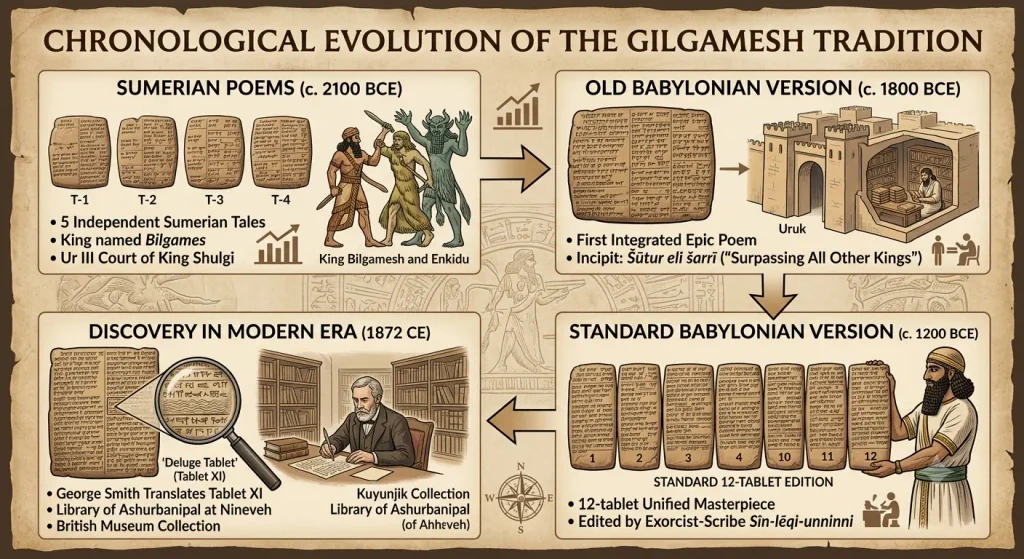
How Old Is the Epic of Gilgamesh and When Was It Written?
The epic was not composed in a single moment by a single author; instead, it developed across three principal historical stages:
- Sumerian Origins (c. 2100–2000 BCE): The earliest surviving poems were composed in the Sumerian language during the Third Dynasty of Ur (Ur III). Kings such as Shulgi celebrated their ancestral kinship with the hero-king, calling him Bilgames. Five independent poems survive from this era, including Gilgamesh and the Bull of Heaven and Gilgamesh and Huwawa.
- The Old Babylonian Version (c. 1800–1600 BCE): During the First Dynasty of Babylon, scribes combined the fragmented Sumerian tales into the first unified Semitic (Akkadian) epic. This version was known by its incipit, Šūtur eli šarrī (“Surpassing All Other Kings”).
- The Standard Babylonian Version (c. 1200–1000 BCE): The definitive twelve-tablet edition was compiled, redacted, and formalized by the Middle Babylonian exorcist-priest (mašmaššu) and royal scribe Sîn-lēqi-unninni. Known by its new opening line, Ša naqba īmuru (“He Who Saw the Deep” or “He Who Saw the Abyss”), this version was preserved on clay tablets in the 7th-century BCE Royal Library of Ashurbanipal at Nineveh.
Epigraphic Profile of the Epic of Gilgamesh
| Philological & Historical Metric | Cuneiform & Academic Record |
| Literary Genre | Heroic / Philosophical Epic Poetry (composed in rhythmic metric verse) |
| Original Standard Incipit | Ša naqba īmuru (“He Who Saw the Deep” / “He Who Saw the Abyss”) |
| Primary Languages | Sumerian (original tales); Standard Babylonian Akkadian (canonical epic) |
| Historical Protagonist | Gilgamesh (Bilgames), King of Uruk (2/3 divine, 1/3 mortal) |
| Canonical Redactor / Editor | Sîn-lēqi-unninni (c. 1200 BCE) |
| Physical Preservation | 12 Cuneiform Clay Tablets (~3,000 lines of Akkadian poetry) |
| Primary Excavation Site | Royal Library of King Ashurbanipal (Kuyunjik / Nineveh, modern Iraq) |
| Modern Rediscovery | 1872, deciphered by British Museum Assyriologist George Smith |
Summary of the Epic of Gilgamesh: The 12 Cuneiform Tablets
The canonical Standard Babylonian version compiled by Sîn-lēqi-unninni is arranged across twelve distinct clay tablets. The narrative structure of the Poem of Gilgamesh divides naturally into two major thematic halves: the heroic exploits of companionship (Tablets I–VI) and the psychological descent into grief and the quest to conquer death (Tablets VII–XII).
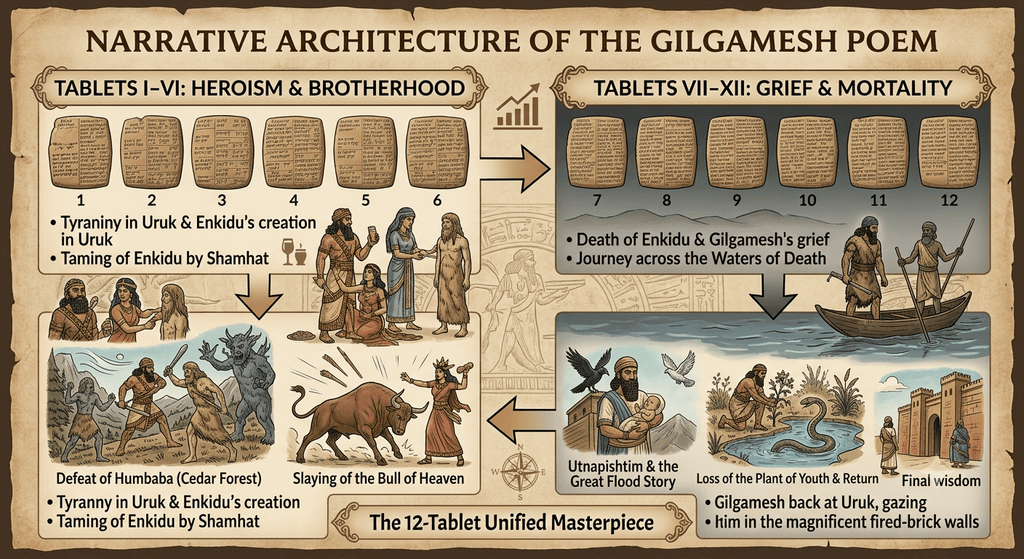
Part I: The Heroic Deeds in the Epic of Gilgamesh (Tablets I to VI)
- Tablet I – The Tyrant of Uruk and the Creation of Enkidu: Gilgamesh, two-thirds divine and one-third human, rules Uruk with ruthless arrogance, working his subjects to exhaustion and exercising droit du seigneur. The citizens cry out to the sky god Anu, who commands the birth goddess Aruru to fashion an equal counterweight out of clay in the wild: the wild man Enkidu.
- Tablet II – The Taming of Enkidu and the Sacred Bond: The temple courtesan (harlot) Shamhat civilizes Enkidu through sexual initiation, human food, and clothing. Enkidu travels to Uruk to challenge Gilgamesh’s tyranny. After a furious wrestling match in the streets, neither can best the other; recognizing their equality, they embrace and forge an eternal brotherhood.
- Tablet III & IV – Journey to the Cedar Forest: Seeking immortal fame (šumu), Gilgamesh proposes a dangerous expedition to the distant Cedar Forest of Lebanon. Despite warnings from the elders of Uruk and King Lugalbanda’s blessing via Queen Ninsun (Gilgamesh’s divine mother), the two companions march across mountains guided by prophetic dreams.
- Tablet V – Defeat of the Monster Humbaba: With the divine assistance of the sun god Shamash, who unleashes thirteen blinding winds, Gilgamesh and Enkidu defeat Humbaba, the monstrous guardian of the sacred forest appointed by Enlil. Despite Humbaba’s pleas for mercy, they strike him down and cut down the tallest cedar trees to construct a massive gate for Nippur.
- Tablet VI – Ishtar’s Proposal and the Bull of Heaven: Returning victorious to Uruk, Gilgamesh washes his hair and dons royal robes. The goddess Ishtar (Inanna) is struck with lust and proposes marriage. Gilgamesh violently rejects her, listing the tragic fates of her past lovers (Tammuz, the lion, the horse). Enraged, Ishtar demands the Bull of Heaven (Gugalanna) from her father Anu to destroy Uruk. Gilgamesh and Enkidu kill the beast, and Enkidu hurls the bull’s severed thigh directly in Ishtar’s face.
Part II: Mortality and the Search for Eternal Life in the Poem of Gilgamesh (Tablets VII to XII)
Tablet XII – The Descent into the Netherworld (Sumerian Appendix): A non-linear literary appendix translated directly from the Sumerian tale Gilgamesh, Enkidu, and the Netherworld. Enkidu descends into the Underworld to retrieve lost sporting objects (pukku and mekku) belonging to Gilgamesh. Breaking sacred underworld taboos, he is trapped. Ea enables Enkidu’s ghost (eṭemmu) to rise temporarily through a fissure in the earth to describe the bleak social conditions of various souls in the afterlife.
Tablet VII – The Death of Enkidu: The high council of gods (Anu, Enlil, Ea, Shamash) decrees that one of the heroes must pay with his life for slaying Humbaba and the Bull of Heaven. Enlil chooses Enkidu. Stricken by a agonizing wasting disease, Enkidu curses Shamhat and the door of cedar, but Shamash comforts him. Enkidu experiences a chilling nightmare vision of the Mesopotamian Underworld (House of Dust) before dying in Gilgamesh’s arms.
Tablet VIII – Gilgamesh’s Mourning and Royal Funeral: Shattered by the loss of his companion, Gilgamesh delivers a poetic lament, orders craftsmen across the empire to construct a golden statue of Enkidu, and pours out lavish funerary offerings to the gods of the Netherworld.
Tablet IX – Wandering the Wasteland and Mount Mashu: Paralyzed by the realization that he too must die, Gilgamesh abandons his royal garments, dresses in animal skins, and roams the desert in search of Utnapishtim, the sole mortal granted immortality by the gods. He reaches the twin peaks of Mount Mashu, guarded by fearsome Scorpion-men, and travels twelve leagues through terrifying total darkness along the Path of the Sun.
Tablet X – The Advice of Siduri and the Waters of Death: Emerging into an enchanted jewel-bearing garden by the sea, Gilgamesh meets the divine alewife Siduri, who urges him to embrace mortal joy. Undeterred, Gilgamesh enlists the ferryman Urshanabi and uses 120 punting poles to cross the lethal Waters of Death to reach the shores of the immortal sage.
Tablet XI – The Great Deluge and the Test of Sleeplessness: Utnapishtim recounts the story of the ancient flood and challenges Gilgamesh to conquer sleep—the minor cousin of death—for six days and seven nights. Gilgamesh fails instantly, falling asleep as Utnapishtim’s wife bakes a daily loaf of bread to mark his failure. Relenting, Utnapishtim reveals a consolation secret: a thorny plant at the bottom of the sweet-water sea that restores youth. Gilgamesh retrieves it, but while he bathes in a pool on the journey home, a water snake smells the plant, steals it, and immediately sheds its skin. Weeping, Gilgamesh returns empty-handed to Uruk, inviting Urshanabi to gaze upon the magnificent fired-brick walls of his city—the only true immortality a mortal king can leave behind.
Core Themes and Meaning of the Epic of Gilgamesh
Beyond its mythological monsters and heroic exploits, the Poem of Gilgamesh is fundamentally a philosophical meditation on what it means to be human. The epic addresses timeless existential dilemmas that still resonate in modern literature.
                    THE PHILOSOPHICAL ARC OF THE POEM

        ARROGANCE ───► ATTACHMENT ───► DESPAIR ───► ACCEPTANCE
     (Immortal Ambition) (Companionship) (Fear of Death)  (Cultural Legacy)
The Inevitability of Death and the Human Condition
The central thematic conflict of the Epic of Gilgamesh is the tragedy of mortality. Gilgamesh is created two-thirds divine and one-third human, giving him superhuman vitality while leaving him subject to physical death.
- The Illusion of Invulnerability: In his youth, Gilgamesh believes that heroic glory in battle can substitute for eternal life.
- The Shattering of Denial: When Enkidu dies, the reality of biological decay strikes Gilgamesh directly. His terror is not merely abstract; it is visceral. He watches a maggot fall from his dead friend’s nose and realizes that he will share the same fate.
- The Wisdom of Siduri: In Tablet X of the Old Babylonian version, the divine alewife Siduri delivers the core philosophical advice of the epic, urging Gilgamesh to abandon impossible quests and embrace earthly life:
“Gilgamesh, where are you hurrying to? You will never find that life for which you are looking. When the gods created man, they allotted death to him, and life they held back in their own hands. As for you, Gilgamesh, let your belly be full, make merry by day and night… Look upon the child holding your hand, and let your wife delight in your embrace. For this alone is the concern of man.”
Nature versus Civilization: The Transformation of Enkidu
The relationship between Gilgamesh and Enkidu explores the tension between pristine wilderness and urban civilization:
- Enkidu the Wild Man: Born in the steppes, Enkidu eats grass with gazelles and drinks at water holes with beasts, representing untamed primal nature.
- Civilization through Shamhat: The temple harlot Shamhat civilizes Enkidu through human intimacy, bread, beer, and woven garments. Once initiated into human culture, the wild animals reject him, forcing him into the social world of the city.
- The Urban Champion: Enkidu becomes the protector of shepherds and the companion of the King, illustrating the Mesopotamian belief that human flourishing only occurs within the ordered confines of the city-state.
Kingship and the Power of Cultural Legacy
The epic begins and ends with an invitation to examine the walls of Uruk. This circular narrative structure delivers the ultimate moral of the poem:
- At the start, the walls represent the vanity of an oppressive king.
- By the end, after failing to attain physical immortality or preserve the rejuvenating plant, Gilgamesh returns to Uruk with the ferryman Urshanabi. He points out the baked brick foundations, the palm groves, and the temple of Ishtar.
- True Immortality (Šumu): While individual biological existence is fleeting, humanity achieves enduring immortality through good governance, lasting architecture, artistic works, and the stories passed down through generations.
Tablet XI and the Flood Myth: Gilgamesh versus Noah’s Ark
The eleventh tablet of the Epic of Gilgamesh is the most widely discussed chapter in ancient Near Eastern literature. It contains a complete account of a catastrophic universal deluge that predates the biblical narrative of Noah’s Ark in the Book of Genesis by centuries.
The Rediscovery by George Smith (1872)
On December 3, 1872, Assyriologist George Smith presented a paper to the Society of Biblical Archaeology in London. Working in the archives of the British Museum, Smith had pieced together fragmented clay tablets from the Royal Library of Ashurbanipal (Tablet K.3375, known as the Deluge Tablet).
As Smith translated the cuneiform signs, he recognized a story nearly identical to the biblical flood: a divinely chosen man commanded to build an ark, coat it with bitumen, gather animals, survive a worldwide deluge, and release birds to find dry land. The discovery caused a global sensation in 19th-century intellectual circles, providing concrete archaeological evidence that Mesopotamian literary traditions directly influenced ancient Near Eastern flood mythology.
The Account of Utnapishtim in the Gilgamesh Epic
When Gilgamesh reaches the remote paradise of Dilmun and asks Utnapishtim how he achieved eternal life among the gods, Utnapishtim recounts the secrets of the antediluvian world:
- The Secret Decree: In the ancient city of Shuruppak, the great gods (led by Enlil) resolved to destroy humanity with a universal flood.
- The Warning of Ea: The god of wisdom, Ea (Enki), bound by a divine oath not to reveal the decree to humans, whispered the warning to the reed wall of Utnapishtim’s house:“Reed house, reed house! Wall, wall! O man of Shuruppak, tear down your house and build a boat! Abandon wealth and seek living beings! Spurn possessions and keep life alive!”
- The Giant Vessel: Ea provided exact dimensions: a massive cubic vessel with six decks, divided into nine compartments per level, completely sealed with melted bitumen and pitch.
- The Storm and Devastation: Utnapishtim boarded the vessel with his family, skilled craftsmen, and specimens of wild and domestic animals. The storm god Adad and the underworld deities unleashed a tempest so ferocious that even the gods fled to the highest heavens, weeping in terror.
- The Mountain of Nimush and the Birds: After six days and seven nights, the storm subsided and the ship came to rest on the peak of Mount Nimush (Mount Pir Omar Gudrun in Iraqi Kurdistan). To test if the waters had receded, Utnapishtim released three birds:
- A dove, which found no resting place and returned.
- A swallow, which also found no resting place and returned.
- A raven, which saw that the waters had diminished, fed on floating carrion, and did not return.
- The Gift of Immortality: Stepping onto dry land, Utnapishtim offered sacrifices. Enlil, initially furious at humanity’s survival, was placated by Ea. Touched by Utnapishtim’s piety, Enlil touched the foreheads of Utnapishtim and his wife, elevating them to immortal divine status.
Side-by-Side Comparison: The Epic of Gilgamesh vs. Noah’s Ark (Genesis 6–9)
| Narrative Element | Tablet XI of the Epic of Gilgamesh | Book of Genesis (Hebrew Bible) |
| Reason for Cataclysm | Human noise and divine caprice | Moral corruption, evil, and violence (ḥamās) |
| Divine Agent of Mercy | Ea (Enki) whispers through a reed wall | Yahweh speaks directly to righteous Noah |
| Vessel Design | Giant multi-deck cube sealed with pitch and bitumen | Multi-deck rectangular ark (Tevah) sealed with pitch |
| Passengers | Family, skilled craftsmen, domestic and wild beasts | Immediate family and pairs/sevens of living animals |
| Duration of the Deluge | 6 days and 7 nights | 40 days and 40 nights of continuous rain |
| Landing Location | Mount Nimush | Mountains of Ararat |
| Birds Sent to Scout | Dove, Swallow, Raven | Raven, Dove (sent three successive times) |
| Post-Flood Sacrifices | Sacrifices burned; gods gather like flies | Altar built; Yahweh smells the soothing aroma |
| Covenant Token | Ishtar holds up her lapis lazuli necklace | God sets the rainbow in the clouds |
| Fate of the Hero | Granted immortal life with the gods | Blessed with a long mortal life, dies at 950 years |
10 Essential Facts About the Epic of Gilgamesh
- 1. It is the world’s oldest surviving epic poem: The earliest Sumerian poems about Gilgamesh date back to the Third Dynasty of Ur (c. 2100 BCE), predating Homer’s Iliad and Odyssey by more than a thousand years.
- 2. The hero was likely an actual historical king: Historical and epigraphic records, including the Sumerian King List and the Tummal Inscription, confirm that King Gilgamesh ruled the city-state of Uruk around 2700 BCE during Mesopotamia’s Early Dynastic II Period.
- 3. The standard version was edited by an exorcist-priest: Around 1200 BCE, the Babylonian scholar-scribe Sîn-lēqi-unninni unified the independent Sumerian and Akkadian tales into the canonical 12-tablet Standard Babylonian edition (Ša naqba īmuru).
- 4. It contains the earliest literary bromance: The deep fraternal bond between the civilized king Gilgamesh and the wild man Enkidu forms the emotional core of the narrative, pioneering the buddy-narrative archetype in world literature.
- 5. The Deluge Tablet caused a 19th-century sensation: In 1872, Assyriologist George Smith deciphered Tablet XI from the Royal Library of Ashurbanipal at the British Museum, revealing an ancient Mesopotamian flood account that closely parallels the biblical story of Noah’s Ark.
- 6. Gilgamesh is two-thirds divine and one-third mortal: Born to the mortal king Lugalbanda and the cow goddess Ninsun, his divine heritage grants him extraordinary strength and beauty, yet leaves him fully subject to human biological death.
- 7. It features humanity’s first recorded mid-life existential crisis: Following Enkidu’s agonizing death, Gilgamesh abandons his royal throne and fine garments, dressing in animal pelts to wander the wilderness in a desperate bid to escape mortality.
- 8. A snake steals the secret of eternal youth: After retrieving the thorny rejuvenating plant (Old Man Becomes Young Again) from the bottom of the cosmic sweet-water deep, a freshwater snake steals it while Gilgamesh bathes, explaining why serpents shed their skins.
- 9. The epic features the original carpe diem advice: In the Old Babylonian version, the divine alewife Siduri advises Gilgamesh to stop seeking immortality and instead savor good food, fine wine, clean garments, dancing, and the love of his family.
- 10. Immortality is found in cultural legacy, not eternal breath: Returning empty-handed to Uruk, Gilgamesh realizes that human immortality is achieved through enduring works, architectural achievements (the fired-brick walls of Uruk), and literary memory.
Frequently Asked Questions About the Epic of Gilgamesh
What is the Epic of Gilgamesh about?
The Epic of Gilgamesh is an ancient Mesopotamian poem that chronicles the transformation of Gilgamesh, King of Uruk. The story follows two main arcs:
- Heroic Camaraderie: Gilgamesh’s friendship with the wild man Enkidu, their joint defeat of the monster Humbaba in the Cedar Forest, and their slaying of the Bull of Heaven.
- The Existential Quest: Following Enkidu’s untimely death, a grief-stricken Gilgamesh embarks on a journey across the Waters of Death to find the flood survivor Utnapishtim and conquer mortality, ultimately realizing that human immortality lies in enduring cultural achievements and legacy.
What is a short summary of the Epic of Gilgamesh?
King Gilgamesh tyrannizes Uruk until the gods create his equal, Enkidu. After a fierce wrestling match, the two become inseparable companions and achieve heroic fame together. When Enkidu dies as punishment from the gods, Gilgamesh falls into deep despair and journeys to the ends of the earth to seek eternal life from Utnapishtim. After failing the tests of immortality and losing a rejuvenating plant to a serpent, Gilgamesh returns to Uruk, finding peace and lasting honor in the magnificent city walls he built for his people.
What is the main point of the Epic of Gilgamesh?
The core philosophical message of the epic is the acceptance of human mortality and the value of mortal life. The poem argues that physical immortality belongs solely to the gods, whereas mortals must find purpose through companionship, family, earthly joys (as advised by the alewife Siduri), and building a lasting legacy (šumu) through virtuous deeds and cultural contributions.
Is Noah’s Ark based on Gilgamesh?
Archaeological, Assyriological, and biblical scholarship confirms that the flood account in the Book of Genesis (Genesis 6–9) shares a direct literary and cultural ancestry with earlier Mesopotamian flood stories, specifically Tablet XI of the Epic of Gilgamesh and its older source, the Epic of Atrahasis. Both accounts feature a divinely warned hero, a bitumen-sealed wooden ark, the preservation of animal species, a devastating universal storm, the release of birds (raven and dove) to test for dry land, and post-flood sacrifices welcomed by the divine.
When was the Epic of Gilgamesh written and how old is it?
The earliest Sumerian poems featuring King Bilgames date back to the Third Dynasty of Ur (c. 2100–2000 BCE), making the tradition over 4,000 years old. The first unified Semitic version (Old Babylonian) was composed around 1800 BCE, while the definitive twelve-tablet Standard Babylonian edition was compiled by the scribe Sîn-lēqi-unninni around 1200 BCE.
Who wrote the Epic of Gilgamesh?
While the epic evolved through centuries of oral and written traditions by various Mesopotamian scribes, the canonical twelve-tablet version preserved in the Library of Ashurbanipal is attributed to the Babylonian scholar, exorcist-priest (mašmaššu), and master scribe Sîn-lēqi-unninni (c. 13th–12th century BCE).
Further Readings & Academic Web Resources
- The British Museum – The Deluge Tablet (K.3375: Tablet XI of the Epic of Gilgamesh)
- SOAS University of London – Electronic Babylonian Library (eBL Project): The Epic of Gilgamesh Editions
- The Electronic Text Corpus of Sumerian Literature (ETCSL, Oxford) – Sumerian Bilgames Tales
- Encyclopaedia Britannica – Epic of Gilgamesh: Summary, Characters, Themes, & Facts
- World History Encyclopedia – The Epic of Gilgamesh: Historical Context, Tablet Breakdown, and Translation
Pingback: Atrahasis: The Mesopotamian Flood Myth Explained - ancientneareast.site