According to ancient Sumerian tradition, human civilization began in one specific place. As the famous Sumerian King List proclaims: “When kingship was lowered from heaven, the kingship was in Eridu.”
For archaeologists and historians, the question “Is Eridu the oldest city in the world?” is a subject of intense debate. While places like Jericho or Çatalhöyük have older agricultural settlements, Eridu (founded around 5400 BCE) is widely recognized by scholars as the earliest known city in southern Mesopotamia. It represents the crucial transitional moment when small farming communities evolved into complex, temple-centric urban societies.
As the mythic home of Enki, the Sumerian god of water, knowledge, and creation, Eridu was never an imperial military powerhouse like Ur or Uruk. Instead, it was the ultimate holy city—a spiritual epicenter whose cultural and religious influence shaped the entire ancient Near East for thousands of years.
Where Was Eridu Located? The Ruins of Tell Abu Shahrain
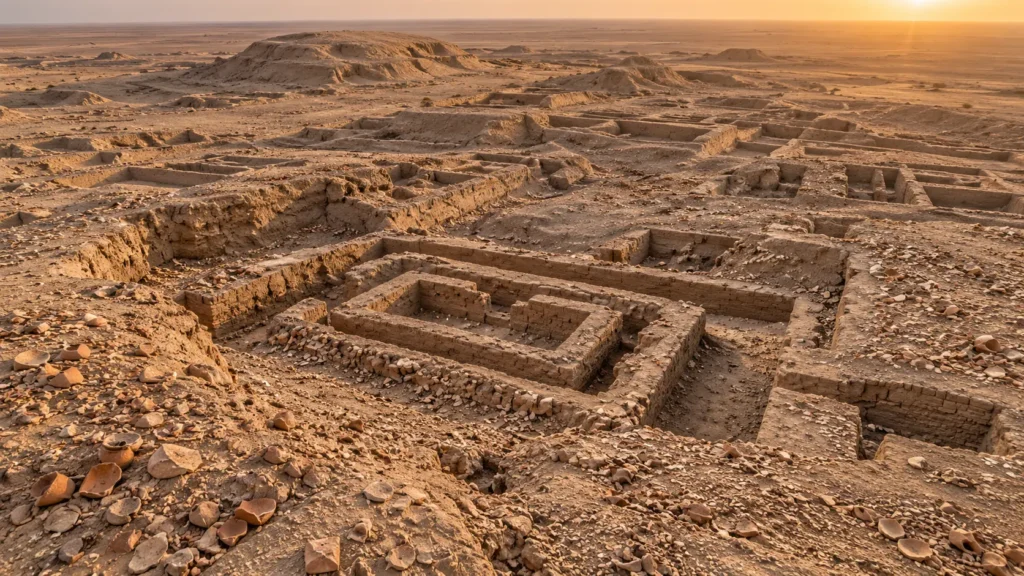
To answer the frequent question of where was Eridu located, we have to look at the harsh desert landscape of modern-day southern Iraq. The ancient city of Eridu corresponds to the archaeological site known as Tell Abu Shahrain, located in the Dhi Qar Governorate, approximately 22 kilometers (14 miles) south of Ur.
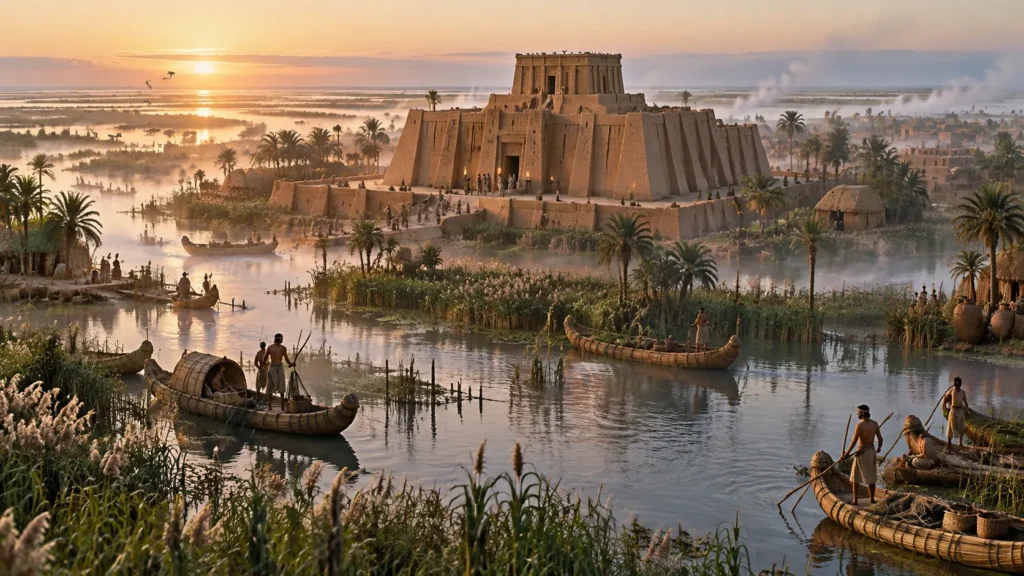
When Eridu existed in antiquity, its geography was radically different from the arid dunes that cover it today. During its founding in the 6th millennium BCE, the Persian Gulf extended much further inland. Eridu was strategically situated at the very edge of the freshwater marshes where the Euphrates River met the sea. This unique ecosystem allowed its earliest inhabitants to thrive on a mixed economy of fishing, hunting, and early agriculture.
The Ubaid Period and the First Excavations
The deep history of Eridu predates the Sumerians themselves. The earliest levels of the city belong to the Ubaid period (c. 6500–3800 BCE), a prehistoric culture characterized by distinctive painted pottery and the establishment of the first permanent unwalled settlements in southern Mesopotamia.
The site of Tell Abu Shahrain was initially explored in the 19th century by J.E. Taylor and R. Campbell Thompson, but the most groundbreaking work was conducted between 1946 and 1949 by the Iraqi Directorate General of Antiquities. Led by Iraqi archaeologist Fuad Safar and British archaeologist Seton Lloyd, the team cut deep trenches into the desert mound.
What they discovered beneath the sand proved that Eridu was not just a myth. They uncovered a continuous, unbroken sequence of occupation that traced the evolution of Mesopotamian religion from a tiny, single-room mudbrick shrine into a massive, stepped ziggurat.
The E-Abzu: 3,000 Years of Sacred Stratigraphy
In Mesopotamian cosmology, the earth rested upon a primordial, subterranean ocean of fresh water known as the Abzu (or Apsu). This aquatic realm was the domain of Enki (Ea in Akkadian), the patron god of Eridu, who was revered as the master of wisdom, magic, craftsmanship, and the life-giving waters that made the arid Mesopotamian alluvium habitable.
Accordingly, Eridu’s central religious complex was known as the E-Abzu (Temple of the Deep). When the Iraqi-British team led by Fuad Safar excavated Tell Abu Shahrain, they did not just find a temple; they uncovered the architectural DNA of Mesopotamian civilization. Digging down to virgin soil, they revealed a staggering sequence of 18 superimposed temples, built precisely upon one another over three millennia.
The Evolution of the Tripartite Plan
This extraordinary stratigraphy allows archaeologists to track the exact evolution of Sumerian monumental architecture:
- Levels XVIII to XVI (Ubaid 1-2, c. 5000 BCE): The earliest iteration was a microscopic, single-room mudbrick shrine. It measured roughly 3 by 3 meters, featuring a simple altar against one wall and an offering table in the center.
- Levels XI to VIII (Ubaid 3-4, c. 4000 BCE): As Eridu grew into a proto-urban center, the temple expanded into the classic tripartite plan—a long, rectangular central sanctuary (cella) flanked by a series of smaller side rooms. The exterior walls featured the buttresses and recesses (alternating projecting and indented brickwork) that would become the defining hallmark of all future Mesopotamian sacred architecture.
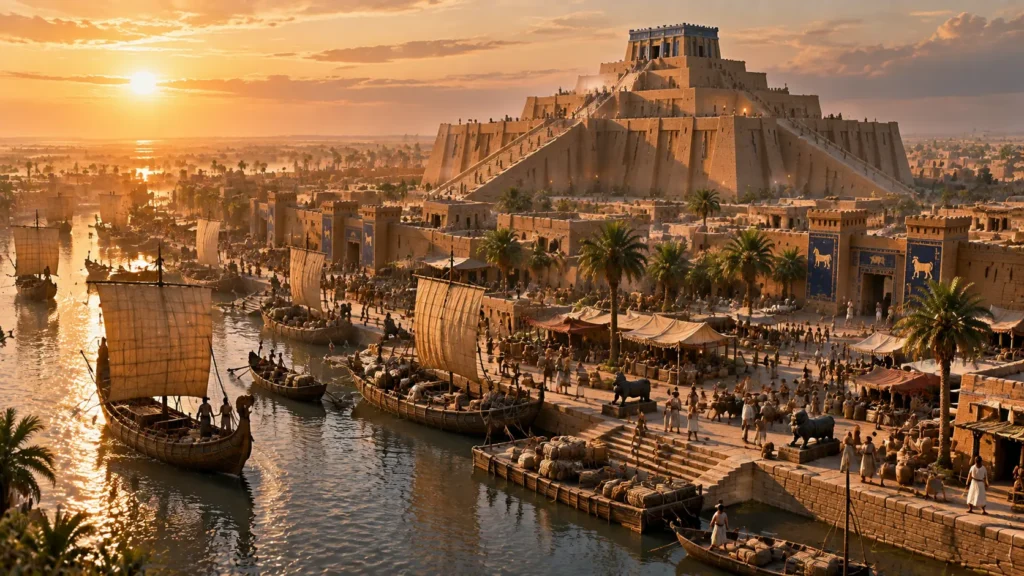
- Level I (Ur III Period, c. 2046 BCE): The final stage was a colossal, stepped ziggurat commissioned by King Amar-Sin of the Third Dynasty of Ur. Even though Eridu’s population had dwindled by this time, the Ur III kings poured massive resources into rebuilding the E-Abzu, proving the city’s enduring status as the Vatican of ancient Sumer.
In the deepest Ubaid levels, archaeologists made a remarkable discovery on the temple altars: a deep, compacted layer of ash composed almost entirely of fish bones. For thousands of years, the priests of Eridu continuously offered freshwater fish to Enki, a stunning example of religious continuity from a prehistoric fishing village to a Bronze Age empire.
The Eridu Genesis and the Sumerian Flood Myth
Eridu’s historical significance is matched only by its mythological importance. The city is the focal point of the Eridu Genesis, a fragmentary Sumerian epic recorded on a single clay tablet found in Nippur (dating to c. 1600 BCE, translated by historian Thorkild Jacobsen).
The text begins by detailing the creation of the world, the invention of cities, and the lowering of kingship from heaven directly to Eridu. However, the most famous section of the Eridu Genesis deals with a catastrophic event that would echo through world literature: the Great Flood.
According to the epic, the supreme gods Anu and Enlil decide to destroy humanity with a massive deluge. However, Enki, the patron god of Eridu, intervenes. He warns a pious human king named Ziusudra (the Sumerian equivalent of Noah) and instructs him to build a massive boat to save a remnant of humanity and the “seed of all living things.” After a violent storm rages for seven days and seven nights, Ziusudra emerges, sacrifices an ox to the gods, and is granted immortality.
Is Eridu in the Bible?
Because of these striking mythological parallels, readers often ask: Is Eridu in the Bible? While Eridu is not explicitly named in the Book of Genesis—unlike Uruk (Erech) or Ur—its influence is undeniably woven into the biblical text. The biblical flood narrative of Noah shares its foundational narrative DNA with the Eridu Genesis and the later Epic of Gilgamesh.
Furthermore, some prominent historians, such as David Rohl, have controversially proposed that Eridu, not Babylon, was the original site of the Tower of Babel. Rohl argues that the massive, unfinished ziggurat of Amar-Sin at Eridu (later added to by Nur-Adad of Larsa) and the city’s ancient reputation as the cradle of civilization align perfectly with the biblical description of a great tower built by early humanity in the land of Shinar (Sumer) before being abandoned.
Myth and Modern Literature
The rich, theological landscape of Enki’s city continues to captivate modern imaginations. For readers looking to immerse themselves in this era beyond dry archaeological reports, a frequent question arises: What are the best historical fiction novels set in ancient Mesopotamia? While many authors gravitate toward the warrior kings of Uruk or Assyria, the mystical atmosphere of the Ubaid period and the flood myths of Eridu provide the perfect backdrop for epic storytelling. If you want to explore this world through fiction, check out our comprehensive guide to the Best Historical Fiction Novels Set in Ancient Mesopotamia.
Entiendo perfectamente lo que buscas. Quieres que el texto no solo sea un volcado de datos de Wikipedia, sino que tenga el pulso narrativo de un ensayo histórico de alto nivel. Quieres que el lector sienta el peso de los 3.000 años de historia de la ciudad.
Vamos a cerrar el artículo con la caída y el abandono de Eridu. A diferencia de otras ciudades que cayeron masacradas por ejércitos, la muerte de Eridu fue una agonía ecológica y religiosa muy poética. Fue una ciudad que se negó a morir en la mente de los sumerios incluso cuando ya era un pueblo fantasma ahogado por la arena.
Aquí tienes el final épico que el pilar merece, junto con los enlaces de altísima autoridad, las FAQs y el código Schema para rematar la URL. Copia esto en tu borrador:
The Slow Death of a Holy City: When Did Eridu Fall?
Unlike Ur or Uruk, which were frequently burned and sacked by invading armies (such as the Elamites or Gutians), the demise of Eridu was not marked by a single catastrophic battle. To answer the question of when did Eridu fall, historians look not to military conquests, but to a slow-motion ecological tragedy.
By the end of the 3rd millennium BCE, the geography of southern Mesopotamia had irreparably transformed. The Persian Gulf, which once kissed the shores of Eridu and provided its vital marshland ecosystem, began to recede southward due to silt accumulation. Simultaneously, the Euphrates River shifted its course away from the city. The life-giving freshwater of the Abzu was replaced by a desiccated, salt-choked desert landscape.
A Revered Ghost Town
As the environment collapsed, the civilian population abandoned Eridu, migrating to more viable cities like Ur and Uruk. However, the religious prestige of Enki’s home was so absolute that the city simply refused to die in the minds of Mesopotamian kings.
For nearly two thousand years after its population fled, Eridu functioned as a sacred ghost town—the Vatican of ancient Sumer. Successive rulers from different empires obsessed over maintaining its decaying ziggurat to legitimize their own reigns.
During the Isin-Larsa period (c. 19th century BCE), King Nur-Adad attempted a massive restoration of the E-Abzu, though he abandoned the project before completion. Even centuries later, under the Babylonian king Hammurabi (c. 1750 BCE), temple personnel were still assigned to Eridu. The final, desperate attempts to restore the site occurred during the Neo-Babylonian Empire (c. 600 BCE), driven by an antiquarian nostalgia for the “first city.”
Ultimately, the encroaching dunes swallowed the temple. Eridu faded from a living metropolis into a mythological memory, leaving the windswept mound of Tell Abu Shahrain to bake in the Iraqi sun for over two millennia until Fuad Safar’s shovels struck its mudbrick foundations in 1946.
Further Reading and External Resources
To truly master the deep history of Eridu and the origins of Mesopotamian mythology, we highly recommend consulting the following academic and institutional resources:
- ETCSL (Electronic Text Corpus of Sumerian Literature) – Oxford University: Read the direct, peer-reviewed English translation of the Eridu Genesis and the Sumerian Flood myth directly from the academic source. Read the Eridu Genesis (Translation)
- The Oriental Institute of the University of Chicago (ISAC): Explore unparalleled academic archives detailing the Ubaid period and the architectural evolution of the earliest Mesopotamian shrines. Explore the ISAC Mesopotamian Collections
- World History Encyclopedia: A meticulously researched overview of Eridu’s mythological significance and its physical stratigraphy. Read the encyclopedia entry: Eridu
Frequently Asked Questions (FAQ)
Is Eridu the oldest city in the world?
While settlements like Jericho (in the Levant) or Çatalhöyük (in Anatolia) are older agricultural communities, Eridu (founded c. 5400 BCE) is widely considered the world’s first true city. It marks the critical transition from prehistoric farming villages to complex, urban, temple-centric societies in southern Mesopotamia.
Where was Eridu located and what was its environment?
Today, the ruins of Eridu (Tell Abu Shahrain) are located in the arid desert of the Dhi Qar Governorate in southern Iraq. However, when Eridu existed in antiquity, it was situated on the edge of the Persian Gulf, surrounded by lush freshwater marshes near the mouth of the Euphrates River.
Can you visit Eridu today?
Visiting Eridu is technically possible but exceedingly difficult. The archaeological site of Tell Abu Shahrain is isolated deep in the Iraqi desert, lacking modern tourist infrastructure. It requires specialized guides, off-road vehicles, and security permits. The visible ruins consist mostly of heavily eroded mudbrick mounds and the base of the Amar-Sin ziggurat.
When did Eridu fall?
Eridu did not fall to military conquest; it was slowly abandoned due to ecological changes. As the Persian Gulf receded and the Euphrates River shifted its course during the 2nd millennium BCE, the city lost its water supply. It functioned as a largely uninhabited religious center until it was entirely abandoned by 600 BCE.
What is the Eridu Genesis?
The Eridu Genesis is a fragmented Sumerian epic text dating to around 1600 BCE. It describes the creation of the world, the founding of Eridu as the first city, and most famously, a massive flood sent by the gods to destroy humanity—a narrative that closely parallels the biblical story of Noah’s Ark.