When exploring the ancient defensive walls and entrances of the Holy City, the Jerusalem sheep gate stands out as one of the most significant archaeological and scriptural sites. Unlike the modern entrances seen today, the sheep gate in Jerusalem was a crucial part of the city’s infrastructure during the First and Second Temple periods.. This guide explores its origins, its historical context, and its enduring theological legacy.
What is a Sheep Gate in the Bible?
For many readers studying the scriptures, a common question arises: what is a sheep gate in the bible, and why does it receive so much attention? In antiquity, a city gate was not just a defensive barrier, but a bustling hub of civic and economic activity.
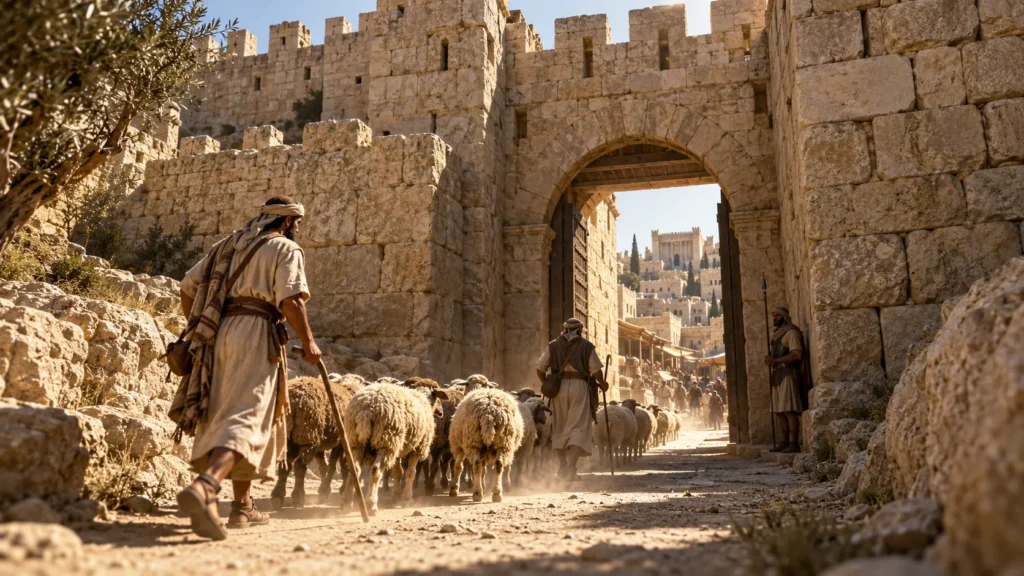
So, what is the sheep gate in jerusalem precisely? It was a highly specialized portal located in the northern wall of the ancient city, situated in close proximity to the Temple Mount. Instead of handling general civilian or military traffic, this specific entrance was dedicated to managing the flow of livestock. Shepherds and merchants used this exact route to bring flocks of sheep and lambs from the surrounding countryside directly into the holy precincts, establishing it as a vital artery for the religious life of the ancient Israelites.
What Was the Purpose of the Sheep Gate in Jerusalem?
When examining the urban layout of antiquity, one must ask: what was the purpose of the sheep gate in Jerusalem beyond simply allowing entry into the city? In the ancient Near East, city gates functioned as civic centers, bustling markets, and legal courts. However, the ancient sheep gate held a strictly specialized and highly regulated role.
So, exactly what was the sheep gate used for? It acted as the primary administrative and logistical checkpoint for the Temple’s massive sacrificial system. Jewish law, detailed in the Torah, required that any animal offered on the altar—particularly the daily lambs and those used during Passover—be entirely without physical blemish. By funneling all livestock through this specific northern entrance, the Levitical priests could carefully inspect the animals before they ever reached the sacred precincts of the Temple Mount. It was essentially a theological quarantine and verification zone, ensuring that only ritually pure animals were permitted inside the holy complex.
The Ancient Sheep Gate in the Old Testament
The legacy of the sheep gate in the bible begins centuries before the time of Jesus and the Roman occupation. As a cornerstone of the city’s spiritual infrastructure, this biblical sheep gate is heavily documented in the Old Testament, emerging as a symbol of restoration during one of the most critical periods of Jewish history: the return from the Babylonian exile.
Nehemiah and the Wall Reconstruction
In 444 BCE, the Jewish cupbearer and governor Nehemiah returned to a ruined Jerusalem with a monumental undertaking: rebuilding the city’s destroyed defenses. The Nehemiah sheep gate account is historically fascinating because of who was responsible for its construction.
According to the scriptural record, Eliashib the high priest and his fellow priests took it upon themselves to rebuild this specific section of the wall. Unlike other gates that were constructed by local merchants, goldsmiths, or regional guilds, this entrance was built exclusively by the religious elite. Furthermore, they did not merely hang its doors; they immediately consecrated it. This rapid dedication underscores how vital the gate was to the restoration of Temple worship. Without a secure, dedicated entrance for livestock, the proper logistical flow of the sacrificial system could not resume.
Bible Verses About the Sheep Gate
For students of history and theology mapping the ancient city, finding the exact bible verses about the sheep gate is essential to understanding its geographical and spiritual importance. If you are looking for a specific sheep gate bible verse, the primary and most detailed references are found in the Book of Nehemiah:
- Nehemiah 3:1: “Eliashib the high priest and his fellow priests went to work and rebuilt the Sheep Gate. They dedicated it and set its doors in place, building as far as the Tower of the Hundred, which they dedicated, and as far as the Tower of Hananel.” This verse confirms its location on the northern wall and its immediate consecration.
- Nehemiah 3:32: “And between the room above the corner and the Sheep Gate the goldsmiths and merchants made repairs.” This highlights the commercial activity that naturally surrounded the livestock market just outside the gate.
- Nehemiah 12:39: This verse mentions the gate during the joyous dedication ceremony of the completed wall, describing a massive procession of choirs marching past the Sheep Gate toward the Temple.
John 5: The Sheep Gate Pool in Jerusalem
Moving from the era of Nehemiah into the first century CE, the New Testament provides one of the most famous geographical markers for this ancient entrance. During the Roman period, the narrative of the sheep gate in John 5 offers a vivid glimpse into the daily religious and social life of the city.
According to the Apostle John’s gospel, there was a specific sheep gate pool in Jerusalem located just inside the city walls. While the gate itself continued to function as the primary inlet for sacrificial livestock, the area immediately surrounding it had developed into a complex of water reservoirs. The exact mention of the sheep gate John 5 serves as a vital bridge, linking the Old Testament sacrificial system directly to the earthly ministry and miracles of Jesus Christ.
The Healing at the Bethesda Sheep Gate
The scriptural account details a massive, twin-basin reservoir surrounded by five covered colonnades. The connection between the Jerusalem sheep gate Bethesda location and the healing ministry of Jesus is profound. Because of the sheer volume of animals passing through the sheep gate, a pool was naturally required, likely serving a dual purpose: providing water for the massive influx of Temple livestock and functioning as a mikveh (ritual bath) for Jewish pilgrims seeking purification.
The sheep gate Bethesda site is world-renowned because it was here that Jesus encountered a man who had been paralyzed for thirty-eight years. Surrounded by a crowd of disabled and sick individuals hoping for a miraculous healing from the stirred waters, Jesus commanded the man to pick up his mat and walk. For centuries, skeptics doubted the existence of this five-sided pool, until 19th-century archaeologists excavated the exact ruins in the modern Muslim Quarter, proving the incredible historical accuracy of John’s gospel.
The Church at the Sheep Gate
Today, visitors exploring the Bethesda excavations will find a stunning piece of Crusader-era architecture standing guard over the ruins. This is the famous church at the sheep gate, formally known as the Church of Saint Anne.
Erected in the 1130s over a Byzantine shrine, the church was built to commemorate the traditional birthplace of the Virgin Mary, whose parents (Anne and Joachim) were believed to have lived near the ancient sheep market. Remarkably preserved—spared from destruction by Saladin after the Crusades—this basilica serves as a monumental physical marker for the ancient gate. Beyond its historical significance, the church is celebrated for its perfect acoustics, drawing Christian pilgrims from around the world to sing hymns in the very shadow of where the ancient livestock entrance once stood.
Did Jesus Enter Through the Sheep Gate on Palm Sunday?
Because of Jesus’s theological title as the “Lamb of God,” a powerful and poetic assumption often circulates among Christians regarding his Triumphal Entry into the city. Consequently, one of the most frequently asked questions by students of biblical geography is: did Jesus enter through the sheep gate on Palm Sunday?
The direct historical and scriptural answer is no. While it is absolutely certain that Jesus enters through the sheep gate on other occasions during his ministry—most notably to reach the Pool of Bethesda in John 5—the specific events of Palm Sunday point to a different geographical route. So, when people ask, did Jesus enter the sheep gate for his final, royal arrival, we must look at the specific travel itinerary provided by the Gospel writers.
According to the Synoptic Gospels (Matthew, Mark, and Luke), Jesus began his Triumphal Entry from the villages of Bethphage and Bethany, situated on the Mount of Olives. Geographically, the Mount of Olives sits directly to the east of the Temple Mount. If a traveler descends from the Mount of Olives and crosses the Kidron Valley, the most direct, monumental, and historically accurate entrance into the Temple courtyard is the Eastern Gate (known today as the Golden Gate).
Entering through the northern-facing Sheep Gate would have required an awkward and unnecessary detour. Therefore, while the Sheep Gate is intimately tied to his healing ministry, his royal presentation as the Messiah on Palm Sunday almost certainly occurred through the Eastern Gate, aligning with the ancient prophecies of Zechariah.
The Spiritual Meaning of the Sheep Gate
While the physical ruins in Jerusalem hold immense archaeological value, the true enduring legacy of this entrance is theological. To fully grasp the meaning of sheep gate in the bible, one must look beyond the stone walls of Nehemiah and turn to the metaphorical teachings of Christ. The sheep gate bible meaning shifts dramatically in the New Testament—from a literal geographical location used for Temple logistics to a profound symbol of salvation and divine protection.
“I Am the Sheep Gate”: Jesus and the Shepherd
In John chapter 10, Jesus uses a powerful agrarian metaphor that would have been instantly understood by his first-century audience, famously declaring: “I am the sheep gate” (often translated in various versions as “I am the door of the sheep”).
To understand this, we must look at ancient Near Eastern pastoral practices. Out in the Judean wilderness, a sheepfold was a simple enclosure made of stacked stones or thorny branches, featuring only one opening. At night, the shepherd would literally lie down and sleep across this single opening. Therefore, the sheep gate and shepherd were physically one and the same—no predator could enter, and no animal could wander off without stepping over the shepherd’s body.
By stating that Jesus is the sheep gate, or simply identifying as Jesus the sheep gate, he was declaring himself as the sole, living entry point to spiritual safety. He acts as the ultimate protector, serving as the gate for the sheep so they may “come in and go out, and find pasture.”
Sermon on the Sheep Gate: What Does it Represent?
For pastors, teachers, and students preparing a sermon on the sheep gate, the focus inevitably turns to this dual theme of exclusivity and sacrificial care. So, what does the sheep gate represent in a broader spiritual context?
The sheep gate spiritual meaning is one of profound contrast and redemption. It is no theological coincidence that the physical gate in ancient Jerusalem was used specifically to bring unblemished lambs to the slaughter for Temple sacrifices. The sheep gate meaning reaches its climax when Jesus, the ultimate “Lamb of God,” transforms the concept. While the ancient stone gate led animals to their death to temporarily cover sin, the new, living gate—Christ himself—leads humanity to eternal life. It represents the transition from the Old Covenant of continuous animal sacrifice to the New Covenant of permanent grace.
Where is the Sheep Gate Located in Jerusalem Today?
For modern pilgrims and history enthusiasts walking the ancient stones of the Holy City, a very practical question arises: where is the sheep gate in Jerusalem right now? If you look at a current tourist map of the city’s perimeter, you will not find it listed among the active entrances.
To answer where is the sheep gate located in Jerusalem, we must understand that the towering stone walls we see today are not the walls of Nehemiah or Jesus. The current fortifications were built in the 16th century by the Ottoman Sultan Suleiman the Magnificent. When these walls were constructed, the ancient gates were either built over or their locations were slightly shifted.
So, where was the sheep gate in Jerusalem historically, and how can you find it? The original gate was located on the northeastern side of the city wall. If you want to visit the sheep gate Jerusalem today, you need to head to the Muslim Quarter of the Old City.
The closest modern entrance to the ancient site is the Lions’ Gate (also known as St. Stephen’s Gate), located on the eastern wall. Just inside this gate, as you begin to walk down the famous Via Dolorosa, you will find the compound belonging to the French “White Fathers.” By stepping inside this peaceful courtyard, you will stand precisely where the ancient sheep market once thrived, surrounded by the excavated ruins of the Bethesda pool and the beautiful acoustics of St. Anne’s Church. Though the wooden doors and stone arches of Nehemiah’s time are long gone, the exact geographical footprint remains one of the most vividly preserved archaeological sites in all of Israel.
If you are tracing the historical perimeter of the northern wall today, your next major architectural stops are the nearby Herod’s Gate and the monumental Damascus Gate.
Study Guide & Quick Answers (FAQs)
What is the significance of the Sheep Gate in Jerusalem?
Historically, it was the designated entrance for bringing sacrificial livestock into the city, ensuring only ritually pure animals reached the Temple Mount. Theologically, it holds immense significance as the site of Jesus’ healing at the Pool of Bethesda and serves as a metaphor for Christ as the ultimate protector of his flock.
Who rebuilt the ancient Sheep Gate?
According to the Old Testament Book of Nehemiah, the gate was rebuilt and immediately consecrated by the high priest Eliashib and his fellow priests following the Jewish return from the Babylonian exile in the 5th century BCE.
Did Jesus enter the Sheep Gate?
Yes, Jesus walked through this area during his earthly ministry, most notably to reach the Pool of Bethesda (John 5). However, biblical historians agree that he did not use this entrance for his Triumphal Entry on Palm Sunday, arriving instead through the Eastern Gate from the Mount of Olives.
Where was the Sheep Gate located?
In antiquity, it was positioned on the northeastern wall of Jerusalem, near the Temple Mount. Today, the original gate no longer exists, but its exact historical footprint is located in the Muslim Quarter of the Old City, near the modern Lions’ Gate and the Church of Saint Anne.