Achaemenid Empire: History, Expansion, Governance, and Ancient Legacy
The Persian Empire—predominantly known as the Achaemenid Empire (c. 550–330 BCE)—was the first global superpower in ancient history, ruling over an estimated 44% of the world’s population at its zenith. Originating in the southwestern Iranian plateau, the empire expanded across three continents—Asia, Africa, and Europe—to stretch from the Indus Valley in the east to Egypt and the Balkan Peninsula in the west. Renowned for its advanced provincial administration through satrapies, its monumental infrastructure such as the Royal Road, and an imperial policy prioritizing cultural autonomy over forced assimilation, the Persian Empire redefined statecraft, long-distance communication, and multicultural governance throughout the ancient Near East.
Chronological Overview: From Tribal Origins to Continental Rule
| Date | Era & Milestone | Historical Significance & Impact |
| c. 550 BCE | Foundation of the Imperial State | Unification of the Persian tribes and subjugation of the Median Kingdom, establishing sovereign rule across the Iranian plateau. |
| 547 BCE | Subjugation of Lydia & Ionian Coast | Defeat of King Croesus of Lydia, bringing wealthy Aegean trade ports and Greek coastal settlements into the imperial orbit. |
| 539 BCE | Peaceful Entry into Babylon | Fall of the Neo-Babylonian Empire; introduction of civic and cultural restoration policies across Mesopotamia and the Levant. |
| 525 BCE | Annexation of Egypt | Subjugation of the 26th Dynasty of Egypt under Cambyses II, integrating the Nile Valley into a unified Near Eastern political system. |
| c. 518–515 BCE | Imperial Reorganization & Infrastructure | Formalization of the satrapy taxation system, completion of the early Royal Road network, and initial construction of monumental ceremonial centers. |
| 513 BCE | European & Central Asian Expeditions | Cross-continental campaigns across the Danube into European Scythia and eastward toward the fertile Indus Valley. |
| 499–449 BCE | Greco-Persian Frontier Conflicts | Decades of defensive and offensive campaigns along the Aegean, shifting imperial strategy from direct military occupation to diplomatic balance of power. |
| 404–343 BCE | Internal Rebellions & Egyptian Recovery | Periods of provincial revolts (Satrapal rebellions) and temporary loss of Egypt, later fully reconquered by Artaxerxes III. |
| 334–330 BCE | Macedonian Conquest | The campaign of Alexander the Great; fall of the royal residences and transition of the Persian administrative apparatus into Hellenistic rule. |
What Was the Persian Empire? (Achaemenid Definition & Scale)
The Achaemenid Persian realm represented a dramatic turning point in the history of statecraft. Prior to its emergence in the mid-sixth century BCE, previous Near Eastern empires—such as the Neo-Assyrians and Neo-Babylonians—had governed primarily through military subjugation, mass deportations, and direct extraction of regional wealth. The Persian model introduced an entirely new political paradigm: an interconnected commonwealth of distinct nations bound by legal treaties, unified infrastructure, and mutual administrative obligations.
Originating in the highland plateau of Persis (modern Fars province in southwestern Iran), the state transformed from a confederation of nomadic pastoralist and agrarian tribes into an expansive multi-continental administration. Rather than dismantling the native institutions of the lands they incorporated, Persian authorities recognized the value of institutional continuity, allowing local legal codes, administrative scribal traditions, and cultural practices to remain active under the supervision of imperial officers.
       ┌─────────────────────────────────────────────────────────┐
       │              THE IMPERIAL COMPACT                       │
       ├────────────────────────────┬────────────────────────────┤
       │     LOCAL POPULATIONS      │      IMPERIAL CROWN        │
       ├────────────────────────────┼────────────────────────────┤
       │ • Pay annual fixed tribute │ • Guarantee regional peace │
       │ • Provide military levies  │ • Protect trade highways   │
       │ • Recognize supreme crown  │ • Respect local customs    │
       └────────────────────────────┴────────────────────────────┘
From an administrative perspective, this balanced governance created what modern historians term the Pax Persica (the Persian Peace). For nearly two centuries, an area stretching across thousands of kilometers enjoyed an absence of major cross-border warfare, enabling unprecedented long-distance movement of goods, engineering techniques, and administrative documentation.
Continental Scale and Geographic Reach
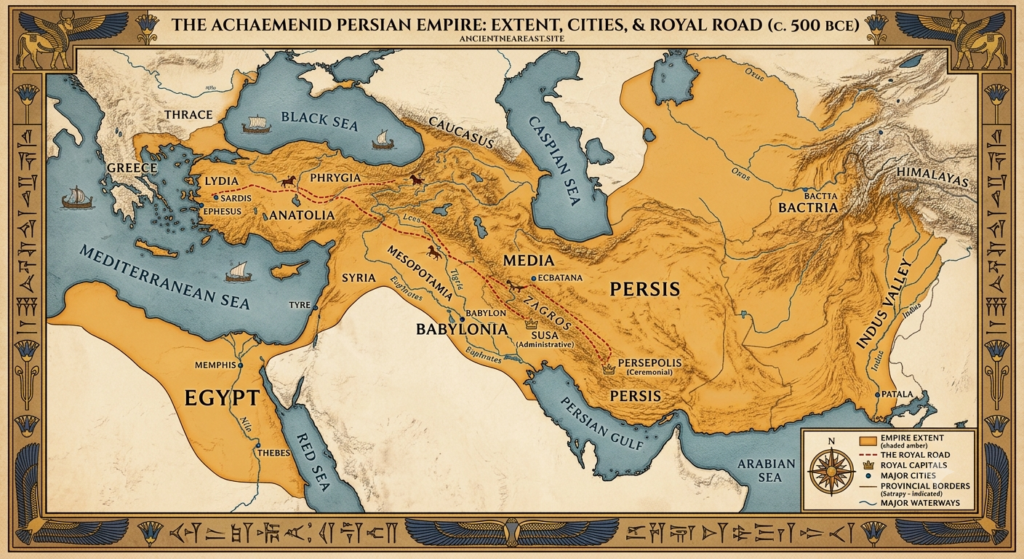
At its height around 500 BCE, the empire represented the largest geopolitical entity the ancient world had ever witnessed. It spanned over 5.5 million square kilometers (more than 2.1 million square miles), encompassing three distinct continents:
- Western Frontiers: Thrace, Macedonia, the Aegean littoral, and the islands of the eastern Mediterranean.
- Southern Domains: The entire Nile Valley up to the borders of ancient Nubia, the Sinai Peninsula, and the Levantine coastline.
- Heartland & Mesopotamian Basin: The Tigris-Euphrates river network, the Syrian steppe, and the Zagros mountain corridors.
- Eastern Limits: The Hindu Kush mountain range, Bactria, Sogdiana, and the fertile plains of the Indus River basin.
Scholars estimate that this territory contained between 30 and 35 million people—nearly half of the estimated global human population at the time.
[Aegean Sea / Nile Valley] <======== ~5,000 km ========> [Indus River / Central Asia]
The Concept of Unified Imperial Space
Before the Persian consolidation, the Near East was fragmented into competitive regional states separated by hostile border zones, differing standards of weight, and high tariffs. The Persian state integrated these disparate regions into a single administrative sphere:
- Official Diplomatic Language: Imperial Aramaic (Reichsaramäisch) was instituted across all chancelleries from the Mediterranean to the borders of India, allowing scribes in Memphis to read decrees dispatched from Susa or Bactra.
- Standardized Weights and Measures: The karsha system and unified royal capacity measures were introduced across provincial treasuries, eliminating regional conversion fraud in tax payments.
- Uniform Legal Codification: Local courts continued to operate, but royal judges (dātābāra) ensured that provincial decisions complied with imperial decrees (dāta).
This geopolitical cohesion laid the groundwork for an enduring system of international trade, specialized regional agriculture, and monumental architectural collaborations that defined life across the ancient Near East.
The Expansion of the Persian Empire Across Three Continents
The expansion of the Persian state transformed a localized plateau kingdom into a tri-continental empire in less than three decades. Rather than an outcome of accidental conquests, this rapid growth followed a calculated strategy combining superior mobile warfare, psychological diplomacy, and the systematic co-optation of local ruling elites.
| Stage of Conquest | Target Region & Year | Strategic Objective | Administrative Outcome |
| Median Annexation | Iranian Plateau (c. 550 BCE) | Unify Persian and Median warrior aristocracies. | Created the bilingual Core Army and secured northern mountain passes. |
| Anatolian Campaign | Lydia & Ionian Coast (547 BCE) | Subjugate King Croesus and capture Aegean trade terminals. | Placed Greek maritime ports and gold-refining centers under imperial tribute. |
| Babylonian Subjugation | Mesopotamia & Levant (539 BCE) | Absorb the ancient agricultural, scribal, and financial center of the Near East. | Inherited Levantine trade ports, Syria, and Phoenician naval shipyards without urban destruction. |
| Nile Valley Annexation | Egypt (525 BCE) | Integrate the granary of the Mediterranean into imperial trade corridors. | Crown assumed pharaonic titles; established direct control over maritime Red Sea routes. |
| Central Asian & Indus Expansions | Bactria, Sogdiana & Punjab (c. 518–513 BCE) | Secure the Silk Road gateways and gold-rich river valleys. | Created fortified frontier garrisons along the Oxus and Indus river systems. |
The Diplomatic Doctrine of Integration
Unlike earlier imperial powers that celebrated the destruction of conquered capitals on monumental stone reliefs, Persian imperial doctrine emphasized restoration and legitimation through local traditions.
| Conquest Model Comparison | Traditional Near Eastern Empire (Assyria/Babylon) | Achaemenid Persian Empire |
| Treatment of Deities | Statues of native gods taken hostage to the imperial capital. | Local temples protected, funded, and restored by royal decree. |
| Population Management | Mass deportation and forced displacement of conquered tribes. | Resettlement of displaced populations back to their ancestral lands. |
| Local Elite Integration | Replaced by foreign imperial governors and military garrisons. | Indigenous scribes, judges, and aristocrats maintained in local offices. |
| Public Ideology | Rule by terror, destruction of rebel cities, and public execution reliefs. | Rule by legitimate inheritance, cosmic order (Arta), and civic protection. |
When imperial forces entered Babylon in 539 BCE, decrees were issued to end forced labor, return confiscated religious icons to their original sanctuaries, and permit displaced groups—including the Jewish exile community—to return to their homelands and rebuild their central temples. This approach secured long-term stability: local populations viewed imperial rule as a protective framework rather than an oppressive occupation.
[Defeat of Opposing Armies] ➔ [Confirmation of Local Elite Privileges] ➔ [Royal Temple Subsidies] ➔ [Voluntary Provincial Loyalty]
Securing the Frontier Corridors
Maintaining imperial integrity required permanent boundary management across extreme geographical frontiers:
- The European Frontier (Thrace and Danube): Imperial campaigns established military bases north of the Hellespont to monitor nomadic Scythian movements and protect silver-mining regions in northern Greece.
- The Central Asian Frontier: Fortresses (phrouria) were erected along the Jaxartes and Oxus rivers to safeguard fertile agricultural oases from nomadic steppe incursions.
- The Maritime Frontiers: By incorporating the naval fleets of Phoenicia, Cyprus, and Egypt, the empire established maritime dominance across the Eastern Mediterranean and opened maritime exploration along the Persian Gulf and Indian Ocean coasts.
By transforming former rival states into interdependent administrative units, the imperial leadership laid the groundwork for a unified system of governance across the ancient world.
How the Persian Empire Was Governed: The Satrapy System
The governance of such an immense and diverse territory required moving away from direct central rule toward a decentralized provincial model. The empire was divided into administrative districts called satrapies (derived from the Old Persian khshathrapāvan, meaning “protector of the realm”).
Rather than concentrating all regional power in a single individual, the imperial constitution established a system of institutional checks and balances within each province to prevent local rebellion and ensure administrative accountability.
| Provincial Office | Authority & Responsibilities | Reporting Line | Check on Power |
| The Satrap (Governor) | Supreme civil administrator; oversees judicial courts, enforces royal law (dāta), and collects provincial tribute. | Reports to the Royal Court at Susa/Babylon. | Cannot command the main provincial fortress troops without royal authorization. |
| The Military Commander (Kāranō) | Commands the royal standing garrisons and fortress troops; secures frontiers and transit highways. | Reports directly to the Imperial High Command. | Has no authority over provincial taxation, treasuries, or civil courts. |
| The Royal Secretary (Grammateus) | Manages official correspondence, archives records on clay/papyrus, and registers decrees. | Direct communication channel with the imperial palace. | Operates independently of the satrap, serving as a permanent record-keeper. |
| The Royal Inspectors (“Eyes & Ears”) | Conduct unannounced audit tours; inspect provincial treasuries, prison conditions, and road security. | Independent officers answering directly to the Great King. | Can immediately suspend corrupt governors and report treasonous behavior. |
The System of Standardized Annual Tributes
Before the administrative reorganization of the late sixth century BCE, subject regions provided sporadic, arbitrary gifts to the crown. This was replaced by a calculated, predictable annual tribute system based on agricultural capacity, mineral wealth, and population surveys.
| Satrapy / Region | Annual Silver/Gold Tribute | Specialized Material & Animal Levies |
| Babylonia & Assyria | 1,000 Silver Talents | 500 castrated youths for royal service; vast stores of grain and dates for imperial storehouses. |
| Egypt & Cyrenaica | 700 Silver Talents | 120,000 measures of Nile wheat to provision stationed imperial garrisons at Memphis and Elephantine. |
| Media & Armenia | 450 Silver Talents | Media: 100,000 sheep; Armenia: 20,000 prize Nisaean horses for the royal cavalry. |
| India (Hindush) | 360 Talents of Gold Dust (equivalent to ~4,680 silver talents) | Exotic woods, ivory, and hunting hounds. |
| Cilicia (Anatolia) | 500 Silver Talents | 360 white horses (one for every day of the official Persian solar year calendar). |
[Provincial Assessment by Royal Cadastral Survey] ➔ [Fixed Annual Quota in Weight of Silver] ➔ [Central Royal Treasuries & Local Public Works]
Imperial Law and Provincial Courts
The legal framework was intentionally pluralistic. The empire operated on two complementary legal tiers:
- Local Customary Law: Egyptian priests resolved legal disputes according to traditional demotic laws, Babylonian scribes adjudicated property contracts according to ancient Mesopotamian codes, and Judean elders judged civil matters using Torah traditions.
- The Imperial Law (Dāta): Issued directly by the crown and preserved in imperial archives. It regulated international transit, treason, highway protection, and state taxation. Royal judges (dātābāra) were appointed for life and traveled between regional administrative centers to enforce absolute impartiality.
By combining military protection, predictable taxation, and legal autonomy, this provincial structure created an unprecedented degree of civic order and administrative predictability across the ancient Near East.
Continental Communication Networks and Imperial Infrastructure
Maintaining cohesive authority across an empire that stretched over five thousand kilometers required an infrastructure capable of overcoming severe geographical barriers, including the Zagros Mountains, the Syrian desert, and major river systems like the Euphrates, Tigris, and Nile. Persian administrators understood that political unity was impossible without reliable, high-speed lines of communication linking the royal court with distant satrapal capitals.
To achieve this, the imperial state engineered a comprehensive network of paved highways, river ferries, fortified mountain passes, and desert waystations. While earlier civilizations had constructed local roads for military campaigns, the Persian system was the first permanent, state-maintained continental transit network designed for continuous civilian, commercial, and administrative use.
[Sardis (Aegean Coast)] <==== 2,699 km via 111 Waystations ====> [Susa (Imperial Center)]
The Royal Road and the Chapar Khaneh Postal System
The backbone of this continental network was the Royal Road, a paved and graded highway stretching approximately 2,699 kilometers (1,677 miles) from Sardis, near the Aegean coast of Anatolia, straight through Mesopotamia to the administrative heart of the empire at Susa.
The true innovation of the Royal Road lay in its institutional relay system, known in Persian tradition as the Chapar Khaneh. Along the route, imperial engineers established 111 regular waystations (stathmoi), spaced at intervals of approximately one day’s ride (roughly 25 to 30 kilometers apart). Each station maintained a permanent staff, a fortified inn (katalysis), fresh supplies of grain and water, and a stable of elite, rested couriers and horses bred specifically for endurance and speed.
| Transit Method & User | Route & Distance | Estimated Travel Time | Operational Mechanism |
| Merchant Caravans | Full length of Royal Road (Sardis to Susa) | ~90 days (~3 months) | Heavy pack animals (oxen, donkeys, camels) moving 25–30 km/day with commercial goods. |
| Imperial Couriers (Pirradazish) | Full length of Royal Road (Sardis to Susa) | ~7 days (168 continuous hours) | Relays of riders galloping day and night, transferring sealed pouches from horse to horse without stopping. |
When an urgent imperial dispatch, royal decree, or intelligence report was issued from the palace, a mounted courier (pirradazish) galloped at full speed to the first station. There, the dispatch was immediately handed to a waiting rider on a rested horse, who set off instantly for the next post. This continuous relay operated without interruption through extreme heat, snow, and rain, allowing messages to cross entire continents in roughly a week—a speed of state communication unmatched in the ancient world until the invention of the telegraph.
Engineering Feats: Bridges, Canals, and Border Security
Beyond terrestrial highways, imperial engineers undertook unprecedented civil engineering projects to facilitate movement between distant provinces:
- The Persian Canal in Egypt (The Precursor to Suez): Under royal commission, engineers linked the Nile River directly to the Red Sea by excavating a navigable shipping canal through the Wadi Tumilat. Monumental stone stelae erected along the banks recorded the passage of imperial transport ships carrying grain, incense, and prestige goods between Egypt and the Persian Gulf.
- Pontoon Bridges across the Hellespont: Imperial engineers constructed floating bridges using hundreds of anchored triremes and heavy flax cables, allowing massive armies and supplies to march from Asia into Europe over open sea channels.
- Fortified Checkpoints and Caravanserais: Every mountain pass and river crossing featured a royal guardpost (phylake). Travelers were required to present an official travel passport (miyatka or parchment warrant) stamped with an imperial seal to verify their identity, authorization, and right to draw rations from royal storehouses along the route.
This level of engineering transformed regional landscapes into an integrated economic zone. By guaranteeing secure travel free from brigandage, the infrastructure fostered widespread long-distance trade, the rapid movement of specialized craftsmen across provinces, and the prompt intervention of imperial authorities in the event of local unrest.
Aquí tienes el siguiente bloque temático, desarrollado con un texto extenso, descriptivo y profundo sobre el ejército imperial, la táctica combinada y la fuerza de élite:
Military Power of the Persian Empire and the Immortals
The defense of an empire spanning three continents required a sophisticated military structure capable of rapid mobilization, frontier defense, and the integration of hundreds of different ethnic contingents. Rather than maintaining an overwhelmingly massive standing army across every province—which would have bankrupted regional treasuries—the Persian state relied on a tiered military model: an elite standing core stationed near the royal court, regional permanent garrison forces stationed along strategic frontiers, and a vast provincial levy system activated during major imperial campaigns.
At the core of this system was the Persian and Median warrior aristocracy. Military service was a foundational element of noble upbringing; young aristocrats were trained from early childhood in horsemanship, archery, and strict discipline. This aristocratic core provided the commanding officers, heavy cavalry regiments, and royal bodyguards that formed the backbone of any imperial field army.
The Ten Thousand Immortals and the Royal Guard
The most famous and formidable component of the imperial army was the elite corps known in Greek historical sources as the Immortals (Athanatoi, likely corresponding to the Old Persian Anûšiya, meaning “Companions”). This unit served both as the permanent royal household guard and as the premier shock infantry on the battlefield.
The unit maintained an exact and constant strength of 10,000 soldiers. If a member died in combat, fell ill, or retired, a fully trained replacement was immediately appointed from the reserves, ensuring that the formation never numbered a single man more or less than ten thousand. This deliberate numerical consistency created a powerful psychological impression among adversaries that the unit was impervious to attrition.
The Immortals were equipped with superior arms and distinctive ceremonial luxury. They carried short spears with silver counterweights (the highest-ranking thousand carried golden counterweights, earning them the title of Melophoroi or “Apple-Bearers”), composite recurve bows with large quivers, short daggers (akinakes), and wore fine linen or wool robes over flexible coats of iron fish-scale armor. On the march, they were accompanied by their own dedicated supply trains, including covered carriages carrying personal attendants, concubines, and specialized rations, underscoring their elite standing within the imperial hierarchy.
| Military Unit / Tier | Primary Role & Composition | Equipment & Armament | Strategic Function |
| The Immortals (10,000) | Permanent elite royal guard; drawn exclusively from Persian and Median nobility. | Scale armor, short spears, composite bows, akinakes daggers, wicker shields (spara). | Shock infantry, battlefield decisive reserve, and direct royal protection. |
| Imperial Heavy Cavalry (Asabāra) | Aristocratic mounted warriors; masters of shock charges and mounted archery. | Heavy bronze/iron helmets, scaled breastplates, dual thrusting spears (palta), composite bows. | Flanking maneuvers, breaking enemy formations, and tactical pursuit. |
| Provincial Garrisons (Phrouroi) | Permanent localized infantry and archers stationed in forts and highway posts. | Varied regional weaponry; supplemented by native auxiliary contingents. | Securing border crossings, protecting treasuries, and suppressing regional brigandage. |
| Multinational Imperial Levy | Broad mobilization called during major continental campaigns. | Diverse national arms: Bactrian archers, Scythian horsemen, Egyptian marines, Ethiopian spearmen. | Mass battlefield screening, logistical support, and siege operations. |
Battlefield Doctrine: The Sparabara and Combined Arms
Persian tactical doctrine was heavily influenced by the open terrain of the Iranian plateau and the Near Eastern steppe, where mobility, speed, and missile volume dominated warfare. The primary infantry formation was the Sparabara (literally “Shield-Bearers”).
In battle, the Sparabara formed deep defensive battle lines. The front rank knelt behind massive, rectangular wicker and leather shields (spara) planted directly into the ground, creating an interlocking, portable defensive wall. Behind this barrier, successive ranks of archers fired rapid, continuous volleys of arrows into advancing enemy ranks from a safe distance. Once the enemy was disordered and broken by missile fire, the heavy cavalry (Asabāra) charged the flanks and rear to complete the rout.
This combined-arms strategy was devastatingly effective against the nomadic horse archers of Central Asia, the chariots of the Levant, and the light infantry of Egypt. However, when faced with heavily armored Greek hoplite phalanxes fighting in narrow, mountainous bottlenecks during the Mediterranean campaigns, the light wicker shields and short spears of the Persian line proved less suited to prolonged, close-quarters hand-to-hand combat, prompting tactical adaptations in later centuries.
Combined Maritime Power and Imperial Fleets
Because the Persian heartland was largely landlocked, the empire projected maritime power through a coordinated coalition of subject seafaring nations. The imperial navy was not a single centralized fleet, but an integrated naval force commanded by Persian admirals utilizing the vessels, expertise, and shipyards of Phoenicia, Egypt, Cyprus, and the Ionian Greek city-states.
The triremes provided by the Phoenician cities of Tyre, Sidon, and Byblos were regarded as the finest in the imperial fleet, celebrated for their exceptional naval engineering and skilled crews. These ships were manned by native sailors but carried detachments of Persian, Median, and Sacaean marine soldiers armed with bows and spears for boarding actions. By coordinating these diverse maritime assets, the imperial state secured vital trade routes across the Mediterranean, the Black Sea, and the Persian Gulf, and executed ambitious naval logistics that supplied continental armies marching along distant coastlines.
Achaemenid Empire and the Mediterranean Frontier
The western frontier along the Aegean Sea represented the most volatile border zone of the empire. When the Greek coastal cities of Ionia in Asia Minor revolted against Persian-backed governors in 499 BCE—aided by naval contingents from Athens and Eretria—it ignited decades of direct military engagement historically known as the Greco-Persian Wars.
While 5th-century BCE Greek historians frequently framed these campaigns as an existential clash of civilizations, imperial archives and modern historiography reveal a different reality: for the Persian court, the expeditions into mainland Greece were punitive and border-stabilization campaigns designed to secure the Aegean coastline, suppress maritime piracy, and establish a permanent buffer zone against western meddling in imperial satrapies.
The Continental Campaigns and Tactical Adaptations
The direct military incursions into the Greek mainland (notably in 490 BCE and 480–479 BCE) demonstrated both the immense logistical reach of the Persian state and the geographic constraints of projecting continental land armies into mountainous maritime environments.
| Phase of Conflict | Key Engagements | Strategic Reality & Operational Challenges |
| First Imperial Expedition (490 BCE) | Naxos, Eretria, Marathon | Punitive naval raid against rebellious islands and Athens; successful across the Aegean archipelago but repelled on the Attic coast. |
| Grand Invasion Campaign (480–479 BCE) | Thermopylae, Artemisium, Salamis, Plataea | Massive amphibious assault combining pontoon crossings and canal excavations; captured and sacked Athens, but suffered unsustainable supply lines and naval losses at Salamis. |
| The Peace of Callias (c. 449 BCE) | Aegean settlements | Formal or de facto cessation of hostilities; confirmed Persian hegemony in Asia Minor while demilitarizing Greek waters along the Anatolian coastline. |
The setbacks at Marathon, Salamis, and Plataea underscored the logistical friction of feeding hundreds of thousands of troops across narrow maritime straits. More critically, they highlighted the tactical difficulty of deploying massed cavalry and light missile infantry within the narrow, rocky defiles of mainland Greece, where heavily armored hoplite formations in tight phalanxes held a distinct localized advantage.
The “Archers of Gold”: Persian Subsidies and Division of Power
Following the end of open continental warfare, the imperial court fundamentally shifted its western grand strategy. Recognizing that military conquest of fragmented, resource-poor Greek city-states yielded little economic return for the immense cost of mobilization, the Persian administration turned to financial diplomacy and strategic realpolitik.
Persian satraps in Anatolia began deploying the state’s vast reserves of gold Darics—famously stamped with the image of the Great King holding a bow, earning them the moniker “the King’s archers”—to fund rival Greek factions. Whenever one city-state threatened to dominate the Greek peninsula, imperial subsidies flowed immediately to its rivals:
- The Peloponnesian War (431–404 BCE): When the Athenian Empire threatened Persian shipping and coastline stability in Anatolia, the Persian crown provided massive financial subsidies and timber resources to Sparta, allowing the Spartans to construct the battle fleet that ultimately crushed Athenian naval power.
- The Corinthian War (395–387 BCE): When a victorious Sparta became overly aggressive in Asia Minor, Persian gold promptly shifted back to Athens, Thebes, Corinth, and Argos, effectively trapping Spartan armies in prolonged domestic warfare.
[Greek State A Becomes Hegemonic] ➔ [Persian Gold Subsidizes Greek State B] ➔ [Greek Balance of Power Restored] ➔ [Imperial Frontier Secured]
The King’s Peace (The Peace of Antalcidas)
The ultimate triumph of Persian diplomacy in the Mediterranean came in 386 BCE with the ratification of the King’s Peace (or the Peace of Antalcidas). Ratified by every major Greek city-state, the treaty formally recognized the Great King as the supreme arbiter of the Greek political landscape:
“King Artaxerxes thinks it just that the cities in Asia should belong to him, as well as the islands of Clazomenae and Cyprus; and that the other Greek cities, both small and great, should be left independent… Whosoever will not accept this peace, him I will fight, with the help of those who agree with me, by land and by sea, with ships and with money.”
Without sending a single imperial soldier across the Aegean, Persian statecraft achieved what decades of direct military invasion could not: total submission of Greek claims in Asia Minor, absolute demilitarization of the western frontier, and formal recognition of the Persian monarch as the dominant political authority of the ancient Mediterranean world.
Step Into the Ancient World: An Imperial Caravan in the Zagros Foothills
Imagine standing along the graded stone flags of the Royal Road at dawn, high in the misty mountain passes of the Zagros range in late spring.
The morning air is sharp and cold, carrying the sharp scent of crushed mountain pine, burning cedar woodsmoke from the nearby station hearth, and the unmistakable aroma of roasting flatbread and brewing herbal infusions. Ahead, the fortified imperial waystation (katalysis) is already awake with purposeful activity. Station attendants, grooms, and armed sentries move across the stone courtyards under the pale blue morning sky, their breath condensing in the crisp mountain air.
[Dawn: High Mountain Pass] ➔ [Waystation Stables & Sentry Post] ➔ [Arrival of the Imperial Courier] ➔ [Merchants, Scribes & Foreign Artisans Meet]
A sudden, sharp brass trumpet blast echoes from the watchtower perched above the mountain gorge. Down the winding paved switchbacks, a lone royal courier (pirradazish) approaches at a breakneck gallop on a dust-caked stallion. The rider’s felt cap (tiara) is pulled low against the wind, and a sealed leather pouch stamped with the royal cylinder seal of the Great King bounces at his hip.
He does not slow down to a walk. As he thunders into the station courtyard, grooms step forward to grab the reins of the panting, sweat-frothed horse. Without touching the ground for more than a second, the courier leaps onto a fresh, rested mount already held in readiness. With a nod to the station master, he spurs the new horse forward, clattering across the timber gate and disappearing down the southern descent toward the administrative palaces of Susa. Total elapsed time: less than thirty seconds.
As the dust settles, the broad highway opens to civilian and commercial traffic. A massive trade caravan that spent the night within the protected caravanserais prepares to depart:
- The Merchants & Cargo: Bactrian camel drivers adjust heavy hemp ropes securing bales of unworked lapis lazuli from the Hindu Kush, raw silk from Central Asian border oases, and jars of mountain honey. Alongside them, Phoenician merchants in dyed purple tunics review inventory lists recorded on imported papyrus rolls.
- The Royal Inspectors & Guards: At the station tollgate, imperial guards bearing iron-tipped spears and wicker shields stand beside a royal scribe (grammateus). The scribe examines clay travel tokens and official wooden warrants (miyatka), meticulously checking that each traveler’s permitted rations of barley, wine, and salted mutton match the quota authorized by the central court.
- The Traveling Artisans: In the caravan courtyard, a diverse group of craftsmen travels under imperial contract: Ionian stonecutters carrying precision iron chisels, Egyptian goldsmiths discussing furnace temperatures, and Babylonian astronomers carrying celestial observation charts inscribed on clay. They are not captives or slaves, but salaried professionals journeying to work on the great imperial palaces.
In the market stalls flanking the highway, daily life unfolds in a dozen tongues. Traders exchange Persian silver sigloi and Athenian silver tetradrachms for dried dates, local cheese, and copper cooking pots. Imperial Aramaic serves as the common medium of understanding, bridging voices from the Nile to the Indus. Across this single mountain pass, the sheer scale of the empire ceases to be an abstract map: it becomes a living, breathing reality of movement, security, and shared human enterprise.
The Fall and Lasting Legacy of the Persian Empire
In 334 BCE, the geopolitical landscape of the ancient Near East underwent a seismic transformation. Alexander III of Macedon crossed the Hellespont into Asia Minor, initiating an eight-year military campaign that brought the centralized rule of the Achaemenid dynasty to an abrupt end.
The collapse of the imperial military was not due to an administrative breakdown or widespread popular uprisings across the provinces, but rather to a succession of decisive tactical defeats at the Granicus (334 BCE), Issus (333 BCE), and Gaugamela (331 BCE). The heavily armored Macedonian phalanx, supported by elite Companion shock cavalry and aggressive personal command, successfully exploited tactical gaps in the multinational Persian battle lines. Following the assassination of Darius III by the satrap Bessus in 330 BCE, the two-century reign of the Achaemenid dynasty formally concluded.
| Phase of Transition | Dominant Power & Era | Institutional Status of the Persian Apparatus |
| Direct Conquest (334–330 BCE) | Macedonian Campaign (Alexander) | Immediate preservation of satrapy boundaries; adoption of Persian royal dress, court ceremonial (proskynesis), and chancellery records. |
| Hellenistic Successors (312–63 BCE) | Seleucid Empire | Continued reliance on Imperial Aramaic for scribal archives, provincial taxation rosters, and the maintenance of the Royal Road network. |
| Iranian Revival (247 BCE – 224 CE) | Parthian Empire (Arsacid Dynasty) | Direct restoration of traditional Iranian feudal structures, royal patronage, and imperial cavalry warfare doctrine. |
| Neo-Persian Zenith (224–651 CE) | Sasanian Empire | Complete codification of imperial governance, revival of court rituals, and ideological continuity as legitimate heirs of the Achaemenids. |
Institutional Continuity Over Systemic Destruction
While Greek historical accounts long celebrated the Macedonian victory as a total triumph over an eastern rival, modern archaeological and historical research confirms that the administrative apparatus of the empire was never dismantled. Recognizing the sheer impossibility of governing millions of Near Eastern subjects with a small European warrior elite, Alexander and his Hellenistic successors deliberately integrated Persian statecraft:
- Satrapy Administrative Architecture: Alexander maintained the existing satrapal borders, initially reappointing native Persian nobles—such as Mazaeus in Babylon and Atropates in Media—to govern their ancestral provinces.
- Fiscal and Land Archives: The Seleucid monarchs continued to rely on the detailed cadastral registers, irrigation quotas, and tax collection mechanisms established under Persian rule, simply substituting Greek titles for Achaemenid offices.
- Chancellery Traditions: Imperial Aramaic persisted as the administrative lingua franca for everyday commerce, legal contracts, and provincial governance alongside Greek for generations.
[Achaemenid Administrative Model] ➔ [Hellenistic Adaptations] ➔ [Parthian & Sasanian Revival] ➔ [Transmission to Roman & Islamic Statecraft]
The Enduring Heritage in World History
The influence of the Persian imperial model extended far beyond the borders of the ancient Near East, establishing statecraft benchmarks that directly shaped Mediterranean and Asian empires:
- The Blueprint for Continental Imperialism: The Persian concept of a multicultural commonwealth—where regional religious and cultural autonomy was actively protected in exchange for civic order and standardized taxation—became the direct administrative foundation for the Roman provincial system (provincia) and the later Islamic Caliphates.
- Transportation and State Postal Systems: The relay courier stations of the Chapar Khaneh served as the immediate institutional model for the Roman Cursus Publicus and the medieval Islamic Barid, proving that vast continental distances could be unified through permanent, state-funded transit corridors.
- The Philosophy of Monarchy and Universal Law: The concept of the monarch not merely as a localized warlord, but as an impartial guardian of cosmic order, public justice (Arta), and monumental public works, established a model of kingship that influenced political thought from the Mediterranean to Central Asia for millennia.
Key Takeaways
- First Multi-Continental Superpower: The Achaemenid Persian Empire was the largest and most populous state of antiquity, uniting over 40% of the world’s population across Asia, Africa, and Europe under a single geopolitical system.
- The Imperial Compact (Pax Persica): Governance relied on a revolutionary model of mutual benefit—conquered populations preserved their native laws, languages, and religious traditions in exchange for regular tax tribute, military levies, and loyalty to the crown.
- Institutional Checks and Balances: The Satrapy system prevented regional rebellions by dividing provincial authority between a civil governor (Satrap), an independent garrison commander, a royal secretary, and unannounced audit inspectors known as the “Eyes and Ears of the King”.
- Continental Infrastructure: The engineering of the Royal Road and the rapid postal relay system (Chapar Khaneh) enabled state dispatches to cross over 2,600 kilometers in approximately seven days, setting a precedent for global long-distance communication.
- Combined Arms and Elite Defense: Imperial military strategy paired massive missile firepower (Sparabara) and heavy shock cavalry with the Ten Thousand Immortals—a permanent elite infantry guard maintained at constant strength to project psychological and tactical superiority.
- Diplomacy over Occupation: Along volatile borders like the Aegean frontier, the crown pioneered strategic balance-of-power diplomacy, utilizing state subsidies of gold coinage (Darics) to control international politics without permanent military overextension.
- Enduring Blueprint of Statecraft: Following its military fall to Alexander the Great, the Persian administrative machinery was preserved by the Seleucid, Parthian, and Sasanian empires, directly shaping the provincial governance models of the Roman and Islamic worlds.
Frequently Asked Questions
What was the Persian Empire?
The Persian Empire, specifically the Achaemenid Empire (c. 550–330 BCE), was the first global superpower in ancient history. Originating in the region of Persis (modern southwestern Iran), it expanded across three continents to unify the ancient Near East, Egypt, Anatolia, and parts of Central Asia and India into a single administrative and economic system.
How large was the Persian Empire at its height?
At its territorial peak around 500 BCE, the Persian Empire covered more than 5.5 million square kilometers (over 2.1 million square miles). It governed an estimated 30 to 35 million people—representing roughly 40% to 44% of the world’s total population at the time—making it the largest empire the ancient world had ever seen.
How long did the Achaemenid Persian Empire last?
The Achaemenid Persian Empire lasted for over two centuries, from the unification of the Persian and Median realms in approximately 550 BCE until its military fall following the campaigns of Alexander the Great in 330 BCE.
How many Persian empires were there in history?
There were four major historical Iranian/Persian imperial dynasties:
- The Achaemenid Empire (c. 550–330 BCE) – The first global imperial state.
- The Parthian Empire / Arsacid Dynasty (247 BCE – 224 CE) – The primary eastern rival of the Roman Republic and Empire.
- The Sasanian Empire (224–651 CE) – The classical Neo-Persian Empire, recognized alongside the Byzantine Empire as a leading world power.
- The Safavid Empire (1501–1736 CE) – The early modern state that established the territorial and cultural foundations of modern Iran.
How was the Persian Empire governed?
The empire was administered through a decentralized provincial framework called the Satrapy system. Each province was governed by a civil governor (satrap), supported by an independent military garrison commander and a royal secretary. Independent imperial inspectors, known as “The Eyes and Ears of the King”, conducted unannounced audits to ensure local justice and prevent corruption.
What was the Royal Road and why was it significant?
The Royal Road was a state-engineered transit artery stretching nearly 2,700 kilometers (1,677 miles) from Sardis in Anatolia to Susa in southwestern Iran. Equipped with 111 relay stations (Chapar Khaneh), it allowed mounted couriers to deliver official imperial dispatches across continents in approximately seven days, laying the foundation for modern postal and state communication systems.
Who were the Ten Thousand Immortals?
The Immortals were the elite heavy infantry corps of the royal household guard. Numbering precisely 10,000 soldiers, the unit was composed exclusively of Persian and Median aristocracy. Whenever a soldier fell in battle, became ill, or retired, he was immediately replaced from reserve ranks, maintaining the permanent illusion of an unbreakable, constant force.
Why was the Persian Empire important in world history?
The Persian Empire established enduring administrative precedents: it proved that vast multicultural populations could be governed peacefully through regional cultural and religious autonomy rather than forced assimilation. Its innovations in road networks, uniform weights and measures, multi-tiered provincial administration, and legal codification directly influenced the statecraft of the Roman, Hellenistic, and Islamic worlds.
Further Reading
- Encyclopaedia Iranica – Achaemenid Dynasty: Historical Overview, Administration, and Legacy https://www.iranicaonline.org/articles/achaemenid-dynasty
- The British Museum – Ancient Iran and the Achaemenid Empire Collection https://www.britishmuseum.org/collection/galleries/middle-east
- The Metropolitan Museum of Art – The Achaemenid Persian Empire (550–330 B.C.) https://www.metmuseum.org/toah/hd/acha/hd_acha.htm
- World History Encyclopedia – Achaemenid Empire: Expansion, Governance, and Culture https://www.worldhistory.org/Achaemenid_Empire/
- Livius.org – The Royal Road and the Satrapies of the Persian Empire https://www.livius.org/articles/concept/royal-road/