Of all the ancient Jerusalem city gates that pierce the monumental walls of the Old City, none is more steeped in mystery, prophecy, and geopolitical tension than the Golden Gate in Jerusalem. Unlike the bustling Jaffa Gate or the Damascus Gate, this specific entrance stands in absolute silence, firmly sealed with solid stone. Known interchangeably by scholars and theologians as the Jerusalem Golden Gate or the Eastern Gate Jerusalem, it is the only gate leading directly into the Temple Mount (Haram al-Sharif) from the outside of the city.
This guide explores the complex history, the architectural beauty, and the profound biblical prophecies that have kept this entrance locked for centuries.
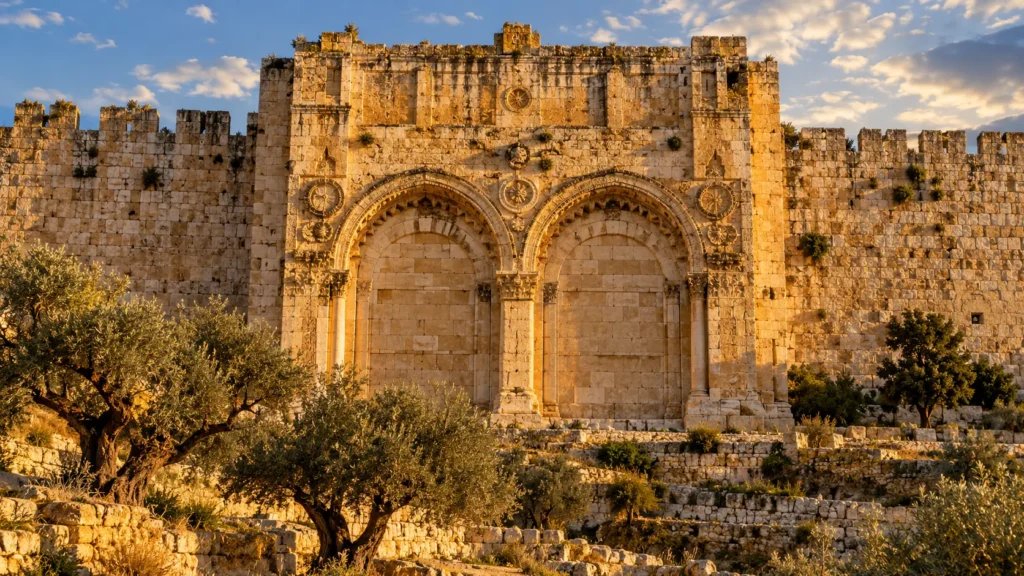
What is the Golden Gate of Jerusalem?
When visitors look at a modern map of the Old City, they often ask: exactly what is the Golden Gate of Jerusalem, and why does it look so different from the rest?
The Golden Gate in Jerusalem is a monumental double portal located on the eastern wall of the city. Architecturally, it is arguably the most beautiful of the ancient Jerusalem city gates. While the current walls were built by the Ottoman Empire in the 16th century, the structure of this specific gate is much older. Most archaeologists date the visible stone arches to the Late Byzantine or Early Umayyad period (around 520–660 CE), though it sits directly atop the ancient, subterranean ruins of the original Herodian and Nehemiah-era entrances.
Today, the Golden Gate of Jerusalem is completely sealed. Its twin arches are walled up with heavy ashlar blocks, creating a fascinating architectural blind spot on the city’s eastern flank.
The Gate of Mercy (Sha’ar HaRachamim)
To truly understand this site, one must recognize that its name changes depending on the religious text you are reading. In Jewish tradition, this entrance is not called the Golden Gate. Instead, it is known in Hebrew as Sha’ar HaRachamim, which translates directly to the Gate of Mercy Jerusalem. According to Jewish eschatology, this is the exact spot where the Shekhinah (the Divine Presence) used to manifest, and it is the door through which the Messiah will ultimately enter the city to bring redemptive mercy to the world.
So, where did the “Golden” name come from? It is actually the result of a fascinating linguistic mix-up. Early Christians reading the Book of Acts in Greek saw a reference to the “Beautiful Gate” (translated as Oraia). When the scholar Jerome translated the New Testament into the Latin Vulgate, he used the Latin word Aurea (Golden) instead of the word for beautiful. Consequently, the Christian world adopted the name “Golden Gate,” while the local Arabic name, Bab al-Dhahabi, also adopted this golden moniker.
Regardless of the name, this Gate of Mercy remains the ultimate focal point for three major world religions.
The Eastern Gate of Jerusalem in Biblical Times
While modern tourists are captivated by the name “Golden Gate,” when we study the gates of Jerusalem in the bible, this entrance is almost exclusively identified by its geographical orientation. In antiquity, the eastern gate of Jerusalem was not just another point of access for merchants or civilians; it was a highly specialized and sacred threshold.
During both the First and Second Temple periods, the east gate of Jerusalem held a unique status because of what lay immediately behind it. Understanding its role in biblical times requires looking at how it connected the world outside the walls directly to the epicenter of Jewish worship.
The East Gate of the Temple Mount
Unlike the other gates that led into residential or commercial districts, this was specifically the east gate of the temple in Jerusalem. It was the only gate in the entire outer city wall that provided direct, uninterrupted access into the sacred precincts.
Because the Jewish Temple was oriented facing east, the east gate temple mount entrance was perfectly aligned with the doors of the Sanctuary and the Holy of Holies. During the Second Temple period, the High Priest would use the ancient predecessor of this temple mount eastern gate to lead the red heifer out to the Mount of Olives for the purification sacrifice. It was an entrance reserved for profound theological and ritualistic purposes, acting as the straightest line between the Divine Presence inside the Temple and the world outside.
The Mount of Olives Eastern Gate and Jesus
You cannot fully grasp the biblical significance of this location without understanding its exact geography. Directly opposite the gate, across the deep Kidron Valley, rises the Mount of Olives. The visual and physical connection between the Mount of Olives eastern gate pathway is one of the most important routes in the New Testament.
When Jesus made his famous Triumphal Entry on Palm Sunday, the Gospels describe him descending the Mount of Olives riding on a donkey. His royal entrance into Jerusalem followed this exact geographical line. He crossed the Kidron Valley and entered the city through the ancient Herodian gate that stood exactly where the current structure stands today. For first-century Jews, a King arriving via the eastern gate Mount of Olives route was a massive, unmistakable declaration of his Messianic identity, fulfilling ancient prophecies and challenging the Roman and religious authorities right at the doorstep of the Temple.
The Eastern Gate Prophecy: Ezekiel and the Messiah
For centuries, the sealed stones of this entrance have stood as a physical testament to the ultimate eastern gate prophecy. According to Jewish, Christian, and even Islamic eschatological traditions, this specific portal is not just an archaeological relic; it is intrinsically tied to the end of days and the arrival (or return) of the Messiah.
The root of this profound eastern gate Jerusalem prophecy traces back to the 6th century BCE during the Babylonian exile. It is entirely based on the prophetic visions given to a Jewish priest who was shown the future restoration of the Temple and the ultimate glory of God returning to the city.
East Gate Bible Meaning and Verses
To fully grasp the east gate bible meaning, we must turn directly to the scriptures, specifically the Book of Ezekiel. When theologians and students search for a definitive eastern gate bible verse, they are pointed to a highly specific and literal vision regarding this entrance.
The most critical east gate bible verses are found in Ezekiel 44:1-3:
“Then the man brought me back to the outer gate of the sanctuary, the one facing east, and it was shut. The Lord said to me, ‘This gate is to remain shut. It must not be opened; no one may enter through it. It is to remain shut because the Lord, the God of Israel, has entered through it. The prince himself is the only one who may sit inside the gateway to eat in the presence of the Lord.'”
These specific verses are the theological cornerstone for why the gate’s current physical state—blocked by massive stone blocks—is viewed with such awe today. The east gate bible meaning carries a dual interpretation depending on the faith of the reader:
- The Christian Interpretation: Christians believe this prophecy was fulfilled when Jesus Christ (recognized as the Lord God of Israel in the flesh) entered through this exact route on Palm Sunday. Because He entered through it, the gate was subsequently shut and sealed by history, waiting only for His Second Coming when His feet will touch the Mount of Olives (Zechariah 14:4).
- The Jewish Interpretation: For Jewish believers, the prophecy indicates that the gate must remain firmly shut and untouched until the future, triumphant arrival of the Jewish Messiah, who will finally open the doors, enter the Temple Mount, and bring eternal peace and redemption to Israel.
Why is the Eastern Gate in Jerusalem Closed?
When standing in the Kidron Valley and looking up at the Temple Mount, the visual of the massive stone blocks filling the twin arches is striking. It is the most common question asked by tourists and pilgrims alike: exactly why is the eastern gate in Jerusalem closed?
Unlike the other old Jerusalem gates that still funnel thousands of pedestrians into the Old City daily, this entrance is a dead end. The east gate Jerusalem closed status is not a result of structural collapse or a recent security measure; rather, it is the result of a deliberate, centuries-old blockade born from a fascinating clash of empires and eschatology.
When Was the Eastern Gate Sealed?
The current physical blockade dates back to the 16th century. In 1541, the Ottoman Sultan Suleiman the Magnificent undertook a massive project to rebuild and fortify the city walls (the same walls that encircle the Old City today). During this reconstruction, Suleiman ordered the eastern gate sealed with massive ashlar stone blocks.
While some historians argue this was purely a defensive military decision to protect the vulnerable eastern flank of the Haram al-Sharif (the Temple Mount compound) from crusaders or invading armies, the historical consensus points to a deeper, theological motive. Suleiman was well aware of the Jewish and Christian prophecies stating that a conquering Messiah would enter the city through this exact portal. By walling it up, the Sultan actively attempted to thwart the prophecy and prevent any future Messianic claimant from making a triumphant entry.
The Cemetery in Front of the Eastern Gate
Suleiman’s efforts to stop the prophecy did not end with stone and mortar. To ensure the gate remained impassable, the Ottomans established a massive Islamic graveyard—the Bab al-Rahma cemetery—directly outside the sealed arches.
But why place a cemetery in front of eastern gate? This was a calculated move based on Jewish law (Halakha). According to Jewish tradition, the prophet Elijah must arrive first to herald the coming of the Messiah. Because Elijah is considered a priest (Kohen), he is strictly forbidden from walking through a graveyard, as contact with the dead would render him ritually impure. Therefore, planting a sprawling cemetery directly across the only path to the gate was viewed as the ultimate theological roadblock—a strategic barrier designed to prevent Elijah from approaching, thereby indefinitely delaying the Messiah’s arrival.
Is the Golden Gate in Jerusalem Opening?
Every few months, social media platforms and clickbait YouTube channels erupt with viral videos claiming a massive biblical event is unfolding. Consequently, thousands of frantic searches flood the internet asking: is the golden gate in Jerusalem opening?
If you are planning a trip or studying eschatology and wondering is the golden gate open in Jerusalem, the definitive, physical reality is a resounding no. The massive ashlar blocks placed by Suleiman the Magnificent have not moved an inch in nearly 500 years. The exterior wall facing the Kidron Valley remains impenetrable.
Has the Eastern Gate in Jerusalem Been Opened in 2024 or 2025?
Because of rising geopolitical tensions in the Middle East, prophetic speculation is at an all-time high. Recent viral trends have specifically triggered the question: has the eastern gate in Jerusalem been opened 2025? This follows similar panics from the previous year, with users insisting the eastern gate of Jerusalem opened 2024.
Let’s be absolutely clear: the claim that the eastern gate in Jerusalem opened to the outside world is a complete fabrication. There are no construction crews dismantling the stone blocks, and the Israeli government maintains a strict status quo regarding the perimeter walls of the Temple Mount. The exterior arches remain sealed shut, keeping the ancient prophecy completely intact.
Rumors: Did the Eastern Gate of Jerusalem Open?
If the stones haven’t moved, why do so many people genuinely ask, did the eastern gate of Jerusalem open? Where does the aggressive search volume for open golden gate Jerusalem come from? The confusion stems from a highly publicized and controversial event that occurred inside the Temple Mount complex, not on the exterior wall.
In 2019, the Islamic Waqf (the Jordanian trust that manages the Temple Mount) forced open the interior building attached to the gate—a compound known as Bab al-Rahma. They opened internal wooden doors to turn the vaulted hall into a Muslim prayer space. Mainstream news outlets ran sensationalized headlines that inadvertently translated to jerusalem eastern gate opened.
Readers panicked, assuming the exterior stone blockade had fallen. Additionally, tourists often mistake routine municipal maintenance on other open gates for the unsealing of the eastern wall. But to answer the ultimate question—did the golden gate in Jerusalem open to allow entry from the Mount of Olives? Absolutely not. The physical and theological barrier remains unbroken.
Where is the Golden Gate in Israel Today?
For travelers planning a pilgrimage or a historical tour, finding the exact location of the Golden Gate in Israel is a top priority. However, because it is sealed, you cannot simply hail a taxi and ask to be dropped off at the Israel Golden Gate to walk inside, as you would with the Jaffa or Zion gates.
So, if you are looking for the Golden Gate in Israel today, you have two distinct ways to view it: from the outside looking in, or from the inside looking out.
To get the most breathtaking, postcard-perfect view of the east gate Jerusalem Israel, you must stand on the Mount of Olives. Looking west across the Kidron Valley, the sealed twin arches of the Israel eastern gate are perfectly visible, dominating the center of the eastern wall of the Old City. The contrast of the white stone against the Golden Dome of the Rock in the background is the most iconic view of the Golden Gate Jerusalem Israel.
If you want to approach it from the inside, you must pass security and enter the Temple Mount (Haram al-Sharif) during tourist visiting hours. Once on the esplanade, you can walk to the eastern perimeter to see the Bab al-Rahma building, the interior structure attached to the gate, though access to the actual stone facade is restricted.
Study Guide & Quick Answers (FAQs)
How many old Jerusalem gates are there?
When counting the gates of the city of Jerusalem built into the current 16th-century Ottoman walls, there are exactly 8 gates of Jerusalem. Seven of these old Jerusalem gates are open and actively used by pedestrians and vehicles (such as the Damascus, Jaffa, and Lion’s Gates), while only one—the Eastern Gate—remains entirely sealed.
What is the Gate of Mercy in Jerusalem?
The Gate of Mercy (Sha’ar HaRachamim) is the Jewish name for the Golden Gate. According to Jewish tradition, this is the holiest gate in the city, representing the exact location where the Divine Presence (Shekhinah) used to manifest and the path through which the Jewish Messiah will enter the Temple Mount.
Why is the East Gate in Jerusalem closed?
The east gate Jerusalem closed status is the result of a 16th-century decree by the Ottoman Sultan Suleiman the Magnificent. Aware of Jewish and Christian prophecies predicting a conquering Messiah entering through this gate, Suleiman ordered it sealed with solid stone and planted a Muslim cemetery in front of it to prevent the prophecy from being fulfilled.
Is the Eastern Gate in Jerusalem opening soon?
Despite constant viral rumors claiming the gate opened in 2024 or 2025, the physical exterior stones of the Golden Gate have not been removed or opened in nearly 500 years. The rumors usually stem from internal administrative changes to the prayer halls inside the Temple Mount complex, not the unsealing of the ancient external arches.