Who Were the Akkadian Kings?
The Akkadian kings were the rulers of the Akkadian Empire, which emerged in Mesopotamia during the 3rd millennium BCE. The dynasty began with Sargon of Akkad, who established the empire, and included rulers such as Rimush, Manishtushu, Naram-Sin, and Shar-Kali-Sharri. These kings expanded and governed territories beyond individual Mesopotamian city-states.
Akkadian Kings Timeline
| Period | King | Main significance |
|---|---|---|
| c. 2334–2279 BCE | Sargon of Akkad | Founded the Akkadian Empire |
| c. 2279–2270 BCE | Rimush | Suppressed rebellions and defended the empire |
| c. 2270–2255 BCE | Manishtushu | Continued imperial expansion |
| c. 2254–2218 BCE | Naram-Sin | Expanded the empire and promoted divine kingship |
| c. 2217–2193 BCE | Shar-Kali-Sharri | Ruled during the empire’s later period |
How the Akkadian Kings Built and Maintained Power
The Akkadian kings combined military force, centralized administration, political authority, and royal ideology to govern a large territorial state.
The king stood at the centre of the political system, exercising authority over territories that extended far beyond a single city-state.
Armies enabled Akkadian rulers to conquer territories, suppress rebellions, and defend imperial control.
Royal officials and governors helped the king administer important cities, territories, resources, and local populations.
Agricultural production, tribute, and trade provided resources that supported the royal administration and military.
Kings reinforced their authority through temples, monuments, rituals, and claims of divine support.
The combination of military strength, administration, resources, and royal legitimacy allowed Akkadian rulers to govern a large and diverse territory.
The Rise of Akkadian Kingship
Before the emergence of the Akkadian Empire, political power in Mesopotamia was largely organised around independent city-states. Rulers controlled individual urban centres and the agricultural territories surrounding them, while neighbouring cities competed for land, resources, and influence.
The emergence of Akkadian kingship changed the scale of political authority.
Rather than limiting royal power to a single city, the Akkadian rulers sought to control multiple cities and territories under a central monarchy. This created a new political model in which the king’s authority extended across different populations, languages, and local traditions.
From City-State Rulers to Imperial Kings
Sumerian city-states had already developed sophisticated forms of kingship. However, their rulers generally operated within a relatively local political framework.
The Akkadian kings introduced a different ambition: to make the authority of one ruler extend across a much larger territorial network.
This transformation can be understood as a progression:
| Political Model | Main Characteristic | Scale of Authority |
|---|---|---|
| 🏘️ Local settlement | Community leadership | Small local territory |
| 🏛️ City-state | Independent ruler and administration | One city and its surrounding lands |
| 👑 Akkadian kingship | Centralised royal authority | Multiple cities and territories |
| 🌍 Imperial rule | One dynasty controlling diverse regions | Large territorial state |
The significance of Akkadian kingship therefore lies not simply in the title of the ruler, but in the scale of authority attached to that position.
The King as the Centre of Political Power
Akkadian royal authority depended on the ability of the king to maintain control over territories that were often far from the political centre.
This required more than military victories. Rulers needed officials, administrators, soldiers, and systems for managing resources and communicating royal decisions.
The king consequently became the central figure connecting different parts of the state.
Local cities could retain their own traditions and institutions, but their political relationship with the Akkadian monarchy had changed. They were now incorporated into a wider system of royal authority.
Why This Was a Major Change in Mesopotamian History
The development of Akkadian kingship established a model that later Mesopotamian rulers could adapt.
The idea that a single monarch could legitimately rule over multiple peoples and territories became an important feature of Mesopotamian political thought.
This does not mean that the Akkadian state was a modern centralized government. Communication was slow, local resistance remained a constant problem, and royal control could vary considerably from one region to another.
Nevertheless, the Akkadian kings demonstrated that political authority could be organised on a scale considerably larger than the traditional city-state.
That transformation provides the essential context for understanding Sargon of Akkad, whose reign marked the beginning of this new phase of Mesopotamian kingship.
Sargon of Akkad and the Beginning of Imperial Rule
Sargon of Akkad was the founder of the Akkadian dynasty and the ruler who transformed Akkad from a regional power into a territorial empire. His reign, traditionally dated to the 24th century BCE, represents a major turning point in the political history of Mesopotamia.
He is particularly important for this page because the rise of Sargon explains why the term Akkadian king came to represent something different from the earlier city-state ruler.
Who Was the First Akkadian King?
Sargon is generally regarded as the first king of the Akkadian Empire and the founder of its ruling dynasty.
He is also frequently described as the first ruler to create a large territorial empire in Mesopotamia. The exact definition of the “first empire” depends on how historians define an empire, but Sargon’s reign clearly represents one of the earliest known examples of a ruler extending authority over numerous previously independent political centres.
His achievement was therefore not simply winning individual battles. It was the creation of a new political structure in which conquered cities became part of a much larger royal system.
How Sargon Changed Mesopotamian Kingship
Before Sargon, political authority in southern Mesopotamia was strongly associated with individual cities.
Sargon’s expansion changed this relationship.
Instead of being primarily the king of one city, he presented himself as a ruler whose authority extended across multiple territories. This created a new model of kingship based on:
- 👑 Central royal authority
- ⚔️ Military expansion
- 🏛️ Administration of conquered territories
- 💰 Control of resources and tribute
- 🌍 Political authority beyond a single city
The significance of Sargon therefore lies in the combination of conquest and political organisation.
Sargon’s Conquests
Sargon’s forces defeated a number of rival rulers and brought important parts of southern Mesopotamia under Akkadian control.
His campaigns also extended Akkadian influence beyond the traditional Sumerian heartland.
However, the extent and permanence of this control should not be imagined as equivalent to a modern nation-state. Ancient rulers depended heavily on military expeditions, local administrators, alliances, and the ability to suppress rebellions.
Sargon’s achievement was establishing a political framework capable of incorporating these different territories under one royal authority.
Why Sargon Became So Important
Later Mesopotamian traditions remembered Sargon as an exceptional ruler.
Stories about his origins and achievements were copied and reshaped long after his reign, contributing to an enduring image of Sargon as the archetypal Mesopotamian conqueror.
This later reputation is important because it shows that Sargon’s significance extended beyond his own lifetime.
He became a model against which later rulers could define their own ambitions.
Sargon and the Akkadian Dynasty
Sargon’s importance was also connected to the dynasty he established.
After his death, his successors inherited a political system that was much more extensive than the traditional city-state kingdoms of earlier Mesopotamia.
Maintaining that system proved difficult. Revolts and political instability affected the following reigns, demonstrating that creating an empire was considerably easier than maintaining it.
This becomes particularly clear when examining the rulers who followed Sargon.
The Kings Who Followed Sargon
Sargon’s death did not end the Akkadian dynasty. His successors inherited an ambitious but difficult political system that stretched across much of Mesopotamia and beyond.
The kings who followed him faced a recurring challenge: how to maintain control over territories that had previously been independent and often resisted Akkadian rule.
The succession also shows that the Akkadian Empire was not the achievement of one ruler alone. Each king had to respond to rebellions, territorial pressures, administrative problems, and the changing balance of power across Mesopotamia.
| King | Relationship to Sargon | Main Significance |
|---|---|---|
| Rimush | Son | Suppressed major rebellions and defended the empire |
| Manishtushu | Son | Continued expansion and royal administration |
| Naram-Sin | Grandson | Reached the height of Akkadian power and promoted divine kingship |
| Shar-Kali-Sharri | Later descendant | Faced increasing instability during the final phase of the dynasty |
Rimush
Rimush succeeded Sargon and inherited an empire that was far from secure.
Rebellions broke out in several parts of the empire, particularly among populations and cities that had previously enjoyed greater political independence. Rimush responded with military campaigns designed to reassert Akkadian authority.
His reign demonstrates an important reality of Akkadian kingship: conquest did not automatically produce permanent political loyalty.
The king had to continually demonstrate his authority through military action and the enforcement of royal control.
Rimush therefore played an important role in preserving the territorial achievements of his father.
Manishtushu
Manishtushu, another son of Sargon, followed Rimush as king.
His reign continued the policies of the early Akkadian dynasty, combining military activity with the administration of a large territorial state.
Manishtushu is also associated with campaigns beyond the immediate Mesopotamian heartland, illustrating the wider ambitions of Akkadian rulers.
His reign is significant because it shows that the Akkadian state remained active after Sargon’s death rather than immediately collapsing.
Naram-Sin
Naram-Sin, the grandson of Sargon, became one of the most powerful and famous rulers of the Akkadian dynasty.
During his reign, Akkadian power reached one of its high points. He expanded the territory controlled by the dynasty and strengthened the ideological position of the king.
Naram-Sin is particularly famous for presenting himself as divine.
This represented a significant development in Mesopotamian royal ideology. Earlier rulers could emphasise their relationship with the gods, but Naram-Sin’s imagery went further by portraying the king himself with divine status.
His famous victory monument, commonly known as the Victory Stele of Naram-Sin, illustrates this new royal image.
Naram-Sin therefore represents an important stage in the evolution of Akkadian kingship: the ruler was no longer simply a military commander or administrator, but increasingly presented as a uniquely powerful figure whose authority had a divine dimension.
Related reading: Naram-Sin
Shar-Kali-Sharri
Shar-Kali-Sharri was one of the final significant rulers of the Akkadian dynasty.
His reign took place during a period when maintaining imperial unity had become increasingly difficult. Internal instability and external pressures challenged the authority that earlier kings had established.
Unlike Sargon and Naram-Sin, whose reigns are associated with expansion and imperial strength, Shar-Kali-Sharri is more closely connected with the later weakening of Akkadian royal power.
His reign illustrates how dependent the Akkadian political system was on the ability of individual kings to maintain military, administrative, and political control.
What the Succession of Kings Reveals
The succession from Sargon to Shar-Kali-Sharri reveals an important pattern.
The Akkadian Empire was not simply created and then maintained automatically by a permanent bureaucracy. Its stability depended heavily on the strength and effectiveness of individual rulers.
The sequence can be summarised as:
Sargon → Expansion
Rimush → Consolidation
Manishtushu → Continuation
Naram-Sin → Imperial Peak
Shar-Kali-Sharri → Increasing Instability
This succession helps explain both the achievements and the eventual problems of the Akkadian dynasty.
The history of these rulers is therefore not just a list of Akkadian kings. It is the story of how one of the earliest territorial states was created, maintained, expanded, and eventually weakened.
How the Akkadian Kings Ruled
The power of the Akkadian kings depended on more than military victories. Governing a large territory required rulers to coordinate cities, resources, officials, armies, and local populations across a politically diverse region.
This made Akkadian government closely connected to the authority of the king. The ruler stood at the centre of the political system, while officials and governors helped translate royal decisions into practical control.
Central Royal Authority
The Akkadian king represented the highest political authority within the state.
Unlike the rulers of independent city-states, Akkadian kings claimed authority over multiple cities and territories. This required a stronger emphasis on central decision-making and royal administration.
The king’s authority was supported by several interconnected institutions:
- 👑 The royal court — where political decisions and administration were coordinated.
- 🏛️ Governors and officials — who represented royal authority in important settlements.
- ⚔️ The army — which protected Akkadian territory and suppressed resistance.
- 💰 Resource management — which helped support the administration, military, and royal institutions.
- 🏺 Religious institutions — which reinforced the legitimacy of royal authority.
Governors and Local Administration
The Akkadian kings could not personally administer every city and territory under their control.
They therefore depended on officials and governors who helped manage local affairs and implement royal authority.
Local communities did not necessarily lose every existing institution or tradition. Instead, Akkadian rule often worked by placing local political structures within a wider framework of royal control.
This distinction is important. The Akkadian state should not be imagined as a perfectly uniform bureaucracy in which every region was administered in exactly the same way.
Royal control varied according to distance, local resistance, economic importance, and the ability of the king to enforce his authority.
Military Power and Political Control
Military force was essential to maintaining Akkadian rule.
The same army that allowed kings such as Sargon and Naram-Sin to expand their territories was also needed to suppress rebellions and protect the political order established by the dynasty.
This created a constant relationship between conquest and administration.
Expansion increased the territory under royal authority, but every new territory also created another political and logistical challenge for the king.
The ability to maintain an empire therefore depended not only on winning battles, but on keeping conquered regions connected to the royal system.
Managing Resources and Tribute
A large territorial state also required access to agricultural production, labour, raw materials, and other resources.
The Akkadian administration had to organise the movement and allocation of these resources, helping sustain the royal court and military institutions.
Tribute and other forms of resource extraction could therefore strengthen royal power.
At the same time, excessive demands on local populations could create additional tensions, particularly in regions that had previously been politically independent.
The Limits of Akkadian Government
Despite its achievements, Akkadian government was not centralized in the modern sense.
Communication depended on messengers travelling over considerable distances, local officials had substantial responsibilities, and royal authority ultimately depended on the ability of the king to enforce decisions.
This helps explain why strong rulers could maintain extensive political control while weaker rulers faced rebellions and fragmentation.
The history of the Akkadian kings therefore demonstrates an important principle of early imperial government: the larger the territory, the greater the challenge of maintaining political cohesion.
The Akkadian rulers developed one of the earliest known systems for managing this problem, combining royal authority, military power, local administration, and resource management on an unusually large scale.
Military Power and the Expansion of Akkadian Rule
Military power was one of the foundations of Akkadian kingship. The rulers of Akkad used armies not only to conquer new territories, but also to suppress rebellions and maintain control over cities that had previously been independent.
Under Sargon of Akkad, Akkadian authority expanded from its Mesopotamian heartland into a much wider political sphere. Later rulers, particularly Naram-Sin, continued to project military power beyond southern Mesopotamia. At its greatest extent, Akkadian influence reached across a large part of Mesopotamia and into neighbouring regions.
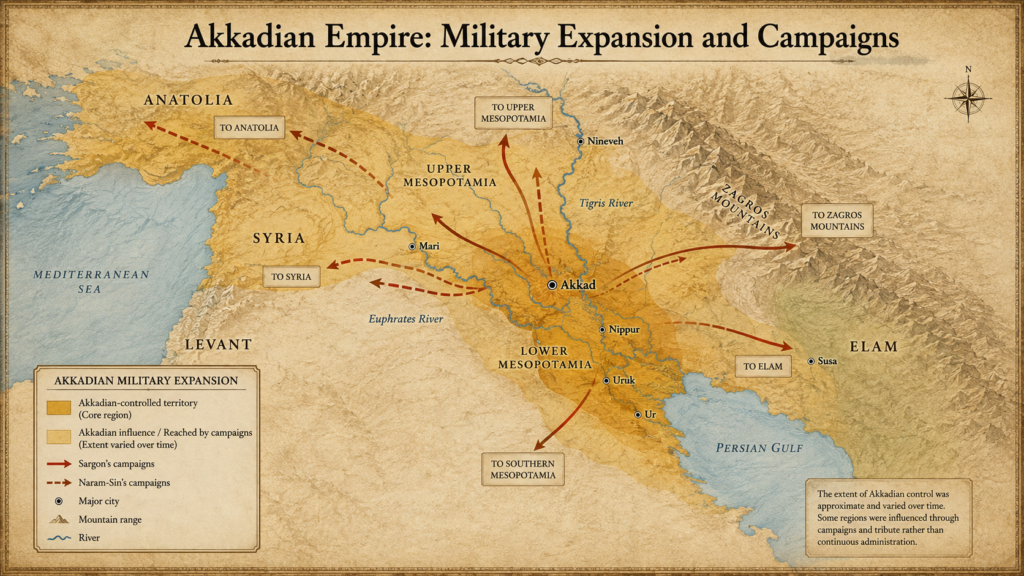
The Main Directions of Akkadian Expansion
Akkadian military activity was not concentrated in a single direction. Campaigns were conducted toward several strategic regions, reflecting the different political and economic challenges faced by the kings.
| Direction | Region | Why It Mattered |
|---|---|---|
| South | Sumerian city-states | Consolidating control over the traditional political heartland of Mesopotamia |
| North | Upper Mesopotamia | Extending royal authority toward important cities and trade routes |
| West | Syria and the Levant | Projecting Akkadian power beyond the Mesopotamian core |
| East | Elam and the Zagros | Controlling rival powers and important routes through the Iranian highlands |
| Northwest | Anatolian frontier | Extending the reach of Akkadian campaigns and influence |
The exact extent of direct Akkadian control varied from region to region. The empire should therefore not be imagined as a modern state with clearly defined borders. In many areas, royal authority depended on military expeditions, political relationships, local rulers, and the ability of the king to enforce his authority.
Sargon’s Military Expansion
Sargon’s campaigns were fundamental to the creation of the Akkadian Empire.
He defeated rival rulers in southern Mesopotamia and brought major Sumerian cities into the sphere of Akkadian royal authority. His campaigns also extended toward Upper Mesopotamia and the western regions.
This expansion transformed the political geography of Mesopotamia.
Instead of a landscape dominated by competing independent city-states, a growing number of political centres were connected to a single royal dynasty.
Sargon’s military achievements therefore cannot be separated from his transformation of kingship. Conquest created the territorial basis on which Akkadian imperial rule could operate.
Naram-Sin and the Expansion of Akkadian Power
The military ambitions of the dynasty continued under Naram-Sin, whose reign is often associated with the height of Akkadian power.
Naram-Sin campaigned in several directions, including against groups in the Zagros region. His famous victory monument depicts his triumph over the Lullubi and presents the king as a dominant military figure leading his army into mountainous territory.
The monument is important not only as evidence of military success but also because it shows how conquest was incorporated into royal ideology.
Military victory demonstrated the king’s power, while royal monuments transformed that victory into a permanent statement of authority.
Why Military Power Was Essential
Military expansion created several advantages for the Akkadian kings.
It allowed them to:
- Expand the territory under royal authority.
- Suppress rebellions in conquered cities.
- Protect important routes connecting different parts of the state.
- Gain access to resources unavailable in southern Mesopotamia.
- Demonstrate royal power to subjects and neighbouring rulers.
But military expansion also created a serious problem.
Every additional territory increased the distance between the king and the people he was expected to govern. Maintaining control therefore required repeated campaigns and a functioning administrative system.
This explains why military power and government were so closely connected in Akkadian kingship.
From Conquest to Imperial Control
The Akkadian rulers did not simply conquer territory and abandon it. Military victories had to be followed by political and administrative measures that kept conquered regions connected to the monarchy.
This created a cycle:
⚔️ Military campaign → 🏛️ Political control → 💰 Resources → 👑 Stronger royal authority
When this system worked, the Akkadian kings could project their power across an exceptionally large area for their time.
When military and political control weakened, however, distant territories became increasingly difficult to hold.
The history of Akkadian expansion therefore reveals both the strength and the fundamental weakness of early imperial rule: the same military power that created the empire had to be continually maintained to preserve it.
Kingship, Religion, and Divine Authority
Religion was closely connected to Akkadian kingship. The authority of the king was not understood solely in political or military terms; it was also connected to the relationship between the ruler, the gods, and the prosperity of the kingdom.
Akkadian kings presented their rule as part of a divinely sanctioned order. Temples, rituals, royal inscriptions, and monuments helped communicate this relationship between political authority and religion.
The King and the Gods
Mesopotamian kings traditionally presented themselves as rulers chosen or supported by the gods.
For the Akkadian kings, this connection became an important element of royal legitimacy.
A successful ruler could portray military victories, political authority, and the prosperity of the kingdom as evidence of divine favour.
This gave kingship a religious dimension that reinforced the political system.
Royal Patronage of Temples
Akkadian rulers supported temples and religious institutions throughout their territories.
Building and maintaining temples served several purposes:
- Religious: honouring the gods and maintaining rituals.
- Political: demonstrating royal authority in important cities.
- Economic: supporting institutions that controlled land, labour, and resources.
- Ideological: presenting the king as a legitimate guardian of the divine order.
Royal patronage therefore connected religious institutions with the wider system of Akkadian rule.
Naram-Sin and Divine Kingship
The most striking development came under Naram-Sin.
Unlike earlier Mesopotamian rulers who emphasised their relationship with the gods, Naram-Sin was represented as a divine ruler.
The Victory Stele of Naram-Sin is particularly important in this context. The king appears larger and more prominent than the other figures, while divine symbols are placed above him.
The monument communicates more than a military victory. It presents Naram-Sin as an exceptional ruler whose authority had a distinctly divine character.
This development made Naram-Sin one of the most important examples of divine kingship in ancient Mesopotamia.
Why Divine Authority Mattered
Divine kingship did not replace military or administrative power. Instead, it complemented them.
The Akkadian king could be presented simultaneously as:
⚔️ Military commander → 👑 Political ruler → 🏺 Religious patron → ✨ Divinely supported king
This combination helped create a powerful image of royal authority.
It also explains why Akkadian royal monuments were so important. They were not simply historical records of what a king had achieved. They communicated a carefully constructed message about why the king had the right to rule.
The relationship between kingship and religion therefore became one of the defining characteristics of Akkadian royal ideology.
For a broader examination of Akkadian beliefs, gods, and religious practices, see Akkadian Religion.
- See our guide about: Akkadian social classes and daily life.
The Akkadian Dynasty and Its Royal Succession
The Akkadian dynasty was established by Sargon of Akkad and continued through several generations of rulers. The succession of these kings provides a useful way to understand how political power was transferred, maintained, and eventually weakened within the Akkadian state.
Rather than viewing the dynasty simply as a list of names, it is more useful to see each reign as part of a changing political environment.
The Main Akkadian Kings
| King | Approximate Reign | Position in the Dynasty | Historical Significance |
|---|---|---|---|
| Sargon of Akkad | c. 2334–2279 BCE | Founder | Established the Akkadian dynasty and expanded royal authority |
| Rimush | c. 2279–2270 BCE | Son of Sargon | Suppressed rebellions and defended the dynasty |
| Manishtushu | c. 2270–2255 BCE | Son of Sargon | Continued the dynasty’s military and administrative policies |
| Naram-Sin | c. 2254–2218 BCE | Grandson of Sargon | Expanded Akkadian power and promoted divine kingship |
| Shar-Kali-Sharri | c. 2217–2193 BCE | Later descendant | Ruled during a period of increasing instability |
Dates for the Akkadian kings are approximate because the chronology of the third millennium BCE remains subject to scholarly debate.
How Royal Succession Worked
Akkadian kingship was hereditary in principle, with members of the ruling dynasty succeeding one another.
However, succession did not guarantee political stability.
Each new ruler inherited a state that required constant maintenance. Rebellions, rival powers, military campaigns, and the logistical difficulties of governing distant territories could all threaten the authority of the monarchy.
This meant that being part of the royal family was not enough to guarantee effective rule.
The king needed to maintain the support and loyalty of officials, soldiers, cities, and other groups throughout the territory.
From Sargon to Naram-Sin
The first generations of the dynasty illustrate both continuity and transformation.
Sargon established the political framework.
Rimush and Manishtushu worked to preserve it.
Naram-Sin then expanded the dynasty’s power and developed a more ambitious image of kingship, presenting himself with an unprecedented degree of divine status.
This progression shows that Akkadian kingship was not static. The meaning and presentation of royal authority evolved as the dynasty developed.
The Final Phase of the Dynasty
By the reign of Shar-Kali-Sharri, maintaining the unity established by earlier rulers had become increasingly difficult.
The dynasty faced internal rebellions, external pressures, and growing political instability.
After the final phase of Akkadian royal rule, political power in Mesopotamia became increasingly fragmented once again.
The Akkadian dynasty nevertheless remained historically important because later Mesopotamian rulers inherited and adapted ideas about territorial kingship, imperial authority, and royal ideology that had developed during the Akkadian period.
Why the Akkadian Dynasty Matters
The significance of the Akkadian dynasty lies in its continuity across several generations.
Sargon created the dynasty, but his successors demonstrated whether the political system could survive beyond its founder.
The succession of Akkadian kings therefore reveals one of the central challenges of early empire building:
Creating a large kingdom required military power, but maintaining it required a dynasty capable of repeatedly transferring and enforcing royal authority.
That is why the history of the Akkadian rulers is essential for understanding the development of large-scale kingship in ancient Mesopotamia.
The Decline of Akkadian Royal Power
The Akkadian dynasty eventually lost the ability to maintain the political unity created by its earlier rulers. The decline was not caused by a single event, but by a combination of internal instability, external pressure, and the increasing difficulty of controlling a large territorial state.
By the final generations of Akkadian rule, the authority that had once allowed kings such as Sargon and Naram-Sin to project power across Mesopotamia had become considerably weaker.
Growing Internal Instability
One of the greatest challenges facing the later Akkadian kings was maintaining loyalty across a politically diverse territory.
The empire incorporated cities and populations with their own traditions and political interests. When royal authority weakened, some regions could challenge Akkadian control or attempt to regain greater independence.
This created a difficult cycle:
Weaker royal authority → more rebellions → greater military pressure → fewer resources for administration
The problem was therefore not simply that the Akkadian army became weaker. The entire political system became increasingly difficult to maintain.
Pressure from Outside the Akkadian State
The later kings also faced pressure from neighbouring peoples and rival powers.
Groups from the surrounding regions could challenge Akkadian control of frontier territories, while political instability within Mesopotamia made it more difficult for the monarchy to respond effectively to external threats.
The Akkadian kings had to divide their attention between maintaining internal order and defending distant parts of their territory.
For an early territorial state with limited communication and transportation, this was a serious structural problem.
The Problem of Governing a Large Territory
The same territorial expansion that had made the Akkadian kings powerful also created one of their greatest weaknesses.
A ruler based in central Mesopotamia could not respond immediately to events occurring hundreds of kilometres away.
Governors and military commanders therefore had considerable responsibility for maintaining royal authority in distant regions.
When central power was strong, this system could function effectively.
When the king became less capable of enforcing his authority, however, distant territories were increasingly difficult to control.
The End of the Dynasty
During the final phase of Akkadian rule, political authority fragmented.
Shar-Kali-Sharri was followed by a period in which the succession of rulers became increasingly uncertain, while competing powers challenged what remained of Akkadian authority.
Eventually, the dynasty disappeared as a major political force.
The end of Akkadian royal power did not mean that Akkadian political ideas disappeared. Instead, later Mesopotamian rulers inherited and adapted many of the concepts associated with territorial kingship and imperial rule.
Why the Akkadian Dynasty Declined
The decline can therefore be understood through several interconnected factors:
| Factor | Effect on Royal Power |
|---|---|
| Internal rebellions | Reduced the king’s control over cities and territories |
| External pressures | Increased the military demands placed on the dynasty |
| Distance | Made administration and communication increasingly difficult |
| Political fragmentation | Weakened central authority |
| Succession problems | Made continuity of royal power more difficult |
| Resource pressures | Reduced the ability to sustain administration and military campaigns |
No single factor explains the entire process.
The Akkadian dynasty was an early experiment in ruling a large territorial state, and its decline demonstrates the difficulties involved in maintaining such a system over several generations.
The achievement of the Akkadian kings was therefore not only that they created an unusually large political structure for their time, but that their successes and failures provided later Mesopotamian rulers with a model of what territorial kingship could achieve — and how difficult it could be to sustain.
The Legacy of the Akkadian Kings
The Akkadian kings left a political legacy that extended far beyond the relatively short period in which the dynasty controlled Mesopotamia.
Their greatest contribution was not simply territorial expansion. They demonstrated that a single dynasty could claim authority over multiple cities, populations, and regions, creating a model of kingship that later Mesopotamian rulers would repeatedly adapt.
A New Model of Kingship
Before the Akkadian period, political authority in Mesopotamia was strongly associated with individual city-states.
The Akkadian rulers demonstrated a different possibility: a king could claim authority across a much larger territorial area.
This idea became an important precedent for later rulers who sought to present themselves as kings of extensive territories rather than simply rulers of individual cities.
The concept of the territorial king therefore became one of the most enduring aspects of the Akkadian political legacy.
Influence on Later Mesopotamian Rulers
Later Mesopotamian states did not simply copy the Akkadian political system, but they inherited many of its ideas.
The memory of Sargon and his successors remained important in Mesopotamian royal traditions, while later rulers continued to use titles, inscriptions, military campaigns, and monumental art to communicate their authority.
The Akkadian period consequently became an important reference point in the development of Mesopotamian imperial ideology.
Sargon as a Model for Later Kings
Among all the Akkadian rulers, Sargon of Akkad developed perhaps the most enduring reputation.
Later traditions portrayed him as an exceptional conqueror and founder, and stories about his life circulated long after the historical dynasty had disappeared.
His name became associated with the idea of a ruler who could rise from relatively modest origins and establish control over a vast territory.
This image helped transform Sargon from a historical king into a model of idealised Mesopotamian kingship.
The Memory of Naram-Sin
Naram-Sin also left a distinctive legacy.
His military victories, monumental representations, and claims of divine status created a powerful model of royal ideology.
The famous Victory Stele of Naram-Sin demonstrates how a ruler could use art to combine military achievement, political authority, and divine symbolism in a single monument.
His reign therefore provides an important example of how ancient kings used visual culture to shape perceptions of their power.
Why the Akkadian Kings Still Matter
The importance of the Akkadian kings extends beyond their own dynasty.
They provide evidence for an important transition in ancient Mesopotamian history: the movement from political systems dominated by competing city-states toward larger territorial kingdoms.
Their history also reveals the challenges that accompanied this transformation.
The Akkadian rulers showed that military conquest could create a powerful territorial state, but they also demonstrated that maintaining such a state required continuous military, administrative, economic, and ideological support.
Their legacy can therefore be summarised in four ideas:
- 👑 Territorial kingship
- ⚔️ Imperial military power
- 🏛️ Centralised royal administration
- 🏺 Powerful royal ideology
These ideas continued to influence Mesopotamian political culture long after the Akkadian dynasty had disappeared.
The Akkadian kings were therefore important not simply because they ruled the first widely recognised Mesopotamian empire, but because they helped establish a political model that later rulers would continue to reinterpret for centuries.
Key Takeaways
- Sargon of Akkad founded the Akkadian dynasty and established one of the earliest large territorial states in Mesopotamian history.
- Akkadian kings ruled through a combination of military power, administration, resource management, and religious authority.
- Rimush and Manishtushu worked to preserve the political system created by Sargon and faced significant resistance.
- Naram-Sin expanded Akkadian power and became particularly famous for presenting himself as a divine ruler.
- Shar-Kali-Sharri ruled during the later weakening of the dynasty, when internal instability and external pressures increasingly challenged royal authority.
- The Akkadian dynasty created a lasting model of territorial kingship that influenced later Mesopotamian rulers.
- The history of the Akkadian kings shows that conquering a large territory was only the beginning; maintaining imperial authority was an even greater challenge.
Frequently Asked Questions About Akkadian Kings
Who was the first ruler of the Akkadian Empire?
▼
Sargon of Akkad was the founder and first king of the Akkadian dynasty. His reign marked the beginning of a new form of territorial kingship in Mesopotamia, as he conquered independent city-states to create the world’s first empire.
Who were the main leaders of the Akkadian dynasty? (List of Kings)
▼
The Akkadian dynasty consisted of a royal family established by Sargon. The official list of its major kings includes:
- Sargon of Akkad: The founder of the empire.
- Rimush: Sargon’s son, known for violently suppressing rebellions.
- Manishtushu: Sargon’s other son, who expanded trade and military reach.
- Naram-Sin: Sargon’s grandson, who led the empire to its absolute peak.
- Shar-Kali-Sharri: The last major ruler before the dynasty’s decline.
Who was the most powerful Akkadian king?
▼
Naram-Sin is universally regarded as the most powerful Akkadian ruler. Under his military leadership, the state reached its greatest territorial extent, and he developed an unprecedented image of royal authority by declaring himself a living god.
Were the Akkadian kings the first kings of Mesopotamia?
▼
No. Kings (known as “ensi” or “lugal”) existed in Mesopotamia centuries before the Akkadian dynasty, specifically ruling over independent Sumerian city-states. What made Akkadian leaders distinctive was their ability to exercise territorial authority over many cities simultaneously.
What was the Akkadian word for king?
▼
The Akkadian word for king was šarrum (often simplified to šar). It became the standard term for royalty across ancient Mesopotamia, later adopted by the Babylonians and Assyrians.
What was the Akkadian king’s title?
▼
Akkadian rulers used several grandiose titles to emphasize their dominion. A crucial title was šar kiššati (“King of the Universe” or “King of All”). Later, rulers also adopted the title “King of Sumer and Akkad” to legitimize their rule over both the northern Akkadian and southern Sumerian populations.
How did Akkadian kings maintain control of their large empire?
▼
Akkadian kings (a method later copied by Babylonian rulers like Hammurabi) maintained control by combining military force with a network of loyal governors. They managed economic resources centrally, standardized weights and measures, dismantled the walls of rebellious cities, and used religious propaganda to legitimize their authority.
What were the military achievements of the Akkadian kings?
▼
They were brilliant military innovators. Sargon created the first standing professional army, armed with highly effective composite bows and bronze weapons. His successors conducted campaigns as far as the Mediterranean Sea, the Zagros Mountains, and the Persian Gulf, prioritizing mobility and siege tactics.
What is the difference between an Akkadian king and a Mesopotamian king?
▼
An Akkadian king specifically belonged to the Semitic-speaking ruling dynasty established by Sargon of Akkad during the 24th to 22nd centuries BCE. “Mesopotamian king” is a broad umbrella term that includes rulers from entirely different eras and cultures, such as the Sumerians, Babylonians, and Assyrians.
Why are the Akkadian kings important today?
▼
They are crucial to ancient history because they provided the absolute blueprint for imperial rule. Their innovations in large-scale territorial administration, military organization, and the concept of a divinely sanctioned “King of the Universe” served as the political model for all subsequent empires in the Near East.
Further Reading
- Encyclopaedia Britannica – Sargon
- Encyclopaedia Britannica – Akkadian Empire
- The Metropolitan Museum of Art – The Akkadian Period
- The British Museum – Mesopotamia
- Yale Babylonian Collection
- Cuneiform Digital Library Initiative (CDLI)