The Sumerian kings were the rulers of the independent city-states of ancient Sumer in southern Mesopotamia. They governed some of the world’s earliest cities, led armies, built temples, managed irrigation systems, and ruled with the belief that their authority had been granted by the sumerian gods. Their reigns laid the foundations of kingship, government, and political organization in early civilization.
Timeline – The Evolution of Sumerian Kingship
| Period | Approximate Date | What Happened |
|---|---|---|
| Temple Leadership | Before c. 2900 BCE | Early Sumerian communities were governed primarily by temple authorities. Priests managed religious ceremonies, agricultural resources, and local administration, while political power remained closely connected to the city’s patron deity. |
| Rise of the First Kings | c. 2900–2600 BCE | As city-states grew and conflicts became more frequent, military leaders known as lugal (“great man”) emerged. Kings gradually assumed responsibility for defending cities, organising public works, and governing alongside religious institutions. |
| The Early Dynastic Kings | c. 2900–2350 BCE | Independent city-states such as Uruk, Ur, Lagash, Kish, and Eridu were ruled by powerful dynasties. Legendary rulers like Gilgamesh and historical kings such as Eannatum helped define Sumerian kingship. |
| Expansion and Reform | c. 2500–2350 BCE | Kings increasingly expanded their authority through military campaigns, monumental temple construction, irrigation projects, and legal reforms. Figures like Urukagina introduced some of the earliest known attempts to combat corruption and social injustice. |
| The Akkadian Conquest | c. 2334 BCE | Sargon of Akkad conquered the Sumerian city-states, ending their political independence. Although Sumerian kingship declined, many of its institutions, administrative practices, and religious traditions were adopted by the Akkadian Empire. |
| The Neo-Sumerian Revival | c. 2112–2004 BCE | The Third Dynasty of Ur (Ur III) briefly restored Sumerian rule. Kings such as Ur-Nammu and Shulgi created one of the most sophisticated bureaucratic states of the ancient Near East, combining royal authority with extensive legal and administrative reforms. |
| Legacy of Sumerian Kingship | After 2000 BCE | Although independent Sumer disappeared, its concept of sacred kingship influenced later Mesopotamian civilizations, including the Babylonians and Assyrians. The idea that rulers governed with divine approval remained a defining feature of Near Eastern monarchy for centuries. |
How Sumerian Kings Ruled a City-State
Sumerian kings were far more than military leaders. They governed every major aspect of city life, combining political authority, religious legitimacy, economic management, and military command to ensure the prosperity of their city-state.
The supreme ruler of the city-state, believed to govern with the approval of the gods.
⚔️ Military Leader
- Commanded armies
- Defended city walls
- Led military campaigns
- Protected trade routes
🏛️ Political Ruler
- Governed the city-state
- Collected tribute
- Organised public works
- Maintained order
🏺 Religious Authority
- Built temples
- Supported priesthoods
- Honoured the city god
- Ruled with divine legitimacy
🌾 Economic Manager
- Maintained canals
- Oversaw agriculture
- Managed labour
- Protected food supplies
When military strength, religious legitimacy, efficient administration, and agricultural production worked together, the city flourished under the king’s rule.
What Was a Sumerian King?
A Sumerian king was the ruler of one of the independent city-states that flourished in southern Mesopotamia during the third millennium BCE. Unlike the monarchs of later empires, Sumerian kings did not govern a single unified kingdom. Instead, each major city—such as Ur, Uruk, Lagash, Kish, or Eridu—had its own ruler who exercised political, military, religious, and economic authority within that city’s territory.
The Sumerians used different titles to describe their rulers, reflecting the evolving nature of kingship. One of the most common was lugal, meaning “great man”, a title generally associated with powerful military rulers. Another important title was ensi, often translated as “governor” or “city ruler”, which was frequently linked to local administration and temple authority. Although the distinction between these titles changed over time, both illustrate that Sumerian kingship developed gradually rather than emerging as a fixed institution.
Unlike modern heads of state, a Sumerian king was expected to fulfil many roles simultaneously. He commanded armies during times of war, supervised large irrigation projects that sustained agriculture, sponsored the construction of temples and city walls, administered justice, and ensured that religious ceremonies honoured the city’s patron deity. Political leadership and religious responsibility were therefore inseparable.
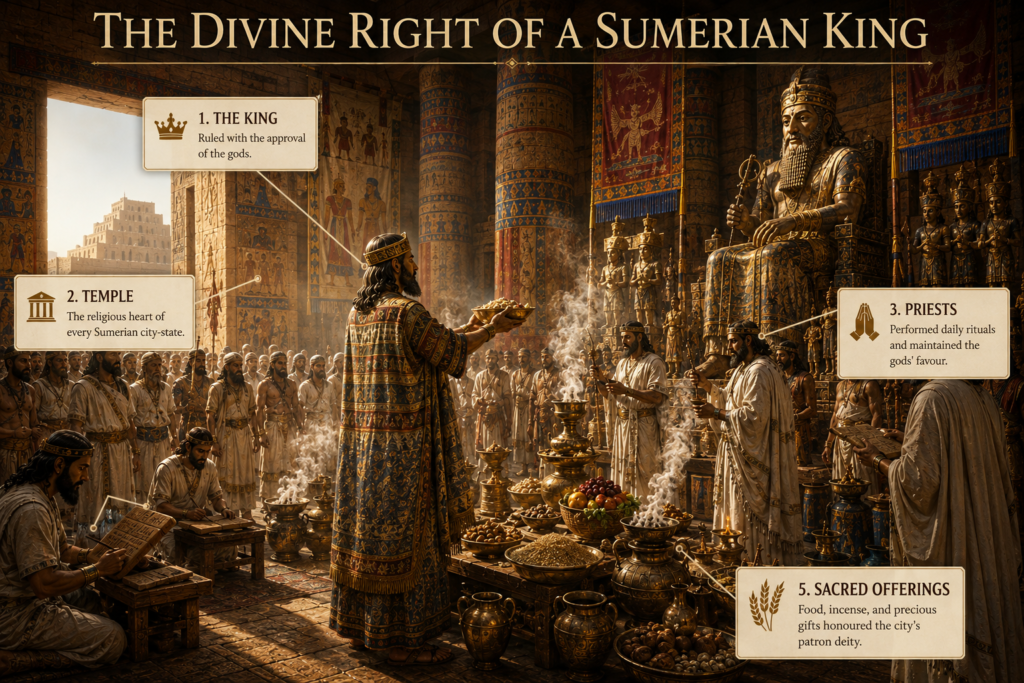
Kings did not usually claim to be gods themselves, but they ruled with the belief that their authority had been granted by the gods. Maintaining the favour of the divine world was considered essential for the prosperity and security of the city-state. Success in war, abundant harvests, and stable government were all interpreted as signs that the ruler enjoyed divine approval.
Understanding what a Sumerian king was is essential to understanding early Mesopotamian civilization itself. These rulers governed some of the world’s first cities, helped establish organised government, and laid many of the political traditions that later civilizations—including the Akkadians, Babylonians, and Assyrians—would adopt and expand.
How Kingship Began in Ancient Sumer
The emergence of Sumerian kingship was closely linked to the rise of the world’s first cities. As settlements such as Uruk, Ur, Kish, and Lagash expanded during the fourth and third millennia BCE, their growing populations required more organised forms of leadership. Managing agriculture, defending city walls, resolving disputes, and coordinating large public works demanded a level of authority that gradually evolved into kingship.
In the earliest stages of Sumerian society, temples played a central role in both religion and administration. Priests oversaw offerings to the gods, controlled agricultural resources, and organised much of the city’s economic activity. Over time, however, increasing competition between neighbouring city-states created the need for permanent military leaders who could protect the population and lead armies during times of conflict.
This changing political landscape gave rise to the lugal, a title commonly translated as “great man” or “king”. While some rulers may initially have been appointed during periods of crisis or war, the office gradually became permanent and hereditary in many cities. Kingship evolved from temporary military leadership into a stable political institution that shaped every aspect of Sumerian government.
Religion remained at the heart of this transformation. The Sumerians believed that kingship was a gift from the gods, not simply a human invention. A ruler’s legitimacy depended on divine approval, and successful kings presented themselves as faithful servants chosen to maintain order, protect the city, and care for its patron deity. Rather than replacing the authority of the temples, kings worked alongside the priesthood, creating a political system in which religious and royal power reinforced one another.
Although every city-state developed its own ruling dynasty, the basic principles of Sumerian kingship remained remarkably consistent. The king was expected to defend the community, oversee public works, administer justice, and preserve the favour of the gods. These responsibilities became the foundation of political leadership throughout Mesopotamia and influenced later civilizations such as the Akkadians, Babylonians, and Assyrians.
By the Early Dynastic Period, kingship had become one of the defining institutions of Sumerian civilization. It provided the political stability that allowed cities to grow, monumental temples to be built, and one of the earliest systems of organised government to flourish in the ancient world.
The Sumerian King List: History, Myth, and Royal Legitimacy
Among all the surviving texts from ancient Mesopotamia, few are as fascinating—or as influential—as the Sumerian King List. More than a simple record of rulers, this remarkable document combines mythology, political propaganda, and historical memory to tell the story of kingship from the very beginning of civilization.
According to the text, “kingship descended from heaven.” This powerful opening statement established one of the central ideas of Mesopotamian political thought: legitimate authority did not originate with human beings but was granted by the gods. Once bestowed, kingship passed from one city to another as history unfolded, explaining why different Sumerian city-states rose to prominence over time.
The King List begins with a series of mythical antediluvian rulers who supposedly reigned before a great flood. Some of these kings are said to have ruled for tens of thousands of years—far longer than any human lifespan. Modern historians generally interpret these extraordinary reigns as symbolic rather than historical, reflecting the Sumerians’ belief that the earliest age of humanity was fundamentally different from the world they knew.
Following the flood, the document gradually becomes more historical. It records dynasties from important city-states such as Kish, Uruk, Ur, Lagash, and Isin, introducing rulers whose existence is supported by archaeological discoveries, royal inscriptions, and contemporary administrative records. This transition from legend to verifiable history makes the King List one of the most valuable sources for reconstructing the political development of early Mesopotamia.
Rather than presenting every ruler who ever lived, the Sumerian King List follows a clear political narrative. It portrays kingship as a single institution that could belong to only one city at any given time. When one dynasty declined, the gods transferred royal authority to another city-state. In reality, archaeology shows that several Sumerian cities often flourished simultaneously, meaning the text simplifies history in order to reinforce the idea of divinely sanctioned kingship.
For historians, the King List is therefore both a historical document and a political statement. It preserves genuine information about early dynasties while also revealing how the Sumerians understood legitimacy, royal succession, and the relationship between the gods and earthly rulers. Few surviving texts illustrate so clearly how mythology and history became intertwined in the earliest civilizations.
The Sumerian King List at a Glance
| Section | What It Contains | Historical Reliability |
|---|---|---|
| Before the Great Flood | Mythical kings with extraordinarily long reigns | Low – symbolic and legendary |
| After the Flood | Early dynasties of Kish and other city-states | Moderate – blends tradition with history |
| Historical Dynasties | Kings of Uruk, Ur, Lagash, Isin, and other cities | High – many rulers are supported by archaeology |
| Purpose of the Text | To explain how kingship passed from city to city under divine authority | Essential for understanding Sumerian political ideology |
The Duties of a Sumerian King
Being a Sumerian king meant far more than commanding soldiers or ruling from a palace. The ruler was responsible for almost every aspect of life within the city-state, combining political leadership, military command, religious responsibility, and economic management. In many ways, the prosperity—or decline—of a city depended on the effectiveness of its king.
One of the king’s most important duties was to protect the city. Rivalries between neighbouring city-states such as Uruk, Lagash, Kish, and Umma frequently led to conflicts over land, trade routes, and water resources. During times of war, the king personally led the army, organised the city’s defences, and sought to secure victory for both his people and their patron deity.
Peace required just as much attention as warfare. Agriculture formed the foundation of the Sumerian economy, and successful harvests depended on an extensive network of canals and irrigation systems. Kings supervised the construction and maintenance of these engineering projects, ensuring that fields received the water needed to sustain growing urban populations. Without effective irrigation, even the most powerful city could face famine.
The king also acted as the chief administrator of the city-state. Royal officials collected taxes and tribute, managed public labour, oversaw trade, and coordinated large construction projects. Monumental temples, defensive walls, canals, and public buildings all required careful organisation, making the royal court the administrative centre of the city.
Religion was inseparable from government. Although priests conducted most daily ceremonies, the king was expected to support the temples, sponsor religious festivals, and honour the city’s patron god through offerings and construction projects. By fulfilling these sacred obligations, the ruler demonstrated that he governed with divine approval and maintained the favour of the gods.
Justice formed another essential responsibility of Sumerian kingship. Rulers settled disputes, enforced laws, protected property, and sought to preserve stability within the community. Some kings, such as Urukagina, became especially well known for introducing reforms that attempted to limit corruption and improve fairness, illustrating that good government was considered an important part of royal duty.
Rather than serving only as warriors or politicians, Sumerian kings embodied the unity of the city-state itself. They defended its people, maintained its economy, honoured its gods, and organised the public works that allowed some of the world’s earliest urban civilizations to flourish. Their model of leadership would influence Mesopotamian rulers for centuries to come.
Step Into the Ancient World
Imagine arriving in Uruk at sunrise around 2500 BCE. The city gates have just opened, merchants begin setting up their stalls, and farmers enter carrying baskets of grain collected from the surrounding fields. In the distance, the towering temple dominates the skyline, while priests prepare the morning offerings for the city’s patron god.
Word quickly spreads that the king is leaving the palace.
Surrounded by soldiers, scribes, and royal officials, he walks through the streets as citizens stop to watch. His first destination is the city’s irrigation canals, where engineers report on repairs needed after the annual flooding. Later, he meets military commanders to discuss rumours of conflict with a neighbouring city-state before presiding over disputes brought before the royal court.
As the day draws to a close, the king climbs the steps of the temple carrying offerings for the gods. Victory in battle, abundant harvests, and the prosperity of the city all depend, the people believe, on maintaining divine favour. To the Sumerians, a successful ruler was not simply a political leader—he was the guardian of order, protector of the city, and the human link between the people and the gods.
The Most Famous Sumerian Kings
Over the course of Sumerian history, dozens of rulers governed the great city-states of southern Mesopotamia. Some became legendary heroes whose stories survived for thousands of years, while others are known through archaeological discoveries, royal inscriptions, and administrative records.
Although each king ruled a different city and faced unique challenges, together they illustrate how Sumerian kingship evolved from local leadership into one of the earliest systems of organised government in human history.
Advanced Academic Explorer: Sumerian Rulers & Dynasties
Select a monarch to analyze deep historical context, epigraphic evidence, and state-level innovations.
Gilgamesh
The Legendary Hero-King of Uruk
Occupying a unique space at the crossroads of myth and rigorous historical analysis, Gilgamesh is traditionally recorded in the Sumerian King List as the fifth ruler of Uruk’s First Dynasty. While the centuries following his reign transformed him into the semi-divine protagonist of the world-famous Epic of Gilgamesh—wherein he quests relentlessly for immortality—contemporary archaeological evidence confirms his existence as a flesh-and-blood historical monarch.
During his rule in the Early Dynastic period, Gilgamesh orchestrated and commanded one of the most monumental civil engineering projects of the ancient Near East: the construction of the massive double-walled fortifications surrounding Uruk. These defensive walls not only protected the city’s burgeoning population from rival city-states like Kish and Ur, but they also cemented Uruk’s status as the undisputed demographic, economic, and cultural epicenter of southern Mesopotamia.
Furthermore, his legacy fundamentally shaped how subsequent Mesopotamian dynasties conceptualized royal authority, blending the demanding duties of military defense, urban administration, and divine stewardship into a single archetype of kingship that echoed down through Babylonian and Assyrian traditions for over two millennia.
Eannatum
The Expansionist Warrior King
Eannatum of Lagash embodies the pinnacle of Early Dynastic militarism and territorial expansion in third-millennium BCE Mesopotamia. Ruling during an intensely volatile epoch defined by bitter border disputes over fertile agricultural land and vital water canals—particularly against the neighboring and aggressive city-state of Umma—Eannatum transformed Lagash from a localized territory into a dominant regional power through a series of sweeping, highly coordinated military campaigns.
His military dominance extended far beyond his immediate rivals, securing victories over Uruk, Ur, Kish, and even pushing influence into the foothill regions of Elam. To legitimize these conquests and record them for posterity, Eannatum commissioned one of the most celebrated surviving artifacts of the ancient world: the Stele of the Vultures. This fragmented limestone monument provides historians with an invaluable visual and textual chronicle of early Sumerian warfare, depicting organized phalanx formations, heavy infantry combat, and divine patronage.
In the inscriptions carved upon the stele, Eannatum meticulously details how the patron god of Lagash, Ningirsu, sanctioned his military campaigns. This established a powerful ideological precedent where military success was directly equated with divine favor, creating a framework of state-level propaganda that future Mesopotamian conquerors would continually emulate.
Urukagina
The Pioneer of Social Reform
Unlike many of his royal contemporaries who are remembered primarily for bloody territorial conquests and aggressive military expansion, Urukagina carved out a unique and enduring legacy through internal governance, structural legislation, and moral reform. Ascending the throne of Lagash during a period of acute domestic turmoil, he inherited a society crippled by rampant institutional corruption, heavy and arbitrary taxation imposed by entrenched temple priesthoods, and systemic exploitation of the urban poor by wealthy royal bureaucrats.
Responding to these severe socio-economic imbalances, Urukagina enacted a sweeping series of legal reforms that modern historians recognize as some of the earliest documented examples of state-level social justice and anti-corruption legislation. His surviving royal inscriptions outline specific decrees designed to protect widows and orphans from extortion, cancel crushing debts, restrict the arbitrary seizures of property by corrupt officials, and curb the financial abuses of the temple elites.
Although his reign was ultimately cut short by external military defeats—most notably the conquest of Lagash by Lugalzagesi of Umma—Urukagina’s reformist decrees revolutionized the ancient understanding of state responsibility. He firmly established the principle that a legitimate Sumerian king was not merely a military commander or a temple manager, but an ethical protector obligated to maintain internal equity, social balance, and divine justice across the entire community.
Gudea
The Pious Builder of Lagash
Gudea governed the city-state of Lagash during a relative geopolitical calm following the collapse of the oppressive Akkadian Empire. Eschewing the bloody campaigns of his predecessors, Gudea redirected the vast economic and labor resources of the state toward a monumental cultural, religious, and architectural renaissance that prioritized civic piety, international trade, and extensive temple restoration above all else.
His supreme architectural achievement was the total reconstruction of the Eninnu temple dedicated to the patron deity Ningirsu. To accomplish this, Gudea organized complex trade expeditions across vast distances, importing rare diorite stone from the mountains of Magan (modern Oman), cedar wood from the Amanus range, and copper from northern regions, demonstrating an extraordinary administrative capacity and commercial network during a post-imperial era.
Gudea is also immortalized by the dozens of masterfully carved diorite and dolerite statues discovered during French excavations at Tello (ancient Girsu). These sculptures—depicting the king seated or standing in a perpetual posture of devout prayer, with architectural plans or measuring rods resting on his lap—serve as the finest surviving physical embodiment of Sumerian royal ideology, portraying the monarch not as an autocrat, but as an utterly dedicated, humble servant executing the direct architectural blueprints revealed to him by the gods in sacred dreams.
Ur-Nammu
The Lawgiver and Neo-Sumerian Founder
As the visionary founder of the Third Dynasty of Ur (commonly designated as the Ur III period), Ur-Nammu successfully unified southern and central Mesopotamia, sparking a brilliant political, literary, and cultural revival that represented the final golden age of independent Sumerian civilization. Following centuries of fragmentation and the disruptive hegemony of the Akkadian and Gutian periods, Ur-Nammu instituted sweeping military reorganization, expelled foreign invaders, and centralized political authority under a highly sophisticated royal bureaucracy.
His most profound legal achievement was the creation of the Code of Ur-Nammu, the oldest surviving law code in human history, which predates the famous Code of Hammurabi by nearly three centuries. Unlike later punitive codes based strictly on harsh corporal retribution, Ur-Nammu’s laws remarkably emphasized financial restitution and monetary compensation for physical injuries, establishing a sophisticated judicial standard that prioritized societal stability, fair trade, and legal consistency across his entire centralized empire.
In addition to his legal reforms, Ur-Nammu initiated the construction of the Great Ziggurat of Ur, a towering architectural masterpiece of sun-dried brick and baked facing tiles designed to bridge earth and heaven. This monumental structure, along with his meticulous provincial administrative networks and standardized systems of weights and measures, ensured that his dynastic model profoundly influenced the governance of subsequent Near Eastern empires for generations.
Major Sumerian Kings at a Glance
Gilgamesh: The Legendary King of Uruk
No Sumerian ruler is more famous than Gilgamesh. Remembered as the central figure of the Epic of Gilgamesh, he became the model of the heroic king in Mesopotamian literature. Although the epic contains many mythical elements, most historians believe that Gilgamesh was inspired by a real ruler who governed Uruk during the Early Dynastic Period.
His story transformed him from a historical king into one of the earliest literary heroes in world history.
Eannatum: The Warrior King of Lagash
Eannatum expanded the influence of Lagash through a series of successful military campaigns against neighbouring city-states. His greatest legacy is the Stele of the Vultures, one of the oldest surviving monuments depicting organised warfare and royal victory.
The monument demonstrates how military success became an important source of political legitimacy for Sumerian rulers.
Urukagina: The Reformer
Unlike many kings remembered for conquest, Urukagina is famous for his attempts to reform the government of Lagash. His inscriptions describe measures intended to reduce corruption, protect vulnerable members of society, and limit abuses by powerful officials.
Although historians continue to debate the extent of these reforms, they represent some of the earliest surviving evidence of governmental legislation and social policy.
Gudea: The Builder King
Gudea ruled Lagash during a period of relative peace and prosperity. Instead of focusing on military expansion, he invested heavily in the construction and restoration of temples dedicated to the gods.
The numerous statues of Gudea discovered by archaeologists provide one of the clearest visual records of a Sumerian ruler and reveal how kings used monumental art to reinforce both political authority and religious devotion.
Ur-Nammu and Shulgi: The Kings Who Revived Sumer
Although they belonged to the later Third Dynasty of Ur, Ur-Nammu and his son Shulgi played a crucial role in preserving the legacy of Sumerian kingship after the fall of the Akkadian Empire.
Ur-Nammu established one of the earliest known legal codes, while Shulgi transformed the kingdom into a highly organised bureaucratic state through administrative, economic, and military reforms. Their reigns marked the final great flourishing of Sumerian political power before new Mesopotamian kingdoms rose to prominence.
Religion and Divine Kingship
Political authority in ancient Sumer was inseparable from religion. Although Sumerian kings governed cities, commanded armies, and organised public works, they were never seen as independent rulers acting solely through military power. Instead, their legitimacy depended on the belief that the gods had entrusted them with the responsibility of governing the city-state.
Unlike the pharaohs of ancient Egypt, who were often regarded as divine themselves, Sumerian kings generally presented themselves as chosen servants of the gods. Their role was to preserve order on earth by carrying out the will of the city’s patron deity. A successful reign demonstrated that the ruler continued to enjoy divine favour, while military defeat, famine, or natural disasters could be interpreted as signs that the gods had withdrawn their support.
Every major Sumerian city had its own patron god or goddess. Inanna protected Uruk, Enlil was closely associated with Nippur, Nanna watched over Ur, and Ningirsu was revered in Lagash. Supporting the temples dedicated to these deities became one of the king’s most important responsibilities. Rulers financed temple construction, restored sacred buildings damaged by time or war, commissioned statues and religious monuments, and sponsored festivals that honoured the gods throughout the year.
Royal inscriptions frequently emphasised this relationship. Rather than celebrating personal ambition, many kings described themselves as humble servants acting under divine instruction. Monumental construction projects often began with declarations that a temple had been built “for the glory of the god” or “according to the command of the deity.” These texts reinforced the idea that political power and religious devotion were fundamentally connected.
This close relationship between kingship and religion helped provide stability to Sumerian society. By presenting the king as the intermediary between the gods and the people, the monarchy gained a source of legitimacy that extended beyond military strength or inherited authority. The concept proved so successful that later Mesopotamian civilizations—including the Akkadians, Babylonians, and Assyrians—adopted many of the same ideas about sacred kingship and divine approval.
Why Did Sumerian Kingship Decline?
For nearly a thousand years, the kings of Sumer ruled a landscape of independent city-states that competed for land, water, trade routes, and political influence. While this system encouraged periods of remarkable cultural and economic development, it also created constant rivalry. Wars between neighbouring cities gradually weakened Sumer, making it increasingly vulnerable to more powerful external forces.
One of the greatest turning points came during the twenty-fourth century BCE, when Sargon of Akkad united much of Mesopotamia under what is widely regarded as the world’s first empire. Instead of ruling a single city-state, Sargon established centralized control over dozens of cities, including the former Sumerian kingdoms.
The Akkadian conquest did not erase Sumerian civilization. On the contrary, many of its political institutions survived. The Akkadian rulers adopted Sumerian administrative practices, continued to use cuneiform writing, maintained temple economies, and preserved the idea that kings ruled with divine approval. In many respects, they expanded rather than replaced the foundations established by earlier Sumerian monarchs.
Although Sumer briefly experienced a political revival during the Third Dynasty of Ur, the era of independent Sumerian kings had effectively come to an end. Over the following centuries, power shifted to new Mesopotamian kingdoms, including Babylon and Assyria, whose rulers inherited many traditions first developed by the kings of Sumer.
The decline of Sumerian kingship therefore marked not the disappearance of its political ideas, but their transformation. Concepts such as organised bureaucracy, monumental royal construction, centralized administration, and sacred kingship continued to shape the governments of Mesopotamia for more than a thousand years after the last Sumerian dynasties disappeared.
The Legacy of the Sumerian Kings
Although the independent kingdoms of Sumer disappeared nearly four thousand years ago, the legacy of their rulers continued to shape the history of the ancient Near East. The Sumerian kings established many of the political, administrative, and religious traditions that later Mesopotamian civilizations inherited and developed.
One of their greatest achievements was the creation of organised government on an urban scale. The earliest Sumerian rulers transformed growing settlements into functioning city-states with permanent administrations, public officials, taxation systems, irrigation networks, and monumental building projects. These innovations became models for later kingdoms across Mesopotamia.
The concept of sacred kingship also endured. The belief that rulers governed with divine approval did not disappear with Sumer but became a defining feature of the Akkadian, Babylonian, and Assyrian kingdoms. Although each civilization adapted the idea to its own political and religious traditions, the foundations had already been established by the kings of Sumer.
The historical importance of Sumerian kings extends beyond politics. Royal inscriptions, monumental architecture, and literary works commissioned during their reigns provide some of the earliest written evidence for organised government in human history. Documents such as the Sumerian King List, together with archaeological discoveries from cities like Ur, Uruk, and Lagash, continue to help historians reconstruct the origins of civilization itself.
Today, figures such as Gilgamesh remain among the most recognisable rulers of the ancient world, while kings like Urukagina, Gudea, and Ur-Nammu are studied for their contributions to government, religion, architecture, and early legal traditions. Their achievements demonstrate how the first rulers of Mesopotamia helped lay the foundations of leadership, state administration, and political authority long before the rise of the great empires of the ancient world.
The story of the Sumerian kings is therefore not only the history of a single civilization. It is the story of how some of humanity’s earliest rulers shaped the development of government, kingship, and urban society for generations to come.
Key Takeaways
The legacy of the Sumerian kings marks the beginning of organised monarchy and remains essential for understanding the political origins of the ancient Near East.
The Sumerian kings ruled the independent city-states of southern Mesopotamia, governing some of the world’s earliest urban civilizations.
Sumerian kings combined political, military, religious, and administrative authority, making them responsible for every major aspect of city life.
The Sumerian King List blends mythology and history, preserving both legendary rulers and historically attested dynasties while explaining the divine origin of kingship.
Famous rulers such as Gilgamesh, Eannatum, Urukagina, Gudea, Ur-Nammu, and Shulgi each shaped Sumerian history through warfare, reform, construction, or administration.
Kings ruled with divine legitimacy, supporting temples and maintaining the favour of the gods rather than claiming to be gods themselves.
Although independent Sumerian kingdoms eventually disappeared, their concepts of kingship, government, and state administration profoundly influenced the Akkadian, Babylonian, and Assyrian civilizations.
Frequently Asked Questions
Who was the most famous Sumerian king?
The most famous Sumerian king was Gilgamesh, the legendary ruler of Uruk and the central figure of the Epic of Gilgamesh. Although the epic contains mythical elements, many historians believe it was inspired by a real king who ruled during the Early Dynastic Period.
What was the Sumerian King List?
The Sumerian King List is an ancient Mesopotamian text that records the rulers and dynasties of Sumer. It combines legendary kings, mythical traditions, and historically documented rulers to explain how kingship passed from one city-state to another under divine authority.
Did Mesopotamia have kings?
Yes. Ancient Mesopotamia was ruled by kings for much of its history. In the earliest period, each Sumerian city-state had its own ruler. Later civilizations, including the Akkadians, Babylonians, and Assyrians, continued the tradition of kingship on a much larger imperial scale.
What was the difference between a lugal and an ensi?
Both were titles used by Sumerian rulers. A lugal, meaning “great man,” usually referred to a powerful king with military authority, while an ensi often governed a city-state and maintained close ties with its religious institutions. The exact distinction varied between cities and historical periods.
Were Sumerian kings considered gods?
Generally, no. Unlike some later rulers in the ancient world, Sumerian kings were usually regarded as chosen by the gods rather than divine themselves. Their legitimacy depended on maintaining the favour of the city’s patron deity through justice, temple building, and religious devotion.
Why were Sumerian kings important?
The Sumerian kings governed some of the world’s first cities and helped establish organised government, public administration, monumental architecture, and sacred kingship. Their institutions became the foundation for later Mesopotamian civilizations, including the Akkadian, Babylonian, and Assyrian kingdoms.
Further Reading
For readers who want to explore Sumerian kingship and the political history of ancient Mesopotamia in greater depth, the following resources provide reliable and well-researched information:
- The British Museum – Mesopotamia Collection
https://www.britishmuseum.org/collection/mesopotamia - World History Encyclopedia – Sumerian King List
https://www.worldhistory.org/Sumerian_King_List/ - Encyclopaedia Britannica – Sumer
https://www.britannica.com/place/Sumer - The Oriental Institute, University of Chicago – Ancient Mesopotamia
https://oi.uchicago.edu - Penn Museum – Mesopotamia
https://www.penn.museum/collections/near-east - Electronic Text Corpus of Sumerian Literature (ETCSL) – University of Oxford
https://etcsl.orinst.ox.ac.uk/ - CDLI (Cuneiform Digital Library Initiative)
https://cdli.ucla.edu/