Introduction
Hatshepsut (Ancient Egyptian: ḤꜢt-špswt; throne name: Maatkare) was one of the most influential rulers of ancient Egypt and one of the few women to assume the complete authority of pharaoh. She ruled during the 18th Dynasty of the New Kingdom (c. 1479–1458 BCE), a period when Egypt reached unprecedented political stability, economic prosperity, and cultural expansion.
Born into the royal Thutmosid family, Hatshepsut was originally a princess, later became the Great Royal Wife of Thutmose II, and eventually served as regent for the young Thutmose III. Around Year 7 of the regency, she adopted the full royal titulary of a king of Upper and Lower Egypt (Nisut-Bity) and ruled as Pharaoh Maatkare.
Her reign was marked by ambitious architectural projects, including the magnificent mortuary temple of Djeser-Djeseru at Deir el-Bahari, a major commercial expedition to the Land of Punt, and a sophisticated theological program that justified her position as Egypt’s female king.
Unlike later popular portrayals of her as merely a queen who temporarily held power, archaeological evidence reveals a monarch who successfully governed Egypt for more than two decades and established one of the most remarkable reigns of the early New Kingdom.
Who Was Queen Hatshepsut?
Hatshepsut was one of the most influential rulers of ancient Egypt and one of the few women in history to assume the complete authority of pharaoh. She ruled during the 18th Dynasty of the New Kingdom (c. 1479–1458 BCE), a period when Egypt experienced remarkable political stability, economic prosperity, and monumental cultural achievements.
Born into the powerful Thutmosid royal family, Hatshepsut was the daughter of Pharaoh Thutmose I and Great Royal Wife Queen Ahmose. She later became the Great Royal Wife of Thutmose II and, after his death, served as regent for his young heir Thutmose III. Around the seventh year of her regency, she adopted the full royal titulary of a king of Egypt, ruling as Maatkare Hatshepsut, King of Upper and Lower Egypt (Nisut-Bity).
Unlike earlier portrayals that reduced her to a temporary female ruler, archaeological evidence reveals Hatshepsut as a powerful monarch who successfully governed Egypt for more than two decades. Her reign was defined by ambitious building programs, international trade expeditions, religious innovation, and a carefully developed ideology of kingship that justified her unprecedented position.
How Do You Pronounce Hatshepsut?
The name Hatshepsut is commonly pronounced in English as:
hat-SHEP-soot
The exact pronunciation used by the ancient Egyptians cannot be reconstructed with absolute certainty because Egyptian hieroglyphic writing recorded mainly consonants rather than vowels. The modern pronunciation comes from Egyptological conventions based on the reconstructed transliteration of her name:
ḤꜢt-špswt
meaning:
“Foremost of Noble Women.”
Her name is often written in different forms depending on the academic tradition:
| Form | Context |
|---|---|
| Hatshepsut | Standard English Egyptological spelling |
| ḤꜢt-špswt | Scholarly transliteration from Egyptian hieroglyphs |
| Hatchepsut | Alternative historical spelling found in older publications |
The pronunciation of Hatshepsut is frequently searched because her name contains sounds that are unfamiliar to modern English speakers, particularly the consonant clusters derived from ancient Egyptian.
What Does the Name Hatshepsut Mean?
The name Hatshepsut (ḤꜢt-špswt) can be translated as:
“Foremost of Noble Women” or “She Who Is First Among Noble Women.”
The name reflects her original identity as a royal woman before she transformed the traditional role of queen into that of a fully legitimate Egyptian king.
After assuming the throne, Hatshepsut adopted the royal throne name:
Maatkare (MꜢꜥt-kꜢ-Rꜥ)
meaning:
“Ma’at is the Ka of Ra” or “The Cosmic Order of Ra Endures.”
This name connected her reign with Ma’at, the fundamental Egyptian principle of balance, justice, truth, and cosmic harmony that every pharaoh was responsible for maintaining.
Hatshepsut at a Glance
| Category | Information |
|---|---|
| Full Name | Hatshepsut Khenemet-Amun |
| Ancient Egyptian Name | ḤꜢt-špswt |
| Throne Name | Maatkare |
| Meaning | “Foremost of Noble Women” |
| Dynasty | 18th Dynasty |
| Period | New Kingdom |
| Reign | c. 1479–1458 BCE |
| Capital | Thebes (Waset) |
| Father | Thutmose I |
| Mother | Queen Ahmose |
| Husband | Thutmose II |
| Co-ruler | Thutmose III |
| Main Monument | Djeser-Djeseru at Deir el-Bahari |
Hatshepsut’s Royal Identity: From Princess to Pharaoh
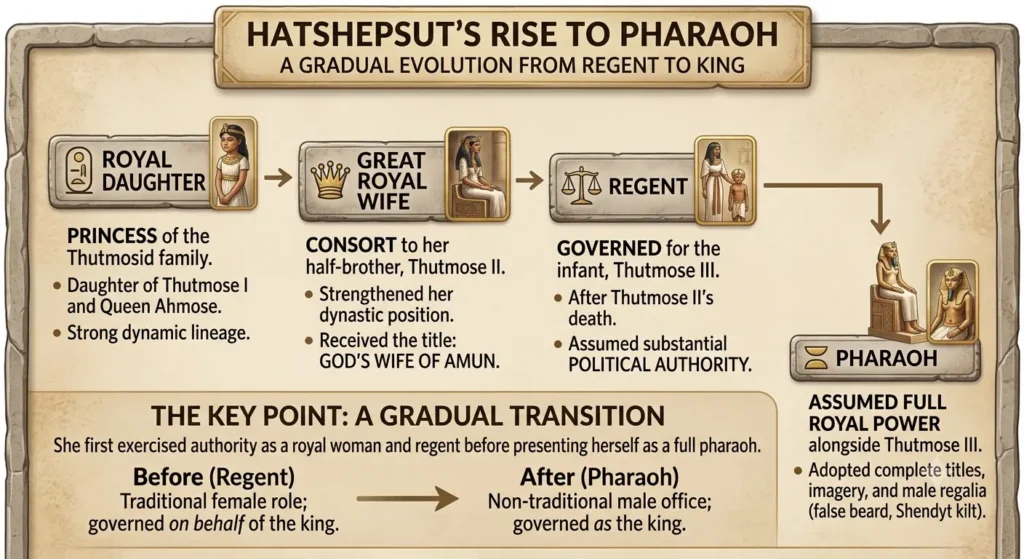
Hatshepsut’s rise to power was rooted in her exceptional position within the Thutmosid royal dynasty. Her maternal lineage connected her with the main royal bloodline established after Egypt’s liberation from Hyksos rule, giving her a level of legitimacy unmatched by many contemporary claimants.
Her transformation from royal daughter to pharaoh followed several stages:
- Royal Princess
As the daughter of Thutmose I and Queen Ahmose, Hatshepsut belonged to Egypt’s highest royal lineage. - Great Royal Wife
Through her marriage to Thutmose II, she became the principal royal woman of Egypt. - Regent of Egypt
After Thutmose II’s death, she governed on behalf of the young Thutmose III. - Pharaoh Maatkare
She eventually assumed the full authority and titles of an Egyptian king.
When Was Hatshepsut Born? Early Life and Royal Family
Hatshepsut was born around 1507 BCE in Thebes (Waset), the religious and political center of southern Egypt during the early 18th Dynasty. She was the daughter of Pharaoh Thutmose I and Great Royal Wife Queen Ahmose, placing her within the most prestigious royal lineage of the New Kingdom.
Her birth occurred during a transformative period in Egyptian history. The 18th Dynasty had recently emerged after the expulsion of the Hyksos rulers, and Egypt was rebuilding itself as a centralized kingdom with a powerful monarchy, expanding military influence, and a growing religious center dedicated to the god Amun at Thebes.
Unlike many Egyptian queens whose influence depended mainly on marriage alliances, Hatshepsut possessed a direct royal bloodline through her father and, especially, through her mother. This dynastic legitimacy would later become one of the foundations of her claim to the throne.
Hatshepsut’s Royal Family Tree
Hatshepsut belonged to the Thutmosid royal house, the ruling family that dominated Egypt during much of the early New Kingdom.
| Royal Figure | Relationship to Hatshepsut | Historical Role |
|---|---|---|
| Thutmose I (Aakheperkare) | Father | Warrior pharaoh who expanded Egyptian influence into Nubia and the Near East |
| Queen Ahmose | Mother | Great Royal Wife connected with the founding Ahmosid royal line |
| Thutmose II (Aakheperenre) | Half-brother and husband | Pharaoh whose early death created a succession crisis |
| Thutmose III (Menkheperre) | Stepson and nephew | Future warrior pharaoh who succeeded Hatshepsut |
| Princess Neferure | Daughter | Royal princess prepared for important religious and dynastic roles |
Who Was Hatshepsut’s Father?
Hatshepsut’s father was Pharaoh Thutmose I (Aakheperkare), one of the most successful military rulers of the early 18th Dynasty.
During his reign (c. 1506–1493 BCE), Thutmose I expanded Egyptian power beyond its traditional borders. His campaigns strengthened Egyptian control over Nubia and extended influence into the Levant.
His achievements established the imperial foundations that later New Kingdom rulers would continue to develop.
For Hatshepsut, being the daughter of Thutmose I provided an important source of legitimacy. In Egyptian royal ideology, descent from a reigning king was one of the strongest arguments supporting a person’s connection to the divine institution of kingship.
Queen Ahmose: Hatshepsut’s Mother and Royal Legitimacy
Hatshepsut’s mother, Queen Ahmose, was the Great Royal Wife (Hemet Nesut Weret) of Thutmose I.
Her importance went beyond her role as queen. She belonged to the royal family that had liberated Egypt from Hyksos rule and founded the political order of the 18th Dynasty.
Through Ahmose, Hatshepsut inherited a connection to the previous ruling house, strengthening her position within the Egyptian succession system.
This maternal lineage became particularly significant because Egyptian kingship was not based only on the father’s line. Royal women played a crucial role in transmitting dynastic legitimacy.
Hatshepsut and Thutmose II: Marriage and the Succession Crisis
Around 1493 BCE, Hatshepsut married her half-brother Thutmose II (Aakheperenre), following Egyptian royal tradition.
Their marriage reinforced Thutmose II’s claim to the throne because Hatshepsut represented the principal royal bloodline.
However, their reign was relatively short. When Thutmose II died around 1479 BCE, Egypt faced a succession problem:
- The legitimate male heir, Thutmose III, was still a child.
- His mother, Iset, was a secondary royal wife rather than the Great Royal Wife.
- The government required an experienced authority capable of managing religious, military, and administrative affairs.
This situation created the political circumstances that allowed Hatshepsut to become regent and eventually assume the full powers of pharaoh.
Did her stepson actually hate her? Was she murdered for the throne? Read our complete guide on the real relationship between Hatshepsut and Thutmose III, where we debunk the revenge myth and explain the true reasons behind her erased legacy.
The Dynastic Importance of Princess Neferure
Hatshepsut and Thutmose II had one surviving daughter:
Princess Neferure
Neferure was raised within the royal court and received an unusually prominent position. She was associated with important religious roles, including the office traditionally connected with the God’s Wife of Amun.
Her position demonstrates how Hatshepsut used royal women and religious institutions as essential components of dynastic power.
The preparation of Neferure also reveals that Hatshepsut was not simply reacting to a political crisis; she was actively managing the future of the Thutmosid dynasty.
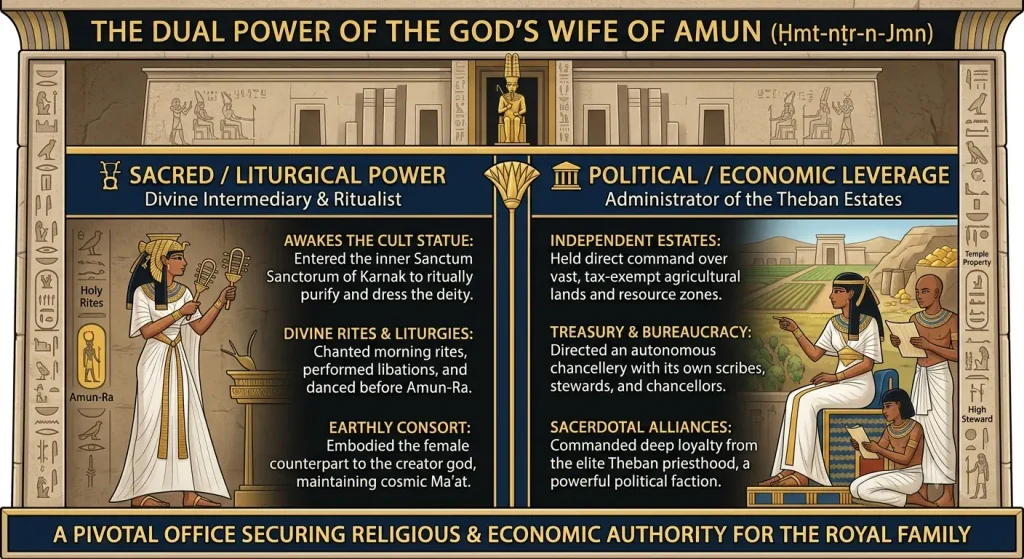
The Office of the God’s Wife of Amun: The Foundation of Hatshepsut’s Power
Before becoming pharaoh, Hatshepsut held one of the most influential religious positions in Egypt:
Hemet Netjer en Amun — God’s Wife of Amun
During the early New Kingdom, this office carried significant religious and economic influence connected with the temple of Amun at Karnak.
The holder of this title:
- participated in major religious ceremonies,
- represented a special relationship with the god Amun,
- controlled important temple resources,
- strengthened political connections within Thebes.
For Hatshepsut, this position provided more than prestige. It created a network of religious authority and institutional support that would later help justify her transition from queen and regent to king of Egypt.
Summary: Hatshepsut’s Early Life
| Question | Answer |
|---|---|
| When was Hatshepsut born? | Around 1507 BCE |
| Where was Hatshepsut born? | Thebes (Waset), Egypt |
| Who was Hatshepsut’s father? | Pharaoh Thutmose I |
| Who was Hatshepsut’s mother? | Queen Ahmose |
| Who did Hatshepsut marry? | Pharaoh Thutmose II |
| Who was Thutmose III to Hatshepsut? | Her stepson and nephew |
| What title did Hatshepsut hold before becoming pharaoh? | God’s Wife of Amun |
How Did Hatshepsut Become Pharaoh?
Hatshepsut became pharaoh through a gradual political transformation that began with her role as regent for the young Thutmose III and culminated around Year 7 of his reign, when she adopted the complete royal titulary of an Egyptian king.
Her rise was not an abrupt seizure of power, but a carefully constructed transition supported by her royal lineage, religious authority, administrative experience, and the political circumstances of early 18th Dynasty Egypt.
After the death of her husband Thutmose II around 1479 BCE, the throne passed nominally to his young son Thutmose III, who was still a child. Because the young king was unable to perform the full responsibilities expected of a pharaoh, Hatshepsut initially acted as regent and governed Egypt on his behalf.
Over time, however, she moved beyond the traditional role of queen regent and became the sovereign ruler of Egypt under the throne name Maatkare Hatshepsut.
Why Did Hatshepsut Become Pharaoh?
The circumstances that allowed Hatshepsut to become pharaoh resulted from a combination of dynastic necessity, political experience, and religious legitimacy.
Following Thutmose II’s death, Egypt faced a succession challenge:
- Thutmose III was the legitimate male heir but was still very young.
- The administration required experienced leadership.
- Hatshepsut possessed exceptional royal legitimacy as the daughter of Thutmose I and Queen Ahmose.
- She already controlled important religious and political networks through her position as God’s Wife of Amun.
Rather than remaining behind the young king as a traditional regent, Hatshepsut gradually expanded her public role until she occupied the highest position in Egyptian kingship.
Hatshepsut’s Role as Regent of Egypt
During the first years after Thutmose II’s death, Hatshepsut followed the traditional model of female regency.
Early inscriptions portray her as acting on behalf of Thutmose III rather than replacing him.
The official ideology presented Thutmose III as king while Hatshepsut managed the practical affairs of government.
The contemporary official Ineni, whose tomb inscription provides important evidence about this transition, recorded:
“His son stood in his place as king of the Two Lands… His sister, the God’s Wife Hatshepsut, conducted the affairs of the land according to her own will.”
This statement reflects the unusual political reality: the young king held the royal position, but Hatshepsut exercised effective governing authority.
When Did Hatshepsut Become Pharaoh?
Hatshepsut became pharaoh around Year 7 of Thutmose III’s reign, approximately 1473 BCE.
At this point, she adopted the complete royal titulary traditionally associated with Egyptian kings.
She was no longer simply:
- Great Royal Wife,
- God’s Wife of Amun,
- Regent.
She became:
Nisut-Bity — King of Upper and Lower Egypt
and adopted the throne name:
Maatkare
meaning:
“Ma’at is the Ka of Ra.”
The Transformation from Queen to King
Hatshepsut’s political evolution can be divided into several stages:
| Period | Role | Historical Meaning |
|---|---|---|
| c. 1507 BCE | Royal Princess | Daughter of Thutmose I and Queen Ahmose |
| c. 1493 BCE | Great Royal Wife | Wife of Thutmose II and principal royal woman |
| c. 1479 BCE | Regent of Egypt | Governs on behalf of young Thutmose III |
| c. 1473 BCE | Pharaoh Maatkare | Assumes complete royal authority |
How Did Hatshepsut Legitimize Her Rule?
Unlike a modern monarchy, Egyptian kingship required more than political control. A pharaoh needed religious and ideological legitimacy because the king was considered the earthly representative of the gods.
Hatshepsut developed several strategies to present her rule as divinely approved.
1. Royal Bloodline
Her descent from Thutmose I and Queen Ahmose gave her a powerful dynastic claim.
Egyptian royal ideology placed enormous importance on the connection between kingship and sacred ancestry.
2. Divine Birth Narrative
At her mortuary temple of Djeser-Djeseru at Deir el-Bahari, Hatshepsut commissioned reliefs depicting her divine conception.
The scenes presented the god Amun-Ra as her divine father, showing that her accession was supported by the gods themselves.
This theological narrative transformed her rule from a political exception into a divinely sanctioned event.
3. Adoption of Complete Pharaoh Titles
When Hatshepsut became king, she adopted the traditional fivefold royal titulary used by Egyptian pharaohs.
Among these titles was:
Nisut-Bity (nswt-bjt)
meaning:
“King of Upper and Lower Egypt.”
By using the same titles, names, and symbols as male pharaohs, Hatshepsut presented herself not as a woman occupying a man’s position, but as the legitimate holder of the divine institution of kingship.
Was Hatshepsut the First Female Pharaoh?
No. Hatshepsut was not the first woman to exercise royal authority in ancient Egypt, but she was one of the most successful and powerful female rulers to assume the full role of pharaoh.
Earlier women connected with Egyptian kingship include:
| Female Ruler | Dynasty | Historical Importance |
|---|---|---|
| Merneith | First Dynasty | Possibly ruled as regent for Den |
| Sobekneferu | Twelfth Dynasty | First confirmed female king of Egypt |
| Ahhotep I | Seventeenth Dynasty | Important royal and military figure |
| Hatshepsut | Eighteenth Dynasty | One of Egypt’s most successful female pharaohs |
What makes Hatshepsut unique is not simply that she ruled Egypt, but that she maintained the full authority and symbolism of pharaoh for more than two decades during the height of the New Kingdom.
Why Was Hatshepsut’s Rise to Power Significant?
Hatshepsut’s accession changed the traditional boundaries of Egyptian kingship.
Her reign demonstrated that:
- royal legitimacy could be constructed through lineage, religion, and political authority;
- the institution of pharaoh could adapt to unusual succession circumstances;
- a woman could successfully perform the symbolic and administrative functions of kingship.
Her government laid the foundations for one of the most prosperous periods of the early New Kingdom.
When Did Hatshepsut Rule Egypt?
Hatshepsut ruled Egypt during the 18th Dynasty of the New Kingdom, approximately between 1479 and 1458 BCE. Her reign lasted around 22 years, making her one of the longest-ruling female monarchs in ancient Egyptian history.
She governed Egypt during a period of exceptional stability and prosperity, when the kingdom was expanding its economic networks, strengthening religious institutions, and producing some of the most remarkable monuments of the New Kingdom.
Although she initially ruled as regent for the young Thutmose III, Hatshepsut later assumed the full authority of pharaoh around 1473 BCE, adopting the throne name Maatkare and ruling as King of Upper and Lower Egypt (Nisut-Bity).
Hatshepsut’s Reign Timeline
The life and reign of Hatshepsut can be divided into several key stages, from her royal birth to her archaeological rediscovery thousands of years later.
| Approximate Date | Event | Historical Significance |
|---|---|---|
| c. 1507 BCE | Birth of Hatshepsut | Born in Thebes to Pharaoh Thutmose I and Great Royal Wife Queen Ahmose |
| c. 1493 BCE | Marriage to Thutmose II | Becomes Great Royal Wife and gains central position within the royal family |
| c. 1479 BCE | Death of Thutmose II | Hatshepsut becomes regent for the young Thutmose III |
| c. 1473 BCE | Becomes Pharaoh | Assumes full royal titulary as Maatkare, King of Upper and Lower Egypt |
| c. 1470 BCE | Major building program begins | Construction of Djeser-Djeseru at Deir el-Bahari and other monuments |
| c. 1464 BCE | Expedition to Punt | Sends a major maritime expedition recorded in temple reliefs |
| c. 1458 BCE | Death of Hatshepsut | Ends approximately 22 years of political authority |
| c. 1438–1433 BCE | Removal of some royal images | Later selective erasure of her pharaonic identity during the late reign of Thutmose III |
How Long Did Hatshepsut Rule?
Hatshepsut ruled Egypt for approximately 22 years, from around 1479 BCE until her death in 1458 BCE.
Her reign can be divided into two major phases:
1. The Regency of Hatshepsut (c. 1479–1473 BCE)
During the first years after Thutmose II’s death, Hatshepsut governed Egypt on behalf of the young Thutmose III.
During this period:
- Thutmose III remained the official king.
- Hatshepsut managed state administration.
- She worked closely with the Theban religious establishment.
- Her political influence continued to increase.
This stage established the foundations for her later transformation into pharaoh.
2. The Pharaoh Maatkare Period (c. 1473–1458 BCE)
After adopting full royal titles, Hatshepsut ruled as king of Egypt.
During this period she:
- commissioned some of Egypt’s greatest monuments;
- expanded trade networks;
- strengthened the cult of Amun;
- maintained military and administrative stability;
- promoted a sophisticated ideology of divine kingship.
Her reign became associated with prosperity, monumental construction, and political continuity.
Hatshepsut’s Reign at a Glance
| Question | Answer |
|---|---|
| When did Hatshepsut rule Egypt? | Approximately 1479–1458 BCE |
| When did Hatshepsut become pharaoh? | Around 1473 BCE |
| How long did Hatshepsut rule? | Around 22 years |
| What dynasty did Hatshepsut belong to? | 18th Dynasty |
| What period did Hatshepsut rule? | New Kingdom |
| What was Hatshepsut’s throne name? | Maatkare |
| Where was Hatshepsut’s capital? | Thebes (Waset) |
Why Was Hatshepsut’s Reign Important?
Hatshepsut’s reign represented a unique moment in Egyptian history because she combined traditional royal ideology with innovative political strategies.
Her government focused on:
Economic Prosperity
Rather than relying exclusively on military expansion, Hatshepsut invested heavily in:
- trade expeditions;
- resource acquisition;
- temple construction;
- economic administration.
The expedition to the Land of Punt became the most famous example of her commercial policy.
Monumental Architecture
Hatshepsut transformed the Egyptian landscape through major building projects, including:
- Djeser-Djeseru at Deir el-Bahari
- additions at Karnak
- monumental obelisks
- religious structures throughout Egypt
These projects served both practical and ideological purposes: they created employment, strengthened temples, and permanently displayed her legitimacy as pharaoh.
Religious Legitimacy
Hatshepsut presented her reign as part of the divine order of Egypt.
Through inscriptions and temple decoration, she emphasized:
- her relationship with Amun-Ra;
- her divine birth narrative;
- her responsibility to maintain Ma’at.
Did Hatshepsut Rule Before or After Thutmose III?
Hatshepsut ruled before Thutmose III became Egypt’s sole ruler. However, Thutmose III remained a co-king during much of her reign and later became one of Egypt’s greatest military pharaohs.
Their relationship was historically complex. Earlier interpretations described Hatshepsut as a rival who prevented Thutmose III from ruling, but modern Egyptology has moved away from this simplified view.
Evidence suggests that Thutmose III remained part of the royal system during Hatshepsut’s reign and received the military training and administrative experience that later contributed to his own achievements.
Historical Summary: Hatshepsut’s Reign
Hatshepsut ruled Egypt from approximately 1479 to 1458 BCE during the 18th Dynasty. Her 22-year reign was characterized by political stability, economic growth, international trade, and extraordinary architectural achievements. By combining traditional concepts of kingship with innovative leadership, she became one of the most remarkable rulers of the New Kingdom.
What Was Hatshepsut Known For?
Hatshepsut is best known for becoming one of ancient Egypt’s most successful female pharaohs, ruling during the 18th Dynasty of the New Kingdom and transforming Egypt through monumental architecture, international trade, and political innovation.
Unlike many rulers whose reputation was built mainly through military conquest, Hatshepsut strengthened Egypt through economic expansion, diplomatic networks, religious institutions, and some of the most ambitious building projects of the New Kingdom.
Her achievements can be summarized in four major areas:
- The expansion of international trade, especially the famous expedition to the Land of Punt
- The construction of monumental temples and architectural masterpieces
- The development of a sophisticated ideology of female kingship
- The preservation of political stability and economic prosperity in Egypt
What Did Hatshepsut Do for Egypt?
During her approximately 22-year rule, Hatshepsut focused on strengthening the foundations of Egyptian power rather than pursuing constant territorial conquest.
Her government invested in:
- long-distance trade expeditions;
- temple construction;
- restoration of religious monuments;
- economic administration;
- the organization of royal building projects.
These policies helped create a period of stability that contributed to the later expansion of the Egyptian Empire during the reign of Thutmose III.
1. Hatshepsut Expanded Egyptian Trade Networks
One of Hatshepsut’s greatest achievements was the organization of a major commercial expedition to the Land of Punt during Year 9 of her reign (c. 1464 BCE).
Recorded in detailed reliefs at her mortuary temple of Djeser-Djeseru at Deir el-Bahari, the expedition returned with valuable goods including:
- gold;
- ebony wood;
- ivory;
- aromatic resins;
- exotic animals;
- living incense trees.
The voyage demonstrated Egypt’s naval capabilities and expanded access to resources that were essential for royal and temple rituals.
The Punt expedition became one of the most famous examples of peaceful economic diplomacy in ancient Egypt.
(Detailed section: Hatshepsut’s Expedition to the Land of Punt)
2. Hatshepsut Built Some of Egypt’s Greatest Monuments
Hatshepsut was one of the most prolific builders of the New Kingdom.
Her most famous achievement was the mortuary temple of:
Djeser-Djeseru (“Holy of Holies”) at Deir el-Bahari
Built against the cliffs of western Thebes, the temple combined architecture, religion, and royal propaganda.
The complex included:
- monumental terraces;
- sanctuaries dedicated to Amun-Ra and Hathor;
- reliefs depicting her divine birth;
- scenes of the expedition to Punt;
- representations of her legitimacy as pharaoh.
She also commissioned major works at Karnak, including:
- enormous obelisks dedicated to Amun;
- the Red Chapel (Chapelle Rouge);
- additions to the sacred precinct.
These monuments were not only religious buildings but permanent statements of her authority as king of Egypt.
For a detailed study of its architecture, construction, religious symbolism and archaeological restoration, see our complete guide to
Hatshepsut’s Temple at Deir el-Bahari.
3. Hatshepsut Created a New Model of Female Kingship
Hatshepsut’s reign was historically unique because she occupied an office traditionally represented as male.
Rather than rejecting traditional concepts of kingship, she adopted them completely.
She used:
- the royal title Nisut-Bity (King of Upper and Lower Egypt);
- the traditional pharaonic regalia;
- royal inscriptions;
- divine ancestry narratives.
Her monuments presented her not simply as a woman holding power, but as the legitimate embodiment of Egyptian kingship.
Her reign demonstrates the flexibility of Egyptian political ideology and the importance of religious legitimacy in maintaining royal authority.
4. Hatshepsut Maintained Political Stability
Hatshepsut governed during a crucial period of the early New Kingdom, when Egypt was consolidating its position after the conflicts of the Second Intermediate Period.
Her administration maintained:
- functioning state institutions;
- temple economies;
- military readiness;
- diplomatic relationships.
Although later rulers emphasized military expansion, Hatshepsut’s government created a wealthy and stable environment that supported the achievements of subsequent pharaohs.
Hatshepsut’s Greatest Achievements at a Glance
| Achievement | Historical Importance |
|---|---|
| Expedition to Punt | Expanded trade networks and brought valuable resources to Egypt |
| Temple of Djeser-Djeseru | One of the greatest architectural achievements of the New Kingdom |
| Karnak monuments | Strengthened the relationship between the pharaoh and Amun-Ra |
| Religious ideology | Created a powerful justification for female kingship |
| Economic administration | Maintained prosperity and political stability |
| Royal propaganda | Developed a sophisticated model of pharaonic legitimacy |
Why Is Hatshepsut Considered an Important Pharaoh?
Hatshepsut is considered one of Egypt’s most important pharaohs because she successfully governed a powerful kingdom, expanded its economic influence, and created monuments that remain among the finest examples of ancient Egyptian architecture.
Her significance does not come only from being a female ruler. It comes from the fact that she successfully performed the full role of pharaoh, preserving Egypt’s political order while introducing new approaches to trade, diplomacy, and royal representation.
Why Did Hatshepsut Portray Herself as a Male Pharaoh?
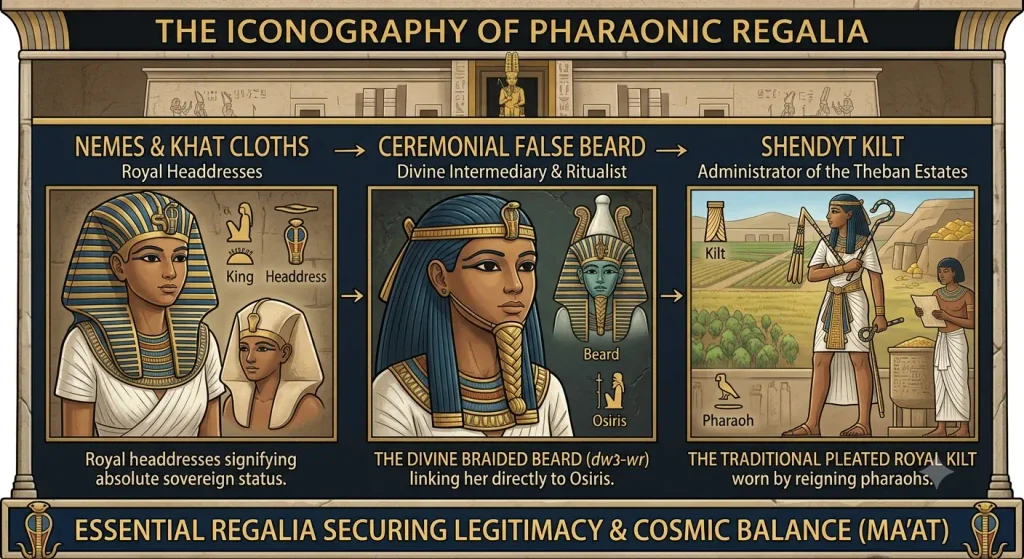
Hatshepsut portrayed herself using traditional male pharaonic imagery because the institution of Egyptian kingship was symbolically masculine. By adopting the traditional appearance of a king, she was not attempting to hide her biological identity, but presenting herself as the legitimate holder of the divine office of pharaoh.
In ancient Egypt, the pharaoh was not simply a political ruler. The king was considered the earthly manifestation of Horus, the divine protector of Egypt, and the person responsible for maintaining Ma’at — the cosmic balance, justice, and order of the universe.
Because the role itself was traditionally represented through male imagery, Hatshepsut adopted the established visual language of kingship.
Did Hatshepsut Pretend to Be a Man?
No. Hatshepsut did not attempt to convince Egyptians that she was biologically male. Instead, she used the official symbols of pharaonic authority to represent herself as king.
Ancient Egyptian royal art was not intended to create realistic portraits in the modern sense. Images of pharaohs followed strict symbolic conventions designed to communicate:
- divine authority;
- eternal kingship;
- political legitimacy;
- connection with the gods.
A female ruler occupying the office of pharaoh therefore needed to be represented according to the traditional visual rules of kingship.
Why Did Hatshepsut Wear a False Beard?
The ceremonial false beard was one of the most recognizable symbols of Egyptian kingship.
The false beard (dwꜢ-wr) was not a sign of ordinary male identity. It was a sacred royal attribute associated with the divine nature of the pharaoh.
Hatshepsut wore the same ceremonial beard used by male rulers because she was presenting herself as:
- Nisut-Bity (King of Upper and Lower Egypt);
- the earthly representative of the gods;
- the legitimate ruler responsible for maintaining Ma’at.
The beard, like the double crown and the nemes headdress, represented the office of kingship rather than the physical characteristics of the individual ruler.
The Evolution of Hatshepsut’s Royal Appearance
Hatshepsut’s representation changed gradually throughout her political career.
She was not immediately portrayed as a male king. Her imagery evolved as her position within Egyptian kingship changed.
| Period | Representation | Historical Context |
|---|---|---|
| Early reign (Years 1–7) | Traditional female royal imagery | Depicted as queen and regent alongside Thutmose III |
| Transitional period | Female body combined with royal symbols | Increasing association with the institution of kingship |
| Full pharaonic reign | Traditional male royal imagery | Represented as Nisut-Bity, King of Egypt |
The Meaning of Male Pharaoh Iconography in Ancient Egypt
Kingship Was an Institution, Not a Personal Identity
Modern discussions often interpret Hatshepsut’s images through contemporary ideas about gender representation. However, Egyptian royal imagery operated according to a different logic.
The body of the pharaoh represented the eternal role of kingship itself.
When Hatshepsut appeared wearing:
- the nemes headdress;
- the shendyt kilt;
- the uraeus cobra;
- the ceremonial beard;
she was communicating that she possessed the complete authority of the Egyptian king.
The Pharaoh as the Living Horus
Egyptian kingship was based on a religious concept in which the ruler represented Horus on earth.
The pharaoh’s role was to:
- defeat chaos (Isfet);
- preserve cosmic balance (Ma’at);
- maintain communication between humanity and the gods.
Because this theological role was traditionally represented as male, Hatshepsut adopted the same iconography to demonstrate that she fulfilled the responsibilities of kingship.
What Did Hatshepsut Look Like?
Ancient Egyptian depictions of Hatshepsut vary depending on the period of her reign.
Early representations show her as:
- a royal woman wearing traditional queenly clothing;
- a female figure with royal attributes.
Later images portray her as:
- a pharaoh wearing the nemes headdress;
- a ruler wearing the ceremonial beard;
- an idealized male royal body following Egyptian artistic conventions.
These images should not be interpreted as literal portraits of her physical appearance. Egyptian royal art emphasized symbolic perfection rather than individual realism.
Why Did Hatshepsut Need Male Pharaoh Imagery?
Hatshepsut’s adoption of traditional royal imagery served several political and religious purposes:
| Purpose | Explanation |
|---|---|
| Legitimacy | Demonstrated that she possessed full royal authority |
| Religious acceptance | Connected her with the traditional role of Horus |
| Political stability | Presented continuity rather than a break with Egyptian tradition |
| Dynastic authority | Reinforced her position within the royal succession |
Historical Summary: Hatshepsut’s Male Pharaoh Representation
Hatshepsut did not portray herself as a male pharaoh because she rejected her identity as a woman. She adopted male royal imagery because Egyptian kingship was represented through a traditional masculine visual language. By using the same symbols as previous kings, she presented herself as the legitimate ruler of Egypt and the guardian of Ma’at.
Hatshepsut’s Divine Kingship and Royal Ideology
Hatshepsut’s rule was based not only on political authority but also on a carefully developed religious ideology that presented her kingship as divinely sanctioned. Through temple inscriptions, royal titles, and theological narratives, she established that her position as pharaoh was part of the divine order of Egypt.
In ancient Egyptian thought, the legitimacy of a pharaoh depended on maintaining harmony between the human and divine worlds. A successful ruler was not simply a monarch but the guardian of Ma’at, the cosmic balance that ensured stability, justice, and prosperity.
Hatshepsut used traditional concepts of Egyptian kingship to demonstrate that she possessed the same divine legitimacy as previous rulers.
The Divine Birth of Hatshepsut: The Theogamy Narrative
One of the most important elements of Hatshepsut’s royal ideology was the Divine Birth narrative (Theogamy) depicted on the walls of her mortuary temple at Djeser-Djeseru in Deir el-Bahari.
The reliefs present a theological account of her origin in which the god Amun-Ra takes the form of her father, Pharaoh Thutmose I, and unites with her mother, Queen Ahmose.
According to this narrative:
- The god Amun-Ra announces his intention to create a legitimate ruler.
- Amun takes the form of Thutmose I.
- Queen Ahmose gives birth to Hatshepsut as a child destined for kingship.
- The gods recognize her future role as ruler of Egypt.
This story was not intended as a biological explanation in the modern sense. It was a religious statement designed to communicate that Hatshepsut’s kingship had divine approval.
Why Did Hatshepsut Use the Divine Birth Narrative?
Establishing Royal Legitimacy
Because Hatshepsut occupied a traditionally male royal office, she needed to demonstrate that her accession followed the principles of Egyptian kingship.
The Divine Birth scenes reinforced three important ideas:
- her connection with the god Amun;
- her rightful place within the royal succession;
- the approval of the divine world.
Presenting Kingship as a Divine Role
In Egyptian ideology, the pharaoh was not merely chosen by humans.
The king existed within a cosmic system established by the gods.
By presenting herself as the daughter of Amun-Ra, Hatshepsut emphasized that her authority came from a higher order beyond ordinary politics.
Hatshepsut and the Concept of Ma’at
A central principle of Egyptian kingship was Ma’at.
Ma’at represented:
- truth;
- justice;
- balance;
- cosmic order;
- social stability.
Every Egyptian pharaoh had the responsibility to preserve Ma’at and prevent Isfet, the forces of disorder and chaos.
Hatshepsut frequently associated her reign with restoring and maintaining this balance.
Her monuments emphasized:
- prosperity under her rule;
- devotion to the gods;
- restoration and construction of temples;
- the continuation of traditional religious practices.
Hatshepsut’s Royal Titles: Becoming Nisut-Bity
When Hatshepsut became pharaoh, she adopted the complete royal titulary used by Egyptian kings.
One of her most important titles was:
Nisut-Bity (nswt-bjt)
meaning:
“King of Upper and Lower Egypt.”
This title represented the political unity of the Two Lands:
- Upper Egypt in the south;
- Lower Egypt in the north.
By adopting this title, Hatshepsut was not presenting herself as a queen with exceptional authority. She was presenting herself as the legitimate king of Egypt.
The Five Names of the Egyptian Pharaoh
Like other pharaohs, Hatshepsut used the traditional fivefold royal titulary.
These names expressed different aspects of royal identity:
| Royal Name | Meaning |
|---|---|
| Horus Name | Connected the ruler with the god Horus |
| Nebty Name (Two Ladies) | Linked the king with the protective goddesses of Upper and Lower Egypt |
| Golden Horus Name | Expressed divine and eternal kingship |
| Nisut-Bity Name | Identified the king as ruler of Upper and Lower Egypt |
| Son of Ra Name | Connected the king with the solar deity |
Her throne name:
Maatkare
belonged to the Nisut-Bity tradition and linked her reign directly with divine order.
Amun-Ra and the Religious Foundation of Hatshepsut’s Rule
The god Amun-Ra played a central role in Hatshepsut’s political and religious program.
During the New Kingdom, Amun of Thebes had become one of Egypt’s most powerful deities, closely associated with royal authority.
By emphasizing her relationship with Amun, Hatshepsut strengthened her connection with:
- the priesthood of Karnak;
- Theban religious institutions;
- the traditional foundations of Egyptian kingship.
Her building projects, especially at Deir el-Bahari and Karnak, reinforced this relationship between ruler, god, and state.
Hatshepsut’s Royal Ideology: Summary
| Element | Purpose |
|---|---|
| Divine Birth Narrative | Presented her kingship as approved by the gods |
| Amun-Ra Connection | Strengthened religious legitimacy |
| Maatkare Name | Linked her reign with cosmic order |
| Nisut-Bity Title | Declared her full authority as king |
| Royal Iconography | Connected her with traditional pharaonic power |
Historical Importance of Hatshepsut’s Ideology
Hatshepsut’s greatest political achievement was not simply becoming pharaoh, but creating a convincing ideological framework that allowed Egyptian society to accept her rule within traditional concepts of kingship.
She did not replace Egyptian royal traditions; she adapted them.
By using the same religious language, titles, and symbols as previous kings, Hatshepsut presented herself as the legitimate continuation of Egyptian monarchy.
Hatshepsut’s Expedition to the Land of Punt
One of Hatshepsut’s most famous achievements was the expedition she sent to the Land of Punt during the ninth year of her reign. Recorded in detailed reliefs at her mortuary temple of Djeser-Djeseru at Deir el-Bahari, the expedition represents one of the best-documented examples of Egyptian long-distance trade during the New Kingdom.
Unlike many later pharaohs who became famous primarily through military campaigns, Hatshepsut’s reputation was built largely on economic expansion, diplomacy, and monumental construction.
The Punt expedition demonstrated Egypt’s ability to organize large-scale maritime voyages and establish commercial connections with distant regions.
Where Was the Land of Punt?
The exact location of the Land of Punt remains debated among historians and archaeologists.
Ancient Egyptian texts describe Punt as a wealthy land located beyond the southern borders of Egypt, probably somewhere in the region of the Red Sea coast and the Horn of Africa, although its precise location has not been conclusively identified.
Egyptian expeditions to Punt had a long history, but Hatshepsut’s expedition is the most detailed because of the extensive reliefs preserved at Deir el-Bahari.
These scenes provide valuable information about:
- the organization of Egyptian trade missions;
- foreign landscapes as understood by Egyptians;
- exchanged goods;
- diplomatic interactions.
Why Did Hatshepsut Send an Expedition to Punt?
Hatshepsut’s expedition was primarily motivated by economic and religious objectives.
The voyage aimed to obtain valuable resources that were essential for Egyptian temples and royal ceremonies.
The expedition brought back:
- frankincense trees;
- myrrh resin;
- gold;
- ebony wood;
- ivory;
- exotic animals;
- precious materials.
The living incense trees were especially significant because aromatic resins played a central role in Egyptian temple rituals.
By bringing these resources to Egypt, Hatshepsut demonstrated her ability to provide for the gods and maintain the proper relationship between Egypt and the divine world.
The Punt Expedition at Deir el-Bahari
The most important evidence for Hatshepsut’s voyage comes from the reliefs carved on the walls of her mortuary temple at Djeser-Djeseru.
These scenes depict:
- Egyptian ships travelling to Punt;
- the arrival of the Egyptian delegation;
- exchanges with Puntite leaders;
- exotic goods being transported back to Egypt;
- the presentation of offerings to Amun.
Unlike typical royal inscriptions that focus on conquest, the Punt reliefs emphasize cooperation, trade, and abundance.
What Do the Punt Reliefs Show?
The reliefs at Deir el-Bahari are among the most detailed visual records of ancient Egyptian foreign expeditions.
They include representations of:
Egyptian Ships and Maritime Technology
The scenes show large Egyptian vessels designed for long-distance travel.
They provide evidence of:
- ship construction;
- navigation techniques;
- organization of royal expeditions.
The Rulers of Punt
The reliefs depict encounters between the Egyptian delegation and the rulers of Punt.
Among the figures shown are:
- the ruler of Punt;
- his wife;
- local inhabitants.
These images represent one of the rare Egyptian artistic records showing a foreign population in such detail.
The Wealth of Punt
The return journey is shown with ships carrying valuable resources.
Among the goods represented are:
- incense trees;
- gold;
- animal products;
- precious materials.
These images communicate a central message of Hatshepsut’s kingship: Egypt prospered under her rule because she restored access to valuable resources.
Did Hatshepsut Go to War?
Hatshepsut is not primarily remembered as a warrior pharaoh. Her greatest achievements were related to trade, architecture, administration, and religious development rather than military conquest.
However, this does not mean that Egypt abandoned military power during her reign.
The Egyptian state maintained control over its territories, and military institutions continued functioning under her government.
Her approach differed from later rulers such as Thutmose III, whose reign became famous for extensive military campaigns in the Levant.
Hatshepsut’s legacy was based more on:
- economic prosperity;
- diplomatic connections;
- religious legitimacy;
- monumental building.
The Importance of the Punt Expedition for Hatshepsut’s Legacy
The Punt expedition became one of the defining symbols of Hatshepsut’s reign because it represented several aspects of Egyptian kingship:
| Aspect | Meaning |
|---|---|
| Economic power | Egypt could organize complex international trade |
| Religious duty | Resources supported temples and divine worship |
| Royal authority | The pharaoh provided prosperity for the kingdom |
| Diplomatic skill | Egypt maintained connections beyond its borders |
The expedition also reinforced Hatshepsut’s relationship with Amun-Ra, as the imported incense was essential for rituals dedicated to the god.
Hatshepsut and Peaceful Expansion
Hatshepsut’s reign demonstrates that Egyptian power was not expressed only through warfare.
Her government expanded Egypt’s influence through:
- commerce;
- religious diplomacy;
- architecture;
- administrative organization.
The Punt expedition became a lasting symbol of this alternative model of royal achievement.
Historical Summary: Hatshepsut’s Expedition to Punt
Hatshepsut’s expedition to the Land of Punt was one of the greatest achievements of her reign. Through this voyage, Egypt acquired valuable resources, strengthened religious institutions, and demonstrated its ability to conduct large-scale international trade. The detailed reliefs at Deir el-Bahari preserve one of the most important records of ancient Egyptian maritime exploration and diplomacy.
The Temple of Hatshepsut at Deir el-Bahari
The Temple of Hatshepsut at Deir el-Bahari, known in ancient Egyptian as Djeser-Djeseru (“Holy of Holies”), is one of the greatest architectural achievements of the New Kingdom. Built during Hatshepsut’s reign in the 18th Dynasty, the temple served as her mortuary temple, a place of worship, and a permanent statement of her divine legitimacy as pharaoh.
Located on the western bank of the Nile at Thebes (modern Luxor), the temple was designed to connect Hatshepsut’s royal identity with the gods, especially Amun-Ra, while commemorating her achievements and ensuring her eternal presence in Egyptian religious tradition.
Unlike traditional pyramid complexes, Djeser-Djeseru used a series of monumental terraces integrated into the natural cliffs of the Theban landscape, creating one of the most distinctive architectural monuments of ancient Egypt.
Where Is Hatshepsut’s Temple Located?
Hatshepsut’s temple is located at Deir el-Bahari on the west bank of the Nile River near Luxor, Egypt.
The site lies within the ancient necropolis of Thebes, an area that included some of Egypt’s most important royal and religious monuments.
Nearby locations include:
- the Valley of the Kings;
- the Valley of the Queens;
- the Ramesseum;
- the Colossi of Memnon.
Although these monuments are close geographically, Hatshepsut’s temple is not located inside the Valley of the Kings.
Her royal tomb was originally planned nearby in KV20, within the Valley of the Kings, while her mortuary temple was built separately at Deir el-Bahari.
Why Was Hatshepsut’s Temple Built?
Hatshepsut’s temple was built for several interconnected purposes:
A Place for the Cult of Hatshepsut
Like other pharaohs, Hatshepsut constructed a mortuary temple where offerings and rituals could continue after her death.
The temple ensured that her royal identity would remain active within the religious system of Egypt.
A Monument to Divine Kingship
Djeser-Djeseru was also a statement of legitimacy.
The temple contained scenes representing:
- Hatshepsut’s divine birth;
- her relationship with Amun-Ra;
- her coronation;
- her role as legitimate ruler of Egypt.
Through these images, the monument communicated that her accession was supported by divine authority.
A Celebration of Her Achievements
The temple walls preserved some of the most important records of Hatshepsut’s reign, including:
- the expedition to Punt;
- religious ceremonies;
- royal rituals;
- theological narratives.
The monument functioned as both a religious structure and a historical record of her rule.
Who Built Hatshepsut’s Temple?
Hatshepsut’s temple was designed by Senenmut, one of the most important officials of her reign and a trusted advisor of the queen-turned-pharaoh.
Senenmut held several important positions, including:
- royal steward;
- administrator;
- architect;
- overseer of royal building projects.
His design created an innovative structure that combined architecture with the natural environment.
The temple’s terraces, colonnades, and alignment with the surrounding cliffs demonstrate a sophisticated understanding of Egyptian architectural principles.
The Architecture of Djeser-Djeseru
The name Djeser-Djeseru means:
“Holy of Holies”
The temple was built on three monumental terraces connected by ramps leading toward the cliffs.
Its main architectural features included:
| Feature | Description |
|---|---|
| Lower terrace | Processional area connecting the temple with the Nile valley |
| Middle terrace | Relief galleries depicting important events of Hatshepsut’s reign |
| Upper terrace | Sacred area containing sanctuaries dedicated to Amun-Ra and Hatshepsut |
The design created a visual connection between:
- the human world;
- the sacred mountain landscape;
- the divine realm.
The Divine Birth Reliefs at Deir el-Bahari
One of the most important sections of the temple depicts the Divine Birth (Theogamy) of Hatshepsut.
These reliefs show:
- Amun-Ra choosing Hatshepsut as future ruler;
- the divine origin of her kingship;
- her connection with the gods.
The scenes were not intended as historical biography in the modern sense. They were theological statements explaining why Hatshepsut possessed legitimate authority as pharaoh.
The Punt Expedition Reliefs
Another famous section of the temple records Hatshepsut’s expedition to the Land of Punt.
The reliefs depict:
- Egyptian ships;
- foreign landscapes;
- Puntite rulers;
- incense trees and valuable resources.
These scenes represent one of the most detailed visual records of an Egyptian foreign expedition.
Hatshepsut’s Obelisks and Karnak Connections
Although Djeser-Djeseru is her most famous monument, Hatshepsut also contributed extensively to the temple complex of Karnak on the east bank of Thebes.
Her projects included:
- monumental obelisks;
- chapels dedicated to Amun;
- restoration and expansion of religious structures.
These works reinforced her relationship with the powerful Amun priesthood and strengthened the religious foundations of her reign.
Hatshepsut’s Temple and Her Legacy
The Temple of Hatshepsut remains one of the most recognizable monuments of ancient Egypt because it represents more than architectural achievement.
It embodies:
- the power of New Kingdom Egypt;
- the connection between religion and kingship;
- the political creativity of Hatshepsut’s reign;
- the ability of Egyptian architecture to transform landscape into sacred space.
Thousands of years later, Djeser-Djeseru remains one of the most important archaeological testimonies to Hatshepsut’s role as pharaoh.
Hatshepsut Temple Quick Facts
| Question | Answer |
|---|---|
| Where is Hatshepsut’s temple? | Deir el-Bahari, west bank of Luxor, Egypt |
| What is Hatshepsut’s temple called? | Djeser-Djeseru (“Holy of Holies”) |
| Who designed Hatshepsut’s temple? | Senenmut |
| When was it built? | During Hatshepsut’s reign in the 18th Dynasty |
| Is Hatshepsut’s temple in the Valley of the Kings? | No, it is located at Deir el-Bahari |
| Why was it built? | As a mortuary temple and monument to divine kingship |
Hatshepsut’s Death, Tomb and Mummy Discovery
Hatshepsut died around 1458 BCE after a reign of approximately 22 years. Unlike many Egyptian rulers whose tombs were lost completely, her burial history provides one of the most fascinating archaeological investigations of the New Kingdom because her original tomb, later discoveries, and the identification of her mummy have all been subjects of extensive research.
After her death, Hatshepsut’s memory was partially altered during the later years of the 18th Dynasty, but archaeological evidence shows that she was not completely erased from Egyptian history. Her monuments, inscriptions, and burial remains continue to provide important information about one of Egypt’s most remarkable pharaohs.
When Did Hatshepsut Die?
Hatshepsut died around 1458 BCE, near the end of her reign as pharaoh of Egypt.
The exact circumstances of her death are not recorded in contemporary sources.
Modern studies of her remains have suggested that she may have suffered from age-related health problems, but the evidence does not allow historians to determine a definitive cause of death.
At the time of her death:
- Hatshepsut had ruled Egypt for approximately two decades;
- Thutmose III was already an experienced adult ruler;
- Egypt remained politically stable and prosperous.
After her death, Thutmose III eventually became the sole ruler of Egypt.
Where Was Hatshepsut Buried?
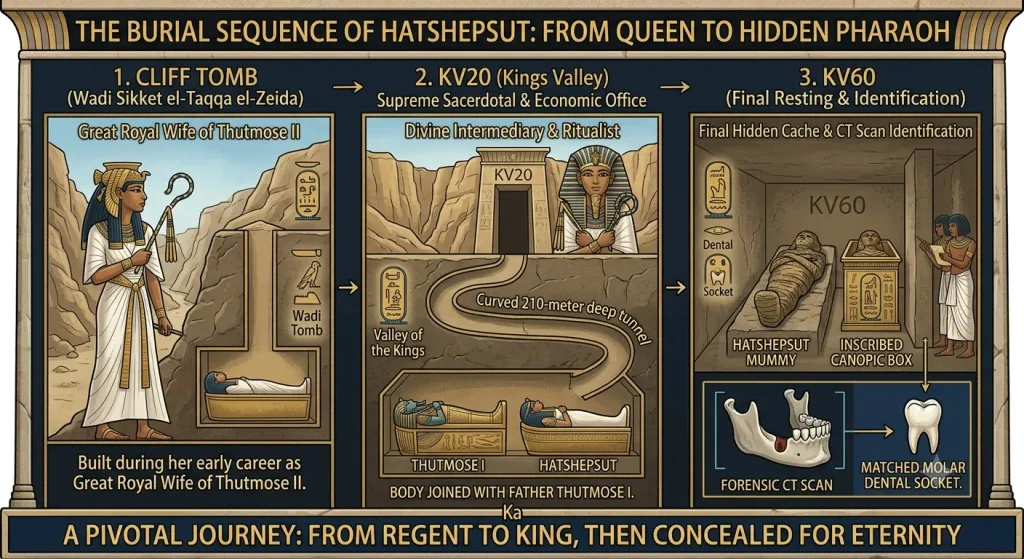
Hatshepsut was buried in tomb KV20 in the Valley of the Kings, one of the most important royal necropolises of ancient Egypt.
KV20 was originally associated with her father, Thutmose I, but Hatshepsut expanded and adapted the tomb after becoming pharaoh.
The decision to place her burial in the Valley of the Kings was significant because this area had become the principal royal cemetery of the New Kingdom.
The tomb’s location reflected her status as king rather than merely as queen.
Hatshepsut’s Tomb KV20
The Construction of KV20
KV20 is one of the earliest royal tombs created in the Valley of the Kings.
The tomb was designed as a long, curved passage descending deep into the mountain.
Its architecture reflected the religious transformation of royal burial practices during the early New Kingdom, when pharaohs moved away from pyramid complexes and chose hidden rock-cut tombs.
The Relationship Between KV20 and Thutmose I
The history of KV20 is complex.
Evidence suggests that the tomb was originally created for Thutmose I, Hatshepsut’s father.
After becoming pharaoh, Hatshepsut expanded the tomb and may have transferred her father’s remains into a more suitable royal burial arrangement.
This action reinforced her connection with Thutmose I and strengthened her dynastic legitimacy.
Who Discovered Hatshepsut’s Tomb?
The tomb KV20 was rediscovered in the early 19th century by European explorers, although it was not immediately recognized as Hatshepsut’s burial place.
Later archaeological work helped establish the connection between KV20 and Hatshepsut.
Important figures in the investigation of Hatshepsut’s burial history include:
- Howard Carter, who worked extensively in the Valley of the Kings and investigated KV20;
- later Egyptologists and archaeologists who studied the royal remains and inscriptions.
Where Is Hatshepsut’s Mummy?
Hatshepsut’s mummy is believed to be the royal female mummy discovered in KV60, identified by modern Egyptologists through archaeological and scientific analysis.
The identification became one of the most discussed discoveries in modern Egyptology.
The mummy was not found inside KV20, where Hatshepsut was originally buried. Instead, evidence suggests that her remains were moved during antiquity, possibly during efforts to protect royal burials from tomb robbers.
The Discovery of the KV60 Mummy
The Tomb of Sitre-In
KV60 was discovered in 1903 by archaeologist Howard Carter.
The tomb contained two female mummies:
- one identified as Sitre-In, Hatshepsut’s royal wet nurse;
- another unidentified female mummy.
For decades, the second mummy received little attention.
The Identification of Hatshepsut’s Mummy
In 2007, Egyptian archaeologist Zahi Hawass announced the identification of the mummy believed to belong to Hatshepsut.
The identification was based on several lines of evidence, including:
- archaeological context;
- comparison with known royal remains;
- genetic and anatomical studies;
- the discovery of a tooth believed to match a missing tooth from a royal storage box bearing Hatshepsut’s name.
Although the identification is widely accepted, discussions continue among specialists regarding aspects of the evidence.
🔬 The 2007 Scientific Identification of Hatshepsut’s Mummy
What Happened to Hatshepsut After Her Death?
After Hatshepsut’s death, some of her royal images and inscriptions were removed or altered during the later reign of Thutmose III.
For many years, historians interpreted this as evidence of personal hostility between Thutmose III and Hatshepsut.
However, modern Egyptology has developed more nuanced explanations.
Possible factors include:
- restoring traditional succession narratives;
- emphasizing Thutmose III’s independent kingship;
- political and dynastic considerations.
The evidence does not prove a simple personal conflict between the two rulers.
Was Hatshepsut Completely Erased From History?
No. Although some monuments were modified, Hatshepsut was not completely erased from Egyptian history.
Many important sources survived, including:
- her temple at Deir el-Bahari;
- inscriptions at Karnak;
- statues and reliefs;
- administrative records.
These discoveries allowed modern historians to reconstruct her reign and recognize her importance as one of Egypt’s most successful rulers.
Hatshepsut’s Burial and Mummy: Quick Facts
| Question | Answer |
|---|---|
| When did Hatshepsut die? | Around 1458 BCE |
| Where was Hatshepsut buried? | Tomb KV20 in the Valley of the Kings |
| Was Hatshepsut’s mummy found? | A mummy from KV60 is widely identified as Hatshepsut |
| Who discovered KV60? | Howard Carter in 1903 |
| Who identified Hatshepsut’s mummy? | A team led by Zahi Hawass announced the identification in 2007 |
| Where is Hatshepsut’s mummy today? | Preserved as part of the Egyptian royal mummy collection |
Historical Importance of Hatshepsut’s Burial Discovery
The archaeological investigation of Hatshepsut’s tomb and mummy transformed our understanding of her reign. Instead of remaining only a name from ancient inscriptions, Hatshepsut became one of the best-documented female rulers of the ancient world.
Her surviving monuments and burial evidence provide a rare opportunity to study:
- female authority in ancient Egypt;
- New Kingdom royal burial practices;
- the relationship between archaeology and historical interpretation.
Why Was Hatshepsut Erased From History?
Hatshepsut was not completely erased from history, but several of her monuments, inscriptions, and royal images were altered or removed after her death. For many years, these actions were interpreted as an attempt by Thutmose III to destroy the memory of a rival. However, modern Egyptology considers the reasons behind this process more complex, involving questions of royal succession, political legitimacy, and dynastic memory.
The evidence shows that Hatshepsut’s name and image were selectively removed from certain monuments, especially during the later part of Thutmose III’s reign and the beginning of the reign of his son Amenhotep II.
However, many of her achievements survived, including:
- her mortuary temple at Deir el-Bahari;
- inscriptions at Karnak;
- statues and reliefs;
- administrative records.
Because of these surviving sources, historians have been able to reconstruct her reign in considerable detail.
Did Thutmose III Erase Hatshepsut From History?
Thutmose III was responsible for some modifications to Hatshepsut’s monuments, but the exact reasons remain debated among historians.
Earlier interpretations suggested that Thutmose III waited until after Hatshepsut’s death and then removed her memory because he had been denied the throne.
This interpretation was influenced by the visible damage to many of her monuments.
However, modern scholars have proposed more nuanced explanations.
Possible reasons include:
- restoring a traditional male succession narrative;
- emphasizing Thutmose III’s independent kingship;
- addressing dynastic concerns after an unusual female pharaoh;
- political decisions made during the transition between reigns.
There is no direct evidence proving that Thutmose III acted purely out of personal hatred toward Hatshepsut.
When Did Hatshepsut’s Name Begin to Disappear?
The removal of Hatshepsut’s royal identity did not happen immediately after her death.
This is an important point because it challenges the idea of an immediate act of revenge.
Evidence suggests:
- Hatshepsut’s monuments remained intact for many years after her death;
- some modifications occurred later during Thutmose III’s reign;
- further changes may have continued under Amenhotep II.
This delayed process suggests that the actions were likely connected with broader political and dynastic considerations rather than a simple personal conflict.
What Was Removed From Hatshepsut’s Monuments?
The modifications affected parts of her official representation as king.
Examples include:
- royal names inside cartouches;
- images showing her as pharaoh;
- certain inscriptions referring to her reign.
However, the destruction was selective.
Many elements survived, including:
- the architecture of Djeser-Djeseru;
- scenes of the Punt expedition;
- theological reliefs;
- references to her family background.
The survival of these materials has allowed archaeologists to recover much of her historical legacy.
Why Would a Pharaoh Remove Another Pharaoh’s Memory?
To understand Hatshepsut’s case, it is necessary to understand Egyptian concepts of kingship.
The pharaoh was not simply an individual ruler. The king represented a continuous institution connected with:
- divine authority;
- cosmic order;
- dynastic succession.
When a new ruler came to power, controlling the official memory of previous kings could help establish legitimacy.
Removing or modifying images was therefore not necessarily an expression of personal hatred. It could also be a political statement about who represented the rightful continuation of kingship.
Was Hatshepsut Forgotten in Ancient Egypt?
No. Hatshepsut was not completely forgotten in ancient Egypt.
Her monuments remained visible, and later generations still had access to evidence of her reign.
The fact that modern archaeologists were able to identify:
- her name;
- her titles;
- her achievements;
- her burial history;
shows that the attempt to modify her memory was incomplete.
The Rediscovery of Hatshepsut’s Legacy
Modern archaeology restored Hatshepsut’s place in Egyptian history.
Important discoveries include:
- the study of her temple at Deir el-Bahari;
- the identification of her inscriptions;
- archaeological investigations of KV20 and KV60;
- analysis of her royal imagery.
Today, Hatshepsut is recognized as one of the most important rulers of the 18th Dynasty.
Her reign provides valuable insight into:
- female authority in ancient societies;
- Egyptian political ideology;
- the relationship between history and royal memory.
Myth vs. Historical Evidence: The Erasure of Hatshepsut
| Popular Claim | Historical Evidence |
|---|---|
| Thutmose III hated Hatshepsut and destroyed everything she built | The evidence suggests selective modifications rather than complete destruction |
| Hatshepsut disappeared completely from Egyptian memory | Many monuments and inscriptions survived |
| Her removal happened immediately after her death | The process appears to have occurred years later |
| Thutmose III erased her because she was a woman | Historians debate multiple political and dynastic explanations |
Historical Summary: Hatshepsut’s Memory After Death
Hatshepsut’s legacy was challenged after her death through selective changes to her royal representation, but she was never completely removed from history. The surviving archaeological evidence reveals a powerful pharaoh whose monuments, inscriptions, and achievements continued to preserve her memory for more than three thousand years.
Hatshepsut’s Legacy: Why She Remains One of Egypt’s Greatest Pharaohs
Hatshepsut’s legacy extends far beyond the fact that she was one of ancient Egypt’s few female pharaohs. Her importance comes from the way she successfully governed one of the most powerful kingdoms of the ancient world, maintained political stability, expanded economic networks, and created monuments that remain among Egypt’s greatest architectural achievements.
Her reign demonstrates the flexibility of Egyptian kingship and the importance of religious, political, and cultural traditions in maintaining royal authority.
Rather than breaking with Egyptian customs, Hatshepsut adapted existing concepts of kingship to establish herself as a legitimate ruler.
Why Is Hatshepsut Important?
Hatshepsut is important because she represents one of the clearest examples of female political authority in the ancient world.
Her reign demonstrates that:
- women could hold the highest levels of political power in ancient Egypt;
- Egyptian kingship could adapt to unusual succession circumstances;
- religious ideology played a central role in legitimizing authority;
- economic prosperity could be achieved through diplomacy and trade rather than only military conquest.
Her success was not based simply on her gender, but on her ability to perform the traditional functions expected of an Egyptian pharaoh.
Hatshepsut’s Achievements and Historical Contributions
A Successful Period of Government
During her approximately 22-year reign, Hatshepsut maintained stability throughout Egypt.
Her administration supported:
- temple institutions;
- economic activity;
- agricultural production;
- royal construction projects;
- international trade.
This stability helped prepare the conditions for the later military expansion of Egypt under Thutmose III.
Monumental Architecture
Hatshepsut’s building projects remain among the most visible reminders of her reign.
Her achievements include:
- the mortuary temple of Djeser-Djeseru at Deir el-Bahari;
- monumental works at Karnak;
- obelisks dedicated to Amun-Ra;
- religious structures throughout Egypt.
These monuments were not only architectural achievements but also expressions of royal ideology.
They communicated:
- her divine legitimacy;
- her relationship with the gods;
- her role as protector of Egypt.
International Trade and Diplomacy
The expedition to the Land of Punt remains one of the defining achievements of her reign.
Unlike rulers remembered mainly for conquest, Hatshepsut demonstrated another model of Egyptian power based on:
- trade;
- diplomatic relationships;
- access to valuable resources;
- religious exchange.
The Punt reliefs at Deir el-Bahari remain one of the most detailed records of ancient Egyptian foreign expeditions.
Hatshepsut’s Place Among Egyptian Pharaohs
Hatshepsut occupies a unique position among Egyptian rulers because she combined traditional royal authority with an innovative approach to leadership.
She was:
- a daughter of a pharaoh;
- a Great Royal Wife;
- a regent;
- a king of Upper and Lower Egypt;
- the builder of some of the New Kingdom’s greatest monuments.
Her reign challenges the idea that Egyptian history was shaped only by male rulers.
Was Hatshepsut the Most Successful Female Pharaoh?
Hatshepsut is often considered one of the most successful female rulers in ancient history, although comparisons between ancient rulers depend on the criteria used.
Her historical importance is based on measurable achievements:
- length of reign;
- political stability;
- surviving monuments;
- economic initiatives;
- lasting influence on Egyptian history.
Other female rulers, such as Sobekneferu and Cleopatra VII, also played important roles in Egyptian history, but Hatshepsut’s reign stands out because she ruled during the height of the New Kingdom and maintained the complete symbolism of pharaoh for more than two decades.
How Did Hatshepsut Change Egypt?
Hatshepsut changed Egypt by expanding the traditional possibilities of kingship and demonstrating that legitimacy could be constructed through:
- royal ancestry;
- religious authority;
- administrative success;
- monumental representation.
Her reign showed that the institution of pharaoh was not dependent only on the biological identity of the ruler, but on the ability to embody the responsibilities of kingship.
The Rediscovery of Hatshepsut’s Historical Importance
For centuries, Hatshepsut’s role was not fully understood because some aspects of her royal representation had been altered after her death.
Modern archaeology changed this perception through:
- excavations at Deir el-Bahari;
- study of royal inscriptions;
- analysis of temple reliefs;
- investigation of her tomb and mummy.
These discoveries transformed Hatshepsut from a partially forgotten ruler into one of the best-documented pharaohs of the New Kingdom.
Hatshepsut’s Legacy in Modern Egyptology
Today, Hatshepsut is studied as a key figure for understanding:
- female leadership in ancient societies;
- Egyptian concepts of kingship;
- the relationship between religion and politics;
- the preservation and reconstruction of historical memory.
Her monuments continue to provide some of the richest archaeological evidence from the 18th Dynasty.
Historical Summary: Hatshepsut’s Legacy
Hatshepsut remains one of ancient Egypt’s most remarkable rulers because she successfully transformed from royal woman to pharaoh while maintaining the traditions of Egyptian kingship. Her reign brought stability, economic prosperity, monumental achievements, and a lasting legacy that continues to shape our understanding of power, gender, and leadership in the ancient world.
Study Guide & Quick Answers About Hatshepsut
This study guide provides concise answers to the most common questions about Hatshepsut’s life, reign, achievements, and historical importance.
Who Was Hatshepsut?
Hatshepsut was an 18th Dynasty Egyptian pharaoh who ruled Egypt during the New Kingdom (c. 1479–1458 BCE). Originally a royal princess and queen, she became regent for Thutmose III and later assumed the full authority of pharaoh under the throne name Maatkare.
When Was Hatshepsut Born?
Hatshepsut was born around 1507 BCE in Thebes (Waset), Egypt. She was the daughter of Pharaoh Thutmose I and Great Royal Wife Queen Ahmose, belonging to the powerful Thutmosid royal family of the 18th Dynasty.
Where Was Hatshepsut Born?
Hatshepsut was most likely born in Thebes, the religious and political capital of southern Egypt during the early 18th Dynasty. Thebes was the center of the cult of Amun, the god who became closely associated with her royal ideology.
When Did Hatshepsut Rule Egypt?
Hatshepsut ruled Egypt approximately from 1479 to 1458 BCE during the 18th Dynasty of the New Kingdom. She initially governed as regent for Thutmose III before becoming pharaoh around 1473 BCE.
How Long Did Hatshepsut Rule?
Hatshepsut ruled Egypt for approximately 22 years. Her reign is considered one of the longest and most successful reigns of a female ruler in ancient Egyptian history.
How Did Hatshepsut Become Pharaoh?
Hatshepsut became pharaoh after serving as regent for the young Thutmose III following the death of Thutmose II. Around Year 7 of Thutmose III’s reign, she adopted the full royal titulary of an Egyptian king and ruled as Maatkare Hatshepsut.
What Was Hatshepsut Known For?
Hatshepsut was known for her monumental building projects, the expedition to the Land of Punt, economic prosperity, and her successful rule as one of Egypt’s most powerful female pharaohs.
What Did Hatshepsut Do for Egypt?
Hatshepsut strengthened Egypt through trade expeditions, temple construction, religious projects, and effective administration. Her reign was marked by stability, prosperity, and some of the greatest architectural achievements of the New Kingdom.
Why Did Hatshepsut Wear a False Beard?
Hatshepsut wore the ceremonial false beard because it was a traditional symbol of Egyptian kingship. It represented the authority of the pharaoh rather than biological gender, allowing her to present herself as the legitimate king of Egypt.
Why Did Hatshepsut Dress Like a Male Pharaoh?
Hatshepsut adopted male royal imagery because the office of pharaoh was traditionally represented through masculine symbols. She was not attempting to hide her identity but showing that she possessed the complete authority of Egyptian kingship.
Did Hatshepsut Pretend to Be a Man?
No. Hatshepsut did not claim to be biologically male. She used traditional royal imagery to represent herself as pharaoh, following the symbolic conventions of Egyptian kingship.
Was Hatshepsut the First Female Pharaoh?
No. Hatshepsut was not the first woman to rule Egypt, but she was one of the most successful female pharaohs. Earlier female rulers included Merneith and Sobekneferu, while Hatshepsut was one of the few women to hold the full authority and symbolism of kingship during the New Kingdom.
Who Was Thutmose III to Hatshepsut?
Thutmose III was Hatshepsut’s stepson and nephew. After the death of his father Thutmose II, he became the legitimate heir to the throne but was still a child, leading Hatshepsut to initially rule as his regent.
Who Was Hatshepsut Married To?
Hatshepsut was married to Pharaoh Thutmose II, her half-brother according to Egyptian royal tradition. Their marriage strengthened Thutmose II’s connection to the main royal bloodline.
Who Was Hatshepsut’s Father?
Hatshepsut’s father was Pharaoh Thutmose I, a successful ruler of the early 18th Dynasty who expanded Egyptian influence into Nubia and the Near East.
What Does Hatshepsut Mean?
The name Hatshepsut means “Foremost of Noble Women” or “She Who Is First Among Noble Women.” Her throne name, Maatkare, connected her reign with Ma’at, the Egyptian concept of cosmic order and balance.
Where Is Hatshepsut Buried?
Hatshepsut was buried in tomb KV20 in the Valley of the Kings. Her mummy is widely believed to be the royal female mummy discovered in KV60, identified through archaeological and scientific research.
Was Hatshepsut’s Mummy Found?
A mummy believed to belong to Hatshepsut was identified in KV60 in 2007 by a team led by Egyptian archaeologist Zahi Hawass. The identification remains one of the most significant discoveries related to New Kingdom royal archaeology.
Why Was Hatshepsut Erased From History?
Hatshepsut was not completely erased from history, but some of her monuments and royal images were altered after her death. Modern historians debate the reasons, which may include dynastic politics and the restoration of traditional succession narratives.
Where Is Hatshepsut’s Temple Located?
Hatshepsut’s temple, Djeser-Djeseru, is located at Deir el-Bahari on the west bank of the Nile near Luxor, Egypt. It is one of the most important architectural monuments of the New Kingdom.
Who Built Hatshepsut’s Temple?
Hatshepsut’s temple at Deir el-Bahari was designed by Senenmut, a powerful official and architect who served during her reign. The temple became one of the greatest architectural achievements of the 18th Dynasty.
What Was Hatshepsut’s Greatest Achievement?
Hatshepsut’s greatest achievements include the construction of Djeser-Djeseru at Deir el-Bahari, the expedition to Punt, and her ability to maintain political stability while ruling Egypt as pharaoh for more than two decades.
Why Is Hatshepsut Important?
Hatshepsut is important because she demonstrated that a woman could successfully hold the full authority of pharaoh in ancient Egypt. Her reign provides valuable evidence about Egyptian kingship, religion, architecture, and political organization
Further Reading & Academic Museum Resources
- The Metropolitan Museum of Art – Hatshepsut: From Queen to Pharaoh
- The British Museum – Eighteenth Dynasty & New Kingdom Collections
- Encyclopaedia Britannica – Hatshepsut: Biography, Reign, & Facts
- World History Encyclopedia – Hatshepsut: The Great Female Pharaoh
Great content! Keep up the good work!