What Were the Major Babylonian Cities?
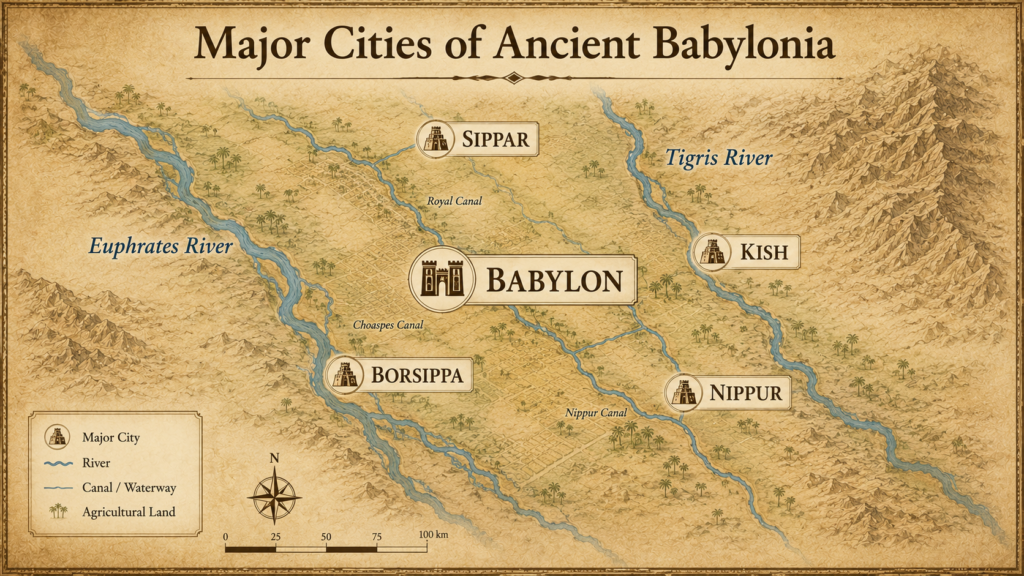
The major cities of ancient Babylonia included Babylon, Borsippa, Sippar, Nippur, and Kish. Each played a different role in Mesopotamian urban life. Babylon became the main political and imperial center, while Borsippa was associated with scholarship and the god Nabu, Sippar with Shamash and administration, Nippur with the sacred cult of Enlil, and Kish with the early development of Mesopotamian kingship and urban civilization.
| City | Main role | Associated deity |
|---|---|---|
| Babylon | Political and imperial center | Marduk |
| Borsippa | Religious and scholarly center | Nabu |
| Sippar | Administrative and religious center | Shamash |
| Nippur | Sacred religious center | Enlil |
| Kish | Early political and urban center | Various traditions |
Together, these cities formed an important network of political, religious, economic, and cultural centers across ancient Babylonia.
Timeline of Babylonian Cities
The history of Babylonian cities stretches across several millennia. Their importance changed as kingdoms rose and fell, but many remained important because of their religious institutions, strategic locations, administrative functions, or connections with older Mesopotamian traditions.
c. 3000 BCE — Kish and the Rise of Early Urban Centers
Kish was already an important urban center during the early development of Mesopotamian cities.
Its prominence in early traditions of kingship gave it a lasting place in Mesopotamian history. Kish represents the older urban landscape from which later Babylonian cities developed.
3rd Millennium BCE — Nippur Becomes a Major Sacred Center
Nippur developed into one of the most important religious centers of southern Mesopotamia.
Its association with Enlil gave the city exceptional religious prestige. Although political power shifted between different cities, Nippur retained importance because of its temples and sacred traditions.
3rd–2nd Millennium BCE — Sippar Develops as a Religious and Administrative Center
Sippar became an important center associated with Shamash, the sun god and divine guardian of justice.
Its location and institutional life supported administration, trade, and scholarship. Cuneiform tablets discovered at the site provide valuable evidence for the activities that took place within the city.
Early 2nd Millennium BCE — Babylon Rises in Importance
Babylon began as a comparatively modest city but gained increasing political importance during the early second millennium BCE.
The rise of the Amorite dynasty transformed Babylon’s position within southern Mesopotamia and created the conditions for its later expansion.
18th Century BCE — Babylon Becomes a Major Political Center
During the reign of Hammurabi, Babylon expanded dramatically.
The city became the center of a powerful kingdom and increasingly combined political administration with religious and economic functions.
This marked a decisive transformation in Babylon’s status among the cities of Mesopotamia.
2nd Millennium BCE — Borsippa Gains Religious Importance
Borsippa, located close to Babylon, became strongly associated with Nabu, the god connected with writing and scholarship.
Its proximity to Babylon and its important temple institutions made it one of the region’s significant religious and intellectual centers.
1st Millennium BCE — Babylon Reaches Monumental Scale
During the later first millennium BCE, particularly under the Neo-Babylonian kings, Babylon underwent major building and restoration projects.
The city developed monumental walls, temples, gateways, processional spaces, and other structures that reinforced its status as one of the great cities of the ancient Near East.
539 BCE — Persian Conquest and a New Political Era
The conquest of Babylon by Cyrus the Great brought Babylonian political independence to an end.
Babylon remained an important city after the conquest, however. Its religious institutions, population, and strategic importance allowed it to continue playing a significant role under Persian rule.
Later First Millennium BCE — Continued Urban Importance
Babylon and several other ancient Mesopotamian cities continued to exist after the end of the Babylonian Empire.
Their importance increasingly depended on their religious, administrative, and cultural roles rather than on independent Babylonian political power.
Why the Timeline Matters
The history of Babylonian cities was not a simple story in which one city replaced another.
Different urban centers could be important for different reasons at the same time:
Kish → early kingship and urban traditions
Nippur → religious authority
Sippar → administration, justice, and scholarship
Borsippa → Nabu and intellectual traditions
Babylon → political, religious, and imperial prominence
This changing balance helps explain why Babylonia was characterized by a network of important cities rather than a single permanent urban center.
“`html
Major Babylonian Cities and Their Roles
Babylonian urban centers served different political, religious, administrative, and intellectual functions across ancient Mesopotamia.
Babylon
Political & Imperial CenterThe most prominent city of Babylonia, Babylon became a major center of government, religion, commerce, monumental construction, and royal authority.
Borsippa
Religious & Scholarly CenterLocated close to Babylon, Borsippa was strongly associated with religious institutions, writing, scholarship, and the cult of Nabu.
Sippar
Administrative & Religious CenterSippar was an important center of administration, religious activity, trade, and scholarship, with a major cult dedicated to Shamash.
Nippur
Sacred Religious CenterNippur held exceptional religious prestige in Mesopotamia and was traditionally associated with Enlil and his major temple institutions.
Kish
Early Political & Urban CenterOne of the oldest important urban centers of Mesopotamia, Kish played a major role in early traditions of kingship and urban civilization.
Babylon as the Urban Center
Babylon became the best-known and most influential urban center of ancient Babylonia. Its position on the Euphrates, its religious institutions, and its growing political importance allowed the city to develop functions that extended far beyond those of a typical Mesopotamian settlement.
The city was simultaneously a political center, religious destination, commercial hub, and administrative capital. These different roles reinforced one another and helped Babylon become one of the defining cities of the ancient Near East.
A City on the Euphrates
Babylon’s location along the Euphrates was an important factor in its development.
The river provided water for agriculture and supported communication and transportation. A network of canals connected urban areas with the surrounding agricultural landscape, linking the city’s population with the resources required to sustain it.
Its position also helped connect Babylon with wider regional trade networks.
This meant that the city was not isolated from its surroundings. Instead, Babylon formed part of a larger economic landscape in which agricultural production, waterways, merchants, workshops, temples, and administrative institutions were closely connected.
Political Functions
As Babylon grew in political importance, the city became a center from which rulers could administer territory and organize resources.
Palaces and administrative institutions provided spaces for:
- royal administration
- taxation
- legal affairs
- diplomatic activity
- storage and redistribution
- management of labor
The concentration of these activities helped distinguish Babylon from smaller settlements.
The city’s importance therefore depended not only on its population or buildings but also on the institutions operating within it.
Religious Importance
Babylon was also one of the most important religious centers of Babylonia.
The city was closely associated with Marduk, whose cult became increasingly prominent as Babylon’s political influence expanded.
Major temples formed important parts of the urban landscape.
Religious institutions were not separate from everyday urban life. Temples could possess land, employ workers, receive offerings, manage resources, and participate in administrative activities.
This made religious institutions important economic and social actors within the city.
Monumental Urban Development
Babylon’s rulers invested heavily in the appearance and infrastructure of the city.
Urban projects could include:
- walls
- gates
- temples
- palaces
- processional routes
- canals
- streets
- monumental decorative programs
These projects served practical purposes, but they also transformed Babylon into a powerful visual statement.
The city’s monumental landscape communicated its importance to residents, visitors, religious participants, merchants, and representatives from other regions.
Babylon as a Commercial Center
The concentration of population and institutions also encouraged commercial activity.
Markets, workshops, merchants, transport networks, and administrative organizations contributed to the city’s economic life.
Babylon was connected to wider routes extending across Mesopotamia and into neighboring regions.
Goods entering the city could be redistributed through local markets and institutional networks, while agricultural products and manufactured goods moved outward.
Urban commerce therefore depended on the relationship between Babylon and the wider countryside.
A Network Rather Than an Isolated Capital
It is important not to view Babylon as a completely independent urban system.
The city depended on other settlements and rural areas for food, raw materials, labor, and specialized production.
At the same time, Babylon was connected with other important cities such as Borsippa, Sippar, Nippur, and Kish.
This created an interconnected urban landscape.
| Urban function | Babylon’s role |
|---|---|
| Government | Administration and royal authority |
| Religion | Major cult center associated with Marduk |
| Trade | Commercial and transport connections |
| Agriculture | Connected surrounding farmland through canals and irrigation |
| Craft production | Workshops and specialist labor |
| Administration | Records, taxation, storage, and redistribution |
| Ceremonial life | Temples, processions, and monumental spaces |
Babylon’s prominence was therefore partly the result of its position within this wider network.
Why Babylon Became the Dominant City
Several factors came together to elevate Babylon above many competing urban centers.
Its geographical position, political importance, religious prestige, economic activity, and monumental development reinforced one another.
As Babylon became more powerful, investment in the city increased. As the city became more impressive and institutionally important, its political and religious significance grew further.
This created a cycle of urban development:
Political power → investment → monumental growth → religious prestige → economic activity → greater urban importance
The result was a city that became much more than the seat of a ruling dynasty.
Babylon and the Other Cities of Babylonia
Babylon’s dominance should not obscure the importance of other Babylonian cities.
Borsippa, Sippar, Nippur, and Kish each possessed their own institutions, traditions, and historical significance.
Their different roles demonstrate that Babylonia was characterized by a network of specialized urban centers rather than a simple hierarchy in which every city existed only to support Babylon.
This wider network is essential for understanding Babylonian urban civilization.
Babylon was the most prominent city, but it was part of a much larger urban world.
Borsippa: A Religious and Scholarly City
Borsippa was one of the most important cities in the Babylonian urban landscape. Located only a short distance southwest of Babylon, the city developed its own religious institutions and traditions while remaining closely connected to the political and cultural center of Babylonia.
Its importance was particularly associated with Nabu, the god traditionally connected with writing and scholarship. This connection gave Borsippa a distinctive identity within the network of Babylonian cities.
Where Was Borsippa?
Borsippa was located in southern Mesopotamia, close to Babylon.
Its position meant that the two cities could maintain close connections while retaining separate urban identities. Rather than functioning simply as a suburb of Babylon, Borsippa possessed its own temples, institutions, population, and traditions.
Its proximity to Babylon nevertheless made it an important part of the wider metropolitan landscape surrounding the capital.
The City of Nabu
Borsippa’s strongest religious association was with Nabu.
The city’s principal temple complex, Ezida, was dedicated to him and became one of the most important religious institutions in the area.
Nabu’s associations with writing and scholarship contributed to Borsippa’s reputation as a place connected with learning and intellectual activity.
This makes the city particularly relevant when studying the relationship between urban life, temples, literacy, and scholarship in ancient Babylonia.
Ezida and the Urban Landscape
Ezida was not simply an isolated religious building.
Like major temple institutions elsewhere in Mesopotamia, it formed part of the wider urban environment.
A major temple could bring together:
- priests
- administrators
- craftsmen
- scribes
- religious specialists
- visitors and pilgrims
The presence of these groups contributed to the economic and social life of the city.
Religious institutions could also manage property and resources, making temples important participants in urban administration.
Borsippa and Scholarship
Borsippa’s association with Nabu gives it an important place in the history of Babylonian intellectual culture.
Scribes worked within a broader tradition of recording and transmitting knowledge on clay tablets.
This intellectual environment included subjects such as:
- writing
- religious texts
- mathematics
- astronomy
- lexical traditions
- scholarly interpretation
Borsippa should not be understood as the only center of Babylonian scholarship, but its institutional and religious connections made it an important part of the wider scholarly landscape.
Its Relationship with Babylon
Borsippa and Babylon were closely connected, but they served somewhat different urban roles.
| Babylon | Borsippa |
|---|---|
| Major political center | Important religious center |
| Associated with Marduk | Associated with Nabu |
| Imperial administration | Temple and scholarly institutions |
| Large monumental urban landscape | Major sacred complex |
| Political and ceremonial prominence | Religious and intellectual prominence |
This relationship illustrates an important feature of Babylonian urban civilization: cities could specialize while remaining closely interconnected.
Borsippa’s importance did not depend on competing directly with Babylon.
Instead, its institutions complemented those of the larger city.
A City Within a Larger Urban Network
Borsippa also demonstrates why the phrase Babylonian cities is more useful than thinking only about Babylon itself.
The region contained multiple settlements with distinct histories and institutional identities.
Babylon provided political and imperial leadership, while Borsippa contributed religious and scholarly institutions. Other cities, such as Sippar and Nippur, had their own traditions and areas of importance.
Together, these centers formed a complex urban network.
Why Borsippa Matters
Borsippa matters because it shows that ancient Babylonia was not simply a civilization organized around one enormous capital.
The city possessed its own identity, institutions, religious traditions, and intellectual associations.
Its connection with Nabu and Ezida also demonstrates how religion, literacy, scholarship, and urban development could become closely intertwined.
For anyone studying the major cities of ancient Babylonia, Borsippa provides an important example of how a secondary urban center could remain highly significant without being the political capital.
Sippar: An Administrative and Religious Center
Sippar was one of the important urban centers of ancient Babylonia and one of the oldest cities in Mesopotamia. Located along the Euphrates, it developed a distinctive identity through its religious institutions, administrative activity, trade connections, and extensive documentary record.
The city was particularly associated with Shamash, the Mesopotamian sun god traditionally connected with justice. This religious importance existed alongside a busy urban environment in which administrators, merchants, scribes, craftsmen, and other inhabitants participated in the city’s economic and institutional life.
Where Was Sippar?
Sippar was located in northern Babylonia along the Euphrates, in a strategically useful position within the Mesopotamian river system.
Its location provided access to waterways and agricultural resources while also connecting the city with other settlements in the region.
This geographical position helped Sippar remain relevant for long periods of Mesopotamian history.
Sippar and the Cult of Shamash
Sippar was one of the principal cult centers of Shamash.
The city’s major temple institution was known as Ebabbara, a name associated with the temple of Shamash.
The temple was an important part of the urban landscape and contributed to the city’s religious prestige.
Its institutional presence also meant that religious activity was closely connected with other aspects of city life.
A City of Administration
Sippar was more than a religious center.
The large number of surviving cuneiform documents associated with the city provides evidence for extensive administrative and economic activity.
Written records document matters such as:
- property
- loans
- contracts
- agricultural production
- taxation
- legal agreements
- institutional administration
These records offer an unusually detailed view of how an ancient Mesopotamian city functioned.
Merchants, Farmers, and Urban Institutions
Like other Babylonian cities, Sippar depended on the relationship between the urban population and the surrounding countryside.
Agricultural production supplied food and raw materials, while merchants and craftsmen participated in the movement and transformation of goods.
Urban institutions helped organize these activities.
This interaction between city, countryside, temple, and administration was fundamental to the functioning of Babylonian urban society.
Sippar and Written Records
Sippar is particularly valuable to historians because of its archaeological and textual remains.
Thousands of clay tablets have been associated with the city, providing evidence about individuals, families, institutions, economic transactions, and legal matters.
The documents reveal that urban life involved far more than monumental buildings.
They show the activities of ordinary people as well as institutions and provide glimpses into the complex networks that connected households, businesses, temples, and administrators.
A Center of Learning and Scholarship
The documentary record also demonstrates the importance of scribal activity.
Scribes produced and managed written records, preserving information required for administration and institutional life.
The broader intellectual traditions of Mesopotamia included the transmission of:
- lexical texts
- legal traditions
- religious literature
- mathematical knowledge
- astronomical observations
Sippar therefore formed part of the wider scholarly environment of Babylonia, even though its primary importance was not limited to scholarship.
Sippar Within the Babylonian Urban Network
Sippar’s role becomes clearer when compared with other major cities.
| City | Distinctive urban role |
|---|---|
| Babylon | Political and imperial center |
| Borsippa | Religious and scholarly center |
| Sippar | Administrative, religious, and commercial center |
| Nippur | Sacred religious center |
| Kish | Early political and urban center |
This comparison shows why ancient Babylonia cannot be understood through Babylon alone.
Different cities developed different institutional strengths while remaining connected through political, economic, religious, and cultural networks.
Why Sippar Matters
Sippar is particularly important because it provides an unusually detailed window into everyday urban administration.
Its temples, written records, economic documents, and long history demonstrate how a Babylonian city could combine religious authority, administration, commerce, agriculture, and private economic activity.
For the study of Babylonian cities, Sippar is therefore valuable not because it rivaled Babylon in political power, but because it reveals how a major urban community actually functioned within the wider Babylonian world.
Nippur: A Sacred Urban Center
Nippur was one of the most important sacred cities of ancient Mesopotamia and remained significant during the Babylonian periods. Unlike Babylon, its importance did not depend primarily on imperial administration or political dominance. Instead, Nippur’s influence came from its extraordinary religious prestige and its long-established temple institutions.
The city was closely associated with Enlil, one of the most important gods in Mesopotamian religious traditions. Because of this connection, Nippur occupied a distinctive position within the network of Babylonian cities.
The Sacred Importance of Nippur
Nippur’s reputation as a sacred city began long before the rise of Babylon as a major political power.
The city’s principal religious complex was associated with Enlil and his consort Ninlil. The temple complex known as Ekur became one of the most prestigious religious institutions in Mesopotamia.
Its importance meant that Nippur could retain influence even when political control of southern Mesopotamia shifted between different kingdoms.
Nippur and Royal Legitimacy
One of the most interesting aspects of Nippur was the relationship between its religious prestige and Mesopotamian kingship.
Rulers who controlled or supported Nippur could associate themselves with one of the most respected religious institutions in the region.
Kings invested in:
- temple restoration
- religious buildings
- offerings
- administrative institutions
- infrastructure
These projects helped maintain the city’s sacred character while also strengthening the ruler’s relationship with established religious traditions.
A City Beyond Politics
Nippur demonstrates that urban importance in ancient Babylonia could take several forms.
Babylon became powerful through political and imperial authority. Sippar developed important administrative and commercial functions. Borsippa became closely associated with Nabu and scholarly traditions.
Nippur followed a different model.
Its influence came primarily from religious authority and historical prestige.
This distinction is important when considering the major Babylonian cities because political importance and cultural importance were not always the same thing.
Temples and Urban Life
The Ekur complex was not simply a religious monument standing apart from the city.
Temple institutions were integrated into the wider urban economy and could be involved in:
- land management
- agricultural production
- labor organization
- storage
- redistribution
- administration
Priests, administrators, craftsmen, laborers, and other inhabitants interacted with these institutions.
The temple therefore formed an important part of the city’s social and economic structure.
Nippur as a Center of Written Culture
Nippur is also important for the history of Mesopotamian scholarship.
Archaeological excavations have uncovered large numbers of cuneiform tablets from different periods.
These documents include material relating to:
- administration
- education
- literature
- religion
- mathematics
- lexical traditions
The city’s scribal traditions demonstrate that religious centers could also become important places for preserving and transmitting knowledge.
Nippur Within the Babylonian Urban Network
Nippur’s role becomes clearer when viewed alongside the other major cities.
| City | Main urban identity |
|---|---|
| Babylon | Political and imperial center |
| Borsippa | Religious and scholarly center |
| Sippar | Administrative and commercial center |
| Nippur | Sacred and religious center |
| Kish | Early political and urban center |
This network shows that Babylonia contained cities with different but complementary functions.
Nippur did not need to become an imperial capital to remain important. Its sacred traditions gave it a form of influence that could survive major political changes.
Why Nippur Matters
Nippur matters because it demonstrates the long-term importance of sacred cities in Mesopotamian urban civilization.
Its connection with Enlil, its major temple institutions, its royal associations, and its rich collection of written records made it an important urban center for centuries.
For the study of Babylonian cities, Nippur provides a useful contrast with Babylon: one city derived much of its influence from political and imperial power, while the other maintained exceptional importance through religious prestige and institutional continuity.
Kish: An Early Center of Mesopotamian Urban Civilization
Kish was one of the oldest and most historically significant urban centers of southern Mesopotamia. Although its political importance changed considerably over time, the city retained a prominent place in Mesopotamian traditions because of its association with early kingship, urban development, and political authority.
For the study of Babylonian cities, Kish is particularly important because it represents an earlier layer of Mesopotamian urban history that continued to influence later traditions.
An Ancient Urban Center
Kish developed during the early stages of Mesopotamian urban civilization.
Its location in southern Mesopotamia placed it within a landscape dominated by rivers, irrigation canals, agricultural settlements, and competing city-states.
Like other early Mesopotamian cities, Kish was connected to a surrounding agricultural territory that provided food, labor, and resources for its urban population.
Over time, the city became part of the changing political landscape of southern Mesopotamia.
Kish and Early Kingship
Kish is especially famous for its connection with early Mesopotamian kingship.
The title “King of Kish” became an important political expression in Mesopotamian traditions. It could represent claims to authority that extended beyond the city itself.
Kish therefore acquired a symbolic importance that went beyond its physical size.
Its association with kingship helped establish the city as a reference point for political legitimacy in later Mesopotamian traditions.
The City in Mesopotamian Traditions
Kish appears prominently in ancient king lists and literary traditions.
These sources associate the city with some of the earliest rulers remembered by Mesopotamian scribes.
Such traditions should be treated carefully because literary and historical evidence do not always provide the same kind of information. Nevertheless, they demonstrate how important Kish remained in the cultural memory of Mesopotamia.
The city’s name became closely associated with the beginnings of organized political authority.
Kish and Urban Development
Kish was not important only because of its royal associations.
Its development also reflects the broader emergence of complex urban societies in southern Mesopotamia.
Urban institutions required systems for:
- agricultural management
- administration
- storage
- religious activity
- labor organization
- construction
- political authority
These systems gradually transformed early settlements into more complex cities.
Kish provides an example of this wider transition.
Kish and Later Babylonian Cities
By the time Babylon emerged as a major political center, Kish belonged to a much older urban tradition.
The rise of Babylon did not occur in an empty landscape. It took place within a region that already contained ancient cities with established institutions, traditions, and political identities.
This historical continuity is important.
Babylonian urban civilization inherited many elements from earlier Mesopotamian cities, including traditions of kingship, temple institutions, writing, administration, and urban organization.
Kish therefore provides useful background for understanding why later Babylonian cities developed within an already sophisticated urban environment.
Kish Compared with the Other Major Cities
| City | Main historical importance |
|---|---|
| Babylon | Political and imperial prominence |
| Borsippa | Religious and scholarly institutions |
| Sippar | Administration, commerce, and religious life |
| Nippur | Sacred traditions and temple institutions |
| Kish | Early kingship and urban development |
This comparison shows that the major cities of Babylonia did not share exactly the same role.
Some became powerful because of political authority, others because of religious prestige, scholarship, commerce, or their long historical traditions.
Why Kish Matters
Kish matters because it connects the later Babylonian urban world with the much older history of Mesopotamian cities.
Its association with early kingship, its place in ancient traditions, and its development as an urban center demonstrate that Babylonian cities emerged from a long process of urban and political development.
Understanding Kish therefore helps explain an important feature of Babylonia: its cities belonged to a much older Mesopotamian urban tradition that continued to evolve over thousands of years.
How Were Babylonian Cities Organized?
Babylonian cities were complex urban environments organized around a combination of religious institutions, administrative buildings, residential areas, commercial activity, transportation routes, and defensive structures.
Their layout was shaped by the needs of both the population and the institutions that controlled land, resources, religion, and political authority. Although individual cities differed in size and organization, many shared features that reflected the broader urban traditions of Mesopotamia.
City Walls and Fortifications
Defensive walls were among the most visible features of major Babylonian cities.
Large urban centers could contain fortified walls, towers, and monumental gates designed to control access and protect important areas.
These structures had practical purposes, but they also communicated political power.
A massive wall demonstrated that a city’s rulers could mobilize the labor, materials, and resources necessary to construct and maintain large defensive systems.
In Babylon itself, monumental gateways became part of the city’s ceremonial landscape as well as its defensive infrastructure.
Temples and Sacred Precincts
Temples occupied prominent positions within many Babylonian cities.
They were not simply places of worship. Major temple complexes could include administrative spaces, storage facilities, workshops, and areas used by religious personnel.
A city’s principal deity often influenced its identity.
For example:
| City | Important religious association |
|---|---|
| Babylon | Marduk |
| Borsippa | Nabu |
| Sippar | Shamash |
| Nippur | Enlil |
These religious centers helped organize both the symbolic and institutional life of their cities.
Palaces and Administrative Buildings
Political authority was also reflected in the urban landscape.
Palaces and administrative buildings provided spaces for rulers, officials, scribes, and other members of the governing system.
From these institutions, authorities could manage:
- taxation
- land
- labor
- legal affairs
- supplies
- diplomatic activity
- official records
The concentration of these functions helped turn major cities into administrative centers.
Streets and Movement Through the City
Urban movement depended on streets, paths, gates, and waterways.
Major ceremonial routes could be wider and more carefully planned than ordinary streets, particularly in important capitals.
Other routes connected residential areas with temples, markets, workshops, and city gates.
The movement of people and goods was essential to urban life, meaning that transportation infrastructure connected otherwise separate parts of the city.
Canals and Water Management
Water management was fundamental to Mesopotamian urban development.
Canals connected cities with agricultural areas and helped move water through landscapes where rainfall alone was insufficient for reliable agriculture.
They could also facilitate transportation and contribute to the movement of goods.
The relationship between city and countryside was therefore closely tied to water infrastructure.
Urban populations depended on surrounding agricultural land, while canals helped connect those resources with urban institutions and households.
Markets and Commercial Areas
Commercial activity formed another important component of Babylonian urban life.
Merchants, craftsmen, agricultural producers, and other workers exchanged goods within cities and through wider regional networks.
Markets could involve the exchange of:
- grain
- textiles
- livestock
- metals
- pottery
- tools
- luxury goods
Commercial activity was closely connected with administrative and institutional systems, particularly where temples, palaces, and private households participated in economic transactions.
Residential Neighborhoods
Most inhabitants did not live inside palaces or temples.
Babylonian cities contained residential areas where families lived, worked, and interacted with their neighbors.
Houses could include:
- courtyards
- storage spaces
- workshops
- living areas
- rooms arranged around internal open spaces
The organization of residential districts varied between cities and periods, but housing formed the everyday foundation of urban life.
Workshops and Craft Production
Craft production was another important part of city life.
Urban craftsmen produced objects required by households, temples, palaces, and merchants.
Activities could include:
- pottery production
- textile work
- metalworking
- woodworking
- food processing
- production of decorative objects
Workshops connected urban populations with both local demand and larger institutional economies.
A City as an Interconnected System
The different parts of a Babylonian city did not function independently.
They formed an interconnected system:
Agricultural land
↓
Canals and transport
↓
City gates and streets
↓
Markets and workshops
↓
Households and neighborhoods
↓
Temples and administrative institutions
↓
Palaces and political authority
This relationship between different urban functions helps explain why Babylonian cities could support large populations and complex institutions.
Urban Life Beyond Monumental Buildings
The most famous remains of Babylonian cities are often monumental: walls, temples, palaces, gates, and other major structures.
Yet these buildings represented only part of the urban environment.
Behind the monuments were households, workshops, streets, storage areas, markets, canals, and administrative spaces that allowed cities to function every day.
This distinction is important when studying Babylonian cities.
The impressive monuments reflected royal and religious power, but the ordinary infrastructure of urban life sustained the cities themselves.
Why Urban Organization Matters
The organization of Babylonian cities reveals how political authority, religion, commerce, agriculture, and everyday life were connected.
A city was not simply a collection of monumental buildings.
It was a network in which people, institutions, resources, and infrastructure interacted constantly.
That urban complexity was one of the defining characteristics of Mesopotamian civilization and helped Babylonian cities remain important centers for centuries.
Daily Life in Babylonian Cities
Babylonian cities were not defined only by temples, palaces, and monumental walls. They were also busy communities where families, merchants, craftsmen, farmers, scribes, priests, administrators, and laborers lived and worked.
Daily life depended on the constant interaction between urban neighborhoods and the agricultural countryside. Food, raw materials, animals, and other resources entered cities from surrounding areas, while urban institutions provided markets, administration, religious services, and specialized crafts.
Homes and Neighborhoods
Most urban inhabitants lived in ordinary houses rather than monumental buildings.
Homes could be organized around an internal courtyard, with rooms serving different domestic or economic purposes. Some households also contained storage areas or spaces where particular crafts and commercial activities took place.
The neighborhood was therefore both a residential and economic environment.
Families could live close to workshops, markets, religious buildings, and administrative institutions, creating a dense network of everyday interactions.
Craftsmen and Workshops
Cities provided ideal environments for specialized production.
Craftsmen could work in activities such as:
- pottery
- textile production
- metalworking
- woodworking
- food processing
- leatherworking
Some production was intended for ordinary households, while other goods were supplied to temples, palaces, merchants, or wealthier families.
Workshops therefore connected everyday consumption with the larger institutional economy of the city.
Merchants and Markets
Merchants played an important role in urban life.
Cities provided places where agricultural products, manufactured goods, raw materials, and luxury items could be exchanged.
A typical commercial environment could involve:
Producers → merchants → markets → households and institutions
Trade also connected Babylonian cities with regions beyond Mesopotamia.
Goods could travel along river routes and overland networks, linking urban communities with the wider Near Eastern economy.
Farmers and the Urban Countryside
Although cities concentrated population and institutions, they depended heavily on agricultural production.
Farmers living in the surrounding countryside produced much of the food required by urban populations.
Canals and transportation routes helped connect agricultural areas with cities.
This meant that the distinction between “urban” and “rural” was not absolute.
A Babylonian city functioned as part of a larger landscape in which:
- fields produced food
- canals transported water
- animals provided labor and resources
- merchants moved goods
- cities processed and redistributed products
Urban life therefore depended on the countryside surrounding each city.
Scribes and Administrators
Written administration was another important part of urban life.
Scribes produced and managed clay-tablet records dealing with matters such as:
- contracts
- loans
- property
- taxation
- deliveries
- employment
- institutional transactions
These records allowed temples, palaces, businesses, and private households to manage increasingly complex activities.
The presence of scribes also demonstrates the importance of literacy and record keeping in Mesopotamian urban institutions.
Religious Personnel
Priests and other religious specialists were another visible part of city life.
Major temples attracted people involved in:
- rituals
- offerings
- administration
- maintenance
- scholarship
- festival activities
Religious institutions could also employ craftsmen, administrators, laborers, and other workers.
As a result, temples influenced urban life well beyond purely religious ceremonies.
Children, Families, and Household Life
The household was one of the fundamental units of Babylonian urban society.
Families were involved in economic activity, property management, education, and religious practices.
Children could become involved in the occupations and traditions of their households, while some received specialized education connected with scribal or professional careers.
Households therefore connected private life with the wider economic and institutional structures of the city.
A Typical Urban Day
Although individual experiences varied greatly according to wealth, occupation, and status, everyday urban activity could follow a pattern similar to this:
| Part of urban life | Typical activity |
|---|---|
| Morning | Work, household tasks, opening of workshops and commercial activity |
| Daytime | Craft production, administration, trade, farming, or temple duties |
| Markets | Buying, selling, and exchanging goods |
| Temples | Rituals, offerings, administration, and institutional work |
| Households | Meals, domestic work, storage, and family activities |
| Evening | Return home and continuation of household life |
This should not be understood as a universal daily schedule. Ancient cities contained people with very different occupations and social positions.
Different Experiences of Urban Life
Life in a Babylonian city was strongly influenced by social status.
A wealthy merchant, temple official, craftsman, laborer, and dependent worker would not have experienced the city in the same way.
Access to:
- housing
- education
- property
- political influence
- economic opportunities
- institutional protection
varied between individuals and families.
This diversity is important because “Babylonian urban life” did not represent a single experience shared equally by everyone.
Why Cities Were Attractive
Despite their inequalities, cities offered opportunities that were difficult to find in smaller settlements.
Urban centers concentrated:
- employment
- markets
- religious institutions
- administrative services
- specialist crafts
- education
- political activity
People could therefore move between different economic and social activities within the same urban environment.
City and Community
The most important feature of Babylonian urban life was the constant interaction between different groups.
A city brought together people who depended on one another:
Farmers supplied food → merchants transported goods → craftsmen transformed materials → households consumed products → temples and palaces organized resources → scribes recorded transactions.
This network made the city a functioning community rather than simply a collection of buildings.
Understanding this everyday interaction is essential for understanding what Babylonian cities actually were.
They were places where work, family life, religion, commerce, administration, and political authority came together on a daily basis.
How Did Babylonian Cities Change Over Time?
The major cities of Babylonia did not remain equally important throughout ancient Mesopotamian history. Their fortunes changed as political powers shifted, trade networks evolved, and new rulers reorganized the region.
Some cities gained prominence because they became political capitals, while others retained their importance because of religious institutions, established communities, or strategic locations.
This means that the history of Babylonian cities is better understood as a process of urban transformation rather than a simple rise and fall.
From Independent Cities to Larger Kingdoms
Early Mesopotamian history was characterized by competition between numerous cities and political centers.
Cities such as Kish and Nippur had already developed important political and religious traditions before Babylon became dominant.
As larger kingdoms emerged, the balance between these cities changed.
Babylon gradually became the principal political center of Babylonia, but older cities did not simply disappear. Instead, they were incorporated into broader political systems.
Babylon’s Rise
The rise of Babylon during the early second millennium BCE represented an important change in the urban landscape.
Under Hammurabi, Babylon became the center of a powerful kingdom.
Its growing political importance encouraged investment in:
- temples
- administrative buildings
- infrastructure
- defensive works
- royal monuments
As Babylon expanded, other cities increasingly operated within a political system centered on Babylon.
Cities Under Imperial Rule
The political status of Babylonian cities continued to change as larger empires controlled Mesopotamia.
Foreign rulers could preserve existing cities and institutions while adapting them to new administrative systems.
Temples often continued to function, populations remained in place, and urban economic activity could continue even when political sovereignty changed.
This distinction is important.
Political conquest did not necessarily mean urban destruction or immediate abandonment.
The Neo-Babylonian Revival
Babylon experienced another major period of urban development under the Neo-Babylonian Empire.
The city’s rulers invested heavily in monumental construction and restoration.
Babylon became particularly famous for its:
- monumental gates
- defensive walls
- temples
- processional routes
- palaces
- decorated architecture
This period reinforced Babylon’s status as the most spectacular urban center associated with Babylonian political power.
Other cities also remained active, although their roles differed from Babylon’s imperial function.
539 BCE and the End of Babylonian Independence
The conquest of Babylon by Cyrus the Great in 539 BCE ended the Neo-Babylonian Empire.
This was a major political turning point, but it did not mean that Babylon immediately ceased to exist.
The city continued to function under Persian rule.
Its religious traditions, population, economic institutions, and strategic position allowed it to retain significance even after Babylon was no longer the capital of an independent empire.
Urban Continuity Under New Powers
The same broader pattern affected other Mesopotamian cities.
A city could lose political influence while continuing to function as:
- a religious center
- an administrative community
- a commercial settlement
- a center of scholarship
- a local population center
This helps explain the long histories of cities such as Sippar, Nippur, Borsippa, and Babylon.
Their importance was not determined exclusively by who controlled the region politically.
Changing Trade and Economic Networks
Urban fortunes could also be affected by changes in trade and transportation.
Cities depended on connections with:
- agricultural areas
- rivers and canals
- regional markets
- merchants
- political authorities
When these connections changed, the economic importance of individual urban centers could also change.
A city that once occupied a strategically important position could gradually become less prominent as political or commercial networks shifted.
Environmental and Infrastructural Challenges
Mesopotamian cities also depended on effective water management.
Agriculture and urban life required the maintenance of canals and other infrastructure.
Changes in water systems, agricultural conditions, or the surrounding environment could affect the ability of a city to support a large population.
Urban development was therefore closely connected with the management of the landscape surrounding each city.
A Long Process of Transformation
The history of Babylonian cities can be summarized as a sequence of changing urban roles:
| Period | Urban development |
|---|---|
| Early Mesopotamian period | Multiple cities develop independent political and religious traditions |
| Rise of Babylon | Babylon becomes an increasingly important political center |
| Babylonian expansion | Other cities become integrated into a larger kingdom |
| Neo-Babylonian period | Babylon experiences major monumental and political development |
| Persian conquest | Babylonian political independence ends |
| Later periods | Cities continue under new political systems with changing functions |
This timeline shows why the history of Babylonian cities cannot be reduced to the history of Babylon alone.
Why Some Cities Survived While Others Declined
Urban survival depended on several factors.
Cities with strong religious institutions could retain importance even after losing political influence.
Those located along important routes could benefit from trade and transportation.
Others remained inhabited because established communities, agricultural resources, or administrative functions continued to support them.
This explains why the urban landscape of Mesopotamia remained dynamic for thousands of years.
The End of the Babylonian Urban World
The Babylonian political system eventually disappeared, but the cities themselves had much longer histories.
Babylon, Borsippa, Sippar, Nippur, and other ancient urban centers continued to experience periods of prosperity, decline, reconstruction, and political change.
Their stories demonstrate an important feature of Mesopotamian history:
empires could disappear while cities continued to evolve.
The legacy of Babylonian urban civilization therefore lies not only in monumental ruins, but also in the long continuity of the cities and institutions that shaped life in ancient Mesopotamia.
Frequently Asked Questions About Babylonian Cities
What were the major Babylonian cities?
The major cities associated with Babylonia included Babylon, Borsippa, Sippar, Nippur, and Kish. Each had a different historical role. Babylon became the principal political and imperial center, while Borsippa, Sippar, and Nippur were particularly important for religious, administrative, and scholarly traditions. Kish represented an older tradition of Mesopotamian kingship and urban development.
What was the most important city in Babylonia?
Babylon was the most important political and urban center of Babylonia, particularly during the reign of Hammurabi and again under the Neo-Babylonian kings. Its location on the Euphrates, monumental buildings, temples, defensive walls, and connection with Marduk made it one of the most influential cities of the ancient Near East.
What are the names of ancient Babylonian cities?
Important ancient Babylonian city names include Babylon, Borsippa, Sippar, Nippur, and Kish. Other cities and settlements also formed part of the Babylonian urban landscape, but these five are especially useful for understanding the different political, religious, economic, and cultural functions of major cities in the region.
Was Babylon a city-state?
Babylon originated as a city and became the center of a larger kingdom under Hammurabi. It is therefore more accurate to describe early Babylon as a city that developed into the capital of a territorial kingdom, rather than treating Babylon throughout its history as simply a city-state.
Was Babylon a Sumerian city?
Babylon existed within the older urban landscape of southern Mesopotamia, which had been shaped by Sumerian and Akkadian civilizations. However, Babylon became especially important under Amorite rulers during the early second millennium BCE and subsequently developed its own Babylonian political and cultural identity.
Where was the ancient city of Babylon?
The ancient city of Babylon was located in southern Mesopotamia along the Euphrates River, in what is now Iraq. Its position helped connect the city with agricultural areas, river transportation, trade routes, and other major settlements of Mesopotamia.
Which Babylonian city was associated with Marduk?
Babylon was the principal cult center of Marduk, who became the chief deity of Babylonian religion. The city’s political importance and its religious association with Marduk reinforced one another, particularly during periods when Babylon dominated southern Mesopotamia.
Why was Nippur important?
Nippur was important primarily because of its religious prestige and ancient temple institutions. It was closely associated with Enlil and the Ekur temple complex and also became an important source of cuneiform tablets documenting administration, religion, literature, mathematics, and scholarship.
What was Borsippa famous for?
Borsippa was closely associated with Nabu, the god connected with writing and scholarship. Its major temple complex, Ezida, contributed to the city’s importance as a religious and intellectual center near Babylon.
Why was Sippar important?
Sippar was an important religious, administrative, commercial, and scholarly center. It was particularly associated with Shamash, the Mesopotamian sun god and a deity connected with justice. Numerous cuneiform tablets discovered at Sippar provide evidence for its institutional and economic life.
Why was Kish important?
Kish was one of the oldest important urban centers of southern Mesopotamia and became strongly associated with early kingship. The title “King of Kish” acquired political significance in Mesopotamian traditions, giving the city a symbolic importance that extended beyond its immediate territory.
Did Babylonian cities have defensive walls?
Yes. Major Mesopotamian cities could have substantial defensive walls, towers, and fortified gates. Babylon became particularly famous for its monumental fortifications and ceremonial entrances, which combined defensive functions with displays of royal power.
What buildings were found in Babylonian cities?
Major Babylonian cities could contain temples, palaces, administrative buildings, residential houses, workshops, markets, defensive walls, gates, streets, and water infrastructure. The exact arrangement varied between cities and periods.
How did people live in Babylonian cities?
Urban populations included families, merchants, craftsmen, scribes, priests, administrators, laborers, and other groups. People lived in residential neighborhoods and interacted with temples, markets, workshops, administrative institutions, and transportation networks. City life was closely connected to the agricultural countryside that supplied food and raw materials.
What happened to Babylonian cities after the Babylonian Empire fell?
The end of Babylonian political independence did not immediately mean the disappearance of its cities. After the Persian conquest of Babylon in 539 BCE, cities such as Babylon continued to exist under new political authorities. Their importance changed over time, but religious, administrative, commercial, and cultural activities could continue for centuries.
Are Babylonian cities the same as Mesopotamian cities?
Babylonian cities were part of the much broader urban tradition of Mesopotamia. Many cities had histories that began before the rise of Babylonian political power and continued under later empires. Babylonian urban culture therefore inherited and transformed older Mesopotamian traditions rather than developing in isolation.
Further Reading
- The Metropolitan Museum of Art — Babylon
- UNESCO World Heritage Centre — Babylon
- British Museum — Mesopotamia 1500–539 BC
- World History Encyclopedia — 12 Great Cities of Ancient Mesopotamia
- Metropolitan Museum of Art — The Isin-Larsa and Old Babylonian Periods
Related Topics