Hammurabi in Brief
Hammurabi was the sixth king of Babylon’s First Dynasty and ruled from approximately 1792 to 1750 BCE. He transformed Babylon from a relatively small kingdom into a dominant power in Mesopotamia through military campaigns, diplomacy, administration, and large public works. He is best known for the Code of Hammurabi, a famous collection of Babylonian laws that regulated property, trade, family life, labor, and criminal offenses.
Although the Code of Hammurabi made his name famous, it was only one part of his achievement. Hammurabi was also a military commander, administrator, diplomat, builder, and king who used religion and royal ideology to strengthen his authority.
His reign is especially important because it shows how Babylon became a major political center during the Old Babylonian period.
Hammurabi’s Reign Timeline
Hammurabi ruled Babylon for more than four decades. His reign can be divided into an earlier period of consolidation and a later period of rapid territorial expansion.
Chronological Timeline of Hammurabi’s 43-Year Reign (c. 1792–1750 BCE)
| Reign Period / Year | Historical Phase | Primary Actions & Geopolitical Developments | Key Impact & Historical Legacy |
| c. 1792 BCE | Accession to the Throne | • Inherits the Amorite throne of Babylon from his father, Sin-Muballit. • Rules over a modest city-state surrounded by powerful rival kingdoms. | Establishes the First Dynasty of Babylon as a contender in central Mesopotamia. |
| Years 1–10 (c. 1792–1783 BCE) | Early Reign: Domestic Consolidation | • Centralizes state administration and tax ledgers. • Expands agricultural canal networks and irrigation systems. • Builds new defensive walls and temples in Babylon and Borsippa. • Maintains defensive alliances with Mari and Larsa. | Creates an economically resilient, fortified core without triggering premature open warfare. |
| Years 11–30 (c. 1782–1763 BCE) | Mid-Reign: Shifting Alliances & Frontier Defense | • Engages in strategic balance-of-power diplomacy with Shamshi-Adad I (Assyria) and Zimri-Lim (Mari). • Executes limited military expeditions to secure trade routes along the Euphrates. • Repels Elamite incursions threatening the central plains. | Positions Babylon as an indispensable diplomatic broker while neighbors exhaust their resources. |
| Years 31–32 (c. 1762–1761 BCE) | Late Reign: Southern & Eastern Conquests | • Year 30–31: Defeats an Elamite-led coalition and conquers Larsa, dethroning King Rim-Sin I. • Year 32: Defeats and annexes the Kingdom of Eshnunna along the Diyala River. | Unifies southern and central Mesopotamia under direct Babylonian rule; secures eastern trade gateways. |
| Years 33–35 (c. 1760–1758 BCE) | Northern Hegemony & Subjugation of Mari | • Year 33: Subjugates the Kingdom of Mari and vassalizes Zimri-Lim. • Year 35: Sacks and dismantles the royal city and walls of Mari following an anti-Babylonian rebellion. | Eliminates the final major Amorite rival; gains absolute control over the Syrian trade corridor. |
| Final Decade (c. 1760–1750 BCE) | Promulgation of the Code of Hammurabi | • Standardizes imperial law on monumental diorite stelae (Louvre Sb 8). • Regulates property rights, contracts, agricultural labor, wages, and family law. • Enforces lex talionis (retributive justice) across all social classes (awīlum, muškēnum, wardum). | Establishes the most comprehensive legal corpus of the Bronze Age and standardizes royal judicial ideology. |
| c. 1750 BCE | Succession & Imperial Legacy | • Hammurabi dies after a 43-year reign; succeeded by his son, Samsu-iluna. • Leaves behind a unified, bureaucratic Mesopotamian super-state. | Transforms Babylon into the supreme cultural, religious, and political capital of the Near East |
Hammurabi’s Rise to Power at a Glance
The transformation of Babylon under Hammurabi was not caused by a single military victory. It developed through several interconnected stages.
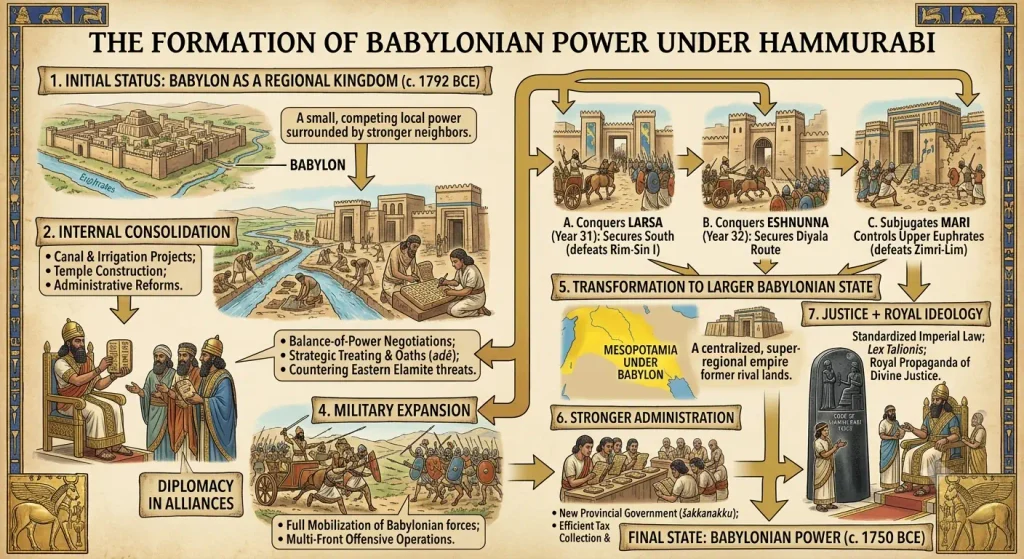
This sequence is important because Hammurabi’s success cannot be explained by warfare alone. Military victories created territorial power, while administration, irrigation, diplomacy, law, and royal ideology helped maintain it.
Why Hammurabi Became Famous
There are several reasons Hammurabi remains one of the best-known kings of ancient Mesopotamia.
1. The Code of Hammurabi
The most famous surviving monument associated with Hammurabi is his law collection.
The text contains numerous legal provisions dealing with everyday problems in Babylonian society. It covers subjects ranging from agricultural responsibilities and commercial agreements to marriage, inheritance, wages, theft, and physical injury.
The laws are particularly valuable to historians because they reveal aspects of Babylonian social organization and ideas about justice.
However, the Code should not be described simply as the first law code in history. Earlier Mesopotamian rulers had already produced legal collections. Hammurabi’s code became exceptionally famous because of the survival, scale, and historical importance of its inscribed monument.
2. The Expansion of Babylon
Hammurabi transformed Babylon’s political position.
At the beginning of his reign, Babylon competed with several other Mesopotamian kingdoms. By the end, Hammurabi controlled a much larger territory and had defeated or absorbed several important rivals.
His victories helped establish Babylon as the leading political center of southern Mesopotamia during his lifetime.
3. His Role as a King
Hammurabi also became famous because his reign illustrates the responsibilities expected of an ancient Mesopotamian ruler.
A successful king was expected to:
- protect the kingdom;
- maintain justice;
- support temples;
- regulate irrigation;
- defend agricultural production;
- manage officials;
- build and repair infrastructure;
- defeat enemies;
- preserve order.
Hammurabi’s surviving inscriptions repeatedly present him as a ruler responsible for the welfare and order of his kingdom.
Hammurabi’s Rise: From Babylonian King to Mesopotamian Power
One of the most important things to understand about Hammurabi is when Babylon became powerful.
It did not happen immediately when Hammurabi took the throne.
During the first part of his reign, Babylon was surrounded by stronger or equally important kingdoms. Hammurabi therefore had to consolidate his position before attempting large-scale expansion.
His strategy combined several tools:
| Tool | Purpose |
|---|---|
| Diplomacy | Build alliances and manage rival kingdoms |
| Military campaigns | Capture strategic territories |
| Administration | Control conquered lands |
| Irrigation | Support agriculture and economic production |
| Construction | Strengthen cities and royal authority |
| Law | Present the king as a guarantor of justice |
| Religion | Connect royal authority with divine approval |
The result was a much more powerful Babylonian state.
This is one reason Hammurabi deserves to be remembered as more than the king behind a famous stone stele. His reign represents a major stage in the political rise of Babylon.
Hammurabi’s Historical Importance
Hammurabi’s importance comes from the combination of law, conquest, administration, and kingship.
The Code of Hammurabi gives historians evidence about Babylonian law and society. His military campaigns reveal the political competition that shaped Mesopotamia. His administrative records provide evidence for the practical operation of government, while his inscriptions reveal how Babylonian kings presented their authority.
Together, these sources make Hammurabi one of the best-documented rulers of the ancient Near East.
His reign also provides essential context for understanding later Babylonian history. The Babylon that became famous centuries later was not created by Hammurabi alone, but his reign was a crucial stage in the city’s transformation into a major center of Mesopotamian political and cultural life.
Who Came First, Hammurabi or Nebuchadnezzar?
Hammurabi came first. Hammurabi ruled Babylon approximately from 1792 to 1750 BCE, while Nebuchadnezzar II ruled more than a thousand years later, from approximately 605 to 562 BCE. Both were famous Babylonian kings, but they belonged to very different periods of Mesopotamian history. Hammurabi belonged to Babylon’s First Dynasty, while Nebuchadnezzar II ruled during the Neo-Babylonian Empire.
Hammurabi vs. Nebuchadnezzar II at a Glance
| Feature | Hammurabi | Nebuchadnezzar II |
|---|---|---|
| Period | 18th century BCE | 6th century BCE |
| Reign | c. 1792–1750 BCE | c. 605–562 BCE |
| Dynasty/Empire | First Dynasty of Babylon | Neo-Babylonian Empire |
| Babylon’s Role | Rising regional power | Major imperial capital |
| Famous For | Code of Hammurabi and territorial expansion | Babylonian expansion and monumental building |
| Historical Period | Old Babylonian period | Neo-Babylonian period |
| Approximate Gap | — | More than 1,000 years after Hammurabi |
Comparative Chronology: The Two Golden Ages of Babylon (Hammurabi vs. Nebuchadnezzar II)
| Parameter / Historical Era | The Old Babylonian Empire (Hammurabi) | The Neo-Babylonian / Chaldean Empire (Nebuchadnezzar II) |
| Chronological Period | c. 1792 – 1750 BCE (Bronze Age) | c. 605 – 562 BCE (Iron Age) |
| Dynasty & Royal Lineage | First Dynasty of Babylon (Amorite Dynasty) | Eleventh (Chaldean) Dynasty of Babylon |
| Accession & Geopolitical Context | • Inherited a minor regional city-state along the Euphrates. • Surrounded by dominant regional rivals (Larsa, Eshnunna, Mari, Elam). | • Inherited a newly liberated imperial core founded by his father, Nabopolassar. • Rose following the total collapse and destruction of the Neo-Assyrian Empire. |
| Key Military & Territorial Expansions | • Defeated Rim-Sin I of Larsa, annexing southern Sumer. • Conquered Eshnunna and sacked the royal palace of Mari. • Unified central and southern Mesopotamia under direct Babylonian rule. | • Defeated Egypt at the decisive Battle of Carchemish (605 BCE). • Subjugated the Levant, captured Jerusalem (587/586 BCE), and besieged Tyre. • Extended imperial borders from the Persian Gulf to the Mediterranean border of Egypt. |
| Administrative & Legal Innovations | • Promulgated the Code of Hammurabi (282 codified laws based on lex talionis). • Centralized imperial bureaucracy, judicial oversight, and provincial tax rolls. | • Standardized imperial economic contracts, credit banking, and cuneiform archives. • Implemented large-scale strategic deportations (e.g., the Babylonian Captivity). |
| Architectural & Infrastructure Legacy | • Extensive agricultural canal systems and irrigation networks along the Euphrates. • Restored and fortified city walls, regional temples, and granaries. | • Transformed Babylon into the largest metropolis of the ancient world. • Built the Ishtar Gate, the Processional Way, the Etemenanki Ziggurat, and the Hanging Gardens (attributed). |
| Succession & Imperial Outcome | • Succeeded by his son, Samsu-iluna (c. 1750 BCE). • The empire faced immediate revolts (Sealand Dynasty) and collapsed ~150 years later to the Hittite raid of Mursili I (1595 BCE). | • Succeeded by his son, Amel-Marduk (Evil-Merodach, c. 562 BCE). • Suffered dynastic instability until falling to Cyrus the Great of Persia in 539 BCE. |
Key Historical Transition (c. 1750 – 605 BCE)
The Intervening Millennium: Over the roughly 1,150 years separating Hammurabi’s death and Nebuchadnezzar II’s accession, Babylon endured foreign rule under the Kassite Dynasty (the longest-ruling dynasty in Babylonian history, c. 1595–1155 BCE), followed by centuries of geopolitical subjugation under the ruthless military dominance of the Neo-Assyrian Empire, before reclaiming supreme independence under the Chaldean kings.
How Far Apart Were Hammurabi and Nebuchadnezzar?
The two kings were separated by roughly 1,200 years.
That means Hammurabi lived much closer in time to the earliest periods of Babylonian history than to the Babylon ruled by Nebuchadnezzar II.
This distinction is important because the name Babylonian can refer to different historical periods.
Hammurabi ruled during the Old Babylonian period, when Babylon was emerging as a major political power in Mesopotamia. Nebuchadnezzar II ruled during the Neo-Babylonian period, when Babylon had become the capital of a powerful empire.
The city was the same great center of Mesopotamian civilization, but the political world surrounding it had changed dramatically.
Hammurabi’s Babylon
When Hammurabi became king, Babylon was one of several competing kingdoms.
His greatest achievement was turning Babylon into a dominant political power through a combination of military campaigns, diplomacy, administration, and royal authority.
His victories over important rivals such as Larsa, Eshnunna, and Mari expanded Babylonian control over a large part of Mesopotamia.
The famous Code of Hammurabi belongs to this same period and provides evidence for Babylonian ideas about law, property, family relationships, labor, and justice.
Nebuchadnezzar’s Babylon
Nebuchadnezzar II ruled in a very different era.
By the 6th century BCE, Babylon had become the center of the Neo-Babylonian Empire. Nebuchadnezzar is particularly associated with the expansion and monumental development of Babylon.
His reign is remembered for major construction projects, including work on temples, walls, gates, and other monumental structures that helped give Babylon its legendary reputation.
This later Babylon should not be confused with the Babylon Hammurabi inherited more than a millennium earlier.
Why Are Hammurabi and Nebuchadnezzar Sometimes Confused?
The confusion is understandable because both were powerful kings of Babylon and both became closely associated with the city’s greatness.
However, they represent two very different moments in Babylonian history.
HAMMURABI
c. 1792–1750 BCE
      │
      ▼
Old Babylonian Period
      │
      ▼
Babylon rises to regional dominance
      │
      │
      ▼
~1,200 years of history
      │
      ▼
NEBUCHADNEZZAR II
c. 605–562 BCE
      │
      ▼
Neo-Babylonian Period
      │
      ▼
Babylon becomes imperial capital
So, if the question is “Who came first, Hammurabi or Nebuchadnezzar?”, the answer is straightforward: Hammurabi came first by more than a millennium.
The two kings should therefore be studied in their own historical contexts rather than treated as rulers of the same Babylonian kingdom.
What God Did King Hammurabi Worship?
Hammurabi worshipped several gods as part of the Babylonian religious tradition, but Shamash and Marduk were especially important to his royal ideology. Shamash was the Mesopotamian god associated with justice and was prominently represented on the famous Stele of Hammurabi. Marduk was the patron deity of Babylon and became increasingly important to Babylonian kingship. Hammurabi therefore presented his rule as supported by the gods rather than as purely secular political authority.
Hammurabi and the Gods of Babylon
Hammurabi ruled in a deeply religious society. In ancient Mesopotamia, political power and religious authority were closely connected, and kings regularly presented themselves as rulers chosen or supported by the gods.
Hammurabi was no exception.
His inscriptions invoke several Mesopotamian deities, reflecting the fact that Babylonian religion included a large pantheon rather than a single exclusive god.
Among the most important deities connected with Hammurabi were:
| God | Role | Connection with Hammurabi |
|---|---|---|
| Shamash | Justice, sun, divine judgment | Closely associated with royal justice and the law stele |
| Marduk | Patron deity of Babylon | Central to Babylonian royal ideology |
| Anu | Sky god and senior deity | Part of the wider divine hierarchy |
| Enlil | Authority, kingship, wind | Important traditional source of divine authority |
| Ea (Enki) | Wisdom, water, craftsmanship | Important deity in Mesopotamian religion |
This means it would be misleading to say that Hammurabi worshipped only Shamash or only Marduk.
Instead, Hammurabi’s religious world was part of the broader Mesopotamian polytheistic tradition.
Shamash and Hammurabi’s Code
The strongest visual connection between Hammurabi and a particular god comes from the famous Stele of Hammurabi.
At the top of the monument, Hammurabi appears before a seated deity who is traditionally identified as Shamash, the god associated with justice and the sun.
The scene is highly significant.
Rather than presenting the laws as simply the personal decisions of a human ruler, the monument connects Hammurabi’s authority with divine justice.
The basic ideological message can be represented like this:
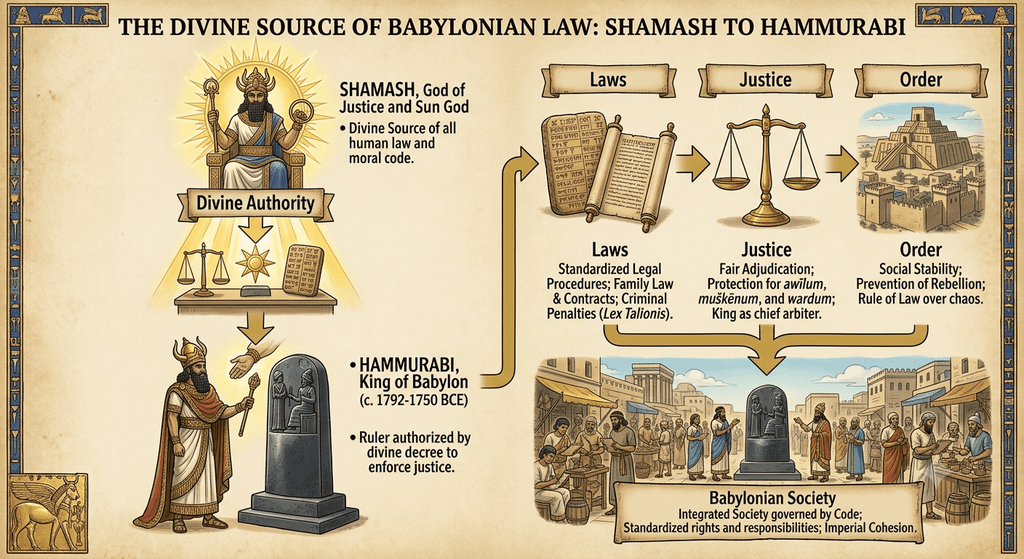
The image therefore reinforces one of the central ideas of Babylonian kingship: a legitimate king was expected to establish justice and maintain order under divine authority.
Was Shamash Hammurabi’s Main God?
Shamash was extremely important in Hammurabi’s presentation of justice, but calling him Hammurabi’s sole or exclusive god would be inaccurate.
The king belonged to a religious system in which many gods had different roles and could be invoked for different purposes.
The famous law stele gives Shamash particular prominence because of the connection between the deity and justice, judgment, and royal authority.
That does not mean other gods were unimportant.
Marduk and Hammurabi
Marduk was the patron deity of Babylon, making him particularly important to the city’s kings.
During Hammurabi’s reign, Babylon was becoming the dominant political power in southern Mesopotamia. The rise of Babylon was therefore accompanied by the growing political and religious importance of its patron god.
Hammurabi’s royal ideology connected his authority with Babylon and its divine protector.
This relationship can be understood as:
        MARDUK
   Patron of Babylon
          │
          ▼
       BABYLON
          │
          ▼
     Royal Power
          │
          ▼
      HAMMURABI
          │
          ▼
 Law + Order + Kingship
Marduk’s later status as the supreme god of Babylonian religion became even more pronounced after Hammurabi’s lifetime, particularly in later Babylonian theological traditions.
This is an important historical distinction: Hammurabi should not be placed into the later religious world of Nebuchadnezzar II without recognizing the centuries of development between them.
Hammurabi’s Religion and Babylonian Kingship
Religion was not simply a private matter for Hammurabi.
It formed part of the ideological foundation of his government.
A Babylonian king was expected to protect temples, honor the gods, maintain justice, defend the kingdom, and preserve order.
Hammurabi’s inscriptions repeatedly emphasize these responsibilities.
His relationship with the gods therefore served several purposes:
- Legitimacy: divine support strengthened the king’s authority.
- Justice: the king presented himself as an agent of divine justice.
- Protection: the gods were invoked as protectors of Babylon and its people.
- Kingship: royal authority was connected with the established divine order.
- Public works: temples, canals, walls, and other projects could be presented as acts of good kingship.
- Military success: victories could be interpreted within a framework of divine favor.
This religious ideology helped turn political authority into something more than military power.
Did Hammurabi Worship Marduk or Shamash?
The simplest answer is both were important, but they played different roles.
Shamash was especially prominent in connection with justice and the famous law stele, while Marduk was the patron god of Babylon and an increasingly important figure in Babylonian royal ideology.
The distinction matters because the ancient Babylonian pantheon was not organized around the idea that a king had to choose only one god.
Hammurabi could honor multiple deities while giving particular importance to different gods in different contexts.
                    HAMMURABI
                        │
          ┌─────────────┴─────────────┐
          ▼                           ▼
       SHAMASH                      MARDUK
   Justice + Judgment          Babylon + Kingship
          │                           │
          ▼                           ▼
      Legal Order                Babylonian Power
          │                           │
          └─────────────┬─────────────┘
                        ▼
                Royal Legitimacy
This broader religious context makes Hammurabi easier to understand.
He was not simply a ruler who happened to believe in the gods. Religion was part of the political, legal, and social structure through which his kingship was understood.
For Hammurabi, ruling Babylon meant maintaining a relationship between the king, the gods, the law, and the wider order of society.
Who Was First, Moses or Hammurabi?
Hammurabi came before Moses according to the most commonly proposed historical chronologies. Hammurabi ruled Babylon approximately from 1792 to 1750 BCE, while Moses is traditionally placed much later, often in the 13th century BCE. This means Hammurabi lived roughly 500 years or more before the period traditionally associated with Moses. However, the historical evidence for Hammurabi’s reign is much stronger than the evidence for dating Moses, whose chronology remains debated.
Hammurabi and Moses Timeline
The easiest way to understand the difference is to place them on the same chronological scale:
c. 1792 BCE
│
▼
HAMMURABI BECOMES KING OF BABYLON
│
├── First Dynasty of Babylon
├── Expands Babylonian territory
├── Defeats major Mesopotamian rivals
├── Develops administration and infrastructure
└── Issues the famous Code of Hammurabi
│
▼
c. 1750 BCE
HAMMURABI DIES
│
│
│       Several centuries
│       of historical development
│
▼
c. 13th century BCE
│
▼
TRADITIONAL PERIOD ASSOCIATED WITH MOSES
│
├── Exodus tradition
├── Israelite religious tradition
└── Mosaic Law
│
▼
Later Israelite and Judahite history
The chronological difference is therefore substantial.
Hammurabi belongs to the Old Babylonian period, while Moses, if placed in the traditional historical timeframe, belongs many centuries later.
Hammurabi vs. Moses at a Glance
| Question | Hammurabi | Moses |
|---|---|---|
| Historical setting | Old Babylonian Mesopotamia | Ancient Israel and Egypt traditions |
| Approximate date | c. 1792–1750 BCE | Traditionally associated with the 13th century BCE |
| Role | King of Babylon | Prophet and leader in biblical tradition |
| Best Known For | Code of Hammurabi | Exodus and Mosaic Law |
| Political Context | Babylonian kingdom | Israelites in biblical tradition |
| Primary Sources | Cuneiform inscriptions and administrative records | Biblical texts and later traditions |
| Dating Certainty | Relatively well established | Debated |
Who Came First?
The answer can be summarized simply:
HAMMURABI
c. 18th century BCE
       │
       │
       │  several centuries
       │
       ▼
MOSES
traditional date:
c. 13th century BCE
So Hammurabi came first.
This is one of the most useful chronological distinctions to make when studying the ancient Near East because Hammurabi and Moses are sometimes discussed together because of their association with law.
They did not, however, belong to the same historical period.
Hammurabi’s Laws and Mosaic Law
The comparison between Hammurabi and Moses is particularly interesting because both became associated with important legal traditions.
Hammurabi’s famous law collection was created in ancient Babylonian society during the 18th century BCE. The laws cover subjects such as property, contracts, marriage, inheritance, agriculture, labor, and criminal offenses.
Moses, in biblical tradition, is associated with the laws given to the Israelites, including the laws contained in the Torah.
This has led to a long-standing question:
Did Moses copy Hammurabi’s laws?
The answer is more complicated than a simple yes or no.
The Code of Hammurabi is older than the traditional period associated with Moses, but that chronological fact does not by itself demonstrate that Mosaic law was copied directly from Hammurabi’s code.
Both traditions emerged within the broader world of the ancient Near East, where legal traditions, royal authority, religious beliefs, social customs, and ideas about justice developed over many centuries.
There are also important differences between the two legal traditions.
Hammurabi’s laws are presented within a Babylonian royal and religious framework. The monument presents the king as an authority responsible for justice, with divine legitimacy associated with his rule.
Mosaic law belongs to a different religious and literary tradition and is connected to the covenant between God and the Israelites.
Therefore, similarities between individual laws should not automatically be treated as proof of direct borrowing.
Did Hammurabi Live Before Moses?
Yes, according to the commonly proposed historical chronology.
Hammurabi ruled Babylon during the 18th century BCE. The traditional chronology that places Moses around the 13th century BCE puts Moses several hundred years later.
The difference is large enough that Hammurabi and Moses should be understood as figures from different phases of ancient Near Eastern history.
ANCIENT NEAR EAST

18th century BCE
      │
      ▼
HAMMURABI
      │
      ▼
OLD BABYLONIAN PERIOD
      │
      │
      ├── Babylonian political expansion
      ├── Hammurabi's administration
      └── Code of Hammurabi
      │
      ▼
Several centuries
      │
      ▼
13th century BCE
      │
      ▼
TRADITIONAL MOSES PERIOD
      │
      ├── Exodus tradition
      └── Mosaic Law
The comparison therefore illustrates how long the history of the ancient Near East really was.
Hammurabi was not a contemporary of Moses. By the time Moses is traditionally placed in the ancient Near East, Hammurabi had already been dead for centuries.
Why Is the Comparison Between Hammurabi and Moses Important?
The comparison matters because both figures became associated with law and justice, but they represent very different historical and religious contexts.
Hammurabi was a documented Babylonian king whose reign can be studied through a large body of cuneiform evidence.
Moses is primarily known through biblical tradition, and scholars continue to debate how and when the traditions surrounding him developed and whether he can be securely placed within a specific historical period.
This difference in evidence is essential.
We can establish Hammurabi’s place in Mesopotamian history with considerably greater confidence than we can establish a precise historical chronology for Moses.
That does not make the comparison meaningless. Quite the opposite: it helps explain why ancient legal traditions cannot be studied as if they all emerged at the same time.
Hammurabi belongs to the world of Old Babylonian Mesopotamia. Moses, in traditional chronology, belongs to a much later period associated with the formation of ancient Israelite religious tradition.
So when asking “Who was first, Moses or Hammurabi?”, the clearest historical answer is:
Hammurabi came first, by several centuries.
The more interesting question is not simply who came first, but how different ancient Near Eastern societies developed their own ideas about law, justice, authority, religion, and social order over the centuries.
How Did Hammurabi Make Babylon a Major Power?
Hammurabi made Babylon a major power through a combination of military campaigns, diplomacy, political alliances, administration, and control of strategic territory. When he became king, Babylon was only one of several competing kingdoms in Mesopotamia. By the end of his reign, Hammurabi controlled a large part of southern and central Mesopotamia, making Babylon the dominant political power of the region.
His expansion did not happen immediately. During the early years of his reign, Hammurabi concentrated on strengthening Babylon and managing its relationships with neighboring states. Only later did he begin a series of campaigns that dramatically changed the balance of power.
Babylon Before Hammurabi’s Expansion
Babylon was already an important city when Hammurabi became king, but it was not yet the dominant kingdom of Mesopotamia.
The political landscape was divided among several powerful states.
Among Hammurabi’s most important rivals were:
- Larsa, a major kingdom in southern Mesopotamia.
- Eshnunna, an important state to the northeast of Babylon.
- Mari, a strategically located kingdom on the Euphrates.
- Assyria, which controlled territories farther north.
- Other smaller kingdoms and city-states competing for land, trade, and political influence.
Hammurabi therefore inherited a kingdom surrounded by potential rivals.
His challenge was not simply to win battles. He had to decide when to negotiate, when to form alliances, when to intervene militarily, and how to maintain control over territories once they came under Babylonian authority.
Hammurabi’s Expansion in Three Stages
The growth of Babylonian power can be understood as a three-stage process:
          BABYLON
             │
             ▼
    1. CONSOLIDATION
             │
     ┌───────┼───────┐
     ▼       ▼       ▼
  Defense  Economy  Diplomacy
     │       │       │
     └───────┼───────┘
             ▼
    2. MILITARY EXPANSION
             │
     ┌───────┼────────┐
     ▼       ▼        ▼
   Larsa  Eshnunna   Mari
     │       │        │
     └───────┼────────┘
             ▼
    3. BABYLONIAN DOMINANCE
             │
             ▼
       Larger Kingdom
             │
             ▼
      Stronger Administration
This sequence helps explain why Hammurabi’s reign was so significant. Babylon’s rise was not the result of a single conquest but of a broader transformation in which military power and government developed together.
Hammurabi and Larsa
One of Hammurabi’s most important victories was his conquest of Larsa.
Larsa had been one of the strongest kingdoms in southern Mesopotamia and had previously exercised considerable influence over the region.
The conflict between Babylon and Larsa became a decisive moment in Hammurabi’s reign.
After defeating Larsa, Hammurabi gained control over extensive territories in southern Mesopotamia. This dramatically increased Babylon’s economic and strategic importance.
The conquest also removed one of Babylon’s most important southern rivals.
For Hammurabi, controlling southern Mesopotamia meant access to valuable agricultural land, cities, waterways, and established economic networks.
The Campaign Against Eshnunna
Hammurabi also expanded Babylonian influence toward the northeast.
Eshnunna was an important Mesopotamian kingdom located in the Diyala region. Its strategic position made it an important competitor for political influence and access to routes connecting different parts of Mesopotamia.
The struggle against Eshnunna formed part of Hammurabi’s wider effort to eliminate rival centers of power.
Rather than treating each conflict as an isolated war, Hammurabi’s expansion can be understood as a gradual restructuring of the political map.
As rival kingdoms were defeated or brought under Babylonian influence, Babylon became increasingly capable of projecting power beyond its original territory.
Hammurabi and Mari
The kingdom of Mari occupied a particularly important position along the Euphrates.
Its location made it strategically valuable for communication, trade, and military movement.
Hammurabi initially maintained diplomatic relations with Mari and its ruler, Zimri-Lim. The relationship between Babylon and Mari demonstrates that Hammurabi did not rely exclusively on direct conquest.
Diplomacy was an important part of Mesopotamian international politics.
Kings exchanged letters, negotiated alliances, discussed military threats, and attempted to influence one another’s decisions.
Eventually, Hammurabi’s relationship with Mari changed, and Babylonian forces took control of the kingdom.
The incorporation of Mari expanded Babylonian authority along the Euphrates and strengthened Hammurabi’s position in northern Mesopotamia.
Diplomacy Before Conquest
One of the most interesting aspects of Hammurabi’s expansion is that diplomacy and warfare were closely connected.
Hammurabi could cooperate with one ruler while preparing for conflict with another. Alliances could change as political circumstances changed.
The basic pattern looked like this:
        REGIONAL RIVALRIES
               │
               ▼
        Diplomatic contacts
               │
        ┌──────┴──────┐
        ▼             ▼
     Alliance      Conflict
        │             │
        ▼             ▼
 Temporary cooperation
                      │
                      ▼
              Military campaign
                      │
                      ▼
                 Conquest
                      │
                      ▼
              Babylonian control
This flexibility helped Hammurabi take advantage of changing political conditions.
It also explains why his rise should not be described simply as a straightforward series of military victories.
Why Were Hammurabi’s Conquests Important?
Hammurabi’s campaigns changed Babylon’s position in Mesopotamia.
Before his expansion, Babylon was one kingdom among many.
After his major victories, it became the political center of a much larger state.
His conquests provided access to:
- Agricultural land
- Major cities
- Waterways
- Trade routes
- Economic resources
- Strategic territory
- Tax and tribute networks
- Military resources
The resulting kingdom required a much stronger administrative system.
Hammurabi therefore had to solve a second problem after conquest:
How could Babylon control such a large territory?
From Conquest to Administration
Military victory alone could not guarantee long-term control.
Hammurabi relied on officials, written correspondence, taxation, legal procedures, irrigation management, and royal orders to govern his expanded kingdom.
Cuneiform writing was particularly important.
Written documents allowed the royal administration to communicate with officials, record transactions, manage resources, and deal with disputes.
This relationship between conquest and administration can be summarized as:
Military Victory
       │
       ▼
Territorial Expansion
       │
       ▼
New Cities + Resources
       │
       ▼
Administrative Challenges
       │
       ├── Officials
       ├── Taxes
       ├── Irrigation
       ├── Law
       ├── Written Records
       └── Royal Orders
       │
       ▼
Stronger Babylonian Government
This is one of the most important aspects of Hammurabi’s reign.
He did not simply enlarge Babylon’s territory. He also developed the mechanisms needed to govern a more complex political state.
Hammurabi’s Greatest Territorial Achievement
By the later part of his reign, Hammurabi had established Babylon as the dominant political power in much of Mesopotamia.
His kingdom stretched across territories that had previously been controlled by several independent rulers.
This did not create a permanently unified Mesopotamian empire. Babylonian control depended heavily on Hammurabi’s authority, and the political situation changed again after his death.
Nevertheless, his reign represented a remarkable concentration of political power.
For a period, Babylon stood at the center of Mesopotamian politics.
That transformation is essential for understanding Hammurabi’s historical importance.
The Code of Hammurabi became famous because it survived as a monumental legal text, but the political achievement behind the monument was equally significant: Hammurabi had turned Babylon into a major regional power through a combination of military strength, diplomacy, administration, and royal authority.
The Code of Hammurabi: What Was It and Why Is It Famous?
The Code of Hammurabi was a collection of Babylonian laws issued during the reign of King Hammurabi in the 18th century BCE. Inscribed in Akkadian cuneiform on a large stone stele, it contains nearly 300 legal provisions dealing with property, trade, agriculture, marriage, inheritance, labor, personal injury, and criminal offenses. It is famous because the stele is exceptionally well preserved and provides valuable evidence about Babylonian law, society, and royal ideas of justice.
Despite its fame, the Code of Hammurabi was not the first collection of laws in Mesopotamia. Earlier rulers had already produced legal collections. Its historical importance comes from the survival of the monument, the breadth of its provisions, and the detailed picture it provides of life in Old Babylonian society.
What Did the Code of Hammurabi Contain?
The laws covered many aspects of daily life.
Rather than being a single set of rules dealing only with crimes, the collection addressed practical disputes involving farmers, merchants, property owners, families, workers, slaves, and other members of Babylonian society.
Its provisions dealt with questions such as:
- Who was responsible when a building collapsed?
- What happened when someone damaged another person’s field?
- How should debts and contracts be handled?
- What were the consequences of theft?
- How were marriage and divorce regulated?
- How was inheritance divided?
- What wages should certain workers receive?
- What happened when one person injured another?
- What responsibilities did farmers and tenants have?
The Code therefore provides much more than examples of punishment.
It gives historians evidence about the economic, social, legal, and family structures of ancient Babylon.
The Structure of the Hammurabi Stele
The monument can be understood through three main components:
          STELE OF HAMMURABI
                 │
        ┌────────┼────────┐
        ▼        ▼        ▼
     IMAGE     PROLOGUE   LAWS
        │         │         │
        │         │         ├── Property
        │         │         ├── Agriculture
        │         │         ├── Trade
        │         │         ├── Family
        │         │         ├── Labor
        │         │         ├── Injury
        │         │         └── Crime
        │         │
        │         └── Hammurabi's
        │             royal legitimacy
        │
        └── King before the
            deity associated
            with justice
                 │
                 ▼
             EPILOGUE
                 │
                 ▼
       Protection of the laws
       and royal reputation
The monument was therefore not merely a list of regulations. It was also a statement about kingship and justice.
Categories of Laws in the Code of Hammurabi
| Category | Examples of Issues Addressed |
|---|---|
| Property | Land, houses, theft, ownership disputes |
| Agriculture | Fields, irrigation, crop damage, tenants |
| Trade | Merchants, agents, commercial transactions |
| Contracts | Debts, agreements, obligations |
| Marriage | Marriage arrangements, divorce, family responsibilities |
| Inheritance | Property passed between family members |
| Labor | Wages and responsibilities of workers |
| Personal Injury | Physical harm and compensation or punishment |
| Criminal Offenses | Theft, fraud, and other offenses |
| Social Status | Different legal consequences for different social groups |
This wide range of subjects is one reason the Code is so useful to historians.
It allows researchers to reconstruct aspects of Babylonian society that would otherwise be difficult to understand.
Was the Code of Hammurabi the First Law Code?
No.
The Code of Hammurabi is one of the most famous ancient legal collections, but it was not the earliest known law code.
Earlier Mesopotamian rulers had already produced legal collections, including Ur-Nammu, whose laws predate Hammurabi by several centuries.
This distinction is important because the phrase “Hammurabi created the first laws” gives a misleading impression.
People in Mesopotamia had developed legal traditions long before Hammurabi became king.
Hammurabi’s achievement was instead to produce one of the most famous surviving royal law collections of the ancient Near East and to preserve it in a monumental form.
The chronological relationship can be simplified like this:
EARLIER MESOPOTAMIAN LAW
        │
        ▼
   Ur-Nammu's Laws
        │
        │  several centuries
        ▼
  HAMMURABI
        │
        ▼
Code of Hammurabi
        │
        ▼
Later Mesopotamian
legal traditions
The Code should therefore be understood as part of a much longer Mesopotamian legal tradition.
What Was “An Eye for an Eye” in Hammurabi’s Code?
One of the most famous ideas associated with Hammurabi is the principle commonly expressed as “an eye for an eye.”
This phrase is often used to summarize the idea that punishment should correspond to the seriousness of an offense.
However, the actual legal collection is considerably more complicated.
The laws did not impose identical punishments for every person or every situation. The social position of the individuals involved could affect the legal outcome.
This means that the Code reflects a hierarchical society, rather than a modern system based on universal legal equality.
For example, the consequences of an injury could differ depending on whether the victim belonged to a higher social group, a lower-status group, or was enslaved.
The Code therefore reveals both an idea of proportional punishment and a society in which legal rights and penalties were connected to social status.
What Does the Code Reveal About Babylonian Society?
The Code is particularly valuable because its laws touch almost every major part of Babylonian economic and social life.
Agriculture and Irrigation
Agriculture was fundamental to Mesopotamian civilization.
The Code includes provisions concerning fields, tenants, crops, irrigation, and responsibility for agricultural damage.
These laws demonstrate how seriously Babylonian society treated the management of farmland and water.
An irrigation failure could affect not only an individual farmer but also neighboring fields, making responsibility for water management an important legal issue.
Trade and Contracts
Babylonian commerce depended heavily on written agreements.
The Code contains provisions concerning merchants, agents, loans, debts, and commercial responsibilities.
This fits into a broader Old Babylonian world in which cuneiform writing was used extensively to record economic transactions.
Written documentation helped establish obligations and provided evidence when disputes arose.
Marriage and Family
The Code also provides insight into Babylonian family life.
Its provisions address marriage, divorce, inheritance, and relationships between family members.
These laws show that the household was not simply a private institution. Family relationships had economic and legal consequences that could be recognized and regulated by the authorities.
Labor
The collection contains provisions concerning different types of workers and their responsibilities.
This is particularly useful because it provides evidence for the organization of labor in ancient Babylon.
The laws show that occupations could carry defined obligations and that economic relationships were subject to legal regulation.
Hammurabi, Law, and Divine Justice
The Code of Hammurabi was closely connected to the religious ideology of Babylonian kingship.
The monument presents Hammurabi as a ruler responsible for establishing justice.
The image at the top of the stele traditionally identifies the seated deity as Shamash, the god associated with justice and the sun. Hammurabi’s appearance before the deity connects royal authority with divine legitimacy.
The message can be summarized as:
             GODS
               │
               ▼
        Divine Authority
               │
               ▼
          HAMMURABI
       King of Babylon
               │
        ┌──────┴──────┐
        ▼             ▼
      JUSTICE        LAW
        │             │
        └──────┬──────┘
               ▼
        Social Order
               │
               ▼
        Babylonian State
This religious dimension matters because ancient Mesopotamian kings did not generally present law as completely separate from religion.
A legitimate ruler was expected to maintain justice and order under the authority of the gods.
Did Hammurabi Personally Write the Code?
The safest way to describe the monument is that it was issued under Hammurabi’s authority.
The laws form part of a royal monument presenting Hammurabi as the king responsible for justice.
There is no need to imagine Hammurabi personally carving every legal provision onto the stone. Ancient Mesopotamian royal monuments were produced through scribal and administrative institutions operating under royal authority.
The important historical point is that the Code represents Hammurabi’s royal legal ideology and Babylonian administrative culture.
Its preservation also demonstrates the importance of scribes and cuneiform writing in the Babylonian state.
Why Is the Code of Hammurabi Important Today?
The Code remains important because it provides an unusually detailed glimpse into an ancient legal system.
It helps historians study:
- Babylonian concepts of justice
- social hierarchy
- property ownership
- agriculture
- commerce
- family structures
- labor
- slavery
- royal ideology
- Mesopotamian writing
- the relationship between law and religion
It also demonstrates that ancient Babylonian government was more complex than a simple system of kings giving arbitrary orders.
Rules, contracts, responsibilities, and legal procedures played an important role in organizing society.
The Code of Hammurabi is therefore valuable not because it was the beginning of law itself, but because it preserves an extraordinary record of how one ancient Mesopotamian kingdom understood justice, authority, property, family, and social order.
Babylonian Law and Justice Under Hammurabi
The laws associated with Hammurabi provide one of the clearest surviving windows into how justice worked in ancient Babylon.
At first glance, the Code can look like a simple list of punishments. In reality, it reflects a much more complicated legal system in which property, contracts, family relationships, professional responsibilities, social status, and personal injury were all regulated.
The underlying idea was that the king had a responsibility to establish and preserve justice and social order.
Hammurabi was therefore presented not simply as a ruler who punished criminals, but as a king whose authority included protecting society, resolving disputes, and maintaining the proper order of Babylonian life.
What Did Justice Mean in Babylon?
Babylonian justice was closely connected to the concept of order.
A dispute over land could threaten agricultural production. A broken contract could disrupt trade. A damaged irrigation system could affect several farmers. A family dispute could involve property and inheritance.
Law provided a framework for dealing with these conflicts.
A simplified model looks like this:
              BABYLONIAN SOCIETY
                       │
       ┌───────────────┼───────────────┐
       ▼               ▼               ▼
    PROPERTY         FAMILY          TRADE
       │               │               │
       └───────────────┼───────────────┘
                       ▼
                    DISPUTES
                       │
                       ▼
                  LEGAL RULES
                       │
                       ▼
                    JUSTICE
                       │
                       ▼
              SOCIAL ORDER
The Code therefore needs to be understood within the wider Babylonian administrative system rather than as an isolated document.
How Were Crimes and Disputes Punished?
The Code contains different kinds of legal consequences.
Depending on the offense and circumstances, a person could face:
- monetary compensation
- repayment of property
- physical punishment
- loss of property
- professional penalties
- imprisonment or other forms of restriction
- death in certain serious cases
The severity of the punishment could depend on the nature of the offense and the social status of the people involved.
This is one of the most important points to understand when reading Hammurabi’s laws.
The system was not based on modern equality before the law.
Ancient Babylonian society was hierarchical, and legal consequences could reflect those social divisions.
Social Classes in Hammurabi’s Laws
The Code distinguishes between people of different social positions.
Historians commonly discuss three broad categories reflected in the laws:
| Social group | General position | Legal implications |
|---|---|---|
| Awilum | Free person of relatively high status | Could receive or face significant penalties |
| Mushkenum | Free person of lower social standing | Some penalties differed from those involving an awilum |
| Wardum | Enslaved person | Legally treated differently from free people |
These categories should not be treated as a perfect modern classification system. Babylonian society was more complicated than three simple classes.
Nevertheless, the legal differences are important because they demonstrate that status mattered in Babylonian justice.
For example, the same physical injury could have different legal consequences depending on the social position of the people involved.
That makes the Code valuable evidence for understanding social hierarchy as well as law.
The Principle of Proportional Punishment
Hammurabi’s laws are frequently associated with the idea of “an eye for an eye.”
This expression is useful as a shorthand for the principle that certain offenses could receive punishments corresponding to the harm committed.
But the actual laws contain a much wider range of legal responses.
Some offenses resulted in compensation rather than physical retaliation.
This distinction matters because the Code was not simply a collection of brutal punishments.
It also regulated:
- financial responsibility
- property damage
- contractual obligations
- agricultural failures
- professional negligence
- family disputes
- commercial relationships
The legal system therefore combined punishment, compensation, and regulation.
Property and Economic Justice
Property was one of the most important subjects in Babylonian law.
Ancient Babylon depended heavily on agriculture, land ownership, irrigation, livestock, and trade. Disputes involving property could therefore have serious consequences for individuals and communities.
The Code contains rules dealing with:
- stolen property
- agricultural land
- fields and crops
- livestock
- houses
- debts
- merchants
- commercial agents
- contracts
- agricultural tenants
These provisions reveal a society in which economic activity was closely connected to written legal obligations.
A simplified example is:
LAND / PROPERTY
       │
       ├── Ownership
       │
       ├── Rental
       │
       ├── Cultivation
       │
       ├── Damage
       │
       └── Theft
             │
             ▼
          DISPUTE
             │
             ▼
       LEGAL RESPONSIBILITY
             │
             ▼
     COMPENSATION / PENALTY
This emphasis on responsibility shows that Babylonian law was deeply connected to everyday economic life.
Agriculture and Legal Responsibility
Farmers occupied a central position in Babylonian society.
The productivity of farmland depended not only on the farmer but also on irrigation.
If water was poorly managed, an individual could potentially damage neighboring fields.
The Code therefore addresses situations involving agricultural responsibility and irrigation.
This tells us something important about Babylon itself.
Law was not merely concerned with dramatic crimes. It also dealt with ordinary problems that could threaten the functioning of the economy.
A damaged field, unpaid debt, failed contract, or neglected canal could become a legal matter.
In this sense, Babylonian law helped transform everyday obligations into recognizable legal responsibilities.
Professional Responsibility
Hammurabi’s laws also show that certain professions carried specific responsibilities.
Builders are a famous example.
Construction was extremely important in Mesopotamian cities, where houses, temples, walls, and other structures formed the physical environment in which people lived.
The Code includes severe consequences for certain cases of professional negligence.
The principle was straightforward: if a professional caused serious harm through poor work, that person could be held responsible.
This provides evidence that Babylonian society did not view professional activity as completely unregulated.
Instead, occupations could involve defined expectations and legal consequences.
Marriage, Divorce, and Family Justice
Family relationships were another major area of Babylonian law.
The Code includes provisions concerning:
- marriage
- divorce
- dowry
- inheritance
- children
- family property
- adultery
- responsibilities between spouses
These laws reveal that marriage was not simply a personal relationship.
It was also an economic and legal institution.
Property could enter a marriage through a dowry. Children could have inheritance rights. Divorce could affect property and financial responsibilities.
The family was therefore closely connected to the wider legal structure of Babylonian society.
Why Did Hammurabi Present Himself as a Just King?
The Code’s royal message is just as important as the individual laws.
Hammurabi presented himself as a ruler chosen and supported by the gods and responsible for establishing justice.
The relationship can be summarized as:
                GODS
                  │
                  ▼
          Divine Legitimacy
                  │
                  ▼
              HAMMURABI
                  │
          ┌───────┴───────┐
          ▼               ▼
       JUSTICE           LAW
          │               │
          └───────┬───────┘
                  ▼
             SOCIAL ORDER
                  │
                  ▼
              BABYLON
This was an important element of ancient Mesopotamian kingship.
The king’s legitimacy was not presented as purely political. Maintaining justice and order was part of the ruler’s expected role.
The Code therefore served two purposes at once.
It communicated legal rules, but it also communicated an image of Hammurabi as a responsible and legitimate king.
Was Babylonian Justice Fair?
By modern standards, Babylonian justice was not equal.
The Code reflects a hierarchical society in which social status, gender, wealth, and legal position could influence outcomes.
Women could possess certain legal and property rights, but the laws also placed them within a strongly patriarchal social structure.
Enslaved people had a different legal status from free people.
Penalties could vary according to the status of the victim or offender.
It would therefore be misleading to describe Hammurabi’s system as “fair” in the modern democratic sense.
A better description is that it attempted to create predictable rules within the social structure of Old Babylonian society.
That distinction is important.
The Code was revolutionary as evidence of organized legal regulation, but it was not a declaration of universal human equality.
What Hammurabi’s Laws Tell Us About Everyday Life
Perhaps the greatest value of the Code is that it reveals how ordinary life could generate legal problems.
Behind the laws we can see:
- farmers working fields
- merchants conducting business
- builders constructing houses
- families arranging marriages
- heirs dividing property
- debtors and creditors negotiating obligations
- enslaved people living under Babylonian law
- property owners defending their possessions
- officials and authorities resolving disputes
The Code therefore gives historians a remarkable indirect portrait of Babylonian society.
It shows that law was woven into everyday economic and family life.
Rather than existing only in royal palaces or temples, legal rules affected people who worked farms, traded goods, built houses, married, inherited property, and entered contracts.
Babylonian Law in Historical Perspective
The Code of Hammurabi should also be placed within the longer history of Mesopotamian law.
It did not suddenly invent the concept of written law.
Earlier Mesopotamian rulers had already produced legal collections, and later societies continued to develop their own traditions.
Hammurabi’s importance lies partly in the exceptional survival and visibility of his monument.
The stele transformed legal rules into a monumental statement of royal authority.
This combination of law, kingship, religion, and social organization is what makes the Code so important for historians today.
It is not simply a list of ancient punishments.
It is evidence for how the Babylonian state attempted to define responsibility, protect property, regulate relationships, and present the king as the guardian of justice.
Key Takeaways About Babylonian Justice
| Question | Answer |
|---|---|
| Was Babylonian law written down? | Yes. Hammurabi’s laws were preserved in cuneiform on a monumental stele. |
| Was the Code the first law code? | No. Earlier Mesopotamian legal collections existed. |
| Did all people receive the same punishment? | No. Social status could affect legal consequences. |
| Did the laws cover only crimes? | No. They also covered property, trade, agriculture, family, labor, and contracts. |
| Was justice connected to religion? | Yes. Royal justice was presented within a religious framework. |
| Why is the Code important? | It provides detailed evidence about Babylonian law, society, economy, and kingship. |
The most useful way to understand Hammurabi’s justice is therefore not simply as a system of harsh punishments.
It was a framework for regulating property, people, economic activity, family relationships, and social responsibilities.
And behind that framework stood the image of the Babylonian king as the person responsible for maintaining justice and order.
The Legacy of Hammurabi
Hammurabi’s legacy goes far beyond the famous legal monument associated with his name.
As king of Babylon, he transformed a relatively modest kingdom into the dominant political power in much of Mesopotamia during his reign. His achievement was not simply military. Hammurabi combined warfare, diplomacy, administration, infrastructure, and royal ideology to strengthen Babylon’s position in a politically fragmented region.
His reign became one of the defining periods of the Old Babylonian period.
                 HAMMURABI'S LEGACY
                        │
        ┌───────────────┼────────────────┐
        ▼               ▼                ▼
     Political       Economic         Administrative
      power          strength            control
        │               │                │
        ▼               ▼                ▼
    Babylon's        Agriculture       Officials
    expansion        Irrigation        Records
        │               │                │
        └───────────────┼────────────────┘
                        ▼
                  Royal authority
                        │
                        ▼
                Historical memory
Hammurabi and the Rise of Babylon
Perhaps Hammurabi’s most important political achievement was the transformation of Babylon’s position within Mesopotamia.
When he became king, Babylon was only one kingdom among several competing powers.
Over the course of his reign, Hammurabi expanded Babylonian influence through a combination of alliances, diplomacy, military campaigns, and strategic decisions.
His victories over powerful rivals such as Larsa, Eshnunna, and Mari allowed Babylon to become the leading power across a large part of Mesopotamia.
          BABYLON BEFORE HAMMURABI
                    │
       Several competing kingdoms
                    │
       ┌────────────┼────────────┐
       ▼            ▼            ▼
     Babylon       Larsa      Eshnunna
                    │
                    ▼
                  Mari
                    │
                    ▼
          Political competition
                    │
                    ▼
                HAMMURABI
                    │
                    ▼
          Babylonian dominance
This transformation is central to understanding why Hammurabi remains historically important.
He did not merely inherit a powerful empire.
He built Babylon’s regional dominance during his own reign.
His Legacy as a Builder and Administrator
Hammurabi also left a legacy through the practical management of his kingdom.
A large territorial state required much more than military victories.
It needed roads, canals, agricultural infrastructure, officials, records, taxation, communication, and systems capable of connecting distant territories to the royal center.
Hammurabi’s surviving correspondence and administrative records provide evidence of this highly organized government.
                 ROYAL GOVERNMENT
                        │
       ┌────────────────┼────────────────┐
       ▼                ▼                ▼
   Officials          Records        Communication
       │                │                │
       ▼                ▼                ▼
 Administration     Decisions       Royal orders
       │                │                │
       └────────────────┼────────────────┘
                        ▼
                  Territorial rule
His attention to irrigation was particularly important.
Agriculture depended on the controlled distribution of water, meaning that maintaining canals could have consequences far beyond an individual farm.
Investment in infrastructure therefore supported both economic production and political stability.
Hammurabi’s Economic Legacy
Hammurabi’s kingdom depended heavily on agriculture, but its economy also included trade, crafts, landholding, livestock, and other forms of production.
A stable agricultural base provided resources for cities, temples, administration, and the royal government.
This meant that infrastructure and political power were closely connected.
             INFRASTRUCTURE
                    │
                    ▼
                Irrigation
                    │
                    ▼
              Agricultural
                production
                    │
                    ▼
               Economic base
                    │
          ┌─────────┴─────────┐
          ▼                   ▼
        Cities             Government
          │                   │
          └─────────┬─────────┘
                    ▼
             Babylonian power
Hammurabi’s legacy should therefore not be reduced to conquest.
Maintaining the resources that made territorial government possible was equally important.
Hammurabi’s Diplomatic Legacy
Military expansion was only one part of Hammurabi’s political strategy.
His reign also demonstrates the importance of diplomacy in Mesopotamian interstate politics.
Kings communicated through letters, negotiated agreements, exchanged information, and formed relationships that could change as political circumstances evolved.
Diplomacy could buy time, isolate rivals, strengthen alliances, or prepare the conditions for military action.
                  DIPLOMACY
                     │
        ┌────────────┼────────────┐
        ▼            ▼            ▼
    Alliances    Negotiations   Intelligence
        │            │            │
        ▼            ▼            ▼
    Political      Time and      Strategic
    advantage      flexibility   decisions
        │            │            │
        └────────────┼────────────┘
                     ▼
              Babylonian power
This combination of diplomacy and warfare was one of the characteristics of Hammurabi’s statecraft.
Hammurabi and the Idea of Kingship
Hammurabi also contributed to a powerful Mesopotamian model of kingship.
The king was expected to maintain order, protect the kingdom, support temples, manage resources, and present himself as responsible for justice and prosperity.
Royal inscriptions and monuments portray the king not simply as a warrior but as the central figure responsible for the well-being of the state.
                     KING
                      │
       ┌──────────────┼──────────────┐
       ▼              ▼              ▼
     Warfare      Administration   Religion
       │              │              │
       ▼              ▼              ▼
   Protection        Order        Legitimacy
       │              │              │
       └──────────────┼──────────────┘
                      ▼
                Royal authority
This image of the king as both conqueror and administrator helped shape how Hammurabi was remembered.
His Reputation After Death
Hammurabi’s political achievements did not create a permanently stable empire.
After his death, Babylonian power gradually weakened under his successors.
This is an important part of his legacy.
Hammurabi’s state was powerful, but its political structure proved difficult to maintain at the same level after his reign.
             HAMMURABI'S REIGN
                    │
                    ▼
          Babylonian expansion
                    │
                    ▼
          Regional dominance
                    │
                    ▼
             Hammurabi dies
                    │
                    ▼
        Gradual political weakening
                    │
                    ▼
       Babylon loses its dominance
This does not diminish Hammurabi’s achievement.
Instead, it shows the difference between building a powerful state during one reign and creating a political system that remains dominant for centuries.
Hammurabi as a Historical Figure
Later generations remembered Hammurabi primarily as an idealized king and lawgiver.
His name survived because his reign produced unusually rich documentary evidence and because Babylon itself became one of the most important cities in Mesopotamian history.
Over time, Hammurabi became closely associated with ideas of:
- kingship
- justice
- political power
- Babylon
- administration
- royal responsibility
His reputation was therefore shaped not only by what he did during his lifetime, but also by how later societies interpreted his reign.
Why Hammurabi Still Matters Today
Hammurabi remains important because his reign sits at the intersection of several major developments in ancient Mesopotamia.
He demonstrates how a relatively small kingdom could become a major regional power.
He shows how military expansion depended on diplomacy and administration.
His reign illustrates the importance of irrigation and economic infrastructure.
And his surviving records provide historians with unusually valuable evidence about government and society in the Old Babylonian period.
               HAMMURABI
                    │
       ┌────────────┼────────────┐
       ▼            ▼            ▼
    Babylon       Statecraft    Economy
       │            │            │
       ▼            ▼            ▼
   Expansion     Diplomacy    Irrigation
       │            │            │
       └────────────┼────────────┘
                    ▼
             Old Babylonian
                history
                    │
                    ▼
             Modern scholarship
Hammurabi’s lasting significance is therefore much broader than the single monument most commonly associated with him.
He was a conqueror, administrator, diplomat, builder, and king whose reign fundamentally changed Babylon’s position in Mesopotamia.
Key Takeaways
- Hammurabi ruled Babylon during the 18th century BCE, approximately from 1792 to 1750 BCE.
- He belonged to the First Dynasty of Babylon and was the sixth ruler of that dynasty.
- Babylon was not yet the dominant Mesopotamian power when Hammurabi came to the throne.
- Through a combination of military campaigns and diplomacy, Hammurabi expanded Babylonian control across much of Mesopotamia.
- His victories over rivals including Larsa, Eshnunna, and Mari were central to Babylon’s rise.
- Hammurabi was not only a military ruler. He was also an administrator and builder who invested in infrastructure and agricultural development.
- Irrigation was particularly important because agriculture formed the economic foundation of Mesopotamian states.
- Hammurabi’s government relied on officials, communication, records, and administrative organization to manage an expanding kingdom.
- His reign provides important evidence for understanding Old Babylonian politics and statecraft.
- Hammurabi’s political achievements were powerful but did not create a permanently stable empire; Babylonian power weakened under later rulers.
- His historical reputation eventually became closely associated with Babylon, kingship, justice, and royal authority.
- Hammurabi remains one of the most important rulers for understanding the political history of ancient Mesopotamia.
          HAMMURABI IN ONE DIAGRAM

                 HAMMURABI
                     │
       ┌─────────────┼─────────────┐
       ▼             ▼             ▼
    Conquest      Diplomacy    Administration
       │             │             │
       ▼             ▼             ▼
   Expansion      Alliances      Officials
       │             │             │
       └─────────────┼─────────────┘
                     ▼
              Babylonian power
                     │
                     ▼
                Lasting legacy
Frequently Asked Questions About Hammurabi
Who was Hammurabi?
Hammurabi was the sixth king of Babylon’s First Dynasty and ruled approximately from 1792 to 1750 BCE. He is remembered as one of the most important rulers of ancient Mesopotamia because he transformed Babylon into the dominant political power in much of the region during his reign.
What was Hammurabi famous for?
Hammurabi is most famous for the legal monument associated with his name, but his historical importance goes beyond it. He was also a successful military ruler, diplomat, administrator, and builder who greatly expanded Babylonian power.
How did Hammurabi make Babylon powerful?
Hammurabi used a combination of diplomacy, alliances, military campaigns, administration, and infrastructure projects. His victories over rival states allowed Babylon to dominate much of Mesopotamia during the later part of his reign.
When did Hammurabi rule Babylon?
Hammurabi ruled approximately from 1792 to 1750 BCE, although dates can vary slightly depending on the chronology used for the ancient Near East.
Was Hammurabi a good king?
That depends on what aspect of kingship is being considered. Hammurabi was highly successful at expanding Babylonian power and organizing his kingdom, but his reign also involved warfare and the destruction or conquest of rival states. It is more useful historically to describe him as an exceptionally effective and influential ruler than to apply a simple modern judgment of “good” or “bad.”
What did Hammurabi accomplish besides his laws?
Hammurabi expanded Babylonian territory, defeated major rivals, strengthened royal administration, supported irrigation and agricultural infrastructure, managed diplomatic relationships, and consolidated Babylon’s position as a major Mesopotamian power.
Who came first, Hammurabi or Nebuchadnezzar II?
Hammurabi came first by more than a thousand years. Hammurabi ruled approximately from 1792 to 1750 BCE, while Nebuchadnezzar II ruled Babylon approximately from 605 to 562 BCE.
What god did Hammurabi worship?
Hammurabi worshipped the Babylonian pantheon. Shamash, associated with justice and divine authority, was particularly important in the royal ideology surrounding Hammurabi, while Marduk was the patron deity of Babylon and became increasingly prominent in Babylonian religious tradition.
Was Hammurabi the first king of Babylon?
No. Hammurabi was the sixth king of Babylon’s First Dynasty. Several rulers, including his father Sin-Muballit, ruled Babylon before him.
Did Hammurabi create an empire?
Hammurabi created a powerful territorial state that dominated much of Mesopotamia during his reign. Calling it an “empire” can be useful as a broad description of its scale, but it should not be confused with the much longer-lived Babylonian empires of later periods.
What happened to Babylon after Hammurabi died?
Babylonian power weakened under Hammurabi’s successors. The territorial state he had assembled proved difficult to maintain, and Babylon eventually lost much of the political dominance it had achieved during his reign.
Why is Hammurabi still important today?
Hammurabi is important because his reign illustrates how political power was built in ancient Mesopotamia. His campaigns, diplomacy, administration, infrastructure projects, and surviving records provide valuable evidence for the history of Babylon and the Old Babylonian period.
Further Reading
- Encyclopaedia Britannica – Hammurabi
- World History Encyclopedia – Hammurabi
- The Metropolitan Museum of Art – Ancient Near Eastern Art
- The British Museum – Ancient Mesopotamia
- Louvre Museum – The Code of Hammurabi